Effects of terlipressin and naloxone compared with
epinephrine in a rat model of asphyxia-induced
cardiac arrest
Herlon S. Martins, Ma´rcia K. Koike, Irineu T. Velasco
Faculdade de Medicina da Universidade de Sa˜o Paulo, Department of Emergency Medicine, Research Laboratory, Sa˜o Paulo/SP, Brazil.
OBJECTIVE:To evaluate the hemodynamic and metabolic effects of terlipressin and naloxone in cardiac arrest. METHODS:Cardiac arrest in rats was induced by asphyxia and maintained for 3.5 minutes. Animals were then resuscitated and randomized into one of six groups: placebo (n = 7), epinephrine (0.02 mg/kg; n = 7), naloxone (1 mg/kg; n = 7) or terlipressin, of which three different doses were tested: 50mg/kg (TP50; n = 7), 100mg/kg (TP100; n = 7) and 150mg/kg (TP150; n = 7). Hemodynamic variables were measured at baseline and at 10 (T10), 20 (T20), 30 (T30), 45 (T45) and 60 (T60) minutes after cardiac arrest. Arterial blood samples were collected at T10, T30 and T60.
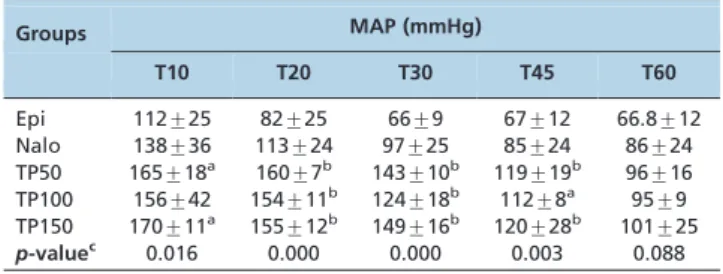
RESULTS:The mean arterial pressure values in the TP50 group were higher than those in the epinephrine group at T10 (165vs. 112 mmHg), T20 (160vs. 82 mmHg), T30 (143vs. 66 mmHg), T45 (119vs. 67 mmHg) and T60 (96 vs. 66.8 mmHg). The blood lactate level was lower in the naloxone group than in the epinephrine group at T10 (5.15vs. 10.5 mmol/L), T30 (2.57vs. 5.24 mmol/L) and T60 (2.1vs. 4.1 mmol/L).
CONCLUSIONS:In this rat model of asphyxia-induced cardiac arrest, terlipressin and naloxone were effective vasopressors in cardiopulmonary resuscitation and presented better metabolic profiles than epinephrine. Terlipressin provided better hemodynamic stability than epinephrine.
KEYWORDS: Cardiopulmonary Resuscitation; Cardiac Arrest; Naloxone; Lypressin/Analogs and Derivatives; Asphyxia.
Martins HS, Koike MK, Velasco IT. Effects of terlipressin and naloxone compared with epinephrine in a rat model of asphyxia-induced cardiac arrest. Clinics. 2013;68(8):1146-1151.
Received for publication onMarch 8, 2013;First review completed onMarch 27, 2013;Accepted for publication onApril 2, 2013 E-mail: [email protected]
Tel.: 55 11 2661-6336
& INTRODUCTION
Survival rates and neurologic outcomes among patients who experience cardiac arrest (CA) are poor (1). Patients with an initial asystole rhythm have a worse prognosis than patients with ventricular fibrillation (VF) (2,3). Epinephrine is the recommended and most widely used vasopressor in this situation, although there is evidence that it increases oxygen consumption, reduces subendocardial perfusion (4) and causes severe myocardial dysfunction following the return of spontaneous circulation (ROSC) (5).
In addition, recent evidence suggests that epinephrine worsens perfusion in the cerebral microcirculation and increases the severity of cerebral ischemia during cardiopul-monary resuscitation (CPR) (6,7). In a previous study, the use
of epinephrine increased mortality in an experimental asphyxia-induced CA model (8). In the single published placebo-controlled human study, epinephrine increased the ROSC rate but was not better than a placebo with regard to neurological outcome or survival to discharge (9).
Two recent studies that used terlipressin to treat pediatric cardiac arrest (in a total of 12 children) produced encoura-ging results (10,11). However, terlipressin did not increase the rate of ROSC in two other recent experimental studies (12,13).
Studies that have used naloxone during CPR have produced conflicting results (14-24). The mechanism under-lying the effect of naloxone during CPR remains unclear. One hypothesis is that hypoxia activates the endogenous opioid system, which is involved in the respiratory control system, stimulates catecholamine release and increases sympathetic nerve activity, thereby elevating heart rate and blood pressure (17). In addition, naloxone has possible anti-arrhythmic effects and ameliorates cardiac function, thereby most likely improving post-resuscitation myocar-dial dysfunction (21). Finally, naloxone has immunomodu-latory effects and a possible protective role in postischemic heart injuries (21).
Copyrightß2013CLINICS– This is an Open Access article distributed under the terms of the Creative Commons Attribution Non-Commercial License (http:// creativecommons.org/licenses/by-nc/3.0/) which permits unrestricted non-commercial use, distribution, and reproduction in any medium, provided the original work is properly cited.
No potential conflict of interest was reported.
Therefore, the current study was designed to evaluate the effects of terlipressin and naloxone in an experimental model of asphyxia-induced cardiac arrest in rats. The main hypothesis was that these drugs could provide better hemodynamic and/or metabolic profiles in the first hour post-CA than the standard treatment with epinephrine.
& MATERIALS AND METHODS
This was a randomized, blinded, placebo-controlled experimental study that was approved by the Institutional Animal Investigation Committee and was conducted in accordance with the ARRIVE guidelines (Animals in Research: Reporting In Vivo Experiments) (25) and Utstein-style guidelines for uniform reporting of laboratory CPR research (26). The animals were managed in accor-dance with the Brazilian College of Animal Experimentation and National Institutes of Health Guidelines.
Animal preparation
Adult male Wistar rats with an average weight of 399 g (range: 340 to 445 g) were obtained from the Central Animal Laboratory of the School of Medicine and anesthetized with intraperitoneal injections of urethane (0.5 mg/kg) and ketamine (50 mg/kg). The proximal trachea was surgically dissected, and a 14-gauge cannula was inserted 10 mm into the trachea to the larynx. Mechanical ventilation was performed with a respiratory rate of 85 cycles/minute, tidal volume of 6 mL/kg, inspired oxygen fraction of 100% and positive end-expiratory pressure of 1 cm H2O (Rodent
Ventilator, model 683, Harvard Apparatus Inc., Natick, MA, USA). A catheter was inserted through the jugular vein and directed toward the right atrium to facilitate drug administration and volume replacement. For blood pressure measurement, the left femoral artery was cannulated, and a catheter was introduced. The catheters were connected to pressure transducers that were coupled to a calibrated preamplifier (Stemtech Inc., GPA-4 model 2, Menomonee Falls, WI, USA) and a computerized data acquisition system (DATAQ Instruments Inc., Akron, OH, USA). Systemic hemodynamic measurements were simultaneously recorded beat by beat. Measurements were taken at baseline and at the five following time points after CA: the 10th(T10), 20th(T20), 30th (T30), 45th (T45) and 60th (T60) minutes. Monitoring
during the experiment included the following:
N
Electrocardiogram: recorded continuously with twosubcutaneous leads.
N
Mean arterial pressure (MAP, mmHg).N
Temperature (rectal probe): temperature was maintained between 36 and 37˚
C throughout the experiment using a passive external warming method (infrared lamp).Vasopressors
The epinephrine dose was 0.02 mg/kg. Although some recent studies have used higher doses of epinephrine (0.04 to 0.05 mg/kg), doses higher than 0.03 mg/kg are asso-ciated with increased rates of myocardial dysfunction, neurological injury and a poor prognosis (27-29). The chosen naloxone dose was 1 mg/kg because lower doses have been associated with lower ROSC rates (15) and higher doses have not been demonstrated to be beneficial (19). The chosen terlipressin doses were extrapolated from pediatric
studies of CA (10,11). In these pediatric series (total of 12 patients), 10-20mg/kg terlipressin was administered
follow-ing the administration of a few doses of epinephrine. Therefore, when terlipressin was used alone, we chose higher doses (50, 100 and 150mg/kg). All of the syringes
were visually identical and contained 1 mL of fluid.
Asphyxia-induced cardiac arrest and resuscitation
A preparation and control phase of the experiment was performed to design a CA model (in anoxia) that had an ROSC rate of at least 50% with the placebo and approxi-mately 100% with epinephrine. Several anoxia durations were studied (4 to 10 minutes). We observed that by defining a total anoxia time rather than a total CA time, the animals would be subjected to different CA durations. Therefore, our model characterized the exact time at which CA began; it measured the total time of arrest and not the total time of anoxia.
After the surgical preparation and hemodynamic stabili-zation of the animal, the trachea was obstructed to induce CA, which was defined as the loss of aortic pulsation and MAP ,15 mmHg. After CA was confirmed, the animals were maintained in asphyxia for 3.5 additional minutes. Subsequently, the rats were resuscitated following standard procedures:
N
Saline solution (SS) or one of the vasopressor drugs wasadministered (all in similar, standardized 1-mL syr-inges), which was followed by a flush of 0.5 mL of SS; both were given directly through a central venous catheter.
N
Chest compressions (200/minute) were performed forall of the groups by a single researcher who was blinded to the administered vasopressor. The researcher was guided by an audio device (to ensure the correct compression frequency), and MAP was monitored and maintained at.30 mmHg.
N
The animal was ventilated with 100% FiO2; therespira-tory rate was 70 cycles/min, and the tidal volume was 8 mL/kg.
ROSC was considered to have occurred when MAP remained .50 mmHg for a minimum of 5 consecutive minutes. Resuscitation efforts were discontinued in the absence of ROSC after 5 minutes of chest compressions.
A neuromuscular blockade was performed with pancur-onium at 15 and 37 minutes after cardiac arrest. The dose was 0.5 mg/kg.
Arterial blood samples were collected at baseline and at T10, T30 and T60. Analyses were performed immediately after each collection and consisted of measurement of arterial blood gases (pH, pO2, pCO2, oxygen saturation,
bicarbonate and base excess), sodium, potassium, hemoglo-bin, hematocrit, glucose and lactate. All of the examinations were performed using the same equipment (Radiometer ABL 835 Flex, Radiometer Medical ApS, Bronshoj, Denmark).
Statistical analysis
values and standard deviations. The normal distribution of data was confirmed using the Kolmogorov-Smirnov test. To compare the mean values in the baseline variables, we used a one-way ANOVA. The ROSC analysis was performed using Fisher’s exact test, and a post-hoc analysis was performed using the Bonferroni test. Two-tailed p,0.05 was considered significant.
& RESULTS
The final sample consisted of 42 animals, which were randomized into one of the following groups: placebo (n= 7), epinephrine (EPI; n= 7), naloxone (Nalo; n= 7),
terlipressin 50mg/kg (TP50; n= 7), terlipressin 100mg/kg
(TP100;n= 7) or terlipressin 150mg/kg (TP150;n= 7).
The groups were homogeneous, and there was no significant difference among them regarding hemodynamic and laboratory variables (Table 1). ROSC occurred in four of the seven animals (57%) in the placebo group and in 100% of the animals in the vasopressor groups (35 animals;
p= 0.002). The time between the induction of anoxia and
the onset of CA was 246.1 seconds (¡67.4 sec), as shown in
Table 2. The total time of hypoxia was not different between the groups and was calculated by adding the time between the onset of anoxia and CA to the time during which the animals remained in CA (3.5 min). During the first hour of the experiment, four animals died: two in the EPI group, one in the TP100 group and one in the TP150 group.
Mean arterial pressure and blood tests
The animals in the terlipressin groups had higher MAP values than animals in the epinephrine group (Table 3). However, the MAP levels were not significantly different when naloxone was compared with epinephrine.
The TP50 and naloxone groups had lower blood lactate values than the epinephrine group (Table 4). The best metabolic profile was observed in the naloxone group, and the worst profile was observed in the epinephrine group (Tables 5 and 6).
& DISCUSSION
Our findings suggest that terlipressin and naloxone could be used as alternatives to epinephrine or vasopressin in the treatment of CA with a nonshockable rhythm (asystole/ PEA). Terlipressin had a better hemodynamic metabolic profile than epinephrine. Naloxone was the vasopressor with the best metabolic profile.
In the present study, we chose three different terlipressin doses to evaluate their effects in resuscitation. The doses were compared both among themselves and with epinephr-ine and a placebo. This is the first study that aimed to study drugs (and dosages) of alternatives to epinephrine in the treatment of cardiac arrest.
In the context of asystole, our data suggest that very high doses (greater than or equal to 100mg/kg) were associated
with worse outcome and even worse metabolic profiles, perhaps because of the greater time necessary to obtain the ROSC. Moreover, 50mg/kg terlipressin produced a more
favorable profile than epinephrine in the first hour follow-ing ROSC. This favorable hemodynamic profile of terlipres-sin may be related to its increased vasopressor effect and its long duration of action (4 to 6 hours). Only two randomized studies have been published that used terlipressin as a vasopressor during CPR. Ovalle evaluated terlipressin in a pig model of ventricular fibrillation (13) and found that terlipressin did not differ from the placebo regarding effects on coronary perfusion pressure, and low rates of ROSC
Table 1 -Baseline variables of the different groups
Variable Placebo (n= 7) Epi (n= 7) Nalo (n= 7) TP50(n= 7) TP100(n= 7) TP150(n= 7) p-value
Weight (g) 405¡29 386¡25 417¡28 404¡41 390¡29 387¡33 0.37
Heart rate 380¡56 358¡65 384¡37 376¡80 419¡98 408¡65 0.65
MAP (mm Hg) 106¡10 120¡17 110¡14 108¡13 121¡16 106¡11 0.16
Hb (g/dL) 16.4¡0.7 16.2¡0.5 16.3¡0.9 16.7¡0.7 16.8¡0.7 15.9¡0.9 0.23
Ht (%) 50.2¡2.3 49.8¡1.6 50¡2.7 51¡2.1 51¡2.2 49¡2.6 0.24
Na+(mmol/L) 139¡2.6 137¡1.8 138¡2.6 137¡2.2 139¡3.2 137¡1.7 0.33
K+(mmol/L) 3.9¡0.2 4.0¡0.3 4.3¡0.3 4.2¡0.2 4.1¡0.4 4.3¡0.5 0.43
Glucose (mg/dL) 208¡30 222¡40 212¡20 212¡29 216¡38 207¡31 0.93
paO2(torr) 343¡83 316¡80 298¡54 338¡68 367¡60 294¡94 0.42
SatO2(%) 97.8¡0.2 97.7¡0.3 97.7¡0.1 97.7¡0.5 97.7¡0.2 97.4¡0.5 0.79
pCO2(torr) 41¡6.3 41¡6.5 39¡6.4 39¡3.7 39¡2.2 41¡3.2 0.96
pH 7.36¡0.04 7.36¡0.04 7.38¡0.05 7.36¡0.03 7.38¡0.03 7.37¡0.06 0.94
Bic (mmol/L) 22.8¡3.1 22.9¡2.1 22.6¡1.3 22.4¡1.4 23.3¡1.6 23.4¡1.1 0.91
Base excess 21.9¡2.8 21.6¡1.8 21.7¡1.2 22¡1.5 21.1¡1.8 2.9¡1 0.78
Lactate (mmol/L) 2.68¡0.58 2.51¡0.39 2.33¡0.55 2.44¡0.63 1.9¡0.44 2.6¡0.43 0.14 The values represent the mean¡SD.
Table 2 -Times (sec) between the onset of anoxia and cardiac arrest, time from cardiopulmonary resuscitation to the return of spontaneous circulation and the total time during which the animals remained in hypoxia
Variable Placebo Epi Nalo TP50 TP100 TP150 p-value
Onset of anoxia to CA 272¡70 243¡71 235¡40 233¡71 236¡79 250¡69 0.55
From CPR to ROSC 114¡40a 79¡43 86¡27 110¡57 125¡59 142¡77 0.16
Total hypoxia 482¡70 453¡71 445¡40 443¡71 446¡79 460¡69 0.55
The values represent the mean¡SD.
were observed in both groups. As a monotherapy, perhaps the low dose of terlipressin (10 to 20mg/kg) chosen explains
these findings. In a pediatric model, ROSC was observed in three of 15 animals receiving standard doses of epinephrine, four of 15 animals receiving high-dose epinephrine, one of 15 animals receiving terlipressin and seven of 15 animals receiving both epinephrine and terlipressin (12). The differences between the groups were not significant. The use of propofol in a model of hypoxia-induced CA may not be desirable and may have contributed to the low frequency of ROSC in that study, which was much lower than the expected rates in pediatric CA models. Furthermore, a low dose of terlipressin (10 to 20mg/kg) was chosen based on
two pediatric series (10,11). The fact that the children in these studies had already received several epinephrine doses prior to receiving terlipressin may not have been considered when the dose of terlipressin was chosen as the only vasopressor in this model of CPR. Lower terlipressin doses have been shown to be effective in the treatment of septic shock (30-32). However, when used as a single drug in CA, higher doses of terlipressin may be necessary (.20mg/kg). Our findings confirm that terlipressin is a
fast-acting vasopressor whose initial effect is inherent and occurs before the endothelial conversion of terlipressin to lysine-vasopressin (33). In addition, we demonstrated that animals that received terlipressin maintained a significantly higher MAP than those that received epinephrine or vasopressin throughout the post-CA period.
No significant differences in MAP were observed with different doses of terlipressin. However, based on the values of lactate, bicarbonate and base excess, animals receiving a 50mg/kg dose had a more favorable metabolic profile than
those receiving 100mg/kg or 150mg/kg.
In other studies using naloxone in rat asphyxia models, the ROSC rates were similar to those obtained with epinephrine (seven of eight animals in each group) (16); there was a trend toward higher ROSC rates at a dose of 1 mg/kg compared with 0.5 mg/kg of naloxone (1 mg/kg: seven of eight animals; 0.5 mg/kg: three of eight animals) (15). In addition, the combination of epinephrine and naloxone decreased the time that was required to attain ROSC during CPR (naloxone plus epinephrine: 133 sec vs.
epinephrine: 206 sec;p,0.01) (23,24). However, it is difficult to interpret this evidence because of methodological problems in these studies. The international recommenda-tions for research in CA (Utstein-style guidelines) were not followed, so it was not possible to assess similarities (or differences) between the animals regarding important baseline variables, and the animals were resuscitated with-out oxygen. Neither laboratory nor arterial blood gas values were monitored before, during or after CA. Finally, the epinephrine doses (0.04 to 0.05 mg/kg) were higher than the currently recommended doses.
In our study, all animals that were resuscitated with naloxone had ROSC and survived through the first hour following CA. The MAP curves in the rats receiving naloxone were intermediate between those in rats receiving terlipressin (better) and epinephrine (worse). Little is known about the possible benefits of naloxone in the treatment of CA. In the cardiovascular system, naloxone may increase sympathetic nervous system activity (34,35), which may increase heart rate and blood pressure. Naloxone could also act as an antiarrhythmic (36), and it could even attenuate myocardial dysfunction after CA (37). Our study is the first to show that naloxone has a favorable profile regarding bicarbonate, base excess and lactate levels when it is used as a vasopressor in CA. These results cannot be attributed to MAP and may instead be intrinsic to the vasopressor. Our
Table 3 -Mean arterial pressure: comparisons of the groupsvs.time
Groups MAP (mmHg)
T10 T20 T30 T45 T60
Epi 112¡25 82¡25 66¡9 67¡12 66.8¡12 Nalo 138¡36 113¡24 97¡25 85¡24 86¡24 TP50 165¡18a 160¡7b 143¡10b 119¡19b 96¡16
TP100 156¡42 154¡11b 124
¡18b 112
¡8a 95 ¡9 TP150 170¡11a 155¡12b 149¡16b 120¡28b 101¡25
p-valuec 0.016 0.000 0.000 0.003 0.088 a:p,0.05 (compared with the epinephrine group).
b:p,0.01 (compared with the epinephrine group). c: ANOVA between groups.
Table 4 -Blood lactate: comparisons of the groupsvs. time
Groups Blood lactate (mmol/L)
T10 T30 T60
Epi 10.5¡3.7 5.24¡3.2 4.1¡2.2
Nalo 5.15¡1.1b 2.57¡0.9a 2.1¡0.9a
TP50 6.6¡1.2b 2.57¡0.4a 2.05¡0.4a
TP100 6.7¡1.3a 3.88
¡1.7 2.46¡0.3
TP150 7.34¡1.5 3.67¡0.6 2.84¡0.8
p-value* 0.0008 0.039 0.029
a:p,0.05 (compared with the epinephrine group). b:p,0.01 (compared with the epinephrine group). c: ANOVA between groups.
Table 5 -Base excess: comparisons of the groupsvs.time
Groups Base excess (mmol/L)
T10 T30 T60
Epi 216.6¡3.5 210.9¡5.2 212¡7.4
Nalo 29.7¡1.7b
26.9¡2.9a
26.7¡2.6 TP50 211.8¡1.8b
29¡1.8 28.8¡1.9 TP100 213.1¡1.5 212.6¡2.1 210.9¡1.5 TP150 213.9¡1.7 211.7¡1.2 210.5¡2.2
p-value* 0.0001 0.0007 0.107
a:p,0.05 (compared with the epinephrine group). b:p,0.01 (compared with the epinephrine group). c: ANOVA between groups.
Table 6 -Bicarbonate: comparisons of the groupsvs. time
Groups Bicarbonate (mmol/L)
T10 T30 T60
Epi 8.1¡4.5 16.1¡3.6 14.7¡6.1
Nalo 18¡1.6b 19
¡2.6a 19.2 ¡2.6
TP50 16.4¡1.7a 17.3¡1.9 16.9¡1.9
TP100 14.5¡1.1 14.2¡1.7 15.1¡1.3
TP150 14.3¡0.9 15.1¡1.1 16.4¡2.1
p-value* 0.017 0.006 0.152
results are consistent with a previous finding that naloxone has a protective effect in ischemia by restoring mitochon-drial activity and energy metabolism (38).
The strengths of our study include the fact that it was designed and performed with a uniform, reproducible sample and control of important variables associated with the prognosis of CA in asystole. Randomization produced homogeneous groups. The group allocation in this study was conducted in a blinded fashion. The measurement of the hemodynamic variables and blood tests were performed at several different intervals, both at baseline and during the experiment, which allowed a temporal analysis of the differences between the groups at different times (not only at a single time point). Resuscitation was performed using a standardized method, which included strict control of MAP levels during chest compressions. We defined the exact time that the animal remained without circulation (3.5 min). Therefore, this model can be used to study different stages of CA, and it allows investigators to adjust the time without effective circulation according to the intended research goals.
Despite these encouraging results, it is important to analyze these data with caution. The study was not designed to show any differences in the rates of ROSC between epinephrine and other drugs. Such an analysis may require a larger sample and a longer absence of circulation. The experiment evaluated a specific duration of CA, and the results could be different in protocols with longer-lasting CA. Furthermore, anesthesia with both ketamine and urethane can potentially interfere in epinephrine metabo-lism, thereby causing hemodynamic variations that may have affected the results. It is also possible that other agents, such benzodiazepines, etomidate and barbiturates, could have less interference. Nevertheless, most published studies have used ketamine and urethane. Finally, it is known that studies that are performed during CPR maneuvers in animals are often not confirmed in clinical trials.
This is the first study that aimed to study terlipressin in different dosages as an alternative to epinephrine in the treatment of cardiac arrest. Based on these results, new studies will be developed to compare the effects of terlipressin (50mg/kg) and epinephrine in a pig model of
cardiac arrest. Furthermore, lower doses of naloxone in association with terlipressin or epinephrine will be evalu-ated.
In this hypoxia-induced rat CA model, terlipressin and naloxone were effective vasopressors in resuscitation and produced better metabolic profiles than epinephrine. Terlipressin administration resulted in significantly better hemodynamic stability in the first hour following CA compared with epinephrine. Among the vasopressors that were studied in this experiment, naloxone had the best metabolic profile.
& ACKNOWLEDGMENTS
This study was supported by Faculdade de Medicina da Universidade de Sa˜o Paulo (FMUSP).
& AUTHOR CONTRIBUTIONS
All authors made substantial contributions to the study and supported the data and conclusions. Martins HS reviewed the literature, formulated the experiment, discussed the findings with a statistician, performed data analysis with a statistical professional and wrote the paper. Koike MK
reviewed the literature, co-formulated the experiment, conducted the experiment (surgery) and revised the paper. Velasco IT managed the overall experiment, developed the methodology of the study, co-discussed the findings with a statistician and revised the paper.
& REFERENCES
1. Travers AH, Rea TD, Bobrow BJ, Edelson DP, Berg RA, Sayre MR, et al. Part 4: CPR overview: 2010 American Heart Association Guidelines for Cardiopulmonary Resuscitation and Emergency Cardiovascular Care. Circulation. 2010 Nov 2;122(18 Suppl 3):S676-84.
2. Sasson C, Rogers MA, Dahl J, Kellermann AL. Predictors of survival from out-of-hospital cardiac arrest: a systematic review and meta-analysis. Circulation Cardiovascular quality and outcomes. 2010;3(1):63-81, http://dx.doi.org/10.1161/CIRCOUTCOMES.109.889576.
3. Meaney PA, Nadkarni VM, Kern KB, Indik JH, Halperin HR, Berg RA. Rhythms and outcomes of adult in-hospital cardiac arrest. Crit Care Med. 2010;38(1):101-8, http://dx.doi.org/10.1097/CCM.0b013e3181b432 82.
4. Ditchey RV, Lindenfeld J. Failure of epinephrine to improve the balance between myocardial oxygen supply and demand during closed-chest resuscitation in dogs. Circulation. 1988;78(2):382-9, http://dx.doi.org/10. 1161/01.CIR.78.2.382.
5. Tang W, Weil MH, Sun S, Gazmuri RJ, Bisera J. Progressive myocardial dysfunction after cardiac resuscitation. Crit Care Med. 1993;21(7):1046-50, http://dx.doi.org/10.1097/00003246-199307000-00022.
6. Ristagno G, Sun S, Tang W, Castillo C, Weil MH. Effects of epinephrine and vasopressin on cerebral microcirculatory flows during and after cardiopulmonary resuscitation. Crit Care Med. 2007;35(9):2145-9, http:// dx.doi.org/10.1097/01.CCM.0000280427.76175.D2.
7. Ristagno G, Tang W, Huang L, Fymat A, Chang YT, Sun S, et al. Epinephrine reduces cerebral perfusion during cardiopulmonary resus-citation. Crit Care Med. 2009;37(4):1408-15, http://dx.doi.org/10.1097/ CCM.0b013e31819cedc9.
8. McCaul CL, McNamara PJ, Engelberts D, Wilson GJ, Romaschin A, Redington AN, et al. Epinephrine increases mortality after brief asphyxial cardiac arrest in an in vivo rat model. Anesth Analg. 2006;102(2):542-8, http://dx.doi.org/10.1213/01.ane.0000195231.81076. 88.
9. Jacobs IG, Finn JC, Jelinek GA, Oxer HF, Thompson PL. Effect of adrenaline on survival in out-of-hospital cardiac arrest: A randomised double-blind placebo-controlled trial. Resuscitation. 2011;82(9):1138-43, http://dx.doi.org/10.1016/j.resuscitation.2011.06.029.
10. Matok I, Vardi A, Augarten A, Efrati O, Leibovitch L, Rubinshtein M, et al. Beneficial effects of terlipressin in prolonged pediatric cardiopul-monary resuscitation: a case series. Crit Care Med. 2007;35(4):1161-4, http://dx.doi.org/10.1097/01.CCM.0000259377.64733.4C.
11. Gil-Anton J, Lopez-Herce J, Morteruel E, Carrillo A, Rodriguez-Nunez A. Pediatric cardiac arrest refractory to advanced life support: is there a role for terlipressin? Pediatr Crit Care Med. 2010;11(1):139-41, http://dx.doi. org/10.1097/PCC.0b013e3181ae7834.
12. Lopez-Herce J, Fernandez B, Urbano J, Mencia S, Solana MJ, del Castillo J, et al. Terlipressin versus adrenaline in an infant animal model of asphyxial cardiac arrest. Intensive Care Med. 2010;36(7):1248-55, http:// dx.doi.org/10.1007/s00134-010-1828-2.
13. Ovalle CC, Moreira MM, Martins LC, Araujo S. The efficacy of terlipressin versus adrenaline in swine cardiopulmonary resuscitation. Revista brasileira de anestesiologia. 2011;61(6):728-35.
14. Berlot G, Gullo A, Romano E, Rinaldi A. Naloxone in cardiorespiratory arrest. Anaesthesia. 1985;40(8):819, http://dx.doi.org/10.1111/j.1365-2044.1985.tb11024.x.
15. Chen MH, Liu TW, Xie L, Song FQ, He T. Does naloxone alone increase resuscitation rate during cardiopulmonary resuscitation in a rat asphyxia model? Am J Emerg Med. 2006;24(5):567-72.
16. Chen MH, Xie L, Liu TW, Song FQ, He T. Naloxone and epinephrine are equally effective for cardiopulmonary resuscitation in a rat asphyxia model. Acta Anaesthesiol Scand. 2006;50(9):1125-30, http://dx.doi.org/ 10.1111/j.1399-6576.2006.01141.x.
17. Endoh H, Honda T, Ohashi S, Shimoji K. Naloxone improves arterial blood pressure and hypoxic ventilatory depression, but not survival, of rats during acute hypoxia. Crit Care Med. 2001;29(3):623-7, http://dx. doi.org/10.1097/00003246-200103000-00027.
18. Endoh H, Taga K, Yamakura T, Sato K, Watanabe I, Fukuda S, et al. Effects of naloxone and morphine on acute hypoxic survival in mice. Crit Care Med. 1999;27(9):1929-33, http://dx.doi.org/10.1097/00003246-199909000-00035.
19. Gervais HW, Eberle B, Hennes HJ, Grimm W, Kilian A, Konietzke D, et al. High dose naloxone does not improve cerebral or myocardial blood flow during cardiopulmonary resuscitation in pigs. Resuscitation. 1997;34(3):255-61, http://dx.doi.org/10.1016/S0300-9572(96)01066-0. 20. Marsden AK, Mora FM. Case report--the successful use of naloxone in an
21. Martins HS, Silva RV, Bugano D, Santana AN, Brandao-Neto RA, Giannini FP, et al. Should naloxone be prescribed in the ED management of patients with cardiac arrest? A case report and review of literature. Am J Emerg Med. 2008;26(1):113 e5-8.
22. Saybolt MD, Alter SM, Dos Santos F, Calello DP, Rynn KO, Nelson DA, et al. Naloxone in cardiac arrest with suspected opioid overdoses. Resuscitation. 2010;81(1):42-6, http://dx.doi.org/10.1016/j.resuscitation. 2009.09.016.
23. Wang Y, Gao L, Meng L. Small-dose naloxone combined with epinephrine improves the resuscitation of cardiopulmonary arrest. Am J Emerg Med. 2008;26(8):898-901.
24. Wang Y, Gao L, Meng L. Naloxone combined with epinephrine decreases cerebral injury in cardiopulmonary resuscitation. J Emerg Med. 2010;39(3):296-300, http://dx.doi.org/10.1016/j.jemermed.2008.10. 014.
25. McGrath JC, Drummond GB, McLachlan EM, Kilkenny C, Wainwright CL. Guidelines for reporting experiments involving animals: the ARRIVE guidelines. British journal of pharmacology. 2010;160(7):1573-6, http://dx.doi.org/10.1111/j.1476-5381.2010.00873.x.
26. Idris AH, Becker LB, Ornato JP, Hedges JR, Bircher NG, Chandra NC, et al. Utstein-style guidelines for uniform reporting of laboratory CPR research. A statement for healthcare professionals from a Task Force of the American Heart Association, the American College of Emergency Physicians, the American College of Cardiology, the European Resuscitation Council, the Heart and Stroke Foundation of Canada, the Institute of Critical Care Medicine, the Safar Center for Resuscitation Research, and the Society for Academic Emergency Medicine. Resuscitation. 1996;33(1):69-84.
27. Vandycke C, Martens P. High dose versus standard dose epinephrine in cardiac arrest - a meta-analysis. Resuscitation. 2000;45(3):161-6, http:// dx.doi.org/10.1016/S0300-9572(00)00188-X.
28. Berg RA, Otto CW, Kern KB, Hilwig RW, Sanders AB, Henry CP, et al. A randomized, blinded trial of high-dose epinephrine versus standard-dose epinephrine in a swine model of pediatric asphyxial cardiac arrest. Crit Care Med. 1996;24(10):1695-700, http://dx.doi.org/10.1097/ 00003246-199610000-00016.
29. Berg RA, Otto CW, Kern KB, Sanders AB, Hilwig RW, Hansen KK, et al. High-dose epinephrine results in greater early mortality after resuscita-tion from prolonged cardiac arrest in pigs: a prospective, randomized
study. Crit Care Med. 1994;22(2):282-90, http://dx.doi.org/10.1097/ 00003246-199402000-00020.
30. Zeballos G, Lopez-Herce J, Fernandez C, Brandstrup KB, Rodriguez-Nunez A. Rescue therapy with terlipressin by continuous infusion in a child with catecholamine-resistant septic shock. Resuscitation. 2006;68(1):151-3, http://dx.doi.org/10.1016/j.resuscitation.2005.06.016. 31. Rodriguez-Nunez A, Oulego-Erroz I, Gil-Anton J, Perez-Caballero C,
Lopez-Herce J, Gaboli M, et al. Continuous terlipressin infusion as rescue treatment in a case series of children with refractory septic shock. Ann Pharmacother. 2010;44(10):1545-53, http://dx.doi.org/10.1345/aph.1P2 54.
32. Morelli A, Ertmer C, Lange M, Dunser M, Rehberg S, Van Aken H, et al. Effects of short-term simultaneous infusion of dobutamine and terlipressin in patients with septic shock: the DOBUPRESS study. Br J Anaesth. 2008;100(4):494-503, http://dx.doi.org/10.1093/bja/ aen017.
33. Ryckwaert F, Virsolvy A, Fort A, Murat B, Richard S, Guillon G, et al. Terlipressin, a provasopressin drug exhibits direct vasoconstrictor properties: consequences on heart perfusion and performance. Crit Care Med. 2009;37(3):876-81, http://dx.doi.org/10.1097/CCM. 0b013e31819b8199.
34. Boyd JJ, Kytta JV, Aittomaki JV, Rosenberg PH, Seppala TA, Randell TT. Cardiovascular changes after naloxone administration in propofol-sedated piglets during opioid overdose. Acta Anaesthesiol Scand. 2006;50(10):1271-6, http://dx.doi.org/10.1111/j.1399-6576.2006.01166.x. 35. Lechner RB, Gurll NJ, Reynolds DG. Naloxone potentiates the
cardiovascular effects of catecholamines in canine hemorrhagic shock. Circ Shock. 1985;16(4):347-61.
36. Hung CF, Wu MH, Tsai CH, Chu SH, Chi JF, Su MJ. Electrophysiological mechanisms for the antiarrhythmic activities of naloxone on cardiac tissues. Life Sci. 1998;63(14):1205-19, http://dx.doi.org/10.1016/S0024-3205(98)00383-X.
37. Parker JL, Keller RS, Behm LL, Adams HR. Left ventricular dysfunction in early E. coli endotoxemia: effects of naloxone. Am J Physiol. 1990;259(2 Pt 2):H504-11.