Upgrading from VVI to DDD Pacing Mode During Elective
Replacement of Pulse Generator. A Comparative Clinical-Functional
Analysis
Luiz Antonio Castilho Teno, Roberto Costa, Martino Martinelli Filho, Fabian Cecchi Teno Castilho, Ivan Ruiz
Instituto do Coração do Hospital das Clínicas – FMUSP e Hospital Beneficência Portuguesa de Ribeirão Preto - São Paulo, SP – Ribeirão Preto, SP, Brazil
Summary
Objective: Evaluate the clinical and functional behavior of the ventricular and atrioventricular stimulation modes in the elective replacement of pulse generator in patients with chagasic cardiopathy and atrioventricular block.
Methods: Twenty-seven patients under ventricular and atrioventricular stimulation were comparatively evaluated at the beginning of the study, and alternately in ventricular and atrioventricular modes in two 90-day phases, with regard to: the clinical behavior evaluated according to quality of life and functional class, and the functional behavior evaluated by transthoracic echocardiography and the six-minute walk test. The statistical analysis was performed with patients at baseline, and under ventricular and atrioventricular modes, using the chi-square test and the repeated measures analysis of variance, and taking into consideration a 0.05 level of significance.
Results: The mean quality-of-life scores were: functional capacity (VVI 71.3+/-18.2 , DDD 69.3+/-20.4); overall health status (VVI 68.1+/-21.8, DDD 69.4+/-19.4) and vitality (VVI 64.8+/-24.6, DDD 67.6+/-25.5); on echocardiography: LVEF (VVI 52.5+/-12.8 , DDD 51.8+/-14.9), LVDD (VVI 53.0+/-7.7 , DDD 42.4+/-7.8), LA (VVI 38.6+/-5.4 DDD 38.5+/-5.1), and in the six-minute walk test: distance walked (VVI 463.4+/-84.7, DDD 462.6+/-63.4). There were four cases of complications, three of them associated with the change in stimulation mode.
Conclusion: This study showed no differences between the two stimulation modes in the clinical behavior assessed by quality of life and functional class, and in the functional behavior, evaluated according to the ecochardiographic findings and the six-minute walk test.
Key words: Chagas’ cardiomiopathy, atrioventricular block, artificial pacemaker, cardiac pacemaker, quality of life.
Mailing Address: Luiz Antonio Castilho Teno •
Rua Prudente de Moraes, 1084 – 14015-100 - Ribeirão Preto, SP, Brazil E-mail: [email protected]
Manuscript received December 28, 2005; revised manuscript received March 6, 2006; accepted March 17, 2006.
Introduction
The sequential stimulation of the atria and the ventricles allows the restoration of atrioventricular synchrony, lost to the onset of conduction block and not recovered with the VVI stimulation mode1. The potential hemodynamic
advantages attributed to this stimulation mode, also known as physiological mode (DDD), are: greater ventricular filling aided by atrial systole, and physiological control of heart rate by the patient’s spontaneous “P” waves2,3. r this reason,
national and international guidelines have suggested that this mode of stimulation should be used as the initial pacemaker implantation due to its being theoretically more physiological than the ventricular pacemaker4,5. This approach has been
used in patients whose indication for pacemaker implantation is sinus node disease; however, it has not been applied to patients with atrioventricular blocks, as there is no evidence of benefits for this group of patients, mainly at the moment
of elective replacement of the pulse generator.
The objective of this study was to find out whether the consequences and clinical-hemodynamic effects resulting from the change of the pacing mode, from ventricular to atrioventricular, during the elective replacement of pulse generators in patients with chagasic cardiopathy and atrioventricular block justify its routine use.
Methods
This is a controlled, prospective, randomized and double-blind study. Patients were informed as to the type of procedure, its risks and potential benefits. After having received all necessary information, they agreed to participate in the research protocol and were asked to sign the informed consent form.
Six-minute walk test- The six-minute walk test was used to assess the functional capacity of the patients; the distance walked was the marker for the clinical condition. The heart rate was measured before and after the test, and also the distance the patient had walked during six minutes.
Statistical analysis- The statistical analysis of the effects of
changing the stimulation mode was performed at baseline condition (pre), VVI and DDD modes. The quantitative variables were compared using the repeated measures analysis of variance. When the values were significant, a complementary contrast test was performed to determine the differences (p<0.05 values were considered as statistically significant).
Results
All surgical procedures were successfully performed and no deaths occurred during the period of the study. The atrial lead was inserted by puncture of the subclavian vein in 25 patients (92.5%), and of the internal jugular vein in two patients (7.5%). Electrode impedance measurements were performed, as well as R and P wave sensitivity and thresholds of atrial and ventricular stimulation at unipolar and bipolar conditions (Tab. 1).
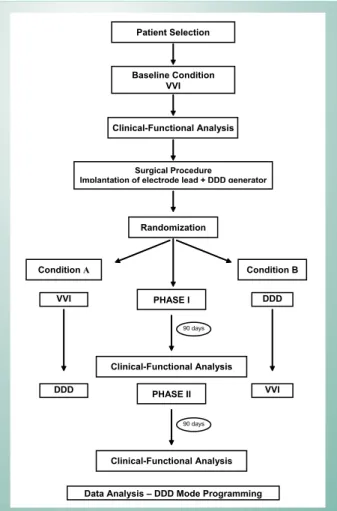
Fig. 1 -Study design
Condition A Condition B
VVI DDD
DDD VVI
Data Analysis – DDD Mode Programming PHASE I
Clinical-Functional Analysis Randomization Clinical-Functional Analysis
Baseline Condition VVI Patient Selection
Surgical Procedure
Implantation of electrode lead + DDD generator
PHASE II
Clinical-Functional Analysis
90 days 90 days
paroxysmal, persistent or permanent atrial flutter, symptoms suggestive of pacemaker syndrome, pregnancy, life-limiting disease or reduced life expectancy.
Patients’ age ranged from 29 to 79 years (mean 55.9 ± 12.7 and median 54 years). Fifteen patients were females and 12 males. Fourteen patients were white, 8 were black and 5 were mulattos.
Patients had had ventricular pacemakers implanted 3 to 30 years ago (mean 11 ± 6 years and median 10 years). In 13 patients, the procedure would replace the first stimulation system implanted; in 7 patients, it was the second pulse generator; in 3, it was the third device, and in 4 patients, it was the fourth pacemaker. All patients were in sinus rhythm with complete block of the atrioventricular conduction, detected by the test of reduction of the pacemaker’s stimulation frequency.
Study design - After selection and clinical-functional
evaluation at baseline, patients underwent the surgical procedure: implantation of an atrial electrode lead and replacement of the single-chamber pulse generator for a dual-chamber one. Next, the pulse generator was programmed to a randomly selected stimulation mode.
In condition A, after the procedure patients remained in ventricular stimulation mode during 90 days (phase I), and were later reprogrammed to atrioventricular mode and remained in this mode for another 90 days (phase II). Under condition B, after the procedure patients were programmed to atrioventricular stimulation mode during 90 days (phase I), and were later reprogrammed to ventricular mode and remained in this mode for another 90 days (phase II) (Fig. 1).
Pacemaker programmation - VVI mode: The frequency of
stimulation was set at 70 bpm, and, as patients had advanced atrioventricular block, AV synchrony never occurred. DDD mode: The minimum frequency of stimulation was set at 70 bpm, with no response to the frequency, whereas the maximum frequency was calculated based on 80% of the maximum rate for the age. The AV interval was not individualized and was set at 120 msec after a spontaneous “p” wave, and at 180 msec after a stimulated “p” wave. The atrial sensitivity was set at 0.5mV and the ventricular, at 2.5mV. At the end of the study, all patients had their pacemakers reprogrammed to atrioventricular mode.
Quality of life - The instrument for mesuring quality of life
in this study was the Medical Outcomes Study SF-36 Health
Survey protocol. The answers to the questionnaire were
evaluated using a database (specific software) which scored quality of life dimensions according to a scale (Raw Scale) that ranges from 0 (worst health status) to 100 (best health status).
Tr a n s t h o r a c i c e c h o c a r d i o g r a m - Tr a n s t h o r a c i c
The complications observed were: Displacement of the atrial electrode,1 case (3.7%); Atrial tachycardia, 1 case (3.7%); Atrial flutter, 1 case (3.7%); Hematoma in the pacemaker implantation site, 1 case (3.7%).
The displacement of the atrial electrode was corrected surgically and repositioned three months after the implantation, after which the patient restarted the study protocol. The atrial tachycardia occurred during the procedure and the atrial flutter, two weeks later. Both arrhythmias were treated by rapid atrial stimulation. The hematoma occurred during the immediate post-operative period (24 hours) and was caused by subcutaneous heparin prophylaxis. The patient was treated by simply interrupting the heparin therapy and clinical follow-up.
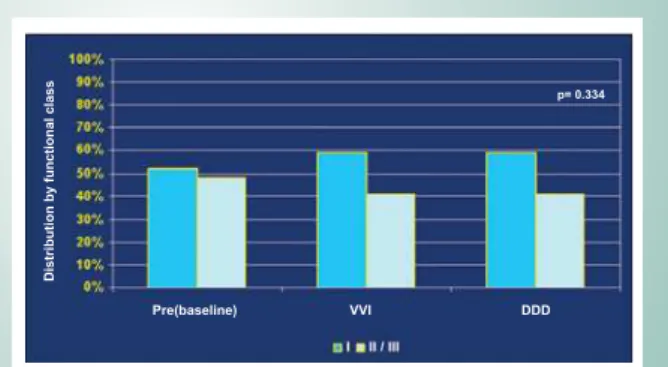
Clinical evaluation- There was no difference in the number
of patients stratified according to NYHA functional classes at pre-evaluation (baseline), and VVI and DDD conditions (p=0.334) (Fig. 2).
Echocardiographic findings- The ejection fraction means
(Teicholz) (p=0.216), LVDD (p=0.095) and LA (p=0.290) measured at the beginning of the study (baseline), at the end of VVI pacing mode and at the end of DDD pacing mode did not show any difference (Tab. 2).
Six-minute walk test- The distance walked during the six
minutes at baseline conditions, in ventricular stimulation mode and DDD stimulation mode showed no significant differences between the means of both modes (p=0.945); however,
Ventricular electrode Atrial electrode
Resistance
(ohms) Wave R(mV)
L. Stimulation
(V) Resistance (ohms) P Wave (mV) L.Stimulation (V)
Uni Bi Uni Bi Uni Bi Uni Bi Uni Bi Uni Bi
Mean 609,5 647,9 9,3 10,6 1,3 1,1 497,7 576,3 2,4 3,2 1,0 1,1
Standard
deviation 149,2 129,3 3,8 4,3 0,7 0,3 133,6 152,2 1,4 1,4 0,6 0,5
Minimum 380,0 440,0 5,3 5,8 0,2 0,7 300,0 310,0 1,0 1,1 0,4 0,5
Maximum 950,0 910,0 16,6 20,0 3,6 1,5 930,0 930,0 7,3 6,4 2,0 2,0
Table 1 - Parameters of resistance, sensitivity, and ventricular and atrial stimulation thresholds assessed during the surgery
Fig. 2 -Distribution of patients with chagasic cardiopathy and atrioventricular block at pre-evaluation (baseline), VVI and DDD conditions, stratified according to NYHA functional classes I and II/III.
D
is
tr
ib
u
ti
o
n
b
y
fu
n
c
ti
o
n
a
l
c
la
s
s
Pre(baseline) VVI DDD p= 0.334
DDD: patient status after 90-day atrioventricular stimulation; P: descriptive level of the chi-square test; Pre (baseline): patient status under ventricular stimulation (just one electrode implanted in the right ventricle) at study selection; VVI: patient status after 90-day single-chamber ventricular stimulation
Pre (baseline) VVI DDD
EF
(
T
EI
C
H
O
LZ
)
LV
D
D
(m
m
)
LA
(
m
m
)
EF
(T
EI
C
H
O
LZ
)
LV
D
D
(m
m
)
LA
(
m
m
)
EF
(T
EI
C
H
O
LZ
)
LV
D
D
(m
m
)
LA
(m
m
)
Mean 50,7 51,8 37,6 52,5 53,0 38,6 51,8 52,4 38,5
Standard
deviation 14,8 7,6 4,4 12,8 7,7 5,4 14,9 7,8 5,1
Minimum 26,0 37,0 29,0 30,0 38,0 27,0 22,0 39,0 27,0
Maximum 77,0 63,0 45,0 71,0 65,0 52,0 74,0 67,0 48,0
LA left atrium; DDD: patient status after 90-day atrioventricular stimulation; LVDD: final left ventricule diastolic diameter; EF; Ejection fraction; PRE: patient status under ventricular stimulation at study selection; VVI: patient status after 90-day ventricular stimulation
the distance walked under the two modes of stimulation was significantly higher than the distance walked at baseline condition (p=0.0006) (Tab. 3).
The mean initial heart rate did not show any statistical difference between the two modes of stimulation; however, the mean heart rate at baseline was significantly lower than at VVI and DDD phases. The heart rate at the end of DDD mode did not show any relevant increase; however the mean was higher relative to the baseline condition and to the VVI mode.
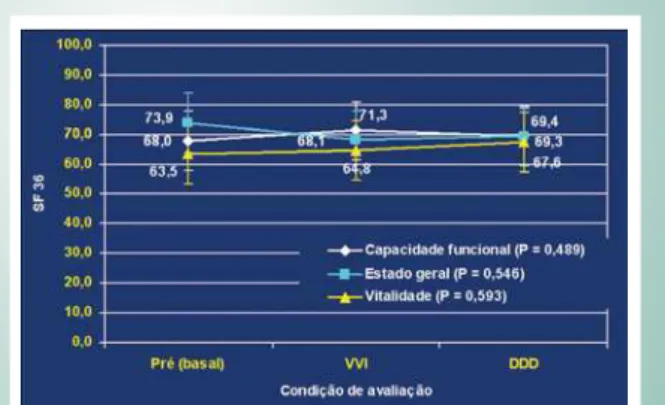
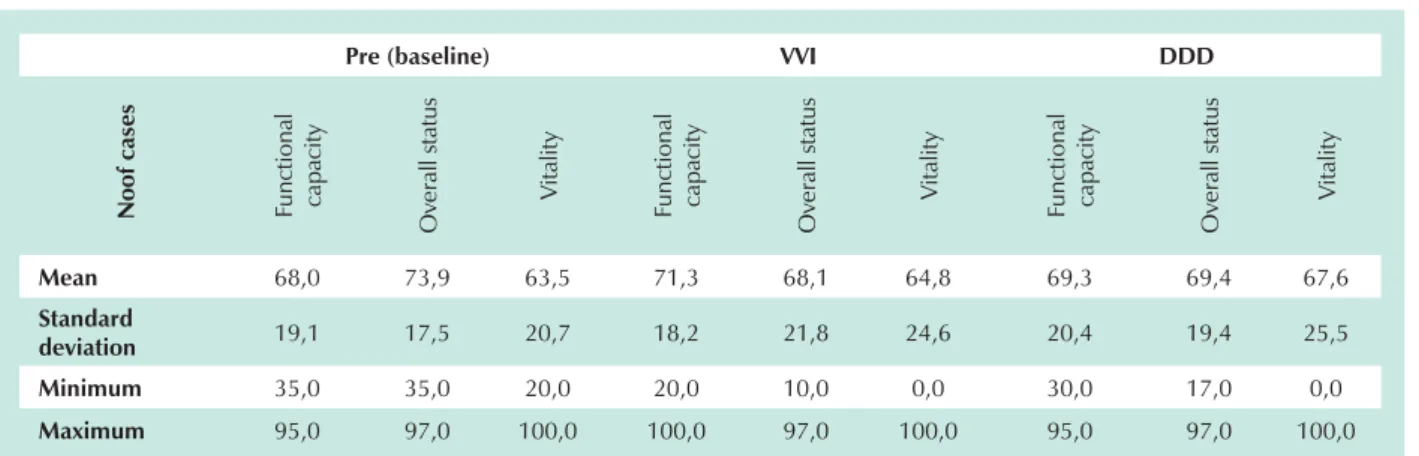
Quality of life- Quality of life evaluated as per the functional
capacity (p=0.489), overall health status (p=0.546) and vitality (p=0.593) did not show any significant difference in the mean of these dimensions under any condition of the study (Fig. 3, Tab. 4).
Discussion
The use of an artificial pacemaker for the treatment of atrioventricular block in patients with chagasic cardiopathy is well-established; however, the decision about the most suitable mode of stimulation deserves to be further discussed.
There are several studies in medical literature comparing the effects of VVI and DDD stimulation modes in non-chagasic patients6-10. However, the chagasic cardiopathy has its own
clinical and electrophysiological characteristics that affect the autonomic function and that distinguish it from other pathologies11,12.
In this study, the analysis of stimulation frequency in our patients under DDD programmation, without activation of the frequency response sensor, showed a slight chronotropic variation in the six-minute walk test. Therefore, it can be concluded that the comparative findings between the VVI pacing (with no rate-adaptative sensors) and the DDD programmations were consequences of the restored atrioventricular synchrony.
There is much controversy over the central theme in this study, since the change in the mode of stimulation during elective pulse generator replacement aimed at obtaining
a better hemodynamic function not always translates into clinical benefit for the patient. The upgrading from VVI to DDD stimulation mode was first proposed in 1992, by Sulke et al, in a randomized study with 16 asymptomatic patients, who had had VVI pacemakers implanted for more than 3 years due to sinus node disease and atrioventricular block. The DDD mode improved the patients’ physical capacity and well-being (subjective evaluation), but it was not different from an echocardiographic point-of-view13.
In 1998, Hildick-Smith et al conducted a retrospective evaluation of 44 cases of ventricular pacemaker upgrading and observed that the change had been of benefit to the symptomatic patients only (the majority of the subjects enrolled in the study), but the 45% rate of complications was considered too high14. Gribbin et al, by evaluating their experience also
observed an overly high rate (36%)15, and therefore concluded
that the change of the stimulation mode during the elective
Pre (baseline) VVI DDD
H
R
(
in
itial
)
H
R
(
fin
al
)
D
istan
ce
(
m
ete
rs)
H
R
(
in
itial
)
H
R
(
fin
al
)
D
istan
ce
(
m
ete
rs)
H
R
(
in
itial
)
H
R
(
fin
al
)
D
istan
ce
(
m
ete
rs)
Mean 66,3 73,1 407,5 69,3 75,1 463,4 70,6 77,8 462,6
Standard
deviation 5,8 6,3 84,3 4,4 5,5 84,7 4,8 6,3 63,4
Minimum 56,0 64,0 210,0 60,0 64,0 230,0 60,0 66,0 375,0
Maximum 74,0 88,0 525,0 80,0 85,0 625,0 84,0 96,0 650,0
DDD: patient status after 90-day atrioventricular stimulation; HR: heart rate; PRE: patient status under exclusive ventricular stimulation at study selection; VVI: patient status under after 90-day ventricular stimulation
Table 3 - Data about the six-minute walk test under baseline, VVI and DDD conditions
Fig. 3 -Quality of life assessed according to functional capacity, overall health status and vitality under pre-evaluation (baseline), VVI and DDD conditions of patients with chagasic cardiopathy and atrioventricular block.
replacement of pulse generator should be performed only for very well-defined reasons. In our study, complications were much less serious, perhaps due to the fact that, differently from retrospective studies, the prospective approach allows to pre-select the examiners and yields better results.
The complications relative to DDD pacemaker are more common than with the VVI devices, and are mainly due to the atrial electrode lead as reported by the UKPACE study16. In our
study, among the four surgical complications observed, three were relative to the change in the stimulation mode. Both the displacement of the atrial electrode lead and the pacemaker-mediated atrial tachyarrhythmias are strictly inherent to the system of atrioventricular stimulation.
Recently, Hoijer et al published the findings about 19 patients who underwent the change from VVI mode to atrioventricular after randomization and showed that most patients preferred the DDDR type, which also improved their quality of life and cardiac function17. From our point of view, however, this study
inadequately included patients with pacemaker syndrome, which means a selection bias that influences the results in any comparative evaluation of stimulation modes. This effect was observed in the MOST study which reported improved quality of life after pacemaker implantation, slightly superior in the atrioventricular stimulation. However, the evaluation performed excluding the group that was crossed over due to intolerance to VVI mode, did not reveal any significant differences between the two situations18. The group of patients in this study were
well adapted to the ventricular pacing mode, and this exempts the study from such criticism.
With regard to the six-minute walk test, although there was no statistical difference between the distance walked under both modes of stimulation, it was clear that test training has an effect on how the patient performs, since in both modes the distance walked was significantly greater when compared to the baseline condition. The mean heart rate at baseline was significantly lower when compared to VVI and DDD pacing modes due to the failure in the pulse generator, which was the main reason for the indication of elective replacement. Final heart rate was greater under DDD condition, although not enough to influence clinical outcomes, probably due to
the underlying heart disease.
Most patients with pacemakers do not usually engage in very intense activities in their daily lives, and this is why the evaluation of quality of life better conveys the day-to-day routine of this group of patients. Quality of life assessed according to functional capacity, overall health status and vitality certainly yielded reliable findings, since they set the correlations consistent with those patients who experience good clinical progression.
Using the same quality of life protocol, other authors, such as Martinelli et al in 2001, and Newman et al in 2003, also compared the clinical-functional behavior under ventricular and atrioventricular stimulation modes and obtained results similar to ours, with no difference observed between the two pacing modes19,20.
The measurements obtained separately under situations A and B were compared for all parameters used in this study, in order to eliminate the tendency towards the first stimulation mode programmed, and the results were similar. The same thing occurred in the comparison of patients with ejection fractions above and below, or equal to 40%, and who had had the pacemaker implanted for more or less than 10 years. The statistical similarity in the comparative sub-analyses of the conditions that could influence the outcomes provided more consistency to the results.
Therefore, this study showed that for patients with chagasic cardiopathy, atrioventricular block and VVI pacemaker, who are clinically well and with no signs of chronic heart failure, the implantation of an additional atrial electrode lead to upgrade the mode of stimulation, besides not being risk-free, did not provide clinical-functional changes in a short-time follow-up. It is worth to point out that the change from ventricular to atrioventricular stimulation mode is absolutely indicated when there is intolerance to the ventricular mode, which was not the case in this study.
Acknowledgements
The authors gratefully acknowledge the assistance of their colleagues at InCor, Dr. Elizabeth Sartori Crevelari and Dr.
Pre (baseline) VVI DDD
N
o
o
f
ca
se
s
Fu
n
ct
io
n
al
cap
ac
ity
O
ve
ral
l statu
s
V
ital
ity
Fu
n
ct
io
n
al
cap
ac
ity
O
ve
ral
l statu
s
V
ital
ity
Fu
n
ct
io
n
al
cap
ac
ity
O
ve
ral
l statu
s
V
ital
ity
Mean 68,0 73,9 63,5 71,3 68,1 64,8 69,3 69,4 67,6
Standard
deviation 19,1 17,5 20,7 18,2 21,8 24,6 20,4 19,4 25,5
Minimum 35,0 35,0 20,0 20,0 10,0 0,0 30,0 17,0 0,0
Maximum 95,0 97,0 100,0 100,0 97,0 100,0 95,0 97,0 100,0
DDD: patient status after 90-day atrioventricular stimulation; PRE: patient status under exclusive ventricular stimulation at study selection; SF36: Short Form (quality of life questionnaire with 36 questions); VVI: patient status after 90-day ventricular stimulation
the patients.
Potential Conflict of Interest
No potential conflict of interest relevant to this article was reported.
References
1. Hummel J, Fazio G, Lawrence J, Midei M, Walford GD, Brinker JA. The natural history of dual chamber pacing. Pacing Clin Eletrophysiol. 1991;14:1745-7. 2. Costa R, Moreira LF, Martinelli Filho M, Pego-Fernandes PM, Stolf NA,
Virginelli G, et al. Marcapasso atrioventricular universal. Critérios de indicação e benefícios. Arq Bras Cardiol. 1986;46(4):225-30.
3. Montanez A, Hennekens CH, Zebede J, Lamas GA. Pacemaker mode selection: the evidence from randomized trials. Pacing Clin Electrophysiol. 2003:26:1270-82.
4. SBC, DAEC, DECA, SBCVV. Diretrizes para avaliação e tratamentos de pacientes com arritmias cardíacas. Arq Bras Cardiol. 2002; 79(Supl.V): 1-50. 5. ACC/AHA/NASPE. Guidelines for Implantation of Cardiac Pacemakers and
Antiarrhythmia Devices. J Am Coll Cardiol. 2002;40:1703-19.
6. Rediker DE, Eagle KA, Homma S, Gillam LD, Harthorne W. Clinical and hemodynamic comparison of VVI versus DDD pacing in patients with DDD pacemakers. Am J Cardiol. 1988; 61:323-9.
7. Alpert MA, Curtis JJ, Sanfelippo JF, Flaker GC, Walls JT, Mukerji V, et al. Comparative survival after permanent ventricular and dual chamber pacing for patients with chronic high degree atrioventricular block with and without preexistent congestive heart failure. J Am Coll Cardiol. 1986; 7:925-32. 8. Edelstam CL, Nordlander R, Undén AL, Gomér KO, Rydén L. Quality of life
in patients treated with atrioventricular synchronous pacing compared to rate modulated ventricular pacing: A long-tem, double-blin crossover study. Pacing Clin Electrophysiol. 1992; 15:1467-76.
9. Payne GE, Williams H, Skehan JD. An approach in the assessment of pacing hemodynamics: a comparison of VVI and DDD. Pacing Clin Electrophysiol. 1995; 8:1861-7.
10. Connolly SL, Kerr C, Gent M, Ysuf S. Dual-chamber versus ventricular pacing. Circulation. 1996;94:578-83.
11. Guzzetti S, Iosa D, Pecis M, et al. Impaired heart rate variability in patients with chronic Chagas’ disease. Am Heart J. 1991:1727-17.
12. Ribeiro AL, Moraes SR, Ribeiro JP, Ferlin EL, Torres RM, Oliveira E, et al. Parasympathetic dysautonomia precedes left ventricular systolic dysfunction in Chagas disease. Am Heart J. 2001;141:260-5.
13. Sulke N, Dritsas A, Bostock J, Wells A, Morris R, Sowton E. “Subclinical” pacemaker syndrome: A randomised study of symptom free patient with ventricular demand (VVI) Pacemakers upgraded to dual chamber devices. Br Heart J. 1992; 67:57-64.
14. Hildick-Smith DJR, Lowe MD, Newell SA, Schofield PM, Shapiro L M, Stone DL, et al. Ventricular pacemaker upgrade: Experience, complications and recommendations. Heart. 1998;79:383-7.
15. Gribbin GM, MComb JM, Bexton RS. Ventricular pacemaker upgrade: experience, complications, and recommendations. [letters to the editor]. Heart. 1998; 80:420.
16. Toff WD, Camm AJ, Skehan JD. Single- Chamber versus Dual-Chamber Pacing for High-Grade Atrioventricular Block (UKPACE Trial Investigators). N Engl J Med 2005; 353:145-54.
17. Höijer CJ, Brandt J, Willenheimer R, Juul-Möller S, Boström PA. Improved cardiac function and quality of life following upgrade to dual chamber pacing after long-term ventricular stimulation. Eur Heart J. 2002; 23:490-7. 18. Lamas GA, Lee KL, Sweeney MO, Silverman R, Leon A, Yee R, et al. Ventricular
pacing or dual-chamber pacing for sinus-node dysfunction. N Engl J Med. 2002;346:1854-62.
19. Martinelli Filho M, Grecco O, Atié J, Péres A, Magalhães L, God EG, et al. Estudo Brasileiro de Marcapasso Fisiológico (ESBRAMAF): Resultados preliminares. In: XVIII Congresso Brasileiro do Departamento de Arritmias Caríacas e Eletrofisiologia Clínica. Reblampa. 2001;14:189.
20. Newman D, Lau C, Tang AS, Irvine J, Paquette M, Woodend K, et al. Effect of pacing mode on health-related quality of life in the Canadian trial of Physiologic Pacing. Am Heart J. 2003;145:430-7
Wagner Tetsuji Tamaki, and the colleagues at the Hospital
Beneficência Portuguesa – RP, Dr. Ulisses Bruno Stella,