Effects of Short-term Carvedilol on the Cardiac Sympathetic Activity
Assessed by
123I-MIBG Scintigraphy
Sandra Marina Ribeiro de Miranda
1, Evandro Tinoco Mesquita
1,2, Hans Fernando da Rocha Dohmann
3,
Jader Cunha Azevedo
2, Gustavo Borges Barbirato
2, Fabiano de Lima Freire
1, Mário Luiz Ribeiro
1,
Antonio Cláudio Lucas da Nóbrega
1,2, Alexandro Coimbra
2, Cláudio Tinoco Mesquita
1,2Universidade Federal Fluminense1, Niterói, RJ; Hospital Pró-Cardíaco2; Procep3, Rio de Janeiro, RJ – Brazil
Abstract
Background: Autonomic alterations in heart failure are associated with an increase in morbimortality. Several noninvasive methods have been employed to evaluate the sympathetic function, including the Meta-Iodobenzylguanidine (123I-MIBG)
scintigraphy imaging of the heart.
Objective: to evaluate the cardiac sympathetic activity through 123I-MIBG scintigraphy, before and after three months of
carvedilol therapy in patients with heart failure and left ventricular ejection fraction (LVEF) < 45%.
Patients and methods: Sixteen patients, aged 56.3 ± 12.6 years (11 males), with a mean LVEF of 28% ± 8% and no previous use of beta-blockers were recruited for the study. Images of the heart innervation were acquired with 123I-MIBG,
and the serum levels of catecholamines (epinephrine, dopamine and norepinephrine) were measured; the radioisotope ventriculography (RIV) was performed before and after a three-month therapy with carvedilol.
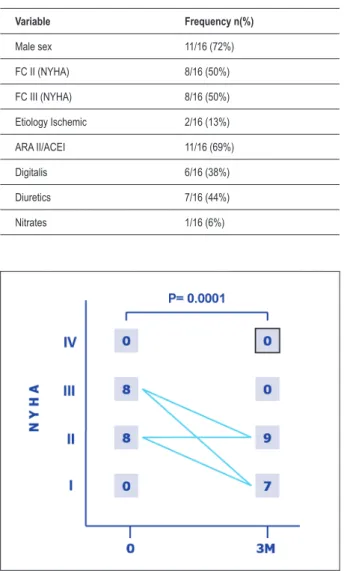
Results: Patients’ functional class showed improvement: before the treatment, 50% of the patients were FC II and 50% were FC III. After 3 months, 7 patients were FC I (43.8%) and 9 were FC II (56.2%), (p = 0.0001). The mean LVEF assessed by RIV increased from 29% to 33% (p = 0.017). There was no significant variation in cardiac adrenergic activity assessed by 123I-MIBG (early and late resting images and washout rate). No significant variation was observed regarding
the measurement of catecholamines.
Conclusion: The short-term treatment with carvedilol promoted the clinical and LVEF improvement. However, this was not associated to an improvement in the cardiac adrenergic activity, assessed by 123I-MIBG scintigraphy, as well as the
measurement of circulating catecholamines. (Arq Bras Cardiol 2010; 94(3):308-312)
Key words: Radionuclide imaging; heart failure / therapy; 3-iodobenzylguanidine.
Mailing address: Sandra Marina Ribeiro de Miranda •
Av. Afonso Arino Mello Franco, 397 / 608 - Barra da Tijuca – 22631455 - Rio de Janeiro, RJ – Brazil
E-mail: [email protected]
Manuscript received November 04, 2009; revised manuscript received March 27, 2009; accepted June 15, 2009.
Introduction
Sympathetic functional disorders have an important clinical significance in cardiac diseases1 and have a central role in the assessment and progression of primary and secondary cardiomyopathies2. Recently, the importance of identifying alterations in the autonomic cardiac innervation in cardiovascular diseases, including heart failure (HF), arrhythmias, ischemic heart diseases and diabetes has been increasingly acknowledged3-5.
There are several invasive and noninvasive, direct and indirect methods used to evaluate the cardiac autonomic function in cardiovascular diseases. However, Nuclear Medicine is currently the only imaging modality with enough sensitivity that offers the visualization of cardiac neurotransmission in vivo at the molecular level6.
Several radiotracers are used to assess the sympathetic nervous system, such as the true catecholamines or catecholamine analogs. The agent that allowed the visualization of the sympathetic nerves was the meta-iodobenzylguanidine (MIBG), a norepinephrine (NE) analog that was developed in 1980 by Wieland et al7.
The role of neurohormonal axis in HF is well known and important for the treatment. One of the characteristic features in the HF scenario is the development of excessive sympathetic tonus and the uncoupling of the beta-adrenergic receptors.
The development of noninvasive methods to evaluate the change of the beta-adrenergic signaling system in HF in response to the therapy is important. The NE-analog 123I-MIBG radiotracer competes with the NE reuptake in the presynaptic vesicles and can be used to analyze the synaptic innervation and heart function8.
The image of the cardiac neurotransmission allows the
vivo, at molecular level, using a neurotransmission radiotracer and ligand receptor6.
In patients with HF, the assessment of the sympathetic activity has important prognostic implications that will result in better treatment and outcome6.
Several studies in the literature, carried out with 123I-MIBG 9-12, have assessed changes in the heart/mediastinum ratio in
response to mid and long-term therapy with beta-blockers in HF. The present study analyzed the response of short-term therapy (3 months) with carvedilol on the cardiac innervation, evaluated by 123I-MIBG scintigraphy and the correlation with the left ventricular ejection fraction (LVEF) in individuals with HF and LVEF< 45%.
Methods
Sixteen patients were prospectively selected – 11 males (69%) – from the Heart Failure Outpatient Clinic and invited to participate in the study after clinical evaluation and LVEF assessment through echocardiography and radionuclide
ventriculography. Subsequently, the patients underwent myocardial 123I-MIBG scintigraphy, in order to assess the cardiac adrenergic innervation; both early (30-minute) and late (4-hour) images were obtained and the washout rate was calculated. All scintigraphy assessments were carried out at the Service of Nuclear Medicine of Hospital Pro-Cardiaco of Rio de Janeiro, in a Siemens digital tomographic Anger scintigraphy chamber (Single Photon Emission Computed Tomography - SPECT) , model E-Cam with double detector, with low-energy, high-resolution collimator. Plasma catecholamines were measured in all patients. Twelve patients (75%) were submitted to a cardiac catheterism and ischemic disease was diagnosed in 2 of them (13%). Among the 16 patients, 15 were receiving medical assistance and used some type of medication, more often an ACEI/ARA II drug (69%) and none of them used beta-blockers. The mean dose of carvedilol, obtained after the 3-month treatment, was 27 ± 14 mg a day. The evaluations were carried out from July 2006 to March 2008, after the patients agreed to participate in the study and signed the Free and Informed Consent Form, which was approved by the Review Board of our Institution. The patients’ data were included in an Access database for statistical analysis. LVEF was assessed in the 16 patients by both echocardiography and radionuclide ventriculography.
For some variables, there was loss of information at data collection, as follows: in one case, the pre-treatment value of the LVEF and the EFIV were not considered, as the patient was assessed post-carvedilol in atrial fibrillation; in another case, the 4-hour MIBG was not performed; and in two cases, the catecholamine results were not available.
Results
The mean age of the 16 selected patients was 56.3 ±
12.6 years. Table 1 shows the general characteristics of the patients. The mean basal heart rate (HR) was 84 ±16.4 bpm. The laboratory variables evaluated at the pre-treatment period showed decreased LVEF at the echocardiography (0.28 ± 0.08) as well as the radionuclide ventriculography (0.29 ± 0.10), and decreased MIBG values at the 30-minute and 4-hour images (1.60 ± 0.17 and 1.55 ± 0.17, respectively), with a high washout rate (0.29 ± 0.11). On average, the plasma catecholamine levels were within the normal range, i.e., NE = 259 ± 86 pg/ml (normal up to 370 pg/ml), DOP = 176.1
± 38.4 pg/ml (normal up to 200 pg/ml) and EPI = 132.3 ±
26.0 pg/ml (normal up to 150 pg/ml).
The variation in functional class (FC) from the pre to the post-treatment period showed significant improvement in parallel with the clinical improvement observed in the patients. Figure 1 shows the change in FC before and after the carvedilol therapy.
It was observed that there was a significant decrease in HR (ECG) from the pre to the post-treatment period. There was a mean decrease of 20.4 bpm (p = 0.0001) in HR, which corresponds, on average, to 22.4% (p = 0.0001).
The patients’ ejection fraction, assessed by both the echocardiography and radionuclide ventriculography, showed a statistically significant increase after the carvedilol therapy, as shown in Table 2.
Figure 1 - Change in functional class
Table 1 – General characteristics of the sample at the start of the study
Variable Frequency n(%)
The cardiac adrenergic activity evaluated by Nuclear Medicine through the early (30-minute) and the late (4-hour) image, as well as the washout rate did not show a statistically significant alteration, similarly to the catecholamine measurements.
Table 2 shows the results of the variables studied in the periods pre and post-treatment with carvedilol and the statistical significance.
To illustrate the cardiac scintigraphy evaluations carried out with 123I-MIBG, we show the scintigraphy images of one patient included in the study with a favorable adrenergic neurotransmission response to carvedilol use before and after the three-month treatment period. Figure 2 shows the image before the treatment and Figure 3 the image after the treatment, both tomographic ones. Figures 4 and 5 are planar images of the same patient before and after carvedilol therapy. All images show the consistent improvement with the adrenergic innervation. However, in most patients, no significant improvement was observed regarding the neurotransmission, as in this case, during the study period.
Discussion
The present study observed a dissociation between the clinical/functional improvement and the recovery of the adrenergic functional integrity of the heart after a short-term treatment with carvedilol. This study is the only one to demonstrate a lack of association between functional improvement and adrenergic function improvement in patients treated with carvedilol for three months.
Nuclear Medicine has been broadly employed in the assessment of patients with cardiopathies, providing diagnostic13 and prognostic9 data. The evaluation of patients with HF through functional methods after therapeutic measures is one of the multiple possibilities of isotopic
Table 2 - Pre and post-carvedilol variables
MEAN PRE MEAN POST P value
LVEF (%) 28% 34% 0.009 EFIV (%) 29% 33% 0.017 HR (bpm) 84 63.6 0.0001 MIBG 30 minutos 1.6 1.64 0.58 MIBG 4 horas 1.55 1.6 0.38 WASHOUT 0.29 0.34 0.57 NE (pg/ml) 259 276.6 0.77 DOP (pg/ml) 176.14 161.07 0.32 EPI (pg/ml) 132.3 117.1 0.11
LVEF - left ventricular ejection fraction; EFIV - ejection fraction by isotope ventriculography; HR – heart rate; MIBG 30 minutes - Meta-Iodobenzylguanidine scintigraphy; Washout - difference between early image versus late image uptake; NE - norepinephrine; DOP - dopamine; EPI - epinephrine.
Figure 2 – Scintigraphy with 123I-MIBG – Pre-treatment. Pre-treatment
scintigraphy with 123I-MIBG showing extensive denervation area in the anterior,
anteroseptal and apical walls.
Figure 3 – Scintigraphy with 123I-MIBG – Post-treatment. Post-treatment
scintigraphy with 123I-MIBG showing adrenergic neurotransmission
improvement in the septal and apical segments.
techniques14, as the 123I-MIBG scintigraphy is unique, providing information on the cardiac adrenergic status. One of the differential factors in the present study, in comparison to other studies published in the literature that specifically address the cardiac adrenergic function evaluated through MIBG, is that there was an improvement in left ventricular function and functional class, without a significant improvement in the adrenergic neurotransmission. There are many explanations for this fact. One of the most adequate ones is the short time interval (3 months) between the assessments carried out pre and post-treatment with carvedilol. Another explanation for the hemodynamic improvement without significant adrenergic improvement may be attributed to the 22.4% decrease in heart rate. In normal hearts, the increase in heart rate is accompanied by the increase in the myocardial contractile performance (Bowditch-Treppe phenomenon)13. Hearts that present failure exhibit phenotypic changes, including the enzymes that regulate calcium homeostasis, resulting in the decreased diastolic uptake of calcium into the sarcoplasmic reticulum, with subsequent decrease in calcium release during the following systole, with the ensuing decrease in the contractile performance and an alteration in the strength/ frequency ratio. In chronic left ventricular dysfunction, therefore, the contractile performance decreases with the increase in heart rate and a improvement in the ejection fraction is observed with the decrease in chronotropism (HR between 50 and 60 bpm)12.
In general, the studies demonstrate a concomitant improvement in the ventricular function and the adrenergic transmission, as in the studies by Agostini and cols., which evaluated 22 patients before and after 6 months of treatment with carvedilol, showing at the H/M late image an improvement from 145% ± 23% to 170% ± 25% (p = 0.0001)15. Cohen-Solal et al16. studied 64 patients with dilated cardiomyopathy – in
a multicentric, double-blind, placebo-controlled study – and submitted 28 patients to carvedilol therapy for 6 months, with a dose of 50 or 100 mg/day, depending on the patient’s weight, < or > 85 kg, respectively. The patients that did not tolerate the maximum dose were excluded from the study. After 6 months, an improvement in the LV ejection fraction was observed, from 25% ± 11% to 31% ± 12% (increase of 24%) as well as of the H/M ratio, which increased from 142%
± 18% to 149% ± 21% and the authors concluded that the hemodynamic benefits of the carvedilol therapy in patients with dilated cardiomyopathy could be associated with the partial recovery of the adrenergic innervation function16. Toyama et al17 evaluated 30 patients, of which 15 received carvedilol (Group A) and 15 metoprolol (Group B) before and after 1 year of treatment. There was an increase in the H/M ratio in both groups, with an increase of 1.67 ± 0.31 to 2.01
± 0.3 in Group A and 1.68 ± 0.21 to 1.93 ± 0.32 in Group B, with p < 0.01 at the late image17. In our study, the pre to post-carvedilol variation was from 1.55 ± 0.17 to 1.60 ± 20, with p = 0.38 after three months of treatment.
Differently from other studies, the present study did not observe an improvement in adrenergic neurotransmission; however, the treatment duration was shorter and the beta-blocker dose used was lower than that used in other studies (30 mg/day), as the dose increase tends to augment the efficacy of the beta-blocking, with a consequent improvement in adrenergic transmission. Therefore, one can suppose that the LV function improvement precedes the improvement in the adrenergic function within a short period of time. A possible limitation would be the number of assessed patients. However, the 16-patient sample has a power of 93% to detect a 15% variation in the H/M ratio in a group of patients with an H/M ratio of 1.8. Lower-intensity modifications cannot be ruled out.
In summary, our study evaluated, through 123I-MIBG scintigraphy, whether a short-term (3 months) treatment with carvedilol would modify the cardiac adrenergic activity in patients with HF due to systolic dysfunction. We concluded that the short-term treatment with carvedilol was associated with clinical and hemodynamic improvement, but not with significant alterations in adrenergic function.
Potential Conflict of Interest
No potential conflict of interest relevant to this article was reported.
Sources of Funding
There were no external funding sources for this study.
Study Association
This article is part of the thesis of master submitted by Sandra Marina Ribeiro de Miranda, from Universidade Federal Fluminense.
References
1. Yashima S, Yamazaki J. Neuronal imaging using SPECT. Eur J Nucl Med Mol Imaging. 2007; 34: 562-73.
2. Higuchi T, Bengel FM. Cardiovascular nuclear imaging: from perfusion to molecular function. Heart. 2008; 94: 809-16.
3. Shirani J, Dilsizian V. Molecular imaging in heart failure. Curr Opin Biotechnol. 2007; 18 (1): 65-72.
4. Higuchi T, Schwaiger M. Imaging cardiac neuronal function and dysfunction. Curr Cardiol Rep. 2007; 8: 131-8.
5. Arora R, Ferrick KJ, Nakata T, Kaplan RC, Rozengarten M, Latif F, et al.
123I-MIBG Imaging and heart rate variability analysis to predict the need
for an implantable cardioverter defibrillator. J Nucl Med. 2003; 10 (2): 121-31.
6. Carrió I, Cardiac neurotransmission imaging. J Nucl Med. 2001; 42: 1062-76.
7. Wieland DM, Wu J, Brown LE, Mangner TJ, Swanson DP, Beierwaltes WH. Radiolabeled adrenergic neuro-blocking agents: adrenomedullary imaging with [ 131 I ] iodobenzylguanidine. J Nucl Med. 1980; 21: 349-53.
8. Tobes MC, Jacques Jr S, Wieland DM, Sisson JC. Effect of uptake – one inhibitors on the uptake of norepinephrine and metaiodobenzylguanidine. J Nucl Med. 1985; 26: 897-907.
9. de Azevedo JC, Félix RC, Corrêa PL, Barbirato GB, Dohmann HF, da Silva PR, et al. Medium term prognostic value of stress myocardial perfusion scintigraphy in a chest pain unit. Arq Bras Cardiol. 2007; 88: 602-10.
10. Kasama S, Toyama T, Hatori T, Sumino H, Kumasura H, Takayama Y, et al. Evaluation of cardiac sympathetic activity and left ventricular remodelling in
patients with dilated cardiomyopathy on the treatment containing carvedilol. Eur Heart J. 2007; 28 (8): 989-95.
11. Kacuchi H, Sasaki T, Ishida Y, Komamura K Miyatake K. Clinical usefulness of 123I-Meta-iodobenzylguanidine imaging in predicting the effectiveness of
β-blockers for patients with idiopathic dilated cardiomyopatthy before and soon after treatment. Heart. 1999; 81:148-52.
12. Just H. Pathophysiological targets for beta-blocker therapy in congestive heart failure. Eur Heart J. 1996; 17: 1-7.
13. Pantoja MR, Futuro DO, Escosteguy CC, de Almeida LA, Esteves RN, Pinto JC, et al. Cineventriculography with radionuclides and intravenous dipyridamole in the prognostic evaluation after acute myocardial infarction. Arq Bras Cardiol. 1990; 55: 175-9.
14. Pimentel Filho WA, Ascer E, Pontes SC, Martins LR, Braga SL, Jorge SC, et al. Clinical, echocardiographic and radioisotopic evaluation of the effect of prazosin on left ventricular function in patients with congestive heart failure refractory to conventional therapy. Arq Bras Cardiol. 1985; 44: 443-8.
15. Agostini D, Belin A, Amar MH, Dorlas Y, Hamon M, Grollier G, et al. . Improvement of cardiac neuronal function after carvedilol treatment in dilated cardiomyopathy: a 123I-MIBG Scintigraphic Study. J Nucl Med. 2000;
41: 845-51.
16. Cohen-Solal A, Rouzet F, Berdeaux A, Le Guludec D, Abergel E, Syrota A, et al. Effectcts of carvedilol on myocardial sympathetic inervation in patients with chronic heart failure. J Nucl Med. 2005; 46 :1796-803.