
• Nenhum resultado encontrado

Arq. NeuroPsiquiatr. vol.71 número4

N/A
N/A
Protected

Academic year: 2018

Share "Arq. NeuroPsiquiatr. vol.71 número4"

Copied!
1
0
0

Texto

(1)

269

IMAGES IN NEUROLOGY

Tension pneumocephalus and rhinorrhea

related to chronic sinusitis

Pneumoencéfalo hipertensivo e rinorreia relacionados à sinusite crônica

Victor de Almeida Kosac

1

, André PC Matta

2

, Frederico M Prado

1

, Osvaldo JM Nascimento

2

, Gabriela DJ Matta

3

,

Tereza CS dos Santos

4

1Medical residents of Neurology, Department of Neurology, Federal Fluminense University, Niterói RJ, Brazil;

2MD, PhD, Professor of Neurology, Department of Neurology, Federal Fluminense University, Niterói RJ, Brazil;

3Ophthalmologist, Post-graduating program in Neurology and Neuroscience, Federal Fluminense University, Niterói RJ, Brazil;

4Radiologist at Antonio Pedro Hospital, Federal Fluminense University, Niterói RJ, Brazil.

Correspondence: Victor de Almeida Kosac; Rua Doutor Paulo César 25 / apto. 1.608; 24240-000 Niterói RJ - Brasil; E-mail: [email protected] Conflict of interest: There is no conflict of interest to declare.

Received 18 March 2012; Received in final form 26 November 2012; Accepted 03 December 2012. 1. Lefranc M, Peltier J, Demuynkc F, et al. Tension pneumocephalus and

rhinorrhea revealing spontaneous cerebrospinal fluid fistula of the anterior cranial base. Neurochirurgie 2009;55:340-344.

2. Webber-Jones JE. Tension pneumocephalus. J Neurosci Nurs 2005;37: 272-276.
References

A 42-year-old woman presented with a sudden-onset severe

headache associated with vomiting and a persistent aqueous

rhinorrhea. She had an allergic chronic sinusitis. here was no

history of head trauma. Neurologic exam disclosed

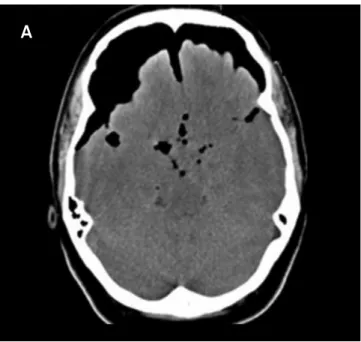
papillede-ma. he computed tomography (CT) scan showed

opaciica-tion of the left sphenoid sinus and pneumocephalus extending

from frontal region until convexity, compressing the

supraten-torial ventricular system (Fig 1). he cerebrospinal luid (CSF)

istula was found in the left pterygoid process (Fig 2). Air

prob-ably came through the dural defect, and may have followed the

CSF low circuit. he physiopathology can be explained by bone

defect, absence of nasal mucosa, and minor traumas

1,2

.

Fig 1.

Computed tomography shows huge pneumocephalus

extending from right temporal fossa and bilateral frontal region

until convexity compressing supratentorial ventricular system.

A

Fig 2.

High resolution computed tomography shows opacification

of the left sphenoid sinus and bone defect of the left pterygoid

process (arrow) permitting the airflow through the fistula.

B

Imagem

Fig 1. Computed tomography shows huge pneumocephalus  extending from right temporal fossa and bilateral frontal region  until convexity compressing supratentorial ventricular system.

Referências

Documentos relacionados

A computed tomography (CT) scan revealed an atypical horseshoe kidney with cysts and three-dimensional spiral CT reconstruction showed the pre- sence of a single ureter.. The

Computed tomography scan and magnetic resonance imaging showed a normal prostate and a 9.0 cm cystic tumor, replacing the left seminal vesicle.. The gross appearance and

9 Preoperative coronal section computed tomography highlighting the right sphenoid heterogeneous opaci fi cation with signs of remodeling in the wall of the sphenoid sinus and

An axial CT scan of the chest showed a soft-tissue tumor that affected the region of the left anterior costal margin, extended to the abdominal region, and compressed the

Nasal endoscopic examination showed a relapsing tumor and CT scans revealed a then T3 neoplasm (the tumor involved the nasal cavity, the ethmoid sinus, the sphenoid sinus, and

A: (Left) axial CT scan of sinuses shows complete opa- ciication of the left sphenoid sinus with dehiscence in the left optic canal (white arrow), opticocarotid recess (black

Figure 1 (A---C) Preoperative coronal computed tomography (CT) scan showing: (A) a hyperdense mass occupying both nasal cavities and the bilateral frontal, bilateral ethmoid,

Computed tomography (CT) findings showed the mandible fracture and complete opacification of the right maxillary sinus, with expansion and focal destruction of the cortical