305
Bras J Rheumatol 2009;49(3):302-7 CASE REPORT
Received on 10/04/2008. Approved on 02/03/2009. We declare no conflict of interest.
Study carried out in Rheumatology and Hematology at the Department of Clinical Medicine of Universidade Federal do Triângulo Mineiro (UFTM) – Uberaba, MG. 1. Assistant Professor of Rheumatology – UFTM
2. Assistant Professor of Rheumatology – UFTM 3. Assistant Doctor of Hematology – UFTM 4. Resident doctor (R2) in Rheumatology – UFTM 5. Resident doctor (R2) in Hematology – UFTM 6. Resident doctor (R2) in Hematology – UFTM
Correspondence to: Marlene Freire. Clinical Medicine Department, Rheumatology Division. Rua Getúlio Guaritá, sem número, bairro Abadia. Zip Code 38025-110. Uberaba, MG. E-mail: [email protected]
INTRODUCTION
Acquired hemophilia A is a rare change of blood coagulation featured by the occurrence of antibody against the procoagulating
activity of factor VIII.1 This condition may occur associated
with autoimmune diseases, such as rheumatoid arthritis (RA),1-8 systemic lupus erythematosus (SLE),2,3 and Sjögren’s
syndrome.9 It has also been reported in healthy elderly,7,8
postpartum period,8 patients with malignant neoplasia,2 and
related with the use of some drugs, such as penicillin.3,8
S e v e r a l t h e r a p i e s , i n c l u d i n g c o r t i c o s t e r o i d , cyclophosphamide, cyclosporine or vincristine, have been used
Acquired hemophilia associated
with rheumatoid arthritis
Marlene Freire1, Reginaldo Botelho Teodoro2,Dulcinéia Aparecida Nogueira3,
Danielle Patrícia Castanheira Rita4, Elmiro Ribeiro Filho5, Lílian Vieira de Sousa6
ABSTRACT
The occurrence of the antibody against factor VIII is a well-known phenomenon in hemophilia A, occuring in 5 to 15% of the hemophilic patients in the United States, England, Sweden and France. The development of factor VIII in non-hemophilic patients is rare and may occur in healthy individuals, mostly elderly and women in postpartum period, and in patients with malignant neoplasia or autoimmune diseases, such as systemic lupus erythematosus, rheumatoid arthritis and Sjögren’s syndrome.
We described the case of a 64-year-old female patient who has had seropositive rheumatoid arthritis for 23 years and presented with a ten-day history of progressive ecchymosis. Therapy with methylprednisolone, intravenous cyclophos-phamide, immunoglobulin and factor VIII reposition was instituted, resulting in a remission of the bleeding and negativity for antibodies against factor VIII titers.
We concluded that, despite its rarity, the presence of acquired factor VIII inhibitors should be investigated when patients with autoimmune diseases develop bleeding manifestations.
Keywords: rheumatoid arthritis, factor VIII inhibitor, acquired hemophilia A.
to reduce or remove factor VIII inhibitors. Treatments with high doses of immunoglobulin, interferon and plasmapheresis have been reported, although today there is no gold standard
therapy deined.4,5,10 The most used treatment plan, when it
is associated with autoimmune diseases, is a combination of methylprednisolone and cyclophosphamide.4,5,7,10,11 During the
last years, rituximab has been said to possibly be a valuable
agent in the treatment of acquired hemophilia.11
Freire et al.
306 Bras J Rheumatol 2009;49(3):302-7
CASE REPORT
A 64-year-old mulatto woman, widow, who was born in the city of Ibiá (state of Minas Gerais) and came from the city of Frutal (state of Minas Gerais), with a history of progressive ecchymosis and hematomas spread all over her
body for 10 days. She was irst admitted at Hospital Escola
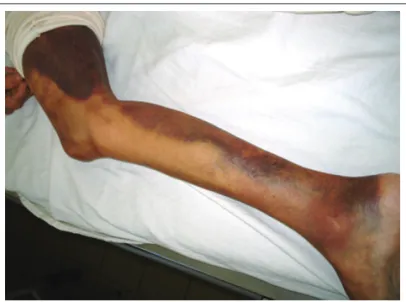
da Universidade Federal do Triângulo Mineiro (UFTM) in April, 2005. She has presented with a diagnosis of RA for 23 years and had used prednisone 5 mg/day since the beginning of the disease, as a facultative follow-up. During physical examination, we found large hematomas and ecchymosis in her lower limbs (Figures 1 and 2), chest and vulva, and also
hands with ulnar deviation of ingers and a synovial thickening
in the metacarpophalangeal joints.
Laboratory exams showed 2,370,000/mm3 erythrocytes,
7.4 g/dL hemoglobin, 22.4% hematocrit, 340,000/mm3 blood
platelets, 23.3 mg/dL C reactive protein, 1.0 g/dL acid
α1-glycoprotein, 50 mm erythrocyte sedimentation rate speed
during the irst hour, activation time of prothrombin (ATP) with
78% of activity and time of activated partial thromboplastin (ActTP) with 3.45 patient-test ratio (normal between 0.9 and 1.25). Doses of rheumatoid factor were 51.6 UI/mL (reference value < 10 UI/mL). Factor VIII dosing was 4.3% (reference value – 50 to 150%), and factor VIII inhibitor dosing was higher than 10 UI Bethesda. Facing the enlargement of activated partial thromboplastin, the reduction of factor VIII dosing and the presence of antibody against factor VIII, acquired Hemophilia A diagnosis was performed (moderate intensity = factor VIII level between 1 and 5%).
Treatment during hospitalization consisted of three cycles, intravenously, of methylprednisolone 700 mg/day, two cycles of immunoglobulin 25 g, cyclophosphamide 500 mg, with a 21-day interval between them and reposition of prothrombinic complex (factor VIII 1250 UI 12/12 hours for 15 days).
The patient evolved with major improvement of her case history, normalization of ActTP and diminishing of antibody against factor VIII in 1 month of treatment. She was discharged from using prednisone 100 mg/day and she has undergone to three more monthly intravenous cycles of cyclophosphamide 500 mg at Ambulatório de Reumatologia. In August, 2005, cyclophosphamide was discontinued, and the patient was followed up at outpatient room with favorable evolution.
DISCUSSION
This case report shows a female patient with autoimmune disease who has developed acquired hemophilia and has been
successfully treated with a combination of methylprednisolone, immunoglobulin, factor VIII reposition/prothrombinic complex, and intravenous cyclophosphamide.
The differential diagnosis of ecchymosis and/or hematoma with ActTP enlargement, reduction of factor VIII dosing and presence of factor VIII inhibitor featuring acquired Hemophilia includes neoplasia or autoimmune diseases, such as RA, SLE and Sjögren’s syndrome, use of drugs like penicillin, women during postpartum period and healthy elderly.
RA association with seric anti-factor VIII antibody is rare. Factor VIII inhibitors in non-hemophilic patients are generally associated with severe bleeding and may cause death in more
than 20% of the cases.1,4 The main objective in the acquired
hemophilia treatment is to eradicate factor VIII antibody10,
additionally to controlling hemorrhage.
Figure 1. Hematoma and extense ecchimosis of a lower limb.
307 Acquired hemophilia A and rheumatoid arthritis
Bras J Rheumatol 2009;49(3):302-7
Type, extension and severity of hemorrhage in patients with autoantibodies (acquired hemophilia) differ from that observed in patients with hemophilia A and who develop inhibitors. In those patients, bleedings start in childhood and appear in joints, muscles and soft tissues, and the presence of factor VIII inhibitors do not increase the frequency of bleeding episodes,
however, it makes it dificult to control such events. Patients
with acquired hemophilia usually are adults with sudden, more severe bleeding in skin, subcutaneous tissue and muscles;
hemarthroses are less common.10,11
The fact that anti-factor VIII antibody production is not associated with the disease activity, as observed in case reported, suggests the importance of monitoring blood coagulation in patients in clinic remission and with bleeding manifestations. An early diagnosis is extremely important, because, although it is a rare condition, it is also extremely severe and has high mortality.3,4,6
By presenting this case, we concluded that the presence of acquired factor VIII inhibitors should be investigated when patients with autoimmune diseases develop bleeding manifestations during prolonged ActTP with ATP and normal blood platelet number.
REFERÊNCIAS REFERENCES
Soriano R mg, Matthews JM, Guerado-Parra E. Case Report. 1.
Acquired haemophilia and rheumatoid arthritis. Br J Rheumatol 1987;26:381-383.
Hall RL, Lealy MF. Acquired Factor VIII autoantibody: four 2.
cases demonstrating the heterogenous nature of this condition and problems involved in diagnosis and treatment Factor VIII Inhibitors in Rheumatoid Arthritis. Eur J Haematol 2001;66:206-209.
Nishino Y, Ueki K, Suto M, Uchiumi H, Ota F, Tamura S e
3. t
al. Successful treatment of patients with rheumatic disorders and acquired factor VIII inhibitors with cyclophosphamide and prednisolone combination therapy: two case reports. J Int Med Res 2001;29:432-463.
Pignone A, Matucci-Cerinic M, Morini M, Lombardi A, Ferrini 4.
Rossi PL, Cagnoni M. Suppression of autoantibodies to factor VIII and correction of factor VIII deiciency with a combined steroid-cyclophosphamide-porcine factor VIII treatment in a patient with rheumatoid arthritis. J Intern Med 1992;231:617-619.
Collins D, Bourke BE. Haemophilia and Rheumatoid Arthritis. Br 5.
J Rheumatol 1988;4:332.
Struillou L, Fiks-Sigaud M, Barrier J, Blat E. Acquired haemophilia 6.
and rheumatoid arthritits: success of immunoglobulin therapy. J Intern Med 1993;233(3):304-5.
Vignes S, Le Moing V, MeeKel P, Papo T, Wechsler B, Godeau P. 7.
Acquired hemophilia: A rare complication of Sjogren’s syndrome. Clin Exp Rheumatol 1996;14:559-560.
Kueh YK, Koh DR, Chan TB, Han P. Acquired factor VIIIC 8.
deiciency due to circulating factor VIIIC inhibitors. Ann Acad Med Singapore 1988;17(4):589-94.
Raphael N, Shulman, Hirschman RJ. Acquired Hemophilia. Trans 9.
Assoc Am Physicians 1969;82:388-97.
Cabral A, Romão T, Monteiro JA, Uva LS. Hemoilia Adquirida, a 10.
propósito de um caso clínico. Med Inter 1998;5(1):53-59. Giangrande P. Hemoilia Adquirida. Tratamiento de la Hemoilia 11.