377
Rev Assoc Med Bras 2011; 57(4):377
IMAGEM EM MEDICINA
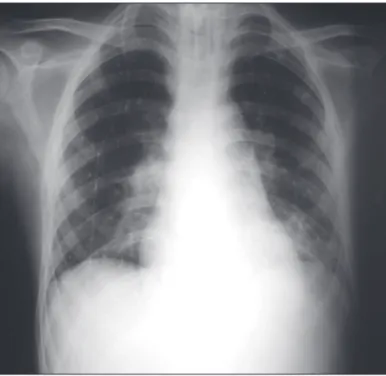
A 34-year-old man was admitted in the emergency room with headache, vomiting, gait ataxia, dizziness and vertigo. He was submitted to a cranial CT that showed an important hydrocephalus secondary to a forth ventricle compression by a posterior fossa hematoma. He received advanced life support in an intensive care unit (ICU) and was submitted to an external ventricular drainage (EVD), posteriorly converted to ventriculoperitoneal shunt (VPS) (visualized in the right hemithorax). Ater stabilization a magnetic resonance image (MRI) and an arteriography revealed a large cerebellum arteriovenous malformation (AVM).
Embolic pulmonary complication of a cerebral arteriovenous
malformation treatment
LUCAS ALVERNE FREITASDE ALBUQUERQUE1, JOÃO PAULO CAVALCANTEDE ALMEIDA2
1 Intern, Neurosurgery, Santa Casa de Belo Horizonte, Belo Horizonte, MG, Brazil
2 Intern, Neurosurgery, Universidade Estadual de Campinas (UNICAMP), Campinas, SP, Brazil
Study conducted at Hospital Geral de Fortaleza, Fortaleza, CE, Brazil
Correspondence to: Lucas Alverne Freitas de Albuquerque – Rua Aimorés, 1006 - apt 202, Funcionários – Belo Horizonte – MG – CEP: 30140-071 – Brazil [email protected]
©2011 Elsevier Editora Ltda.Todos os direitos reservados.
It was decided to treat the AVM with surgery pre-ceded by endovascular embolization with N-butyl-cyano-acrylate (Histoacryl). One day ater the third section of embolization, the patient evolved to moderate respiratory distress. he x-ray revealed migration of the Histoacryl to the lung. he patient developed respiratory insuiciency and died.
Although nidus embolization with Histoacryl is an ef-fective and safe technique that may permit complete cure of brain AVMs, with or without surgical resection and/ or radiosurgery, serious complications are described1-3.
here is no speciic data related to Histoacryl migration frequency in the endovascular therapy, but it has already been described in the treatment of bleeding gastric ulcer and skull base tumors, as anecdotal cases4-7.
REFERENCES
1. Lv X, Wu Z, Jiang C, Li Y, Yang X, Zhang Y, Zhang N. Complication risk of endovascular embolization for cerebral arteriovenous malfor-mation. Eur J Radiol 2010;Oct 13. [Epub ahead of print]
2. Natarajan SK, Siddiqui AH, Hopkins LN, Boulis NM, Levy EI. To glue or not to glue? hat is the question!!! Neurosurgery 2010;67(4):E1181-8.
3. Yuki I, Kim RH, Duckwiler G, Jahan R, Tateshima S, Gonzalez N et
al. Treatment of brain arteriovenous malformations with high-low
arteriovenous istulas: risk and complications associated with endo-vascular embolization in multimodality treatment. Clinical article. J Neurosurg 2010;113(4):715-22.
4. Huk W, Becker H. [Complication ater embolization of an AVM with Onyx]. Klin Neuroradiol 2009;19(2):145-52.
5. Lee GH, Kim JH, Lee KJ, Yoo BM, Hahm KB, Cho SW et al.
Life-threatening intraabdominal arterial embolization ater histoacryl injection for bleeding gastric ulcer. Endoscopy 2000;32(5):422-4. 6. Debrun GM, Aletich V, Ausman JI, Charbel F, Dujovny M.
Embo-lization of the nidus of brain arteriovenous malformations withn-butyl cyanoacrylate. Neurosurgery 1997;40(1):112-21.
7. Casasco A, Houdart E, Biondi A, Jhaveri HS, Herbreteau D, Aymard A et al. Major complications of percutaneous embolization of
skull-base tumors. AJNR Am J Neuroradiol 1999;20(1):179-81.