SUMMARY
Objective: To compare the rates of overall survival (OS), disease-free survival (DFS) and tox-icity in diferent techniques of postoperative radiotherapy for stage IA endometrioid adeno-carcionoma of endometrium, histological grades 1and 2. Methods: A historical comparison between treatment regimens was performed, and 133 women with a minimum follow-up of 5 years were included. Teletherapy (TELE group), with 22 patients treated from 1988 to 1996, with a 10 MV linear accelerator, average dose 46.2 Gy. Low dose rate brachytherapy (LDRB group) was performed between 1992 and 1995, in 19 women, with an insertion of Cesium 137, at a 60 Gy dose. Fourteen women operated between 1990 and 1996 did not receive radiotherapy (NO RT group). High dose rate brachytherapy was performed in 78 pa-tients (HDRB group), from 1996 to 2004, in ive weekly 7 Gy insertions, prescribed at 0.5 cm from the vaginal cylinder. Results: he 5-year disease-free survival was 94.6% for the HDRB group, 94.1% for the LDRB group, 100% for the TELE group and NO RT groups (p = 0.681). he 5-year overall survival was 86.6% for the HDRB group, 89.5% for the LDRB group and 90% for the TELE group and NO RT groups (p = 0.962). Grades 3-5 late toxicity was 5.3% in LDRB group and 27.3% for the TELE group (p < 0.001). Conclusion: Patients submitted to adjuvant teletherapy showed very high toxicity, which contraindicates that treatment for those patients. here may be a role for adjuvant HDRB, but randomized controlled trials are still needed to evaluate its beneit.
Keywords: Genital neoplasms, female; radiotherapy, adjuvant; brachytherapy; endometrial neoplasms.
RESUMO
Radioterapia adjuvante para câncer do endométrio estádio inicial
Objetivo: Comparar as taxas de sobrevida global (SG), sobrevida livre de doença (DFS) e de toxicidade em diferentes técnicas de radioterapia pós-operatória para adenocarcionoma endometrioide do endométrio estádio IA, graus histológicos 1 e 2. Métodos: Realizou-se uma comparação histórica entre regimes de tratamento, incluindo 133 mulheres com segui-mento mínimo de cinco anos. Teleterapia (grupo TELE), com 22 pacientes, de 1988 a 1996, tratadas com acelerador linear 10 MV, dose média de 46,2 Gy. Braquiterapia de baixa taxa de dose (grupo LDRB), realizada entre 1992 e 1995, em 19 mulheres, com uma inserção de Césio 137, dose de 60 Gy. Quatorze mulheres operadas entre 1990 e 1996 não receberam radioterapia (grupo NO RT). Braquiterapia de alta taxa de dose foi realizada em 78 pacientes (grupo BATD), 1996-2004, cinco inserções semanais de 7 Gy, a 0,5 cm do cilindro vaginal. Resultados: A DFS em cinco anos foi de 94,6% para o grupo BATD, 94,1% para o grupo LDRB, 100% para os grupos TELE e RT (p = 0,681). A sobrevida global em cinco anos foi de 86,6% para o grupo BATD, 89,5% para o grupo LDRB e 90% para os grupos TELE e NO RT (p = 0,962). A toxicidade tardia graus 3-5 foi de 5,3% no grupo LDRB e 27,3% para o grupo TELE (p < 0,001). Conclusão: Pacientes submetidos à teleterapia adjuvante apresentaram toxicidade muito elevada, o que contraindica o tratamento para essas pacientes. Pode haver um papel para a BATD adjuvante, mas estudos controlados randomizados são necessários para avaliar seu benefício.
Unitermos: Neoplasias dos genitais femininos; radioterapia adjuvante; braquiterapia; neopla-sias do endométrio.
Study conducted at the Departament of Tocogynecology, Universidade Estadual de Campinas (UNICAMP),
Campinas, SP, Brazil
Submitted on: 02/01/2011 Approved on: 05/18/2011
Correspondence to: Antonio Carlos Zuliani Radioterapia CAISM-UNICAMP Rua Alexander Flemming, 101 Cidade Universitária ‘’Zeferino Vaz’’
Campinas, SP, Brazil CEP: 13081-970 [email protected]
Conlict of interest: None.
©2011 Elsevier Editora Ltda. Todos os direitos reservados.
Adjuvant radiotherapy in early stage endometrial cancer
ANTONIO CARLOS ZULIANI1, AUREA AKEMI CAIRO2, SÉRGIO CARLOS BARROS ESTEVES3, CARLA CRISTINADOS SANTOS WATANABE4,
MAÉRCIODE OLIVEIRA CUNHA4, GUSTAVO ANTONIODE SOUZA5
1 M.D., Radiotherapist, Department of Gynecology, Medical School, Universidade Estadual de Campinas (FCM-UNICAMP), Campinas, SP, Brazil 2 Professor at FCM-UNICAMP, Campinas, SP, Brazil
3 Head of the Department of Radiotherapy, Universidade Estadual de Campinas (UNICAMP), Campinas, SP, Brazil 4 M.D., Specialist in Radiotherapy, UNICAMP, Campinas, SP, Brazil
INTRODUCTION
Surgery is the primary treatment for stage 1 endometrial cancer, and radiotherapy can be used as adjuvant treat-ment. Medical literature has not deined the best adjuvant treatment for stage 1A endometrial cancer, histological grades 1 and 21. Teletherapy is advocated by some authors,
high dose rate brachytherapy (HDRB) by others, and also low dose rate brachytherapy (LDRB) has been described2-7.
here are also authors who question the use of any adju-vant radiotherapy8,9.
A meta-analysis evaluated the beneit of adjuvant tele-therapy in cancer of endometrium stage I. With four ran-domized controlled trials included, 1,770 patients were analyzed, with 870 in the treatment group and 900 in the control group. here was a reduction of 72% in the risk of loco-regional recurrence, p < 0.00001, with NNT (number needed to treat) of 16.7 to prevent a recurrence. here was no diference between the rates of distant recurrence, over-all survival, and deaths, but higher toxicity10.
here are no randomized controlled trials comparing adjuvant brachytherapy and teletherapy for endometrial carcinoma, stage IA, histological grades 1 and 2 carriers. he question remains, whether vaginal brachytherapy can bring local control beneit comparable to teletherapy. We can not say if the toxicity for these treatments is similar, just for lack of such clinical trials. Given these consider-ations, this study was conducted, as a retrospective analy-sis of sequential series. It reports comparative results of en-dometrial cancer patients, stage IA, grades 1 and 2, treated with LDRB, HDRB and teletherapy.
METHODS PATIENTS
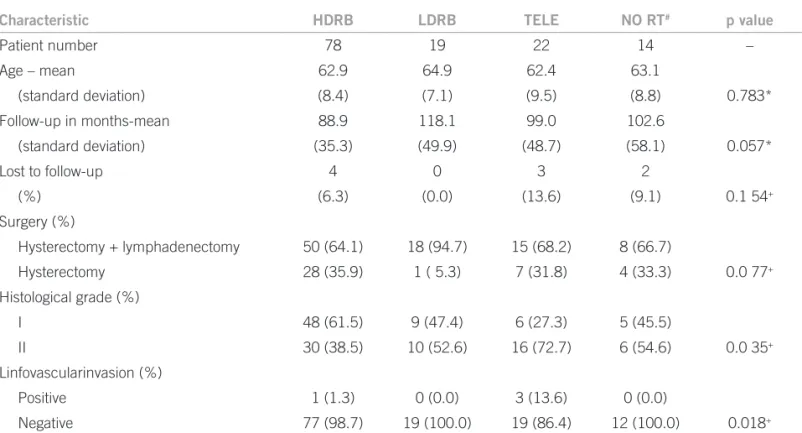
his is a historical comparison between treatment regi-mens. Between 1988 and 2004, 133 women with uter-ine endometrioid adenocarcinoma, FIGO stage IA (less than half myometrial invasion), histological grades 1 and 2, underwent surgery at the department of Gyne-cology and Obstetrics, School of Medicine, Universidade Estadual de Campinas, Campinas, Brazil. Before 1996, some of them received no adjuvant treatment, and oth-ers were submitted to teletherapy or LDRB. In 1996, with the introduction of HDRB, all patients received adjuvant HDRB. hese patients had a minimum follow-up of 5 years, and their treatment results were retrospectively evaluated, with progression-free survival, overall surviv-al and toxicity as endpoints. Table 1 summarizes patient characteristics.
he HDRB group with 78 patients and mean age 62.9 years was treated between 1996 and 2004 with Nucletron micro-Selectron HDRB with the largest vaginal cylinder possible. hey received ive weekly 7 Gy fractions, pre-scribed to 0.5 cm of the applicators, 4 cm length, total dose of 35 Gy. his fractioning regimen was calculated based on Dale radiobiological equations11.Bladder and rectum
doses were not calculated.
he LDRB group, with 19 patients and a mean age 64.9 years was treated between 1992 and 1995, received one in-sertion of LDRB, with Cesium 137, in vaginal vault, receiv-ing a dose of 60 Gy at the cilinder, in the upper two thirds of vaginal cuf length.
Table 1 – Patient characteristics according to treatment group
Characteristic HDRB LDRB TELE NO RT# p value
Patient number 78 19 22 14 –
Age – mean 62.9 64.9 62.4 63.1
(standard deviation) (8.4) (7.1) (9.5) (8.8) 0.783*
Follow-up in months-mean 88.9 118.1 99.0 102.6
(standard deviation) (35.3) (49.9) (48.7) (58.1) 0.057*
Lost to follow-up 4 0 3 2
(%) (6.3) (0.0) (13.6) (9.1) 0.1 54+
Surgery (%)
Hysterectomy + lymphadenectomy 50 (64.1) 18 (94.7) 15 (68.2) 8 (66.7)
Hysterectomy 28 (35.9) 1 ( 5.3) 7 (31.8) 4 (33.3) 0.0 77+
Histological grade (%)
I 48 (61.5) 9 (47.4) 6 (27.3) 5 (45.5)
II 30 (38.5) 10 (52.6) 16 (72.7) 6 (54.6) 0.0 35+
Linfovascularinvasion (%)
Positive 1 (1.3) 0 (0.0) 3 (13.6) 0 (0.0)
Negative 77 (98.7) 19 (100.0) 19 (86.4) 12 (100.0) 0.018+
Teletherapy group, 22 patients with a mean age 62.4 years, was treated between 1988 and 1996, with pho-ton beam energy in a 10 MV megavoltage linear accelera-tor, using the four-ield technique. Anteroposterior superi-or bsuperi-orders ields were between L4 and L5, inferisuperi-or bsuperi-orders at the obturator foramen and lateral limits were 1.5 cm lateral to pelvic brim. Lateral ields had anterior borders at the pubic symphysis, and posterior borders between S2 and S3. Doses ranged from 45 to 52.2 Gy (mean: 46.2 Gy), in daily 1.8-2 Gy, fractions 5 times a week.
NO RT group, with 14 patients, mean age 63.1 years, operated between 1990 and 1996, had no adjuvant radio-therapy.
FOLLOW-UPANDSTATISTICALANALYSIS
Ater treatment, patients were reassessed every four months during the irst two years, every six months un-til the ith year, and annually thereater, on the basis of clinical examination, oncotic colpocytology, pelvic ultra-sound and laboratory tests. hey were followed up for at least ive years. Overall survival (OS) time was measured from the date of surgery to the date of death or the most recent follow-up, progression free survival (PFS) as period from time of surgery to date of irst documented evidence of progressive disease. Treatment toxicity was graded ac-cording to toxicity criteria of the radiation therapy oncol-ogy group (RTOG)12.
he Kaplan-Meier method was used to generate sur-vival curves to compare treatment results. A Log-Rank test was used to analyze the results. Patients without recurrent disease were censored at their last follow-up visit or death. For all statistical tests, p < 0.05 was considered signiicant. All statistical analyses were performed using SPSS sot-ware (version 11.01. for windows) Leadtoolsq 1991-2000 LEAD Technologies Inc.
his study was reviewed and approved by the research ethics committee of the institution.
RESULTS
Table 2 shows the patients status by treatment group, at the end of follow-up. he 5-year disease-free survival was 94.6% for HDRB group, 94.1% for LDRB group, 100% for TELE group and 100% for the NO RT group (p = 0.681).
he 5-year overall survival was 86.7% for the HDRB group, 89.5% for the LDRB group, 89.9% for the TELE group and 90.1% for the NO RT group.
Toxicity was described using the criteria of the Radia-tion therapy oncology group (RTOG)12. Grades 1 and 2
radiotherapy-related late toxicity was 18% for HDRB group, 10.5% for the LDRB group, and 1% for the TELE group. Grades 3-5 late toxicity did not occur in HDRB group, but was 5.3% in LDRB group and 27.3% for the TELE group (p < 0.001). here was no signiicant statistical relation between lymphadenectomy and higher toxicity, and the worsening of severe toxicity was related to radiation dose above 45 Gy (p < 0.001). Table 3 reports toxicity details.
According to Cox, acute lower G.I. toxicity, includ-ing pelvis is graded as 0 when there is no change. Grade 1 with increased frequency or change in quality of bowel habits, not requiring medication, rectal discomfort not requiring analgesics. Grade 2, includes diarrhea requiring parasympatholytic drugs, mucous discharge not necessi-tating sanitary pads, rectal or abdominal pain requiring analgesics. Grade 3 diarrhea requiring parenteral support, severe mucous or blood discharge necessitating sanitary pads, abdominal distention. Grade 4, acute or subacute obstruction, istula or perforation, GI bleeding requiring transfusion, abdominal pain or tenesmus requiring tube decompression or bowel diversion. Grade 5, death related to radiation efects.
he acute genitourinary toxicity is graded as 0, when there is no change. Grade 1, frequency of urination or noc-turia, twice pretreatment habit, dysuria, urgency not requir-ing medication. Grade 2, frequency of urination or noctu-ria, that is less frequent than every hour. Dysunoctu-ria, urgency, bladder spasm requiring local anesthetic. Grade 3, frequen-cy with urgenfrequen-cy and nocturia hourly or more frequently, dysuria, pelvis pain or bladder spasm requiring regular, frequent narcotic/gross hematuria with or without clot pas-sage. Grade 4, hematuria requiring transfusion, acute blad-der obstruction not secondary to clot passage, ulceration, or necrosis. Grade 5, death related to radiation efects.
Cronic GI toxicity, grade 0 no change. Grade 1 mild diarrhea; mild cramping; bowel movement 5 times dai-ly; slight rectal discharge or bleeding. Grade 2, moder-ate diarrhea and colic; bowel movement > 5 times daily;
Table 2 – Survival and estimated relative risks by treatment group
Treatment Patients
(n)
OS+ (%)
at 5 years
Hazards ratio* (95% Cl)
DFS# (%)
at 5 years
Hazards ratio* (95% Cl)
HDRB 78 86.7 1.0 94.6 1.0
LDRB 19 89.5 0.8 (0.2-3.8) 94.1 0.5 (0.6-4.3)
TELE 22 89.9 0.8 (0.2-3.6) 100.0 0.5 (0.7-3.7)
excessive rectal mucus or intermittent bleeding. Grade 3, obstruction or bleeding, requiring surgery. Grade 4 ne-crosis, perforation and istula. Grade 5, death related to radiation efects.
Cronic genitourinary toxicity is grade 0 when there is no change. Grade 1 slight epithelial atrophy; minor tel-angiectasia (microscopic hematuria). Grade 2 moderate frequency; generalized telangiectasia; intermittent mac-roscopic hematuria. Grade 3 severe frequency and dys-uria, frequent hematuria; reduction in bladder capacity (< 150 cc). Grade 4, necrosis, contracted bladder (capac-ity < 100 cc), severe hemorrhagic cystitis. Grade 5, death related to radiation efects12.
DISCUSSION
he current study used a time-series design to evaluate outcomes and toxicity in adjuvant treatment for FIGO stage IA endometrial adenocarcinoma, histological grades 1 and 2. here was no diference in DFS and OS for the diferent radiotherapy regimens, even when compared to no radiotherapy at all.
Aalders et al.13 published a randomized study with
540 patients, FIGO old stages IB and IC, including IB, histological grade 114. he patients were operated without
lymphadenectomy and received low dose rate brachy-therapy in vaginal vault, dose of 6,000 cGy, then random-ized into two groups: observation and pelvic teletherapy, dose of 4,000 cGy. In a 3 to 10 years follow-up, the group that received teletherapy showed lower pelvic and vaginal recurrence (1.9 x 6.9%, p < 0.01) but no improvement in overall survival.
he PORTEC study15 included 715 patients with stage I,
from 19 radiotherapy centers. hey were submitted to sur-gery, without lymphadenectomy, but with palpation and biopsy of suspicious nodes. Ater the surgery, they were randomized between adjuvant teletherapy with 4,600 cGy or no other treatment. In a median follow-up of 52 months, there was a signiicant reduction of local recur-rence in ive years (4% x 14%, p < 0.001), but worsening toxicity. here was no signiicant diference in survival at ive years (81% x 85%, p = 0.31)16. Data of this study was
updated to a mean 94 months follow-up, with local recur-rence at 10 years of 5% in the group with radiotherapy and 14% in the group without radiotherapy (p < 0.0001) and overall survival at 10 years of 66% for radiotherapy group and 73% for the group without radiotherapy (p = 0.09), showing again the radiation inluence on local control, but without impact on overall survival, even excluding the pa-tients stage IA grade 1 ater pathological review.
he GOG 9917 study included 448 women with old
FIGO stages IB, IC and II (occult disease), and 392 (88%) were considered eligible. he surgery included pelvic and para-aortic lymphadenectomy, and subsequent ran-domization to teletherapy with 5,040 cGy to pelvis or no other additional treatment. With a mean follow-up of 68 months, the group submitted to external radiotherapy had a reduction in recurrence risk by 58% (p = 0.007). he estimated survival at four years for the control group was 86% and 92% for the group that received radiother-apy. his improvement in survival did not reach statisti-cal signiicance (p = 0.557). he authors concluded that radiotherapy reduces the risk of recurrence, but should Table 3 – Radiation toxicity by treatment group
Characteristic HDRB LDRB TELE p value*
Acute toxicity (%) 0.239
Absent 66 (84.6) 18 (94.7) 21 (95.4)
Grades 1-2+ 12 (15.4) 1 (5.3) 1 (4.6)
Acute toxicity organs (%) 0.153
Gastrointestinal 0 (0.0) 0 (0.0) 1 (4.6)
Bladder 8 (10.3) 1 (5.3) 0 (0.0)
Vagina 4 (5.1) 0 (0.0) 0 (0.0)
Late toxicity (%) < 0.001
Absent 64 (82.0) 16 (84.2) 15 (68.2)
Grades 1-2+ 14 (18.0) 2 (10.5) 1 (4.6)
Grades 3-5+ 0 (0.0) 1 (5.3) 6 (27.3)
Late toxicity organs (%)
Gastrointestinal 10 (12.8) 1 (5.3) 5 (23.0)
Bladder 1 (1-3) 2 (10.5) 1 (4.6)
Vagina 3 (3.9) 0 (0.0) 1 (4.6) 0.384
be used only in women aged more than 70 years, in tu-mors with linfovascular invasion, stage IC14, histological
grades 2 and 3.
Our series failed to show an association between the diferent adjuvant radiotherapy techniques and improve-ment in local control or overall survival. An important point to note is that patients included in our study had better prognostic factors than those described in the pa-pers cited above. herefore, the measurement of a ben-eit, if any, may require a much larger number of women to be included, and perhaps a longer follow-up is needed. Actually, this study had no statistical power to compare these outcomes, due to the very low number of events.
Regarding toxicity, Piver and Hempling7 reported that
among 92 patients treated with low dose rate brachyther-apy, 1% had severe toxicity, and of 41 submitted to tele-therapy, 9% had severe toxicity. Cengiz et al.4 described
9% of grade 3-4 toxicities with teletherapy in 78 patients and no cases of grade 3-4 toxicity in 31 women treated with low and high dose rate brachytherapy. Aalders et al.13 found that, among 540 patients, two of the
brachy-therapy group had grades 3-4 complications, and three of the teletherapy group had grades 3-4 complications. he PORTEC study16 described 2% of grades 3-4 toxicity
in the teletherapy group, with 354 women and the GOG 9917described 5% of grades 3-4 toxicity in the group of
190 women subjected to external radiotherapy.
In the present study, grades 3-5 toxicity was 27% in the teletherapy group, markedly higher than in the other groups, even higher than in the literature. he patients who did not receive radiotherapy had the best prognos-tic factors, and therefore had no postoperative treatment. he teletherapy group had worse prognostic factors, what induced more aggressive intervention to these patients. his historic comparison is very important, because it shows progressive changes, during time, in the adjuvant radiotherapy magnitude, always based in retrospectives studies. In our series, the more aggressive treatment led to a worse outcome, due the higher toxicity of telether-apy, therefore, contraindicated for these patients. here was no signiicant statistical relation between lymphad-enectomy and higher toxicity, in this series.
Several authors agree on the adjuvant radiotherapy in-dication for the old FIGO stage IB and grade 3 subgroup, giving preference to teletherapy in these cases10,15-19.
De-spite the prevalence of this disease, there is no consensus for the adjuvance of cancer of the endometrium stage IA, histological grades 1 and 2 patients, due to the lack of randomized studies. he indings of the PORTEC16 and
GOG 9917 studies showed that most recurrences of
ini-tial tumors were limited to vagina, which, added to low toxicity of this treatment, encourages the use of adjuvant brachytherapy in these cases, but still without strong evi-dence in the literature.
REFERENCES
1. Pecorelli S. Revised FIGO staging for carcinoma of the vulva, cervix, and endometrium. Int J Gynaecol Obstet 2009;105(2):103-4. Erra-tum in: Int J Gynaecol Obstet 2010;108(2):176.
2. Greven KM, D’Agostino RB Jr, Lanciano RM, Corn BW. Is there a role for a brachytherapy vaginal cuf boost in the adjuvant manage-ment of patients withuterine-conined endometrial cancer? Int J Ra-diat Oncol Biol Phys 1998;42(1):101-4.
3. Karolewski K, Kojs Z, Urbański K, Jakubowicz J, Blecharz P, Dymek
P et al. he eiciency of treatment in patients with uterine-conined
endometrial cancer. Eur J Gynaecol Oncol 2006;27(6):579-84. 4. Cengiz M, Singh AK, Grigsby PW. Postoperative vaginal
brachyther-apy aloneis the treatment of choice for grade 1-2, stage IC endome-trial cancer. Int J Gynecol Cancer 2005;15(5):926-31.
5. Lin LL, Mutch DG, Rader JS, Powell MA, Grigsby PW. External ra-diotherapy versus vaginal brachytherapy for patients with intermedi-ate risk endometrial cancer. Gynecol Oncol 2007;106(1):215-20. 6. Charra-Brunaud C, Peifert D, Hofstetter S, Luporsi E, Guillemin F,
Bey P. Low-dose postoperative vaginal brachytherapy of adenocarci-noma of theendometrium. Cancer Radiother 1998;2(1):34-41. 7. Piver MS, Hempling RE. A prospective trial of postoperative
vagi-nal radium/cesium for grade 1-2 less than 50% myometrial inva-sion and pelvic radiation therapy for grade 3 or deep myometrial invasion in surgical stage Iendometrial adenocarcinoma. Cancer 1990;66(6):1133-8.
8. Straughn JM Jr, Huh WK, Kelly FJ, Leath CA 3rd, Kleinberg MJ, Hyde J Jr et al. Conservative management of stage I endometrial car-cinoma ater surgical staging. Gynecol Oncol 2002;84(2):194-200. 9. Papanikolaou A, Kalogiannidis I, Goutzioulis M, Misailidou D,
Makedos A, Vergote I et al. Pelvic lymphadenectomy as alternative to postoperative radiotherapy in high risk early stage endometrial cancer. Arch Gynecol Obstet 2006;274(2):91-6.
10. Kong A, Johnson N, Cornes P, Simera I, Collingwood M, Williams C, Kitchener H. Adjuvant radiotherapy for stage I endometrial cancer. Cochrane Database Syst Rev. 2007;(2):CD003916.
11. Dale RG. he use of small fraction numbers in high dose-rate gyn-aecological aterloading: some radiobiological considerations. Br J Radiol 1990;63(748):290-4.
12. Cox JD, Stetz J, Pajak TF. Toxicity criteria of the Radiation herapy Oncology Group (RTOG) and the European Organization for Re-search and Treatment of Cancer (EORTC). Int J Radiat Oncol Biol Phys 1995;31(5):134-46.
13. Aalders J, Abeler V, Kolstad P, Onsurd M. Postoperative external irradiation and prognostic parameters in stage I endometrial car-cinoma: clinical and histopathologic study of 540 patients. Obstet Gynecol 1980;56(4):419-27.
14. Benedet JL, Bender H, Jones H 3rd, Ngan HY, Pecorelli S. FIGO stag-ing classiications and clinical practice guidelines in the management of gynecologic cancers. FIGO Committee on Gynecologic Oncology. Int J Gynaecol Obstet 2000;70(2):209-62.
15. Scholten AN, van Putten WL, Beerman H, Smit VT, Koper PC, Lybeert ML et al. Postoperative radiotherapy for Stage 1 endome-trial carcinoma: long term outcome of the randomized PORTEC trial with central pathology review. Int J Radiat Oncol Biol Phys 2005;63(3):834-8.
16. Creutzberg CL, Van Putten WL, Koper PC, Lybeert ML, Jobsen JJ, Wárlám-Rodenhuis CC et al. Surgery and postoperative radio-therapy versus surgery alone for patients with stage-1 endometrial carcinoma: multicentre randomized trial. PORTEC Study Group. Post operative radiation therapy in endometrial carcinoma. Lancet 2000;355(9213):1404-11.
17. Keys HM, Roberts JA, Brunetto VL, Zaino RJ, Spirtos NM, Bloss JD et al. A phase III trial of surgery with or without adjunctive external pelvic radiation therapy in intermediate risk endometrial adeno-carcinoma: a Gynecologic Oncology Group study. Gynecol Oncol 2004;92(3):744-51.
18. Lukka H, Chambers A, Fyles A, hephamongkhol K, Fung-Kee-Fung M, Elit L et al. Adjuvant radiotherapy in women with stage I endome-trial cancer: a systematic review. Gynecol Oncol 2006;102(2):361-8. 19. Kong A, Powell M, Blake P. he role of postoperative radiotherapy in