ww w . r e u m a t o l o g i a . c o m . b r
REVISTA
BRASILEIRA
DE
REUMATOLOGIA
Review
article
Prevalence
of
fibromyalgia:
literature
review
update
Amelia
Pasqual
Marques,
Adriana
de
Sousa
do
Espírito
Santo,
Ana
Assumpc¸ão
Berssaneti,
Luciana
Akemi
Matsutani,
Susan
Lee
King
Yuan
∗UniversidadedeSãoPaulo(USP),FaculdadedeMedicina,DepartamentodeFisioterapia,FonoaudiologiaeTerapiaOcupacional,São Paulo,SP,Brazil
a
r
t
i
c
l
e
i
n
f
o
Articlehistory:
Received29March2016 Accepted25October2016 Availableonline8February2017
Keywords:
Fibromyalgia Prevalence Review
Rheumaticdiseases Chronicpain
a
b
s
t
r
a
c
t
Thepresentstudyaimedtoupdatetheliteraturereviewontheprevalenceoffibromyalgia publishedin2006.Abibliographicalsurveywascarriedoutfrom2005to2014intheMEDLINE, WebofScience,Embase,LILACSandSciELOdatabasesand3274recordswereidentified. Fiveresearchersselectedthestudies,followingtheinclusioncriteria:studiesthatobtained theprevalenceoffibromyalgia.Fibromyalgiastudiesinassociateddiseaseswereexcluded. Whenscreeningbytitleandabstract,2073irrelevantarticleswereexcluded.Thefulltextsof 210articleswereevaluatedforeligibilityandthisreviewincluded39studies,describedin41 articles.Theselectedstudiesweregroupedintofourcategories:(A)prevalenceof fibromyal-giainthegeneralpopulation;(B)prevalenceoffibromyalgiainwomen;(C)prevalenceof fibromyalgiainruralandurbanareas;(D)prevalenceoffibromyalgiainspecialpopulations. Theliteratureshowsvaluesoffibromyalgiaprevalenceinthegeneralpopulationbetween 0.2and6.6%,inwomenbetween2.4and6.8%,inurbanareasbetween0.7and11.4%,in ruralareasbetween0.1and5.2%,andinspecialpopulationsvaluesbetween0.6and15%. Thisliteraturereviewupdateshowsasignificantincreaseinfibromyalgiaprevalence stud-iesintheworld.Thenew2010AmericanCollegeofRheumatologycriteriahavenotbeen widelyusedyetandtheCOPCORD(Community-orientedprogramforcontrolofRheumatic Diseases)methodologyhasincreasedthequalityofstudiesontheprevalenceofrheumatic diseasesingeneral.
©2017ElsevierEditoraLtda.ThisisanopenaccessarticleundertheCCBY-NC-ND license(http://creativecommons.org/licenses/by-nc-nd/4.0/).
∗ Correspondingauthor.
E-mail:[email protected](S.L.Yuan).
http://dx.doi.org/10.1016/j.rbre.2017.01.005
A
prevalência
de
fibromialgia:
atualizac¸ão
da
revisão
de
literatura
Palavras-chave:
Fibromialgia Prevalência Revisão
Doenc¸asreumáticas Dorcrônica
r
e
s
u
m
o
Opresenteestudotevecomoobjetivoatualizararevisãodeliteraturasobreaprevalênciada fibromialgiapublicadaem2006.Foirealizadolevantamentobibliográficodoperíodode2005 a2014nasbasesdedadosMEDLINE,WebofScience,Embase,LILACSeSciELO, identificando-se3274registros.Cincopesquisadoresselecionaramosestudos,deacordocomoscritérios deinclusão:estudosqueobtiveramaprevalênciadafibromialgia.Foramexcluídos estu-dosdafibromialgiaemdoenc¸as.Natriagempelotítuloeresumo, foramexcluídos2073 artigosirrelevantes.Foramavaliadosquantoàelegibilidadeostextoscompletosde210 arti-gos,incluindo-senestarevisão39estudos,descritosem41artigos.Osestudosselecionados foramagrupadosemquatro categorias:a)prevalênciadafibromialgianapopulac¸ãoem geral;b)prevalênciadafibromialgiaemmulheres;c)prevalênciadafibromialgiaemáreas ruraiseurbanas;d)prevalênciadafibromialgiaempopulac¸õesespeciais.Aliteraturaaponta valoresdeprevalênciadafibromialgianapopulac¸ãoemgeralentre0,2e6,6%,emmulheres valoresentre2,4e6,8%,nasáreasurbanasentre0,7e11,4%,nasruraisentre0,1e5,2%, eem populac¸õesespeciaisvaloresentre0,6e15%.Estaatualizac¸ãoderevisãode liter-aturamostraumaumentoexpressivodeestudosdeprevalênciadafibromialgiaaoredor domundo.OsnovoscritériosdoColégioAmericanodeReumatologiade2010foramainda poucoutilizadoseametodologiaCOPCORD(ProgramaOrientadoparaaComunidadepara ControledeDoenc¸asReumáticas)aumentouaqualidadedosestudosdeprevalênciade doenc¸asreumáticasemgeral.
©2017ElsevierEditoraLtda.Este ´eumartigoOpenAccesssobumalicenc¸aCC BY-NC-ND(http://creativecommons.org/licenses/by-nc-nd/4.0/).
Introduction
Fibromyalgia(FM)isachronicpainsyndromewithacomplex, multifactorial and not completely known etiopathogenesis that affects mainly women, being characterized by gener-alized musculoskeletal pain and palpation-specific tender points,oftenassociatedwithsleepdisorders,fatigue,somatic andcognitivesymptoms,aswellaspsychicdisorders.1,2
WepublishedourfirstliteraturereviewonFMprevalence in2006,intheBrazilianJournalofRheumatology.3Duringthe
periodof1990–2005, theFMprevalencefoundinthe popu-lationrangedbetween0.7and4.4%,beingmoreprevalentin womenthan inmen.Itwaspossibletoconstructfive cate-goriesaccordingtostudysimilaritypatterns:prevalenceofFM inadultpopulations;prevalenceofFMinwomen;prevalence ofFMinchildrenandadolescents;prevalenceofFMinspecific populationsand;prevalenceofchronicanddiffusepaininthe population,accordingtotheAmericanCollegeof Rheumato-logy(ACR)criteriaof1990.4Weobservedthatmoreprevalence
studieswerenecessary.
Afteralmostadecade,itisnecessarytoupdatethe litera-turereviewonFMprevalence,aimingtoknowthenewstudies onthistopic,especiallyafterthepublicationin2010ofthenew ACRfibromyalgiadiagnosticcriteria.2
Methods
Thisliteraturereviewupdatewascarriedout withan elec-tronicsearchintheMEDLINE,LILACS,Embase,WebofScience
andSciELOdatabases,from2005to2014.Thekeywordsused were “fibromyalgia” and “prevalence” and the correspond-ingwordsinPortuguese,“fibromialgia”and“prevalência”.A searchwasalsocarriedoutbasedonthelistofpublications availableonthewebsiteoftheCommunity-OrientedProgram forControlofRheumaticDiseases’(COPCORD),aninitiativeof theInternationalLeagueofRheumatologyAssociations.
Atotalof3274articleswerefound,and992wereexcluded, astheywereduplicates.Fivephysicaltherapistswithclinical and research experience infibromyalgia selectedthe stud-iesaccordingtotheinclusioncriteria:cross-sectionalstudies that obtainedthe prevalenceoffibromyalgiainthegeneral populationandinspecificpopulations,forinstance,women, children, adolescents and the elderly. Theexclusion crite-rionwasstudiesthatobtainedtheprevalenceoffibromyalgia associatedwithotherdiseases.Whenscreeningbytitleand abstract,2073articleswereexcludedfromthisreview.Thefull textsof210articleswereassessedforeligibility.Attheend, 39studies,described in41articles(Fig.1),wereincludedin thisreview.
Eachresearchercarried out the selectionprocess ofthe studiesindividuallyandtwomeetingswereheld:oneafterthe screeningandanotherafterapplyingtheeligibilitycriteriato jointlydefinethearticlestobeincluded.
Records after removal of duplicates (n=2282) Records identified at the electronic search (n=3273)
Additional records identified from other sources (n=1)
Full-text articles evaluated regarding eligibility (n=210)
Full-text articles included (n=41)
Studies included in the qualitative synthesis (n=39)
Records excluded after screening (n=2073)
Unavailable full-text articles (n=3)
Excluded articles (n=166) SciELO (n=33)
WOS (n=1036) LILACS (n=45)
Embase (n=1189) MEDLINE (n=970)
Fig.1–Flowchartoftheselectionoffibromyalgiaprevalencestudies.
(ofoverall FMprevalence,partialandstratified);Discussion (limitations);Contact(email).
Results
and
discussion
Inthisupdatedsearch,therewasasignificantincreaseinFM prevalencestudies,asweobtainedmorethantwicethe num-berofstudiesincludedinthefirstreview.3Onlyfourrecent
studies used the new 2010 ACR diagnostic criteria and/or itsmodifiedversionforepidemiologicalstudies.5–8Intwelve
studies, the method used was based on the standardized
high-qualityprotocolanddesignrecommendedbyCOPCORD (Fig.2).9–20
The selected articles were carefully grouped into four categories: (A) prevalence of FM in the general popula-tion; (B) prevalenceofFMin women; (C)prevalenceofFM in rural and urban areas; (D) prevalence of FM in special populations.
Prevalenceoffibromyalgiainthegeneralpopulation
InthecategoryPrevalenceofFibromyalgiaintheGeneral Pop-ulation,19articleswerefound.Ofthese,tworeportedonthe prevalenceinNorthAmerica,oneinCentralAmerica,twoin
BRA: 2.0%
VEN: 0.2%
CUB: 0.2% MEX: 0.7–0.8%
SPA: 2.3–2.4% FRA: 1.4–5.4%
SCO: 1.2–5.4% HOL: 1.3%
GER: 0.5–5.8% ITA: 2.2–6.6%
TUR: 8.8%
LEB : 1.0%
IND: 0.05%
MAL: 0.9% CHI: 0.8%
JAP: 2.1% IRA: 2.3%
USA: 1.1–6.4% POR: 3.6%
Table1–Prevalenceoffibromyalgiainthegeneralpopulation.
Reference Country Sample FMdiagnosticcriteria Prevalence
Salaffi(2005)21 Italy n=3664
>18years
ACR1990 2.22%
Scudds(2006)22 China n=1467
18–65years
ACR1990 0.82%
Veerapen(2007)14 Malaysia n=2594
>15years
Unspecified Overall:0.92%
F:0.8%/M:0.08%
Loza(2008)23 Spain n=2192
>20years
ACR1990 2.4%
Reyes-Llerena(2009)13 Cuba n=3155 Unspecified 0.22%
Branco(2010)24,25 France,Italy,Germany,
SpainandPortugal
n=4517 >15years
LFESSQ-4andLFESSQ-6 LFESSQ-4:4.7%
LFESSQ-6:2.9%
Creavin(2010)26 Netherlands n=2447
>18years
Self-report 1.3%
Sauer(2010)27 Germany n=1.646.284 CID-10:M79.7indatabases Overall:0.45%
F:0.4%/M:0.05% Peláez-Ballestas
(2011)12,28
Mexico n=19,213
>18years
ACR1990 Overall:0.68%
F:1%/M:0.34%
Perrot(2011)29 France n=3326
>18years
LFESSQandACR1990 1.6%
Chaaya(2012)9 Lebanon n=3530
15–90years
ACR1990 Overall:1%
F:2%/M:0%
Goren(2012)30 Brazil n=12,000
>18years
Self-report 2%
Jones(2013)5 Scotland n=1604
>25years
ACR1990,ACR2010and modifiedACR2010
ACR1990:1.7%/ACR2010:1.2% ACR2010mod:5.4%
Sandoughi(2013)11 Iran n=2700
>15years
Unspecified Overall:2.31%
F:3.66%/M:0.9%
Vincent(2013)7 USA n=2994
>21years
ModifiedACR2010 6.4%
Wolfe(2013)8 Germany n=2515
≥15years
ModifiedACR2010 2.1%
Granados(2014)10 Venezuela n=3973
>18years
ACR1990 0.2%
Nakamura(2014)6 Japan n=20,407
>20years
ACR2010 2.1%
FM,fibromyalgia;ACR,AmericanCollegeofRheumatology;LFESSQ,TheLondonFibromyalgiaEpidemiologyStudyScreeningQuestionnaire;F, female;M,male.
SouthAmerica,eightinEuropeandfiveinAsia.Thelowest overallprevalencewas0.2%inVenezuela,10andthehighest
was6.4%intheUnitedStates.7Thehighestprevalencevalues
werefoundintwoarticlesthatusedthemodifiedACR crite-riaof2010:6.4%inaprevalencestudyinaspecificregionof theUnitedStates7and5.4%inastudyinScotland.5Overall,
excludingthesestudies,prevalencerangedfrom0.2%to4.7% (Table1).
Prevalenceoffibromyalgiainwomen
FMiscommonlymoreprevalentamongwomen.31The
preva-lence of FM in studies carried out in the adult female populationrangedbetween2.4%and6.8%.Fourstudieswere found,halfofthemfromTurkey32,33andtheotherhalffrom
Norway.34,35 BotharticlesontheTurkishpopulationstudied
samplesofwomenfromthesamecity ofTrabzon.Thetwo articlesontheNorwegianpopulationarebasedondatafroma largehealthcarestudycarriedoutintheNord-Trøndelag dis-trict,withseveralcharacteristicsofwomenresiding inthat district,inadditiontoFM.Possibly,forthisreason,the preva-lencevalueswereclose(2.4%and2.6%).
Themethodologicaldifferenceofthestudieswasthe cri-terionusedtoidentifyFM.IntheNorwegianstudies,women wereaskedwhethertheyhadeverbeendiagnosedwithFM. InTurkey,womenwereevaluatedbyaresearcherphysician followingthe 1990ACRcriteria atthetime ofthe research (Table2).
Prevalenceoffibromyalgiainurbanandruralareas
Sincetheacknowledgmentofthefibromyalgiasyndrometo thepresentday,oneofthequestionsofthescientific commu-nityistheunderstandingoffactorsthatareimplicatedinits onset.36Socio-economic-culturalfactorsarebelievedtohave
aninfluenceonitsprevalence.37Inthisrespect,someauthors
havechosenadivisionregardingwherepeoplelive:urbanand ruralareas.
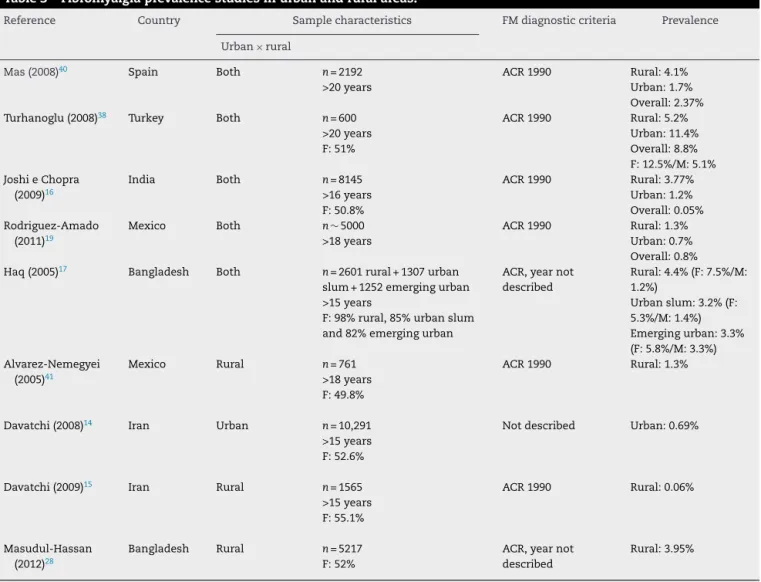
Amongthenineselectedstudies,sixshowed geographi-calproximity(Iran,15,18Turkey,38India,16Bangladesh17,39),and
fiveofthemusedtheCOPCORDmethodology.15–19
Table2–Prevalenceoffibromyalgiainwomen.
Reference Country Sample FMdiagnosticcriteria Prevalence
Topbas(2005)32 Turkey n=1930
20–64years
ACR1990 3.6%
Cakirbay(2006)33 Turkey n=1045
18–55years
ACR1990 6.8%
Mork(2010)34 Norway n=15,990
>20years
Self-reportofmedicaldiagnosis 2.4%
MorkeNilsen(2012)35 Norway n=12,350
>20years
Self-reportofmedicaldiagnosis 2.6%
FM,fibromyalgia;ACR,AmericanCollegeofRheumatology.
beatendencyfortheruralareatopresentahigherprevalence thantheurbanarea,especiallyinstudiesthatevaluatedboth regions.
Prevalenceoffibromyalgiainspecialpopulations
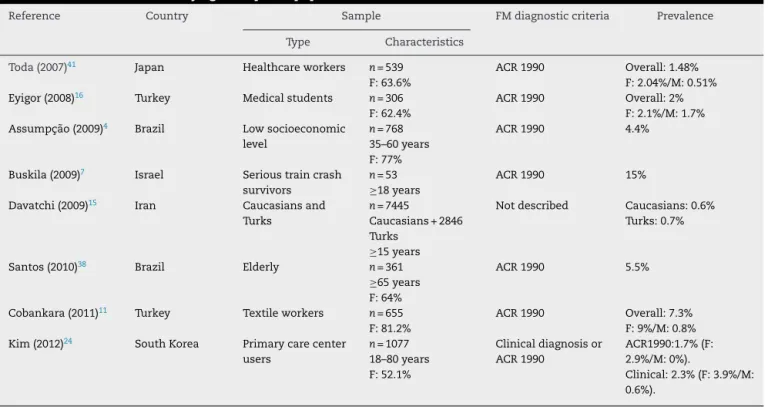
Table4showsthestudiesonfibromyalgiaprevalenceinspecial populations.Workersfromsevendifferenthealthinstitutions wereinvitedtoparticipateintheTodastudy,butthesampling
processwasnotclearlydescribed.Sevenwomenandonlyone manmettheFMclassificationcriterion.42
Eiygor et al. invited all 322 medical students from the School ofMedicine of Ege University to participate in the study,ofwhich11refusedtoparticipateand5wereexcluded. SixsubjectsmettheFMclassificationcriteria,withaslightly higherprevalenceinwomenthanmen.43
Assumpc¸ãoetal.recruitedbytelephonesubjectsfromalist of2269registeredusersofbasichealthunitsthathadacontact
Table3–Fibromyalgiaprevalencestudiesinurbanandruralareas.
Reference Country Samplecharacteristics FMdiagnosticcriteria Prevalence
Urban×rural
Mas(2008)40 Spain Both n=2192
>20years
ACR1990 Rural:4.1%
Urban:1.7% Overall:2.37%
Turhanoglu(2008)38 Turkey Both n=600
>20years F:51%
ACR1990 Rural:5.2%
Urban:11.4% Overall:8.8% F:12.5%/M:5.1% JoshieChopra
(2009)16
India Both n=8145
>16years F:50.8%
ACR1990 Rural:3.77%
Urban:1.2% Overall:0.05% Rodriguez-Amado
(2011)19
Mexico Both n∼5000
>18years
ACR1990 Rural:1.3%
Urban:0.7% Overall:0.8%
Haq(2005)17 Bangladesh Both n=2601rural+1307urban
slum+1252emergingurban >15years
F:98%rural,85%urbanslum and82%emergingurban
ACR,yearnot described
Rural:4.4%(F:7.5%/M: 1.2%)
Urbanslum:3.2%(F: 5.3%/M:1.4%) Emergingurban:3.3% (F:5.8%/M:3.3%) Alvarez-Nemegyei
(2005)41
Mexico Rural n=761
>18years F:49.8%
ACR1990 Rural:1.3%
Davatchi(2008)14 Iran Urban n=10,291
>15years F:52.6%
Notdescribed Urban:0.69%
Davatchi(2009)15 Iran Rural n=1565
>15years F:55.1%
ACR1990 Rural:0.06%
Masudul-Hassan (2012)28
Bangladesh Rural n=5217
F:52%
ACR,yearnot described
Rural:3.95%
Table4–Prevalenceoffibromyalgiainspecialpopulations.
Reference Country Sample FMdiagnosticcriteria Prevalence
Type Characteristics
Toda(2007)41 Japan Healthcareworkers n=539
F:63.6%
ACR1990 Overall:1.48%
F:2.04%/M:0.51%
Eyigor(2008)16 Turkey Medicalstudents n=306
F:62.4%
ACR1990 Overall:2%
F:2.1%/M:1.7%
Assumpc¸ão(2009)4 Brazil Lowsocioeconomic
level
n=768 35–60years F:77%
ACR1990 4.4%
Buskila(2009)7 Israel Serioustraincrash
survivors
n=53
≥18years
ACR1990 15%
Davatchi(2009)15 Iran Caucasiansand
Turks
n=7445
Caucasians+2846 Turks
≥15years
Notdescribed Caucasians:0.6%
Turks:0.7%
Santos(2010)38 Brazil Elderly n=361
≥65years
F:64%
ACR1990 5.5%
Cobankara(2011)11 Turkey Textileworkers n=655
F:81.2%
ACR1990 Overall:7.3%
F:9%/M:0.8%
Kim(2012)24 SouthKorea Primarycarecenter
users
n=1077 18–80years F:52.1%
Clinicaldiagnosisor ACR1990
ACR1990:1.7%(F: 2.9%/M:0%).
Clinical:2.3%(F:3.9%/M: 0.6%).
FM,fibromyalgia;ACR,AmericanCollegeofRheumatology;F,female;M,male.
telephonenumberinthecityofEmbudasArtes,stateofSao Paulo,Brazil.Ofthenon-probabilisticsampleof768contacted individuals,only304agreedtotheclinicalexamination.Based onaBayesiananalysis,a4.4%FMprevalencewasestimated usingthelargersample.44
In2008,Buskilaetal.sentmailinvitationsto153survivors ofthe2005traindisasterinIsrael,ofwhich115respondedand only53agreedtoparticipateinthestudy.Eightwomenmet theFMclassificationcriteria.45
Davatchietal.carriedoutthestudyin22districtsofTehran, followingthe COPCORD projectmethods. Of 10,291people interviewed,71.4% wereCaucasians and 23.1% were Turks. Therewasnostatisticallysignificantdifferencebetweenthe ethnicgroupsregardingtheprevalenceofFM.20
Basedonasamplecalculation, Santoset al.invited400 individuals(9 refusedto participateand 30 were excluded) fromasampleof2072subjectsfromthecross-sectionalstudy “SaoPauloAging&HealthStudy”,carriedoutwithallelderly residentsof66censussectorswiththelowestHuman Devel-opmentIndexesofthedistrictofButantã.Twentywomenmet theclassificationcriteriaintheFMprevalencestudy.46
Inapopulationof16,383textileworkersintheindustrial regionofthecityofDenizli,Cobankaraetal.neededtorecruit 585subjects,accordingtothesamplecalculation.Oftentextile mills,theyrandomlyselectedfourwith655workers,ofwhich nonerefusedtoparticipateinthestudy.Forty-eightsubjects withFMwerediagnosed,withtheprevalencebeinghigherin womenthaninmen.47
Kimet al.recruited all1158individuals who visitedthe FamilyMedicineCenteratKangbukSamsungHospitalfrom ApriltoMay2010.Thirty-fivesubjectsrefusedtoparticipate, while46wereexcluded,astheyrespondedinadequatelytothe evaluationquestionnaires.The1990ACRclassificationcriteria
weremetby18women,whileagreaternumberof25subjects (22womenand3men)were obtainedbasedontheclinical diagnosis.48
Theresultsofstudiesinwhichthesamplingprocedureor thecriteriausedforFMdiagnosiswerenotadequateshould beanalyzedwithcaution.Therateofrespondentsand non-respondents shouldbe described and bewithinacceptable valuestoconfirmthevalidityoftheprevalencedata.49
Practicalimplications
This reviewcan contributetothe implementation of diag-nosticguidelinesandrecommendationsforthetreatmentof fibromyalgia,updatinghealthprofessionals,aswellas stimu-latingfutureprevalencestudies.
Studylimitations
Thelimitations foundwere:inclusion ofarticleswrittenin PortugueseandEnglishonlyand,despiteattemptstocontact theauthors,threeoftheselectedarticlescouldnotbeincluded becausethefulltextcouldnotbefound.
Conclusion
COPCORDmethodologyincreasedthequalityofstudiesonthe prevalenceofrheumaticdiseasesingeneral.
Conflicts
of
interest
Theauthorsdeclarenoconflictsofinterest.
r
e
f
e
r
e
n
c
e
s
1. MartinezJE,editor.Fibromialgia–umaintroduc¸ão.SãoPaulo: EDUC;1998.
2. WolfeF,ClauwDJ,FitzcharlesMA,GoldenbergDL,KatzRS, MeaseP,etal.TheAmericanCollegeofRheumatology preliminarydiagnosticcriteriaforfibromyalgiaand measurementofsymptomseverity.ArthritisCareRes. 2010;62:600–10.
3. CavalcanteAB,SauerJF,ChalotSD,AssumpcaoA,LageLV, MatsutaniLA,etal.Theprevalenceoffibromyalgia:a literaturereview.RevBrasReumatol.2006;46:40–8.
4. WolfeF,SmytheHA,YunusMB,BennettRM,BombardierC, GoldenbergDL,etal.TheAmericanCollegeofRheumatology 1990criteriafortheclassificationoffibromyalgia.Reportof themulticentercriteriacommittee.ArthritisRheum. 1990;33:160–72.
5. JonesGT,BeasleyM,AtzeniF,FlussE,Sarzi-PuttiniP, MacfarlaneG.Theprevalenceoffibromyalgiainthegeneral population–acomparisonoftheACR1990,2010andmodified 2010classificationcriteria.ArthritisRheum.2013;65.S358–S.
6. NakamuraI,NishiokaK,UsuiC,OsadaK,IchibayashiH, IshidaM,etal.Anepidemiologicinternetsurveyof fibromyalgiaandchronicpaininJapan.ArthritisCareRes. 2014;66:1093–101.
7. VincentA,LahrBD,WolfeF,ClauwDJ,WhippleMO,OhTH, etal.Prevalenceoffibromyalgia:apopulation-basedstudyin OlmstedCounty,Minnesota,utilizingtheRochester
EpidemiologyProject.ArthritisCareRes(Hoboken). 2013;65:786–92.
8. WolfeF,BrahlerE,HinzA,HauserW.Fibromyalgia prevalence,somaticsymptomreporting,andthe
dimensionalityofpolysymptomaticdistress:resultsfroma surveyofthegeneralpopulation.ArthritisCareRes (Hoboken).2013;65:777–85.
9. ChaayaM,SlimZN,HabibRR,ArayssiT,DanaR,HamdanO, etal.HighburdenofrheumaticdiseasesinLebanon:a COPCORDstudy.IntJRheumDis.2012;15:136–43.
10.GranadosY,CedenoL,RosilloC,BerbinS,AzocarM,Molina ME,etal.Prevalenceofmusculoskeletaldisordersand rheumaticdiseasesinanurbancommunityinMonagasState, Venezuela:aCOPCORDstudy.ClinRheumatol.2015;34:871–7.
11.SandoughiM,ZakeriZ,TehraniBanihashemiA,DavatchiF, NarouieB,ShikhzadehA,etal.Prevalenceofmusculoskeletal disordersinsoutheasternIran:aWHO-ILARCOPCORDstudy (stage1,urbanstudy).IntJRheumDis.2013;16:509–17.
12.Pelaez-BallestasI,SaninLH,Moreno-MontoyaJ,
Alvarez-NemegyeiJ,Burgos-VargasR,Garza-ElizondoM,etal. EpidemiologyoftherheumaticdiseasesinMexico.Astudyof 5regionsbasedontheCOPCORDmethodology.JRheumatol Suppl.2011;86:3–8.
13.Reyes-LlerenaGA,Guibert-ToledanoM,Penedo-CoelloA, Perez-RodriguezA,Baez-DuenasRM,Charnicharo-VidalR, etal.Community-basedstudytoestimateprevalenceand burdenofillnessofrheumaticdiseasesinCuba:aCOPCORD study.JClinRheumatol.2009;15:51–5.
14.VeerapenK,WigleyRD,ValkenburgH.Musculoskeletalpain inMalaysia:aCOPCORDsurvey.JRheumatol.2007;34:207–13.
15.DavatchiF,BanihashemiAT,GholamiJ,FaeziST,Forouzanfar MH,SalesiM,etal.Theprevalenceofmusculoskeletal complaintsinaruralareainIran:aWHO-ILARCOPCORD study(stage1,ruralstudy)inIran.ClinRheumatol. 2009;28:1267–74.
16.JoshiVL,ChopraA.Isthereanurban-ruraldivide?Population surveysofrheumaticmusculoskeletaldisordersinthePune regionofIndiausingtheCOPCORDBhigwanmodel.J Rheumatol.2009;36:614–22.
17.HaqSA,DarmawanJ,IslamMN,UddinMZ,DasBB,RahmanF, etal.Prevalenceofrheumaticdiseasesandassociated outcomesinruralandurbancommunitiesinBangladesh:a COPCORDstudy.JRheumatol.2005;32:348–53.
18.DavatchiF,JamshidiAR,BanihashemiAT,GholamiJ, ForouzanfarMH,AkhlaghiM,etal.WHO-ILARCOPCORD study(stage1,urbanstudy)inIran.JRheumatol.2008;35:1384.
19.Rodriguez-AmadoJ,Pelaez-BallestasI,SaninLH,
Esquivel-ValerioJA,Burgos-VargasR,Perez-BarbosaL,etal. Epidemiologyofrheumaticdiseases.Acommunity-based studyinurbanandruralpopulationsinthestateofNuevo Leon,Mexico.JRheumatolSuppl.2011;86:9–14.
20.DavatchiF,JamshidiAR,TehraniBanihashemiA,GholamiJ, HosseinForouzanfarM,AkhlaghiM,etal.Effectofethnic origin(CaucasiansversusTurks)ontheprevalenceof rheumaticdiseases:aWHO-ILARCOPCORDurbanstudyin Iran.ClinRheumatol.2009;28:1275–82.
21.SalaffiF,DeAngelisR,GrassiW.Prevalenceof
musculoskeletalconditionsinanItalianpopulationsample: resultsofaregionalcommunity-basedstudy.I.TheMAPPING study.ClinExpRheumatol.2005;23:819–28.
22.ScuddsRA,LiEKM,ScuddsRJ.Theprevalenceoffibromyalgia syndromeinChinesepeopleinHongKong.JMusculoskelet Pain.2006;14:3–11.
23.LozaE,AbasoloL,JoverJA,CarmonaL,AretxabalaI,BallinaJ, etal.Burdenofdiseaseacrosschronicdiseases:ahealth surveythatmeasuredprevalence,function,andqualityof life.JRheumatol.2008;35:159–65.
24.BrancoJC,BannwarthB,FaildeI,AbelloCarbonellJ,Blotman F,SpaethM,etal.Prevalenceoffibromyalgia:asurveyinfive Europeancountries.SeminArthritisRheum.2010;39:448–53.
25.BannwarthB,BlotmanF,Roue-LeLayK,CaubereJP,AndreE, TaiebC.Fibromyalgiasyndromeinthegeneralpopulationof France:aprevalencestudy.JointBoneSpine.2009;76:184–7.
26.CreavinST,DunnKM,MallenCD,NijrolderI,vanderWindt DA.Co-occurrenceandassociationsofpainandfatigueina communitysampleofDutchadults.EurJPain.
2010;14:327–34.
27.SauerK,KemperC,GlaeskeG.Fibromyalgiasyndrome: prevalence,pharmacologicalandnon-pharmacological interventionsinoutpatienthealthcare.Ananalysisof statutoryhealthinsurancedata.JointBoneSpine. 2011;78:80–4.
28.Alvarez-NemegyeiJ,Pelaez-BallestasI,SaninLH,CardielMH, Ramirez-AnguloA,Goycochea-RoblesMV.Prevalenceof musculoskeletalpainandrheumaticdiseasesinthe southeasternregionofMexico.ACOPCORD-based communitysurvey.JRheumatolSuppl.2011;86:21–5.
29.PerrotS,VicautE,ServantD,RavaudP.Prevalenceof fibromyalgiainFrance:amulti-stepstudyresearch
combiningnationalscreeningandclinicalconfirmation:the DEFIstudy(DeterminationofEpidemiologyofFIbromyalgia). BMCMusculoskeletDisord.2011;12:224.
31.ImbodenJ,HellmannD,StoneJ.Currentreumatologia: diagnósticoetratamento.2ed.SãoPaulo:McGraw-Hill;2008.
32.TopbasM,CakirbayH,GulecH,AkgolE,AkI,CanG.The prevalenceoffibromyalgiainwomenaged20–64inTurkey. ScandJRheumatol.2005;34:140–4.
33.CakirbaylH,CebiA,CebiE,KarkucakM,CapkinE.Riskfactors offibromyalgiainTurkishwomen.PainClin.2006;18:251–7.
34.MorkPJ,VasseljenO,NilsenTI.Associationbetweenphysical exercise,bodymassindex,andriskoffibromyalgia:
longitudinaldatafromtheNorwegianNord-TrondelagHealth Study.ArthritisCareRes(Hoboken).2010;62:611–7.
35.MorkPJ,NilsenTI.Sleepproblemsandriskoffibromyalgia: longitudinaldataonanadultfemalepopulationinNorway. ArthritisRheum.2012;64:281–4.
36.FitzcharlesMA,RampakakisE,Ste-MariePA,SampalisJS,Shir Y.Theassociationofsocioeconomicstatusandsymptom severityinpersonswithfibromyalgia.JRheumatol. 2014;41:1398–404.
37.MacfarlaneGJ,NorrieG,AthertonK,PowerC,JonesGT.The influenceofsocioeconomicstatusonthereportingofregional andwidespreadmusculoskeletalpain:resultsfromthe1958 BritishBirthCohortStudy.AnnRheumDis.2009;68:1591–5.
38.TurhanogluAD,YilmazS,KayaS,DursunM,KararmazA, SakaG.Theepidemiologicalaspectsoffibromyalgia
syndromeinadultslivinginturkey:apopulationbasedstudy. JMusculoskeletPain.2008;16:141–7.
39.MasudulHassanM,HaqSA,ChoudhuryMR,IslamMN,DasA, BanikG,etal.Patternsofnonarticularrheumatisminarural areaofBangladesh.JMed(Bangladesh).2012;13:165–9.
40.MasAJ,CarmonaL,ValverdeM,RibasB.Prevalenceand impactoffibromyalgiaonfunctionandqualityoflifein individualsfromthegeneralpopulation:resultsfroma
nationwidestudyinSpain.ClinExpRheumatol. 2008;26:519–26.
41.AlvarezNemegyeiJ,NunoGutierrezBL,AlcocerSanchezJA. Rheumaticdiseasesandlabordisabilityinadultrural population.RevMedInstMexSeguroSoc.2005;43:287–92.
42.TodaK.TheprevalenceoffibromyalgiainJapaneseworkers. ScandJRheumatol.2007;36:140–4.
43.EyigorS,OzdedeliS,DurmazB.Theprevalenceofgeneralized softtissuerheumaticconditionsinTurkishmedicalstudents. JClinRheumatol.2008;14:65–8.
44.AssumpcaoA,CavalcanteAB,CapelaCE,SauerJF,ChalotSD, PereiraCA,etal.Prevalenceoffibromyalgiainalow
socioeconomicstatuspopulation.BMCMusculoskeletDisord. 2009;10:64.
45.BuskilaD,AblinJN,Ben-ZionI,MuntanuD,ShalevA, Sarzi-PuttiniP,etal.Apainfultrainofevents:increased prevalenceoffibromyalgiainsurvivorsofamajortraincrash. ClinExpRheumatol.2009;27Suppl.56:S79–85.
46.SantosAMB,BurtiJS,LopesJB,ScazufcaM,MarquesAP, PereiraRMR.Prevalenceoffibromyalgiaandchronic widespreadpainincommunity-dwellingelderlysubjects livinginSaoPaulo,Brazil.Maturitas.2010;67:251–5.
47.CobankaraV,UnalUO,KayaA,BozkurtAI,OzturkMA.The prevalenceoffibromyalgiaamongtextileworkersinthecity ofDenizliinTurkey.IntJRheumDis.2011;14:390–4.
48.KimC,KimH,KimJ.Prevalenceofchronicwidespreadpain andfibromyalgiasyndrome:aKoreanhospital-basedstudy. RheumatolInt.2012;32:3435–42.
49.LoneyPL,ChambersLW,BennettKJ,RobertsJG,StratfordPW. Criticalappraisalofthehealthresearchliterature:prevalence orincidenceofahealthproblem.ChronicDisCan.