Rev Bras M ed Esporte _ Vol. 11, Nº 6 – Nov/Dez, 2005
329e
1. Associate Professor, Department of Family M edicine and CommunityHealth, University of M innesota M edical School. Received in 20/10/05. Approved in 24/10/05.
Correspondence to: William O. Roberts M D, Phalen Village Clinic, 1414 M aryland Ave E, St Paul, M N 55106 / 651-772-4361 / [email protected]
Exertional heat stroke: life-saving recognition
and onsite treatment in athletic settings
William O. Roberts1
R
EVIEWA
RTICLEKeyw ords: Heat stroke. Training. Athletes.
ENGLISH VERSION
ABSTRACT
The prognosis for exertional heat stroke depends upon the prod-uct of length of time the core temperature is elevated and the degree of elevation. The athlete w ith EHS w ho is discovered promptly and efficiently cooled w ill most likely survive the epi-sode w ith little if any residual. In contrast, the athlete w ho has delayed presentation for treatment, especially if the area under to cooling curve is > 60 degree-minutes (centigrade), w ill have a com-plicated and often fatal course. Conductive cooling methods w ith ice or cool w ater immersion or rotating ice w ater cooled tow els provide rapid and consistent w hole body temperature reduction that is both organ and life saving. Recognition depends on a high index of suspicion on the part of athletes, coaches, and onsite medical personnel. In high risk conditions, athletes should “ buddy up” to w atch for subtle changes that can signal the onset of EHS.
Exertional heat stroke (EHS) is a risk for athletes w ho train or compete in hot humid conditions, especially w hen the heat and humidity are unexpectedly high or above the athlete’s usual train-ing and livtrain-ing conditions(1-3). Exertional heat stroke occurs in
run-ners competing in 5 K through the 42 K distances, in football, both American rules and soccer, and in most other high intensity or longer duration athletic activities(4-8). There have been exertional
heat stroke deaths in all these activities, especially w hen the con-dition is not promptly recognized and treated. The paradox of heat stroke is that in hazardous heat conditions not all athletes seem to be a the same risk and w hen heat stroke occurs in an athlete there are usually many others at the same site w ho are not affected. In contrast, there are athletes w ho develop exertional heat stroke in conditions that should be ideal for prolonged, high intensity exer-cise(9).
Exertional heat stroke is defined by a rectal temperature above 40oC associated w ith abnormal organ system function induced by
tissue hyperthermia(1). In athletes this is most readily seen as
cen-tral nervous system (CNS) dysfunction that manifests w ith confu-sion, loss of neuromuscular control, or frank collapse(1,10,11). Some
athletes demonstrate very subtle CNS changes in personality or coordination that are difficult to detect by those w ho are not famil-iar w ith the athlete, w hich leads to missed or delayed recognition. When the core body temperature reaches critical levels, body or-gan systems begin to fail. The multisystem oror-gan failure associat-ed w ith exertional heat stroke is reversible as long as the temper-ature elevation duration is “ short.” It appears from the review of successfully treated and fatal EHS cases that athletes w ith rectal temperatures above 41oC w ho are identified early and cooled
rap-idly, recover w ith little if any residual, w hereas athletes w ho are “ missed,” especially if the rectal temperature is above 42oC, and
cooled later usually die(11-13). The critical element is not the peak of
the rectal temperature, but rather the area under the cooling curve above 40oC in degree minutes (figure 1). Athletes seem to
toler-ate up to 60 degree (C)-minutes w ithout difficulty, but fall victim to the cascade of fatal system failures somew here over 60 degree (C)-minutes. Acute heat induced heart and renal failure are revers-ible w ith early cooling. Once the clotting systems begin to fail, the chances of survival seem to plummet. These are not “ proven” rules, but seem to be valid w hen outcome data are retrospective-ly review ed.
Fig. 1 – Composite EHS treatment cooling curves for runners identified at
the finish line w ho all lived (Series 2) and football players w ho w ere not immediately identified w ho all died (Series 1). The area under the cooling curve for series 1 is approximately 50 degree-minutes and for series 2 is approximately 200 degree-minutes. Series 1 athletes w here cooled w ith fans and w ater sponging in emergency rooms and series 2 athletes w here cooled in medical tents w ith tub immersion.
While hot humid environments and dehydration are often con-sidered the primary antecedent conditions for exertional heat stroke, there are other factors that seem to play a critical role in the evolution of exertional heat stroke in a given athlete(14-17).
De-hydration to a clinically significant level of greater that 5-10% of body w ater loss w ill certainly decrease the ability to produce sw eat, decrease the cardiac output for body systems support, and de-crease the critical cardiovascular transport of heat from the core to the body surface. This in turn accelerates the core temperature elevation. How ever, heat stroke occurs in athletes w ho have ade-quate body w ater, particularly in shorter road races(12,13). Individual
cas-330e
Rev Bras M ed Esporte _ Vol. 11, Nº 6 – Nov/Dez, 2005 es(18-21). The individual drive to excel or perform at maximal levelsdespite the heat or preexisting risk factors seems to be a factor in many cases. For example, three marathon runners w ith exertional heat stroke in relatively safe conditions w ith WBGT < 14oC trying
to make personal goals of qualifying for the Boston marathon, fin-ishing in < 4 hours, and finfin-ishing in < 5 hr, 20 min all collapsed w ith exertional heat stroke; tw o before the finish line and one im-mediately after the finish line, all at or near their intended pace. (Unpublished data, W Roberts) One had been ill w ith a viral infec-tion in the w eek prior; the others w ere w ell w ith no identifiable risk factors. In a review of several American rules football deaths, one of the common factors shared by these young athletes w as an unbridled w ill to achieve and excel no matter w hat the condi-tions. Add to this innate drive, heat trapping protective equipment and some athletes end up w ith dramatically elevated core temper-atures that destroy tissues and disrupt organ systems(22). What
triggers the loss of heat dissipation in these athletes and w hat allow s them to continue activity despite a critically rising core tem-perature remain unansw ered questions.
RECOGNIZING HEAT EXERTIONAL HEAT STROKE
When an athlete collapses in hot humid conditions, the set of potential conditions that cause the collapse is relatively narrow and includes exertional heat stroke. A rectal temperature mea-surement can rule out exertional heat stroke quickly and is the simplest means of detecting EHS(8,11,13,23). The more convenient
body temperature measurements of skin, aural canal, oral sub-glottic, and axillary regions are not accurate or precise measures of core body temperature in athletes w ho are often actively cool-ing at the shell level(8,10,23,24). The athletes w ho actually collapse to
the ground are the easiest to detect, and a rectal temperature should be measured as a routine vital sign in collapsed athletes, even in “ safe” temperature and humidity ranges.
The greater challenge in recognizing exertional heat stroke oc-curs w hen athletes are able to keep their feet under them w ith core temperatures that are dangerously elevated. It is these cas-es w here the diagnosis of EHS is often delayed or missed, and the treatment delays lead to adverse outcomes. In the usual sce-nario, an athlete heats and fatigues to a point that the brain shuts dow n the musculoskeletal system and the athlete either collaps-es or discontinucollaps-es activity(25). Some of these athletes w ith “ heat
exhaustion” are indistinguishable from exertional heat stroke ca-sualties and a rectal temperature measurement w ill be required to rule out heat stroke.
The signs and symptoms of EHS, other than the rectal temper-ature measurement of > 40 EC, are neither sensitive nor specific. Hyperthermia can range from range 40 to 45 and hyperthermia in the range of 40-42 EC w ithout heat stroke has been documented. Symptoms of EHS include fatigue, impaired judgment, w eakness, flushing, chills, dizziness, and change in personality (often subtle). Signs include hyperventilation (think of panting and Aprimal cool-ing@ like a dog), hypotension, tachycardia (elevated heart rates over 100 and often over 150 w hen the heart is failing), CNS de-pression, skin color changes consistent w ith shock, and occasion-ally seizure. CNS depression is the most important field marker of heat stroke. The changes may vary from subtle personality chang-es to bizarre behavior. This may be the first and only sign of EHS until the athlete collapses and is unable to get up. Athletes often have no memory of event from time of critical brain temperature elevation. It is not unusual for road racers to stop their w atches to record the race time and not remember the act. In contact sports this memory loss can be mistaken for head injury. Athletes w ith EHS are often described as having a blank stare, or as the saying goes, “ lights on, no one home.” In quadruped mammals, the loss of hind limb function is common as the body overheats. This trans-lates to low er limb dysfunction and collapse in humans. Left
un-treated, athletes w ill linger in mild delirium and eventually drift into stupor or coma. The mild delirium can persist for an hour or more, but the heat induced organ damage only intensifies during this time and the chances for survival plunge.
The textbook description of skin color and appearance in heat stroke is dry, pink or red, and hot. In EHS, this is a late finding and clinging to the classic description of the skin is a common cause for late recognition of heat stroke. The most common skin find-ings in exertional heat stroke are similar to shock w ith circulatory collapse. The skin is usually sw eaty and often cool as the body is still actively attempting to cool. Once sw eating has stopped, the skin becomes pink in color and hot to the touch; this is the com-mon finding in severely dehydrated athletes and athletes w ho have prolonged high brain temperatures that induce hypothalamic fail-ure. Autonomic nervous system dysfunction occurs w ith hypotha-lamic failure and is accompanied by miosis (pin point pupils), de-creased pain response, and anhydrosis. If you screen for exertional heat stroke w ith dry skin you w ill miss or delay the diagnosis. Seizure is not common in exertional heat stroke, until the brain has been “ cooked” for a considerable length of time and is rare in athletes w ho are diagnosed and treated promptly. The phenome-non of phantom running w here the athlete continues to make a running motion w ith the arms and legs can be confused w ith sei-zure and is an occasional finding in exertional heat stroke.
The laboratory and diagnostic imaging changes that occur in exertional heat stroke depend upon the duration of critical hyper-thermia levels. In the field, blood studies are used to assess for hyponatrem ia (serum Na+), hypoglycem ia, hydration estim ate
(BUN, hct), pulmonary status (% O2 saturation), and renal status (BUN, hct, K+). The field diagnosis of EHS does not require
labora-tory studies. In the hospital setting, the hepatic, renal, muscle, hematological, and coagulation systems should be assessed seri-ally to determine the cares needed for survival. Rhabdomyolysis is common in all road racers, especially at the longer distances. In EHS, the risk of symptomatic rhabdomyolysis rises dramatically if the renal blood flow is not sustained and myoglobin precipitates in the kidneys(26). Athletes w ho are not recognized and treated
w ithin the “ golden hour” of degree minutes w ill need careful at-tention to fluid status to protect the kidneys from the effects of rhabdomyolysis and the other organs from shock(11,27-29). The heart
is heat sensitive and echocardiograms follow ing heat stroke often show high output failure patterns w ith markedly decreased ejec-tion fracejec-tion(17). This cardiac muscle depression can be completely
reversed w ith rapid cooling. Renal function can also shut dow n as a result of the heat insult, but can return to normal if cooling oc-curs before there is permanent cell death and change in the renal structure.
TREATING EXERTIONAL HEAT STROKE
Once hyperthermia w ith associated CNS changes has been iden-tified in an athlete, the treatment is immediate w hole body cool-ing(11-13,30-33). The most rapid form of body cooling is ice w ater tub
immersion w ith cooling rate that can exceed 8oC per hour(12). When
tubs are not available or w hen the athlete is not able to be im-mersed in a tub for body size or medical complications, rapidly rotating ice w ater tow els or sheets is nearly as effective w ith cool-ing rates in the 7oC per hour range. (Personal observation, W
Rob-erts, M D) The ice w ater tow els can be augmented w ith ice packs over the major heat loss areas in the groin, neck, and axilla(34).
Both the immersion and the ice tow el techniques are conductive heat loss measures. The heat exchange is rapid and consistent. Fan and mist or evaporative cooling may be effective in some sit-uations, but the cooling rates in actual heat stroke patients have not compared w ell (approximately half) to immersion and rotating tow els (see figure 1), especially if used in humid conditions(12).
meth-Rev Bras M ed Esporte _ Vol. 11, Nº 6 – Nov/Dez, 2005
331e
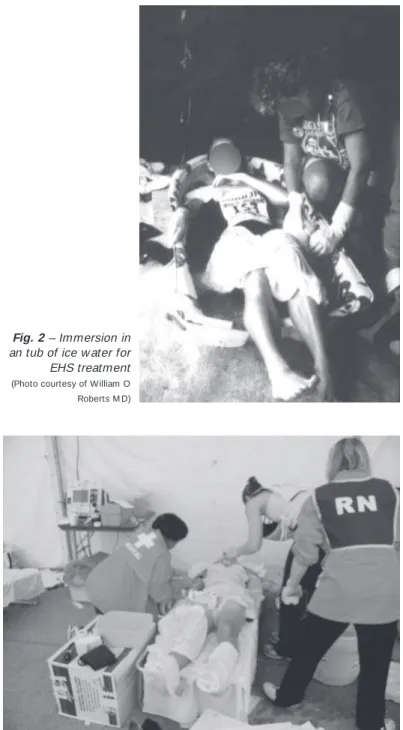
od of choice, but in the field it is not very effective. Fans may beused to augment the ice tow el or immersion techniques. The immersion and rotating tow el methods are pictured in fig-ures 2 and 3. Tub immersion requires a shallow tub half filled w ith a mixture of ice and w ater. The athlete is placed in the tub and the head is supported to keep the mouth and nose above w ater. Body parts that are not immersed in the tub can be sponged w ith the ice w ater or covered w ith ice w ater tow els. When a tub is not available, the ice w ater is mixed in a container, like a large cooler, and hand tow els or sheets are soaked, w rung out, and place on the athlete. Tw o providers w orking w ith 4-6 tow els each can soak and exchange the tow els rapidly and produce sw ift drops in core temperature.
tus and gastric or peritoneal lavage could also be attempted to remove body heat (as is done in severe hypothermia to add body heat), but the delays to implement these more invasive proce-dures could do more harm than good.
The prognosis for EHS casualties is based on the duration of hyperthermia and the response to cooling. Patients w ho “ w ake up” during the cooling treatment usually do w ell(27). Casualties w ho
remain comatose, stuporous, or inappropriate in their verbal and physical responses often have bad outcomes. Organ system sup-port is needed w hen there is delay in recognition and treatment or the patient does not “ w ake up,” because the tissue damage w ill suppress normal function. Exertional heat stroke casualties may require intubation for airw ay management if in stupor or coma to protect the lungs from aspiration. The tachycardia associated w ith EHS w ill usually relent as the body temperature is decreased and the heat induced pump failure is restored(35). M ore than one
ath-lete has succumbed to elevated body temperature w hile the med-ical staff concentrated on cardiac abnormalities that w ere heat re-lated. The overheated kidney w ill often fail to produce urine and renal support w ith dialysis may be necessary. If the kidney tissue is cooled to normal range “ in time,” the renal function can return to normal almost as if turned on by a sw itch. Respiratory gas ex-change is also tissue temperature dependent, but pulmonary func-tion may also be affected by tissue edema that can result from vigorous fluid resuscitation. Organ preservation in shock situations is augmented by vascular flow and normal saline fluid resuscita-tion is critical to tissue survival(28). In EHS patients w ho do not
respond to cooling, monitoring central venous pressures w ill im-prove the safety profile during large volume fluid administration(17,28).
All the authors declared there is not any potential conflict of inter-ests regarding this article.
REFERENCES
1. American College of Sports M edicine. Position statement on heat and cold ill-nesses during distance running. M ed Sci Sports Exerc 1996;28:i-vii.
2. M cCann DJ, Adams WC. Wet bulb globe temperature index and performance in competitive distance runners. M ed Sci Sports Exerc 1997;29:955-61.
3. M oran DS. Potential applications of heat and cold stress indices to sporting events. Sports M ed 2001;31:909-17.
4. Barthel HJ. Exertion-induced heat stroke in a military setting. M ilitary M ed 1990; 155:116-9.
5. Elias S, Roberts WO, Thorson DC. Team sports in hot w eather: guidelines for modifying youth soccer. Phys Sportsmed 1991;19:67-80.
6. England AC. Preventing severe heat injury in runners. Ann Intern M ed 1982;92:196-201.
7. Epstein Y, Shani Y, M oran DS, Shapiro Y. Exertional heat stroke the prevention of a medical emergency. J Basic Clin Phys Pharm 2000;11:395-401.
8. Roberts WO. Assessing core temperature in collapsed athletes. Phys Sportsmed 1994;22:49-55.
9. Roberts WO. A tw elve year profile of medical injury and illness for the Tw in Cities M arathon. M ed Sci Sports Exerc 2000;32:1549-55.
10. Brengelman GL. The dilemma of body temperature measurement (chapter 1). In: Shiraki K, Yousef M K, editors. M an in stressful environments: Thermal and w ork physiology. Springfield: Thomas, 1987.
11. Roberts WO. M anaging heatstroke: On-site cooling. Phys Sportsmed 1992;20:17-28. 12. Armstrong LE, Crago AE, Adams R, Roberts WO, M aresh CM . Whole-body cool-ing of hyperthermic runners: comparison of tw o field therapies. Am J Emerg M ed 1996;14:355-8.
13. Brodeur VB, Dennett SR, Griffin LS. Exertional hyperthermia, ice baths, and emergen-cy care at The Falmouth Road Race. Journal of Emergenemergen-cy Nursing 1989;15:304-12. 14. Coyle EF, M ontain SJ. Benefits of fluid replacement w ith carbohydrate during
exercise. M ed Sci Sports Exerc 1992;24:S324-30.
15. Noakes TD, M yburgh KH, du Pliessis J, Lang L, Lambert M , van der Riet C, et al. M etabolic rate, not percent dehydration, predicts rectal temperature in marathon runners. M ed Sci Sports Exerc 1991;23:443-9.
16. Saw ka M N, Young AJ, Latzka WA, Neufer PD, Quigley M D, Pandolf KB. Human tolerance to heat strain during exercise: influence of hydration. J Appl Physiol 1992;73:368-75.
Fig. 3 – Cooling w ith rotating ice w ater soaked tow els
(Photo courtesy of William O Roberts M D)
Fig. 2 – Immersion in
an tub of ice w ater for EHS treatment
(Photo courtesy of William O Roberts M D)
appara-332e
Rev Bras M ed Esporte _ Vol. 11, Nº 6 – Nov/Dez, 200517. Seraj M E, Channa AB, Al Harti SS, Kahn FM , Zafrullah A, Samarkandi AH. Are heat stroke patients fluid depleted? Importance of monitoring central venous pres-sure as a simple guideline for fluid therapy. Resuscitation 1991;21:33-9. 18. Bailes JE, Cantu RC, Day AL. The neurosurgeon in sport: aw areness of the risks
of heatstroke and dietary supplements. Neurosurgery 2002;51:283-6. 19. Gardner JW, Kark JA, Karnei K, Sanborn JS, Gastaldo E, Burr P, Wegner CB. Risk
factors predicting exertional heat illness in M arine Corps recruits. M ed Sci Sports Exerc 1996;28:939-44.
20. M artinez M , Devenport L, Saussy J, M artinez J. Drug associated heat stroke. S M ed Assoc J 2002;95:799-802.
21. Vassallo SU, Delaney KA. Pharmacologic effects on thermoregulation: mecha-nisms of drug related heatstroke. Clin Toxicology 1989;27:199-224.
22. Kulka TJ, Kenney WL. Heat balance limits in football uniforms: how different uni-form ensembles alter the equation. Phys Sportsmed 2002;30:29-39.
23. Armstrong LE, M aresh CM , Crago AE, Adams R, Roberts WO. Interpretation of aural temperatures during exercise, hyperthermia, and cooling therapy. M ed Ex-erc Nutr Health 1994;3:9-16.
24. Deschamps A, Levy RD, Cosio M G, M arliss EB, M agder S. Effect of saline infu-sion on body temperature and endurance during heavy exercise. J Appl Physiol 1989;66:2799-804.
25. Noakes TD, St Clair-Gibson A. Logical limitations to the “ catastrophe” models of fatigue during exercise in humans. Br J Sports M ed 2004;38:648-9.
26. Hubbard RW, M atthew CB, Durkot M J, Francesconi RP. Novel approaches to the pathophysiology of heatstroke: the energy depletion model. Ann Emerg M ed 1987;16:1066-75.
27. Bouchama A, Knochel JP. Heat stroke. N Engl J M ed 2002;346:1978-88. 28. Chang CK, Chien CH, Chou HL, Lin M T. The protective effect of hypervolemic
hemodilution in experimental heatstroke. Shock 2001;16:153-8.
29. Richards D, Richards R, Schofield PJ, Ross V, Sutton JR. M anagement of heat exhaustion in Sydney’s The Sun City-to-Surf fun run. M ed J Aust 1979;2:457-61. 30. Clements JM , Casa DJ, Knight JC, M cClung JM , Blake AS, M eenen PM , et al. Ice w ater immersion and cold w ater immersion provide similar cooling rates in runners w ith exercise induced hyperthermia. J Athl Training 2002;37:46-150. 31. Costrini AM . Emergency treatment of exertional heat stroke and comparison of
w hole body cooling techniques. M ed Sci Sports Exerc 1990;22:15-8.
32. Roberts WO. Exercise associated collapse in endurance events: a classification system. Phys Sportsmed 1989;17:49-55.
33. Roberts WO. M ass participation events. In: Lillegard WA, Butcher JD, Rucker KS, editors. Handbook of sports medicine: A symptom oriented approach. 2nd ed.
Butterw orth Heinemann, 1998.