RESUmo
O presente trabalho trata-se de estudo
so-bre os efeitos da inferilidade no relaciona
-mento dos cônjuges, com os objeivos de descrever o peril da população de estudo e analisar os efeitos da inferilidade na vida emocional, sexual e conjugal. Para tal, foi realizado um estudo transversal e prospec
-ivo em insituição especializada. A amos
-tra foi consituída por 50 casais inférteis com seis anos de inferilidade em média. As mulheres manifestaram senimentos negaivos perante a inferilidade, enquan -to os homens assumiram uma postura de
suporte e apoio. Os efeitos na vida sexual foram mais expressivos nas mulheres, e o tratamento da inferilidade levou a mu
-danças posiivas para ambos os cônjuges. Ao comparar os efeitos da inferilidade sobre os indivíduos que haviam realizado mais de um tratamento com aqueles no primeiro tratamento, observamos que não houve diferenças entre as mulheres; entre os homens houve diferenças no aspecto emocional (frustração e alívio) e no relacio
-namento conjugal (fortalecimento e ama
-durecimento).
dEScRiToRES Inferilidade Cônjuges
Técnicas reproduivas Enfermagem
The effects of infertility
on the spouses’ relationship
*O
r
i
g
i
n
a
l
a
r
ti
c
le
AbSTRAcT
The present study invesigated the efects of inferility on the spouses’ relaionship, with the objecives to describe the proile of the studied populaion, and analyze the efects of inferility on their emoional, sexual and marital life. To do this, a cross-secional and prospecive study was per
-formed in a specialist insituion. The sam
-ple consisted of 50 inferile cou-ples with a mean of six years of inferility. The women manifested negaive feelings in view of the inferility, while the men assumed an ai
-tude of support. The efects on the couples’ sexual life were more pronounced in wom
-en, and the inferility treatment resulted in posiive changes for both spouses. No dif
-ferences were found regarding the efects of inferility between the women who had undergone more than one treatment and those undergoing treatment for the irst ime; between the men there were difer
-ences in the emoional aspect (frustraion and relief) and in the marital relaionship (strengthening and maturing).
dEScRiPToRS Inferility
Spouses
Reproducive techniques Nursing
RESUmEn
Estudio sobre los efectos de la inferilidad en la relación de los cónyuges, objeivando describir el peril de la población estudiada y analizar los efectos de la inferilidad en la vida emocional, sexual y conyugal. Se rea
-lizó estudio transversal prospecivo en ins
-itución especializada. Muestra consituida por 50 parejas infériles con seis años de inferilidad en promedio. Las mujeres ma
-nifestaron senimientos negaivos ante la inferilidad, mientras que los hombres asu
-mieron una postura de soporte y apoyo. Los efectos en la vida sexual fueron más ex
-presivos en las mujeres, el tratamiento de la inferilidad derivó en cambios posiivos para ambos cónyuges. Al compararse los efectos de la inferilidad en individuos que habían realizados más de un tratamiento con la de aquellos en el primero, obser
-vamos que no hubieron diferencias entre las mujeres; entre los hombres exisieron diferencias en aspectos emocionales (frus
-tración y alivio) y en la relación conyugal (fortalecimiento y maduración).
dEScRiPToRES Inferilidad
Esposos
Técnicas reproducivas Enfermería
dieime Elaine Pereira de Faria1, Silvana chedid Grieco2, Sônia maria oliveira de barros3
EfEitos da infErtilidadE no rElacionamEnto dos cônjugEs
EfEctos dE la infErtilidad En la rElación dE los cónyugEs
* Extracted form the dissertation “Efeitos da infertilidade na vida emocional, sexual e no relacionamento conjugal”, federal university of são Paulo, 2009.
1master degree by the federal university of são Paulo. Professor of the maternal-child department at medical sciences faculty, santa casa de são Paulo.
são Paulo, sP, Brazil. [email protected] 2Human reproduction Expert by the center for reproductive medicine, university of Brussels – Belgium.
inTRodUcTion
Inferility, deined as the inability to conceive ater one year of regular sexual intercourse without the use of any contracepive method, is an old, and yet frequent, problem(1-2).
The number of inferile individuals has increased over the past years. Approximately 30% of couples of a ferile age are unable to conceive, with female and male factors contribuing equally with a 35% rate each; 20% of couples are unable to conceive due to male and female factors combined, and 10% are unable to conceive for unknown reasons(3-4).
Couples rarely expect to deal with inferility, as they believe they will be able to have children whenever they wish(2). The cultural construct has been that the act of be-ing unable to conceive children is atributed to women, which reinforces their feelings of guilt when they cannot conceive and allows men to shirk their own accountability in a couple’s failure to conceive (5).
When a couple turns to a clinic for help, both partners must be invesigated before conirming the diagnosis of inferility. Al -though the eiology may be speciically due to either female or male factors, inferility is considered to be a problem of both (the couple).
Maternity and paternity are social as -pects esteemed in many cultures, and par -enthood is an important phase in the life of most couples. Having or not having a child is not a random issue; there are ideological, cultural and social contexts involved which, directly or indirectly, pressure couples to -wards becoming parents (5).
The impact of inferility generates individual or mari -tal problems and emoions and can also contribute to insigaing and/or worsening marital problems. Sex can become a duty dissociated from pleasure; furthermore, sexual frequency may be reduced(6). All of these factors contribute directly or indirectly to increasing gestaional failure. Thus, mulidisciplinary teams that counsel and care for inferile couples must have broad knowledge regarding the main alteraions that can occur in the cou -ple’s emoional, sexual and marital relaionships, thus allowing the team to provide quality care and achieve beter outcomes.
In this sense, the objecive of the present study was to idenify and analyze the main efects of inferility on the emoional and sexual lives and on the marital relaionship of men and women who underwent treatment for inferil -ity in a specialist service.
mETHod
This is an observaional, descripive research using a cross-secional and prospecive design. The study was performed at the outpaient clinic of the Center for Pel-vic Endoscopy and Human Reproducion, located at Real e
Benemérita Associação Portuguesa de Beneicência – Hos-pital São Joaquim, in São Paulo. This service was chosen
based on the number of couples undergoing treatment for inferility.
The studied population consisted of 50 couples. The following inclusion criteria were considered: cou -ples of ages equal to or above 18 years; medical diag -nosis of infertility; and having undergone some form of treatment for infertility or obtaining treatment during the data collection period. Patients with a his -tory of psychiatric treatment or a medical diagnosis of cancer were excluded from the study. This information was obtained from the patients’ medical records be -fore data collection.
The data collection instrument was comprised of sociodemographic (age group, education level, race, city of birth, country of birth, income, years of cohabi -tation, couple’s number of children, num -ber of children with other partners, length of time of infertility, cause(s) of infertility, treatment for infertility), emotional (sad -ness, embarrassment, struggle, disap -pointment, anguish, rage, loss, surprise, frustration, anxiety, guilt, acceptance, inferiority, depression, relief), sexual (di -minished pleasure and libido, unsatisfac-tory relations), and marital variables (ten -sion, conflicts, dissatisfaction, maturing, strengthening).
Data collecion was performed ater the research proposal received the approval from the Research Eth -ics Commitee at Federal University of São Paulo (CEP 1325/06). Data collecion was performed on the day of the couple’s medical appointment ater they had signed the free and informed consent form. Each couple was ideniied by the same number, but were divided into two groups: group A women and B men.
The results were analyzed as follows: 1) analysis of the study variables; 2) associaion of the sociodemographic variables with those related to emoional, sexual, and marital aspects; 3) associaion of the variables related to emoional, sexual and marital aspects with subjects who had already undergone some form of treatment (Intracy -toplasmic Sperm Injecion – ICSI, In vitro ferilizaion – IVF,
and Ariicial Inseminaion), and those who were under -going treatment for the irst ime.
the impact of infertility generates individual or marital problems and emotions and can also contribute to instigating
and/or worsening marital problems. all of these factors contribute directly or indirectly to increasing
The data regarding the study variables were stored on a Microsoft Office Excel 2000TM electronic spread -sheet. Mann-Whitney tests were used for continuous variables, and Chi-square and Fisher’s Exact test were used, when necessary, for the categorical variables.
In the presentation of the results, absolute frequen -cies (N) and relative frequen-cies (%) are used for quali -tative variables; quanti-tative variables are presented as mean, median and standard deviation, and minimum and maximum values were used to show the variability. Level of significance was set at p < 0.05.
RESULTS
1- Analysis of the study variables between men and women
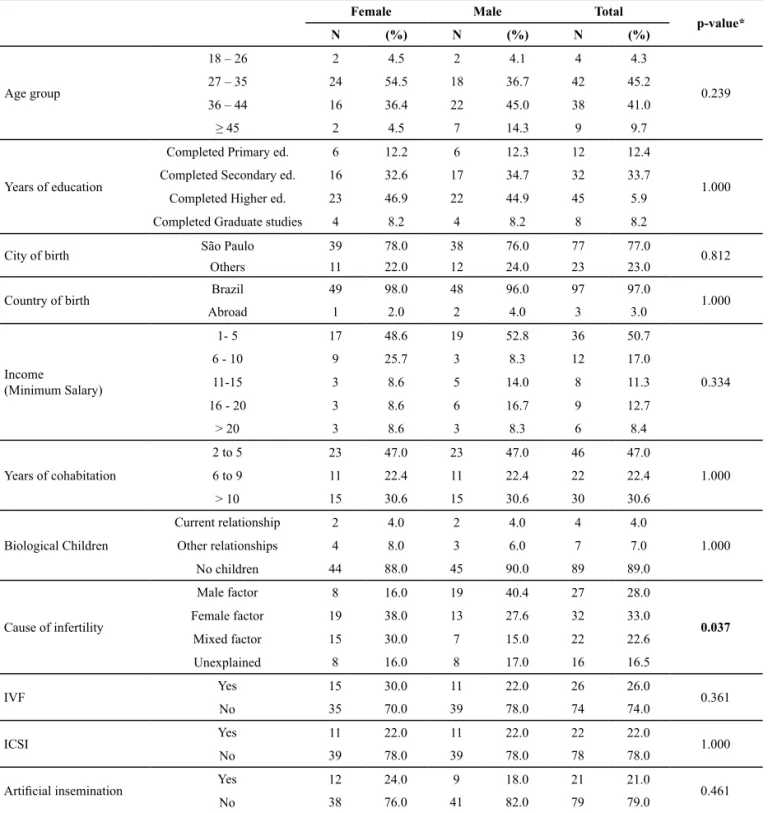
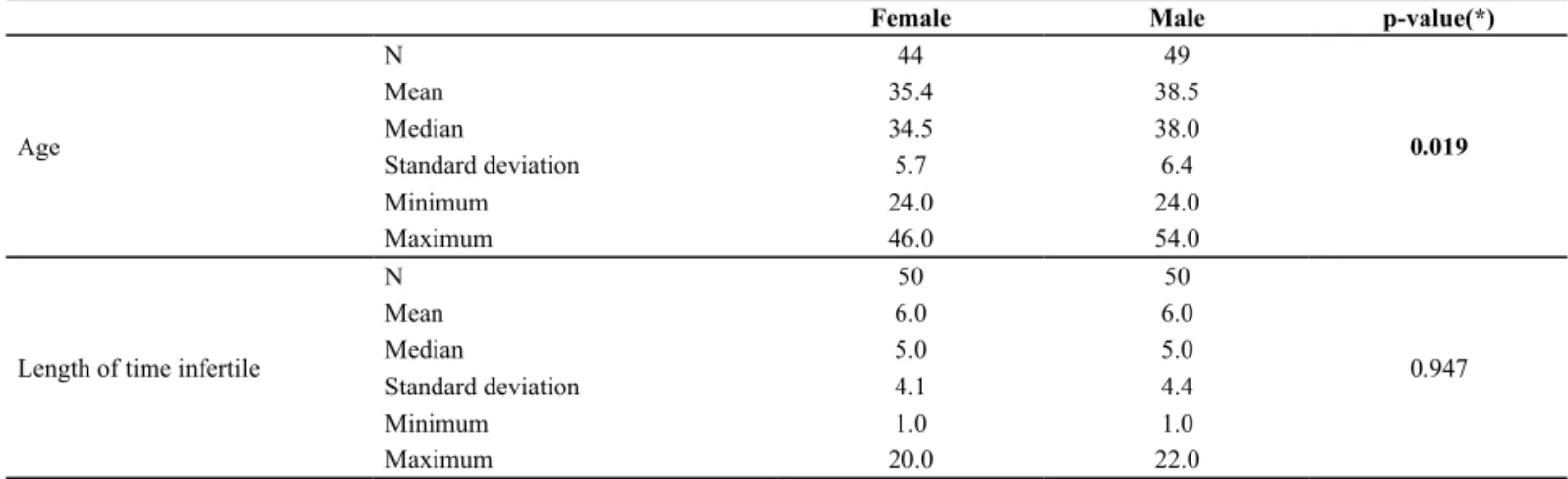
Regarding the sociodemographic variables, a signiicant diference was observed between genders in terms of the cause of inferility (Table 1). The ages of the study parici -pants ranged between 24 and 46 years, with a mean age of 35.4 years for women. There was a predominance of women in the age group between 27 and 35 years (54.5%). Men’s ages ranged between 24 and 54 years, and the pre -dominant age group was 36 to 44 years (45%) (Tables 1, 2).
Table 1 – Subjects according to sociodemographic variables and gender – São Paulo, 2011
Female Male Total
p-value*
N (%) N (%) N (%)
Age group
18 – 26 2 4.5 2 4.1 4 4.3
0.239
27 – 35 24 54.5 18 36.7 42 45.2
36 – 44 16 36.4 22 45.0 38 41.0
≥ 45 2 4.5 7 14.3 9 9.7
Years of education
Completed Primary ed. 6 12.2 6 12.3 12 12.4
1.000
Completed Secondary ed. 16 32.6 17 34.7 32 33.7
Completed Higher ed. 23 46.9 22 44.9 45 5.9
Completed Graduate studies 4 8.2 4 8.2 8 8.2
City of birth São Paulo 39 78.0 38 76.0 77 77.0 0.812
Others 11 22.0 12 24.0 23 23.0
Country of birth Brazil 49 98.0 48 96.0 97 97.0 1.000
Abroad 1 2.0 2 4.0 3 3.0
Income
(Minimum Salary)
1- 5 17 48.6 19 52.8 36 50.7
0.334
6 - 10 9 25.7 3 8.3 12 17.0
11-15 3 8.6 5 14.0 8 11.3
16 - 20 3 8.6 6 16.7 9 12.7
> 20 3 8.6 3 8.3 6 8.4
Years of cohabitation
2 to 5 23 47.0 23 47.0 46 47.0
1.000
6 to 9 11 22.4 11 22.4 22 22.4
> 10 15 30.6 15 30.6 30 30.6
Biological Children
Current relationship 2 4.0 2 4.0 4 4.0
1.000
Other relationships 4 8.0 3 6.0 7 7.0
No children 44 88.0 45 90.0 89 89.0
Cause of infertility
Male factor 8 16.0 19 40.4 27 28.0
0.037
Female factor 19 38.0 13 27.6 32 33.0
Mixed factor 15 30.0 7 15.0 22 22.6
Unexplained 8 16.0 8 17.0 16 16.5
IVF Yes 15 30.0 11 22.0 26 26.0 0.361
No 35 70.0 39 78.0 74 74.0
ICSI Yes 11 22.0 11 22.0 22 22.0 1.000
No 39 78.0 39 78.0 78 78.0
Artiicial insemination Yes 12 24.0 9 18.0 21 21.0 0.461
Regarding the variables related to emoional aspects, a signiicant diference was observed in terms of the man
-ifestaion of feelings of sadness, struggle, loss and depres -sion among men and women (Table 3).
Table 2 – Descriptive measures of age and length of time infertile (years), according to gender – São Paulo, 2011
(*) p = Value based on the mann-Whitney test.
Female Male p-value(*)
Age
N 44 49
0.019
Mean 35.4 38.5
Median 34.5 38.0
Standard deviation 5.7 6.4
Minimum 24.0 24.0
Maximum 46.0 54.0
Length of time infertile
N 50 50
0.947
Mean 6.0 6.0
Median 5.0 5.0
Standard deviation 4.1 4.4
Minimum 1.0 1.0
Maximum 20.0 22.0
Table 3 – Subjects’ descriptions of feelings associated with infertility, according to gender – São Paulo, 2011
(*) p = Value based on the chi-square test.
Female Male Total p-value(*)
N (%) N (%) N (%)
Sadness Yes 31 62.0 20 40.0 51 51.0 0.027
No 19 38.0 30 60.0 49 49.0
Embarrassment Yes 5 10.0 3 6.0 8 8.0 0.715
No 45 90.0 47 94.0 92 92.0
Struggle Yes 9 18.0 0 0.0 9 9.0 0.002
No 41 82.0 50 100.0 91 91.0
Disappointment Yes 14 28.0 12 24.0 26 26.0 0.648
No 36 72.0 38 76.0 74 74.0
Anguish Yes 10 20.0 6 12.0 16 16.0 0.275
No 40 80.0 44 88.0 84 84.0
Rage Yes 2 4.0 2 4.0 4 4.0 1.000
No 48 96.0 48 96.0 96 96.0
Loss Yes 9 18.0 1 2.0 10 10.0 0.007
No 41 82.0 49 98.0 90 90.0
Surprise Yes 12 24.0 9 18.0 21 21.0 0.461
No 38 76.0 41 82.0 79 79.0
Frustration Yes 22 44.0 15 30.0 37 37.0 0.147
No 28 56.0 35 70.0 63 63.0
Anxiety Yes 14 28.0 11 22.0 25 25.0 0.488
No 36 72.0 39 78.0 75 75.0
Guilt Yes 5 10.0 4 8.0 9 9.0 1.000
No 45 90.0 46 92.0 91 91.0
Acceptance Yes 4 8.0 10 20.0 14 14.0 0.083
No 46 92.0 40 80.0 86 86.0
Inferiority Yes 7 14.0 3 6.0 10 10.0 0.182
No 43 86.0 47 94.0 90 90.0
Depression Yes 7 14.0 0 0.0 7 7.0 0.012
No 43 86.0 50 100.0 93 93.0
Relief Yes 3 6.0 4 8.0 7 7.0 1.000
No 47 94.0 46 92.0 93 93.0
Women reported negaive feelings towards sexual ac -ivity, such as diminished libido (p = 0.037) and unsais
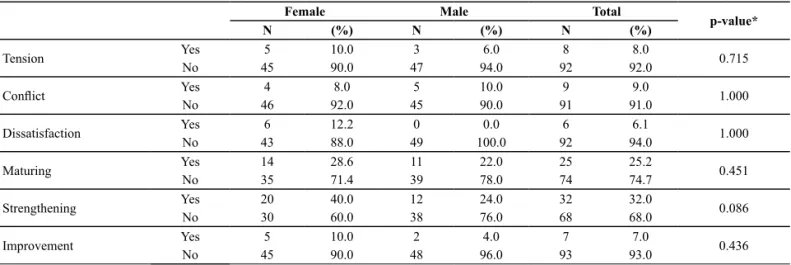
Regarding the variables related to the marital rela -ionship, no diferences were observed between the study subjects; however, the maturing and
strengthen-ing variables, considered to be posiive features in the marital relaionship, were emphasized by the study sub -jects (Table 5).
Table 4 – Subjects according to feelings related to sexual activity, according to gender– São Paulo, 2011
(*) p = Value based on the chi-square test.
Female Male Total
p-value*
N (%) N (%) N (%)
Diminished pleasure Yes 8 16.3 3 6.1 11 11.2 0.109
No 41 83.7 46 94.0 87 89.0
Diminished libido Yes 10 20.4 3 6.1 13 13.3 0.037
No 39 79.6 46 94.0 85 86.7
Unsatisfactory relations Yes 6 12.2 0 0.0 6 6.1 0.026
No 43 88.0 49 100.0 92 94.0
Table 5 – Subjects according to the types of changes in their relationships with their partners, according to gender – São Paulo, 2011
(**) p = Value based on the chi-square test.
Female Male Total
p-value*
N (%) N (%) N (%)
Tension Yes 5 10.0 3 6.0 8 8.0 0.715
No 45 90.0 47 94.0 92 92.0
Conlict Yes 4 8.0 5 10.0 9 9.0 1.000
No 46 92.0 45 90.0 91 91.0
Dissatisfaction Yes 6 12.2 0 0.0 6 6.1 1.000
No 43 88.0 49 100.0 92 94.0
Maturing Yes 14 28.6 11 22.0 25 25.2 0.451
No 35 71.4 39 78.0 74 74.7
Strengthening Yes 20 40.0 12 24.0 32 32.0 0.086
No 30 60.0 38 76.0 68 68.0
Improvement Yes 5 10.0 2 4.0 7 7.0 0.436
No 45 90.0 48 96.0 93 93.0
2 – Associaion of sociodemographic variables with the variables related to emoional, sexual, and conjugal aspects of the inferile couples
Signiicant diferences were found regarding the asso -ciaion of the sociodemographic variables with the vari -ables related to emoional aspects between: 1) educaion and frustraion (p<0.001) and disappointment (p=0.034) – 83.6% and 72% of subjects who manifested feelings of frustraion and disappointment, respecively, had com -pleted higher educaion or graduate studies; 2) educaion and relief (p=0.001) – 85.7% of the subjects who reported this feeling had completed a primary or secondary level educaion; 3) sadness/anxiety and income- 66.7% and 86% of the subjects who manifested feelings of sadness (p=0.045) and anxiety (p=0.043) had a monthly income of up to 10 minimum salaries; 4) relief and length of ime of inferility- 7.1% of the subjects reported feeling relief (p = 0.008) ater the diagnosis of inferility, regardless of the ime of cohabitaion; 5) struggle and frustraion and length of ime of inferility- the feelings of struggle (p = 0.028) and frustraion (p = 0.044) were present in subjects who were inferile between 7.4 and 5.2 years (mean), re
-specively; 6) anxiety and IVF- 92% of the subjects who manifested anxiety (p = 0.017) had not undergone IVF; and 7) loss/guilt/depression and ICSI- feelings of loss (p = 0.039), guilt (p = 0.023), and depression (p = 0.005) were present in 50%, 55.6%, and 71.4%, respecively, of the subjects who had undergone ICSI.
Signiicant diferences were observed for the asso -ciaions between sociodemographic, sexual and marital variables: 30% presented diminished libido (p = 0.023), and 59% of the subjects who reported their relaionship bond was strengthened (p = 0.002) had undergone ICSI; 92% and 84.3% of the subjects who reported maturing (p = 0.013) and strengthening of the relaionship bond (p = 0.005), respecively, had cohabited for up to nine years.
3 – Associaion of variables related to emoional, sexual, and marital aspects between subjects who had already undergone treatment and those who were undergoing treatment for the irst ime
-ual and marital aspects between women who had already undergone at least one treatment for inferility and those who had not. On the other hand, men who were under -going treatment for the irst ime reported experiencing feelings of frustraion (p = 0.001) and relief (p= 0.046), as well as changes in the marital relaionship: maturing (p= 0.025) and strengthening (p= 0.001).
diScUSSion
Women achieve the peak of their ferility at the age of 24 years; ferility then decreases unil the age of 30 years, at which ime it drops abruptly(7). Women be -tween the ages of 27 and 35 years have a 25% probabil-ity of experiencing physical problems and being unable to conceive ater trying for one year(3). In opposiion to men, women’s ferility has a limited ime, staring at the menarche and ending at menopause. In addiion, there are many factors that can hinder pregnancy as women age. These data corroborate the present study indings (Tables 1 and 2).
A specialist in ferility gives the diagnosis of inferility ater performing a clinical invesigaion of both spouses. In the present study, women reported that 38% of the di-agnoses of inferility were due to female factors and 16% to male factors, while men stated that 40% of the causes were related to them and 27.6% to women. The ques -ion was asked of the subjects without any conirma-ion of the diagnosis by the health team assising the couple. Therefore, the indings suggest that the spouses assume a protecive stance towards their partner, taking on the responsibility for the inferility (Table 1).
Most couples, at a certain ime in their relaionship, decide to have children and stop using contracepive methods; 60% of these couples get pregnant within about ive or six months of unprotected sexual relaions, 90% become pregnant within approximately one year, and 10% are unable to achieve pregnancy(8). According to the results (Table 2), the study subjects’ mean ime of inferil -ity was six years.
Men who experience inferility tend to repress their feelings by assuming a protecive role and supporing their partners, thus it appears they are less afected emo -ionally(5,9). Women experience inferility more intensely, even when the cause of the inferility is associated with their male partner(10).
A study(6) has shown that 43% of inferile women re -ported experiencing serious negaive feelings in terms of sexual relaions, while inferile men did not menion any alteraion in their feelings towards sexual acivity. The sexual act, formerly considered to be a ime of pleasure and saisfacion becomes, for inferile couples, merely a means to fulill their conjugal duies, contribuing to the start or increase of conlict and the loss of saisfacion in sexual relaions(11). According to the present study results
(Table 4), inferile women reported more dissaisfacion with their sexual life than did men.
Men’s interest in reaching a diagnosis, paricipaing and being involved in the inferility treatment results in posiive changes in the marital relaionship. In addiion, strengthening or distancing will depend on the relaion -ship that already exists between spouses before they are diagnosed with inferility(12). Results (Table 5) showed that the efects of inferility did not cause any negaive altera -ions in the marital rela-ionship, suggesing that men had an acive role in this phase.
The sociodemographic variables were associated with the study variables (emoional, sexual and marital aspects).
The results showed that when the educaion vari -able was associated with vari-ables related to emoional aspects, as described in the present study, signiicant evi -dence was found regarding the feelings of frustraion, dis-appointment and relief.
If, on the one hand, the level of educaion helps in-dividuals understand and seek knowledge regarding the issues involved in seeking inferility treatment, on the other hand it can make them more vulnerable to posiive or negaive changes.
Couples hope and expect to have children whenever they wish, but the conirmaion of inferility puts their dreams and expectaions at risk, and they therefore feel frustrated and disappointed that they are incapable of transferring their genes and generaing a descendant(2,13).
Nearly 65%of the 106 subjects of a study performed in public and private hospitals in Saniago reported that the costs related to inferility treatment were a problem for them, and they had to work more in order to cover that cost. The techniques are expensive and, throughout the treatment, can trigger negaive feelings, such as anxi -ety and sadness, depending on the economic power and emoional balance of each couple(3,14).
Anxiety emerges among couples ater they receive the conirmaion of their inferility; however, it appears that anxiety is evidenced, or exacerbated, among those with a low income. The possibility of not becoming pregnant af -ter the treatment, added to their concern regarding the i-nancial impact, contributes to the onset and worsening of anxiety(3). The techniques for Assisted Human Reproduc -ion (AHR) do not provide a 100% guarantee of becoming pregnant at the end of the treatment(9).
Relief is a feeling that is present mainly when the ei-ology of inferility is not related to the male because, in certain parts of the world, ferility remains culturally as -sociated with virility(6). When the eiology of inferility is due to a male factor, men tend to paricipate more in the treatment(15). In the present study, the eiology of inferil -ity, regardless of the subjects’ gender, did not bring relief.
It is known that the longer the ime of inferility, the smaller the chances of a successful treatment outcome. Couples demonstrate feelings of struggle throughout the treatment and, when they do not become pregnant at the end of the cycle, they use this feeling as the foundaion to begin one more cycle towards achieving the fulillment of their dream of becoming parents. In addiion, couples can experience feelings of frustraion, depending on the woman’s age and the length of ime of inferility.
At the end of the 1970’s, the irst report was made of a birth resuling from extracorporeal ferilizaion, thus con -irming man’s success in solving issues afecing couples waning to become parents. In Brazil, there are numerous centers that perform modern techniques such as in vitro
ferilizaion (IVF) and intracytoplasmic sperm injecion (ICSI), aimed at providing care to couples that experience inferility.
According to a study that analyzed 400,135 IVF cycles in the United Kingdom, a mean number of nine oocytes were captured ater hormonal simulaion for IVF, and a mean number of ive embryos were formed from these oocytes, resuling in a 21.3% success rate of live births; however, the number of live births decreased as mater-nal age increased(16). Therefore, despite the use of modern technologies, it is possible that some couples will never become parents, hence the need for a mulidisciplinary team prepared to provide the necessary support to infer-ile couples.
Anxiety is described as a fear of the unknown, and may occur in the stage of searching for the eiology of in -ferility, throughout the treatment, at the end of the cycle, and while waiing for the results of the treatment. Accord-ing to a Fortaleza study, the necessary exams and medica -ions involved in a cycle of in vitro ferilizaion can trigger
the onset of anxiety(17). In the present study, nearly 92% of the subjects that reported feeling anxious had not yet undergone IVF.
Because it is an advanced technique, ICSI increases the subjects’ expectaions in terms of fulilling their dreams of parenthood. Failure at the end of the treatment may make them associate their failure with a sense of being punished for things they have done in the past and can generate or increase their feelings of guilt, in addiion to increasing psychopathological symptoms such as depres -sion, anguish and loss(1,3).
Undergoing ariicial inseminaion, in vitro ferilizaion
(IVF) and intracytoplasmic sperm injecion (ICSI) did not
result in any changes in the sexual acivity of the inferile subjects. Change in sexuality (36.3%) is directly related to the success of the inferility treatment, and this factor should be considered as a means of improving the chances of success(14). Regarding the efects of ICSI on the marital relaionship, the couples that underwent this procedure re -ported that it strengthened the bond between them.
A San Diego study, performed with 30 inferile couples, showed they had a mean of 7.3 years of cohabitaion and did not reveal any changes in the marital relaionship(7). In this study, the subjects presented posiive characterisics regarding the marital relaionship, such as maturing and strengthening, and these factors were mostly evidenced in couples with a cohabitaion ime of less than ten years. The occurrence of changes over a long period of ime could cause a deterioraion in the marital relaionship of inferile couples, resuling in separaion(18).
No signiicant diferences were found between the study variables (emoional, sexual and marital aspects) in comparing women who had undergone at least one treatment and those who had not. Women are emoion -ally fragile, and, therefore, they express their feelings con -stantly, regardless of the experiences they are living.
Men who were undergoing the treatment for the irst ime reported feeling frustrated compared to those who had undergone treatment more than once. They consider it diicult and distressing to realize they need help from someone else (the physician) for concepion to occur, and this causes feelings of inferiority and frustraion(14). The results from this study showed that men experienced di-minished marital saisfacion ater undergoing inferility treatment.
The efects of inferility are substanial and, the more perspecives the mulidisciplinary team has in terms of the subjects’ reacions, the beter prepared the team will be to help the couple cope with this diicult phase(14). Fur -thermore, understanding the efects of inferility allows nurses to elaborate thorough instruments to be used in the nursing appointments in Assisted Human Reproduc-ion (AHR), thus allowing them (nurses) to achieve higher precision in the nursing process.
AHR is experiencing an exponenial growth worldwide, and several countries already employ specialist nurses who provide direct care to inferile couples, including techniques such as the retrieval of eggs and embryo trans-fer. In Brazil, the irst course on ARH for nurses occurred in 2010. Therefore, in addiion to preparing specialist profes -sionals, it is necessary to produce scieniic material that will contribute to the advancement of the ield.
concLUSion
Women manifested negaive emoional changes, while men expressed feelings related to an aitude of providing support and balance. Negaive feelings towards sexual acivity were also more common among women; regarding the marital relaionship, the changes were posi -ive for both spouses.
The sociodemographic variables of educaion, monthly income, years of cohabitaion, length of ime of inferility,
in vitro ferilizaion (IVF), and intracytoplasmic sperm injec
-ion (ICSI) were accountable for the negaive changes in the emoional aspects of the inferile couples. There were nega -ive changes in regards to sexual acivity when correlated with ICSI, but this variable had a posiive efect on the marital relaionship, as did the variable of years of cohabitaion.
No diferences were observed regarding the studied aspects between women who had undergone inferility treatment at least once and those who had not, but men manifested changes in the emoional aspect (frustraion and relief) and in the marital relaionship (strengthening and maturing).
REFEREncES
1. Schmidt L, Christensen U, Holstein BE. The social epidemiol -ogy of coping with inferility. Hum Reprod. 2005;20(4):1044-52.
2. Calero JL, Santana F. La inferilidad como evento de frus -tración personal: relexiones de un grupo de varones de pare -jas infériles. Rev Cubana Endocrinol. 2006;17(1):1-18.
3. Delgado MJC. O desejo de ter um ilho... As vivências de um casal inféril [dissertação]. Lisboa: Universidade Aberta; 2007.
4. Graner VR, Barros SMO. Complicações maternas e ocorrên -cias neonatais associadas às gestações múliplas resultantes de técnicas de reprodução assisida. Rev Esc Enferm USP. 2009;43(1):103-9.
5. Bernal ZD, Jordá DG. Cultura sobre madernidad y paternidad y su repercusión en la concepción de la inferilidad. Rev Cubana Salud Publica. 2010;36(3):198-203.
6. Monga M, Alexandrescu B, Katz SE, Stein M, Ganiats T. Impact of inferility on quality of life, marital adjustment and sexual funcion. Urology. 2004;63(1):126-30.
7. Baird DT, Collins J, Egozcue J, Eyers LH, Gianaroli L, Leri -don H, et al. Ferility and ageing. Hum Reprod Update. 2005;11(3):261-76.
8. Barros SMO, Graner VR, Faria DEP. Inferilidade. In: Enferma -gem obstétrica e ginecológica: guia para práica assistencial. 2a ed. São Paulo: Roca; 2009. p. 49-66.
9. Seger LJ. Estresse na gênese e no tratamento da inferilidade. Psicologia em reprodução humana assisida: experiências brasileiras. São Paulo: Casa do Psicólogo; 2006. p.121-53.
10. Melamed RMM. Inferilidade: senimentos que decorrem. In: Melamed RMM, Quayle J. Psicologia em Reprodução Hu -mana Assisida: Experiências Brasileiras. 1a ed. São Paulo: Casa do Psicólogo; 2006. p.71-90.
11. Díaz JAA. Sexualidade en parejas con problemas de ferili -dad. Gac Méd Méx. 2007;143(1):65-71.
12. Pasch LA, Dunkel CS, Christensen A. Diferences be -tween husband`s and wive`s approach to inferility af -fect marital communicaion and adjustment. Feril Steril. 2002;77(6):1241-7.
13. Matsubayashi H, Hosaka T, Izumi S, Suzuki T, Kondo A, Maki -no T. Increased depression and anxiety in inferile Japanese women resuling from lack of husband’s support and feel -ings of stress. Gen Hosp Psychiatry. 2004;26(5):398-404.
14. Palacios E, Jadresic E, Palacios F, Miranda C, Domínguez R. Estudio descripivo de los aspectos emocionales asociados a la inferilidad y su tratamiento. Rev Chil Obstet Ginecol. 2002;67(1):1-10.
15. Calero JL, Santana F. La solución ante la inferilidad: repre -sentaciones de un grupo de varones atendidos por este pa -decimiento. Rev Cuba Endocrinol. 2006;17(2):1-15.
16. Sunkara SK, Ritenberg V, Raine Fenning N, Bhatacharya S, Zamora J, Coomarasamy A . Associaion between the num -ber of eggs and live birth in IVF treatment: an analysis of 400 135 treatment cycles. Hum Reprod. 2011;26(7):1768-74.
17. Oriá MOB, Ximenes LB, Glick DF. Inferile couples facing in vi -tro ferilizaion – a quanitaive research. Online Braz J Nurs [Internet]. 2006 [citado 2011 set. 22];5(2):361-77. Disponív -el em:htp://www.uf.br/objnursing/viewaricle.php?id=13