RESUmo
O objeivo deste estudo foi analisar com -paraivamente a vulnerabilidade ao HIV/ AIDS de homens e mulheres adolescentes, baseada em seus conhecimentos, valores e práicas. Trata-se de um estudo explo -ratório-descriivo com abordagem quan -itaiva. Os estudantes responderam a um quesionário do qual foram selecionadas questões relevantes para análise. Totali -zaram 207 adolescentes, sendo 43,5% do sexo masculino e 56,5% do feminino. A maior parte dos adolescentes declara já ter ido sua primeira relação sexual até o momento do estudo. Observaram-se dé -icits de conhecimento sobre transmissão do HIV e práicas sexuais seguras. Embora haja conhecimento declarado das técnicas de uso do preservaivo, isso não relete em seu uso constante. Observaram-se valores ligados às representações de gênero, mas percebe-se uma evolução quanto à auto -nomia e poder de negociação das meninas sobre o uso do preservaivo.
DEScRItoRES
Síndrome de Imunodeiciência Adquirida HIV
Adolescente
Vulnerabilidade em saúde Idenidade de gênero
Differences between female and male
adolescents regarding individual
vulnerability to HIV
O
riginal
a
r
ticle
AbStRAct
The objecive of this study was to com -paraively analyze male and female ado -lescents’ vulnerability to HIV/AIDS, based on their knowledge, values and pracices. This is an exploratory-descripive study, performed using a quanitaive approach. The students answered a quesionnaire from which relevant quesions were select -ed for the analysis. The paricipants were 207 adolescents, 43.5% male and 56.5% female. Most adolescents report having iniiated sexual aciviies. It was observed that the paricipants have knowledge dei -cits regarding HIV transmission and safe sexual pracices. Although they report knowing about condom use as a method of protecion against HIV, they do not al -ways use them. It was observed that there are values connected to the representa -ions of gender, but it is noiced there is an evoluion regarding the autonomy and power of the girls’ negoiaion regarding condom use.
DEScRIPtoRS
Acquired Immunodeiciency Syndrome HIV
Adolescent Health vulnerability Gender idenity
RESUmEn
El estudio objeivó analizar en forma com -paraiva la vulnerabilidad al VIH/SIDA en hombres y mujeres adolescentes, en base a sus conocimientos, valores y prácicas. Estudio exploratorio, descripivo, con abor -daje cuanitaivo. Los estudiantes respon -dieron a un cuesionario, del cual fueron seleccionadas preguntas relevantes para el análisis. Se evaluaron 207 adolescentes, 43,5% de sexo masculino y 56,5% de sexo femenino. La mayoría de los adolescentes declara haber tenido ya su primera relación sexual al momento del estudio. Se observó déicit de conocimientos sobre transmisión del VIH y prácicas sexuales seguras. A pe -sar de que exista conocimiento expreso sobre técnicas de uso del preservaivo, eso no se releja en su uso constante. Se obser -varon valores ligados a representaciones de género, per se percibe una evolución en cuanto a la autonomía y poder de negocia -ción de las adolescentes sobre el uso del preservaivo.
DEScRIPtoRES
Síndrome de Inmunodeiciencia Adquirida VIH
Adolescente
Vulnerabilidad en salud Idenidad de género
Renata Holanda Dutra dos Anjos1, José Augusto de Souza Silva2, Luciane Ferreira do Val3, Laura Alarcon Rincon4, Lucia Yasuko Izumi nichiata5
Diferenças entre aDolescentes Do sexo feminino e masculino na vulnerabiliDaDe inDiviDual ao Hiv
Diferencias entre aDolescentes De sexo femenino y masculino en la vulnerabiliDaD inDiviDual al viH
1Degree in nursing from the university of são Paulo school of nursing. são Paulo, sP, brazil. [email protected] 2Degree in nursing from the
university of são Paulo school of nursing. são Paulo, sP, brazil. [email protected] 3Doctoral student of the Post-graduate nursing Program
of the collective Health nursing Department of the university of são Paulo school of nursing. são Paulo, sP, brazil. [email protected] 4Degree
IntRoDUctIon
The AIDS epidemic remains a major health challenge worldwide. Data from the UNAIDS show that currently there are approximately 33 million people living with HIV in the world and that in 2009 2.9 million new cases of the disease were detected(1). Informaion on the occurrence
of Sexually Transmited Diseases (STDs) and HIV/AIDS in Brazil are presented and analyzed annually in the Epide -miological Bullein. In its latest version, released in 2010, focus is given to cases of AIDS in young people of between 13 and 24 years of age, who accounted for 11.3% of the cases registered in the country between 1980 and June 2010(2). During this period there were 492,581 AIDS cases reported in Brazil. In 2009, 20,832 cases were reported, with 13,159 in males and 7,671 in females, and in 2010, unil June, there were 5,845 cases with 3,718 in males and 2127 in females. It is observed that in the last two years the raio of the genders was 1.7:1 (17 men for every 10 women)(2). Among young people of 13 to 24 years of age 3,398 cases of AIDS were reported in 2009, with 1,875 in males and 1,523 in females, and in 2010, un
-il June, 1,317 cases, with 745 in males and 572 in females. The gender raio was 1.2:1 (12 men for every 10 women) and 1.3:1 (13 men for every 10 women) in the years 2009 and 2010 respecively. The highest propor -ion of cases of the disease in this age group is atributed to the sexual exposure cat -egory, accouning for 73.8% of the cases in males and 94.0% in females, in 2009(2).
The concept of vulnerability, adopted in
the present study seeks to comprehend the individual, collecive and contextual aspects that make people suscepible to HIV infec -ion and AIDS. The analysis of vulnerabil -ity seeks to integrate three interdependent
axes, which are the individual, social, and programmaic dimensions. In the individual dimension, the values, inter -ests, beliefs, desires, knowledge, aitudes, and behavior, which impact in the exposure to or prevenion of HIV/AIDS for the individual, are considered. In the social dimension, it is sought to contextualize, material, cultural, poliical, and moral factors, which afect individual vulnerability. In the programmaic dimension, how the health, educaion, social welfare and cultural insituions provide the social resources that people need to protect themselves from HIV infecion and AIDS is analyzed(3).
Adolescence is a period of intense physical, psycholog -ical and social changes, in which the individual undergoes personal and interpersonal conlicts. This phase of life, in which values and concepts are consolidated, is inluenced by the cultures of family, media, friends and society as a whole, which will permeate the persons aitudes in future life(4-5). In this stage of life, the exercise of sexuality starts to occupy a very important space(6) and many adolescents
become sexually acive, which makes them vulnerable to sufer health problems. Regarding sex in adolescence, many issues are not properly approached, indicaing a spontaneous aitude regarding sexuality that disfavors conversaion and prior preparaion(7). The vulnerability of adolescents to STDs is the result of the interacion of in -dividual factors with the social factors in which they are involved, with them becoming more or less vulnerable depending on their ability to criically reinterpret social messages of danger(5). It is therefore necessary to encour -age them to think criically about the reality in which they live to be able to exercise autonomy in their choices, thus reducing their vulnerability(4).
Several studies show that there are diferences in the behavior of male and female adolescents regarding sexu -ality, and that a common point is the greater atribuion of responsibility to women. The boys show interest earlier regarding the iniiaion of their sexual lives and are more uninhibited and inconsequenial in relaion to STDs and pregnancy. They are under pressure from parents and friends to begin their sexual lives, to prove their masculinity(5). The girls take a role of si -lence and conformity with the desire of the partner, presening a disadvantage when negoiaing condom use. In addiion, they trust in a steady partner, relinquishing the use of condoms during sex because they be -lieve in their partner’s idelity, arguing that to request the use of a condom may indicate a lack of trust or even betrayal by them(5).
It is interesing to note that social repre -sentaions are amenable to change, which is oten necessary since many established paterns are detrimental to the way of life of the men and the women. These paterns of masculinity and femininity are treated as natural, without thinking criically about them, which can impact negaively on health, as both are vulnerable to STDs. For the woman, vulnerability increas -es due to the lack of negoiaing power and control over the relaionship, for the man, it increases due to social pressure to always be ready for sex, assuming a role of being without control over their impulses. The discussion of these issues assumes an emancipatory character in that it quesions the internal logic of the construcion of the diference, suggests a more criical posture faced with the social roles assigned to men and women, and moivates adolescents to become agents of change in the environ -ment in which they live, recognizing the place of women in society and reclaiming their rights. We understand that, when we discuss gender issues, we have already begun to transform them(4).
The aim of this study was to analyze the vulnerability to HIV/AIDS in female and male, adolescent, high school students from two public schools in Peruíbe/SP, according to their knowledge, values and pracices.
several studies show that there are differences in
the behavior of male and female adolescents regarding
sexuality, and that a common point is the greater attribution of responsibility to
mEtHoD
This quanitaive, exploratory, descripive study is an integral part of the study Vulnerability of High School Youths to HIV/AIDS: What Changed in Ten Years?, which
aims to compare knowledge and protecive pracices tak -en against HIV, reported by stud-ents from two public high schools in Peruíbe/SP, where the same approach was car -ried out in 1999 and 2010(8). The study paricipants were students enrolled in two state public schools in Peruíbe, SP, Brazil. In the study conducted in 1999, 2,219 students were enrolled in the two schools. Probability sampling was used, resuling in 360 students, 15% of the total pos -sible populaion.
In the study conducted in 2010, 1,512 students were enrolled in the two schools. To deine the sample of stu -dents, a proporion based on the knowledge about sex of
the high school students from the irst study (67%) was used, considering a margin of error of 0.05%, which re -sulted in a sample size of 323 students. However, 226 stu -dents acively paricipated in the study. The loss of 30% occurred because, despite the recepivity of the students and the schools, some students did not bring the signed Terms of Free Prior Informed Consent (TFPIC), others re -fused to receive the TFPIC to collect the signature of the parent or guardian, and other missed the delivery date of the TFPIC or the day of data collecion.
In accordance with Resoluion 196/96 (Brazil, 1998), of the Naional Health Council, the project was submited to the Research Ethics Commitee of the University of São Paulo School of Nursing (EEUSP) and was approved un -der protocol No. 871/2009. The TFPIC was delivered the day before for the under 18 to request the signature of the parent or guardian and the next day it was exchanged for the quesionnaire with the researchers. All the stu -dents answered the quesionnaire and then returned it immediately.
In 2010, the self-applied anonymous quesionnaire used in 1999(8) was applied. Composed of two parts, the irst inquires about the general socioeconomic character -isics of students and the second addresses issues related to the knowledge, beliefs, values, aitudes and pracices related to sexuality and vulnerability to HIV, totaling 51 quesions. The quesionnaire contains closed quesions, some of which are muliple choice, scored on a Likert type scale. A total of 226 students responded to the quesion -naires, with 99 (43.8%) males and 127 (56.2%) females, aged between 13 and 30 years. However, for this, study students were selected who were aged up to 19 years, totaling 207 individuals, of which 43.5% were males and 56.5% were females. This selecion occurred because this age group represents the young people at the peak of their biopsychosocial transformaions and in a phase of formaion of concepts that accompany and inluence the rest of their lives(9).
In the present study, not all the maters contained in the quesionnaire were analyzed, choosing to select only those that were most relevant to the topic. The answers to the quesions were entered in to a Microsot Excel database and analyzed using the Epi Info staisical pro -gram. The data is presented in a comparaive form and de -scribed by gender. For comparison of the responses by the adolescent males and females the Chi-square, Likelihood Raio and Fisher staisical tests were used. For a conven -ional 0.05 level of signiicance, values of p>0.05 showed there was no staisically signiicant diferences between the variables, and values of p<0.05 show that there was signiicant diferences between the variables. Be -fore the analysis, the missing data were removed for each quesion, and therefore each has a diferent total of respondents.
RESULtS
The paricipants were 207 adolescents, 90 male (43.5%) and 107 females (56.5%) aged between 13 and 19 years. According to the boys, 60.7% said they have had their irst sexual intercourse by the ime the study was con -ducted, the mean age of irst sexual intercourse was 14.53 years, with nine years the minimum age and 17 years the maximum. Among the girls, 57.3% had had their irst sexu -al intercourse, with the irst sexu-al intercourse occurring at the mean age of 14.70 years, 12 years being the minimum age and 17 years the maximum. The diferences between the sexes were not staisically signiicant. In relaion to knowledge about AIDS, there was a higher percentage of girls (44.3%) than boys (40.2%) who evaluated that they knew litle or nothing about the mater, without staisical signiicance diferences between the sexes.
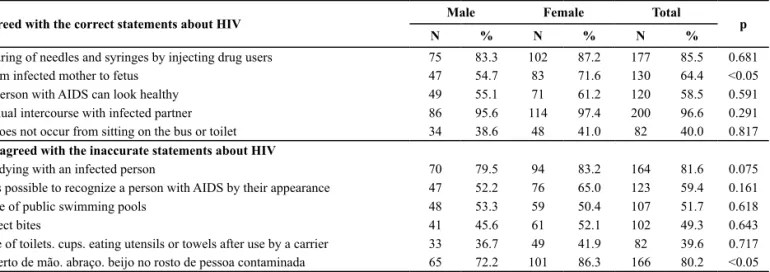
Table 1 shows that the vast majority of adolescents of both sexes agree that it is possible to acquire HIV through sexual intercourse with a partner and from the sharing of contaminated needles and syringes by injecing drug us -ers. There was a higher percentage of girls (71.6%) than boys (54.7%) that agreed that the transmission of the vi -rus from an infected mother to her child occurs, with a sta -isically signiicant diference between the sexes. A per -centage of 58.5% of the adolescents agreed that a person with AIDS can look healthy, and 40% of them agreed that HIV transmission does not occur from bus or toilet seats. Table 1 also shows that the majority of the adolescents disagreed with the idea that it is possible to acquire HIV from studying with an infected person. There were 72.2% of the boys and 80.2% of the girls who disagreed with the idea that you can acquire the virus from shaking hands, hugging or kissing the cheek of an infected person. A low proporion of adolescents disagreed with the misconcep -ions about HIV transmission, such as through: the use of public swimming pools (51.7%), insect bites (49.3%), the
carrier (39.6%). There was also a low proporion of ado -lescents who disagreed that it is possible to recognize a person with AIDS by their appearance (59.4%). It is pos -sible that the majority of the adolescents, with a higher proporion of females, had correct knowledge about the ways that HIV is actually transmited. However, in relaion to the myths about the transmission and the physical ste -reotypes of a person with AIDS, the males presented more doubts.
The majority of the adolescents of both sexes believed that AIDS is a dangerous disease (95.1%) and that every
-one is at risk of acquiring the disease (82.5%). They also believed in the use of condoms as a safe means for dis -ease prevenion (95.2%). Most of them (89.3%) disagreed that the only way to avoid AIDS is to have faith in God.
There was a higher percentage of girls (86.1%) than boys (73.3%) who disagreed with the idea that having good luck avoids AIDS, and there was also a higher percent -age of girls (74.1%) than boys (60.0%) that disagreed that there is no point doing anything as it is the desiny of that
person to have AIDS. It can be seen that the adolescent
males believe more in luck and desiny as decisive factors for acquiring HIV or not.
Table 1 - Knowledge about HIV transmission according to the adolescents, by gender - Peruíbe, SP, 2010
Agreed with the correct statements about HIV Male Female Total p
N % N % N %
Sharing of needles and syringes by injecting drug users 75 83.3 102 87.2 177 85.5 0.681
From infected mother to fetus 47 54.7 83 71.6 130 64.4 <0.05
A person with AIDS can look healthy 49 55.1 71 61.2 120 58.5 0.591
Sexual intercourse with infected partner 86 95.6 114 97.4 200 96.6 0.291
It does not occur from sitting on the bus or toilet 34 38.6 48 41.0 82 40.0 0.817
Disagreed with the inaccurate statements about HIV
Studying with an infected person 70 79.5 94 83.2 164 81.6 0.075
It is possible to recognize a person with AIDS by their appearance 47 52.2 76 65.0 123 59.4 0.161
Use of public swimming pools 48 53.3 59 50.4 107 51.7 0.618
Insect bites 41 45.6 61 52.1 102 49.3 0.643
Use of toilets. cups. eating utensils or towels after use by a carrier 33 36.7 49 41.9 82 39.6 0.717
Aperto de mão. abraço. beijo no rosto de pessoa contaminada 65 72.2 101 86.3 166 80.2 <0.05
Table 2 shows that the vast majority of the adolescents considered the pracice of vaginal sex without a condom unsafe. The pracice of anal sex without a condom was considered unsafe by the majority, but caused doubts in
20.5% of the adolescents and oral sex without a condom was also considered unsafe by the majority, but caused doubts in 27.8 % of adolescents.
Table 2 - Knowledge of the adolescents regarding the insecurity of sexual practices without the use of condoms, by gender - Peruíbe, SP, 2010
Sexual practices Male Female Total p
N % N % N %
Vaginal intercourse without a condom
Safe 1 1.2 0 0.0 1 0.5
Unsafe 80 93.0 105 92.1 185 92.5 0.368
Unsure 5 5.8 9 7.9 14 7.0
Oral sex without a condom
Safe 9 10.8 8 7.2 17 8.8
Unsafe 51 61.4 72 64.9 123 63.4 0.669
Unsure 23 27.7 31 27.9 54 27.8
Anal intercourse without a condom
Safe 5 6.1 4 3.5 9 4.6
Unsafe 61 74.4 85 75.2 146 74.9 0.688
Unsure 16 19.5 24 21.2 40 20.5
In Table 3, we can see that there was a higher percent -age of girls (99.1%) than boys (88.9%) who believed that they can catch AIDS if they do not use condoms, and there was also a higher percentage of girls (82.9%) than boys (67.8%) who disagreed with the fact that choosing part -ners carefully avoids AIDS, with staisically signiicant dif
Regarding the self-assessment of the risk of acquir -ing HIV, there was a higher percentage of boys (57.0%) than girls (46.1%) who believed they have some risk, while there was a higher percentage of girls (31.3%) than boys (26.7%) who believe that they had no risk. A total of 16.3% of the boys and 22.6% of the girls stated that they did not know if they had a risk of acquiring the vi -rus, and these diferences were not staisically signiicant (p=0.288). It was found that over half of the adolescents perceived themselves at risk for contracing the disease, with a higher percentage of boys having this percepion.
Regarding the correct use of condoms, there was a higher percentage of boys (73.3%) than girls (56.4%) who said they knew how to do this, which is a staisically sig -niicant diference (p=0.012). Concerning the frequency of condom use, a higher percentage of boys (66.7%) than girls (52.4%) said they use one in all their sexual relaions. A total of 29.4% of the boys and 42.9% of the girls stat -ed that they use one in some relaions and 3.9% of boys and 4.8% of girls claimed to never have used a condom, with no staisically signiicant diferences between the sexes (p=0.297). The percentage of girls (19.8%) was sig -niicantly higher than the percentage of boys (4.7%) who stated that they would be embarrassed to carry a con -dom in their pocket or purse. Furthermore, there was a higher percentage of girls (48.5%) than boys (21.7%) who stated that they would be embarrassed to ask to borrow a condom from a friend, these diferences were staisi -cally signiicant (p<0.001). Conversely, there was a higher percentage of boys (14.1%) than girls (1.8%) who stated that they would be embarrassed to say to a steady part -ner that they did not want to have sex without a condom, which is a staisically signiicant diference (p<0.001). In relaion to the fear of becoming infected from unprotect -ed sexual intercourse, a higher percentage of girls (81.5%) than boys (69.9%) said they would have that feeling, with no staisically signiicant diferences between the sexes (p=0.059). Fear can be associated with the self-percepion
of vulnerability and exposure to risk situaions for acquir -ing the disease, which this study found to a lesser extent in the males.
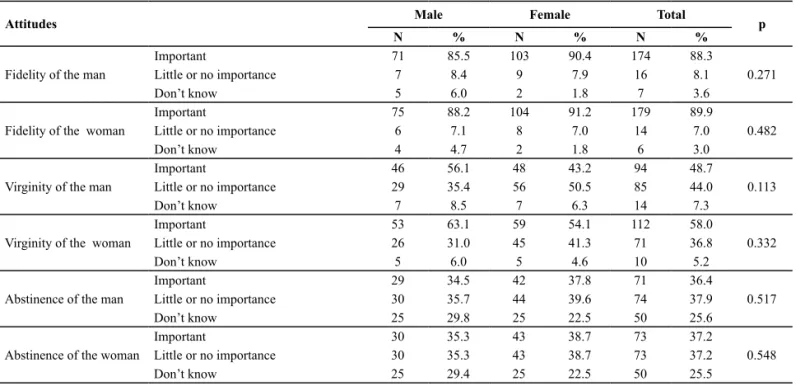
In Table 4, it can be seen that the vast majority of the adolescents consider the idelity of men and women im -portant in the prevenion of AIDS. The emphasis on virgin -ity is greater on behalf of the boys, with both them and the girls placing more value on the virginity of the woman than on that of the man. The representaions of the wom -an as chaste -and pure -and the m-an as strong -and virile in -luence the values of the adolescents, which give greater emphasis to female virginity.
DIScUSSIon
A study invesigated the issue of age and condom use in the irst sexual intercourse, noing that there is a drop in condom use in individuals who started their sexual life at 14 years of age, and that this decrease was even greater in women(10). The interest in this issue is due to the associa -ion between the behavior at the irst sexual intercourse and the behavioral paterns that will be followed for the enire life. Therefore, if there is a tendency to not use con -doms when the age at irst sexual intercourse is low, this behavior, which increases vulnerability to HIV/AIDS, needs to be studied. In the present study it was observed that the mean iniiaion of the sexual life was very close to 14 years of age for both sexes, which is the maximum age the cited author deemed to be negaively associated with condom use.
Data presented in the Survey of Knowledge, Aitudes and Pracices in the Brazilian Populaion (PCAP)(11), per
-formed with individuals 15-64 years of age, with the enire naional territory represented, in 2008 and published by the Ministry of Health in 2011, show that there is a higher percentage of men (36.9%) than women (17%) who had irst intercourse before 15 years of age, indicaing a pat
-Table 3 - Self-perception of the adolescents regarding vulnerability to acquire HIV during sex, by gender - Peruíbe, SP, 2010
Self-perception of vulnerability to acquire HIV during sexual intercourse
Male Female Total
p
N % N % N %
I can get AIDS if I do not use condoms
Agree 80 88.9 116 99.1 196 94.7
Disagree 6 6.7 1 0.9 7 3.4 <0.05
Unsure 4 4.4 0 0.0 4 1.9
I can get AIDS if I do not use condoms with my partner
Agree 66 74.2 87 75.7 153 75.0
Disagree 15 16.9 17 14.8 32 15.7 0.918
Unsure 8 9.0 11 9.6 19 9.3
I cannot get AIDS from having sex without a condom because I only have sexual intercourse with safe people
Agree 26 28.9 20 17.1 46 22.2
Disagree 55 61.1 88 75.2 143 69.1 0.084
Unsure 9 10.0 9 7.7 18 8.7
I can not get AIDS, even if not using a condom, because I choose my partner(s) carefully
Agree 20 22.2 12 10.3 32 15.5
Disagree 61 67.8 97 82.9 158 76.3 <0.05
tern of underage males at the irst sexual intercourse. This result is further noted in two studies(10,12), with the lat -ter inding a mean age at irst in-tercourse for adolescent males of 13.7 years, compared to the mean of the female
adolescents of 15.1 years. The present study did not show the same patern, since the mean ages found among the girls and boys were very close.
Table 4 - Degree of importance given to certain attitudes by the adolescents in the prevention of AIDS, by gender - Peruíbe, SP, 2010
Attitudes Male Female Total p
N % N % N %
Fidelity of the man
Important 71 85.5 103 90.4 174 88.3
Little or no importance 7 8.4 9 7.9 16 8.1 0.271
Don’t know 5 6.0 2 1.8 7 3.6
Fidelity of the woman
Important 75 88.2 104 91.2 179 89.9
Little or no importance 6 7.1 8 7.0 14 7.0 0.482
Don’t know 4 4.7 2 1.8 6 3.0
Virginity of the man
Important 46 56.1 48 43.2 94 48.7
Little or no importance 29 35.4 56 50.5 85 44.0 0.113
Don’t know 7 8.5 7 6.3 14 7.3
Virginity of the woman
Important 53 63.1 59 54.1 112 58.0
Little or no importance 26 31.0 45 41.3 71 36.8 0.332
Don’t know 5 6.0 5 4.6 10 5.2
Abstinence of the man
Important 29 34.5 42 37.8 71 36.4
Little or no importance 30 35.7 44 39.6 74 37.9 0.517
Don’t know 25 29.8 25 22.5 50 25.6
Abstinence of the woman
Important 30 35.3 43 38.7 73 37.2
Little or no importance 30 35.3 43 38.7 73 37.2 0.548
Don’t know 25 29.4 25 22.5 50 25.5
In relaion to knowledge about AIDS, the degree of knowledge was not suicient for a person to adopt pro -tecive behavior, with this lack contribuing to increased vulnerability to HIV/AIDS(13). The analysis of the indica -tors of knowledge by gender carried out in the PCAP(11)
revealed that the men had a higher level of correct knowledge about modes of transmission of HIV than the women. However, in the present study, it was found that the female adolescents had greater knowledge about HIV transmission and other aspects of AIDS than the males. Thus, it can be inferred that the distribuion between the genders of knowledge on the subject in the age group from 13 to 19 years is diferent from the distribuion in a wider age range (15 to 64 years).
The literature shows that knowledge about available contracepive methods is high, however, although this knowledge has provided a considerable increase in ad -herence to these methods, their use does not always oc -cur regularly or in the most suitable way(14). The degree of knowledge of AIDS prevenion measures revealed by the adolescents interviewed would be suicient to pre -vent HIV infecion, however, some aitudes and some behavior denote inconsistency between the discourse and pracice of prevenion, making it possible to engage in un -protected sexual intercourse(15) . This diference between knowledge and pracice regarding the use of condoms is conirmed in the present study. The transformaion of knowledge about HIV/AIDS into the adopion of protec -ive pracices depends not only on informa-ive issues, but also on the comprehension and ability to assimilate this
informaion, which are inluenced by gender, social class, race and other social issues(13).
The diferences found in this study regarding knowl -edge of the correct use of male condoms, which was most oten found in the male adolescents, may be linked to the fact that male condom use is in pracice for the use of men, who eventually dominate the techniques of use. It is also possible that for this reason the girls delegate the responsibility of knowing how to use condoms to their partners. Furthermore, it was observed that condom use was more frequent among the boys, which may be associ -ated with many factors, such as: the greater number of partners, the greater knowledge of the technique of use or greater control over the way that the sexual intercourse will be conducted. Another study presented signiicant diferences between men and women regarding the per -cepion of risk for HIV/AIDS(13), which was conirmed in this study. Fear of AIDS was present in the populaion studied, and this feeling was higher among the students who rec -ognized that they were not protecing themselves from the disease and among those who reported not knowing whether they do or not, than among those who claimed to protect themselves(16). In the present study, the fear of catching AIDS through unprotected sexual intercourse was also found in the majority of the adolescents, with this feeling presented more by the girls.
-course will be performed. However, in the present study, it was found that the majority of the adolescents reported having no embarrassment in asking their partner to use condoms or to refuse to have sex if they did not want to use one, demonstraing that they have greater negoiat -ing power and greater autonomy in the relaionship. The higher percentage of female adolescents than males that revealed that they would be embarrassed to carry con -doms or to ask to borrow one from a friend may be as -sociated with the fear they have of being seen as inter -ested in sex, which would go against the passive role of the woman expected by society. Also, the fact of inding a higher frequency of male adolescents who indicated that they would be embarrassed to tell a steady partner that they do not want to have sex without a condom can be as -sociated with the stereotype that the man should always be ready for sex and not refuse to have sex, and also the concern that the girlfriend might quesion their idelity if they should suggest condom use.
The most frequent reasons reported by the girls for not using condoms were trust in the partner, the partner does not like condoms, they reduce the pleasure and they break the mood of sex. The trust in the partner is probably relat -ed to the type of bond and the emoional involvement at the moment of the sexual act(6). One study demonstrates that the condom is replaced by trust, resoring to the pill
to avoid pregnancy and the acquisiion of a disease ceas -ing to be an issue(7). The opion for other contracepive methods when the relaionship becomes stable can also be observed in another study(18). This is conirmed in the present study where the adolescents revealed that they would have less fear of catching HIV having unprotected intercourse with a steady partner than having unprotect -ed intercourse in general. This also appear-ed among the girls, who declared that they no longer ask the partner to use condoms because they trust him.
The pact of idelity in steady relaionships, which brings conidence in the partner, was highlighted by an -other study(6). In the present study it is clear that the im -portance given to idelity as a means of HIV prevenion was presented by the vast majority of the adolescents. In our society, the representaion exists that to have ex -tramarital afairs is natural for the man, while idelity is a characterisic atributed to the women(18). However, the adolescents of both sexes gave a great deal of importance to the idelity of both the man and the woman.
Despite the promoion of condom use being efec -ive, the proposals relaing to delaying the iniiaion of the sexual life, of absinence and of idelity to one partner, have also proved successful in prevening HIV/AIDS in the context of predominantly heterosexual transmission. Con -versely, programs that only adopt virginity unil marriage and idelity are not efecive methods of prevenion(10).
This study focused upon the knowledge, values, prac -ices and representaions of the adolescents that are indi
-cators of their individual vulnerability to HIV. However, it is important to note that individual vulnerability is strongly inluenced by the social vulnerability. By comparing the diferences of these indicators in the females and males, it must be comprehended that one of the social and cultural issues that directly inluences the sexuality of the adoles -cent, and consequently their vulnerability to STDs, is the relaionships of power that demonstrate the exising gen -der relaions in society. It is necessary to comprehend that the concept of gender is diferent to that of sex. Sex refers only to biology, while the former is related to social rep -resentaions related to being a man and being a woman. These concepts are culturally and historically constructed, and inluence the aitudes of men and women(17).
In Western society, the representaion of man is re -lated to freedom of sexual pracice, with them having to prove early on that they are potent and sexually capable, and have the power to decide when and how to perform sexual intercourse, without control over their impulses, being valued for their many sexual experiences. On the contrary, the representaion of women is linked to sexual inexperience, to concealment, conformism, passivity, de -pendence on men, with litle or no negoiaing power, be -ing valued for their chasity and idelity to their partner(17). These, historically constructed social representaions, rooted in the culture in which adolescents live, must be considered and approached when the aim is to reduce vulnerability to HIV/AIDS.
concLUSIon
The global experience ater the onset of AIDS has taught that successful prevenion must be based on three elements: a) informaion and educaion; b) health services and social assistance tailored to the needs of the commu -nity that sufers the consequences of the epidemic; and c) social support. These three perspecives, are associated with the individual, social and insituional/state dimen -sions of vulnerability to AIDS. Therefore, the approach to the variables that focus on health should not be restricted to the biological aspects, with it being necessary to in -clude the cultural and social values that permeate the in -dividual construcions.
It is worth noing that for the reducion in the vulner -ability of adolescents to HIV it is necessary to work with them beyond the techniques of prevenion, bringing out the cultural and social elements that contribute to the un -equal relaionships between the sexes, discussing them, challenging them and remaking them so as to contribute
to the construcion of a way of life that is directed in fa -vor of health. The disclosure of the vulnerability concept which overcomes the limits of the concept of biological risk, addressed in this study, contributes in this respect to the advancement of knowledge, allowing a wider view for health professionals who work with the adolescent public.
REFEREncES
1. Nações Unidas. Programa Conjunto das Nações Unidas so
-bre HIV/AIDS (UNAIDS) [Internet]. Brasília; 2011 [citado 2011
set.28]. Disponível em: htp://www.unaids.org.br/
2. Boleim Epidemiológico AIDS – DST. Brasília: Ministério da Saúde; 2010;2(1).
3. Ayres JRCM, Calazans GJ, Salei Filho HC, França Junior I. Tratado de saúde coleiva. Rio de Janeiro: FIOCRUZ; 2006. Risco, vulnerabilidade e práicas de prevenção e promoção da saúde; p. 375-417.
4. Amaral MA, Fonseca RMGS. Entre o desejo e o medo: as rep
-resentações sociais das adolescentes acerca da iniciação sexu
-al. Rev Esc Enferm USP. 2006;40(4):469-76.
5. Torres CA, Beserra EP, Barroso MGT. Relações de gênero e
vulnerabilidade às doenças sexualmente transmissíveis: per
-cepções sobre a sexualidade dos adolescentes. Esc Anna Nery Rev Enferm. 2007;11(2):296-302.
6. Vieira MAS, Guimarães EMB, Barbosa MA, Turchi MD, Alves
MFC, Seixas MCS, et al. Fatores associados ao uso do preser
-vaivo em adolescentes do gênero feminino no Município de Goiânia. DST J Bras Doenças Sex Transm. 2004;16(3):77-83. 7. Alves CA, Brandão ER. Vulnerabilidades no uso de métodos
contracepivos entre adolescentes e jovens: interseções en
-tre políicas públicas e atenção à saúde. Ciênc Saúde Coleiva. 2009;14(2):661-70.
8. Val LF. Estudos dos fatores relacionados à aids entre estu
-dantes do ensino médio [dissertação]. São Paulo: Escola de Enfermagem, Universidade de São Paulo; 2001.
9. Vidal EI, Ribeiro PRM. Algumas relexões sobre relacionamen
-tos afeivos e relações sexuais na adolescência. Rev Psicol. 2008;20(2):519-31.
10. Paiva V, Calazans G, Venturi G, Dias R. Idade e uso de preser
-vaivo na iniciação sexual de adolescentes brasileiros. Rev Saúde Pública. 2008;42(1):45-53.
11. Brasil. Ministério da Saúde; Secretaria de Vigilância em Saúde, Departamento de DST, Aids e Hepaites Virais. PCAP – 2008 - Pesquisa de Conhecimentos, Aitudes e Práicas na População Brasileira de 15 a 64 anos de idade [Internet]. Brasília; 2011 [citado 2011 nov. 11]. Disponível em: htp:// www.aids.gov.br/publicacao/pcap-2008
12. Azevedo RLW, Couinho MPL, Saldanha AAW. Freqüência do uso do preservaivo e percepção de vulnerabilidade para o HIV entre adolescentes. In: Livro do 7º Congresso Virtual HIV/AIDS: O VIH/SIDA na Criança e no Idoso; 2006; Lisboa, PT [Internet]. Lisboa: Associação Lusófona para o Desenvolvimento do Conhecimento; 2007. p. 45-51. [citado 2011 set. 28]. Disponível em: htp://www.aidscongress. net/Modules/WebC_AidsCongress/CommunicaionHTML. aspx?Mid=36&CommID=325
13. Ferreira MP. Nível de conhecimento e percepção de risco da população brasileira sobre o HIV/Aids, 1998 e 2005. Rev Saúde Pública. 2008;42(1):65-71.
14. Teixeira AMFB, Knauth DR, Fachel JMG, Leal AF. Adolescen
-tes e uso de preservaivos: as escolhas dos jovens de três capitais brasileiras na iniciação e na úlima relação sexual. Cad Saúde Pública. 2006;22(7):1385-96.
15. Asinelli-Luz A, Fernandes Júnior N. Gênero, adolescências e prevenção ao HIV/aids. Pro-Prosições. 2008;19(2):81-97.
16. Camargo BV, Botelho LJ. Aids, sexualidade e aitudes de ado
-lescentes sobre proteção contra o HIV. Rev Saúde Pública. 2007;41(1):61-8.
17. Taquete SR, Vilhena MM, Paula MC. Doenças sexualmente
transmissíveis e gênero: um estudo transversal com adolescen
-tes no Rio de Janeiro. Cad Saúde Pública. 2004;20(1):282-90. 18. Wiese IRB, Braga LNG, Saldanha AAW. Representações de
gênero e situações de vulnerabilidade às DST/aids na ado
-lescência. In: 2º Seminário Nacional Gênero e Práicas Cult