RESUmo
Este trabalho trata-se de um estudo quase experimental aplicado em uma interven-ção educaiva de curta durainterven-ção aos auxi -liares de enfermagem do Centro Cirúrgico, cujos objeivos foram conhecer as caracte -rísicas sociais e de formação dos auxiliares de enfermagem; ideniicar a diferença no conhecimento sobre hipotermia no auxiliar de enfermagem após a intervenção educa-iva e relacionar as ações de enfermagem às variáveis estudadas. A intervenção edu-caiva foi efeiva, uma vez que a diferença na média das ações de enfermagem foi de 5,35 após a intervenção educaiva. Entre -tanto, não se veriicou diferença signii -caiva das ações de enfermagem quando relacionadas às variáveis estudadas. Reco-menda-se realizar estudos sobre educação nos proissionais de Enfermagem, baseado na aprendizagem signiicaiva nas diferen -tes unidades.
DEScRitoRES Auxiliares de Enfermagem Aprendizagem
Hipotermia
Enfermagem perioperatória
Educational intervention regarding
hypothermia: a teaching strategy for
education in the Surgery Department
*O
r
i
g
i
n
a
l
a
r
ti
c
le
AbStRAct
This is a quasi-experimental study per-formed using a short-term educaional in -tervenion involving nursing aides working in a Surgery Department, with the objec -ive to idenify the social and professional characterisics of the nursing aides, idenify the diferences in their knowledge regard -ing hypothermia follow-ing the educaional intervenion, and relate the nursing acions to the studied variables. It was found that the educaional intervenion was efec -ive, considering that the diference in the mean nursing acions was 5.35 following the intervenion. However, no signiicant diference was found regarding the nurs -ing acions related to the studied variables. Further studies should be performed to in-vesigate the educaion of nursing profes -sionals considering their signiicant learn -ing requirements in diferent units.
DEScRiPtoRS Nurses’Aides Learning Hypothermia Perioperaive nursing
RESUmEn
Se trata de un estudio experimental aplican-do en una intervención educaiva de corta duración a los auxiliares de enfermería de quirófanos, cuyos objeivos fueron: conocer las caracterísicas sociales y de formación de los auxiliares de enfermería, ideniicar la diferencia en el conocimiento sobre hipo-termia por parte del auxiliar de enfermería luego de la intervención educaiva y rela -cionar las acciones de enfermería con las variables estudiadas. La intervención educa-iva fue efeceduca-iva, toda vez que la diferencia promedio de las acciones de enfermería fue de (5,35) luego de la intervención educaiva. Sin embargo, no se veriicó diferencia signi -icaiva en las acciones de enfermería en cuanto a lo relaivo a las variables estudia -das. Se recomienda realizar estudios sobre educación en los profesionales de Enferme-ría, basado en el aprendizaje signiicaivo en las diferentes unidades.
DEScRiPtoRES Auxiliares de Enfermería Aprendizaje
Hipotermia
Enfermería perioperatoria
isabel Yovana Quispe mendoza1, Aparecida de cássia Giani Peniche2
Intervenção educatIva sobre hIpotermIa: uma estratégIa de ensIno para aprendIzagem em centro cIrúrgIco
IntervencIón educatIva sobre hIpotermIa: una estrategIa de enseñanza para aprendIzaje en quIrófanos
intRoDUction
Educaion is an instrument by which we create knowl
-edge and informaion, a wealth of irrefutable importance that enhances the vision about the world within(1).
Educaion is currently in search of a teaching axis that allows individuals to atain knowledge based on construct
-ing content regard-ing what must be learned, It involves considering the person who is already experienced and al
-ready has knowledge about certain content, in addiion to establishing targets that will result in the enhancement of the iniial knowledge state. Therefore, educaion has been reorganizing itself to subsitute the tradiional model with a transforming, decentralized and integrated model in which the teacher’s role is as a change agent to simu
-late diferent potenialiies and help others to understand their limitaions(2).
Thus, technology progress has been demonstrated to help health professionals in general. In nursing, there is a
fundamen-tal point that makes this profession special: human relaions, In order not to damage this relaionship due to technologic progress, a speciic educaional processes are needed
so that health professionals can improve the
care delivery quality while maintaining the important and needed human relaionship(3).
Therefore, creaing educaional pro -grams in the Surgery Center sector,
appro-priately servicing workers needs, may lead to changes in the aciviies developed, re
-laing theory and pracice for the beneit of
the delivery of provided care(4).
Choosing the theme of hypothermia
oc-curred ater the conclusion of the master’s degree essay in which the most frequent complicaions in the post- anesthesia re
-covery room were evaluated for the elderly
surgical paient. Results demonstrate hypothermia to be the most frequent complicaion, with a 55% occurrence
rate(5), based on speciic literature, and it can be demon
-strated to be present in the majority of paients who un
-dergo a surgical procedure with anesthesia. Its presence is related to complicaions such as surgical site infecions, higher oxygen consumpion, alteraions in platelet func
-ion, higher blood loss and a consequently higher need for
blood transfusions, and longer stay in the post-anesthesia
recovery room (PAR)(6).
Therefore, implemening technical-scieniic training
programs in the surgery center is needed in order to
sys-temaize the working process, since it requires profound and updated knowledge and speciic abiliies from profes -sionals to promote, prevent, diagnose, treat and evaluate
hypothermia within the surgical and postoperaive period(7).
This research is concerned with demonstraing the beneits that educaion on hypothermia brings to the sur -gery context, bringing it closer to reality and to the nurs-ing professionals’ interest.
In this present study, the conceptual basis of
educa-ion is based on Ausubel’s signiicant learning perspecive, allied to the construcion of Novak’s concept map and case study with a view to presening a new alternaive to educaion pracice for care delivery, facilitaing the under -standing of hypothermia-related contents.
Ausubel’s theory, from 1978, proposes a model for the
assimilaion process of new informaion in the cogniive
structure(a) of the apprenice(8). Therefore, learning
com-prises the enhancement of the cogniive structure by in
-corporaing new ideas into it. Depending on the type of relaionship among exising ideas in this structure and the new ideas being internalized, a process of
learning can vary from being mechanic to being very meaningful.
Thus, meaningful learning takes place when new ideas are related in a non- arbi
-trary mode, adding substance to the exising
ideas. Non-arbitrary is understood here as a
logical and explicit relaionship between the new idea and the other exising idea(s) in the individual’s cogniive structure. On the op
-posing end, learning must be illed with sub
-stance; in other words, once certain contents are learned, the person can explain it with his own words. Therefore the same concept
can be expressed in synonymous language
and will transmit the same meaning(5).
Therefore, this present study has the
following objecives: to learn about the so
-cial and educaional characterisics of the nurses’ aides; and idenify the diference in knowledge regarding hypothermia in the nurses’ aide ater the educaional interven
-ion has been completed and relate this knowledge to social variables and the studied content.
mEtHoD
This present study is a semi-experimental study
ap-plied during a short period in an educaional interven
-ion provided to nurses’ aides of the Surgery Center in the researched insituion. This project was submited to and approved by the Ethics Commitee of the insituion in February of 2009: Process No 030/09 with front page No 264414, All paricipants signed the Free and Informed
Consent Form (FICF) prior to the beginning of the study.
...implementing
technical-scientiic
training programs in the surgery center is needed in order to systematize the working process,
since it requires profound and updated knowledge
and speciic abilities
from professionals to promote, prevent,
diagnose, treat and evaluate hypothermia within the surgical and
postoperative period.
An observaion script was elaborated for use with the nurses’ aides during the intra-surgery period and was sub
-mited to validaion using the Delphi technique. This tech
-nique allows users to obtain a consensus of opinions from
an expert group regarding future events and is based on
the structured use of knowledge, experience and creaiv
-ity by the experts’ panel, assuming that collecive judg
-ment is beter than the opinion of a sole individual, where the evoluion of an agreement represents the consolida
-ion of the experts’ judgment regarding the theme(9).
The validaion process was performed by seven ex
-perts, selected as judges based on the following criteria:
surgery center specialist nurse, experienced in teaching
or pracicing nursing in the surgical center; and agreeing to paricipate in the study by signing a Free and Informed
Consent Form.
In the irst round, judges received a list of nursing in
-tervenions speciic to the intra-surgery period and non-intenional hypothermia. They were then required to
judge each item as to its content property and clarity of
instrucion, It is important to point out that all predicted items in the iniial version were kept in the instrument un
-il the end of the process, since none were excluded by the judges. The items that were not approved due to lack of clear instrucion were reformulated, presented again and judged once more in the second round, They were ap
-proved in the third round as the technique previews. Establishing the instrument punctuaion was per -formed by the researcher, listed as sub items (20) and composing a total of 20 points.
Once the inal validaion product of the instrument was obtained (checklist), data collecion was performed, divided into three phases. In the irst phase, all nurses’ aides were invited to the surgery center, composing a to
-tal sample of 60, of which 40 met the criteria of working in the insituion for at least one year staring from the irst contact with the researcher. Of these nurses’ aides, ive chose not to paricipate in the study, therefore 35 signed
the Free and Informed Consent Form.
Aterwards, the nurses’ aides were evaluated regard
-ing nurs-ing intervenions performed dur-ing the intra-surgery period for non-intenional hypothermia, using the checklist. Each nurses’ aide was evaluated 12 imes; in other words, while providing care to twelve paients in
the surgical suite. This phase lasted four months. There
were ive evaluaions per day, from Monday through Fri
-day or Satur-day in some cases; medium-sized surgeries were considered, lasing less than 2 hours and on pa
-ients who fell between the age parameters of 18 to 60
years of age.
In the second phase, the researcher presented the
ed-ucaional intervenion proposal regarding non-intenional hypothermia to nurses’ aides from the studied locaion. The nurses from the surgery center booked the days, the
ime and the number of workers who would atend the educaional intervenion, with a view to not interfering in working aciviies. Three groups were formed of 10-12
nurses’ aides, (A, B and C) and the days established for the
intervenion were Monday, Wednesday and Friday ater their shits were completed.
The educaional intervenion was administered by the researcher and the following concepts were approached: deiniion of hypothermia, hypothermia physiopathology,
temperature control, heat loss mechanisms, passive and
acive heaing mechanisms, hypothermia consequences, and medical ile informaion recording.
The concept map was used as a teaching strategy with a view to presening a diagram showing the hierar
-chic relaionships among the concepts perinent to the content structure. The average ime for the strategy to take place was 50 minutes. The case study was used as another teaching strategy since it allows for a detailed and objecive analysis of a real situaion in need of invesiga
-ion. Data from icional paients who underwent surgery were used in the teaching process. Using this strategy,
the researcher randomly divided the groups (A, B and C) into subgroups (A1, A2, B1, B2, C1, and C2) and presented
two diferent case studies to each subgroup, which were based on the items to be analyzed. Later, the main topics were reviewed, soluions were proposed and analyzed by paricipants and the best conclusions were agreed upon, allowing for improvement through the researchers’ and paricipants’ contribuions. The average ime for analysis and discussion was 25 minutes for each group.
At the end of the teaching strategy, paricipants were ofered a cofee break with a view to creaing an interac
-ive moment and as a way to evaluate the educaional intervenion. Following, comments regarding coninu
-ing educaion for nurses’ aides were made in addiion to
the importance of the proposed theme in the surgery context.
In the third and last phase, two months ater the educaional intervenion with a view to evaluaing the nurses’ aides’ educaional intervenion, they were evalu
-ated regarding nursing intervenions during the intra-surgery period for non-intenional hypothermia, using the checklist.
Data are described uilizing absolute and relaive fre
-quency, mean and standard deviaion. Staisics analysis was performed using the paired t-test to compare means before and ater the intervenion. The adopted signii
-cance level was 0,05. The Staisical Package for Social Sciences (SPSS, version 15,0 for Windows) sotware was
used.
Tables 1, 2, 3 and 4 present data regarding nursing
RESULtS
Table 1 – Nurses’ aide participants in the intervention characte-ristics - São Paulo, Brazil, 2010
Variables N % Mean (SD)
Gender
Male 03 8.6
Female 32 91.4
Education Instituion
Public 12 34.3 Private 23 65.7
Age Group
20 ├ 30 16 45.7 32.74 (8.04)
30 ├ 40 13 37.1
40 ├ 50 04 11.4
50 ├ 60 02 5.7
Graduation Time
1 ├ 5 17 48.6 6.97 (4.61)
5 ├ 10 10 28.6
10 ├ 15 07 20.0
15 ├ 20 01 2.9
Working Time
1 ├ 5 32 91.4 2.86 (2.09)
5 ├ 10 03 8.6
Nurses’ aides’ characterizaion regarding social and educaional variables demonstrated a female prevalence (91,4%), most of whom (65,7%) graduated from private insituions. Paricipants ages varied from 20 to 60 years, with an average ime since graduaion ime of 6,97 years (sd=4,61) and an average working ime of 2,86 years
(sd=2,09).
Table 2 - Descriptive statistics of the nurses’ aides’ action varia-bles before and after the educational intervention regarding non--intentional hypothermia - São Paulo, Brazil, 2010
Minimum Maximum Mean (SD) p
Nursing actions before
intervention 6.67 9.58 8.09(0.72) 0.00*
Nursing actions after
intervention 11.42 14.67 13.44(0.88)
*p < 0,05
As ideniied in Table 2 there was an increase in the mean number of nursing intervenions following the edu
-caional intervenion.
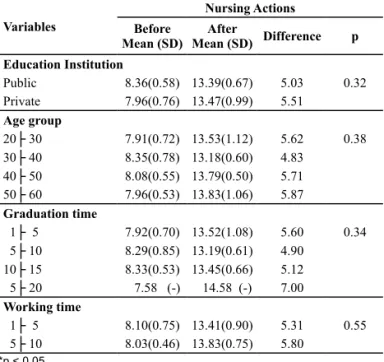
In Table 3 there is no signiicant staisical associaion between nursing acions and social and educaional vari -ables. It is important to point out that the means obtained
ater the educaional intervenion are higher than those obtained before the educaional intervenion for all stud -ied variables.
Table 3 – General characteristics of Surgery Center nurses’ aides before and after the educational intervention regarding non-inten-tional hypothermia - São Paulo, Brazil, 2010
Variables
Nursing Actions Before
Mean (SD) After
Mean (SD) Difference p
Education Institution
Public 8.36(0.58) 13.39(0.67) 5.03 0.32
Private 7.96(0.76) 13.47(0.99) 5.51
Age group
20├ 30 7.91(0.72) 13.53(1.12) 5.62 0.38
30├ 40 8.35(0.78) 13.18(0.60) 4.83
40├ 50 8.08(0.55) 13.79(0.50) 5.71
50├ 60 7.96(0.53) 13.83(1.06) 5.87
Graduation time
1├ 5 7.92(0.70) 13.52(1.08) 5.60 0.34
5├ 10 8.29(0.85) 13.19(0.61) 4.90
10├ 15 8.33(0.53) 13.45(0.66) 5.12
5├ 20 7.58 (-) 14.58 (-) 7.00
Working time
1├ 5 8.10(0.75) 13.41(0.90) 5.31 0.55
5├ 10 8.03(0.46) 13.83(0.75) 5.80
*p < 0,05
Data demonstrate in Table 4 that the nursing
interven-ion evaluainterven-ion items were staisically signiicant follow
-ing the educaional intervenion.
Table 4 – Comparison between evaluation items and the descrip-tive statistics before and after the educational intervention regar-ding non-intentional hypothermia for nurses’ aides - São Paulo, Brazil, 2010
Variabçes
Nursing Actions Before
Mean (SD) After
Mean (SD) Difference p
Risk factors 2.07(0.28) 4.26(0.31) 2.19 0.00*
Temperature control 0.56(0.26) 1.59(0.30) 1.03 0.00*
Prevention measures 2.94(0.28) 4.16(0.31) 1.22 0.00*
Heating methods 1.14(0.26) 1.67(0.28) 0.53 0.00*
Medical ile recording 1.38(0.19) 1.79(0.47) 0.41 0.00*
*p < 0,05
DiScUSSion
Nursing has been historically featured as a typically
female profession, although the male nursing populaion has tripled in the last decade, going from 86,5% in 1991 to 90% in 2010. Men represent only 7,6% of the total num
-ber of nurses(10). Studies demonstrate a wide disparity in
the percentage of male nurses, ranging from 4,5% to 30%, although females sill prevail in 100% of the educaional
programs studies(11-12). Regarding age, one other study
al-so presents ages between 27 and 39 years(10).
1,480,653 acive nursing professionals in the country;
among those, 556,779 are nurses’ aides (NAs), totaling
37,6% of the nursing workforce in the naional territory.
The Southeast region contains the highest number of nurses’ aides (207,305)(13).
Support and educaion for these workers, from the 1890s to the present, were a consequence of the pre
-dominant health pracice inluenced, at the ime, mainly by socio-poliic and economic factors. Under this context, eforts to train mid-level workers in nursing has become a priority for the Nursing Brazilian Associaion (ABEn in Bra
-zilian acronyms) and for public policies, especially those regarding health and educaion(14).
Therefore, the naional Educaion Guidelines and Basis Law (LDB in Brazilian acronyms) No. 9,394/96(15),
introduc-es changintroduc-es to profintroduc-essional educaion regarding the basic, technological and technical levels that afect the nursing technician and nurses’ aide, with a view to promoing the transiion between school and the workplace, including qualiicaions and updaing, training young adults and adults with general and speciic knowledge and abiliies to perform producive aciviies.
As of 2000, the Nursing Sector Workers Training Proj
-ect (PROFAE in Brazilian acronyms) was presented as a poliical iniiaive originaing from a pedagogical nature with a view to enhance mid-level professional educaion, which represented the best way to face the incorporaion of new technologies and changes in the technical division ield, since up unil 1999, according to esimates, there were 250,000 workers providing care delivery with no for -mal training(12).
Currently, technical educaion insituions represent the highest concentraion of schools in the private sector within all regions of the country. These insituions should be endeavoring to improve the educaional processes needed to perform acions required by schools and health
services.
In regards to graduaion and length of working ime
in the Surgery Center, most nurses’ aides had 1 to 5 years
in the workplace since graduaion. These results allow for the inference that the Surgery Center was the irst place of
employment for these professionals, a non-favoring factor
since a short period of ime since graduaion combined with a short working experience in the ield may lead to a
higher possibility of adverse events occurring. Therefore,
it is not recommended that nurses’ aides be speciically educated to provide care to criical paients through up
-daing courses.
Table 2 demonstrates that there was a signiicant sta
-isical diference ater the educaional intervenion re
-garding intra-surgery non-intenional hypothermia. Simi
-lar results were found while evaluaing the efeciveness of educaional programs, both in change of knowledge levels and in the improvement of nursing pracices(16).
It is important to point out that, in this present study,
the nurses’ aides’ cogniive structure already contained informaion regarding intra-surgery hypothermia since
these professionals had already, at some point, been
faced with a hypothermic paient, In addiion, most pro
-fessionals between 20 and 30 years of age are studying to
become nurses and have had the content approached in the Surgery Center nursing subject.
Therefore, when we applied the quesionnaire before the educaional intervenion took place, basic acquisiion of previous knowledge was sought. Thus, we were able to determine from the professionals their knowledge regard -ing the basic elements of hypothermia. These elements
are important to know so that the new concepts can an
-chor and change in such a way as to enhance the cogniive structure by incorporaing new ideas(17).
Another favoring point was the availability of the nurs
-es’ aides in composing the study group. The apprenice availability is considered as an internal factor in which the individual leaves his passive condiion and becomes ac
-ive, It is inherent in each individual(7).
This present study used the following as teaching strategies: the conceptual map, in which criical thinking is required to select key concepts and relate the new in
-formaion to previous known concepts. Case studies were also used with the objecive to illuminate the signiicant
aspects of the presented content(15).
Results in Table 3 demonstrate that social and edu-cational variables exercise no influence on the evalu-ation results of nursing interventions for intra-surgery hypothermia.
However, an increase in the means is observed af
-ter the educaional in-tervenion, mainly in professionals with higher graduaion and working ime. This can be at
-tributed to the acquisiion of knowledge through experi
-ences which, allied to their theoreical knowledge, allows the professional to develop the needed skills to eiciently perform the required aciviies in this work sector. This
development is also related to experiencing adverse
sit-uaions and social relaions in the groups in which they
have formed acquaintances throughout their professional lives(18).
One of the relevant aspects in this discussion is that the nursing team as a whole is responsible for the direct care of paients, providing for basic needs and promot
-ing welfare, hygiene and comfort, In light of these pro
-fessional responsibiliies, the need for courses taught by technically competent nurses who dominate the content and knowledge of the pedagogical-didacic pracice(19) was
perceived.
However, graduate courses in nursing present de
at recovery and fragmented care delivery intervenions, opposing current guidelines and favoring a collecive health-centered focus resuling from governmental public health strategies. The iniial nursing educaion in
itself is no guarantee of good performance in teaching
intervenions, It requires permanent educaion in care
delivery and the possibility of enhancing teaching
strate-gies supported mainly by speciic technical professional
experience(20).
Since 2000, ater PROFAE, the teaching ield was en -hanced by arriving professionals, a fact that is evidenced by the increase in the number of private nursing schools
of a technical level in Brazil. As a result, nurses are con -cluding their programs and teaching in public and private
insituions, providing classes with no speciic and deep knowledge of educaional pracices. Very few have a de
-gree in educaion, pedagogical educaion or teaching ed
-ucaion for professional ed-ucaion at the technical level
required in health care(18).
Data demonstrated in Table 4 leads us to deduce that
the nursing intervenion evaluaion items were staisi
-cally signiicant (p<0,005) following the educaional inter
-venion, suggesing that there was the acquisiion of new
meanings regarding intra-surgery hypothermia in the
cog-niive structure of nurses’ aides, based on the presented
teaching strategies.
However, these results are also connected to the per -sonal and implicit nature of nurses’ aides, since nursing is a
personal, contextual acion produced through experience relecing over and about the acion itself. The knowledge atained in the classroom holds an instrumental value, as it is internalized by the subject in his ield of reference as another element in his pracice knowledge(21).
Therefore, it is important to say that the knowledge of the items menioned here is important since non-inten
-ional hypothermia during surgery is frequent, consitut -ing an important cause of the increase in anesthesia
re-covery room complicaions, not only puing the health of the paient in danger, but also increasing the costs of the insituion due to the need for more nursing hours, consequently increasing the ime of stay in the anesthesia
recovery room.
concLUSion
Intra-surgery non-intenional hypothermia is men
-ioned as one of the main complicaions in the peri-sur -gical period. Hence, nursing professionals require training
that will enable them to handle this complicaion. Atain
-ing knowledge is a fundamental way to diminish these in
-dex complicaions in the surgery context. In this present study, the educaional intervenion was efecive, since the diference in the means for the nursing intervenions was higher (5,35) following the educaional intervenion. However, a signiicant diference in nursing intervenions was not demonstrated when related to the studied social and educaional variables. Results suggest that the con
-cepts regarding the theme were meaningful for nursing professionals; in other words, informaion was anchored, modiied and enhanced in the cogniive structure of the subjects in the study. On the other hand, the teaching strategies used in the study were also believed to contrib
-ute in ataining the results seen in this study.
Although this was not a probability sample, results corroborate those already ideniied in internaional and naional studies. Therefore, new invesigaions regarding nursing professionals’ educaion based on meaningful
learning in other hospital units must be performed.
REFEREncES
1. Jennings D. Strategic management: an evaluaion of the use of three learning methods. J Manage Develop. 2002;21(9):655-65.
2. Almeida APS, Souza NVDO. Estudo de caso: uma estratégia para construção de aitude críico-relexiva em discente de enfermagem. Rev Enferm UERJ. 2005;13(2):204-9.
3. Chang WY, Hsiao Sheen ST, Chang PC, Lee PH. Developing an e-learning educaion programme for staf nurses: processes and outcomes. Nurse Educ Today. 2008;28(7):822-8.
4. Alvarez AG, Sasso GTM. Aplicação de objeto virtual de apren -dizagem, para avaliação simulada de dor aguda, em estudantes de enfermagem. Rev Laino Am Enferm. 2011;19(2):229-37.
5. Mendoza IYQ, Peniche ACG. Factores de riesgo para compli -caciones en el período de Recuperación Postanestesica en el paciente anciano. Inves Educ Enferm. 2010; 28(3):355-62.
6. Sessler DI. Temperature monitoring and perioperaive ther -moregulaion. Anesthesiology. 2008;109(2):318-38.
7. Mendoza IYQ. Intervenção educaiva sobre hipotermia: uma estratégia de ensino para aprendizagem em centro cirúrgico [tese doutorado]. São Paulo: Escola de Enfermagem, Universi -dade de São Paulo; 2011.
9. Faro ACM. Técnica Delphi na validação das intervenções de enfermagem. Rev Esc Enferm USP. 1997;31(1):259-73.
10. Conselho Regional de Enfermagem de São Paulo (COREn-SP) SP [Internet]. São Paulo; 2011[citado 2011 jan. 13]. Dis-ponível em: htp://inter.coren-sp.gov.br/node/1375
11. Gask L, Dixon C, Morris R, Appleby L, Green G. Evaluaing STORM skills training for managing people at risk of suicide. J Adv Nurs. 2006;54(6):739-50.
12. Liu JE, Mok E, Wong T, Xue L, Xu B. Evaluaion of an inte -grated communicaion skills training program for nurses in cancer care in Beijing, China. Nurs Res. 2007;56(3):202-9.
13. Luz S. Total de proissionais no Brasil [internet]. 2010 [citado 2011 agosto 15]. Disponível em: htp: www.portaldaenfer -magem.com.br
14. Götems LBD, Alves ED, Sena RR. A enfermagem brasileira e a proissionalização de nível técnico: análise em retrospeciva. Rev Laino Am Enferm. 2007;15(5):1033-40.
15. Brasil. Lei n. 9.394, de 20 de dezembro de 1996. Dispõe so -bre Lei de Diretrizes e Bases da Educação Nacional. Diário Oicial da União, Brasília, 23 dez. 1996. Seção 1, p.1
16. González HL, Palencia AP, Umanã LA, Galindo L, Villafrade MLA. Mediated learning experience and concept maps: a pedagogical tool for achieving meaningful physicology stu-dents. Adv Physiol Educ. 2008;32(4):312-6.
17. Gul RB, Boman JA. Concep mapping: a strategy for teach -ing and evaluaion in nurs-ing educaion. Nurse Educ Pract. 2006;6(4):199-206.
18. Perrenoud P, Thurler MG. As competências para ensinar no século XXI: a formação dos professores e o desaio da avalia -ção. Porto Alegre (RS): Artmed; 2002.
19. Secaf V. A licenciatura em enfermagem e a práica de en -sino: uma revisão críica da sua evolução na Universidade de São Paulo [tese doutorado]. São Paulo: Escola de Enferma -gem, Universidade de São Paulo; 1987.
20. Ferreira MAJ. Os relexos da formação inicial na atuação dos professores enfermeiros. Rev Bras Enferm. 2008;61(6):866-71.