ABSTRACT This paper examines the profile of physical health resources available in Brazil so to support the debate of the reorganization of the health service network, using as example the case of highly complex trauma. Data were retrieved from the 2013 version of the National Register of Health Establishments. Quantitative failure and poor geographical distribution were identified in the provision of large hospitals and beds in intensive care units, as well as the eight structures required by the Ministry of Health to licensing establishments to operate high complexity trauma. The acquisition of one structure by the establishments that already carry the seven other ones would increase from 30 to 80 the number of municipalities offering high complexity trauma care.
KEYWORDS Health care rationing. Regional health planning. Hospital care. Trauma centers.
RESUMO Este artigo analisa o perfil dos recursos físicos de saúde disponíveis no Brasil, utilizan-do o exemplo utilizan-do trauma de alta complexidade para subsidiar o debate da reorganização da rede de serviços de saúde. Utilizou-se o Cadastro Nacional de Estabelecimentos de Saúde de 2013. Identificou-se que há insuficiência quantitativa e baixa oferta na distribuição geográfica de leitos de Unidades de Terapia Intensiva, de hospitais de grande porte e das oito estruturas exigi-das pelo Ministério da Saúde para habilitação dos estabelecimentos ao atendimento do trauma de alta complexidade. A aquisição de uma estrutura nos estabelecimentos que já possuem as outras sete aumentaria esta oferta de 30 para 80 do número de municípios com atendimento ao trauma de alta complexidade.
PALAVRAS-CHAVE Alocação de recursos para a atenção à saúde. Regionalização. Assistência hospitalar. Centros de traumatologia.
Reallocating the Unified Health System’s
supply to face attend future problems: the
case of traumatology in Brazil
Realocar a oferta do SUS para atender problemas do futuro: o caso do
trauma no Brasil
Luisa Regina Pessôa1, Isabela Soares Santos2, Juliana Pires Machado3, Ana Cristina Marques Martins4, Claudia Risso de Araujo Lima5
1 Fundação Oswaldo Cruz (Fiocruz), Escola Nacional de Saúde Pública Sergio Arouca (Ensp), Centro de Referência Professor Hélio Fraga (CRPHF) – Rio de Janeiro (RJ), Brazil.
luisareginapessoa@hotmail. com
2 Fundação Oswaldo Cruz (Fiocruz), Escola Nacional de Saúde Pública Sergio Arouca (Ensp) – Rio de Janeiro (RJ), Brazil.
3 Ministério da Saúde, Agência Nacional de Saúde Suplementar (ANS) – Rio de Janeiro (RJ), Brazil.
4 Ministério da Saúde, Agência Nacional de Saúde Suplementar (ANS) – Rio de Janeiro (RJ), Brasil.
5 Fundação Oswaldo Cruz (Fiocruz), Escola Nacional de Saúde Pública Sergio Arouca (Ensp), Cadernos de Saúde Pública (CSP) – Rio de Janeiro (RJ), Brazil.
Introduction
This article aims to map and analyze the profile of existing health physical resources in Brazil, adopting as example the resources applied to high complexity trauma so as to subside the debate on investment alternatives for the reorganization of the health services network with regards to demographic and epidemiological transitions and health high costs envisaged for the coming years, particularly the investment in Science and Technology (S&T).
There is a concern on how the incorporation of new health technologies in Brazil is being handled, especially by the public sector. The increase of the installed capacity used or made available often occurs in an inappropriate way, given the fragility of the incorporation and the peculiarity of the public-private mixed operation in the Brazilian health system (MACHADO ET AL., 2015). An example of the seriousness of this
situation is the audit result released by the Federal Court of Accounts (TCU) (BRASIL, 2013B)
with regard to the service provided by the hospitals pertaining to the Unified Health System (SUS). TCU performed a broad diagnosis across the country by assessing the 116 public hospitals that offer more than 50 beds each with a focus on identifying the reason for the existence of beds and services unavailable and/or blocked for use by the population, starting on media complaints and coverage.
The process of demographic transition has transformed the Brazilian society profile into a more long-lived one (OLIVEIRA; O’NEILL, 2013). This changing in age structure directly
affects the usage pattern of health services, the model of hospital care (BRAGA NETO ET AL., 2012), and the need to adjust the physical
resources supply to the new reality.
The services network reorganization to supply future needs should take into account that in recent decades the events caused by external causes (violence and accidents) are
among those that most affect the Brazilians, showing a significant increase in the rate of SUS inpatients by external causes in the last decade. The two main reasons (murders and traffic accidents) accounting for mortality rates are much higher than those of developed countries, being the third cause of population mortality (MORAES NETO ET AL., 2012; LUNA; SILVA JÚNIOR, 2013). The year
2000 coefficient achieved 69.7/100.000. It is to be noted that deaths by external causes have progressively increased in recent years, indicating a possible aggravation of the problem in the coming years (GAWRYSZEWSKI; KOIZUMI; MELLO-JORGE, 2004; BRASIL, 2013A).
In Brazil, data on mortality and morbidity due to external causes in 2000 revealed that the profile of external causes associated with death differs from that related to morbidity. Homicides are the main cause of deaths, while falls are responsible for more than half of inpatients. On the other hand, trauma and injuries related to ground transportation are important both to mortality and morbidity. Combined, homicides, traffic accidents and falls are the most important causes and should guide the priorities in the trauma care organization (GAWRYSZEWSKI; KOIZUMI; MELLO-JORGE, 2004).
The knowledge of morbidities and of these chronic diseases load would contribute in the guidance line of trauma care and other disabling pathologies, in organizing the Services of Diagnostic and Therapeutic Support (SADT), and, subsequently, in rehabilitation services, such as physiotherapy, speech therapy, among others, required for the monitoring of former inpatients.
Ministry of Health (MS) established, in 2006, the National Care Policy for High Complexity Traumatology and Orthopedics. In 2011, as well, MS created the Care Network for Urgencies and Emergencies (RUE), defining strategies for organization of services and health actions as for care in urgency and emergency situations (BRASIL, 2011).
In 2013, MS published the Ordinance No. 1,366, which established the organization of Trauma Centers within SUS scope by setting the units qualification requirements in the ranking of medium complexity trauma care hospitals, Trauma Centers type I, high complexity centers, and Trauma Centers types II and III (BRASIL, 2013A). Together, such
ordinances define guidelines and aim to provide the trauma care organization at all SUS levels.
This is the context in which a sharp look towards the supply and the investment in medium and high complexity trauma centers is needed in Brazil.
Methods
For the purposes of this work, physical health resources refer to the installed capacity comprising the health services supply. As the supply assumes the existence of other resources in addition to the installed capacity – as the human, cognitive, technological, material, financial, and power ones –, it is important to note that this study examines only the physical resources.
The National Register of Health Establishments (CNES), published by SUS Department of Informatics (Datasus/ MS), was used as source of information on physical health resources available in Brazil in December 2013. Existing institutions were identified and described as for their geographical location and selected characteristics: legal status (public, non-profit private, for-non-profit private); type of service provided (inpatient, outpatient,
SADT, emergency); type of establishment (health centre or clinic, polyclinic, specialized clinic or outpatient, general or specialized hospital, general or specialized emergency room, SADT unit).
Due to the high detailing degree of CNES variables, these received new categories, following the methodology defined by Santos et al. (2016), so to select only those
that fall within the scope of this study and to aggregate detailed data, such as, for example, hospitals that were categorized by total of beds, existing policies and ordinances, and the number of beds in Intensive Care Units (ICU).
The equipments in use were selected for analysis, being disregarded those ones out of use.
The availability of ‘SUS’ and ‘non SUS’ beds was observed, where ‘SUS’ includes beds in public and private establishments (mostly non-profit), and ‘non SUS’ beds comprise also for-profit private organizations as non-profit private organizations without a covenant with SUS.
As for the structure analysis involving inpatient beds, a database was built encompassing all establishments whose CNES field ‘type of service provided’ was filled in with the category ‘hospital care’. Among these, establishments without beds were excluded. Specific bases were also built for the analysis of selected equipments, services and qualifications.
For a health unit to be enable to treat high complexity trauma (Trauma Center types II and III), it must meet eight requirements defined by the National Trauma Policy
(BRASIL, 2013A; BRASIL, 2006): 1. offer of more than
REGION LEGAL STATUS Health centre or clinic
Polyclinic, clinic or specialized
outpatient
General or specialized hospital
General or specialized emergency room
SADT TOTAL
North
Public 3,834 277 284 56 113 4,564
Non-profit private 8 42 32 - 10 92
For-profit private 25 1,531 209 9 858 2,632
Northeast
Public 16,755 1,450 918 180 485 19,788
Non-profit private 36 223 263 5 17 544
For-profit private 277 7,148 591 71 3,300 11,387
Southeast
Public 13,239 2,450 509 579 477 17,254
Non-profit private 40 705 837 14 141 1,737
For-profit private 128 16,014 842 90 8,184 25,258
South
Public 7,033 653 249 147 155 8,237
Non-profit private 32 576 467 8 76 1,159
For-profit private 82 5,629 322 37 4,568 10,638
Midwest
Public 3,034 440 289 79 144 3,986
Non-profit private - 74 95 - 15 184
For-profit private 25 3,535 388 21 1,732 5,701
TOTAL
Public 43,895 5,270 2,249 1,041 1,374 53,829
Non-profit private 122 1,620 1,694 27 259 3,722
For-profit private 537 33,857 2,352 228 18,642 55,616
Total 44,554 40,747 6,295 1,296 20,275 113,167
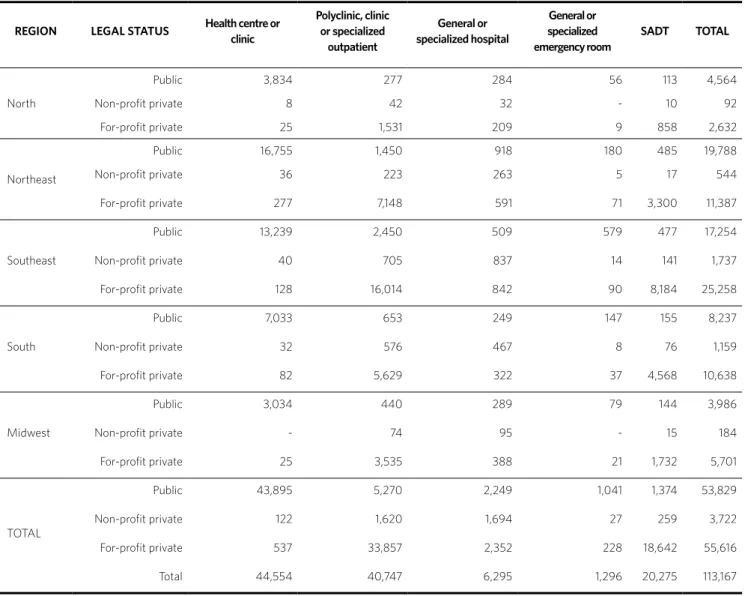
Table 1. Establishments as for type and legal status – Brazil and regions, 2013
Results
Brazil offers more than 113,000 health units as total of those that are connected to SUS (non-profit public and private ones) and those that operate only privately (whether for-profit or non-profit). The distribution of establishments differs by regions across
the country, especially when outpatient care is concerned.
Emergency rooms are mainly public organizations (80%), whereas SADT are predominantly for-profit private ones (92%) as are medical offices, specialized clinics or outpatients and polyclinics (83%) (table 1).
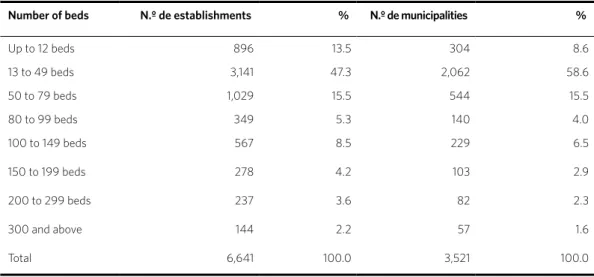
Inpatient bed units spread through approximately 3,500 municipalities. It is worth to point out that if, on one hand, only 2% of establishments provide more than 300 beds, distributed in only 2% of the municipalities that offer
hospital care, on the other hand, the vast majority of establishments that offer inpatient beds across the Country (80%) providing fewer than 100 beds are the so-called small and mid-sized hospitals (table 2).
Table 2. Number and percentage of establishments and municipalities as for availability of beds – Brazil, 2013
Number of beds N.º de establishments % N.º de municipalities %
Up to 12 beds 896 13.5 304 8.6
13 to 49 beds 3,141 47.3 2,062 58.6
50 to 79 beds 1,029 15.5 544 15.5
80 to 99 beds 349 5.3 140 4.0
100 to 149 beds 567 8.5 229 6.5
150 to 199 beds 278 4.2 103 2.9
200 to 299 beds 237 3.6 82 2.3
300 and above 144 2.2 57 1.6
Total 6,641 100.0 3,521 100.0
Source: CNES, 2014.
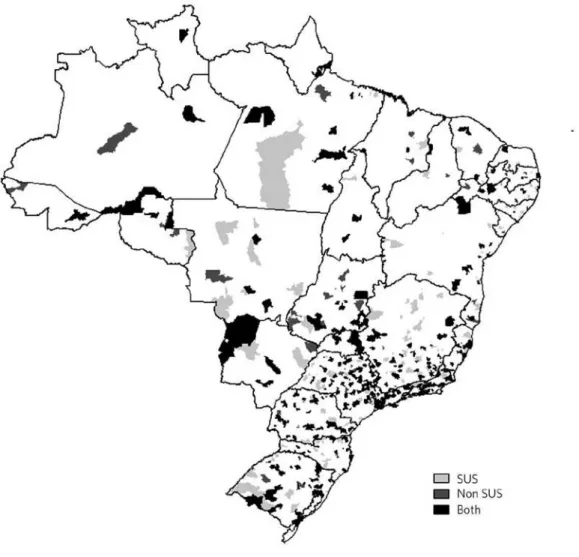
Amongst the 430,000 beds, 37,968 pertain to intensive care units and are much more evenly divided between SUS and non-SUS organizations – respectively, 18,970 (50.3%) and 18,998 (49.7%).
When ICU and general beds are compared, a greater complexity of non-SUS beds (14%) in relation to SUS ones (6%) can be noted. This imbalance is most evident in
some cities, like São Paulo, Rio de Janeiro, Brasília and Niterói, where the private offer is quite higher than SUS one.
Figure 1. Municipalities as for availability of SUS and non SUS ICU beds, or both – Brazil, 2013
Source: CNES, 2014.
Concerning high complexity trauma, just 41 hospitals in 30 municipalities fulfill the eight items required for high complexity trauma servicing. Among them, 17 are public services, 21 are non-profit private and three are for-profit private ones.
Regarding investments for the reorgani-zation of the high complexity trauma care network, it is observed that 99 hospitals in 50 municipalities fulfill seven or eight of the
In case the resources are allocated to 50 out of the 99 hospitals meeting just one of the analyzed structures, Brazil would more than double the number of municipalities carrying capacity to high complexity trauma assistance, increasing from 30 to 80 the number of municipalities covered.
When grouping the municipalities that fulfill seven or eight of the structures for complexity trauma care, one can clearly note the shortage of hospitals available for
that service in the North and Northeast regions. The units able to provide that service are concentrated in the South and Southeast regions, especially in the cities of São Paulo, Rio de Janeiro, Porto Alegre, Salvador, Belo Horizonte, Santos e Recife, which carry at least one hospital meeting the eight structures required. The 14 municipalities in which 37 hospitals meeting seven of the eight required structures are located also carry a unit fulfilling the eight structures ( figure 2). Chart 1. Hospitals and municipalities as for number of structures of existing high complexity trauma services – Brazil, 2013
Figure 2. Municipalities as for the classification of establishments by number of structures servicing complex trauma – Brazil, 2013
Source: CNES, 2014.
Discussion
The results here presented aim to provide, in particular, allocating choices in the field of high complexity trauma viewing to sub-sidize a health physical resource network in its future processes of health care reorgani-zation and planning. It is supposed that the high cost of S&T investment and the real shortage of the public sector resources in-creasingly require the decision on where to
carry out the investment.
service capacity.
While having as objective the reorganization of services related to the public sector so to increase the supply of medium complexity services, consultations and tests, the Brazilian health system still has to deal with the relevant issue embodied by the difficulty of the municipal administration in investing in the expansion of public installed capacity at this level of care given the challenges of the management itself that consist of, among others, the need for technical staff trained in public administration, provided the continuity/ stability in the public service.
The low supply of hospitals carrying more than 100 beds is another issue preventing the reversal of negative indicators in the organization of these services. The role of small hospitals in care rendering has been discussed and shows that the occupancy rate tends to be lower in hospitals with less than 100 beds despite the different classifications on the number of beds for the definition of small hospital adopted in the researches. In addition, the greater cost of procedures and frequency of security problems, the units low resolution capacity, and the insufficient specialized outpatient care were also identified.
The study revealed important gaps in the provision of social assistance services as of ICU beds, which are currently essential to the quality of attention in almost all lines of care. The quantity of ICU beds in the country is critically insufficient, but investments cannot be limited to filling of voids and rebalancing the public-private provision; they should also fulfill the coming needs.
In order to be able to shield new demands, experts affirm that the proportion of ICU beds, actually established between 4% and 10% by a Ministerial Ordinance, is likely to increase as a result of changes
also in the complexity of care services as in demographic and epidemiological profiles. ICU beds should achieve 20% of total beds in high complexity hospitals over the next 20 years. Once again, SUS, whose ICU beds represent 6% of total beds, are behind the private sector, which already reached 14%.
In the case of high complexity trauma care service, both the quantitative insufficiency and the dispersion of ICU beds across the country interfere with the possibility of increasing the provision of Trauma Centers.
This study revealed that, if resources are allocated to 50 out of the 99 hospitals carrying just one of the structures analyzed, the number of municipalities in Brazil able to render assistance to high complexity trauma would more than double, increasing from 30 to 80 the number of cities covered by the service.
Conclusion
When the large amount of unavailable existing resources is under consideration, it could be worthwhile to the country to make available the existing resources and to reduce their idleness rather than to acquire new resources and units, even if the transformation requires restructuring or relocating resources from one place to another, by means of resources migration.
In case of high complexity trauma, the both by the municipalities and SUS institutions already fulfilling all the remaining structures necessary to service this trauma and by municipalities showing the potential to become a SUS network knot in trauma.
system and strengthens the expansion and consolidation of private offering, reinforcing the public-private imbalance of the medium complexity provision of services. In addition, it enables initiatives also of international scope seeking to influence the Brazilian health system design – such as the Universal Health Coverage — as those approved in Congress favoring the private sector in detriment to SUS. Examples of the latter
are Constitutional Amendment Bill (PEC) no.451, which compels the employer to offer private plan to employees, proposed by Congressman Eduardo Cunha in 2014; law no.13,097, proclaimed in 2015, which allows the foreign capital to control and directly or indirectly participate in health services; and Agenda Brazil, proposed by Congressman Renan Calheiros in 2015. All of them are strong threats to SUS consolidation and to the right to health. s
References
BRAGA NETO, F. C. et al. Atenção Hospitalar: evolução histórica e tendências. In: GIOVANELLA, L. et al. (Org.). Políticas e Sistema de Saúde no Brasil. 2 ed. Rio de Janeiro: Fiocruz, 2012, p. 577-608.
BRASIL. Ministério da Saúde. Política nacional de atenção às urgências. 3 ed. Brasília, DF: Ministério da Saúde, 2006. 256 p.
______. Ministério da Saúde. Portaria nº 1.600, de 7 de julho de 2011. Reformula a Política Nacional de Atenção às Urgências e institui a Rede de Atenção às Urgências no Sistema Único de Saúde (SUS). Diário Oficial [da] União, Brasília, DF, 8 jul. 2011. Disponível em: <http://bvsms.saude.gov.br/bvs/saudelegis/ gm/2011/prt1600_07_07_2011.html>. Acesso em: 18 jul. 2016.
______. Ministério da Saúde. Portaria nº 1.366, de 8 de julho de 2013. Estabelece a organização dos Centros de Trauma, estabelecimentos de saúde integrantes da Linha de Cuidado ao Trauma da Rede de Atenção às Urgências e Emergências (RUE) no âmbito do
Sistema Único de Saúde (SUS). 2013a. Diário Oficial [da] União, Brasília, DF, 9 jul. 2013. Disponível em: <http://bvsms.saude.gov.br/bvs/saudelegis/gm/2013/ prt1366_08_07_2013.html>. Acesso em 18 jul. 2016.
______. Tribunal de Contas da União. Relatório de Levantamento: FiscSaúde. Brasília, DF, 2013b. Disponível em: <http://portal3.tcu.gov.br/portal/ page/portal/TCU/imprensa/noticias/noticias_ arquivos/032.624-2013-1%20Fisc%20Saude.pdf>. Acesso em: 22 ago. 2016.
GAWRYSZEWSKI, V. P.; KOIZUMI, M. S.; MELLO-JORGE, M. H. P. As causas externas no Brasil no ano 2000: comparando a mortalidade e a morbidade. Cad. Saúde Pública, Rio de Janeiro, v. 20, n. 4, p. 995-1003, jul./ago. 2004.
LUNA, E. J. A.; SILVA JR., J. B. Doenças
gasto setorial. Rio de Janeiro: Fiocruz; Ipea; Ministério da Saúde; Secretaria de Assuntos Estratégicos da Presidência da República, 2013. p. 97-107.
MACHADO, J. P.; MARTINS, M.; LEITE, I. C. O mix público-privado e os arranjos de financiamento hospitalar no Brasil. Saúde debate, v. 39, n. especial, p. 39-50, dez. 2015.
MORAIS NETO, O. L. et al. Mortalidade por acidentes de transporte terrestre no Brasil na última década: tendência e aglomerados de risco. Ciênc. saúde colet., Rio de Janeiro, v. 17, n. 9, p. 2223-2236, set. 2012.
OLIVEIRA, A. T. R.; O’NEILL, M. M. V. C. Cenário Sociodemográfico em 2022-2030. In: FUNDAÇÃO OSWALDO CRUZ (Fiocruz). A saúde no Brasil em
2030: prospecção estratégica do sistema de saúde brasileiro: estrutura do financiamento e do gasto setorial. Rio de Janeiro: Fiocruz; Ipea; Ministério da Saúde; Secretaria de Assuntos Estratégicos da Presidência da República, 2013, p. 85-89.
SANTOS, I. S. et al. Os recursos físicos de saúde no Brasil: um olhar para o futuro. In: NORONHA, J. C. (Org.). Brasil Saúde Amanhã: dimensões para o planejamento da atenção à saúde. Rio de Janeiro: Fiocruz, 2016.
Received for publication in: February, 2016 Final version: July, 2016