ISSN 0104-6632 Printed in Brazil
www.abeq.org.br/bjche
Vol. 34, No. 01, pp. 109 - 117, January - March, 2017 dx.doi.org/10.1590/0104-6632.20170341s20150040
Brazilian Journal
of Chemical
Engineering
A COMBINED ELECTROCOAGULATION–
ELECTROOXIDATION TREATMENT FOR
DAIRY WASTEWATER
I. Chakchouk
1, N. Elloumi
2, C. Belaid
1, S. Mseddi
1, L. Chaari
1and M. Kallel
1*1Laboratory of Water, Energy and Environment, Sfax University, National Engineering School of Sfax, Tunisia. E-mail: [email protected]
2Laboratory of Water, Energy and Environment, Sfax University, Higher Institute of Biotechnology of Sfax, Tunisia.
(Submitted: January 22, 2015 ; Revised: September 7, 2015 ; Accepted: September 22, 2015)
Abstract - Dairy industry effluent is characterized by high chemical oxygen demand (COD) and other pollution load. This study addresses the elimination of organic compounds in dairy wastewater using electrocoagulation (EC), electrooxidation (EO) and a synergistic combination of EC and EO.The removal of COD, color and turbidity was investigated at various current intensities by using different electrodes and at various electrolysis times. Results show that EC is a relatively quick process (6 min), which is very effective in removing colloidal and suspended particles, as seen in changes in turbidity and color, but it is effective to eliminate only half of the COD. However, EO reduces 40% of COD in a practical time of about 30 min. To improve the removal of COD we proceeded to combine the two processes. Thus, the coupled process eliminates 60% of COD in a practical amount of time (21 min), removes the colloidal and suspended particles and eliminates color, turbidity, phosphorus, K+ and NTK. The use of the seed toxicity test allows evaluating the quality and effectiveness of
the studied effluent treatment system. Seed irrigated with raw waste or treated dairy effluent show no phytotoxicity.
Keywords: Dairy wastewater; Electrocoagulation; Electrooxidation; Combined electrocoagulation-electrooxi-dation treatment.
INTRODUCTION
Industrial wastewater is now one of the major sources of water pollution. Apart from organic carbon, wastewater also contains significant amounts of or-ganic/inorganic nutrients like nitrogen, protein, am-monia, nitrate, and phosphate, including biorefractory organic compounds which resist conventional treat-ment techniques (Narkis et al.,1979).
Agro-industries, like the dairy industry, generate large amounts of wastewaters, which are difficult to treat properly because of their complex behavior. Dairy waste effluents are concentrated in nature. The
main contributors of organic charge to these ef-fluents are carbohydrates, proteins and fats origi-nating from milk (Vidal et al.,2000; Bensadok et al., 2011).
Recently, electrochemical techniques are gaining importance for the treatment of wastewater containing organic and inorganic compounds such as phenols (Comninellis and Nerini, 1995; Kallel et al., 2009; Belaid et al., 2013), tannins (Murugananthan et al., 2007), dyes (Muthukumar et al.,2007; Bhaskar Raju et al.,2008) and hexavalent chromium (Lakshmipathiraj
et al., 2008). The application of electrochemical
advantages compared with chemical or biological methods.
Chemical oxidation methods can be used for the oxidative decomposition of many organic pollutants, but these methods require large amounts of reactive chemical reagents. Biological and electrochemical methods have little negative effects on the environ-ment, because these techniques do not involve the use of harmful reagents.
Among the different electrochemical methods, the most applied technologies include the oxidation of or-ganic pollutants by cathodic generation of hydrogen peroxide (Sanchez-Sanchez et al.,2007; Nidheeshand Gandhimathi, 2012), anodic oxidation using different electrodes (Panizza et al., 2001; Iniesta et al.,2002), cathodic removal of metals (Fu and Wang, 2011) and electrocoagulation (Valero et al.,2008; Linares-Her-nández et al., 2010; Emamjomeh and Sivakumar, 2010; Valero et al.,2011).
Electrocoagulation (EC) has been in use for water production or wastewater treatment (Matveevich, 2000). It is finding more applications using either alu-minum, iron or hybrid Al/Fe electrodes. EC is effi-cient in removing suspended solids as well as oil and greases. It is very effective in coagulating the colloids found in natural water, reducing the turbidity and color (Can et al.,2003; Daneshvar et al.,2006). It can be used to remove iron ions, silicates, humus, dis-solved oxygen, etc. (Chen, 2004). EC has been em-ployed in treating wastewaters from textile (Can et al., 2006; Phalakornkule et al.,2010), tannery (Benhadji
et al., 2011), food industries (Tezcan et al., 2006;
Valero et al., 2014), catering (Chen et al., 2000), pe-troleum, tar sand and oil shale wastewater (Renk, 1988), municipal sewage (Pouet and Grasmick, 1995), chemical fiber wastewater (Lin and Lin, 1998), oily wastewater (Pazenko at al., 1985), nitrite (Abuzaid et al.,1999), and dye stuff (Ogutveren and Koparal, 1992) from wastewater.
In those cases where EC is not able to reduce COD to below discharge limits, it is compulsory to use an additional treatment.
Several papers showed that Electrooxidation (EO) was an effective method for reducing the pollutant load of water containing soluble organic matter (Valero et al., 2014). Moreover, due to the growing development of more efficient electrodes, electro-chemical oxidation is able to destroy several practi-cally recalcitrant organic pollutants such as polyphe-nols and fatty acids (Belaid et al.,2013). Titanium-based boron-doped diamond film electrodes (Ti/BDD) show high activity and give reasonable stability. Its industrial application calls for the production of
Ti/BDD anodes of large size at reasonable cost and durability. On the other hand, EO systems are not de-signed for treating water containing high amounts of suspended solids. Therefore, wastewater containing suspended solids should be first treated, for example by EC, to remove those solids before sending the wastewater to an EO treatment system.
The objective of this study is to compare the effec-tiveness of EC and EO methods for pollutant removal from dairy effluent. Once the optimal conditions of each method were identified, we combine them to produce synergistic effects and to obtain the best con-ditions for complete pollutant removal, allowing wa-ter recovery and reuse for agricultural purposes.
METHODOLOGY
Water Physicochemical Analysis
The dairy effluent sample was collected from the wastewater treatment plant of a Tunisian dairy indus-try and kept at 4 °C before use. The actual wastewater treatment plant receives 600 m3 of effluents every day and it consists of a primary clarifier, biological acti-vated sludge reactors and secondary clarifier.
The pH and electric conductivity of untreated and treated wastewaters were determined using a pH me-ter (Model EA940, Orion, USA) and a conductivity meter (Model WTW LF 90), respectively. Chemical oxygen demand (COD) was determined according to the Knechtel (1978) standard method. Biochemical oxygen demand (BOD5) was determined by the mano-metric method using a digital respirometer BSB-Con-troller, Model 620 T (WTW). The phosphorus con-centration in aqueous media was determined accord-ing to Hanson (1973).
Electrocoagulation Reactor
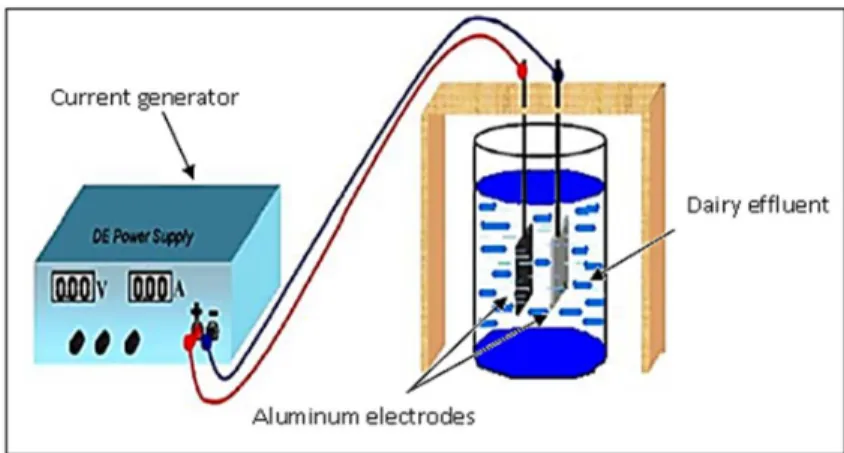
Electrocoagulation was performed in a cylindrical reactor with a working volume of 1 L. All the ex-periments were conducted at a constant temperature of 25 °C. The electrochemical cell has two aluminum plates, one serving as a cathode and the other as anode (Figure 1). The spacing between electrodes was 5mm. A direct current variable from 0 to 10 A was supplied from a current generator, type CLES 35-10 (Labora-tory Power Supply, Convergie, France).
Figure 1: Electrocoagulation reactor.
The eletrochemical reactions involved in the reac-tor can be written as:
At the cathode:
2 2
3H O 3e (3 / 2) H (g)3OH (1)
At the anode:
3
AlAl 3e (2)
In the solution:
3
2 3
Al (aq)3H OAl(OH) 3H(aq) (3)
The H2 produced as a result of the redox reaction
may remove dissolved organics or any suspended materials by flotation and this phenomenon is one of the advantages of the EC process (Yildiz, 2008).
In order to enhance the process performance, the effect of the density of current has been explored. Four densities of current were chosen for this study:
0.6 A/dm2, 1.2 A/dm2, 1.8 A/dm2 and 2.4 A/dm2 with an application time of 15 min. To follow the progress of the treatment, samples of 10 mL were periodically taken from the beaker, then decanted for 30 min to separate sludge produced during the process.
Electrooxidation
Electrooxidation was performed in a cylindrical reactor with a working volume of 500 mL. All the ex-periments were conducted at a constant temperature of 25 °C. The reactor cell is composed of two cylin-drical electrodes made of expanded platinized tita-nium and the electrodes were separated by 0.5 cm (Figure 2). To keep the homogenization of the effluent a small pump with a flow rate of 2 mL/min was used. During the EO process, two phenomena can be ob-served. In the first case, the electrode is active and par-ticipates directly in the oxidation of the organic product by adsorption of the pollutant on the surface of the anode and its degradation by electron transfer. In the second case, the electrode contributes to oxida-tion via hydroxyl radicals formed during electrolysis of water.
Methods of Analysis
The evaluation of the treatments was determined by analysis of the chemical oxygen demand (COD) (Knechtel, 1978), biochemical oxygen demand (BOD5), color (OD), turbidity, suspended solids, dry matter and pH, as indicated in the Standard Methods procedures. The color was assayed at 270 nm using a UV/Visible spectrophotometer (Thermospectronic UV1).
Total nitrogen was determined by the Kjeldahl method (Kjeldahl, 1883); phosphorus was measured colorimetrically (Hanson, 1973) and K, Na and Cl by atomic absorption spectrophotometry (HITACHI Model Z-6100).
Phytotoxicity Test
The phytotoxicity was assessed for the dairy efflu-ent treated (EC, EO and EC+EO) samples mefflu-entioned above by using seed germination of pea (Pisum
sa-tivum). The phytotoxicity was determined according
to the Zucconi test (Zucconi et al., 1981). Ten pea seeds were placed on filter papers in glass Petri dishes with dimensions 110 mm x 20 mm. 10 ml of dairy ef-fluent samples were then uniformly added to each dish. The dish was capped and kept in a dark incubator at 25 °C temperature for 5 days. 10 ml of tap water were used for the controls, instead of dairy effluent. All samples, including the control, were run in tripli-cate. All seeds were kept in tap water for approxi-mately 12 h prior to the initiation of the experiments, to accelerate seed growth. A germination index (GI) was calculated by counting the number of germinated seeds and the average sum of the seeds’ root elonga-tion in a sample relative to the control. Results were finally expressed as a percentage.
RESULTS AND DISCUSSION
Dairy Effluent Characteristics
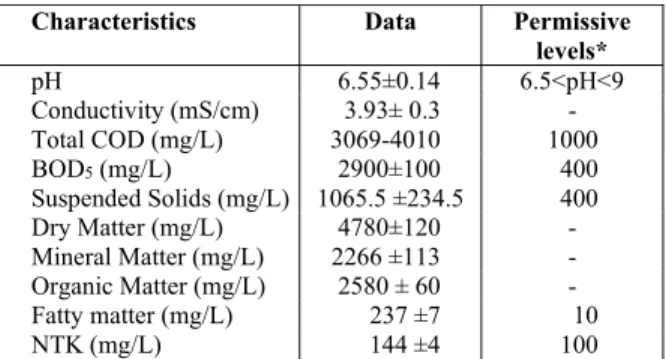
The physico-chemical properties of dairy effluent are given in Table 1. The dairy effluent was milky white in color and turbid. The analyses performed on this effluent demonstrate that it is principally charac-terised by a slightly acidic pH (around 6.55) and an electrical conductivity of around 3.93 mS/cm. Total suspended solid (1065.5 mg/L) is higher when com-pared to the permissible value. The total solid concen-tration in the waste effluent represents the colloidal form and dissolved species. It contains large amount of total solids and total dissolved solids, resulting in high BOD and COD. COD and BOD5 values of the
effluent were 3069 and 2900 mg/L respectively, com-pared to their respective standard values of 1000 and 400 mg/L.
Table 1: Physico-chemical characteristics of the dairy effluent used in this study.
Characteristics Data Permissive levels*
pH 6.55±0.14 6.5<pH<9
Conductivity (mS/cm) 3.93± 0.3 - Total COD (mg/L) 3069-4010 1000 BOD5 (mg/L) 2900±100 400 Suspended Solids (mg/L) 1065.5 ±234.5 400 Dry Matter (mg/L) 4780±120 - Mineral Matter (mg/L) 2266 ±113 - Organic Matter (mg/L) 2580 ± 60 - Fatty matter (mg/L) 237 ±7 10
NTK (mg/L) 144 ±4 100
*Tunisian norms for effluent discharge in sewer (TN 106 002)
Electrocoagulation of Dairy Effluent
EC experiments have been run with dairy effluent for four current densities, from 0.6 to 2.4 A/dm2 and
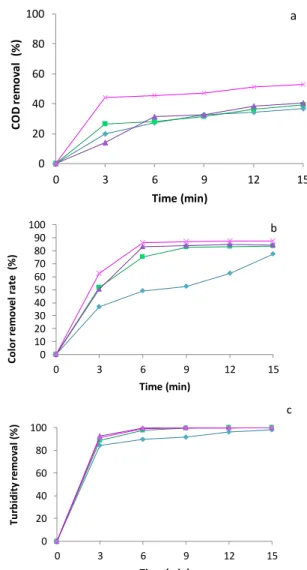
with aluminum electrodes (anode and cathode), Figure 3 (a, b and c) represents the effects of the elec-trolysis time on COD, turbidity and color removal ef-ficiencies for various current densities using Al elec-trode materials. As shown in Fig. 3, when the current density was increased from 0.6 to 2.4 A/dm2, the COD
removal increased from 19.6 to 53%. As the current density increased, the electrolysis time needed to achieve similar efficiencies decreased. As seen in Fig. 3, 31.51% of COD removal was obtained at the cur-rent density of 1.8 A/dm2 in 6 min. However, 31.19%
of COD removal was reached at current densities of 1.2 A/dm2 in 9 min.
At the current density of 2.4 A/dm2, 53% of COD removal was achieved with an electrolysis time of 15 min. Likewise, 87.52% of color removal was attained at the current density of 2.4 A/dm2 in 15 min. Similar color removal efficiencies of 86.84% and 87.52% were obtained at a current density of 2.4 A/dm2 in 9
More to the point, the results showed that, for cur-rent densities ≥1.2 A/dm2
, abatement of the pollution variables occurs in two phases as follows:
− The first phase of decreasing pollution during which the COD, the color and the turbidity removal yields increase with the current density. This can be explained by the fact that Al3+ production resulting from the anode dissolution increases with current den-sity according to Faraday's law.
− The second phase represents the stationary phase. This phase is reached after 6 min of treatment. For this period, a further increase in aluminum con-centration has no further effect on the treatment.
In general, Figure 3 for COD, turbidity and color removals versus electrolysis time demonstrated an in-creasing trend with the increase of current density. Our results show also an increase of pH, which passes from 6.6 to 6.9, and this can be explained by for-mation of OHby the reduction of water at the cathode. The pH has a considerable effect on the performance of the EC process (Kobya et al.,2003). In a previous study conducted by Adhoum and Monser (2004), the highest COD and color removal efficiencies were obtained in acidic medium, at pH values in the limits of 4.0–6.0. However, very poor removals are found either at low (<2.0) or high pH (>10). This behavior was attributed to the amphoteric character of Al(OH)3
that does not precipitate at pH less than 2.0. However, high pH will increase Al(OH)3 solubility and lead to
the formation of soluble Al(OH)4- which is useless for
water treatment. Can et al. (2003) have reported that an acidic or neutral initial medium is beneficial for low electrical energy consumption.
Electrooxidation of Dairy Effluent
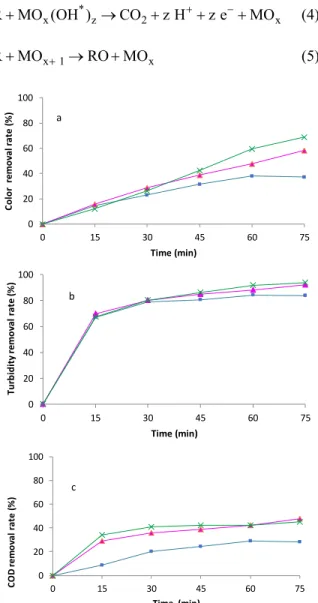
Electrooxidation is an effective method for degra-dation of organic pollutants. Effect of current intensity was also investigated in the range of 1.1 A/dm2 to 1.8 A/dm2 at an initial pH of 6.6 and at constant flow rate of wastewater. As shown in Figure 4, increasing cur-rent intensity led to the decrease of turbidity, color and COD following Faraday’s law (Prentice, 1991).
For higher current densities, the treatment can be carried out with high efficiency: turbidity of the waste could be nearly removed (+91.61%) after 60 min. At the same current intensity of 1.8 A/dm2, 59.46% and 42% of color and COD were reduced within 60 min electrolysis time. The decrease of color and COD is attributed to the destruction of organic contaminants in wastewater when the EO was implemented. These results showed that the treatment process by EO re-quired a relatively longer reaction time than EC.
Figure 3: Effect of electrocoagulation on (a) COD, (b) color and (c) turbidity reduction as a function of electrolysis time and current density. Current density and electrolysis time (pH 6.6; Al–Al electrodes). 0.6 A/dm2 (), 1.2 A/dm2 (□), 1.8 A/dm2 (), 2.4 A/m2 ().
The EO process also allowed the elimination of odors caused by the high pollution load of the effluent. Piya-areetham et al. (2006) show that the reduction mechanism of organic contaminants by EO can occur directly on anodes by generating physically adsorbed active oxygen (adsorbed hydroxyl radicals, OH*) or chemisorbed active oxygen (oxygen in the oxide lat-tice, MOx+1). The physically adsorbed active oxygen
can cause the complete combustion of organic com-pounds (R), and the chemisorbed active oxygen can participate in the formation of selective oxidation products, as shown in Eqs. (4) and (5).
Generally, OH* is more effective for pollutant oxi-dation than O in MOx+1 (Chen, 2004).
0 20 40 60 80 100
0 3 6 9 12 15
CO D rem o v a l (% )
Time (min)
a 0 10 20 30 40 50 60 70 80 90 100
0 3 6 9 12 15
Co lo r rem o v e l ra te (% )
Time (min)
b 0 20 40 60 80 100
0 3 6 9 12 15
Tu rb id ity remo v a l (% )
Time (min)
*
x z 2 x
RMO OH( ) CO z Hz eMO (4)
x 1 x
RMO RO MO (5)
Figure 4: Effect of Electrooxidation on color (a), Turbidity (b) and COD (c) reduction as a function of electrolysis time and current density. 1.1 A/dm2 (□),
1.4 A/dm2 (), 1.8 A/dm2 ().
In summary, the results show that the time to re-duce the COD to about 40% with EO takes about 27 min, while EC (Figure 4) takes less than 6 min. Hence, EC is a fast but an incomplete process and EO is a slow process and can improve the efficiency of treat-ment; coupling the two processes offers a practical hybrid.
Combined Electrocoagulation–Electrooxidation
The optimal conditions for the EC and EO pro-cesses were determined and then the coupled treat-ment was applied. Figure 5 show that EC is a suitable
technique to eliminate suspended solids and floccu-late particles. The time to reduce the COD to about 40% with EC takes about 6 min with a current density 0.6A/dm2, then EO oxidizes the remaining organics
up to 60%. Table 2 summarizes the results of the treat-ments. Note that, in addition to reducing COD, it also greatly reduced the BOD5, turbidity, fatty matter,
phosphorus, K+ and NTK.
Figure 5: Combined treatment: electrocoagulation and electrooxidation processes. The current density used was 0.6 for EC and 1.4 A/dm2 for EO and the pH
of the water sample was 6.6.
Table 2: Physicochemical characteristics of treated dairy wastewater.
Parameters Raw EC EO EC+EO
COD(mg/L) 3850 2079 2503 1390 BOD5(mg/L) 2800 1100 1900 1000 Suspended Matter (mg/L) 831 140 180 30 Fatty Matter(mg/L) 230 16 20 6.6
pH 6.62 6.94 7.03 7.04
Conductivity (mS/cm) 4.08 3.98 4 3.69
PT(mg/L) 21 2.6 20.4 0.7
NTK(mg/L) 140 100 133 79
Cl-(mg/L) 460 426 358 341
Na+(mg/L) 352 340 345 322
K+(mg/L) 56 17 19 12.6
Impact of Dairy Effluent on Seed Germination
Seed germination of pea (Pisum sativum) was used to evaluate the feasibility reuse of treated dairy wastewater in irrigation. The seed germination index (GI) is a good indicator for phytotoxicity (Brewer and Sullivan, 2003). The results showed that the germina-tion index for raw dairy wastewater was 151% (Figure 6), while seed germination of the treated effluents was 131%, 91% and 73%, respectively, for EC, EO and combined treatment.
According to Abdullahi et al. (2008), a seed ger-mination index (GI) greater than 70% is considered non-phytotoxic, while a GI of less than 70% is con-sidered phytotoxic. Hence, Figure 6 suggests that both
0 20 40 60 80 100
0 15 30 45 60 75
Co lo r rem o v a l ra te (% )
Time (min) a 0 20 40 60 80 100
0 15 30 45 60 75
T u rb id it y remo v a l ra te (% )
Time (min) b 0 20 40 60 80 100
0 15 30 45 60 75
COD rem o v a l ra te (% )
Time (min) c 0 20 40 60 80 100 120
0 6 21 36 51 66 81
Remo v a l rat e (% )
Time (min)
Turbidity
COD
raw waste and treated effluent are non-phytotoxic. Our results demonstrate clearly the beneficial effect of dairy effluent on seed germination of Pisum sativum (GI>70%). However, seed irrigated with wastewater treated by EO and the combined treatment have rela-tively lower germination rates than raw effluent and EC. More to the point, results show that the use of the EO treatment is expected to be insufficient because of the formation of organic oxidation intermediates which may be more refractory to oxidation treatment than the parent compounds. Moreover, the oxidation intermedi-ates may be more toxic than the parent compounds, thus increasing the final toxicity/phytotoxicity.
Figure 6: Germination index (GI) obtained for Pisum
sativum seeds.
CONCLUSIONS
EC, EO and hybrid processes were employed for the treatment of dairy industry effluent. The operating parameters such as electrolysis time and current den-sity were examined to maximize COD, color and tur-bidity removal of the effluent with minimal power consumption. The percentages of color, turbidity and COD removal for the EC, EO and hybrid processes were compared. The result showed that the hybrid technique was more effective than EC or EO alone.
The maximum percentage turbidity, color and COD removals of 100%, 90.4% and 66.4%, respec-tively, were observed at 21 min for an initial COD concentration of 3850 ppm, initial pH 6 and current density 3 A/dm2. This technology will work in the
wastewater treatment process due to the significant improvement over the conventional system. The use of the seed toxicity test allowed evaluating the quality and effectiveness of the studied effluent treatment sys-tem. Seed irrigated with raw waste or treated dairy ef-fluent show no phytotoxicity. However, seed irrigated with wastewater treated by EO and by the combined treatment have relatively low germination rates com-pared to raw effluent and effluent treated with EC. The
EO treatment is expected to be insufficient because of the formation of organic oxidation intermediates which may be more refractory to oxidation treatment than the parent compounds.
REFERENCES
Abdullah, Y. A., Akunna, J. C., White, N. A., Hallett, P. D., Wheatley, R., Investigating the effects of an-aerobic and an-aerobic post-treatment on quality and stability of organic fraction of municipal solid waste as soil amendment. Bioresour. Technol., 99, 8631-8636 (2008).
Abuzaid, N. S., Al-Hamouz, Z., Bukhari, A. A., Essa, M. H., Electrochemical treatment of nitrite using stainless steel electrodes. Water Air Soil Pollut., 109, 429-442(1999).
Adhoum, N., Monser, L., Decolourization and re-moval of phenolic compounds from olive mill wastewater by electrocoagulation. Chem. Eng. Process., 43, 1281-1287 (2004).
Belaid, C., Khadraoui, M., Mseddi, S., Kallel, M., Elleuch, B., Fauvarque, J. F., Electrochemical treatment of olive mill wastewater: Treatment ex-tent and effluent phenolic compounds monitoring using some uncommon analytical tools. J. Environ. Sci., 25(1), 220-230 (2013).
Benhadji, A., Ahmed, M. T., Maachi, R., Electrocoagu-lation and effect of cathode materials on the re-moval of pollutants from tannery wastewater of Rouïba. Desalination, 277, 128-134 (2011). Bensadok, K., El Hanafi, N., Lapicque, F.,
Electro-chemical treatment of dairy effluent using com-bined Al and Ti/Pt electrodes system. Desalination, 280, 244-251 (2011).
Bhaskar Raju, G., Thalamadai Karuppiah, M., Latha, S. S., Parvathy, S., Prabhakar, S., Treatment of wastewater from synthetic textile industry by elec-trocoagulation- electrooxidation. Chem. Eng. J., 144, 51-58 (2008).
Brewer, L., Sullivan, D., Maturity and stability evalu-ation of composted yard trimmings. Comp. Sci. Util., 11, 96-112 (2003).
Can, O. T., Bayramoglu, M., Kobya, M., Decoloriza-tion of reactive dye soluDecoloriza-tions by electrocoagula-tion using aluminum electrodes. Industrial and In-dustry Chemical Research, 42, 3391-3396 (2003). Can, O. T., Kobya, M., Demirbas, E., Bayramoglu,
M., Treatment of the textile wastewater by com-bined electrocoagulation. Chemosphere, 62,181-187 (2006).
Eng., 126(9), 858-863 (2000).
Chen, G., Electrochemical technologies in wastewater treatment. Sep. Puri. Technol., 38, 11-41 (2004). Chen, X., Chen, G. H., Yue, P. L., Separation of
pol-lutants from restaurant wastewater by electrocoagu-lation. Sep. Purif. Technol., 19, 65-76 (2000). Comninellis, C., Nerini, A., Anodic oxidation of
phe-nol in the presence of NaCl for wastewater treat-ment. J. Appl. Electrochem., 25, 23-28 (1995). Daneshvar, N., Oladegaragoze, A., Djafarzadeh, N.,
Decolorization of basic dye solutions by electro-coagulation: An investigation of the effect of opera-tional parameters. J. Hazard. Mater., 129, 116-122 (2006).
Emamjomeh, M. M., Sivakumar, M., Review of pol-lutants removed by electrocoagulation and electro-coagulation/flotation processes. J. Environ. Man-age., 90, 1663-1679 (2009).
Fu, F., Wang, Q., Removal of heavy metal ions from wastewaters: a review. J. Environ. Manage., 92, 407-418 (2011).
Hanson, N. W., Official standardized and recom-mended methods of analysis. The Society for An-alytical Chemistry, London (1973).
Inan, H., Dimoglo, A., Simsek, H., Karpuzcu, M., Ol-ive mill wastewater treatment by means of electro-coagulation. Sep. Purif. Technol., 36, 23-31(2004). Iniesta, J., Expósito, E., Gonzalez-Garcia, J., Montiel, V., Aldaz, A., Electrochemical treatment of indus-trial wastewater containing phenols. J. Electro-chem. Soc., 149, 57-62(2002).
Kallel, M., Belaid, C., Boussahel, R., Ksibi, M., Mon-tiel, A., Elleuch, B., Olive mill wastewater degra-dation by Fenton oxidegra-dation with zero-valent iron and hydrogen peroxide. J. Hazard. Mater., 163(2-3), 550-554 (2009).
Kim, T. H., Park, C., Shin, E. B., Kim, S., Decoloriza-tion of disperse and reactive dyes by continuous electrocoagulation process. Desalination, 150, 165-175 (2002).
Kjeldahl, J. Z., A new method for the determination of nitrogen in organic matter. Anal. Chem., 22, 366 (1883).
Knechtel, R. J., A more economical method for the de-termination of chemical oxygen demand. Water Pollut. Control, Fed May/June, 25-29 (1978). Kobya, M., Can, O. T., Bayramoglu, M., Treatment of
textile wastewaters by electrocoagulation using iron and aluminum electrodes. J. Hazard. Mater., 100, 163-178 (2003).
Lakshmipathiraj, P., Bhaskar Raju, G., Raviatul Basa-riya, M., Parvathy, S., Prabhakar, S., Removal of Cr (VI) by electrochemical reduction. Sep. Purif. Technol., 60, 96-102 (2008).
Lin, S. H., Lin, C. S., Reclamation of wastewater ef-fluent from a chemical fiber plant. Desalination, 120, 185-195 (1998).
Linares-Hernández, I., Barrera-Díaz, C., Bilyeu, B., Juárez-GarcíaRojas, P., Campos-Medina, E., A com-bined electrocoagulation-electrooxidation treat-ment for industrial wastewater. J. Hazard. Mater., 175, 68-694 (2010).
Matveevich, V. A., Electrochemical methods of natural and waste water purifying. Elektronnaya Obrabotka Materialov, 5, 103-114 (2000).
Murugananthan, M., Bhaskar Raju, G., Prabhakar, S., Removal of tannins and polyhydroxy phenols by electrochemical techniques. J. Chem. Technol. Bi-otechnol., 80, 1188-1197 (2005).
Muthukumar, M., Thalamadai Karuppiah, M., Bhaskar Raju, G., Electrochemical removal of CI Acid orange 10 from aqueous solutions. Sep. Purif. Technol., 55, 198-205 (2007).
Narkis, N., Rebhum, M., Sheindorf, C. H., Denitrifi-cation at various carbon to nitrogen ratios. Water Res., 13, 93-98 (1979).
Nidheesh, P. V., Gandhimathi, R., Trends in electro-Fenton process for water and wastewater treatment: An overview. Desalination, 299, 1-15 (2012). Ogutveren, U. B., Koparal, S., Electrochemical
treat-ment of water containing dye-stuffs: Anodic oxi-dation of congo red and xiron blau 2RHD. Int. J. Environ. Stud., 42, 41-52 (1992).
Panizza, M., Michaud, P. A., Cerisola, G., Comninel-lis, C., Electrochemical treatment of wastewaters containing organic pollutants on boron-doped dia-mond electrodes: Prediction of specific energy consumption and required electrode area. Electro-chem. Commun., 3, 336-339 (2001).
Pazenko, T. Ya., Khalturina, T. I., Kolova, A. F., Rubailo, I. S., Electrocoagulation treatment of oil-containing wastewaters. J. Appl. USSR, 58, 2383-2387 (1985).
Phalakornkule, C., Polgumhang, S., Tongdaung, W., Karakat, B., Nuyut, T., Electrocoagulation of blue reactive, red disperse and mixed dyes, and appli-cation in treating textile effluent. J. Environ. Man-age., 91, 918-926 (2010).
Piya-areetham, P., Shenchunthichai, K., Hunsom, M., Application of electrooxidation process for treat-ing concentrated wastewater from distillery indus-try with a voluminous electrode. Water Research, 40, 2857-2864 (2006).
Pouet, M. F., Grasmick, A., Urban wastewater treat-ment by electrocoagulation and flotation. Water Sci. Technol., 31, 275-283 (1995).
Renk, R. R., Electrocoagulation of tar sand and oil shale wastewaters. Ener. Prog., 8, 205-208 (1988). Sanchez-Sanchez, C. M., Expósito, E., Casado, J.,
Montiel, V., Goethite as a more effective iron dos-age source for mineralization of organic pollutants by electro-Fenton process. Electrochem. Com-mun., 9, 19-24 (2007).
Tezcan, Ü., Ugur, S., Kopraral, A. S., Ögütveren, Ü. B., Electrocoagulation of olive mill wastewaters. Sep. Purif. Technol., 52, 136-141 (2006).
Valero, D., García-García, V., Expósito, E., Aldaz, A., Montiel, V., Electrochemical treatment of waste-water from almond industry using DSA-type anodes: Direct connection to a PV generator. Sep. Purif. Technol., 123, 15-22 (2014).
Valero, D., Ortiz, J. M., Expósito, E., Montiel, V., Al-daz, A., Electrocoagulation of a synthetic textile
effluent powered by photovoltaic energy without batteries: Direct connection behavior. Sol Energy Mater. Sol. Cells, 92, 291-297 (2008).
Valero, D., Ortiz, J. M., García-García, V., Expósito, E., Montiel, V., Aldaz, A., Electrocoagulation of wastewater from almond industry. Chemosphere, 84, 1290-1295 (2011).
Vidal, G., Carvalho, A., Mendez, R., Lema, J. M., In-fluence of the content in fats and proteins on the anaerobic biodegradability of dairy wastewaters. Bioresour. Technol., 74, 231-239 (2000).
Yildiz, S. Y., Optimization of Bomaplex Red CR-L dye removal from aqueous solution by electro-coagulation using aluminum electrodes. J. Hazard. Mater., 153,194-200 (2008).