ISSN 0104-6632 Printed in Brazil
www.abeq.org.br/bjche
Vol. 34, No. 01, pp. 85 - 92, January - March, 2017 dx.doi.org/10.1590/0104-6632.20170341s20150466
Brazilian Journal
of Chemical
Engineering
SONO-OXIDATIVE PRE-TREATMENT OF WASTE
ACTIVATED SLUDGE BEFORE ANAEROBIC
BIODEGRADATION
S.
Ş
ahinkaya
Department of Environmental Engineering, Faculty of Engineering and Architecture, Nevşehir Hacı Bektaş Veli University, Turkey.
E-mail: [email protected]
(Submitted: July 23, 2015 ; Revised: September 3, 2015 ; Accepted: September 3, 2015)
Abstract - The effects of sonication, potassium ferrate (K2FeO4) oxidation and their simultaneous
combination (called “sono-oxidative pre-treatment”) on chemical properties and anaerobic digestion of waste activated sludge (WAS) were investigated and compared comprehensively. Based on chemical parameters, the optimum operating conditions were found to be 0.3 g K2FeO4/g total solids (TS) dosage for 2-h individual
K2FeO4 oxidation, 0.50 W/mL ultrasonic power density for 10-min individual sonication and, lastly, the
combination of 2.5-min sonication at 0.75 W/mL ultrasonic power density with 2-h chemical oxidation at 0.3 g K2FeO4/g TS dosage for sono-oxidative pre-treatment. The disintegration efficiencies of these methods
under the optimized conditions were in the following descending order: 37.8% for sono-oxidative pre-treatment > 26.3% for sonication > 13.1% for K2FeO4 oxidation. The influences of these methods on
anaerobic biodegradability were tested with the biochemical methane potential assay. It was seen that the cumulative methane production increased by 9.2% in the K2FeO4 oxidation reactor, 15.8% in the sonicated
reactor and 18.6% in the reactor with sono-oxidative pre-treatment, compared to the control (untreated) reactor.
Keywords: Sludge digestion; Potassium ferrate; Pre-treatment; Sonication; Waste Activated Sludge (WAS).
INTRODUCTION
The activated sludge process is one of the most commonly used biological processes for treatment of both domestic and municipal wastewaters. Inevita-bly, the formation of large amounts of excess bio-mass (called “waste activated sludge, WAS”) is the most important disadvantage of the activated sludge process. Prior to final disposal of the WAS, it must be treated, because its improper disposal brings about a significant threat for ecological systems due to its highly putrescible nature and its pathogen con-tent (Şahinkaya and Sevimli, 2013a). However, the treatment and disposal of the waste sludge are among the most difficult and expensive problems in the treatment plants. The cost of its treatment and final
Ultrasonic pre-treatment (called briefly ‘soni-cation’) is one of the most effective and eco-friendly sludge disintegration methods (Pilli et al. 2011). Sonication is based on acoustic cavitation, which is the rapid and repeated formation and collapse of microbubbles in a liquid medium, resulting of the propagation of ultrasonic waves. When ultrasonic pressure waves pass through a sludge sample, mi-cron-sized dissolved gas bubbles are generated and collapse in less than a few microseconds during soni-cation. Their collapse causes extreme increments in temperature and pressure. Temperature and pressure can reach values in the ranges of 500–15000 °K and 100–5000 atm in the collapsing bubbles, respectively (Gogate and Kabadi, 2009). Under these extreme circumstances, both highly reactive radicals (such as OH•) and shockwaves, which are able to enhance mass transfer and shear induced processes, are gen-erated in the liquid medium (Gogate and Pandit, 2008). These severe physical forces, named “hydro-mechanical shear forces”, are the most powerful at low ultrasonic frequencies around 20 kHz, and are the predominant mechanism of the ultrasonic sludge disintegration, as a natural consequence of acoustic cavitation (Pilli et al., 2011). These extremely power-ful mechanic forces disrupt the sludge flocs, break up the cell walls and membranes, and release the cellu-lar organic substances into the supernatant of the sludge (Pilli et al., 2011). An increase in the ultra-sonic power, applied to the sludge, increases the intensity of acoustic cavitation and so enhances the disintegration of sludge, which can be proved by an increase in soluble organic matter fractions and a reduction in particle size (Pham et al., 2010). Thus, sonication plays the same role as the biochemical hydrolysis in the digestion process and shortens the hydrolysis of sludge and enhances the anaerobic biodegradation and the production of methane gas (Sahinkaya and Sevimli, 2013b). However, its most important disadvantage is its consumption of high amounts of electrical energy. In order to reduce its capital and operating costs, sonication can be com-bined with acidification (Şahinkaya, 2015), alkaliza-tion (Şahinkaya and Sevimli, 2013b), the Fenton process (Şahinkaya et al., 2015) and thermal pre-treatment (Şahinkaya and Sevimli, 2013a). The pre-sent work prepre-sents a new approach combining soni-cation with an advanced oxidation method using potassium ferrate (K2FeO4).
K2FeO4 is a powerful oxidizing agent in the whole pH range (Wang et al., 2015) and has a strong potential for disintegration of the waste sludge (Wu et al., 2015). In addition, oxidation and reduction products of K2FeO4 are not harmful for humans and
the environment, as they are essentially iron oxy/hy-droxides (Anquandah et al., 2013). With these fea-tures, K2FeO4 is a good alternative oxidizing reagent for sludge pre-treatment. Its oxidative sludge disin-tegration mechanism is based on the disruption of sludge flocs and destruction of cell walls and mem-branes by ferrate anion (FeO42-) (Wu et al., 2015), which is one of the strongest water-stable oxidising species known, so that extracellular and intracellular organic substances are transfered from the solid phase into the aqueous phase of the WAS. Thus, both the rate and efficiency of the sludge digestion are enhanced as a result of the increase in the solubiliza-tion of sludge. In a similar study by Ye et al. (2012), the effects of K2FeO4 oxidation on sludge disintegra-tion were investigated and it was found that the waste biological sludge was effectively disintegrated with increasing doses of K2FeO4 up to 0.81 g/g total solids (TS), after a 2-h oxidation period. In another study, Wu et al. (2015) examined the influences of K2FeO4 oxidation on the disintegration and anaerobic biodegradability of sludge from a municipal waste-water treatment plant. Their results showed that, while maximum sludge disintegration was achieved at a dosage of 500 mg/L (equal to 0.1 g/g TS) K2FeO4, cumulative biogas production was aug-mented by about 44%. Therefore, K2FeO4 oxidation was reported as an alternative method for the disinte-gration of excess biological sludge before anaerobic digestion.
MATERIALS AND METHODS
Waste Activated Sludge
Sludge samples were obtained from the outlet of a final clarifier of a full-scale municipal wastewater treatment plant. The WAS had a pH of 7.2, total chemical oxygen demand (tCOD) of 9100 mg/L, soluble chemical oxygen demand (sCOD) of 70 mg/L, total solids (TS) of 9770 mg/L, suspended solid (SS) of 8010 mg/L, volatile suspended solid (VSS) of 5980 mg/L, soluble protein of 35 mg/L and soluble carbohydrate of 25 mg/L. Before the experi-ments, the sludge concentration was adjusted to 1% TS content through removing or adding supernatant obtained by sludge settlement.
The mesophilic anaerobic seed sludge samples (used in the BMP assay) were collected from an an-aerobic sludge digester of an industrial wastewater treatment plant using an activated sludge process. The anaerobic inoculum had a pH of 7.6, tCOD of 10145 mg/L, TS of 21800 mg/L, SS of 20610 mg/L, volatile solids (VS) of 3560 mg/L and VSS of 3205 mg/L.
The anaerobic seed sludge and waste activated sludge samples were stored in the dark at +4 °C up to 7 days, before the experiments. All chemicals were of analytical grade. Ultra-pure water was used for all analyses.
Sludge Disintegration Experiments
In order to observe the individual effects of K2FeO4 oxidation on the sludge disintegration, the experiments were carried out under different K2FeO4 dosages at the original pH of the WAS. The oxidative pre-treatment experiments were performed in a jar tester (Mtops, South Korea) using a 250 mL volume of the WAS. After the addition of K2FeO4 to the sludge samples, it was assumed that the oxidation reaction was started and then the reaction mixture was stirred at 60 rpm mixing speed for a 2-h reaction period at room temperature.
Sonication was performed via an ultrasonic ho-mogenizer (Bandelin, Germany) equipped with a TT 13 probe (Bandelin, Germany). Its maximum power output was 200 W at a fixed frequency of 20 kHz, which is the most effective frequency for the sludge disintegration. The ultrasonic power density applied to the sludge was adjusted by the input power setting of the equipment. During the sonication experiments, the sludge samples were not mixed, but were ho-mogenized by the turbulence effect of acoustic cavi-tation. In the each experimental run, 100 mL of the
sludge was placed in a pyrex-glass beaker. The ultra-sonic probe was immersed 2 cm into the WAS. Then, the sludge samples were sonicated at low ultrasonic densities (0.50, 0.75 and 1.00 W/mL) for varying sonication times from 1 min to 30 min.
Sono-oxidative pre-treatment is the simultaneous combination of sonication with 2 h - K2FeO4 oxida-tion. In the sono-oxidative pre-treatment experiments, the ultrasonic power density and sonication period were optimized at a fixed potassium ferrate dosage (0.3 g/g TS), since the optimal dosage of K2FeO4 was determined as 0.3 g/g TS in the oxidative pre-treatment experiments. After the desired amount of K2FeO4 was added to the sludge, the reaction mix-ture was sonicated and the sono-oxidative pre-treatment was initiated. After sonication, the reaction mixture was kept at room temperature until the end of the 2 h pre-treatment period. The individual soni-cation and sono-oxidative pre-treatment experiments were carried out at 0.50, 0.75 and 1.00 W/mL at varying sonication periods from 1 min to 30 min. In this way, the contribution of K2FeO4 oxidation to the energy efficient sono-oxidative pre-treatment method was determined.
Biochemical Methane Production (BMP) Assay
The anaerobic biodegradability experiments of untreated, chemical oxidized, sonicated and sono-oxidized sludge samples were carried out by BMP tests in the batch mesophilic reactors, according to the study of Eskicioglu et al. (2007). In the BMP assays, the anaerobic inoculums (20 mL) were first placed into 125 mL bottles and then the pre-treated or untreated sludge samples (80 mL) were added. After a mixture containing equal parts of NaHCO3 and KHCO3 to achieve an alkalinity of 4000 mg/L (as CaCO3) was added to the bottles, the bottles (120 mL) were sealed. Nitrogen flushing was applied to the batch reactors in order to remove the oxygen. The batch reactors were kept in a darkened temperature-controlled incubator at 36±2 °C, until they stopped producing biogas in the BMP assays. The reactors were shaken manually once a day for proper contact of seed and substrate. Biogas and methane gas were measured daily by the liquid displacement method.
Analytical Procedures
the procedures of Standard Methods (APHA/ AWWA/WEF, 2005). Before the measurements of soluble carbohydrate, protein and COD, the samples were centrifuged at 2500 rpm for 15 min, and the supernatant was filtered through a 0.45 μm mem-brane filter (Sartorius). Soluble COD was measured in the filtrate according to the Standard Methods (APHA/AWWA/WEF, 2005). The soluble carbohy-drate and protein analyses were carried out colori-metrically by the modified Lowry method (Pierce, USA) and phenol–sulphuric acid method (Dubois et al., 1956), respectively. Sludge pH and temperature were analyzed using a multi-parameter measuring instrument (Hach Lange, Germany). All measure-ments were performed in triplicate.
The disintegration degree (DDCOD) is the main
pa-rameter to evaluate the performance of the pre-treatment methods for sludge disintegration, and was defined as the ratio of sCOD increase upon pre-treatment to the maximum possible sCOD increase (Eqn. (1)) (Zhang et al., 2007),
0
0
( )
(%) 100
( )
d COD
sCOD sCOD DD
tCOD sCOD
(1)
where sCODd is sCOD of the pre-treated sludge
(mg/L), sCOD0 is sCOD of the raw sludge (mg/L) and tCOD is tCOD of the raw sludge (mg/L).
The total volume of biogas was first measured by passing it through a liquid containing 2% (v/v) H2SO4 and 10% (w/v) NaCl (Beydilli et al., 1998). Then, the volume of methane gas was determined by using a liquid containing 3% NaOH to scrub out the carbon dioxide (CO2) from the biogas (Razo-Flores et al., 1997). The volumes of biogas and methane gas were measured daily or every other day by the liquid displacement method.
RESULTS AND DISCUSSION
Effect of K2FeO4 Oxidation on Sludge
Disinte-gration
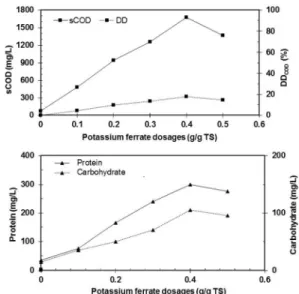
K2FeO4 oxidation experiments were performed with a 2-h oxidation period at room temperature. The results of individual K2FeO4 oxidation experiments are presented in Figure 1. As seen from these graphs, the sludge disintegration was improved steadily with increasing K2FeO4 dosage up to 0.3 g K2FeO4/g TS. The concentrations of sCOD, carbohydrate and pro-tein in the supernatant were increased significantly from 70, 15 and 35 mg/L to 1260, 70 and 240 mg/L at 0.3 g/g TS dosage, respectively. At this dosage, the
DDCOD value was calculated as 13.1%. This incre-ment was due to the disruption of bacterial flocs as a result of oxidation of the extracellular organic matter, the destruction of cell walls and membranes by fer-rate (FeO42-), and thereafter the release of organic fractions into the aqueous phase. When the K2FeO4 dosage was augmented to 0.4 g/g TS, soluble COD, carbohydrate and protein concentrations were in-creased negligibly to 1675, 105 and 299 mg/L, re-spectively. However, a further increase in K2FeO4 dosage to 0.5 g/g TS led to a decrease in the con-centrations of soluble COD, carbohydrate and protein to 1370, 95 and 275 mg/L, respectively. This decrease might result from the oxidation of organic material in the supernatant by excess K2FeO4, since FeO42- (ferrate) is a non-selective and powerful oxi-dizing agent. Therefore, the optimal K2FeO4 dosage was determined to be 0.3 g/g TS for the oxidative sludge pre-treatment method in this study. Contrary to this finding, Wu et al. (2015) reported that the maximum sludge disintegration was achieved at a dosage of 500 mg/L K2FeO4 (equal to 0.1 g/g TS), and that higher dosages reduced the disintegration efficiency by oxidizing the solubilized organic mate-rials. In another study, Ye et al. (2012) found that the waste sludge was effectively disintegrated with in-creasing dosages of K2FeO4 up to 0.81 g/g TS, after a 2-h oxidation period. These differences in the re-sults of sludge disintegration experiments are caused mainly by different chemical and biological charac-teristics of the WAS (such as pH, buffering capacity, bacterial cell content, inorganic ions and organic materials, which can be reacted with non-selective oxidizing ferrate ions) and grade of the K2FeO4 rea-gent utilized in these studies.
Effect of Sonication on Sludge Disintegration
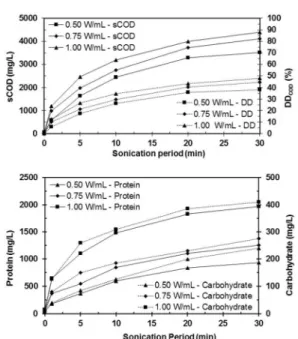
In order to investigate the influences of sonication period and ultrasonic density at a fixed frequency of 20 kHz, individual sonication experiments were car-ried out by varying ultrasonic densities from 0.50 to 1.00 W/mL in the time range of 1–30 min. As illus-trated in Figure 2, the sludge disintegration was promoted steadily with an increase in ultrasonic den-sity and extending the sonication period. Individual sonication at the densities of 0.50, 0.75 and 1.00 W/mL resulted in a significant increment in the sCOD concentration from 70 to 2450, 2750, 3180 mg/L in the first 10 min, and 3510, 4100, 4395 mg/L in the total sonication period of 30 min, respectively. Based on these sCOD results, the DDCOD values were calculated as 26.3, 29.7 and 34.4% for 10 min cation, and 38.1, 44.6 and 47.9% for 30 min soni-cation at 0.50, 0.75 and 1.00 W/mL densities, respec-tively. Soluble carbohydrate and protein concentra-tions were increased from 15 to 125, 185, 310 mg/L and from 35 mg/L to 595, 845, 1485 mg/L in the first 10 min; soluble carbohydrate and protein concentra-tions were 240, 275, 410 mg/L and 930, 1255, 1970 mg/L at the end of a 30 min sonication period at 0.50, 0.75 and 1.00 W/mL densities, respectively. The ratios of sCOD concentrations in the first 10 min compared to those at 30 min at the densities of 0.50, 0.75 and 1.00 W/mL were 69, 68 and 72%. There-fore, it was observed that the sludge was disinte-grated in two stages: an initial rapid disintegration stage in the first 10 min and a slow stage in the re-maining part of the sonication period, as shown in Figure 2. The sludge flocs were rapidly disrupted and the exposed cells were disintegrated in the rapid sludge disintegration stage, while additional cells were exposed and damaged by sonication in the fol-lowing slow disintegration stage (Huan et al., 2009). Similarly, Huan et al. (2009), Şahinkaya and Sevimli (2013a), Yan et al. (2010) and Zhang et al. (2007) also reported that the ultrasonic sludge disintegration occurred in two stages. The reason for this rapid disintegration obtained in the first 10 min was the rapid cavitational effect arising from the collapse of powerful transient bubbles created in fractions of microseconds close to microbial cells (Show et al., 2007). As a result, the optimum sonication condi-tions were found to be 10 min sonication at 0.50 w/mL density by taking the concentrations of soluble carbohydrate and protein into consideration in addi-tion to sCOD and DDCOD.
Figure 2: Effect of sonication on sludge disinte-gration.
Effect of Sono-Oxidative Pre-Treatment on Sludge Disintegration
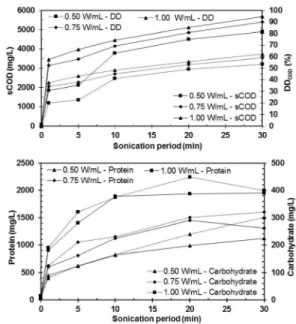
The influences of ultrasonic density and sonication period in the combined sono- oxidative pre-treatment method were examined to develop a new process consuming less energy than sonication. For this reason, the sono-oxidative pre-treatment experiments was conducted at the constant 0.3 g/g TS K2FeO4 dosage (determined as the optimal dosage before).
DDCOD values were 19.7, 34.1 and 37.4% with cation of 1 min and 53.4, 59.1 and 62.1% with soni-cation of 30 min at 0.50, 0.75 and 1.00 W/mL densi-ties, respectively. The soluble carbohydrate and pro-tein concentrations were measured to be 80, 125, 190 mg/L and 445, 600, 905 mg/L by the combined pre-treatment with 1 min-sonication, while they were 300, 320, 400 mg/L and 1120, 1310, 1950 mg/L by the combined pre-treatment with 30 min-sonication at 0.50, 0.75 and 1.00 W/mL, respectively. There-fore, this combined pre-treatment method more effi-ciently disintegrated the WAS, even at lower ultra-sonic densities and shorter ultra-sonication periods, com-pared to individual sonication. In addition, the effi-ciency of the sono-oxidative method was higher than the total of these two different methods, as summa-rized in Table 1. As understood from this table, the sludge disintegration was enhanced by synergistic effects as a result of the increasing ultrasonic power applied to the WAS. The proposed mechanism for the synergistic effects is that the sludge flocs were first disintegrated by hydro-mechanical shear forces so that microbial cells released from the disrupted sludge flocs were more effectively exposed to oxi-dizing FeO42-. Thus, more extracellular and intracel-lular organic substances are released from the solid phase to the aqueous phase of the WAS. On the other hand, as seen from Table 2, prolonging of the soni-cation period in the combined method caused a de-crease in the disintegration efficiency. This dede-crease in the concentrations of organic materials in the sol-uble phase might result from the oxidative destruc-tion of cellular organic substances via highly reactive hydroxyl radicals (OH●) created by acoustic cavita-tion and FeO42-. Consequently, based on the chemical
parameters, the optimal conditions were determined to be 1 min sonication at 0.75 W/mL ultrasonic den-sity at a 0.3 g/g TS K2FeO4 dosage for the 2-h sono-oxidative pre-treatment method.
It was noted that, while the energy consumption per unit volume of the WAS was 5 W·min for soni-cation alone under the determined optimum condi-tions, it was 0.75 W·min for the combined method in this study (as a function of the multiplication of time with power). In this way, it was proven that the sim-ultaneous combination of sonication with K2FeO4 oxidation not only enhances the disintegration effi-ciency, but also reduces significantly the ultrasonic energy consumption.
Figure 3: Effect of sono-oxidative pre-treatment on sludge disintegration.
Table 1: Synergistic effects of sono-chemical pre-treatment with 1 min sonication.
Pre-treatment Conditions DDCOD by individual pre-treatment (%) Actual DDCOD by the
combined pre-treatment (%)
Syneristic DCOD
increase (%) (with 1 min - sonication) K2FeO4
dosage (g/g TS)
Ultrasonic Density (W/mL)
K2FeO4
Oxidation
Sonication (for 1 min)
Total of DDCOD
values
0.3
0.50
13.1
5.7 18.8 19.7 1.1
0.75 10.1 23.2 34.1 10.9 1.00 12.4 25.5 37.4 11.9
Table 2: Synergistic effects of sono-chemical pre-treatment with 10 min sonication.
Pre-treatment Conditions DDCOD by individual pre-treatment (%) Actual DDCOD
by the combined pre-treatment (%)
Syneristic DCOD
increase (%) (with 1 min - sonication) K2FeO4
dosage (g/g TS)
Ultrasonic Density (W/mL)
K2FeO4
Oxidation
Sonication (for 10 min)
Total of DDCOD
values
0.3
0.50
13.1
26.3 39.4 41.1 1.7
0.75 29.7 42.8 45.1 2.3
Effect of Pre-Treatment Methods on Anaerobic Sludge Digestion
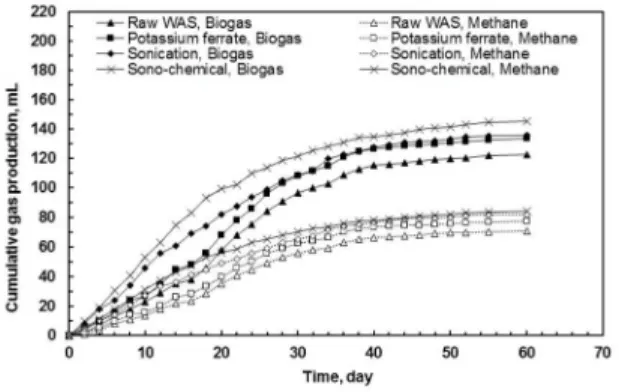
The BMP assays were performed in the batch mesophilic (36±2 °C) anaerobic reactors in order to examine the influences of these three disintegration methods under their own optimum conditions on the anaerobic biodegradability of WAS. The experi-mental results can be seen in Figure 4. As shown from this graph, sono-oxidative pre-treatment obvi-ously shortens the rate-limiting hydrolysis phase, and promoted the anaerobic biodegradability of the WAS. While maximum substrate usage in the pre-treated reactors happened in the first week of the incubation period; it was seen in the reactor with raw sludge in the third week. This result was expected due to the considerable increment in the solubiliza-tion of WAS via the pre-treatment applicasolubiliza-tion, prior to the anaerobic digestion (Pilli et al., 2011; Şahinkaya and Sevimli, 2013b; Wu et al., 2015). In addition, it was observed that there was no toxic effect on the anaerobic digestion of sludge. While biogas and methane productions were increased relatively by 9% and 9.2% in the reactors with K2FeO4 oxidation pre-treatment, 10.8% and 15.8% in the reactors with sonication, the utmost biogas (18.3%) and methane (18.6%) productions were achieved in the sono-oxidative pre-treated reactors at the end of a 60-day digestion period of the BMP assay. Furthermore, the sludge stabilization was also enhanced in the batch reactors. Compared to the untreated reactor, the tCOD reductions in the K2FeO4 oxidized, sonicated and sono-oxidative pre-treated reactors were im-proved by 27.3, 30.1 and 44.8%, respectively. There-fore, the sono-oxidative pre-treatment both increased the methane production and improved the stabiliza-tion degree of WAS in the anaerobic digester.
Figure 4: Effects of sludge pre-treatment methods on anaerobic biodegradability.
CONCLUSIONS
The effects of K2FeO4 oxidation, sonication, and sono-oxidative pre-treatment methods on both the disintegration and anaerobic biodegradability of sludge were investigated. Based on the experimental data, the following results can be summarized as:
While the optimum conditions for individual K2FeO4 oxidation and sonication methods were 0.3 g/g TS K2FeO4 dosage and 0.50 W/mL ultrasonic density for 10-min, the optimized conditions for sono-oxidative pre-treatment was found to be the combination of 1-min sonication at 0.75 W/mL den-sity with 2-h chemical oxidation at 0.3 g/g TS K2FeO4 dosage. The disintegration efficiencies of these methods under the optimized conditions were in the following descending order: 37.8% for sono-oxidative pre-treatment>26.3% for sonication > 13.1% for K2FeO4 oxidation.
The mechanism of sono-oxidative pre-treat-ment may be that the sludge flocs were first dis-rupted and disintegrated by vigorous hydro-mechani-cal shear forces (created by sonication) so that mi-crobial cells released from the disrupted sludge flocs were more effectively exposed to oxidative FeO42-. Therefore, more organic substances were released into the soluble phase of the WAS, compared to the individual pre-treatment methods.
The sludge disintegration by sonication and sono-oxidative methods happened in two stages: a rapid and a subsequent slow disintegration stage.
The anaerobic digestion was enhanced due to the solubilization of particulate organic matter by the sludge pre-treatment. While relative increases in the methane productions were 15.8% in the sonicated reactor and 9.2% in the K2FeO4 oxidized reactor, this increment was 18.6% in the sono-oxidative pre-treated reactor, compared to the unprepre-treated reactor. Moreover, the anaerobic stabilization of the sludge was also clearly augmented by the sono-oxidative pre-treatment.
As a result, it was proven that the combination of sonication, even at lower ultrasonic densities and shorter sonication periods, with K2FeO4 oxidation promoted both the disintegration and the anaerobic biodegradability of WAS. Hence, this new combined method has been found to be a more energy efficient sludge pre-treatment method in this study.
ACKNOWLEDGEMENT
REFERENCES
Anquandah, G. A. K., Sharma, V. K., Panditi, V. R., Gardinali, P. R., Kim, H. and Oturan, M. A., Fer-rate (VI) oxidation of propranolol: Kinetics and products. Chemosphere, 91, 105-109 (2013). APHA/AWWA/WEF, İn: Clesceri, L. S., Greenberg,
A. E. and Eaton, A. D. Standard Methods for the Examination of Water and Wastewater. (21st Ed.). American Public Health Association, American Water Works Association, and Water Environ-ment Federation, Washington DC (2005).
Beydilli, M. I., Pavlosathis, S. G. and Tincher, W. C., Decolorization and toxicity screening of selected reactive azo dyes under methanogenic conditions. Water Sci. Technol., 38, 225-232 (1998).
Dubois, M., Gilles, K. A., Hamilton, J. K., Rebers, P. A. and Smith, F., Colorimetric method for deter-mination of sugars and related substances. Anal. Chem., 28, 350-356 (1956).
Eskicioglu, C., Terzian, N., Kennedy, K. J., Droste, R. L. and Hamoda, M., Athermal microwave ef-fects for enhancing digestibility of waste activat-ed sludge. Water Res., 41, 2457-2466 (2007). Gogate, P. R. and Kabadi, A. M., A review of
appli-cations of cavitation in biochemical engineer-ing/biotechnology. Biochem. Eng., J. 44, 60-72 (2009).
Gogate, P. R. and Pandit, A. B., Application of cavi-tational reactors for cell distruption for recovery of introcellular enzymes. J. Chem. Technol. Bio-technol., 83, 1083-1093 (2008).
Huan, L., Yiying, J., Mahar, R. B., Zhiyu, W. and Yongfeng, N., Effects of ultrasonic disintegration on sludge microbial activity and dewaterability. J. Hazard. Mater., 161, 1421-1426 (2009).
Nickel, K. and Neis, U., Ultrasonic disintegration of biosolids for improved biodegradation. Ultrason. Sonochem., 14, 450-455 (2007).
Pilli, S., Bhunia, P., Yan, S., LeBlanc, R. J., Tyagi, R. D. and Surampalli, R. Y., Ultrasonic pretreatment of sludge: A review. Ultrason. Sonochem., 18, 1-18 (2011).
Pham, T. T. H., Brar, S. K., Tyagi, R. D. and Suram-palli, R. Y., Influence of ultrasonication and Fen-ton oxidation pre-treatment on rheological char-acteristics of wastewater sludge. Ultrason. Sono-chem., 17, 38-45 (2010).
Razo-Flores, E., Luijten, M., Donlon, B. A., Letinga, G. and Field, J. A., Complete biodegradation azo dye azodisalicylate under anaerobic conditions. Environ. Sci. Technol., 31, 2098-2103 (1997). Show, K. Y., Mao, T. and Lee, D. J., Optimisation of
sludge disruption by sonication. Water Res., 41, 4741-4747 (2007).
Şahinkaya. S., Disintegration of municipal waste activated sludge by simultaneous combination of acid and ultrasonic pretreatment. Process Saf. Environ., 93, 201-205 (2015).
Şahinkaya, S. and Sevimli, M. F., Sono-thermal pre-treatmentof waste activated sludge before anaero-bic digestion. Ultrason. Sonochem., 20, 587-594 (2013a).
Şahinkaya, S. and Sevimli, M. F., Synergistic effects of sono-alkaline pretreatment on anaerobic bio-degradability of waste activated sludge. J. Ind. Eng. Chem., 19, 197-206 (2013b).
Şahinkaya, S., Kalıpcı, E. and Aras, S., Disintegra-tion of waste activated sludge by different appli-cations of Fenton process. Process Saf. Environ., 93, 274-281 (2015).
Wang, Y., Liu, H., Liu, G., Xie, Y. and Gao, S., Oxi-dation of diclofenac by potassium ferrate (VI): Reaction kinetics and toxicity evaluation. Sci. To-tal Environ., 506-507, 252-258 (2015).
Wei, Y., Van Houten, R. T., Borger, A. R., Eikel-boom, D. H. and Fan, Y., Minimization of excess sludge production for biological wastewater treat-ment. Water Res., 37, 4453-4467 (2003).
Wu, C., Jin, L., Zhang, P. and Zhang, G., Effects of potassium ferrate oxidation on sludge disintegra-tion, dewaterability and anaerobic biodegrada-tion. International Biodeter. Biodegr., 102, 137-142 (2015).
Yan, Y., Feng, L., Zhang, C., Zhu, H. and Zhou, Q., Effect of ultrasonic specific energy on waste acti-vated sludge solubilization and enzyme activity. Afr. J. Biotechnol., 9, 1776-1782 (2010)
Ye, F., Ji, H. and Ye, Y., Effect of potassium ferrate on disintegration of waste activated sludge (WAS). J. Hazard. Mater., 219-220, 164-168 (2012).