D.E.L.T.A., 30 especial, 2014 (447-463)
D E L TA
Endangered languages in Brazil*
Línguas em perigo de extinção no Brasil
Aryon D. RODRIGUES (CNWS and University of Brasília)
1. The social importance of the indigenous languages
The culture of every human society is the result of a specifi c res-ponse to the challenges nature and other human societies have imposed through millennia to human survival in physical and mental health. Even the culture of the least human society is a complete universe of integrated knowledge, strongly bound to the milieu where it was developed but also accumulating experience of the remotest past. The native language of a society is not only the means of communication that keeps social solidarity, but it is also the basic means of organizing and storing experience and knowledge. Every human language is unique in the way it codifi es knowledge and experience, for it has been shaped and reshaped following the needs for the adequate expression of an extremely diversifi ed and variable complex of mental representations. A true understanding of mankind can ideally be achieved only with the knowledge of every particular culture and society. This implies that
448
every unique key for an in-deep accessing of the culture of the society that speaks it.
In the course of history and prehistory many cultures and many languages have disappeared from the face of the earth. With some fragmentary exceptions, their knowledge is lost and unretrievable. The same is true of the non-human companions of man on the world, the animals and the plants. But what has been for millennia, in the one and in the other case, a matter of sporadic accidents, only rarely inten-sifi ed by cataclysmic events, is becoming in the last few centuries a growing process if systematic destruction not only of animal and plant species, but also of human languages and cultures. The exacerbated predatory and imperialist spirit that became an important feature of modern civilization has led to a vertiginous destruction of genetic and cultural diversity in large parts of the world. Even where there is plenty of space for peaceful coexistence , minority peoples are not allowed to carry freely their own ways of life and strong pressure is exerted on them for assimilating to the mainstream culture and language.
The maintenance of the native language favours a smooth evolution of the respective culture, even under strong outside pressure, enabling people to incorporate new knowledge without systematically losing their old wisdom. This is vital not only for the healthy psychological equilibrium of the individuals, but also for the social and economic adaptation to new situations. If a community is compelled to abandon its native language in a too short space of time, say in one or two ge-nerations, a too large break occurs in the transmission of old concepts and knowledge, long before new knowledge and new experiences can mature and become integrated and functional. The whole community will fall in a culturally void space and people will become dependent on foreigners for the simplest actions and get impoverished both eco-nomically and culturally.
449 For the minority peoples that managed so far to preserve their
language it is essential to stop to be directly or indirectly pushed to abandon this language. It is equally essential for them to receive se-rious, well founded and well planned help for coping with the extre-mely delicate problem of getting effective access to and control of a dominant language and culture without losing the command of their own language, the knowledge of their own culture, and the control of the very diffi cult situation they are confronting as subjects (frequently involuntary) of a modern state. This means to have the opportunity of having sound programs of bilingual/ bicultural education.
2. Short overview of the linguistic scene
The territory of Brazil with its 8.500.000 km² embraces most of the lowlands of South America, including most of Amazonia. This territory was formerly occupied by many indigenous peoples, the so-called Indians or Amerindians, which spoke a very large number of languages. As a consequence of the conquest of the territory by the Europeans and their descendants, in the course of the last fi ve hundred years there was an enormous reduction in the number of indigenous peoples and languages. The Portuguese as carriers of Western culture arrived in Brazil in the last year of the 15th century, 1500, and, as
pio-neers of modern expansionism, soon engaged in one of the most wild exploitation enterprises the world has known, draining intensively not only mineral, fl oral, and animal resources, but also native human ener-gy. The indigenous peoples, if friendly, were seen by most settlers as sources of cheap workers to be exploited to exhaustion, and if hostile , were seen as obstacle to be removed until extermination. It is enough to recall that the General Governor of Brazil in the middle of the 16th
450
Only recently more attention is being given by historians, archae-ologists, anthroparchae-ologists, and linguists to the process of depopulation of the Indians and to the proportions it reached. Huge areas were soon emptied out of Indians and others became progressively territory of Portuguese or of Língua geral speaking mestizos. Língua geral is the name given in colonial Brazil to an originally indigenous language that became the common language of mestizos, white men, and Indians submitted by these, not as a pidgin, but as the continued mother tongue of children of indigenous mothers and white fathers. There has been two línguas gerais, both based on Tupí-Guaraní languages, a southern one (língua geral paulista), expanding from São Paulo into the southern and central provinces and a northern one (língua geral amazônica
or nheengatú), spreading from Pará westwards into Amazonia. The southern língua geral became extinct in most of its domain in the se-cond half of the 18th century, and its last speakers have probably lived
in some places until the end of the 19th century. The northern língua
geral is yet spoken, but it has been losing ground to Portuguese since the beginning of the 20th century and counts now with no more than
3,000 speakers.
451 Most of the languages spoken today are to be found in northern
and western Brazil, that is to say, in the innermost regions of the country. Portuguese colonization started from the Atlantic coast in the East and progressively wiped out most indigenous peoples on its way. Only three indigenous languages of Eastern Brazil are yet being regularly passed on to the children: Yatê in Pernambuco, Maxakalí in Minas Gerais, and Xokleng in Santa Catarina. It is true that there are now many speakers of Mbiá, a Guaraní dialect, in South-eastern Brazil (and a few in Northern Brazil), but these are very recent mi-grants from the valley of the Paraná River in the Southwest. Even in Northern Brazil, however, there are areas where the original indigenous languages disappeared almost completely. One important case is the valley of the Amazon stream, where the big nations whose villages extended continuously on both banks as reported by the fi rst Spanish and Portuguese explorer, have left no trace of them-selves but some archeological remains. Indigenous peoples and languages are almost totally absent in an extension of about 1,800 km along the valley and about 250 km from each river bank, with additional extensions in the valleys of the major tributaries.
452
The extant languages in all Brazilian territory belong to several linguistic families. If we count each genetically isolated language as a one-member family, we have 35 linguistics families, 10 of which are one-member ones. Those of the extinct languages for which there is some date preserved reveal the existaence in the past of more genetic families. Probably some families have completely disappeared with all its members before any record could be done of them. Comparati-ve research has shown that certain linguistic families, although quite different in the phonology, grammar, and lexicon, may be grouped into larger genetic units on the basis of regular phonological corres-pondences in their basic vocabularies. One well established case is that of the Tupí stock, that embraces 10 linguistic families (here the term “family” corresponds more properly to complexes such as Romance, Germanic, Slavic, and so on, whereas “stock” corresponds to a more comprehensive one such as Indo-European. Another case, with a lesser degree of confi dence for many of the proposed components, is the Macro-Jê stock, with possibly 12 families. In table 1 are all the families to which belong any living languages, without reference to their affi liation to the one or the other stock. To the Tupí stock have been ascribed the following families: Arikem, Jurúna, Mondé, Mun-durukú, Ramarpama, Tuparí, and Tupí-Guaraní, as well as the isolates (one-member families) Awetí, Mawé, and Puruborá. The most likely members of the Macro-Jê stock are the following families: Boróro, Botocudo, Karajá, and Maxakalí (and also the families Kamakã, Karirí, and Purí, whose languages are all dead), as well as the isolates Guató, Ofayé, Rikbaktsá, and Yatê.
453 statistically negligible for even deserving the slightest consideration
in planning of any sort. This notwithstanding, some success has been reached in opening space, for instance, for bilingual education, but the small gains are always under the risk of becoming ineffective for lack of understanding and interest in the intermediate administrative instances, not to speak of lack of money.
3. The scientifi c importance of the indigenous languages and particularly of the Brazilian ones
As has been stressed in several recent publications (especially Robins & Uhlenbeck, eds., 1991, and Hale, ed., 1992), all the mi-nority languages of the world are equally important and essential for the knowledge of human language in general. There are today in the world between 5,000 and 6,000 languages, but the data used by theoretical linguists for proposing and testing hypotheses on the nature of language are yet restricted to relatively few languages. If unbiased knowledge of the very nature and dimensions of human language and of the cognitive processes associated with it is worth of being researched, account must be taken of as many as langua-ges as possible. From a scientifi c point of view no language should be neglected: the next one to be analysed may present something new in its phonology, in its grammar, or in its organization of the discourse, and may ask for minor or major revision of some theoretical assumptions. Thus every indigenous language in every part of the world is an important object of research for linguistic science and its study has to be seen as a must for a sound linguistic scientifi c policy.
454
Together with the other South American languages, die indigenous languages of Brazil may play a signifi cant role in the development of linguistic knowledge. South America is in a certain way comparable to Australia. On the one hand, it is almost an island, for it is separated from the other continents by the two greater oceans and is connected to Central and North America only by the Isthmus of Panama, which, although having been the bridge through which prehistoric man pe-opled the South American sub-continent, restrained considerably the opportunity of refl ux movements northwards. Most human groups that entered South America when it was fi rst peopled expanded and evolved inside it, adapting themselves to the new environments it offered, for thousands of years, without any direct contact with people of other continents (the most conservative estimates for the antiquity of man in South America are in the range of 10,000 to 12,000 years, while others push it back in time to more than 30,000 years). Inno-vations in their languages are unlikely to have spread even to North America, so that we would not wonder to fi nd in some of the South American languages features uncommon or even unknown in other parts of the world. This appears to be true of some phonological, gram-matical, and discursive features found so far in indigenous languages of Brazil, e.g. an alveo-labial-fl ap (Pirahã: Everett 1979), nasaliza-tion generated at word ends (Maxakalí, Xetá, etc.: Rodrigues 1986), nasalization as an extreme degree of vowel compactation (Kain-gang, Tapirapé, etc.: Rodrigues 1981), object-initia1 basic word order (Hixkaryána, Nadëb, etc.: Derbyshire 1977, Derbyshire & Pullum 1981), sentence negation expressed by omission of tense/aspect markers (Karitiána: Landin 1984), neutralization of the distinction between lst person inclusive and 3rd person (Tupinambá: Rodrigues
1990).
455 once well described, will have a signifi cative role to play in improving
our knowledge of language in general. This likeliness is even greater if we consider that all the Australian languages belong to only one genetic family, whereas South American languages are divided into many linguistic families, what means that there is much more linguistic differentiation in South America than in Australia
4. The research on the Brazilian indigenous languages
456
Abbot and D. Borgman of Missao Evangélica da Amazônia (MEVA) under the stimulus of D. Derbyshire of SIL. Catholic missionaries in Brazil have no linguistic training, but the best dictionary produced in this century for a Brazilian indigenous language, Boróro, is due to the Salesian Fathers Albisetti and Venturelli.
Before 1980 linguistic fi eldwork by Brazilian students of Indian languages was sporadic. Only thus recently institutional conditions were met for stimulating more systematically graduate students to engage in fi eldwork. In 1988 the National Research Council agreed to sponsor a program of scientifi c research on the indigenous languages (Programa de Pesquisa Cientifi ca das Línguas Indígenas Brasileiras), which, though without any special funds, multiplied the number of stu-dents entering the fi eld of indigenous languages. The program defi ned four degrees of priority for research: 1) languages strongly endangered for which there is no previous study, 2) languages strongly endangered for which there is already some data and analysis, 3) languages not immediately endangered for which there is no previous study, 4) lan-guages not immediately endangered for which there is already some data and analysis. Last year the number of (non-missionary) people carrying out linguistic research under the sponsorship of this program was about 60. This number included 10 people working on languages with less than 50 speakers. Most of the researchers are graduate stu-dents at the master’s level and a few are working towards the doctor’s degree. This is an exceedingly happy situation indeed both in what concerns the endangered indigenous languages and as to perspectives of forming a strong professional group of descriptive linguists, but it is also a matter of deep concern. Although the number of institutions open to the research on indigenous languages has increased from two in the seventies to seven or eight now, it is being and will continue to be very diffi cult to assure conditions for so many students to prosecute the work begun at the masters level and to complete their education as linguists, so that many research projects now initiated are doomed to be discontinued prematurely.
457 documentation, analysis, and description of the many endangered
lan-guages of Brazilian Amazonia. The project foresees intensive coopera-tion with linguists of other institucoopera-tions, in Brazil and elsewhere in the world, aiming at becoming a logistic basis for linguists and students of linguistics interested in working on languages of Brazilian Amazonia. The conditions for housing the centre at the Goeldi Museum (Museu Paraense Emilio Goeldi) are very good, indeed in this moment better than in any Brazilian university. If fi nancial support is found, such a centre may overcome a great deal of the desperate situation of the scientifi c research of indigenous languages in Brazil.
With so many languages to be described and with most of them seriously endangered, requiring urgent research, it is clear that other centres of study in the country must be reinforced or even created. The universities should be the natural nests for such centres or programs of research, but in the area of humanistic studies (letras), they are in general very weak institutions. This is the reason why the Programa de Pesquisa Científi ca das Línguas Indígenas Brasileiras has also been aiming at a National Centre for the Study of Indigenous Languages. If the Centre designed by the linguists at the Goeldi Museum becomes reality, most of what was intended for a national canter will be real-ized. Minor efforts could then be directed to encourage research on the non-Amazonian languages.
5. The need for international cooperation
458
No program of urgent research can be conducted properly without the means for putting at work, as soon as possible, personnel and equip-ment. If an effective action is to be developed for the documentation and description of the many languages that are strongly endangered in Brazil, international resources must be asked.
International cooperation for this task should not, however, be seen as a purely fi nancial matter. Much cooperation is needed and will be welcome in the form of scientifi c competence to reinforce the as yet modest capacity present in the country and to contribute to the training of young local linguists for the work of documenting and analysing the languages as well as for the application of linguistic knowledge to the benefi t or the indigenous communities. Such an application may be either in pedagogical tasks, like the elaboration of orthographies and the training of native writers and teachers, or in psychosocial orientation, such as devising means of stimulating people to cultivate their own na-tive language alongside with the country’s offi cial language instead of simply (and tragically) abandoning die fi rst in favour of the second
International help can also come from the side of technology, by bringing to the local linguists the knowledge and use of technical de-vices that help to organize and to accelerate the work of documentation and analysis of linguistic and paralinguistic data.
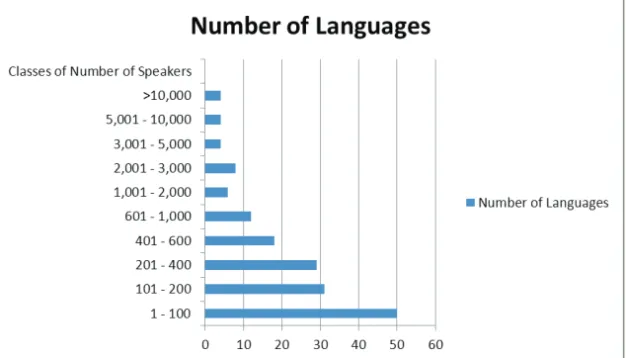
459 Table 1: List of languages with summary information on number of speakers,
localization, and research activities (November 1993)
Abbreviations:
(a) States of Brazil where spoken: AC Acre, AM Amazonas, AP Amapa, ES Espírito Santo, GO Goiás, MA Maranhão, MG Minas Gerais, MS Mato Grosso do Sul, MT Mato Grosso, PA Pará, PE Pernambuco, PR Paraná, RJ Rio de Janeiro, RO Rondônia, RR Roraima, RS Rio Grande do Sul, SC Santa Catarina, SP São Paulo, TO Tocantins.
(b) Linguistic families: AK Arawak, AR Arikem, AW Arawá, BO Bororo, BT Botocudo, GK Guaikurú, IS isolate (= one-member family), JE Jê, JU Jurúna, KB Karib, KJ Karajá, KT Katukína, MK Makú, MO Mondé, MR Múra, UM Mundurukú, MX Maxakalí, NB Nambikwára, PN Páno, RM Ramaráma, TG Tupí-Guaraní, TK Tukáno, TP Tuparí, TX Txapakúra, YA Yanomámi.
(c) Research: C current study, I previous study now interrupted, N under study in a neigh-bouring country, O no study.
(d) Researchers: M missionary linguists, U academic linguists: mi master’s level students unfi nished, mc master’s level students fi nished, di doctor level students unfi nished.
Language Nº of
speakers Localization Family Research Researchers 1-20 speakers
Apiaká 2 MT TG O
Arikapú 4 RO IS O
Aruá ? RO MO O
Avá 10 GO, TO TG C Umi
Baré 1? AM AK C Umc
Guató 5? MS IS I U
Kanoê 5 RO IS C Umc
Katawixí 10 AM KT O
Kaoiá 13 RO IS O
Kokáma 5 AM TG C Udi
Krenak 6? MG BT C U
Kujubim 2 RO ? O
Máku 1 RR IS C Umc
Mondé ? RO MO O
Múra ? AM MR O
Puruborá 2 RO IS O
Sabanê 20 RO NB O
Suriána 10 AM TK O
Tariána ? AM AK C U
Umutína 1? MT BO O
Wayoró 20 RO TP C U
Xabriabá ? MG JE O
Xetá 5 PR TG I U
460
Language Nº of
speakers Localization Family Research Researchers 21-50 speakers
Arára-do-Beiradão
?
MT ? O
Awetí 36 MT IS I U
Barasána 43 AM TK N
Galibí 37 AP KB N
Jabutí 40 RO IS C Umc
Jurití 35 AM TK O
Kamã 30? AM MK C M
Karapanã 49 AM TK N
Matipú 40 MT KB O
Mekém 40 RO TP O
Ofayé 23 MS IS I
Paraná 31 MT JE C Umc
Sakirabiap ? RO TP O
Txunhuã-djapá 37 AM KT O
Trumái 34 MT IS I/C U/Umc
51-100 speakers
Anambé 61 PA TG C Umc
Asuriní-do-Xingu
53
PA TG O
Káro 92 RO RM C Udi
Kuruáya ? PA MU O
Karipúna-TG 60? RO TG O
Mehináku 95 MT AK C Umc
Nahukwá 83 MT KB O
Tuparí 56 RO TP C Umc
Yebá-masã 55 AM TK O
Yoé 60? PA TG C Udi
Zuruahá 100 AM AW C M
101-200 speakers
Apalaí 135 PA KB C M
Arára-do-Xingu 110? PA KB C M
Araweté 136 PA TG O
Asuriní-do-Tocantins
131
PA TG C M/U
Banawá 130? AM AW C M
Irántxe 195 MT IS I M
Jamamadí 150 AM AW C M
Jarawára 120 AM AW C M/U
Jurúna 126 MT JU C Umc
461 Language Nº of
speakers Localization Family Research Researchers 101-200 speakers
Kanamantí 130 AM AW O
Karitiána 109 RO AR C M/Umi
Kaxararí 110 RO PN O
Kaxuyána 198 PA KB I Umc
Kubéwa 150 AM TK N
Matsés 141 AM PN O
Mayongong. (Yekuána)
200
RR KB N
Nambikwára-do-Norte
180
MT, RO NB I U/M
Pirahã 200 AM MR C M/U
Salumã 154 MT AK O
Suruí-do-Tocantins
101
PA TG C Umc
Suyá 114 MT JE C U
Txikão 107 MT KB I U
Urupá 150? RO TX O
Waurá 130 MT AK C M
Wayána 125 PA KB C U
Xambioá 102 TO KJ O
Yawalapití 135 MT AK C Umc
Yawanáwa 196 AC PN O
Zoró 175 MT, RO MO O
201-400 speakers
Amawáka 220 AM PN N
Atroarí 350 AM KB O
Gavião/ Ikõrõ 230 RO MO C U
Guajá 240 MA TG I Umc
Hixkaryána 308 AM KB C M
Javaé 383 TO KJ C Udi
Kamayurá 207 MT TG C U
Kampa 235 AM, AC AK N
Katukína-do-Biá 253 AM KT O
Katukína-Páno 353 AC PN C Umc
Kuikúru 221 MT KB C U
Makurap 215 RO TP C Umc
Maxinéri 345 AM AK N
Nukuíni 238 AM PN O
Parakanã 197 PA TG O
Parintintim 396 AM TG C M
Paumarí 280 AM AW C M
462
Language Nº of
speakers Localization Family Research Researchers 201-400 speakers
Suruí-Paitér 340 RO MO C M
Tapirapé 217 MT TG C U
Taulipang. (Pemong)
220
RR KB N
Tiriyó 264 PA KB C U
Torá 256? AM TX O
Uruewawau 215 RO TG C Umc
Warekéna 338 AM AK C Umc
Warikyána 300 PA KB O
Wayampí 291 AP TG C M
Yamináwa 357 AC PN O
Yuhup 400 AM MK C M
401 - 600 speakers
Apinayé 508 TO JE C M
Bakairí 409 MT KB C M/Udi
Dení 560 Am AW C M
Ingarikó. (Kapong)
459
RR KB N
Manitenéri 530 AC AK N
Marúbo 499 AM PN C Umc
Maxakalí 500 MG MX C M/Umc
Nadëb 480 AM MK C M
Nambikwára-do-Sul
550
MT NB I/C U/M
Ninam 466 RR YA C U
Palikur 561 AP AK C M
Rikbaktsa 466 MT IS I M
Sanumá 462 RR YA C M
Tembé 410 PA TG O
Tuyúka 465 AM TK N
Urubú-Kaapor 500 MA TG C M
Wanána 555 AM TK N
Yamamadí 450 AM AW C M
601 – 1,000 speakers
Boróro 752 MT BO C M
Cinta-Larga 953 MT, RO MO I M
Desána 960 AM TK N
Kadiwéu 850 MS GK C M/Udi
Kanamarí 647 AM KT C M
Kayabí 620 MT TG C M
463 Language Nº of
speakers Localization Family Research Researchers 601 – 1,000 speakers
Paresí 631 MT AK C M
Pirá-tapúya 613 AM TK N
Waiwái 922 PA, RO KB N
Xerénte 850 TO JE C M
Xokleng 634 SC JE C M/Umi
1,001 – 2,000 speakers
Húpda 1,431 AM MK C M
Karajá 1,194 GO, T, TO KJ C M/U
Kaxináwa 1,987 AC PN C U
Mundurukú 1,460 AM MU I M
Pakaanóva 1,147 RO TX C M
Yanomámi 2,000 AM, RR YA I/C U/M
2,001 – 3,000 speakers
Apurinã 3,000 AC, AM AK C M/Umi
Kayapó 2,400 MT, PA JE C M/Umi
Kulína 2,437 AC, AM AW C M
Língua. Geral 3,000 AM TG C U
Mawé 3,000 Am IS I M
Mbiá 2,250 RS, SC, PR, SP,
RJ, ES TG C M/U
Timbíra 2,670 MA, PA, TO JE C M/U
Tukáno 2,635 AM TK N
3,000 – 5,000 speakers
Baníwa.do.Içana 4,672 AM AK C U
Nhadéva 4,900 MS, PR, SP TG C M
Xavánte 4,413 MT JE C M/U
Yatê 4,000 PE IS I/C M/U
5,001 – 10,000 speakers
Guajajára 6,776 MA TG C M
Kaiwá 7,000 MS TG C M
Wapixána 5,122 RR AK N
Yanomam 6,000 RR YA C M
10,001 or more speakers
Kaingang 10,426 RS, SC, PR, SP JE I/C M/U
Makuxí 15,000 RR KB C/I M/U
Teréna 10,100 MS, SP AK C M
Tikúna. (Tukúna)
18,000