Artigo Original
http://dx.doi.org/10.4322/rbeb.2013.015*e-mail: [email protected]
Recebido: 14/09/2012 / Aceito: 19/02/2013
Brain-computer interface: Proposal of a shaping-based training
Leandro da Silva-Sauer*, Luis Valero-Aguayo, Francisco Velasco-Álvarez, Ricardo Ron-Angevín, Salvador Sancha-Ros
Abstract Introduction: Persons affected by certain motor disabilities such as amyotrophic lateral sclerosis can evolve with important motor and speech dificulties in communication. A BCI (Brain Computer Interface) is a system that allows interaction between the human brain and a computer, permitting the user to control a communication channel through his or her brain activity. It is based on the analysis and processing of electroencephalographic (EEG) signals to generate control commands. The present study focuses on the subjects’ capability to improve the way they learn to control a BCI system. Methods: Two training procedures were compared: standard and progressive shaping response. Six volunteers participated in a reversal single-subject ABAC design. Results: The study showed that both procedures are equally effective in producing a differential responding in the EEG signals, with no signiicant differences between them. Nevertheless, there were signiicant differences when distinguishing two neuronal responses (relax state and hand-movement imagination). Also, in the analysis of individual signals, an adaptive process for the shaping process and a lower error rate in the idle response appeared. Conclusion: Both proposed training procedures, standard and progressive shaping, are equally effective to achieve training of differential responses (imagination of hand/relax) in the interaction with a BCI.
Silva-Sauer L, Valero-Aguayo L, Velasco-Álvarez F, Ron-Angevín R, Sancha-Ros S
Introduction
Those who are affected by a number of neurological disorders can also be affected by physical disabilities. In some cases, motor deiciencies can become quite severe, even to the extreme of producing a loss of total control of the muscles that are responsible for voluntary movement of the body, including the movements of the eyes and the muscles involved in respiration. People who suffer from such deiciencies lose all possibility of exterior communication; this means that the only possible alternative for these individuals would be to present the brain with a new, non-muscular, channel that would permit them to send messages and orders to the outside world. A BCI system allows communication between the brain and an external device. The system provides an additional channel of communication, transforming brain signals into commands that are interpreted by the machine but without any muscle movements. BCI systems can help people affected by severe motor disabilities such as amyotrophic lateral sclerosis to express themselves, and thus provide greater autonomy in their daily lives (Wolpaw et al., 2002).
These interfaces are considered one of the most important applications in the future of neurorehabilitation, creating a communication and a control channel for those individuals with serious handicaps in their motor functions, but who do not show disorders at the cognitive level (Birbaumer, 2006). Nowadays, the studies which are presently being carried out are focused on the investigation of algorithms to process EEG signals. However, there are some aspects that still have not been studied with the intensity they deserve. In particular, those
aspects related to the person, his or her behavior, and the psychological aspects involved in the interaction between the person and the computer. The training required to control a BCI requires a considerable effort. Sustained attention, motivation, fatigue, distraction (Neumann and Kubler, 2003), concentration and attention (Silva-Sauer et al., 2011), are some of the factors that need to be taken into account when establishing a protocol of training that guarantees eficient learning.
One of the peculiarities of this kind of interface is its ability to determine a general neuronal state from the available EEG signals, thus providing the user with a minimal communication alphabet, essentially as activation/deactivation of a given brain area or wave frequency. In order to achieve this purpose with certain success, it is necessary for the system to discriminate between at least two different bioelectrical signals. The EEG signals in the BCI system can be obtained by performing different mental tasks, such as imagining given activities or situations (Hassan et al., 2008; Keirn and Aunon, 1990; Neuper et al., 2009). The extraction of the required EEG signals for a BCI system may be invasive (by surgical procedures – electrocorticogram) or non-invasive (obtained from the bioelectrical potentials that are generated in the brain, and can be detected with electrodes applied on the scalp).
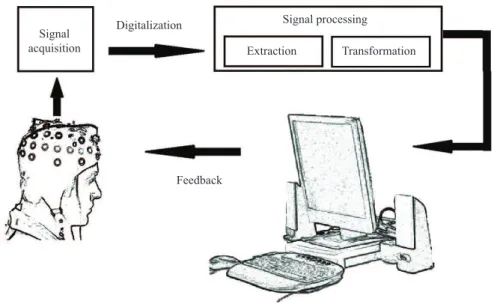
The basic structure of a BCI system is based on acquisition (ampliication), digitalization and processing of the EEG signals. The inal stage is the output, where the signals are transformed in order to generate control commands. The subject perceives a feedback indicating his or her performance (Figure 1).
Figure 1. Basic structure of a BCI system. 124
Psychology technique in BCI system
The EEG signals coming from the user may be classiied as endogenous, where the modulation stimulus comes from the person, or exogenous, where the modulation stimuli are external to the person. Among the endogenous are the Sensorimotor Rhythm-based BCIs (SMR-BCI), which are Rhythm-based on the changes of μ and β rhythms. These rhythms correspond to speciic features of the EEG signals, characterized by frequencies that can be modiied by voluntary thoughts. When a person performs a movement, it causes a synchronization/desynchronization in his or her brain activity (event-related synchronization/ desynchronization, ERS/ERD), which involves a rhythm amplitude change (Wolpaw et al., 2000).
The advantage of SMR-BCI systems is that they provide the user with intentional changes, which enable a greater control over the devices. In particular, the µ and β rhythms have the characteristic that when the subject performs or imagines a motor action, the amplitude of such rhythms is modiied, thus making it possible to assign control commands to those characteristics of the signal. Brain rhythms have been used to provide the user with control over a number of devices which allowed him/her to manipulate his/ her environment (Millán et al., 2004), communicate (Obermaier and Müller, 2003) or operate computer programs (Muller et al., 2008; Pineda et al., 2003).
The learning process aims to modulate the EEG components by trial and error. This is provided by feedback, in most cases visual, that provides the subject with an image of his/her performance. Training to control a BCI system requires a considerable effort, and it depends, beyond proper acquisition and signal processing, on the degree to which the neuronal activity can be controlled by the subject. This implies that most papers on BCI are made with single-subject studies or very small groups, as the procedure to obtain control on the desynchronization of the rhythms entails a great amount of tests and time (Ron-Angevin and Díaz-Estrella, 2008).
Considering that the BCI system is an interface between an organism and a computer, a subject of study could be the “interaction”, the reciprocal action between both of them; that is, the “behavior” of the person in front of the computer stimuli. One of the methods used in psychology to improve the learning process for new behaviors, with minimum errors and in a progressive way, is the shaping by successive approximations procedure (Domjan, 2009; Skinner, 1975). This technique consists of differentially reinforcing small approximations to a inal behavior; that is, guiding the subject’s behavior through the rewards towards the desired behavior. In that case, we presented reinforcing consequences
in the visual feedback after small changes in the subject’s brain rhythms, in such a way that when those behaviors’ remove variations increase, the intensity of the feedback is reduced, so that the learning process is progressive and with fewer errors (Malott et al., 2003). Using this strategy, the intention is that the individual would gradually learn a discriminative response that was originally very complex and out of his repertoire.
We present a study aimed at testing the effectiveness of a psychological learning technique, namely shaping by successive approximations, using feedback with differential reinforcement over the behavior, in order to achieve an improvement in the training for a BCI system. We seek to improve the learning process, with fewer errors and shorter learning time, comparing it with a standard BCI training procedure proposed by Ron-Angevin and Díaz-Estrella (2009), in which the movement of a car is presented as a feedback associated to two mental tasks.
Methods
Participants and design
Initially, eight participants volunteered, all of them students from the School of Psychology at the University of Málaga, without previous experience on BCI. Only six of them were included in this experiment: two men and four women, with an average age of 22.7 years. The inclusion criterion was to obtain a minimum amount of control (more than 70%) in the irst session.
A reversal subject design, with single-subject condition control and counter-balancing of the order of such conditions among subjects, was used. The subject serves as his/her own control, rather than using another individual/group. These designs are sensitive to individual organism differences versus group designs which are sensitive to averages of groups. Thus, both procedures were compared for the same participant (ABAC or ACAB), where A, B and C indicate the three possible stages (each stage consisted of two sessions): A = base line without feedback, B = sessions with the shaping procedure and C = sessions with the standard procedure. In the shaping procedure (B) is applied differential reinforcement of successive approximations that modiies the feedback received by the user (explained in more detail later). In the sessions with the standard procedure (C), the feedback is the same proposed by Ron-Angevin and Díaz-Estrella (2009), the car movement corresponds directly to EEG processed. This design was repeated with six participants distributed randomly, in pairs,
125 Rev. Bras. Eng. Biom., v. 29, n. 2, p. 123-132, jun. 2013
Silva-Sauer L, Valero-Aguayo L, Velasco-Álvarez F, Ron-Angevín R, Sancha-Ros S
where the order of the conditions was standard irst and then shaping, or vice versa.
Training protocol and signal acquisition and processing
Each session consisted of 4 sets of 40 tests. In the irst session all subjects were explained what the experiment consisted of, and were urged not to move during the tests, as any body movement would cause noise on the signal. The 40 tests of each set were randomly divided in 20 tests for each mental task, with a rest period of 1.5s between the tests. One of the two mental tasks to be carried out was the imagination of the movement of the right hand; the another mental task was the maintenance of a relaxed state. The intervals between sets ranged between three and ive minutes.
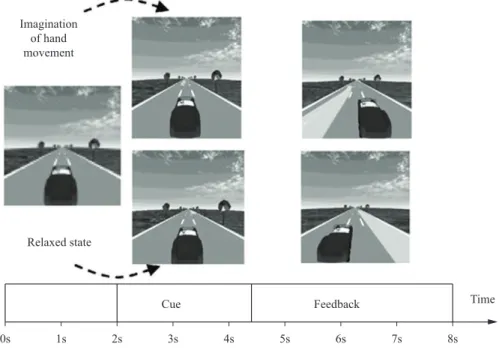
The virtual environment showed a car moving in a three-lane road, where at a given instant visual stimulus of a puddle of water came up on either side of the road. This cue indicated what mental task subjects should carry out in order to skip the puddle: imagining the right hand movement would move the car to the right and keeping the relaxed state would move it to the left.
Each test was eight seconds long, starting with the car moving down the central lane. After two seconds the puddle became visible and, depending on its position, the subject was to perform one of the
two mental tasks that were being discriminated, and maintain it continuously up to the 8th second. In the
sessions with feedback, the feedback was presented after the irst 4.25 seconds, moving the car farther to the right or the left according to the signal classiication. After the eight seconds the test ended, and there was a 1.5s pause (with the car stopped) until the next test started (see Figure 2).
In stage A, sessions one and four, there was no feedback; subjects only had to perform one of the two mental tasks matching the visual stimulus that was presented. Besides serving as “neutral” or control stages, they were used to update the parameters of the classiier. In stages B and C the visual feedback of the car moving was presented, as provided by the real-time extraction and classiication of the EEG patterns. During the shaping by successive approximations (applied in the B stage) the reinforcement of the visual feedback was modiied according to the results in the previous set of tests.
For the development of the BCI system the following instruments were used: The EEG was recorded from two bipolar channels using gold electrodes placed 2.5 cm anterior and posterior to electrode positions C3 and C4 (right and left hand sensorimotor areas, respectively) according to the 10/20 international system, as in previous experiments (Iturrate et al., 2009). The ground electrode was placed
Figure 2. Car movement paradigm and timing of the tests. The feedback is in the form of a car movement. The cue stimulus, between 2 and 4.25 s, consists of a puddle-like obstacle which appears in the left or right lane and which comes into view at the end of the road. Between 4.25 and 8 s, the subject controls the movement of the car to the right or left, according to the mental task required in order to avoid the puddle.
Psychology technique in BCI system
at the FPz position. Signals were ampliied by a 16 channel biosignal g.BSamp ampliier and then digitized at 128 Hz by a 12-bit resolution data acquisition NI USB-6210 card. For analysis, a MATLAB program was developed that allowed for both online and ofline study of all the signals and subsequent statistical comparative study in SPSS.
Signal processing in the BCI system implied extracting the characteristics of the EEG signals and classifying them. Such processing was based on that proposed by Guger et al. (2003), without artifact detection. Extraction of characteristics consisted of estimating the average power of the signal in 0.5s windows in a subject-speciic reactive frequency band, which was manually identiied by comparing the power spectra of two traces in two different 1-second intervals: one in which the subjects were not performing any mental activity, and other one in which they were. For each session, we obtained a curve for the error rate, e(t), averaged over the 160 tests, as a result of a LDA (Linear Discriminant Analysis) classiication, following the procedure proposed by Guger et al. (2001).
After stage A, the parameters of the classiier were updated with those of another LDA calculated for the samples of the instant in which the e(t) curve reached its minimum. In the feedback sessions (B and C), calculation of the average power for each of the two EEG channels, and the result of the classiication, were obtained in real-time. The LDA classiication was then translated online into the length L of the feedback displacement of the car, according to the following Equation 1:
3 4
1 2 0
( ) C( ) C ( )
L t =w P t +w P t +w (1)
Length L was updated on the screen every four samples; that is, every 32ms, to make feedback as continuous as possible. A negative/positive value of
L was translated into left/right displacement of the car. Thus, classiication consisted of a simple linear combination of the power from each channel (PC3 for C3 and PC4 for C4), with the classiication weights (W1, W2 and W0) obtained in the irst session (stage A). A deeper explanation of this procedure can be found in Ron-Angevín and Díaz-Estrella (2009).
Adapted shaping
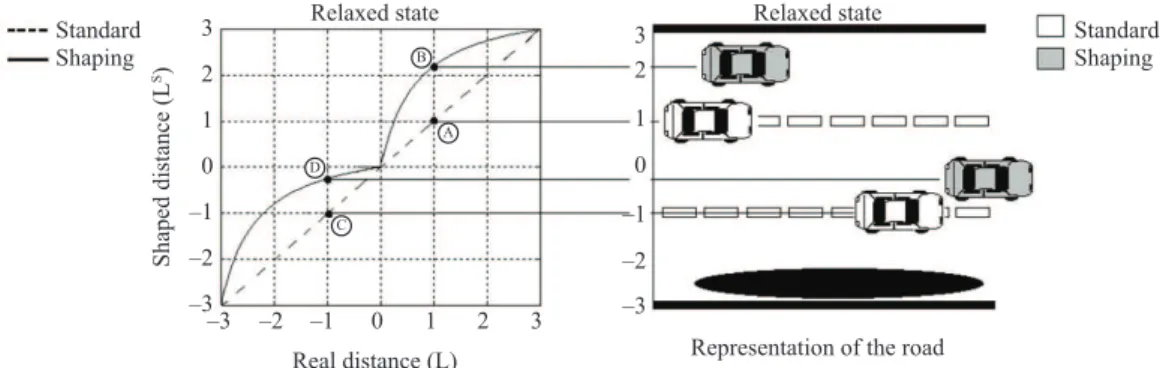
Shaping consisted of modifying the visual feedback, reinforcing correct behavior (avoiding the puddle) and attenuating errors. Reinforcing a correct behavior meant, in this case, moving the car a greater distance than the actual one (corresponding to the subject’s performance in the standard procedure); attenuating an error meant making such distance shorter. This modiication was implemented with a function that obtained the shaped distance (LS) from the unshaped
distance (L). In the standard procedure (stage C), this function was the straight line LS = L; that is, no
shaping for hits or errors, the distance the car moved on the screen and the real one were equivalent. In stage B, the shape of the function was a curve, so in case of a hit |LS| > |L|; that is, the car moved more
than the detected neuronal response, and in case of an error |LS| < |L|, which means that the car moved
less than the neuronal response. A greater curvature of the function (curve farther away from the straight line LS = L) means greater reinforcement. This way,
the effect of reinforcement is maximized over the hits and minimized over the errors. This effect can be observed in Figure 3, in an example of a curve corresponding to the right-hand mental task. When the relax task is requested the curve is symmetrical to the former about the origin of coordinates.
The technique of learning by shaping actuates as reinforcement over the adequate neuronal response, thus maximizing the effect of visual feedback, and successively approximating to the desired behavior.
Figure 3. Example of two curves: the dashed one corresponds to the standard procedure (no shaping), and the continuous one to the procedure that modiies the visual feedback. A hit that would have a 1m displacement in the standard procedure (A) would be represented by more than 2m (B) when using shaping, which implies positive reinforcement. In case of an error with a displacement of 1m in the standard procedure (C), the represented displacement with shaping would be 0.3m (D), thus attenuating the consequences of the error.
Rev. Bras. Eng. Biom., v. 29, n. 2, p. 123-132, jun. 2013
Silva-Sauer L, Valero-Aguayo L, Velasco-Álvarez F, Ron-Angevín R, Sancha-Ros S
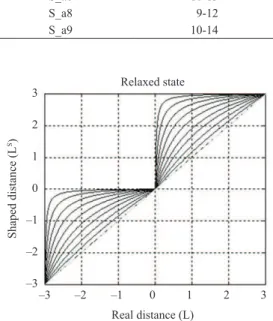
In the case of the present BCI system, the behavior to shape consists of the subject’s control of their brain rhythms, because these rhythms are responsible of the control of the system. The variability and dependence of these behaviors on the previous execution is relected on the choice of different reinforcement curves. Because of this, each subject started out with an initial reinforcement curve that depended on their control, determined by the minimum of the error rate obtained as an average of the e(t) for the 160 tests of the previous A stage. The successive approximations in stage B were expressed in variations of the shaping curve as long as the subject obtained positive results (analyzed every 40 tests), so their progress had an effect on the choice of a curve in which reinforcement was smaller. In case their results were negative, no modiication was made to the curve. In this study we decided to establish 10 thresholds for the error rate (0% to 50%), associated to 10 shaping curves (see Figure 4).
In the previous paragraph, reference was made to positive or negative results of the subject’s performance; it is necessary to detail what criterion was used to make this choice. We deined as “displacement area” the region between the central line of the road and the trajectory of the virtual car in each test. This way, a balance can be established between areas linked to hits and errors, both for right and left, according to the movement of the car. To calculate these areas we used the Equation 2:
256 256
E'
136 136
( ) A ( )
( ) hit ( ) error
0 error 0 hit
H H E
i i
H E
A L i L i
L i L i
L L
= =
= ∑ = ∑
= =
(2)
The used indices correspond to the feedback period (from instant t1 = 4.25 seconds to t2 = 8 seconds). The variable “right balance” (BR) was calculated as the difference between the accumulation of all the hits areas (AH) and the error areas (AE) in the tests in which a movement to the right was requested. The variable “left balance” (BL) was deined analogously. Depending on the performance of the tests, these variables held positive or negative values. The “total balance” (BT) is the sum BR + BL. This variable determines the possible switch to the next curve in stage B of the experiment.
In stage C (standard procedure) behavior reinforcement was not applied, so the received feedback corresponded to the subject’s real performance. This way, learning in this stage produces trial-and-error, giving large displacements of the car in both directions, until they stabilized as the number of tests increased.
As dependant variables to compare the performance during the usage of the BCI in both procedures, we used several parameters obtained and processed simultaneously to the task, and processed a posteriori from the EEG data acquired by the system. As real-time variables we used the following: BR, BL and BT. The a posteriori variables considered were: i) minimum error rate (MER), deined as the minimum of e(t); ii) right- and left- hit rate (HRR and HRL respectively), the number of hits, divided by the total number of tests, for each mental task. In order to calculate the latter two variables, a test was considered a hit or an error depending on the result of the classiier only in the instant were the minimum e(t)
was produced.
Results
The results of three sets from Subject 1 were not validated due to the poor quality of the signals. Consequently, the same three sets from the next stage were removed for purposes of statistical validation. Eventually, a total of 90 sets among all subjects were considered, 45 from stage B and 45 from stage C. In Table 1 it is possible to observe the reactive frequency band for each participant.
Figure 4. Displacement curve with and without shaping, when the subject is requested relaxed state. The curves start at 0% of the error rate (straight line, corresponding to the standard procedure), with increments of 5% up to 50%.
Table 1. Reactive frequency band for each participant. Subject Frequency band (Hz)
S_a1 10-12
S_a2 10-13
S_a3 9-12
S_a6 10-13
S_a8 9-12
S_a9 10-14
Psychology technique in BCI system
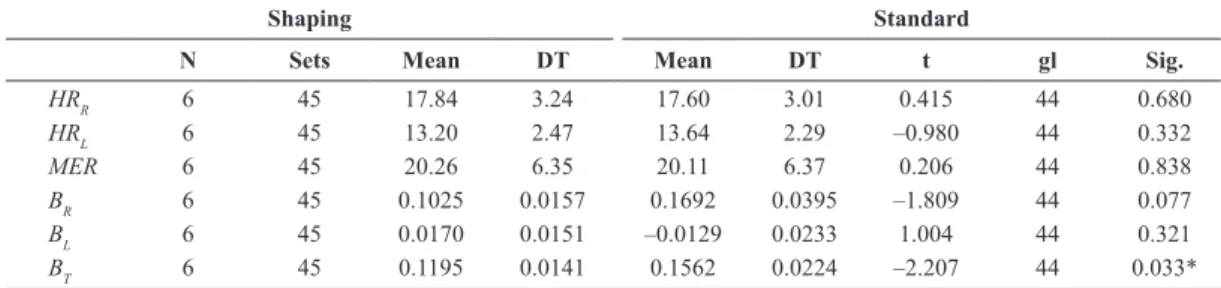
No signiicant differences are observed between the two procedures in most of the studied variables, using the t test for related samples for repeated measures (see Table 2). A signiicant difference appears only in the global parameter BT of the virtual car (t(44) = 2.20; p < 0.05), averages can be seen in table 2. In this case, the obtained displacement with the brain responses in the standard procedure is more extreme or variant than during the shaping. In the variables obtained ofline we observed that both procedures achieve control of the virtual car, but no improvement or manifest superiority of one over the other appears (see Figure 5).
There is a difference between right and left task because mold a mental task force (right hand) appears to be more effective than a mental task consisting do/ think anything (relax state)
When the graphs of these data are observed, this global analysis over the equality of both procedures can be conirmed. Nevertheless, with regard to the BT
of the virtual car, where there is signiicance, it can be appreciated that the responses are more extreme (BT), or even negative (BL) in the standard procedure, whereas they vary less and they are always positive in the case of the shaping procedure (see Figure 6).
Table 2. Average of the BCI variables in both procedures.
Shaping Standard
N Sets Mean DT Mean DT t gl Sig.
HRR 6 45 17.84 3.24 17.60 3.01 0.415 44 0.680
HRL 6 45 13.20 2.47 13.64 2.29 –0.980 44 0.332
MER 6 45 20.26 6.35 20.11 6.37 0.206 44 0.838
BR 6 45 0.1025 0.0157 0.1692 0.0395 –1.809 44 0.077
BL 6 45 0.0170 0.0151 –0.0129 0.0233 1.004 44 0.321
BT 6 45 0.1195 0.0141 0.1562 0.0224 –2.207 44 0.033*
*p < 0.05 **p < 0.01.
Figure 5. At the left, the graph for the “hit” percentage (identiication of the requested mental task, at the optimum second of the test) general in both procedures in an a posteriori analysis. At the right, the graph for the total average of displacements among all subjects, subtracting negative values from positive ones, for both procedures. Values greater than 0 are correct movements, and lower than 0 are wrong.
Figure 6. Average of RB and LB as measured in each set of 40 tests during both stages, corresponding to subject 6. Zero indicates the center of the road. Positive values mean the subject was performing the appropriate task, this moving towards the correct side. Negative values mean the subject was not managing to move towards the correct side.
Rev. Bras. Eng. Biom., v. 29, n. 2, p. 123-132, jun. 2013
Silva-Sauer L, Valero-Aguayo L, Velasco-Álvarez F, Ron-Angevín R, Sancha-Ros S
If the acquisition graphs of these “right” (HRR and
BR) and “relax” (HRL and BL) are analyzed during the whole procedure as a single case design, in several subjects differentiated curves appear as those shown in Figure 6. It can be observed that, in the standard procedure, both responses are completely separated and differentiated, with very positive values in the irst one that indicate adequate movements of the car (the right hand is properly imagined), but with negative values in the situation of “relax”; that is, more errors are made or negative distance of the car when trying to stay relaxed. However, in the shaping procedure a progressive change is seen, as intended, where both tasks approach each other; that is, an intermediate positive displacement point is modeled in both mental tasks.
Signiicant differences have been found between HRR and HRL in the shaping procedure (t(44) = 7.43; p < 0.001) as well as between BR and BL (t(44) = 3.11; p <0.01); but the same signiicant differences have also been obtained in the case of the standard procedure in HRR and HRL (t (44) = 7.42; p < 0.001), and BR and
BL (t(44) = 7.98; p < 0.05) (see Table 3).
This implies that both procedures achieve well differentiated neuronal responses. When the number of hits in the optimum second is analyzed, signiicant differences are found too, which means that in that instant the participant was managing to execute the proper mental task to avoid the puddle. The mental task of right hand imagination obtains greater averages in all the variables, which indicates better execution and control with that movement imagination, but imagination of relax seems more dificult to achieve.
Discussion
In this paper we have shown that both proposed training procedures, standard and progressive shaping, are equally effective to achieve training of differential responses (imagination of hand/relax) in the interaction with a BCI. As the effectiveness of shaping in creating new behaviors and increasing other progressively is known, we started with the hypothesis that the shaping technique might be superior. In total scores,
errors and discriminating capacity, it is as effective as the standard. Nevertheless, a general process has been observed as the training was performed, so that errors or deviation in the “relax” responses are notably reduced.
A difference is clearly observed between the subject’s control with one mental task and the other, being signiicantly better in the case of right hand imagination. It is possible that herein resides the key for a better shaping procedure, as the presented study progressively changes the response of both tasks simultaneously, so learning one is affected by the progress of the other. In this case, it has been observed that the task of relaxation would have needed different shaping curves from the right one, given the general difference in performance. In other words: relaxation needed more help, and it did not receive it because performance with the right-hand task was higher. This made the improvement in this task mild. On the other hand, the right-hand tasks would have needed curves that implied a smaller reinforcement of the feedback; as it did not happen, excessive reinforcement made the subject continuously perceive his right-hand performance as excellent, so it is possible that the subject progressively reduced their efforts to achieve control. Future research which has already started in our group, aims to obtain a differentiated response for each task.
It was observed that control of the relaxed mental state is more unstable, so one of the possible ways to improve control should be to promote the capacity to hold that state, as shown by several studies (Eskandari and Erfanian, 2008; Mahmoudi and Erfanian, 2006; Tan et al., 2009). The reliability of this control is the key to develop more complex asynchronous interfaces with a greater freedom of movement.
All in all, BCI system and all the aspects of psychological interaction implied in them constitute an inexhaustible source of new research; it is an ongoing process. The present study is the result of a research project in which two ields collaborate: Engineering and Psychology. People from different departments are working together in order to make progresses both in the system’s eficiency and the
Table 3. Average of all the variables in the differential responses of “right” and “idle” in both procedures.
Right Left
N Sets Mean DT Mean DT t gl Sig.
MER with shaping 6 45 17.84 3.247 13.20 2.473 7.437 44 0.0001***
MER standard 6 45 17.60 3.011 13.64 2.298 7.412 44 0.0001***
BT with shaping 6 45 0.1025 0.1059 0.0170 0.1014 3.116 44 0.003**
BT standard 6 45 0.1692 0.2655 –0.0129 0.1567 7.986 44 0.005**
**p_ < 0.01. ***p_ < 0.001.
Psychology technique in BCI system
user’s performance. The inal aim of our research is not only to develop a BCI-controlled wheelchair, but to provide the potential users with a proper training procedure as well.
Acknowledgements
This work was partially supported by the Innovation, Science and Enterprise Council of the Junta de Andalucía (Spain), project P07-TIC-03310, the Spanish Ministry of Science and Innovation, Project TEC 2011-26395 and by the European fund ERDF. We would like to thank the volunteers for their time and contribution to the experiment.
References
Birbaumer N. Breaking the silence: brain-computer interfaces (BCI) for communication and motor control. Journal of Psychophysiology. 2006; 46(6):517-32.
Domjan M. Principios de aprendizaje y conducta. 2th ed. Mexico: Thomson; 2009.
Eskandari P, Erfanian A. Improving the performance of brain-computer interface through meditation practicing. Engineering in Medicine and Biology Society. In: EMBS 2008: Proceedings of the 30th Annual International Conference of the IEEE Engineering in Medicine and Biology Society; 2008; Vancouver. IEEE; 2008. p. 20-5. http://dx.doi.org/10.1109/IEMBS.2008.4649239
Guger C, Edlinger G, Harkam W, Niedermayer I, Pfurtscheller G. How many people are able to operate an EEG-based brain-computer interface (BCI). IEEE Transactions on Neural Systems and Rehabilitation Engineering. 2003; 11:145-7. PMid:12899258. http:// dx.doi.org/10.1109/TNSRE.2003.814481
Guger C, Schlögl A, Neuper C, Walterspacher, D, Strein T, Pfurtscheller, G. Rapid prototyping of an EEG-based brain-computer interface (BCI). IEEE Transactions on Neural Systems and Rehabilitation Engineering. 2001; 9:49-58. PMid:11482363. http://dx.doi.org/10.1109/7333.918276 Hassan A, Ali AF, Eladawy MI. Classiication of the Imagination of the left and right hand movements using EEG. In: CIBEC 2008: Proceedings of the IEEE International Biomedical Engineering Conference; 2008; Cairo. IEEE; 2008. p. 1-5. http://dx.doi.org/10.1109/ CIBEC.2008.4786098
Iturrate I, Antelis JM, Kübler A, Minguez J. A noninvasive brain-actuated wheelchair based on a P300 neurophysiological protocol and automated navigation. IEEE Transactions on Robotics. 2009; 25(3):614-27. http://dx.doi.org/10.1109/ TRO.2009.2020347
Keirn ZA, Aunon JI. A new mode of communication between man and his surroundings. IEEE Transactions on Biomedical Engineering. 1990; 37(12):1209-14. PMid:2149711. http:// dx.doi.org/10.1109/10.64464
Mahmoudi B, Erfanian A. Electro-encephalogram based brain-computer interface improved performance by mental practice and concentration skills. Medical & Biological Engineering & Computing. 2006; 44:959-69. PMid:17028907. http://dx.doi.org/10.1007/s11517-006-0111-8
Malott RW, Malott ME, Trojan EA. Principios elementales del comportamiento. 2th ed. Mexico: Prentice-Hall; 2003.
Millán JR, Renkens F, Mouriño J. Non invasive brain-actuated control of a mobile robot by human EEG. IEEE Transactions on Biomedical Engineering. 2004; 51(6):1026-33. P M i d : 1 5 1 8 8 8 7 4 . h t t p : / / d x . d o i . o rg / 1 0 . 11 0 9 / TBME.2004.827086
Muller KR, Tangermann M, Dornhege G, Krauledat M, Curio G, Blankertz B. Machine learning for real-time single-trial EEG-analysis: From brain-computer interfacing to mental state monitoring. Journal of Neuroscience Methods. 2008; 167:82-90. PMid:18031824. http://dx.doi. org/10.1016/j.jneumeth.2007.09.022
Neumann N, Kubler A. Training locked-in patients: A challenge for the use of brain-computer-interfaces. IEEE Transactions on Neural Systems and Rehabilitation Engineering. 2003; 11:169-72. PMid:12899265. http:// dx.doi.org/10.1109/TNSRE.2003.814431
Neuper C, Scherer R, Wriessnegger S, Pfurtscheller G. Motor imagery and action observation: modulation of sensorimotor brain rhythms during mental control of a brain-computer interface. Journal of Clinical Neurophysiology. 2009; 120(2):239-47. PMid:19121977. http://dx.doi.org/10.1016/j.clinph.2008.11.015
Obermaier B, Müller GR. “Virtual Keyboard” controlled by spontaneous EEG activity. IEEE Transactions on Neural Systems and Rehabilitation Engineering. 2003; 11(4):422-6. P M i d : 1 4 9 6 0 11 9 . h t t p : / / d x . d o i . o rg / 1 0 . 11 0 9 / TNSRE.2003.816866
Pineda JA, Silverman DS, Vankov A, Hestenes J. Learning to control brain rhythms: Making a Brain-Computer interface possible. IEEE Transactions on Neural Systems and Rehabilitation Engineering. 2003; 11(2):181-4. P M i d : 1 2 8 9 9 2 6 8 . h t t p : / / d x . d o i . o rg / 1 0 . 11 0 9 / TNSRE.2003.814445
Ron-Angevin R, Díaz-Estrella A. Evaluación de un protocolo de entrenamiento en una interfaz cerebro-computadora: propuesta de tareas mentales. Revista de Neurologia. 2008; 47(4):197-203. Spanish. PMid:18671209.
Ron-Angevin R, Díaz-Estrella A. Brain-Computer interface: Changes in performance using virtual reality techniques. Neuroscience Letters. 2009; 449:123-7. PMid:19000739. http://dx.doi.org/10.1016/j.neulet.2008.10.099
Silva-Sauer L, Aguayo LV, Velasco-Álvarez F, Ron-Angevin R. Variables psicológicas en el control de interfaces cerebro-computadora. Psicothema. 2011; 23 (4):745-51. Spanish. PMid:22047868.
Skinner BF. La conducta de los organismos. 2th ed. Barcelona: Fontanella; 1975.
Rev. Bras. Eng. Biom., v. 29, n. 2, p. 123-132, jun. 2013
Silva-Sauer L, Valero-Aguayo L, Velasco-Álvarez F, Ron-Angevín R, Sancha-Ros S
Tan LF, Jansari A, Keng SL, Goh SY. Effect of mental training on BCI performance. In conference: Human-Computer Interaction: Novel Interaction Methods and Techniques Lecture Notes in Computer Science. 2009; 561:632-5. http:// dx.doi.org/10.1007/978-3-642-02577-8_69
Wolpaw JR, McFarland DJ, Vaughan TM .Brain-Computer interface research at the Wadsworth
Center. IEEE Transactions on Neural Systems and Rehabilitation Engineering. 2000; 8:222-5. http://dx.doi. org/10.1109/86.847823
Wolpaw JR, Birbaumer N, McFarland dJ, Pfurtscheller G, Vaughan TM. Brain-computer interfaces for communication and control. Clinical Neurophysiology. 2002; 113:767-91. http://dx.doi.org/10.1016/S1388-2457(02)00057-3
Authors
Leandro da Silva-Sauer*, Francisco Velasco-Álvarez, Ricardo Ron-Angevín, Salvador Sancha-Ros
Departamento de Tecnología Electrónica, Escuela Técnica Superior de Ingeniería de Telecomunicaciones, University of Málaga, Spain.
Luis Valero-Aguayo
Departamento de Personalidad, Evaluación y Tratamiento Psicológico, Facultad de Psicología University of Málaga, Spain.