*e-mail: [email protected] Recebido: 30/10/2012 / Aceito: 15/05/2013
N-acetylcysteine and vancomycin alone and in combination against
staphylococci bioilm
Bruna Leite, Fernanda Gomes, Poliana Melo, Clovis Souza, Pilar Teixeira, Rosário Oliveira, Elisabeth Pizzolitto*
Introduction
Staphylococci are the most frequent causative agents of nosocomial infections and infections on medical
devices (Otto, 2008). Their ability to form bioilm on
surfaces, either biotic or abiotic, seems to be critical for the establishment of infections and to contribute to their persistence by protecting cells from antibiotics and host defenses (Costerton et al., 1999; Domínguez-Herrera et al., 2012; Mah and O’Toole, 2001).
S. epidermidis is able to form bioilms on implanted
medical devices namely central venous catheter, urinary catheters, prosthetic heart valves, orthopedic devices, contact lenses, being also responsible by chronic infections such as septicemia and endocarditis (Cargill and Upton, 2009). Staphylococcus aureus has been recognized as a common cause of human disease (Lowy, 1998) and, as in the origin of a wide range of infections, from minor skin infections, chronic bone infections until to devastating septicemia and endocarditis (Chambers, 2005; Charles et al., 2004; Davis, 2005; Gosbell, 2005; Howden et al., 2004).
S. aureus are also associated with infections related
to artiicial devices (Cramton and Gotz, 2004). Bioilm formation is nowadays seen as the main
virulence mechanism evidenced by staphylococci.
The presence of polymeric matrix in bioilms is
preponderant to bacterial adhesion and produces a complex structure that makes the eradication of
microorganisms more dificult (Boles and Horswill, 2011; Kloos and Bannerman, 1994). Bacterial bioilms are dificult to detect in routine diagnostics and are
inherently tolerant to host defenses and conventional antibiotic therapies (McCann et al., 2008). Additionally, the emergence of antibiotic-resistant bacteria and the slow progress in identifying new classes of antimicrobial agents have encouraged research into novel therapeutic strategies (Costerton et al., 2009). One of the approaches to solve this problem is the use of antimicrobial agent combinations because the development of resistance is reduced when drugs are combined (Blaser et al., 1995; Chuard et al., 1991; Gagnon et al., 1992; Lucet et al., 1990).
Moreover, combinatorial therapies are used with the
aim of ind a more effective alternative to antibiotics
alone since combinations may allow the enhancement of the effects of individual antimicrobial agents by synergistic action.
N-acetylcysteine (NAC) is a non-antibiotic drug that has antibacterial properties (Perez-Giraldo et al., 1997). NAC affects several processesthat are important
for bacterial bioilm formation on stainlesssteel surfaces, including a drastic reduction in extracellular polysaccharide production, and thus acts as an
antibioilm substance (Olofsson et al., 2003). On the other hand, vancomycin is a glycopeptide that inhibit cell wall synthesis of S. aureus and other Gram-positive organisms (Pootoolal et al., 2002). Then, the aim of this work was to determine the in
vitro effect of two antimicrobial agents with different mode of action, alone and in combination, against
bioilms of S. epidermidis and S. aureus.
Methods
Bacterial strains and growth conditions
S. epidermidis (5 strains- 1, 127, 165, 9142 and 1457) and S. aureus (5 strains- 2, 35, 73, 173 and 174) clinical isolate strains were used in this study. The culture media used (tryptic soy broth (TSB), tryptic soy
agar (TSA) and Mueller-Hinton agar) were prepared according to the manufacturer instructions. All strains were inoculated into 15 mL of TSB from TSA plates not older than 2 days and grown for 18 (± 2) h at 37 °C in an orbital shaker at 130 rpm. Cells were harvested by centrifugation (for 5 min at 9500 g and 4 °C), and ressuspended in TSB adjusted to 0.5 McFarland scale equivalent to 1.5 × 10⁸ cells/mL–1 before being used
in the subsequent assays. Each solution of NAC (MIC and 10 × MIC) was prepared in TSB and the solution of vancomycin (MIC and peak serum (Cerca et al., 2005)) was prepared in Milli-Q water.
Vancomycin MIC determination: E test
The E test was used to evaluate the susceptibility of all staphylococci strains tested to vancomycin. The cell suspension (1.5 × 10⁸ cells/mL), prepared with
S. epidermidis or S. aureus, was applied with a sterile cotton swab onto Petri plates containing Mueller-Hinton agar. The antibiotic carriers (E test strip) were then applied to each plate. Plates were incubated at 37 °C for 24 h. After incubation, an elliptical zone of growth inhibition was seen around the strip. The MIC was read from the scale at the intersection of the elliptical zone with the strip.
N-acetylcysteine MIC determination: Microbroth dilution method
For all strains of staphylococci, the N-acetylcysteine MIC determination was carried out in a dilution range of 0.5-64 mg/mL. The MIC was determined in 96 well tissue culture plates (Sarstedt, Newton, NC, USA) containing 100 µL of a stock solution of NAC diluted with TSB and by adding at the end 100 µL of a cell suspension (1 × 10⁶ cells mL–1). Plates were incubated
determined by identifying the lowest concentration able to inhibit bacterial growth. The controls were cells not exposed to the antimicrobial agent tested. All experiments were carried out in triplicate and repeated three times.
Congo red agar test
The Congo red agar is made up of brain heart infusion broth 37 g/L, sucrose 50 g/L, agar 10 g/L and Congo red dye 0.8 g/L. All cell suspensions (1.5 × 10⁸ cells/
mL) were seeded separately on plates containing the Congo red agar. Plates were incubated at 37 °C for 24 h. After incubation, the staphylococci that produced black colonies were considered positive slime producers, whereas the colonies that showed red color were considered negative.
Expression of gene icaD
Isolation of genomic DNA
S. epidermidis and S. aureus chromosomal DNA was extracted with Invitek® kit (Uniscience, Brazil).
Polymerase chain reaction-PCR
The primers used for the ampliication of icaD genes were designed from the published sequence of the ica
locus described by Cramton and Gotz (2004). For the detection of icaD, primers iCADF (ATG GTC AAG CCC AGA CAG AG) and iCADR (CGT GTT TTC AAC ATT TAA TGC AA) were used for a 198 bp fragment. A 20 µL reaction volume consisted of 2.5 mM MgCl2, 200 mM of each nucleotide, 1 mM of each primer, 1.25 U of Taq polymerase and 100 ng
of template DNA. Thirty cycles of ampliication, each
consisting of denaturation at 92 °C for 45 s, annealing at 49 oC for 45 s and elongation at 72 °C for 1 min,
along with a inal extension at 72 °C for 7 min were
performed in a thermocycler (Eppendorf, USA). The
presence and size of the ampliied products were conirmed by electrophoresis on 1.5% agarose gel.
Effect of NAC and vancomycin on biofilm cells
Bioilms were formed in 96 well tissue culture plates
(Sarstedt, Newton, NC, USA) containing 200 µL of a cell suspension (1 × 10⁶ cells/mL) in TSB supplemented
with 0.25 % of glucose per well to promote bioilm
formation. Plates were incubated at 37 °C with orbital shaking at 130 rpm for 24 h. At the end, planktonic
cells were removed carefully, and the bioilm was washed twice with 200 µL of saline solution (0.9% NaCl; Merck). The bioilms were incubated for 24 h
in fresh nutrient medium containing NAC (MIC and
10 × MIC) and vancomycin (MIC and peak serum) alone and in combination.
To assess the number of viable cells after treatment, 200 µL of saline solution were added to each well
before removing the bioilm by scrapping. An aliquot
of 1 mL of each sample was centrifuged (for 10 min at 9500 g and 4 °C) and the pellet ressuspended in 1 mL of saline solution. Next, the suspension was
sonicated (20 s with 22% of amplitude; Ultrasonic
Processor, Cole-Parmer, Illinois, USA) to promote
bioilm disruption. The number of colony forming units (CFU) in bioilm for each strain evaluated was
determined by performing 10-fold serial dilutions in saline solution and plating in TSA in triplicate and incubating for 48 h.
Bioilm controls were cells not exposed to any
antimicrobial agent tested. All experiments were carried out in triplicate and repeated three times.
Statistical Analysis
The data from all assays were compared using one-way analysis of variance (ANOVA) by applying Tukey’s test with all calculations carried out using SPSS software (Statistical Package for the Social
Sciences). Differences achieving a conidence level of 95 % were considered signiicant.
Results
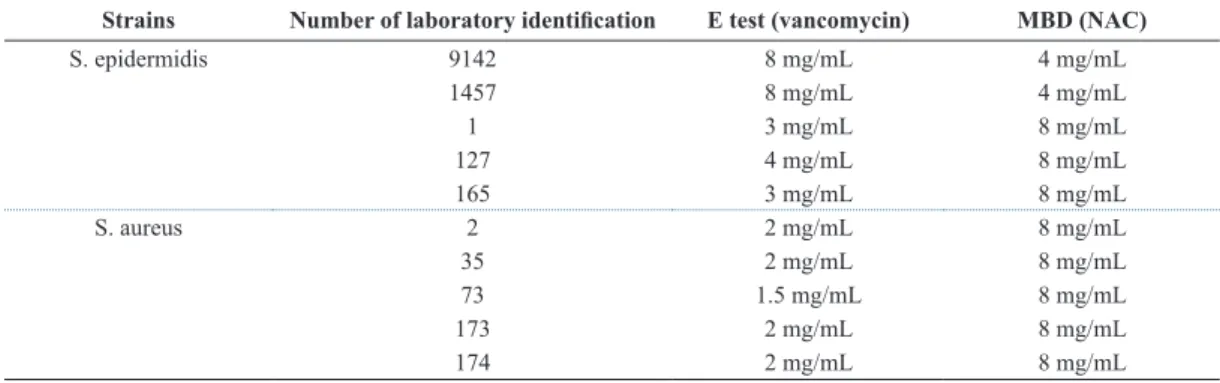
Table 1 summarizes the values of vancomycin minimum inhibitory concentration obtained by E test and NAC minimum inhibitory concentration determined by the microbroth dilution method, for all the strains of staphylococci tested in this study. On the other hand, Table 2 shows the production of slime by Congo red agar and the expression of icaD gene in the strains of staphylococci evaluated. Slime production
was detected in three strains (60 %) of S. epidermidis
and in all S. aureus strains (100 %). The icaD gene was expressed in all strains of staphylococci evaluated.
Figures 1 and 2 present the number of viable cells (after exposure to the two antimicrobial agents tested alone) of S. epidermidis and S. aureus strains tested, respectively, expressed as log CFU/mL. The results evidenced that vancomycin alone causes no effect on the staphylococci strains evaluated, since the reduction promoted by this antibiotic was less than 3 log10. On the contrary, the use of NAC alone
showed to reduce the number of cells in bioilms of
staphylococci strains. In fact, the use of NAC 10 × MIC
reduced signiicantly the cells in bioilm, evidencing
Table 1. Values of minimal inhibitory concentration by E test (vancomycin) and microbroth dilution method (MBD) (NAC) for the staphylococci strains studied.
Strains Number of laboratory identiication E test (vancomycin) MBD (NAC)
S. epidermidis 9142 8 mg/mL 4 mg/mL
1457 8 mg/mL 4 mg/mL
1 3 mg/mL 8 mg/mL
127 4 mg/mL 8 mg/mL
165 3 mg/mL 8 mg/mL
S. aureus 2 2 mg/mL 8 mg/mL
35 2 mg/mL 8 mg/mL
73 1.5 mg/mL 8 mg/mL
173 2 mg/mL 8 mg/mL
174 2 mg/mL 8 mg/mL
Figure 1. Effect of NAC and vancomycin (VAN) alone on bioilm cells of S. epidermidis. *Antimicrobial effect statistically different from untreated cells (p < 0.05).
Figure 3. Effect of NAC and vancomycin (VAN) in combination on bioilm cells of S. epidermidis. *Combinations statistically different from control (p < 0.05).
Figure 4. Effect of NAC and vancomycin (VAN) in combination on bioilm cells of S. aureus. *Combinations statistically different from control (p < 0.05).
Table 2. Slime production determined by the method of Congo red agar and icaD gene expression.
Strains Number of laboratory identiication Congo red agar
(black or red colonies)
Gene expression of icaD (present or absent)
S. epidermidis 9142 Black Present
1457 Black Present
1 Red Present
127 Black Present
165 Red Present
S. aureus 2 Black Present
35 Black Present
73 Black Present
173 Black Present
combination) of S. epidermidis and S. aureus strains tested, respectively, expressed as log CFU/mL. It can be observed that the combination of NAC at 10 × MIC with vancomycin (independently of the concentration
used) showed a notorious effect on bioilm cells of
all strains of S. epidermidis and S. aureus evaluated, promoting CFU reductions of about 5-6 log10 (p < 0.05).
Discussion
Bacterial cells have grown in bioilm for billions of
years, as a part of their successful strategy to colonize most of this planet and most of its life forms. In fact, this is the predominant mode of growth of bacteria in natural environment. Their distinct phenotype makes them resistant to antimicrobial agents, and their matrix makes them tolerant to the antibacterial molecules and immune system cells mobilized by the host. The antimicrobial molecules must diffuse through
the bioilm matrix in order to inactivate the encased
cells. Thus, the extracellular polymeric substances constituting this matrix present a diffusional barrier
for these molecules by influencing either the rate
of transport of the molecule to the interior of the
bioilm or the reaction of the antimicrobial agent with
the matrix material (Donlan and Costerton, 2002; Presterl et al., 2009).
The ability of staphylococci cells to adhere and
form bioilm is mediated by the production of the
polysaccharide intercellular adhesin (PIA). Their synthesis is encoded by the gene product of ica locus of the operon icaADBC, being the product
of this locus essential for bioilm formation and
virulence of microorganisms (O’Toole et al., 2000). Arciola et al. (2001) work corroborates with the former statement, showing in their studies that the gene icaA and icaD have an important role in bioilm formation of S. epidermidis and S. aureus. The icaD gene was evaluated in this study and was reported to be expressed in all strains of S. epidermidis (100%) and S. aureus (100 %) evaluated. Another indicator of virulence is the Congo red reaction that provides information about the ability of microorganisms to produce slime (Prpic et al., 1983; Bernardi et al., 2007). This study showed that three S. epidermidis strains (9142, 1457 and 127) and all S. aureus strains evaluated were slime producers.
Several authors have reported that the development of resistance is reduced when antibiotics are combined (Moellering, 2008; Perlroth et al., 2008). Taking into consideration this notion and aiming to overcome the current problem of the emergence of resistance several researchers focused their studies in the use of
combinations. This study evaluated the susceptibility
of bioilm cells of S. epidermidis and S. aureus to NAC and vancomycin alone and in combination. NAC
was choose due to its potential role in bioilm matrix
being able to reduce the extracellular polysaccharide
content of bioilm (Olofsson et al. 2003). Our results demonstrated that NAC-vancomycin exhibited a
signiicant antimicrobial effect on bioilm cells of
all strains studied. This was possibly due to the degradation of the matrix promoted by NAC which
facilitated the penetration into the bioilm and the
action of vancomycin being then able to reduce the viable number of bacterial cells (Dunne et al., 1993; Wilcox et al., 2001). As we have previously hypothesized this combination has a synergistic effect due to their different modes of action, acting into two
different components of the bioilm namely the matrix
and the cellular content. The use of vancomycin alone
was ineffective against bioilm cells of the isolates studied, whereas NAC demonstrated a signiicant
inhibitory action expressed by reductions of viability of circa of 4-5 log10 CFU/mL (Figures 1 and 2). As described by several authors, antibiotics at MIC concentration cause no killing effect on bacteria
when growing in bioilm communities (Tetz et al., 2009). Our results are in accordance with the previous researchers since NAC and vancomycin alone or in combination both at MIC concentration caused no killing effect on staphylococci cells, showing a viable cells reduction of less than 3 log10. On the contrary, when exposed to NAC-vancomycin (NAC 10 × MIC combined with vancomycin independently of the concentration used) a high antibactericidal activity was observed, reaching a reduction on viability cells of about 5-6 log10 CFU/mL. Other
studies were performed with the objective to ind new
therapeutic strategies using combinatorial approaches and using NAC or vancomycin but no promising results were obtained. As example, Gomes and co-workers demonstrated that no synergy was observed combining farnesol with vancomycin (Gomes et al., 2011) and NAC with farnesol (Gomes et al., 2012)
on bioilms of S. epidermidis. The combination of NAC and tigecycline on S. epidermidis bioilms was reported by Aslam et al. (2007) and using NAC at 20 × MIC (80 mg/mL) and tigecycline at 1000 × MIC (1 mg/mL), neither synergy nor an effective activity was also observed (reduction of less than 3 log10). On the other hand and supporting our results Abbas et al. (2012) studied the effect of
Zhao and Liu (2010) also proved the inhibitory effect of this compound against the previous microorganism expressed by the antibacterial activity and detachment
of bioilm cells and defend that its action is caused by
competitively inhibiting cysteine utilization in bacteria or by reaction of its sulfhydryl group with bacterial cell proteins. El-Feky et al. (2009) investigated the effect of NAC (2 and 4mg/mL) in combination with
ciprofloxacin (MIC and 2 × MIC) against bioilm cells
of several bacteria including S. aureus, S. epidermidis,
E. coli. and others. The authors concluded that NAC
potentiate the therapeutic action of ciprofloxacin.
This was due to the ability of NAC to degrade the
extracellular polysaccharide matrix of bioilms. As
general conclusion they suggest the potential use of
ciprofloxacin-NAC combination as therapeutic strategy against bacterial infections mediated by bioilms.
In general, it is believed that NAC is able of acting at the level of the matrix promoting the increasing
therapeutic eficacy of vancomycin, which alone had no signiicant effect on cells in bioilms. This
activity of NAC can result in the detachment of cells,
individually or in clusters, becoming the bioilm and
detached cells more susceptible to the action of other antimicrobial agents and to the immune system. Thus, the role of NAC and other antimicrobial agents targeting matrix and promoting this mechanism of detachment of cells can be an important help in the
eradication of bioilms associated infections.
In conclusion, the results of the present study show excellent activity in vitro of NAC (10 × MIC) alone and in combination with vancomycin (MIC or peak serum) on S. epidermidis and S. aureus bioilms. The results indicate that this combination may represents a novel therapeutic option for infections caused by staphylococci, especially by strains able to form
bioilm on biotic or abiotic surfaces, because the use
of antimicrobial agents in combination as described by other authors reduces the development of resistance.
Acknowledgements
The authors acknowledge the inancial support from
CAPES, Microbiology Laboratory/NAC (UNESP/ FCF/CAr, Araraquara, Brazil) and Molecular Biology Laboratory (UNESP/Faculty of Preventive Veterinary Medicine, Jaboticabal, Brazil).
References
Abbas HA, Serry FM, El-Masry EM. Combating
Pseudomonas aeruginosa bioilms by potential bioilm
inhibitors. Asian Journal of Research in Pharmaceutical Sciences. 2012; 2:66-72.
Arciola CR, Baldassarri L, Montanaro L. Presence of icaA and icaD genes and slime production in a collection of
Staphylococcal strains from catheter-associated infections. Journal of Clinical Microbiology. 2001; 39:2151-6. PMid:11376050 PMCid:88104. http://dx.doi.org/10.1128/ JCM.39.6.2151-2156.2001
Aslam S, Trautner BW, Ramanathan V, Darouiche RO. Combination of tigecycline and N-acetylcysteine
reduces bioilm-embedded bacteria on vascular catheters.
Antimicrobial Agents Chemotherapy. 2007; 51:1556-8. PMid:17220399 PMCid:1855497. http://dx.doi.org/10.1128/ AAC.00893-06
Bernardi ACA, Pizzolitto EL, Pizzolitto AC. Detecção da
produção de slime por estailococos coagulase-negativa
isolados de cateter venoso central. Revista Ciências Farmacêuticas Básica e Aplicada. 2007; 28(1):57-66.
Blaser J, Vergeres P, Widmer AF, Zimmerli W. In vivo
veriication of in vitro model of antibiotic treatment of device-related infection. Antimicrobial Agents Chemotherapy. 1995; 39:1134-9. http://dx.doi.org/10.1128/ AAC.39.5.1134
Boles BR, Horswill AR. Staphylococcal bioilm disassembly.
Trends in Microbiology. 2011; 19(9):449-55. PMid:21784640 PMCid:3164736. http://dx.doi.org/10.1016/j.tim.2011.06.004
Cargill JS, Upton M. Low concentration of vancomycin
stimulate bioilm formation in some clinical isolates
of Staphylococcus epidermidis. Journal of Clinical Patholology. 2009; 62:1112-6. PMid:19640858. http:// dx.doi.org/10.1136/jcp.2009.069021
Cerca N, Martins S, Cerca F, Jefferson KK, Pier GB, Oliveira R, Azeredo J. Comparative assessment of antibiotic
susceptibility of coagulase-negative staphylococci in bioilm
versus planktonic culture as assessed by bacterial enumeration or rapid XTT colorimetry. Journal of Antimicrobial Chemotherapy. 2005; 56:331-6. PMid:15980094 PMCid:1317301. http://dx.doi.org/10.1093/jac/dki217
Chambers ST. Diagnosis and management of staphylococcal
infections of pacemakers and cardiac deibrillators. Internal
Medicine Journal. 2005; 35:63-71. PMid:16271062. http:// dx.doi.org/10.1111/j.1444-0903.2005.00980.x
Charles PGP, Ward PB, Johnson PDR, Howden BP, Grayson ML. Clinical features associated with bacteremia due to heterogeneous vancomycin-intermediate Staphylococcus
aureus. Clinical Infectious Diseases. 2004; 38:448-51. PMid:14727222. http://dx.doi.org/10.1086/381093
Chuard C, Herrmann M, Vaudaux P, Wadvogel FA. Successful therapy of experimental chronic foreign-body infection due to methicillin-resistant Staphylococcus aureus by antimicrobial combinations. Antimicrobial Agents Chemotherapy. 1991; 35:2611-6. http://dx.doi.org/10.1128/ AAC.35.12.2611
Costerton W, Montanaro L, Balaban N, Arciola CR. Prospecting gene therapy of implant infections. International
Journal Artiicial Organs. 2009; 32:689-95. PMid:19882546. Cramton S, Gotz F. Bioilm development in Staphylococcus.
Microbial Bioilms. 2004; 64-84.
Davis JS. Management of bone and joint infections due to
Staphylococcus aureus. Internal Medicine Journal. 2005; 35: 79-96. PMid:16271064. http://dx.doi.org/10.1111/j.1444-0903.2005.00982.x
Domínguez-Herrera J, Docobo-Pérez F, López-Rojas R, Pichardo C, Ruiz-Valderas R, Lepe JA, Pachón J. Efficacy of daptomycin versus vancomycin in an experimental foreign-body and systemic infection model
caused by bioilm-producers and methicillin-resistant
Staphylococcus epidermidis. Antimicrobial Agents and Chemotherapy. 2012. 56:613-7. PMid:22123684 PMCid:3264234. http://dx.doi.org/10.1128/AAC.05606-11
Donlan RM, Costerton JW. Bioilms: Survival mechanisms
of clinically relevant microorganisms. Clinical Microbiology Reviews. 2002; 15:167-93. http://dx.doi.org/10.1128/ CMR.15.2.167-193.2002
Dunne WMJ, Mason EOJ, Kaplan SL. Diffusion of rifampin and vancomycin through a Staphylococcus epidermidis bioilm. Antimicrobial Agents Chemotherapy. 1993; 37:2522-6. http:// dx.doi.org/10.1128/AAC.37.12.2522
El-Feky MA, El-Rehewy MS, Hassan MA, Abolella
HA, Abd El-Baky RM, Gad GF. Effect of ciprofloxacin
and N-acetylcysteine on bacterial adherence and bioilm formation on ureteral stent surfaces. Polish Journal of Microbiology 2009; 58:261-7. PMid:19899620.
Gagnon RF, Richards GK, Subang R. Experimental
Staphylococcus epidermidis implant infection in the mouse: Kinetics of rifampin and vancomycin action. Asaio Journal. 1992; 38:M596-9. PMid:1457930. http://dx.doi. org/10.1097/00002480-199207000-00106
Gomes F, Leite B, Teixeira P, Azeredo J, Oliveira R. Farnesol in combination with N-acetylcysteine against Staphylococcus
epidermidis planktonic and bioflm cells. Brazilian Journal
of Microbiology. 2012:235-42. http://dx.doi.org/10.1590/ S1517-83822012000100026
Gomes F, Leite B, Teixeira P, Cerca N, Azeredo J, Oliveira R. Farnesol as antibiotics adjuvant in Staphylococcus
epidermidis control in vitro. American Journal of the Medical Sciences. 2011; 341:191-5. PMid:21107231. http://dx.doi. org/10.1097/MAJ.0b013e3181fcf138
Gosbell IB. Diagnosis and management of catheter-related blood-stream infections due to Staphylococcus aureus. Internal Medicine Journal. 2005; 35:45-62. PMid:16271061. http://dx.doi.org/10.1111/j.1444-0903.2005.00979.x
Howden BP, Ward PB, Charles PG, Korman TM, Fuller A, Du Cros P, Grabsch EA, Roberts J, Read K, Bak N, Hurley J, Johnson PD, Morris AJ, Mayall BC, Grayson ML. Treatment outcomes for serious infections caused by methicillin-resistant Staphylococcus aureus with reduced vancomycin susceptibility. Clinical Infect Diseases. 2004; 38:521-8. PMid:14765345. http://dx.doi.org/10.1086/381202
Kloos WE, Bannerman TL. Update on clinical
signiicance of coagulase-negative staphylococci. Clinical
Microbiology. 1994; 7:117-40.
Lowy FD. Staphylococcus aureus infections. New England Journal of Medicine. 1998; 339:520-32. PMid:9709046. http://dx.doi.org/10.1056/NEJM199808203390806
Lucet JC, Herrmann M, Rohner P, Auckenthaler R, Waldvogel FA, Lew DP. Treatment of experimental foreign body infection caused by methicillin-resistant Staphylococcus aureus. Antimicrobial Agents Chemotherapy. 1990; 34:2312-7. http://dx.doi.org/10.1128/AAC.34.12.2312
Mah TF, O’Toole GA. Mechanisms of bioilm resistance to
antimicrobial agents. Trends in Microbiology. 2001; 9:34-9. http://dx.doi.org/10.1016/S0966-842X(00)01913-2
McCann MT, Gilmore BF, Gorman SP. Staphylococcus
epidermidis device-related infections: pathogenesis and clinical management. Journal of Pharmacy and Pharmacology. 2008; 60:1551-71. PMid:19000360.
Moellering RC. Current treatment options for community-acquired methicillin-resistant Staphylococcus aureus infection. Clinical Infectious Diseases, 2008; 46:1032-7. PMid:18444820. http://dx.doi.org/10.1086/529445
Olofsson AC, Hermansson M, Elwing H. N-acetyl-l-cysteine affects growth, extracellular polysaccharide production,
and bacterial bioilm formation on solid surfaces. Applied
and Environmental Microbiology. 2003; 69:4814-22. PMid:12902275 PMCid:169071. http://dx.doi.org/10.1128/ AEM.69.8.4814-4822.2003
O’Toole G, Kaplan HB, Kolter R. Bioilm formation
as microbial development. Annual Review Microbiology. 2000; 54:49-79. PMid:11018124. http:// dx.doi.org/10.1146/annurev.micro.54.1.49
Otto M. Staphylococcal bioilms. Current Topics in
Microbiology and Immunology. 2008; 322:207-28. PMid:18453278 PMCid:2777538. http://dx.doi. org/10.1007/978-3-540-75418-3_10
Perez-Giraldo C, Rodriguez-Benito A, Moran FJ, Hurtado C,
Blanco MT, Gómez-García AC. Influence of N-acetylcysteine on the formation of bioilm by Staphylococcus epidermidis. Journal of Antimicrobial Chemotherapy. 1997; 39:643-6. PMid:9184365. http://dx.doi.org/10.1093/jac/39.5.643
Perlroth J, Kuo M, Tan J, Bayer AS, Miller LG. Adjunctive use of rifampin for the treatment of S. aureus infections. Archives of Internal Medicine. 2008; 168:805-19. PMid:18443255. http://dx.doi.org/10.1001/archinte.168.8.805
Pootoolal J, Neu J, Wright GD. Glycopeptide antibiotic resistance. Annual Review Pharmacology and Toxicology. 2002; 42:381-408. PMid:11807177. http:// dx.doi.org/10.1146/annurev.pharmtox.42.091601.142813
Presterl E, Hadju S, Lassnigg AM, Hirschl AM, Holinka J, Graninger W. Effects of azithromycin in combination with vancomycin, daptomycin, fosfomycin, tigecycline,
and ceftriaxone on Staphylococcus epidermidis bioilms.
Prpic JK, Robins-Browne RM, Davey RB. Differentiation between virulent and avirulent Yersinia enterocolitica isolates by using Congo red agar. Journal of Clinical Microbiology. 1983; 18:486-90. PMid:6630438 PMCid:270839.
Tetz GV, Artemenko NK, Tetz VV. Effect of DNase
and antibiotics on bioilm characteristics. Antimicrobial
Agents Chemotherapy. 2009; 53:1204-9. PMid:19064900 PMCid:2650517. http://dx.doi.org/10.1128/AAC.00471-08
Wilcox MH, Kite P, Mills K, Sugden S. In situ measurement of linezolid and vancomycin concentrations in intravascular
catheter-associated bioilm. Journal of Antimicrobial
Chemotherapy. 2001; 47:171-5. PMid:11157901. http:// dx.doi.org/10.1093/jac/47.2.171
Zhao T, Liu Y. N-acetyl cysteine inhibit bioilms produced by
Pseudomonas aeruginosa. BMC Microbiology. 2010; 10:140. PMid:20462423 PMCid:2882372. http://dx.doi. org/10.1186/1471-2180-10-140
Authors
Bruna Leite, Clovis Souza, Elisabeth Pizzolitto
Department of Biotechnology, Federal University of São Carlos – UFSCar, Rodovia Washington Luis, Km 235, CEP 13560-000, São Carlos, SP, Brazil.
Fernanda Gomes, Pilar Teixeira, Rosário Oliveira
Institute for Biotechnology and Bioengineering – IBB, University of Minho, Braga, Portugal.
Poliana Melo
Faculty of Preventive Veterinary Medicine, São Paulo State University – USP, Jaboticabal, SP, Brazil.
Elisabeth Pizzolitto*