Contexto Internacional vol. 39(2) May/Aug 2017 http://dx.doi.org/10.1590/S0102-8529.2017390200011
Brazil’s Discourse
on the Environment in
the International Arena, 1972-1992
Antonio Teixeira de Barros*
Abstract:In this article, I analyse key statements by the Brazilian government about environmental issues during two important decades, from 1972 to 1992. I identify the speciic subjects addressed by Brazilian spokespersons, and the rhetorical strategies they adopted for doing so. I conclude that these spokespersons largely adopted a defensive posture in response to mounting international pres-sures on a range of environmental issues, while using various rhetorical devices to highlight the positive dimension of the government’s environmental policies and initiatives.
Keywords: Environment; International Relations; Environmental Discourse; Brazil.
Introduction
Environmentalism emerged in the latter half of the previous century as a global move-ment linked to criticism of the capitalist system of production. It rose to prominence in response to the social and environmental impacts of the essentially capitalist process of globalisation (Beck 1994). As a result, international relations became a domain for creat-ing a new framework for dealcreat-ing with environmental issues, and for deincreat-ing the major political actors and their relevant roles. his had the potential to deine an important new dimension in international relations, involving a diversity of actors and interests.
he involvement of an unusually broad range of social actors relected the fact that en-vironmentalism presented itself as embodying values and interests which transcended dif-ferences of gender, ethnicity, religion, class, education, regionalism and nationality (Cas-tells 1999). It dealt with a range of issues that traversed the public and private sectors, as well as civil society. It was essentially global in character, while also incorporating the local and regional. hese dynamics were ampliied in the international arena by the symbolic dimension associated with the unity of Planet Earth. International relations are based on the principle that countries retain sovereign control over their own territories. However,
the environmental domain is essentially transnational, and international negotiations about environmental issues and the formation of multilateral organisations developed in response to common and largely global environmental challenges. Brazil was in the main-stream of these international discussions due to its size, its forests, its hydro potential, its coastal zones, and – above all – the importance of the Amazon to the global climate.
Against this background, I intend to assess oicial Brazilian speeches about environ-mental issues during a 20-year period, from 1972 to 1992. he research questions are: (a) How did Brazilian representatives approach this subject in addressing the international community? And (b) what rhetorical strategies did they use in the course of doing so?
his period has been selected as it is highly relevant to the emerging national and international debate on environmental issues. he irst major international conference on environmental issues, also known as the Stockholm Conference, or Eco 72, took place in that city in 1972. Organised by the UN, it became a milestone in the development of en-vironmental thinking in the contemporary world. he Earth Summit, also known as Eco 92 or Rio 92, held in the Brazilian city of Rio de Janeiro in 1992, served to consolidate the prominence of the environmental agenda in the international arena.
My research method consisted of searching for relevant documents, and analysing their content. he documents largely comprised speeches by Brazilian representatives in international forums, since they served to relect the Brazilian government’s position on ecological or environmental issues in the period in question. Presidential speeches at in-ternational events such as UN conferences stand out among these documents. I also col-lected speeches by other government ministers and representatives, as well as documents published by the old Environment Bureau, the Press Bureau in the Presidency, the Foreign Relations Ministry, and the Science and Technology Ministry.
Content analysis (CA) was adopted as a means of analysing these documents, under-stood as ‘a method to treat and analyze information gathered through data collection tech-niques and substantiated within the documents’ (Bardin 1977: 31). While speeches can be analysed in diferent ways, I chose to analyse them as they would have been understood in their speciic socio-historical contexts. I agree with Bardin that, if this is done, ‘the way the utterances are organized can only be fruitful for content analysis’ (Bardin 1977: 276).
Environmentalism in the international arena
Scholars such as Bobbio (1992), Hobsbawn (1995) and Castells (1999) have drawn attention to the historical connection between environmentalism and other social dimen-sions. Environmentalism, according to Bobbio, relects the historical emergence of so-called third-generationrights(ethnic and gender rights, the rights of immigrants, quality of life, ecological rights, and so on). According to him, when it comes to the rights of the third generation, the individual is equal to mankind itself. Hobsbawn has noted that these movements point towards claims that demand changes in the structure of society and ap-peal to general communities of people, and not just to speciic ones.
Concerns about the environment were irst expressed in the early 20th century, al-though in a very embryonic way. he Geneva Protocol of 1925 prohibited the use of as-phyxiating and toxic gases as well as bacteriological weapons for the purposes of war. Another key document was the Convention for the Protection of Flora, Fauna and Natural Scenic Beauties of the Americas, signed in 1940. he International Convention for the Prevention of Sea Pollution by Oil was signed 18 years later, in 1958. he Antarctic Treaty of 1959 dealt with the paciic use of scientiic research conducted in the Antarctic. his was followed by the Treaty Banning Nuclear Weapon Tests in the Atmosphere, in Outer Space and Under Water, or Partial Test Ban Treaty, in 1963.
In 1968, the UN Educational, Scientiic and Cultural Organization (UNESCO) staged an Intergovernmental Conference on the Rational Use and Conservation of the Biosphere. Another important development in the 1960s was the discussions staged by the Club of Rome, which led to dozens of reports about current and impending ecological crises on the local, regional and global level.
A milestone in the 1960s was the establishment of the US Environmental Protection Agenda (EPA) in 1969, motivated by the ideas and pressures emanating from the UN, UNESCO, and the Club of Rome. he early 1970s saw important debates about the envi-ronment at the Fournex Meeting held in Switzerland in June 1971 as part of the prepara-tions for the Stockholm Conference. In the same year, the NGO Greenpeace launched an aggressive agenda of civil demonstrations and non-violent tactics for the preservation of the environment, fauna and lora. In the same year, the International Institute for Environ-ment and DevelopEnviron-ment (IIED) was established in the United Kingdom.
he Stockholm Conference, held from June 1972, was a milestone in the development of ecological thinking. Key events in the 1980s included the UN Convention on the Law of the Sea, signed in 1982; the 1986 Ottawa Conference, which further developed themes raised by the Club of Rome, and reinforced arguments that had emerged in Stockholm; and the formation of the Intergovernmental Panel on Climate Change (IPCC) in 1988 (Barros 2013).
herefore, the emergence of environmental issues and their insertion into the global agenda is directly linked to major transnational organisations such as the UN, and the ca-pacity for political intervention of leading western countries (Barros 2015). Accordingly, the environmental agenda gained strength ater it began to be managed by various inter-national organisations. hese institutions have greater symbolic power than green parties, whose inluence remains limited (Guimarães 1986).
he environmental historian J R McNeill (2001, 2003) sees the 20th century as ‘the environmentalism century’. According to him, international political history is oten told through wars, the rise and fall of political regimes, and economic crises. However, despite two world wars and the fall of communism, he believes the main legacy of the 20th cen-tury will be the rise of the environmental dimension and its impact on international afairs (McNeill 2001: 21). Indeed, he believes this is the most signiicant feature of the 20th cen-tury, from a historical standpoint or in terms of political agreements among western na-tions. Moreover, despite adopting standard defensive proiles in response to pressures on environmental issues, Southern countries began to acknowledge and adopt new forms of development based on the green economy (Barros-Platiau, Varella and Schleicher 2004).
McNeill (2001, 2003) considers the rise of the environmental dimension as natural as well as cultural history. In the irst perspective, studies of biological and physical changes stand out, as these changes afect human societies, mainly from an economic standpoint. he second perspective emphasises representations of, discourses about and social images of nature. hese representations and discourses have changed throughout time; moreover, they are ‘revelations of people and the societies that reproduce them’ (McNeill 2003: 6).1 he second approach is more relevant for our purposes.
Given its essentially global nature, environmentalism also puts local issues into the global mainstream, as happened with Brazil at the Stockholm Conference in 1972. he Brazilian delegation claimed the right to unfettered industrial development on the grounds that pollution was an inevitable byproduct of economic growth, even though this conlicted with the views of most of the 112 countries attending the conference. his led the Swedish media to claim that Brazil had ‘sabotaged the conference’ by defending its rights to retain its predatory development model (Barros 1999). hus Ferreira (1993) states that Brazil ofered one more advantage to multinational companies intending to es-tablish operations in Brazil: besides beneiting from cheap labour, artiicial social stability, and strong controls over workers and unions, they would also be exempted from investing in expensive anti-polluting measures and technology.
as-similation of environmental topics into the international agenda (Duarte 2004: 5). Among other things, these interdependencies dilute the separation between the foreign and do-mestic policy spheres, sotening the borders between them.
All this provides a background for examining Brazil’s stance on environmental issues in the period under review. In a previous study of the impact of the global green agenda on Brazilian domestic policy (Barros 2015), I argue that the Brazilian response was initially a largely reactive one, with respresentatives responding to pressures exerted by interna-tional organisations such as the UN and World Bank. However, the Brazilian government gradually began to develop positive new policies on conservation, environmental risk control, sustainable development, and ecological management.3
More speciically, I examine the adoption of industrial pollution control measures in the south western region as a prominent example of the ‘the acknowledged legacy of the Stockholm agenda on Brazilian domestic policy’ (Barros 2015: 27). he notion of ‘develop-ment’ was also widely discussed in a clear attempt to engage with the global sustainable de-velopment agenda. Finally, I point to recent measures for controlling air pollution, among others, as a means of arresting global warming as well as climate change (Barros 2015: 27).
Hardin Garrett (2009) calls attention to the debate about the ‘global commons’ – i.e., common global assets such as the atmosphere, the oceans, and biodiversity. According to him, this debate put the culture of the super-exploitation of natural resources under inter-national scrutiny, contrasting large-scale extractive activities with the notion of nature as a good. he global commons is threatened by population growth. hus, the environmental debate has focused attention on global risks that threaten the survival of humankind as well.
When it comes to Brazilian environmental policy, as I have written previously, ‘the accumulation of political expertise, as a consequence of the national participation in in-ternational agreements about environmental governance, is irrefutable’ (Barros 2015: 21). he globalisation of Brazilian environmental policy stands out as the main legacy of the period from 1990 to 1998. According to Viola (1998), this period had the following fea-tures: (a) the transnationalisation of national actors, mainly governmental role players; (b) the development of a transnational environmental agenda; and (c) the broadening of organisational and political linkages among the diferent national environmentalisms. hroughout this period, policies about the environment moved from a nationalist to a globalised model, with a ‘broaden openness to international co-operation about environ-mental issues, mainly in the Amazon’ (Viola 1998: 2).
I will now proceed to analysing oicial statements about the environment in the pe-riod 1972 to 1992 against this background of complex interdependencies, and the globali-sation of the environmental agenda.
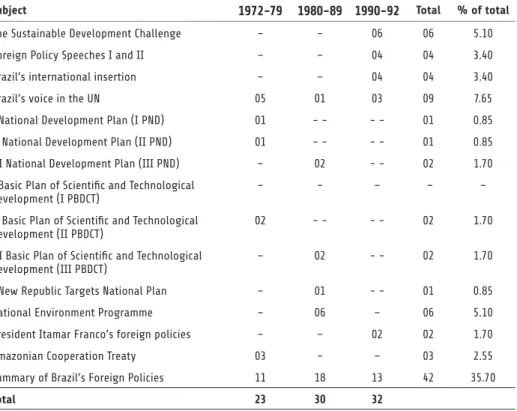
Brazilian statements about the environment in the international arena
Table 1: Government statements on environmental issues by subject and period, 1972–1992
Subject 1972-79 1980-89 1990-92 Total % of total
The Sustainable Development Challenge – – 06 06 5.10
Foreign Policy Speeches I and II – – 04 04 3.40
Brazil’s international insertion – – 04 04 3.40
Brazil’s voice in the UN 05 01 03 09 7.65
I National Development Plan (I PND) 01 - - - - 01 0.85
II National Development Plan (II PND) 01 - - - - 01 0.85
III National Development Plan (III PND) – 02 - - 02 1.70
I Basic Plan of Scientific and Technological Development (I PBDCT)
– – – – –
II Basic Plan of Scientific and Technological Development (II PBDCT)
02 - - - - 02 1.70
III Basic Plan of Scientific and Technological Development (III PBDCT)
– 02 - - 02 1.70
I New Republic Targets National Plan – 01 - - 01 0.85
National Environment Programme – 06 – 06 5.10
President Itamar Franco’s foreign policies – – 02 02 1.70
Amazonian Cooperation Treaty 03 – – 03 2.55
Summary of Brazil’s Foreign Policies 11 18 13 42 35.70
Total 23 30 32
Source: Compiled by the author with data from Ministry of Foreign Affairs of Brazil (1990b, 1993a, 1995).
Because there is no central repository, and because the institutions responsible for the sector are subject to administrative changes introduced during each presidential and ministerial mandate, the document search was very diicult. he Ministry of the Natural Environment, Water Resources and the Legal Amazon, for instance, does not even have an inventory of documents about the environment. Its searchable repository of documents basically consists of technical and inancial reports (Barros 2013).
Itamaraty holds the largest number of documents, almost all of which relect the government’s intention to relect a positive international image. In fact, they relect what could be described as a strategy of ‘diplomatic marketing’. he Social Communication Bureau in the Presidency holds a large inventory of presidential speeches, which also tend to focus on the international dimension.
Table 2: Statements by intended audience
Audience 1970 1980 1990 Total %
International community 17 19 32 68 60.50
Brazilian society 03 05 04 12 39.50
Total 20 24 36 89 100
Source: Elaborated by the author.
Statements about the environment in UN forums
Speeches by Brazilian representatives in the UN General Assembly (UNGA) are the most expressive records of the statements directed at the international community. I will irst present an overview of each decade; next, I will identify some of the most prominent topics, such as the Amazon, the use of natural resources, and the issue of sovereignty/self-determination, among others. Table 3 classiies statements to the UNGA into thematic categories as well as periods.
Table 3: Speeches in the UN General Assembly by theme and decade
Themes 1970 1980 1990 Total N %
Access to technology – 02 04 06 1.70
Amazon 14 21 13 48 13.80
Stockholm Conference 02 03 06 11 3.10
Ecological consciousness 03 02 04 09 2.40
Regional cooperation 06 08 05 19 5.70
Environmental damages 03 03 04 10 2.60
Nuclear disarmament 04 02 03 09 2.40
National economic development 08 12 11 31 8.90
Regional development 04 07 05 16 4.60
Sustainable development – – 17 17 4.90
Funding projects 02 03 02 07 2.10
Alternative energy sources 02 02 01 05 1.40
Economic integration 04 04 07 15 4.30
Environment and land reform – 01 03 04 1.15
Population and environment – 02 03 05 1.40
Pollution 05 09 02 16 4.60
National Parks – 03 – 03 0.90
PNUMA – 03 03 06 1.70
Quality of life – 05 02 07 2.10
Human resources qualification – 03 – 03 0.90
Sovereignty/self-determination 06 17 13 36 10.40
Shared use of natural resources 04 01 – 05 1.40
TOTAL 67 113 108 288 100
Statements intended for an international audience, 1970s
Speeches by Federal spokespersons from 1972 to 1979 do not deal with the environment in a clear and direct way. Instead, they refer to it in the course of dealing with other issues such as regional co-operation, national sovereignty, and national development. his was even the case in 1972, immediately ater the Stockholm Conference. Perhaps this omission relects the discomfort about Brazil’s position at Stockholm where it stated that pollution was an inevitable result of industrialisation, and that poverty was worse than environmen-tal degradation. Spokespersons also dealt with the environmenenvironmen-tal agenda in an indirect way via other bilateral and multilateral issues. At that time, therefore, environmental is-sues were not fully recognised in Brazilian public policy or political discourse. Speeches in the irst years of this decade were most oten about ‘the use of shared natural resources’. his was due to problems created by Argentina, since the Brazilian and Paraguayan gov-ernments had agreed in 1971 to build and jointly use the Itaipú Hydroelectric Plant, which is located on the Paraná River.
As a result, Brazilian representatives at the UN began to advocate Brazil’s sovereign right to use the natural resources in its territory, and share them with Paraguay. hese arguments were presented in the UNGA in 1972, and reinforced in 1973 and 1974. In 1974, Brazil and Uruguay agreed on a joint plan for developing the Mirim Lagoon, which extends from southern Brazil into Uruguay. In the same year, Brazil and Portugal agreed on changes to the Protocol on Working Relations and Social Insurance with Paraguay to allow for the construction of the Itaipú plant. he same arguments about sovereignty were presented to the World Energy Conference in 1975.
A second, closely related theme was that of the relation between natural resources and economic growth in developing countries. hus, in an address to the UNGA in 1976, Celso Amorim, the Brazilian Ambassador to the UN, declared:
One of the characteristics of the times we are living in is the growing control the developing countries have over their natural resources. his enables these countries to reduce their excessive economic de-pendence on the developed countries, and to better orient their own economic growth. It also opens original co-operation opportunities between developing countries (Ministry of Foreign Afairs of Brazil 1995: 307-8).
Natural resources were solely regarded as economic factors; their ecological dimen-sion was not mentioned. Moreover, while Brazil was clearly seeking to advance its own interests vis-à-vis those of the ‘developed’ countries’, it projected itself as a spokesperson for other ‘developing countries’ as well. Amorimthen went on to argue that:
en-ergy, raw materials and food crises (Ministry of Foreign Afairs of Brazil 1995: 308).
In other words, Brazil was arguing that the unrestrained use of natural resources by Latin American countries would beneit developed countries as well, as this would help to address some major global problems.
Brazil also used these rherotical arguments to restate its position about the use of shared natural resources. hus, Brazilian representatives at the UN argued that the shared utilisation of natural resources by Latin-American countries would boost regional de-velopment. his would beneit a set of developing countries and also mitigate serious in-ternational crises, mainly in the energy sector. Nature emerges as a resource for national economic development. hese rhetorical arguments had a single purpose, namely to le-gitimise the construction of the binational Itaipú Hydroelectric Plant.
It is worth noting that this stance was not exclusive to Brazil; it was shared by several other South American countries, notably Argentina and Chile. his goes beyond justify-ing the exploitation of natural resources on the grounds of national sovereignty, portray-ing it as a signiicant driver of national and regional economic development.
In 1976, in an address to the UNGA, AmbassadorAntonio Francisco Azeredo da Silveira continued to emphasise economic factors. While ecology emerged as an explicit theme, it was mentioned in a negative context, with da Silveira arguing that international attempts to hamper or frustrate Brazilian development on ecological grounds would con-stitute a ‘new and unacceptable form of domination’ (Ministry of Foreign Afairs of Brazil 1995: 322). his argument served to reinforce the notion of national sovereignty.
In 1977, da Silveira did not mention the environment in his addresses to the UNGA. In 1978, this theme re-emerged implicitly in the form of a comment on the lack of prog-ress made in respect of the UN Convention on the Rights of the Sea (UNCLOS), without going deeper in the subject. In 1979, AmbassadorRamiro Saraiva Guerreiro also referred to UNCLOS; however, ‘ecology’ was only mentioned in respect of the National Alcohol Programme (Programa Nacional do Álcool, or PROÁLCOOL), a new initiative for invest-ing in renewable sources of energy. Again, the sovereignty argument and the notion of nature as a resource for national economic development prevailed.
Moreover, the Brazilian government used ecological arguments to advocate extending territorial waters to a 200-mile limit. Besides arguments based on sovereignty, Guerreiro sought to justify this by arguing that it would
[…] assure the fundamental interests of coastal countries that look forward to accelerating the economic development of their popula-tion through the exploitapopula-tion of marine resources and the preserva-tion of the ecology (emphasis added) (Ministry of Foreign Afairs of Brazil 1995: 331).
However, it is worth noting that the preservation of the environment (‘ecology’) was ex-plicitly mentioned in this speech for the irst time.
Statements in the international arena in the 1980s – the ‘lost decade’
he 1980s was a ‘lost decade’ in the UNGA when it comes to references to ecology in speeches by Brazilian representatives. Although Chancellor Abreu Sodré once described the UNGA as the ‘forum of mankind’, President José Sarney mentioned ecologyonly once in an address in the Assembly in 1989.
As in the previous period, Brazil’s stance on ecological issues remained defensive, focusing on sovereignty. Presidential speeches responded to international opposition to Brazilian policy on the Amazon, mainly in respect of burns and deforestation. Another prominent subject was the murder of the rubber tapper leader Chico Mendes in 1988. his further reinforced Sarney’s defensive stance. Amazonian deforestation also attracted strong international criticism, with some developed countries even suggesting that the region be managed by a supranational body.4
Sarney used the same broad arguments as his predecessors, but with some diferences. he main innovation was that he went beyond the dimension of economic development, and placed ecology in an international social context. Notably, he linked environmental protection to the combating of drug traicking, which he characterised as ‘highly det-rimental to human life, especially young people’ (Ministry of Foreign Afairs of Brazil 1995: 501), and which, he argued, was partly caused by the developed countries as well. he argument went like this: it was common cause that drug cultivation contributed sig-niicantly to the deforestation process. Given that the drugs in question, speciically co-caine, were largely consumed in developed countries such as the USA, those countries, and therefore the international community, were partly responsible for drug traicking as well as its impact on the Brazilian environment. he Brazilian government reserved the right to take decisive steps to combat drug traicking, including placing military forces on its borders to prevent the illegal cross-border low of drugs and drug traders from other countries. herefore, while introducing a new element into the Brazilian discourse on the environment, this argument resonated with the previous emphasis on Brazilian sovereignty as well.
By speciically speaking about the environment, Sarney was responding to the new jargon about ‘saving the planet’ and assuring humankind’s survival. He then stated that the interdependence of nations was a key factor in environment issues, because ‘as inhabit-ants of the same small planet, we are sentenced to solidarity’. In the process, the Brazilian government began to refer to the environment by acknowledging the green agenda and its implication for international negotiations, while highlighting the asymmetries between developed and developing countries.
he environmental issue in its global aspect […] cannot and must not be discussed based on a strict perspective, as if it was a North-South issue, wherein the less developed countries were, due to an irrespon-sible attitude, afecting the ecological balance worldwide;
[…] industrialized countries are responsible for environmental pollution. Developing countries cannot accept, as the basis for a new international relationship, an ecological sustainable development concept that just gives them the task of assuring the ecological ba-lance on the planet (Ministry of Foreign Afairs of Brazil 1995: 501).
Brazil therefore entered the mainstream of the environmental debate by rejecting ex-clusive responsibility for environmental damage. However, in his introduction, Sarney declared that ‘the relevance attributed to the environmental issue and Brazil’s intention to deal with it in a clear and transparent way is clearly relected in our intention to host the 1992 UN Conference on the Environment and Development’. His explicit reference to environmental issues is noteworthy, indicating a change in the oicial Brazilian approach, which began to give more political relevance to this topic.
Following this, Sarney proudly highlighted the profusion of Brazilian natural resourc-es and natural beauty: ‘More than anything else, Brazil is aware of its exuberant, rich and extraordinary nature. Its forests, fauna and lora are a patrimony and richness that we do not refuse to protect.’ In efect, Sarney linked Brazil’s natural resources and natural beauty to its national identity. I have previously identiied national pride and the exaltation of natural beauty as one of the features of the oicial Brazilian discourse about the Amazon. his was strongly emphasised in the 1970s and 1980s, when the state used this rhetorical strategy to justify its stance on the environment to the international community as well as Brazilian society, and its approach to mitigating international environmental pressures as well as internal environmental demands (Barros 2007: 129).
In the same speech, Sarney emphasised Brazil’s historical role of preserving nature and opposing the extractive colonialism practiced by the ‘rich world’ in Africa, Asia and the Americas:
Brazil did not accept them, but forbade their presence. Back in the 1960s, the Hudson Institute conceived a large lake to lood the Ama-zon. Brazil has rejected this. If the world nowadays can turn its eyes to the Amazon, it is because Brazilians knew how to preserve the Amazon thus far, and will continue to do so in the future (Ministry of Foreign Afairs of Brazil 1995: 497).
he sovereignty argument resurfaces, with Sarney declaring: ‘We are willing, as we have always been, to co-operate. However, we will never accept impositions afecting our sovereignty’ (Ministry of Foreign Afairs of Brazil 1995: 502).
Under the ‘Our Nature Programme’, we have already diminished burns by 40% in a single year, we forbade timber exports, stopped incentives to projects that seemed predatory, and created the En-vironment Institute by gathering dozens of organs in a broadened ecological protection project. Approximately eight million hectares of Brazilian territory are currently under a permanent preservation regime. Approximately ten percent of the national territory, which holds 200 000 indigenous people, is reserved for indigenous popula-tions (Ministry of Foreign Afairs of Brazil 1995: 502).
He ended his remarks about ecology by returning to the drug traicking issue, stating that:
Our policy in this ield is energetic and preventive. Two years ago, under the ‘Calha Norte do Amazonas’ Programme, we occupied and supervised our extensive borders in order to help the local popula-tions and to stop the entry of drug dealers from other countries. We have controlled trade in illegal products. We are ighting the drugs (Ministry of Foreign Afairs of Brazil 1995: 502).
herefore, the oicial Brazilian discourse about the environment traversed the 1980s without any major change compared to the previous decade. Ecology was mentioned in circumspect ways, in the course of justifying the Brazilian government’s position on the use of shared natural resources, or responding to growing international pressures on en-vironmental issues. Nevertheless, a shit in the discourse is also evident. Despite retaining its claim to sovereignty, Brazilian representatives began to give greater recognition to the theme of ecology and the environment, introducing traces of a pragmatic approach that were reinforced in the 1990s.
Statements in the international arena in the 1990s
Unlike the previous decades, the early 1990s was a fruitful period for ecological issues in the UNGA. Addressing the irst session of the Assembly in 1990, President Fernando Col-lor de Melo, who had succeeded Sarney earlier the same year, called ecology ‘the second most important issue on the new international agenda’ (following economic development and international co-operation). Collor de Melo referred to Brazil’s willingness to host Rio 92, and commented on the global expectations of this event. Next, he declared:
At irst, it seemed as if the format of the oicial Brazilian speeches had changed, with Collor talking freely about Brazil’s situation without the characteristic evasions of his predecessors. However, this was just an inversion; ater these introductory remarks, he returned to the previous arguments, blaming the rich countries for environmental degra-dation, and emphasising the need for access to ‘green technologies’:
Brazil, as the other developing countries, must have easy access to ecologically safe technologies that enable eliminating damage to the environment. hese technologies must be applied to beneit all countries. It is urgently necessary to create the inancial conditions at the international level to allow their application in competitive terms (Ministry of Foreign Afairs of Brazil 1995: 517).
He went on to declare:
Countries that historically contributed to environmental contami-nation have a major responsibility for it. By facilitating the provision of these technologies and resources, these countries will embody the crucial role of reversing the catastrophic ecological framework that this generation has unfairly inherited (Ministry of Foreign Afairs of Brazil 1995: 517).
hese arguments once more turned ecology into an economic issue, drawing atten-tion to the relaatten-tionship between science, technology and ecology. Accordingly, in the Bra-zilian governmental discourse, technology was projected as the foundation for sustainable environmental measures.
Collor also spoke extensively about the forthcoming conference, Rio 92, in a way which suggested that this single event would resolve all ecological problems:
he Conference has an inescapable commitment to the future gen-erations, because they will be the great beneiciaries of our work, whose primary goal is to improve the population’s quality of life. […]
Perhaps the most important characteristic of a Conference on the Environment and Development lies in giving the participants an op-portunity to broaden and deepen the debate. […]
At the Conference, we will debate the adoption of economic poli-cies – in developed and developing countries – to eradicate poverty and to correct unsustainable production and consumption patterns (Ministry of Foreign Afairs of Brazil 1995: 531).
cli-mate, and stating that this would help to inaugurate a ‘new phase of international co-oper-ation’. He also referred to the emergence of new ideas based on the concept of sustainable development, stating:
A new paradigm emerged at Rio 92 – a new social contract. he main concern is assuring a rational balance between legitimate de-velopment on the one hand, and the preservation of our planet’s health and of the well-being of future generations on the other. Sus-tainable development is the contemporary expression of progress, and the basis of a new international environmental order (Ministry of Foreign Afairs of Brazil 1995: 550).
He then spoke about Brazil’s eforts in the following terms:
On its own initiative, and in terms of its own interests, Brazil has demonstrated its intent to assist international action in this ield. From 1987 to 1991, deforestation in the Amazon was reduced by 85% due to internal measures and the growing mobilization of Bra-zilian society to preserve the environment (Ministry of Foreign Af-fairs of Brazil 1995: 551).
He concluded by mentioning a new Brazilian initiative:
Brazil wishes to make an additional contribution to the eforts of the Rio Conference by making itself available to host an International Research Centre on Sustainable Development. We hope to count on public and private support for such an initiative, which was pro-posed in a Conference resolution, and is already being developed. he Centre will be an academic institution aimed at helping to de-velop sustainable dede-velopment by opening an international forum for interchange and research about the implementation of decisions made in Rio (Ministry of Foreign Afairs of Brazil 1995: 552).
To summarise, while Brazil’s stance at the UN on the environment in the early 1990s was much more deinite than in previous decades, it remained circumspect, avoiding commenting on certain issues by repeated references to Rio 92. he fact that Brazil had made itself available to host this gathering was given an exalted status, which it could al-ways refer to when concrete government action was lacking. In this way, Brazilian leaders exploited Brazil’s willingness to host the conference as evidence of the country’s adherence to a green agenda.
Brazil’s report to the UNCED
environmental issues in that period. Prepared by an Interministerial Commission, the report was divided into six chapters. he preface states that the document would ‘openly reveal Brazilian reality, with no touch-ups’, and ‘draw a clear and authentic picture of Bra-zil, worthy of being presented to the international community’.
In theory, this document was generated by the same government actors – the Presi-dency, and the International Relations Ministry. Its members were members of ministries and government departments linked to the Presidency. he diference lay in the asses-sors, all of whom were experts at the Brazilian Institute of Renewable Natural Resources (Instituto Brasileiro de Recursos Naturais Renováveis, or Ibama), the Brazilian Agricultural Research Company (Empresa Brasileira de Pesquisa Agropecuária, or Embrapa), the Na-tional Research Institute of the Amazon (Instituto Nacional de Pesquisas da Amazônia, or INPA), the National Spatial Research Institute (Instituto Nacional de Pesquisas Espaciais, or INPE), the National Weather Department, the Brazilian Tourism Company (Empresa Brasileira de Turismo, or Embratur) and the Interministerial Commission for Marine Re-sources.
he main theme was sustainable development, which was dealt with in terms of eco-nomic development, environmental crises, and the ecological transition. Brazil’s historical development path was described as ‘ecologically predatory, socially perverse and politi-cally unfair’ (Presidency of the Republic of Brazil 1991: 13). he environmental crisis was depicted as the result of this developmental trajectory, in association with political crises: ‘It is a crisis that is ecological (the progressive exhaustion of natural resources) and envi-ronmental (the reduced ability of ecosystems to recover from damage). However, it is also political, directly related to power systems for the distribution and use of social resources […]’ (Presidency of the Republic of Brazil 1991: 13). he ecological transition was de-picted as a response to this crisis, the triggering of awareness by states and society of the need to change global and national development paradigm.
However, the report argued that Brazil was not solely responsible for predatory forms of development, stating that the crisis was ultimately global in character, ‘the crisis of a global economic development model’ (Presidency of the Republic of Brazil 1991: 14) in which developing countries were forced to ‘import the lifestyles’ of developed countries. In this way, the document reverted to and reinforced the oicial Brazilian discourse: en-vironmental degradation in developing Southern countries was caused by the ‘lifestyles’ of people in developed Northern countries, and the demand for primary products for industrial production in the rich countries. his worked to exhaust natural resources in the South, including those in Brazil.
As regards the energy sector, since the 1950s, two great centralised energy systems had been created, both predominantly public: electric power and oil (Presidency of the Repub-lic of Brazil 1991: 36). Until recently, however, socio-environmental issues had played a minor role in electric power planning (Presidency of the Republic of Brazil 1991: 42).
As regards mining, while highlighting Brazil’s mining potential, the report stated that:
he rapid expansion and accelerated mechanisation of goldields brought consequences that nowadays stigmatise such activity: envi-ronmental degradation, conlicts with indigenous populations and organised mining, poor working conditions, gold traic, and the depredation of reservoirs. he environmental impacts of the gold mining mainly result from uncontrolled mining, the lack of previous knowledge about the regional geology, from the indiscriminate was-te discharges, from the silting of natural drainage, from the dischar-ge of the metallic mercury used to amalgamate gold, and the failure to recover degraded areas (Presidency of the Republic of Brazil 1991: 46).
As regards recycling, the report emphasises the environmental impacts of chemical, oil, metal, logging, paper and cellulose facilities, as well as the processing of non-metallic minerals. All these industries operated in terms of ‘obsolete environmental technological standards, and a lack of treatment, recycling and reprocessing technologies’ (Presidency of the Republic of Brazil 1991: 47).
According to the report, transport infrastructure was extended due to the growth in the automotive industry, and the expansion of economic frontiers. However,
the accelerated construction of roads, which was not followed by an efective large-scale territorial ordering policy, helped to worsen social issues such as: rural-urban and inter-regional migration; the delation of cities and regions; economic and population concentra-tions; quality of life decay in big metropolitan areas; and increased oil dependence. […]
he opening of the Amazonian roads have resulted in the inadequa-te use of natural resources and in the devastation of areas where the settlement projects, the timber extraction and the agriculture were implemented. he transportation network in other areas have allo-wed the supply of goods coming from the South-central region, whi-ch started competing with the locally produced assets (Presidency of the Republic of Brazil 1991: 51).
Urban environmental issues in Brazil derive from the two determi-ning factors. On the one hand, poverty in the cities, mainly in big cities, afects a big fraction of the Brazilian population and is mixed with the environmental degradation consequences. On the other hand, there are problems caused by the concentration of economic activities, mainly of the industrial sector, in the urban locations. he accelerated urbanization led to deicit in the infrastructure of urban services, whose most severe environmental manifestation is the lack of basic sanitation […]. According to oicial data, 35% of the urban houses, which are mostly located in slum areas, are considered “ina-dequate” from a healthy viewpoint. he statistics concerning hou-sing adequacy only bring up the health issue in the urban environ-ment. he other basic issue regarding urbanization refers to garbage and urban cleaning. Garbage disposal is as bad as sewage discharge. Of the 12 thousand locations where the Brazilian counties discharge their solid residues, most are outdoor dumps and water bodies, and it leads to air and soil contamination issues, besides favouring the proliferation of vectors harming to human health […] (Presidency of the Republic of Brazil 1991: 60-61).
One of the chapters in the report dealt with environmental legislation, which, it stated, had become more complex ater the Stockholm Conference in 1972. Before Stockholm, legal mechanisms were limited to lora and fauna, as well as the use of water and mineral resources. Ater the conference, legislation started to regulate environmental education, the zoning of land, the licensing system for polluting activities, and rules and standards for environmental control itself.
Another chapter focused on the main Brazilian ecosystems: the Amazon, Cerrado (Brazilian savannah), the Atlantic forest, the Southern ields, the Araucaria forest, Panta-nal (wetlands), and the coastal and insular ecosystems.
Yet another chapter dealt with so-called global issues: climate change, biodiversity, endangered species, and the depletion of the ozone layer. here was some data about these issues in Brazil, but this was dispersed among tables and graphs that depicted the general global situation. Some information was given about the Amazon, including eforts to con-trol deforestation, as well as mineral and vegetation wealth. Anything outside this domain was limited to CFC (Chloro-luorocarbon) production, given as 10 000 tonnes in 1988 and 8.6 000 tons in 1990 (whereas 280 000 tonnes were recorded in the USA in 1985). hus the report argued that
most important observation centre in the tropical region, due to its equatorial database (Presidency of the Republic of Brazil 1991: 146).
he second last chapter dealt with strategies and challenges for sustainable develop-ment in Brazil, including poverty reduction, participation in and social control of devel-opment, and scientiic-technological improvements. Poverty was proiled as follows:
About 40% of Brazilian families live in poverty, marked by low mon-thly incomes (one fourth of the minimum wage per capita). Of these families, 45% are living in conditions of misery, which corresponds to 4.7 million families. In 1989, the richest 5% of the population ceived 38.5% of the total income, whereas the poorest 40% only re-ceived 7.2% of the total income (Presidency of the Republic of Brazil 1991: 152).
Social participation in development would help to ‘close the gap among material pro-cess, social justice and environmental sustainability’ (Presidency of the Republic of Brazil 1991: 155). his involved the building of alliances among various social groupings, pro-viding a consensual base for the reform of public institutions and social participation in state structures. Techno-scientiic advances could help to reduce industrial pollution, and encourage ventures for reducing pollution and conserving ecosystems.
he Amazon was a prominent topic in the report, as in oicial speeches in the period in question. However, the report said nothing new, besides the normal references to the Amazon’s biodiversity, size, mineral wealth, and so on.
Statements before and during Eco 92
Speeches between 1990 and 1991 largely dealt with preparations for Rio 92, namely the irst and second meetings of the UN Preparatory Commission, the CIMA Regional Pre-paratory Meeting, and the First and Second CIMA PrePre-paratory Committee Meeting, pro-jecting these as ‘milestones of multilateral policy’. he conference itself set the tone for government statements in the early 1990s which portrayed it as an event that would:
[…]
reinforce, deepen, and make the political changes in Euro-pean and global relations universal. Our conference is an excellent opportunity to launch a new era in global negotiations. his new period will be characterised by a sense of shared responsibility and functional solidarity among all international, national and non-go-vernmental actors (Ministry of Foreign Afairs of Brazil 1990b: 43).Do-with a National Social Well-being Product (NSWP), declaring that ‘the struggle to reduce inequality must be a permanent cause for all those who are aware of belonging to a broad-er human society’ (Ministry of Foreign Afairs of Brazil 1992a: 149).
his did not mean that the political and economic dimensions were suppressed; they remained on the agenda. However, the social dimension became more prominent, thus broadening the Brazilian government’s discourse on the environment. hese dimensions cannot be strictly separated, as the social aspect also encompasses the others. However, Brazilian representatives began to speak about them in a diferent way. In Lafer’s speeches in particular, the social perspective was closely associated with the legal issues emanat-ing from the conference, which he referred to as ‘the celebration of a new social contract supported by values of a new humanism’ (Ministry of Foreign Afairs of Brazil 1992b). In fact, he stated that ‘the Rio Declaration, the 21 Agenda, the Declaration on forests, the Convention on Climate and the Convention on Biodiversity deine a juridical framework of fundamental importance for international cooperation’ (Ministry of Foreign Afairs of Brazil 1993a: 231).
He also declared that the new concept of sustainable development was ‘the contem-porary expression of progress, and the basis of a new international environmental order’ (Ministry of Foreign Afairs of Brazil 1993a: 231). For him, this new notion had a funda-mentally social meaning, as according to Lafer, ‘sustainable development is development itself. here is no sustainable stagnation. Misery is also intrinsically unsustainable, be-cause it is inhuman […]’ (Ministry of Foreign Afairs of Brazil 1993a: 95).
he adoption of the notion of sustainable development was the biggest change in Bra-zil’s oicial discourse on the environment in this period. Although Brazil continued to insist on its sovereign rights in environmental matters, it paradoxically began to deny this right to neighbouring countries, claming the right to ‘defend’ its borders in the course of the war against drug traicking. Brazil also became an active participant in interna-tional negotiations about the green agenda, among others at the conference about climate change, biodiversity, and other international environmental regimes.
Final comments
Statements about the environment in the period under review served to formulate and consolidate Brazil’s oicial position on this issue. Some treatments remained constant and others changed, depending on the speciic issues in question. his discourse was closely linked to the political context at that time, as well as international power politics. In the early 1970s, following the Stockholm Conference, ecology entered the oicial discourse in an indirect way, utilised to reinforce Brazil’s claims to sovereignty in this area. In other words, ecology and the environment was not yet treated as a self-standing category or dimension in the oicial Brazilian discourse.
over the region, considered to be the ‘lungs of the world’, and of ecological interest to the whole of humankind. he Brazilian discourse claiming the right to exploit its own natural resources must also be understood as a rhetorical alignment with similar stances adopt-ed by other Southern countries. hus, Brazil was seeking the support of other Southern countries, mainly in South America, where its neighbours were also claiming the exploita-tion of natural assets and resources as legitimate developmental strategies.
Due to international pressures, Brazilian leaders had to talk about this issue in de-fensive ways, highlighting positive state policies and initiatives. his was an attempt to mitigate external pressures and to project itself as a protagonist in formulating and im-plementing its own environmental policies. Spokespersons used the interests if Brazilian society as a whole as a rhetorical strategy for legitimising its stance in the international arena.
In the late 1980s and early 1990s, the environmental agenda gained greater promi-nence and autonomy in the oicial discourse, thus showing that the country was improv-ing its internal and external commitment to the green agenda. Brazil moved away from its principled claim to sovereignty towards a more pragmatic position by showing its willing-ness to participate in multilateral negotiations about environmental issues.
As Rio 92 approached, Brazilian representatives increasingly emphasised the urgency of environmental issues, including the need to globalise the green agenda. hey used Bra-zil’s willingness to host the conference as evidence of its adherence to the green agenda, and its engagement with ecological issues. Brazil’s report to UNCED was entitled he Challenge of Sustainable Development (1991). As its title suggests, it demonstrated Brazil’s acceptance of this new foundational concept, and its adherence to the UN’s major propo-sitions. he report also steps take to implement a new approach to national development. Speeches at Rio 92 displayed two new features, namely the primacy of the social di-mension, and an emphasis on the legacy of the event. he insertion of the social dimen-sion broadened the oicial Brazilian discourse about the environment, overshadowing the previous emphasis on economic development, and encompassing the sustainable develop-ment agenda focused on social developdevelop-ment and the combating of poverty.
Indeed, acceptance of the notion of sustainable development was the most important legacy of Rio 92. Based on this new position, Brazil began to play a more active role in international negotiations and in more recent debates about climate change and biodiver-sity. Nevertheless, the two decades from 1972 to 1992 remain an important period in the development of the environmental agenda, thus reinforcing its importance in the history of environmentalism (McNeil 2001, 2003).
Notes
1 In my view, these two perspectives are complementary, although the second approach prevails in the social sciences.
commonly called a zero-sum game. his perspective questions ‘the state-centered model of unitary actor in the international scene, thus acknowledging that the world politics develops in a more complex world of interdependent, formal and informal relations occurring not just between national states, but also between private corporations and international organisms’ (Maia and Saraiva 2012: 107).
3 Barros (2015) presents a study about international inluence over the formulation of environmental laws in Brazil from 1973 to 2012.
4 he critics emerged at diferent stages during the 1980s and 1990s. he most critical countries, notably the USA, France and Russia, suggested that the Amazon should be internationalised, arguing that, given its environmental importance and its function in climate regulation, the region was a territory of humankind.
References
Bardin, Lawrence. 1977. Análise de Conteúdo. Transl. Luís Antero Reta and Augusto Pinheiro. Lis-boa: Edições 70.
______. 1999. Atores e discursos ecológicos no Brasil: ciência, estado e imprensa. PhD hesis. Uni-versity of Brasilia.
Barros, Antonio Teixeira. 2007. ‘Visões do paraíso: o discurso oicial brasileiro sobre ecologia e a exaltação das belezas naturais da Amazônia’. Latinoamérica,44: 129-156.
______. 2013. ‘A visibilidade ambiental em perspectiva sociológica’. Sociologias, 15 (33): 318-345. _____. 2015. ‘Agenda Verde Internacional e seus impactos no Brasil’. Revista de Estudos e Pesquisas sobre as Américas, 9 (2): 169.
Barros-Platiau, Ana Flávia, Marcelo Dias Varella and Rafael T Schleicher. 2004. ‘Meio ambiente e relações internacionais’. Revista Brasileira de Política Internacional, 47 (2): 100-130.
Beck, Ulrich. 1994. ‘A reinvenção da política’. In Ulrich Beck, Anthony Giddens and Scott Lash, A Modernização Relexiva. Transl. Maria Amélia Augusto. São Paulo: Editora Unesp, pp. 11-71.
Bobbio, Norberto. 1992. A Era dos Direitos. Rio de Janeiro: Campus.
Castells, Manuel. 1999. O Poder da Identidade. Transl. Klauss Brandini Gerhardt. Rio de Janeiro: Paz e Terra.
Duarte, Lílian Cristina Burlamaqui. 2004. ‘A política ambiental internacional: uma introdução’. Re-vista Cena Internacional, 6 (1): 4-12.
Ferreira, Lúcia da Costa. 1993. Os fantasmas do vale: qualidade ambiental e cidadania.Campinas: Unicamp.
Guimarães, Roberto Pereira. 1986. Ecopolitics in the hird World. PhD hesis. University of Con-necticut.
Hardin, Garrett. 2009. ‘he tragedy of the commons’. Journal of Natural Resources Policy Research, 1 (3): 243-253.
Hobsbawn, Eric. 1995. A Era dos Extremos. Transl. Marcos Santa Rita. São Paulo: Companhia das Letras.
Keohane, Robert O and Joseph Nye Jr. 2001. Power and Interdependence: World Politics in Transition.
3rd ed. New York: Addison-Wesley Longman.
Mcneill, John Robert. 2001. Something New under the Sun:An Environmental History of the Twenti-eth-century World (the Global Century Series). New York and London: Norton & Company. ______. 2003. ‘Observations on the nature and culture of environmental history’. History and he-ory, 42 (4): 5–43.
Ministry of Foreign Afairs of Brazil. 1990a. ‘II Reunião Preparatória para a Rio-92’. Resenha de política exterior do Brasil, 27 (65): 63-98.
______. 1990b. ‘Relatório da III Reunião Preparatória para a Rio-92’. Resenha de política exterior do Brasil, 27 (66): 112-143.
______. 1992a. ‘Discurso do Presidente da República na Reunião de Chanceles do Mercosul’. Rese-nha de política exterior do Brasil, 19 (70): 23-31.
______. 1992b. ‘Discurso do Ministro Celso Lafer na abertura da IV Reunião Preparatória da Rio-92’. Resenha de política exterior do Brasil, 20 (71): 72-93.
______. 1993a. Discursos de política externa I. Brasília: MRE.
______. 1995. A Palavra do Brasil nas Nações Unidas (1945-1995). Brasília: FUNAG.
Pasquariello, Karina Lilia. 1993. ‘Relações internacionais e meio ambiente’.Cadernos Cedec, 26: 1-30. Presidency of the Republic of Brazil. 1991. O Desaio do desenvolvimento Sustentável: Relatório do Brasil para a Conferência das Nações Unidas sobre Meio Ambiente e Desenvolvimento. Brasília: Secre-taria de Imprensa, Presidência da República.
Viola, Eduardo. 1998. ‘A globalização da política ambiental no Brasil, 1990-1998’. Annals of the XXI International Congress of the Latin American Studies Association.Chicago, IL, 24-26 September. ______. 2005. ‘Meio ambiente e relações internacionais: as complexas negociações internacionais para atenuar as mudanças climáticas’. In André Trigueiro (ed), Meio Ambiente no Século XXI. Cam-pinas: Autores Associados, pp. 182-197.
About the author
Antonio Teixeira de Barros holds a PhD in Sociology with an emphasis on Science,
Tech-nology and Society from the University of Brasilia (UnB), Brazil. He has been a university professor since 1995. He currently teaches the MA programme in Political Science at the Centre for Education, Training and Advancement of the Chamber of Deputies (CEFOR), Brazil, where he also researches institutional policy of the legislative branch. He has con-ducted research on environmental policy and environmental sociology since the early 1990s, and has written numerous papers for national and international journals, as well as book chapters. His current research addresses the issues of youth and environmental poli-cies, environmental management in Brazilian metropolises, and related topics.