* Study carried out at Radiologia Anchieta, Taguatinga and in the Radiology Department of the Universidade Federal do Rio de Janeiro – UFRJ, Federal University of Rio de Janeiro – Rio de Janeiro, Brazil.
1. Coordinator of Medical Residency in Radiology and Diagnostic Imaging. Taguatinga Regional Hospital, Taguatinga, Brazil.
2. Full Professor and Head of the Radiology Department. Universidade Federal Fluminense – UFF, Fluminense Federal University – Rio de Janeiro, Brazil. 3. Professor of Clinical Medicine. Faculdade de Medicina de Petrópolis – FMP, Petrópolis School of Medicine – Petrópolis, Brazil.
4. Adjunct Professor of Radiology. Universidade Federal do Paraná – UFPR, Federal University of Paraná – Curitiba, Brazil. 5. Resident Physician. Radiologia Anchieta, Taguatinga, Brazil.
Correspondence to: Edson Marchiori. Rua Thomaz Cameron, 438, Valparaiso, CEP 25685-120, Petrópolis, RJ, Brasil. Tel 55 21 2629-9076. E-mail: [email protected]
Submitted: 10 May 2007. Accepted, after review: 16 July 2007.
Pulmonary complications of crack cocaine use: high-resolution
computed tomography of the chest*
Complicações pulmonares após uso de crack: achados na tomografia computadorizada de alta resolução do tórax
Alexandre Mançano1, Edson Marchiori2, Gláucia Zanetti3, Dante Luiz Escuissato4,
Beatriz Cunha Duarte5, Lourenço de Araujo Apolinário5
Abstract
Here, we report high-resolution computed tomography (HRCT) findings in a patient who developed sudden hemoptysis, dyspnea and chest pain after smoking crack cocaine. Chest X-rays showed consolidations, primarily in the upper lobes, and HRCT scans showed ground glass attenuation opacities, consolidations and air-space nodules. A follow-up CT, after drug use discontinuation and administration of corticosteroids, showed partial resolution of pulmonary lesions and the appearance of cavitations. Clinical, imaging and laboratory findings led to a diagnosis of ‘crack lung’.
Keywords: Crack cocaine/adverse effects; Cocaine-related disorders; Tomography, X-ray computed; Street drugs/adverse effects; Lung/drug effects.
Resumo
Relatamos os achados na tomografia computadorizada de alta resolução de um paciente que, após uso de cocaína fumada (crack), desen-volveu quadro de hemoptise, dispnéia e dor torácica súbitas. As radiografias de tórax mostravam consolidações predominando em lobos superiores. A tomografia de alta resolução evidenciava opacidades em vidro fosco, consolidações e nódulos do espaço aéreo. Nova tomografia de controle, após suspensão da droga e uso de corticóides, mostrou regressão parcial das lesões e aparecimento de escavações. A correlação entre os achados clínicos, laboratoriais e de imagem permitiu o diagnóstico de “pulmão de crack”.
Descritores: Cocaína crack/efeitos adversos; Transtornos relacionados ao uso de cocaína; Tomografia computadorizada por raios X; Drogas ilícitas/efeitos adversos; Pulmão/efeitos de drogas.
Introduction
It is calculated that there are between 5 and 8 million users of cocaine in the United States, and the principal form used is smoked cocaine (crack).(1) In Brazil, although there is a considerable lack of statistics, a significant and progres-sive increase in the number of crack cocaine users has been observed.(2)
Inhaled crack can induce a variety of acute pulmonary alterations, including alveolar hemorrhage, acute pulmo-nary edema and various types of infiltration.(3-7) The most frequently observed symptoms are chest pain, dyspnea, productive cough, fever and hemoptysis.(8)
Although some articles in the literature report chest X-ray findings,(4,8) studies that specifically describe tomographic alterations in this group of patients are rare.(9) In this study, the authors describe a case of pulmonary involvement after crack use, emphasizing high-resolution computed tomog-raphy (HRCT) findings.
Case report
Upon admission, oxygen therapy (through a nasal cannula) and intravenous corticosteroids were administered. The patient presented favorable evolution, and was discharged, asymptomatic, after 4 days. He was instructed to discontinue use of the illicit drug and to return for a control tomography scan within two weeks.
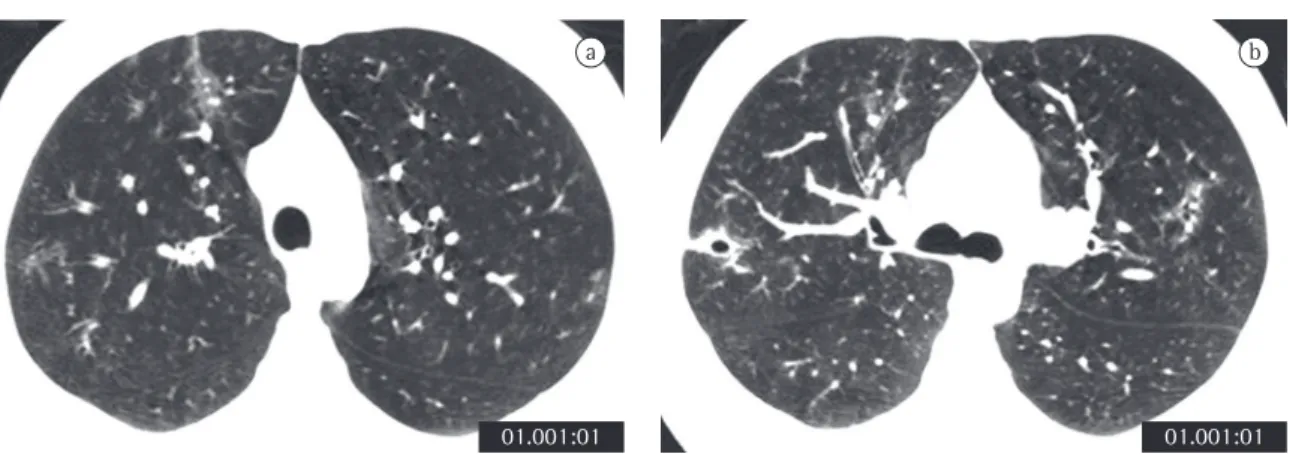
A control HRCT scan performed 15 days after the first examination (Figure 3) revealed great radi-ological improvement, with some persisting sparse ground-glass opacities and the appearance of some cavitations where there had been consolidations.
At this writing, the patient was in outpatient follow-up treatment, without complaints, and reporting definitive cessation of drug use.
Discussion
The use of cocaine can lead to complications such as cardiac arrhythmias, myocardial infarction, subarachnoid hemorrhage, obstetric complications, convulsions, psychiatric disorders and respira-tory complications, as well as having the potential to cause sudden death.(2,4,8) Since the lung is the principal organ exposed to crack smoke, pulmo-nary complications are frequently observed in crack smokers.(3,10) Cocaine has the capacity to signifi-pleuritic chest pain in the lower thirds of both
hemithoraces, accompanied by dyspnea and cough with bloodstained sputum (hemoptysis), 12 h after crack use. The patient reported no fever, convulsions, vomiting, aspiration, or loss of consciousness. Nor did he report any cardiovascular or urinary symp-toms, In addition, he stated that he had not used injection drugs. He was a smoker (8 pack-years).
The physical examination revealed that the patient presented good general health status and no signs of psychomotor agitation. He was well hydrated, with good color, and presented no cyanosis, skin rash or petechiae. His fingertips were burned, which raised suspicion of drug use. Pupils were isocoric and reactive to light. The results of the remaining neurologic tests were normal. Arterial pressure was 120/70 mmHg, without postural alterations, respiratory rate was 20 breaths/min, and heart rate was 80 bpm. The patient presented normal precordial examination, regular pulse and good pulse amplitude. Upon pulmonary ausculta-tion, there were universally audible breath sounds without adventitious sounds. Electrocardiogram results were normal.
Laboratory tests performed at admission revealed the following: normal blood workup and platelets; erythrocyte sedimentation rate, 27 mm in the first hour; C-reactive protein, 192 mg/dL; creatinine, 0.8 mg/dL; aspartate aminotransferase, 21 U/L; alanine aminotransferase, 20 U/L; alkaline phosphatase, 61 IU/L; gamma-glutamyl transpepti-dase, 20 IU/L; total proteins, 6.40 g/dL; albumin, 3.91 g/dL; globulin, 2.49 g/dL; blood culture, three negative samples; negative results for antineu-trophil cytoplasmic antibodies; negative results for HIV I and II antibodies; negative results for acid-fast bacilli and fungi in three sputum samples. Testing for illicit substances in urine (thin layer chromatog-raphy method) was positive.
Chest X-rays revealed heterogeneous areas of consolidation, predominantly in the upper and middle lung fields, bilaterally, without signs of pleural effusion (Figure 1). The patient was admitted for investigation, and the HRCT scan requested revealed consolidations, peribronchial nodules and ground-glass opacities, with evident involvement of the upper and middle lung fields (Figure 2). There were no parenchymal cavitations, nor was there any pleural or mediastinal involvement.
monia and bronchiolitis obliterans with organizing pneumonia, as well as acute pulmonary infiltration associated with a spectrum of clinical and patho-logical findings, referred to as “crack lung”.(4,7,10) The mechanism through which crack causes these various types of lung injury has not been well established.(7) Since pulmonary hemorrhage is radiologically indis-tinguishable from other types acute lung injury, the development of respiratory insufficiency with bilat-eral opacities that appear immediately after crack use and rapidly clear up after cessation of drug use has also been designated “crack lung”.(1,3,13)
The most common pulmonary alterations are edema and alveolar hemorrhage. The edema can be either cardiogenic or noncardiogenic (resulting from increased pulmonary capillary permeability). Autopsy findings show that alveolar hemorrhage is very common in this group, not only in the acute form but often in the chronic form, asymptomatic and without hemoptysis.(1,4,7,9,14)
Barotrauma can develop as the result of pronounced inspiratory effort, often followed by prolonged Valsalva maneuver and the uncontrollable coughing that accompanies the inhalation of crack smoke. The sudden increase in intrabronchial and intra-alveolar pressure, resulting in alveolar rupture and air in the interstitium, can cause pneumomedi-astinum, pneumothorax or pneumopericardium.(8,12) The thermal aggression and airway injury resulting from the inhalation of extremely hot fumes cantly damage all structural components of the
lung, negatively affecting pulmonary function in a variety of ways.(1)
Although acute respiratory symptoms typically develop a few hours after inhalation of the smoke, they can appear within minutes. Acute respiratory symptoms include dry cough or cough with elimi-nation (bloodstained sputum or sputum containing dark material, resulting from the inhalation of tobacco smoke residues), dyspnea, fever, chest pain, asthma and episodes of bronchospasm.(3,11,12)
Although 25 to 60% of crack users present respiratory symptoms after smoking the drug, few of them seek medical attention.(1) It should be noted that many users initially deny using illicit drugs, and that urine testing can be used in order to later confirm such use. Occasionally, certain physical examination findings can suggest the diagnosis, such as burned fingertips, resulting from handling the glass pipes typically used to smoke the drug,(3,13) or the presence of black sputum, characteristic of crack use, attributed to the inhalation of carbon residues from butane or from the alcohol-soaked cotton used to cook the cocaine.(3,12)
Marked and repeated pulmonary exposure to smoked cocaine has been associated with a large spectrum of pulmonary complications, including pulmonary edema, diffuse alveolar hemorrhage, acute asthma exacerbations, barotrauma, eosinophil pulmonary infiltrations, nonspecific interstitial
pneu-a
38,0 mm 38,0 mm
b
158,0 mm 158,0 mm 1,0 mm
pulmonary infarction after crack use, suggesting that pulmonary infarctions result from cocaine-induced vascular spasm, with endothelial lesion and the resulting in situ thrombosis, rather than from pulmonary embolism.(1,3) The cavitations observed in our patient probably resulted from pulmonary infarction.
The use of corticosteroid therapy is controversial. Some authors believe that there is no evidence that their use alters clinical evolution.(3) Others have treated patients with short courses of corti-costeroids and have reported that their use can be beneficial.(13,15)
Although it cannot be stated that cocaine was unequivocally responsible for the acute pulmonary syndrome observed in our patient, the temporal relationship between the act of smoking crack and the symptom onset, together with the absence, as confirmed through clinical and laboratory tests, of other conditions that might have been respon-sible for the symptomatology, as well as the rapid resolution of pulmonary lesions after drug use was discontinued, allowed us to draw this correlation.
A significant increase in the use of crack cocaine has been observed in recent years. The attending physician should be alert to this diagnostic possi-bility, and know its multiple clinical and radiological manifestations. Again, it should be borne in mind that a history of drug use is often omitted by patients.
or foreign bodies during smoking can be facilitated by the local anesthetic effect that cocaine has on the oral cavity and airways, together with the altered mental state that cocaine use promotes. This mech-anism can lead to severe reactive airway disease and tracheal stenosis.(1) Finally, crack smoking can cause or contribute to the development of asthma, prob-ably due to nonspecific irritation of the airways.(10)
One group of authors(8) assessed the chest X-rays of 71 crack users and found abnormalities in nine: atelectasis or focal consolidations in four, pneumomediastinum in two, pneumothorax in one, hemothorax in one and pulmonary edema in one.
Regarding the HRCT scan, the only study found in the literature reports that cardiogenic edema, as well as noncardiogenic edemas such as alveolar hemorrhage, can manifest as diffuse or multifocal pulmonary involvement, with ground-glass opacities, consolidations and smooth thickening of interlob-ular septa, with or without pleural effusion.(9) In our patient, alterations were located in the upper and middle lung fields, as is typically seen in inhala-tion-related lung diseases. Lesions are characterized by consolidations, peribronchial nodules and ground-glass opacities. Pulmonary alterations were extensive and had disappeared almost completely by the time of the control tomography scan, performed 15 days after drug use cessation and initiation of corticosteroid therapy. The appearance of some cavitations where there had been consolidations should be highlighted. Some authors have reported
Figure 3 - High-resolution computed tomography scan performed 15 days after the first scan (after discontinuation of drug use and initiation of corticosteroid therapy), with slices at the level of the aortic arch (a) and at the level of the bronchial bifurcation (b). As can be seen, there was nearly complete reabsorption of consolidations, although discreet ground-glass opacities persisted. In b), note the appearance of cavitations in the right lung, adjacent to the pleural surface.
01.001:01
a
01.001:01
8. Eurman DW, Potash HI, Eyler WR, Paganussi PJ, Beute GH. Chest pain and dyspnea related to crack cocaine smoking: value of chest radiography. Radiology 1989; 172(2): 459-462.
9. Gotway MB, Marder SR, Hanks DK, Leung JW, Dawn SK, Gean AD, et al. Thoracic complications of illicit drug use: an organ system approach. Radiographics. 200222 Spec No:S119-35.
10. Tashkin DP. Pulmonary complications of smoked substance abuse. West J Med. 1990;152(5):525-30.
11. Tashkin DP, Khalsa ME, Gorelick D, Chang P, Simmons MS, Coulson AH, et al. Pulmonary status of habitual cocaine smokers. Am Rev Respir Dis. 1992;145(1):92-100.
12. Terra Filho M, Yen CC, Santos Ude P, Muñoz DR. Pulmonary alterations in cocaine users. Sao Paulo Med J. 2004;122(1):26-31.
13. Gatof D, Albert RK. Bilateral thumb burns leading to the diagnosis of crack lung. Chest. 2002;121(1):289-91. 14. Borges ER, Ab’Saber AM, Barbas CS. Pulmonary hemorrhage
syndromes. J Bras Pneumol. 2005:31(Supl1):S36-S43. 15. Forrester JM, Steele AW, Waldron JA, Parsons PE. Crack
lung: an acute pulmonary syndrome with a spectrum of clinical and histopathologic findings. Am Rev Respir Dis. 1990;142(2):462-7.
References
1. Laposata EA, Mayo GL. A review of pulmonary pathology and mechanisms associated with inhalation of freebase cocaine (“crack”). Am J Forensic Med Pathol. 1993;14(1):1-9. 2. Ferri CP, Laranjeira RR, Silveira DX, Dunn J, Formigoni ML.
Aumento da procura de tratamento por usuários de crack em dois ambulatórios na cidade de São Paulo, nos anos de 1990 a 1993. Rev Ass Med Brasil. 1997;43(1):25-8.
3. Haim DY, Lippmann ML, Goldberg SK, Walkenstein MD. The pulmonary complications of crack cocaine. A comprehensive review. Chest. 1995;107(1):233-40.
4. Hoffman CK, Goodman PC. Pulmonary edema in cocaine smokers. Radiology. 1989;172(2):463-5.
5. Kleerup EC, Koyal SN, Marques-Magallanes JA, Goldman MD, Tashkin DP. Chronic and acute effects of “crack” cocaine on diffusing capacity, membrane diffusion, and pulmonary capillary blood volume in the lung. Chest. 2002;122(2):629-38.
6. Janjua TM, Bohan AE, Wesselius LJ. Increased lower respiratory tract iron concentrations in alkaloidal (“crack”) cocaine users. Chest. 2001;119(2):422-7.