ORIGINAL
RES
EAR
CH
Address for correspondence: Maria Elaine Trevisan – Rua Silva Jardim, 2.141/701 – CEP: 97010-493 – Santa Maria (RS), Brazil – E-mail: [email protected] Presentation: May 2013 – Approved for publication: Feb. 2014 – Financing source: none – Conflict of interests: nothing to declare – Approval at the Ethics Committee n. CAAE 0256.0.243.000-10.
ABSTRACT | The objective of this study was to eva-luate the functionality of gait and cardiorespiratory parameters in individuals with chronic obstructive pul-monary disease (COPD), before and after a walk test, in order to allow the development of strategies, aimed at maintaining autonomy and preservation of inde-pendence. In this study, were included individuals with COPD, aged between 50 to 80 years, and excluded tho-se with orthopedic, neurological and cardiac problems, or any condition that would prevent the assessments proposed in this study. The variables measured were:1st peak force, mid peak low and 2nd peak force, time of 1st double support, the swing moment and 2nd double sup-port; single support time, stride length and stride, speed and time gait cycle, heart rate, oxygen saturation and dyspnea/tiredness score, pre and post-test. The sam-ple consisted of 14 individuals (8 females and 6 males), mean age 65.21±9.42 years. In the post-test patients had greater sensation of dyspnea / fatigue, increased speed and reduced time of the gait cycle, increase the 1st peak force and reduction of the mid peak low, reduction the time the 1st double support and the time of the 1st peak force. The physical effort had influenced the gait pattern and cardiorespiratory parameters in this group of indi-viduals with COPD.
Keywords | Pulmonary Disease, Chronic Obstructive; Gait; Dyspnea.
Effects of an incremental walking test in the
gait of individuals with Chronic Obstructive
Pulmonary Disease
Efeitos de um teste incremental de caminhada na marcha de indivíduos
com Doença Pulmonar Obstrutiva Crônica
Efectos de un test adicional de caminada en la marcha de individuos con
Enfermedad Pulmonar Obstructiva Crónica
Cecília Rossatto Facco1, Juliana Corrêa Soares1, Carlos Bolli Mota2, Maria Elaine Trevisan3
Study conducted at the Biomechanics Laboratory of the Federal University of Santa Maria (UFSM) – Santa Maria (RS), Brazil. 1Biomechanics Laboratory at the UFSM – Santa Maria (RS), Brazil.
2Department of Sports Techniques and Methods of the Center of Physical Education and Sports at the UFSM – Santa Maria (RS), Brazil. 3Department of Physiotherapy and Rehabilitation at the UFSM – Santa Maria (RS), Brazil.
RESUMO | O objetivo do estudo foi avaliar o padrão da marcha e os parâmetros cardiorrespiratórios em indiví-duos com doença pulmonar obstrutiva crônica (DPOC), antes e após um teste de caminhada, para permitir o de-senvolvimento de estratégias visando à manutenção da autonomia e preservação da independência. Foram incluí-dos indivíduos com DPOC, com idade entre 50 e 80 anos, e excluídos os com problemas ortopédicos, neurológicos, cardíacos, ou qualquer condição que inviabilizasse as avaliações propostas neste estudo. As variáveis aferidas foram: 1º pico de força, vale e 2º pico de força; tempo do 1º duplo apoio, da fase de balanço e do 2º duplo apoio; tempo de apoio simples, comprimento do passo e da pas-sada, velocidade e tempo do ciclo da marcha, frequência cardíaca, saturação periférica de oxigênio e escore disp-neia/cansaço, nos períodos pré e pós-teste. A amostra foi constituída por 14 indivíduos (8 do sexo feminino e 6 do sexo masculino), média de idade de 65,21±9,42 anos. No pós-teste os indivíduos apresentaram maior sensação de dispneia/cansaço; aumento da velocidade e redução do tempo do ciclo da marcha; aumento do 1º pico de força e redução do vale; redução do tempo do 1º duplo apoio e do tempo do 1º pico de força. O esforço físico influenciou o padrão de marcha e os parâmetros cardiorrespiratórios neste grupo de indivíduos com DPOC.
INTRODUCTION
he Chronic Obstructive Pulmonary Disease (COPD) is a preventable and treatable disease with some signii-cant extra pulmonary efects that may contribute indi-vidually to the severity, as deined by the consensus of
the World Health Organization – Global Initiative for
Chronic Obstructive Lung Disease1.
he prevalence of COPD increases gradually with
age, being the leading cause of morbidity in the elderly2.
As a result of the ageing population, the prevalence of COPD will continue to grow in the coming decades,
resulting in a large economic impact2-4.
In addition to pulmonary components, systemic con-sequences are often observed in patients with COPD, such as weight loss, malnutrition, emotional problems,
muscle weakness and physical deconditioning2-8.
he ability of functional independence seems to depend on the maintenance of lexibility, muscu-lar strength and endurance, features that, as a whole, could be considered as components of muscular itness. Authors suggest that the gait is a good, if not the best
indicator of the risk of loss of autonomy8,9.
he human gait comprises a sequence of rapid and complex events, being diicult, by clinical observation, to analyze these phenomena and quantify the degree of
departure from normality10,11. In order that the
ambu-lation is eicient, three fundamental properties are re-quired: support stability, appropriate means of
progres-sion and methods to conserve energy12. Everyone has a
particular gait pattern to move in the environment with the minimum possible efort, adequate stability and
ac-ceptable appearance10.
he ground reaction force (GRF) is a force exerted by the ground on a body in contact with it, representing
a response to muscle action and body weight transmit-ted through the feet. It has the same magnitude and direction, but opposite direction to the force that the
body exerts on the ground surface13. It is a variable that
contains quantitative information on gait characteris-tics, which relect the efects of internal and external forces during locomotion and enable the identiication
of changes in the movement pattern13.
For evaluation of the functional capacity in patients with diferent pathologies, the literature points out the use of walking tests, being the Shuttle Walking Test (SWT), an alternative that meets the basic criteria for a
stress test for patients with chronic airway obstruction14.
It is based on a family activity, unlike the cycle er-gometer or treadmill, and has the advantage of being normalized, with controlled speed and imposing a
pro-gressive efort15,16.
he clinical gait analysis is of great importance to the therapeutic planning of diferent neuromuscular pathologies and musculoskeletal disorders, such as
ce-rebral palsy and in the case of lower limb amputations11.
he knowledge of the functional characteristics and the inluence of stress on the gait of individuals with COPD may allow the development of speciic rehabili-tation strategies to maintain the autonomy and preserve
independence, for as long as possible8,9,12,17.
Studies, which have assessed the gait pattern in COPD with the methodological approach of the cur-rent research, were not found in the literature. A sys-tematic study, with this research focus, can contribute in the evaluation and clinical practice of these individuals. From the above, this study aims to evaluate the gait pattern and cardiorespiratory parameters of individuals with COPD, before and after a walking test with pro-gressive loading.
RESUMEN | El objetivo del estudio fue evaluar el patrón de la marcha y los parámetros cardiorrespiratorios en individuos con enfermedad pulmonar obstructiva crónica (EPOC), antes y después de un test de caminada, para permitir el desarrollo de estrategias orientadas a mantener preservación de su autono-mía e independencia. Fueron incluidos individuos con EPOC, de edades entre 50 y 80 años, y excluidos los que presentaban problemas ortopédicos, neurológicos, cardíacos, o cualquier condición que impidiera las evaluaciones propuestas en este estudio. Las variables medidas fueron: 1º pico de fuerza, valle y 2º pico de fuerza; el tiempo del 1º doble apoyo, de la fase de balanceo y del segundo doble apoyo; tiempo de apoyo simple, longitud del paso y pasada, velocidad y tiempo de ciclo de la
marcha, la frecuencia cardíaca, saturación periférica de oxíge-no y puntuación de la disnea/fatiga, antes y después del test. La muestra fue constituida en 14 individuos (8 del sexo femeni-no y 6 masculifemeni-no), promedio de edad de 65,21±9,42 años. En el postest los individuos presentaron mayor sensación de disnea/ fatiga, aumento de la velocidad y reducción del tiempo del ciclo de la marcha; aumentó del 1º pico de fuerza y la reducción del valle; reducción del tiempo del 1º doble apoyo y del tiempo del 1º pico de fuerza. El esfuerzo físico influyó el patrón de la mar-cha y los parámetros cardiorrespiratorios en este grupo de indi-viduos con EPOC.
METHODOLOGY
his is a convenient and transversal observational study, descriptive type, with quantitative analysis of data.
he study group was composed of individuals of both sexes, aged between 50 and 80 years, with clinical diagnosis of COPD, who attended the local Physiotherapy Service of the Basic Health Unit. Smokers and/or patients with comorbidities, limit-ing the performance of the activities proposed in the study, such as orthopedic, neurological or cardiac dis-eases, and tracheostomized patients in oxygen therapy, were excluded. he research protocol was approved by the Research Ethics Committee of the local institu-tion (CAAE 0256.0.243.000-10) and the acceptance conirmed by signing the Informed Consent Form. he sample calculation was estimated for obtaining a level of signiicance (alpha) of 5% (p<0.05) and power (beta) of 80%. For the calculation, the result related to the percentage of the second peak of the ground reac-tion force during the gait was considered, for being the variable that showed the highest standard deviation (SD 15.84) in the pilot study that served as a reference for this study. he WinPepi program version 10.5 was used, and according to the calculation, the prediction was of a sample of 14 individuals.
Initially, anthropometric and identiication data were obtained. hen, with the participant sitting down, the heart rate (HR) and peripheral oxygen saturation
(SpO2) by ingertip pulse oximeter, and the level of
dyspnea/fatigue by Borg scale were obtained at rest. Participants were instructed on collection procedures and should be wearing shorts and sports footwear.
For measuring the gait speed, two TRON photo-cells, with a distance of 5 m between them, were used. From the time used to walk between the two photocells, the gait speed was determined. Strips were placed on the loor to mark the path of 5 m along with 3 m more at the beginning and end to enable the acceleration and deceleration. he participant received instructions to walk with its usual speed.
For the acquisition of kinetic data regarding GRF, two AMTI OR6-6-2000 (Advanced Mechanical Technologies, Inc.) force plates, 5 mm apart from each other, with sampling rate of 1000 Hz, were used. he variables analyzed included: First peak force, trough and second peak force, and the relationship of these variables with the duration of the gait cycle. he irst peak force represents the initial contact of the foot with the force plate, and is related to the irst double support
of the gait cycle; the trough occurs when the foot is in the lat position on the ground, and refers to the swing phase of the contralateral foot; and the second peak is related to the withdrawal of the foot from the force plate, i.e. represents the forward forefoot
propul-sion to start the next step13. he information from the
force plate was handled in a routine developed in the Interactive Data Language (IDL) environment to ilter data and eliminate possible environmental inter-ferences. A 4th order Butterworth low-pass ilter at 75 Hz frequency was used.
For the kinematic gait assessment, they used the VICON system (model 624, Oxford, United Kingdom), with the software VICON NEXUS 1.5.2 for obtaining and processing data. Seven MX cameras sensitive to in-frared, operating at a frequency of 100 Hz, were used he participants were marked on 20 anatomical land-marks, with 14 mm diameter relective markers, using the xplug in gait model (pelvis, thigh, leg and foot, on both sides). Using these landmarks, it was possible to obtain speed and displacement measurements of the segments and joints. he kinematic variables analyzed included: irst double support time, swing phase time, second double support time, single support time, cycle
time and gait speed, step length and stride length. A 4th
order and 8 Hz cutof frequency Butterworth low-pass ilter was used.
he incremental SWT14 was conducted subsequent
to the initial assessment. It consisted of 12 levels of consecutive walks on a lat route of 20 m round trip, in increasing speed. he distance was set by two cones half a meter from the end of each route. he increase in speed was determined by the number of back-and-forth cycles in a minute: the irst walk was 30 m (0.5 m/s speed), in the last walk, the participant should make seven round trips in a minute (2.33 m/s speed). A beep indicated when the participant would be close to the cone and change direction. he participants were told to walk until they feel they would not be able to main-tain the required speed, i.e. be three meters before the
cone when the beep was sounded14. he total distance
(in meters) walked by the participant was calculated.
Soon after the walk test, the HR, SpO2 and perception
of dyspnea/efort were monitored. Immediately at the end of the walk, the gait was reassessed. he evaluators were blinded to the outcome of the study.
comparison between groups, the T-Student test was used for dependent samples for normal distribution data, and the Wilcoxon test was used for non-normal distribution data. he signiicance level used for all
tests was 5% (α=0.05).
RESULTS
he study group was composed of 14 individuals (8 females and 6 males), aged between 52 and
78 years (mean 65.21±9.42) and BMI between 20
and 33 kg/m2 (mean 25.29±4.11). The participants
performed two consecutive gait cycles (right and left), and since there was no significant difference in the comparison between the two cycles in the vari-ables studied, we decided to work with the average between cycles. In the spatial variables “step length” and “stride length”, a significant difference between the pre and post-test was not verified.
Regarding the sensation of dyspnea/fatigue report-ed by participants, an increase in the dyspnea score at
the post-test (mean 3.07±1.82) when compared to rest
(mean 0.5±0.73) was noted.
With regard to the variables “cycle time” and “gait velocity”, a signiicant increase in speed after the walk test was noted and, consequently, a signiicant reduction of the gait cycle time (Table 1).
he GRF-related data were normalized by the par-ticipant’s weight, and are presented in Table 2, in per-centage values. At the post-test, there was a signiicant increase of the irst peak force and signiicant trough reduction of the force used.
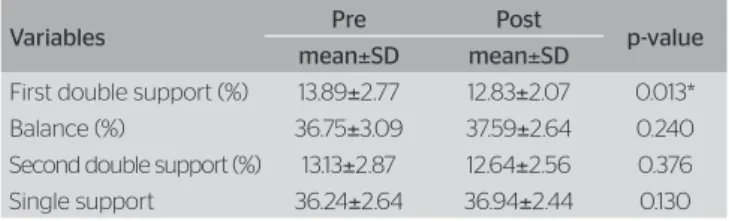
he gait cycle phases are shown in percentages in relation to the gait cycle length (Table 3).
In Tabela 4, there are the GRF data in accordance with the time percentage when they occurred dur-ing the gait cycle. It is evidenced that, at the post-test, the time of the irst peak force demonstrated a signiicant reduction, characterizing the advance of the event, decreasing the damping time of the foot’s impact on the ground.
DISCUSSION
The study aimed to evaluate the gait pattern and car-diorespiratory parameters of individuals with chron-ic obstructive pulmonary disease, before and after a walking test with progressive loading. It consisted of 14 individuals who, during the post-test, presented more sensation of dyspnea/fatigue; speed increase and reduction of the gait cycle time; increase of the first peak force and reduction of the trough; reduc-tion of the first double support time and first peak force time.
After exposing individuals with COPD to an in-cremental test, we observed increased sensation of
dyspnea and reduction in SpO2.
Pessoa et al.18 investigated the cardiovascular and
metabolic-ventilatory responses in COPD during the performance of submaximal tests, and also ob-served desaturation in all tests performed. The study
of Dourado et al.2 noted that the SpO
2 had a
nega-tive correlation with the physical activity field, sug-gesting that hypoxemic patients have minor physical performance capacity.
Cordoni et al.19 also found increased dyspnea score
after stress test and attributed this condition to the
Table 1. Speed and gait cycle time in pre and post-test of walking
Variables Pre Post p-value
mean±SD mean±SD
Cycle time 1.37±0.25 1.20±0.19 0.000* Gait speed (m/s) 0.90±0.24 1.07±0.25 0.002* SD: standard deviation; *Wilcoxon, p<0.05
Table 2. Variables of the ground reaction force curve during gait
Variables Pre Post p-value
mean±SD mean±SD
First peak (%) 96.37±14.14 100.84±15.57 0.017* Trough (%) 84.79±14.54 76.53±13.40 0.000* Second peak (%) 100.07±15.51 104.04±15.84 0.043* Data normalized by the participant’s weight; * Wilcoxon, p<0.05; SD: standard deviation
Table 3. List of gait phases with the gait cycle duration
Variables Pre Post p-value
mean±SD mean±SD
First double support (%) 13.89±2.77 12.83±2.07 0.013* Balance (%) 36.75±3.09 37.59±2.64 0.240 Second double support (%) 13.13±2.87 12.64±2.56 0.376 Single support 36.24±2.64 36.94±2.44 0.130 SD: standard deviation; *Student´s t test for dependent samples, p<0.05
Table 4. Ground reaction force curve in relation to the gait cycle duration
Variables (%) Pre Post p-value
mean±SD mean±SD
movement of the arms, which causes the intercostal inspiratory muscles contribute less to respiratory mechanics, because they are actively participating in the support of the arms and trunk. The abdominal muscles also aid in stabilizing the trunk, being less efficient in expiratory lung emptying and, as a result, less efficient gas exchange and a worsening of ventilation/perfusion mismatching.
There are evidences that the cardiorespiratory changes can result in increased execution speed of the gait. Our results showed that, during the post-test, individuals presented more gait speed and reduction in cycle time, performing the route in less time. It is believed that the increased speed can be a result of the compensatory postural pattern adopted by these individuals characterized by the anterior tilt of the trunk. The pendulum movement of the center of gravity, which characterizes the gait in the terrestrial environment, is modified in COPD, as well as in aging, causing the body to adopt differentiated an-gular positions to compensate for the change in the projection of the center of gravity and facilitate the increase of the muscle work, which generates the
impulse of the foot and moves the body forward8.
Ribeiro et al.8 observed correlation between gait
speed and respiratory muscle strength, suggesting that the possibility of dyspnea during a physical ac-tivity leads the individual to perform the gait more quickly and with changes in step length, aiming at greater stability and less time and effort.
Yentes et al.20 found significant correlation
be-tween the presence of abnormality in gait and physi-cal activity with severe COPD, suggesting that the gait changes may be due to physical inactivity that is present in patients with COPD.
The speed is one of the factors that can change
the GRF standard. Cook et al.21 assert that the speed
influence on GRF can elevate the first peak of the
vertical force in relation to the second peak. Perry22
confirms that at higher speeds, there are higher and less durable vertical peak forces, and larger troughs on vertical GRF. In this study, we highlight the re-duction in the duration and GRF increase in the first peak force.
The fact of the speed adopted by the participants of this study during the post-test has been greater than those speeds observed in the pre-test can be attributed to the weakness of the peripheral muscles of COPD and consequent fatigue, so as to try to recover its center of gravity and not lose the balance
during the strides. The loss and recovery of the cen-ter of gravity causes the gait to be performed more
quickly so that the individual does not fall23.
Arantes et al.24 noted in their study that, elderly
women in strength training showed double support time less than the elderly women practicing water aerobics. Thus, the muscle strength of lower limbs is an essential factor to reduce or prevent the increased double support with aging. In addition, the single support found to be smaller, due to the increased muscle strength and, consequently, due to the higher average linear velocity of the gait.
The results found in this study are relevant to clinical practice because of the growing number of
falls evidenced by Beauchamp et al. 25 in the elderly
population and with chronic diseases. It is suggested that the professionals involved in the rehabilitation of individuals with COPD are aware of that the training of functional activities must be carried out progressively, so that during gait performance, the CG recovery occurs quickly and efficiently, avoiding the risk of falls and thus improving the targeting of rehabilitation.
As a limitation of the study, we highlight the ab-sence of a control group. The lack of literature with this approach in this clinical condition draws atten-tion to the need for studies focusing on the effect of therapy in recovery/maintenance of the gait func-tionality of these participants.
CONCLUSION
REFERENCES
1. Rabe KF, Hurd S, Anzueto A, Barnes PJ, Buist AS, et al. Global
Initiative for Chronic Obstructive Lung Disease. Global strategy for the diagnosis, management, and prevention of chronic obstructive pulmonary disease: GOLD executive summary. Am J Respir Crit Care Med. 2007;176(6):532-55.
2. Dourado VZ, Antunes LCO, de Carvalho LR, Godoy I. Influência de características gerais na qualidade de vida de pacientes com doença pulmonar obstrutiva crônica. J Bras Pneumol. 2004;30(2):207-14.
3. Langer D, Probst VS, Pitta F, Burtin C, Hendrinks E, Schans CPVD,
et al. Guia para prática clínica: Fisioterapia em pacientes com
Doença Pulmonar Obstrutiva Crônica (DPOC). Rev Bras Fisioter. 2009;13(3):183-204.
4. Trevisan ME, Porto AS, Pinheiro TM. Influência do treinamento da musculatura respiratória e de membros inferiores no desempenho funcional de indivíduos com DPOC. Fisiot Pesq. 2010;17(3):209-13.
5. Velloso M, Jardim JR. Funcionalidade do paciente com doença pulmonar obstrutiva crônica e técnicas de conservação de energia. J Bras Pneumol. 2006;32(6):580-6.
6. Ferreira SA, Guimarães M, Taveira N. Reabilitação respiratória na DPOC: do treinamento de exercício para a “vida real”. J Bras Pneumol. 2009;35(11):1112-5.
7. Dourado VZ, Tanni SE, Vale SA. Manifestações sistêmicas na doença pulmonar obstrutiva crônica. J Bras Pneumol. 2006;32(2):161-71.
8. Ribeiro A, Wayhs JHA, Machado MM, Fleig TCM, Silva ALG. Análise da marcha em portadores de doença pulmonar obstrutiva crônica. Fisioter Mov. 2011;24(2):211-9.
9. Farinatti PTV, Lopes LNC. Amplitude e cadência do passo e componentes da aptidão muscular em idosos: um estudo correlacional multivariado. Rev Bras Med Esporte. 2004;10(5):389-94.
10. Ribas DIR, Israel VL, Manfra EF, Araújo CC. Estudo comparativo dos parâmetros angulares da marcha humana em ambiente aquático e terrestre em indivíduos hígidos e adultos jovens. Rev Bras Med Esporte. 2007;13(6):371-5.
11. Sousa DSS, Tavares JMRS, Correia EM, Mendes E. Análise clínica da marcha exemplo de aplicação em laboratório de movimento. Anais do 2º Encontro Nacional de Biomecânica; 8-9 de fevereiro 2007; Évora, Portugal. Porto, U.Porto; 2008.
12. Derom E, Marchand E, Troosters T. Pulmonary rehabilitation in chronic obstructive pulmonary disease. Ann Readapt Med Phys. 2007;50:615-26.
13. Ortiz CAL. Classificação da força de reação do solo durante a marcha de sujeitos com fratura de membro inferior (dissertação). Rio de janeiro: Universidade Federal do Rio de Janeiro; 2010.
14. Rosa FW, Camelier A, Mayer A, Jardim JR. Avaliação da capacidade de exercício em portadores de doença pulmonar obstrutiva crônica: comparação do teste de caminhada com carga progressiva com o teste de caminhada com acompanhamento. J Bras Pneumol. 2006;32(2):106-13.
15. Bekkering GE, Hendriks HJM, Chadwick-Straver RVM, Gosselink R, Jongmans M, Paterson WJ, et al. Clinical practice guidelines for physical therapy in patients with chronic obstructive pulmonary disease. Royal Dutch Socielty for Physical Therapy. KNGF. 2003;3:1-41.
16. Singh SJ, Morgan MD, Scott S, Walters D, Hardman AE. Development of a shuttle walking test of disability in patients with chronic airways obstruction. Thorax. 1992;47(12):1019-24.
17. da Cunha-Filho IT, Pereira DAG, de Carvalho AMB, Campedeli L, Soares M, Freitas JS. Confiabilidade de testes de caminhada em pacientes claudicantes: estudo piloto. J Vasc Bras. 2008;7(2):106-11.
18. Pessoa BV, Jamami M, Basso RP, Regueiro EMG, Di Lorenzo VAP, Costa D. Teste do degrau e teste da cadeira: comportamento das respostas metábolo-ventilatórias e cardiovasculares na DPOC. Fisioter. Mov. 2012;25(1):105-15.
19. Cordoni PK, Berton DC, Squassoni SD, Scuarcialupi MEA, Neder JA, Fiss E. Comportamento da hiperinsuflação dinâmica em teste em esteira rolante em pacientes com DPOC moderada a grave. J Bras Pneumol. 2012;38(1):13-23.
20. Yentes JM, Sayles H, Meza J, Mannino DM, Rennard SI, Stergioua N. Walking abnormalities are associated with COPD: An investigation of the NHANES III dataset. Respiratory Medicine, 2011;105(1):80-7.
21. Cook TM, Farrell K, Carey IA, Gibbs JM, Wiger GE. Efects of restricted knee flexion and walking speed on the vertical ground reaction force during gait. J Orthop Sports Phys. 1997;25(4):236-44.
22. Perry J. Análise da marcha: marcha normal Barueri, SP: Malone; 2005.
23. Iwabe C, Diz MAR, Barudy DP. Análise cinemática da marcha em indivíduos com Acidente Vascular Encefálico. Rev Neurocienc. 2008;16(4):292-6.
24. Arantes L, Coelho F, Silva P, Costa G, Gobbi LTB. Caracterização dos parâmetros temporo-espaciais da marcha em idosas praticantes de diferentes modalidades de exercícios. Revista Movimenta, 2009;2(1):7-11.