ORIGIN
AL RESEAR
CH
Comparisons between motor performance and
opportunities for motor stimulation in the home
environment of infants from the North and
Southwest regions in Brazil
Comparações entre o desempenho motor e oportunidades de estimulação motora no ambiente
domiciliar de lactentes residentes nas regiões Sudeste e Norte do Brasil
Comparaciones del desempeño motor y oportunidades de estimulación motora en el entorno del
hogar de lactantes moradores en las regiones Sureste y Norte de Brasil
Tatiane G. A. Almeida1, Priscila M. Caçola2, Carl Gabbard3, Mayara Thaís Correr1,
Guanis B. Vilela Junior4, Denise C. C. Santos1,4
Mailing address: Priscila Caçola – 500 W. Nedderman Drive-ZIP code: 76019 – P.O. Box: 19259 – Arlington (TX), United States of America – E-mail: [email protected] Presentation: Apr. 2014 – Accepted for publication: Apr. 2015 – Funding source: CNPq and PIBIC – Conlict of Interests: nothing to declare
Ethics Committee: Procedure no. 29/08, Universidade Metodista de Piracicaba (SP), Brazil.
A study developed at Universidade Metodista de Piracicaba - Piracicaba (SP), Brazil.
1Physical Therapy Post-Graduate Program, School of Health Sciences (FACIS), Universidade Metodista de Piracicaba (UNIMEP) –
Piracicaba (SP), Brazil.
2Department of Kinesiology, University of Texas – Arlington (TX), Estados Unidos.
3Department of Health & Kinesiology, Texas A&M University – Arlington (TX), Estados Unidos.
4Post-Graduate Program in Human Movement Sciences, (FACIS), Universidade Metodista de Piracicaba (UNIMEP) – Piracicaba (SP), Brazil. ABSTRACT | This study aimed at comparing the
relationships between motor development and the characteristics in the home environment (physical space, daily activities, toys) of infants in two Brazilian regions, North (Marabá, PA) and Southeast (Piracicaba, SP). Alberta Infant Motor Scale (AIMS) was used to analyze motor development, and Afordances in the Home Environment for Motor Development – Infant Scale (AHEMD-IS) was used in order to analyze the family environments of eight breastfeed babies of 3 to 18 months of age. The groups in the two municipalities were not diferent in regards to motor development (p<0.05); however, signiicant diferences were found among groups concerning day care frequency, fatherly schooling, and number of rooms in households. The results also indicated signiicant diferences for opportunities at home, with the group from Marabá receiving signiicantly lower scores for the most part of the AHEMD-IS: external space (p=0.021), toys for ine motor skills (p<0.001), and total AHEMD-IS score (p=0.002). No diferences were found among groups in daily activities and the internal space of homes. Motor development and opportunities in the home environment (total AHEMD-IS) were found to have weaker correlations for both the group from Marabá (r=0.33; p=0.03) and the group from Piracicaba (r=0.45; p<0.001). In summary, although both
142
groups had similar motor development levels, the group of infants from Marabá was found to have fewer afordances (opportunities for action) as compared to the ones living in Piracicaba, which may result in diferences in the motor development of the groups in the future.
Keywords | Infant; Environment; Child Development.
(p=0,021), brinquedos para motricidade ina (p<0,001) e grossa (p<0,001), e o escore total do AHEMD-IS (p=0,002). Não foram encontradas diferenças entre os grupos nas atividades diárias e no espaço interno da residência. O desempenho motor e as oportunidades no ambiente domiciliar (total do AHEMD-IS) demonstraram uma correlação fraca tanto para o grupo de Marabá (r=0,33; p=0,03) quanto para o grupo de Piracicaba (r=0,45; p<0,001). Em conclusão, apesar dos grupos apresentarem níveis de desenvolvimento motor similares, o grupo de lactentes em Marabá apresentou menos afordances (oportunidades de ação) comparados aos residentes de Piracicaba, o que, no futuro, pode resultar em diferenças no desempenho motor dos grupos.
Descritores | Lactente; Meio Ambiente; Desenvolvimento Infantil.
RESUMEN | En este estudio tuvo el propósito de comparar las relaciones entre el desempeño motor y las características del entorno del hogar (el espacio físico, las actividades diarias, los juguetes) de lactantes moradores en dos regiones de Brasil, el Norte (Marabá, PA) y el Sureste (Piracicaba, SP). Se utilizaron el Alberta Infant Motor Scale (AIMS) para el desempeño motor y el Afordances in the Home Environment for Motor Development – Infant Scale (AHEMD-IS) para el análisis del entorno del hogar
en ochenta lactantes de 3 hasta 18 meses de edad. Los grupos de los dos municipios no presentaron diferencias signiicativas en relación al desempeño motor (p>0,05), sin embargo, se encontraron diferencias signiicativas en lo que se reiere a la asistencia a guardería, al nivel de educación del padre y al número de habitaciones en sus casas. Los resultados también mostraron diferencias signiicativas en las oportunidades en los hogares, el grupo de Marabá obtuvo puntuaciones signiicativamente menores en la mayor parte del AHEMD-IS: espacio externo (p=0,021), juguetes para habilidades motoras inas (p<0,001) y gruesas (p<0,001), y el escore total del AHEMD-IS (p=0,002). En cuanto a las actividades diarias y al espacio interno de las casas no se encontraron diferencias. El desempeño motor y las oportunidades en el entorno del hogar (total del AHEMD-IS) mostraron una correlación baja tanto para el grupo del Marabá (r=0,33; p=0,03) como para el de Piracicaba (r=0,45; p<0,001). Aunque los grupos presentaron niveles semejantes de desarrollo motor, se concluyó que el grupo de lactantes de Marabá presentó menos afordances (oportunidades de acción) que el de Piracicaba, lo que puede resultar en diferencias para su futuro en relación al desempeño motor de los grupos.
Palabras clave | Lactante; Ambiente; Desarrollo Infantil.
INTRODUCTION
Brazil is a country which is characterized by regional diferences which arise from culture contexts and specialized resources, which represents each geographical region. he inequalities between northern and southeastern regions in Brazil are shown in indicators such as the human development index (HID), education, life expectancy, per capita income, poverty, and in Brazil’s gross domestic product
(GDP)1-3. Although those diferences are very famous,
little is known as to how much they afect the motor development in early childhood, and to which extent they inluence the opportunities for actions and events (afordances) in the family environments of breastfeed babies. To Unesco, the quality in the family environment over the irst few years of life is a critical indicator in childhood development, and it can be used as a direct
measure for development4.
he irst year of life is characterized by important changes in motor behavior; however, the speciicities of that path and the ways through which breastfed babies move depend on their cultural and environmental
context5. Inside that context, we may point out the
inluence of the number and diversity of opportunities (stimuli) in the home environment, which are speciic for the motor development of breastfed babies. Recently, a speciic instrument to evaluate those opportunities in the home environment was created and validated in the USA and in Brazil, with a focus on understanding the internal and external spaces of daily activities and toys which are available for breastfed babies between
3 and 18 months of age6. hat instrument is called
Afordances in the Home Environment for Motor Development – Infant Scale (AHEMD-IS), which is know in Brazil as AHEMD - Escala Bebê (Baby Scale). Some studies using that instrument have found, for example, that the motor development opportunities in the home environment are as important as the
biological development factors7, and they also have a
positive impact in breastfed babies’ future motor and
cognitive development8.
In Brazil, the cultural and socioeconomic diferences
are very famous1,2, but little is known in regards to
motor development and the characteristics in the home environment (physical space, daily activities, toys) of typical breastfeed babies in two Brazilian regions, North (Marabá, PA) and Southeast (Piracicaba, SP). Due to the inluences from cultural, environmental, and socioeconomic diferences in the motor development of breastfed babies in Brazil and other countries9,10, and this study is expected
to show diferentiated interactions among opportunities in the home environment and motor development for each subject in investigated Brazilian regions.
METHODOLOGY
Sample
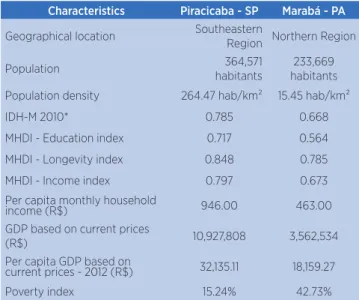
Exploratory study, with a transverse design and quantitative approach. he sample comprised typical breastfed babies (with not neurological alterations, genetic syndromes, or congenital malformations) of 3 to 18 months of age, which lived in Marabá (PA), northern region (n=40, 21 females and 19 males) and in Piracicaba (SP) southeastern region, (n=40, 20 females and 20 males) of Brazil. Conducting studies comparing faraway regions in a country with large continental regions such as Brazil is a great challenge. Both of them were medium-sized municipalities (populations between 100 thousand and 500 thousand inhabitants); Piracicaba was chosen as it is the location where the host university of the study is in, and Marabá was chosen due to the fact it is the location where the irst author teaches at.
Table 1. Studied locations and their characteristics
Characteristics Piracicaba - SP Marabá - PA
Geographical location Southeastern
Region Northern Region
Population 364,571
habitants
233,669 habitants Population density 264.47 hab/km² 15.45 hab/km²
IDH-M 2010* 0.785 0.668
MHDI - Education index 0.717 0.564
MHDI - Longevity index 0.848 0.785
MHDI - Income index 0.797 0.673
Per capita monthly household
income (R$) 946.00 463.00
GDP based on current prices
(R$) 10,927,808 3,562,534
Per capita GDP based on
current prices - 2012 (R$) 32,135.11 18,159.27
Poverty index 15.24% 42.73%
*Municipal Human Development Index (M-HDI) of the United Nations Development Program (UNDP). Sources: IBGE - Instituto Brasileiro de Geograia e Estatística (Brazilian Institute of Geography and Statistics), (2010). Available on: http://www.ibge.gov.br/cidadesat/
Atlas of Human Development in Brazil 2013 (With data from 1991, 2000, and 2010 Censuses). Available on: http://www.pnud.org.br/atlas/ranking/Ranking-IDHM-Municipios-2010.aspx
he research was approved by the Ethics Committee of Universidade Metodista de Piracicaba (procedure no. 29/08). he data which characterize both study locations are described in Table 1.
Instruments
he opportunities for motor development in the home environment were evaluated through the Brazilian version of questionnaire “Afordances in the home environment for motor development
– Infant Scale (AHEMD-IS)”6, a self-evaluation
and self-explanatory questionnaire focused on the fathers of breastfed babies of ages between 3 and 18 months. his instrument is based on the premise from the ecological theory which sees the concept of afordances as opportunities providing the
potential for action11. It comprises a section about
the breastfed baby’s characteristics and family (15 questions); characteristics and dimensions of the internal and external physical spaces (10 questions), daily activities (11 questions), and materials and toys which provide opportunities for the breastfed baby’s ine and gross motor skills (20 questions). It uses three types of questions: dichotomous (yes/no), Likert-type (four answer levels), and descriptive questions using illustrations as examples for the diferent types of toys. In the study, the scores obtained in AHEMD-IS questionnaire were analyzed as a whole and in each of its ive dimensions, based on the score that was used in the irst study which presented AHEMD-IS (for the full explanation please refer to Caçola et al.6).
Alberta Infant Motor Scale (AIMS)12 was used to
When families inished answering AHEMD-IS questionnaire, motor development evaluation was started. he motor evaluation was conducted by the main researcher in both cities. On the occasion, the breastfed babies had no clothes on or wore diapers; they were left free in their home environments, moving spontaneously and going through the four positions (prone, supine, sitting, and standing) required by AIMS. When a breastfed baby’s behavior did not safely relect its skill, concerning behaviors of crying, feeling sleepy, or hungry, evaluations were interrupted and rescheduled to up to seven days to be inished.
Statistical analysis
he groups to which breastfed babies and families belonged to (either Piracicaba or Marabá) were considered as independent variables. Breastfed babies motor development and its opportunities for motor development in the home environment were considered as dependent variables. he data were processed through Statistical Package for Social Sciences for Personal Computer (SPSS/PC version 11.0). Mann-Whitney U test was used to compare the groups in regards to motor development and to the opportunities, and Spearman’s rank correlation coeicient, in turn, was used to investigate the relationships between motor development and the motor development opportunities (total AHEMD-IS score), with a 5% signiicance level.
RESULTS
he groups were not found to have statistically signiicant diferences in regards to chronological or adjusted ages for prematurity, gender, birth weight classiication, prematurity (gestational age), and Apgar score. here were no diferences either in regards to family characteristics such as: schooling of mothers (p=0.315), number of adults (p=0.144) and children (p=0.459) in the households, type of household (p=0.132), and the fact of a mother being the main caregiver (p=0.063). However, signiicant diferences were found between the groups in regards to the following family characteristics: attending day care facilities (p=0.004), fatherly schooling (p=0.001), and number of rooms in the households (p=0.030).
he breastfed baby groups of both municipalities were not found to be diferent in regards to motor
development (p=0.678); however, the results exhibited diferences for home opportunities, the group from Marabá (PA) obtaining signiicantly lower scores in motor development opportunities for almost all dimensions, except for dimensions daily activities (p=0.782) and internal household space (p=0.170), as compared to the group from Piracicaba. Groups were found to have a signiicant diference in their total AHEMD-IS scores (Marabá: 32.31; Piracicaba: 48.69, p=0.002) in regards to the external household space (Marabá: 34.68; Piracicaba: 46.33, p=0.021), as well as the type of toys for ine (Marabá: 31.36; Piracicaba: 49.64, p<0.001) and gross motor skills (Marabá: 30.70; Piracicaba: 50.30, p<0.001).
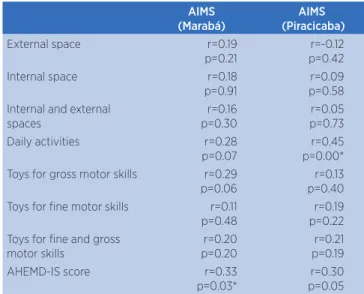
In regards to the association between motor development and opportunities in the home environment (total AHEMD-IS score), in the two municipalities, weak correlations (r=0.33; p=0.03) were found for the groups of breastfed babies from Marabá and Piracicaba (r=0.45; p<0.001). Table 2 shows the correlation values with all AHEMD-IS dimensions and AIMS scores by municipality.
Table 2. Correlation between a breastfed baby’s motor development and the motor development opportunities at home in Marabá (PA) and Piracicaba (SP)
AIMS (Marabá)
AIMS (Piracicaba)
External space r=0.19
p=0.21
r=-0.12 p=0.42
Internal space r=0.18
p=0.91
r=0.09 p=0.58 Internal and external
spaces
r=0.16 p=0.30
r=0.05 p=0.73
Daily activities r=0.28
p=0.07
r=0.45 p=0.00* Toys for gross motor skills r=0.29
p=0.06
r=0.13 p=0.40 Toys for ine motor skills r=0.11
p=0.48
r=0.19 p=0.22 Toys for ine and gross
motor skills
r=0.20 p=0.20
r=0.21 p=0.19
AHEMD-IS score r=0.33
p=0.03*
r=0.30 p=0.05
r = Spearman’s rank correlation coeicient; n=40; *Signiicant correlation with p<0.05.
DISCUSSION
North region, and Piracicaba municipality, in São Paulo state, representing Brazil’s Southeast. he results show that the groups have not difered in regards to their motor developments, but the were diferent concerning the opportunities for motor development in the home environment, with breastfed babies from Marabá having a signiicantly lower number of opportunities/ afordances than the group of breastfed babies which lived in Piracicaba. However, in both groups, a weak correlation was found to exist between home opportunities and motor development.
Motor development assessment through AIMS scale showed that groups were not diferent in regards to motor development. hat inding is based on the understanding that motor development is the result from the integration of several domains: sensory-motor, cognitive, and social-emotional. hose domains are, in turn, inluenced by genetic inheritance, biological and socioenvironmental factors, and they may be afected by adverse or favorable situations, thus their results
cannot be totally predicted11,13. Groups were not found
either to difer in regards to family characteristics such as the schooling of mothers or the number of adults and children in the households, which goes against the expected diferences, once the groups are culturally and geographically diferent. Such factor may be justiied through the high number of migrants who are attracted by the regional economic wealth (Marabá), which could result in modiied cultural habits and practices. However, almost all families of studied breastfed babies in Marabá came from a single neighborhood, whose houses were made of wood and were similar to stilt houses. hey were located in an encroached area that is characterized by poor infrastructure conditions, such as dirt streets, lack of basic sanitation services, and poverty conditions.
However, signiicant diferences were shown between groups concerning the following characteristics: breastfed babies attending day care facilities, fatherly schooling, and number of rooms in the households. he similarities indicate relative homogeneity in the characteristics of families, with the schooling of
mothers standing out. hat inding14 shows a trend to
the higher schooling of mothers as compared to fathers, regardless of the economic levels, which may be a factor
that inluences the acquisiion of motor skills9,15
. In regards to home opportunities, it is important to point out that no diferences were observed in the municipalities concerning daily activities. In
AHEMD-IS, that dimension speciically refers to the varied stimulation means that are ofered in the home environment, which does not depend on owning equipment or toys. Even though the breastfed babies from Marabá have less home opportunities, the daily activities which do not depend on the socioeconomic
levels of families were not afected16. From those
indings, it is possible to suggest that, the same way the socioeconomic status is related to the acquisition of toys and the physical space in the home environment, the interaction between parents and breastfed babies is related to daily activities.
Despite the lack of diferences in motor development for both groups, it is important to warn that environmental and cultural diferences may also inluence motor development between ages 3 and 18 months, considering that it is a period of dramatic changes in the reciprocal interaction between a breastfed baby’s motor possibilities and the stimuli that are provided by
its family8. In the same study, the environmental impact
in the motor and cognitive development of babies was found to increase with age, which shows that home environments signiicantly inluenced the ine motor development of breastfed babies, and that is related to
cognitive skills8. hose results point towards the fact
that motor development and its relationship with home opportunities are continuous, and it is possible that the
groups are diferentiated by their motor developments8
in the future, as a consequence from the diferent opportunities between the two studied municipalities.
One of the limitations in this study was due to its probability sampling and to the fact it was conducted in a transverse fashion. Longitudinal supervision could contribute to understand the relationships, with time, between motor development and the characteristics in the home environment (physical space, daily activities, and toys) in a perspective comparing cultures in Brazil. As the country is very large and socioeconomically and culturally diverse concerning its regions, it is understood that research must be conducted in less developed centers, as well as in less favored regions, involving the relationship between opportunities from typical breastfed babies and the possible inluences on motor development.
aspects in the clinical practice17. In the physical
therapy practice, the importance of instructions stand out in regards to the home activities which complement treatments, which, in general, involve the use of spaces, toys, and moments for care and playfulness in the daily routing of breastfed babies and their families. In the clinical practice, the inclusion of evaluation instruments in home environments (as proposed by AHEMD-IS) may contribute to guide the home instructions to the conditions in the environment, thus focusing on motor development stimulation aspects which lack reinforcement.
It is possible to conclude that living in distinct Brazilian regions, such as the North and the Southeast, does not lead to immediate impacts in the motor development of breastfed babies. However, studied home environments in the northern region are less privileged in regards to motor development opportunities, speciically in relation to external physical spaces and number and variety of available toys. he indings also suggest some inluence from the environment in the motor developments of both groups. For the ones living in the northern region, the relationship that was found was with global opportunities for motor development (total AHEMD-IS score), and the babies residing in the southeastern region, in turn, such relationship was with the dimension of daily activities in AHEMD-IS. In a certain way, it is possible that the discrepancy in home opportunities results in future diferences in the motor development of the breastfed babies.
REFERENCES
1. Instituto Brasileiro de Geograia e Estatística (IBGE). Mapa de pobreza e desigualdades dos municípios brasileiros - 2003. Piracicaba_SP. Código: 353870. [citado 2011 nov 13]. Disponível em: http://www.ibge.gov.br/cidadesat/
2. Instituto Brasileiro de Geograia e Estatística (IBGE). Censo demográico - 2010. Características da população e dos domicílios: Marabá_PA. Código: 150420 [citado 2011 nov 13]. Disponível em: http://www.ibge.gov.br/cidadesat/
3. ONU. Programa das Nações Unidas para o Desenvolvimento (PNUD). O Brasil e as metas de desenvolvimento do milênio.
Relatório do Desenvolvimento Humano do ano de 2003. 2003.
[citado 2011 dez 27]. Disponível em: http://hdr.undp.org/ sites/default/iles/hdr2003-portuguese.pdf
4. Iltus S. UNESCO-United Nations Educational, Scientiic and Cultural Organization. Paper commissioned for the EFA Global Monitoring Report 2007, Strong foundations: early childhood care and education. Signiicance of home environments as proxy indicators for early childhood care and education. 2006. Disponível em: http://unesdoc.unesco. org/images/0014/001474/147465e.pdf
5. Adolph KE, Karasik BL, Tamis-Lemonda SC. Motor skills. Handbook of cultural developmental science. In: Bornstein M. Handbook of cultural developmental science. New York: Psychology Press; 2010. p. 61-88. Ed. 2010;61-88.
6. Caçola P, Gabbard C, Santos DCC, Batistela AC. Development of the afordances in the home environment for motor development - Infant Scale. Pediatr. Int. 2011;53(6):820-5. 7. Saccani R, Valentini NC, Pereira KRG, Müller AB, Gabbard
G. Associations of biological factors and afordances in the home with infant motor development. Pediatr Int. 2013;55(2):197-203.
8. Miquelote AF, Santos, DCC, Caçola, PM, Montebelo, MIL, Gabbard, C. Efect of the home environment on motor and cognitive behavior of infants. Infant Behav Dev. 2012;35(3):329-34.
9. Santos DCC, Gabbard C, Gonçalves VMG. Motor development during the irst 6 months: a comparative study. J Gen Psychol. 2001;162(2):143-53.
10. Lopes VB, Lima CD, Tudella E. Motor Acquisition rate in brazilian infants. Inf Child. Dev. 2009;18(2):122-32.
11. Adolph KE, Robinson SR. In defense of change processes. Child Dev. 2008;79(6):1648-53.
12. Piper MC, Darrah J. Motor assessment of the developing infant. Philadelphia: Saunders, PA, 1994.
13. Grantham-McGregor S, Cheung YB, Cueto S, Glewwe P, Richter L, Strupp B. Developmental potential in the irst 5 years for children in developing countries. Lancet. 2007;369(9555):60-70.
14. Nobre FSS, Costa CLA, Oliveira DL, Cabral DA, Nobre GC, Caçola P. Análise das oportunidades para o desenvolvimento motor (afordances) em ambientes domésticos no Ceará-Brasil. Rev Bras Crescimento Desenvolvimento Hum. 2009;19(1):9-18.
15. Kolobe THA. Childrearing practices and developmental expectations for Mexican-American mothers and the developmental status of their infants. Phys Ther. 2004;84(5):439-53.
16. Freitas TCB, Gabbard C, Caçola P, Montebelo MIL, Santos DCC. Family socioeconomic status and the provision of motor afordances in the home. Braz J Phys Ther. 2013;17(4):319-32. 17. Oliveira AS, Chiquetti EMS, Santos H. Caracterização do