Molecular epidemiology of type 1 and 2
dengue viruses in Brazil from 1988 to
2001
1Departamento de Clínica Médica, Faculdade de Medicina de Ribeirão Preto, Universidade de São Paulo, Ribeirão Preto, SP, Brasil
2Hospital São José de Doenças Infecciosas, Secretaria de Saúde do Estado do Ceará, Fortaleza, CE, Brasil
3Seção de Arbovírus, Instituto Adolfo Lutz de São Paulo, São Paulo, SP, Brasil R.J. Pires Neto1,2,
D.M. Lima1, S.O. de Paula1, C.M. Lima1, I.M. Rocco3 and B.A.L. Fonseca1
Abstract
Dengue is a mosquito-borne viral infection that in recent decades has become a major international public health concern. Epidemic dengue fever reemerged in Brazil in 1981. Since 1990 more than one dengue virus serotype has been circulating in this tropical country and increas-ing rates of dengue hemorrhagic fever and dengue shock syndrome have been detected every year. Some evidence supports the associa-tion between the introducassocia-tion of a new serotype and/or genotype in a region and the appearance of dengue hemorrhagic fever. In order to study the evolutionary relationships and possible detection of the introduction of new dengue virus genotypes in Brazil in the last years, we analyzed partial nucleotide sequences of 52 Brazilian samples of both dengue type 1 and dengue type 2 isolated from 1988 to 2001 from highly endemic regions. A 240-nucleotide-long sequence from the envelope/nonstructural protein 1 gene junction was used for phyloge-netic analysis. After comparing the nucleotide sequences originally obtained in this study to those previously studied by others, and analyzing the phylogenetic trees, we conclude that, after the initial introduction of the currently circulating dengue-1 and dengue-2 geno-types in Brazil, there has been no evidence of introduction of new genotypes since 1988. The increasing number of dengue hemorrhagic fever cases seen in Brazil in the last years is probably associated with secondary infections or with the introduction of new serotypes but not with the introduction of new genotypes.
Correspondence
B.A.L. Fonseca
Laboratório de Virologia Molecular Departamento de Clínica Médica FMRP, USP
Av. Bandeirantes, 3900 14049-900 Ribeirão Preto, SP Brasil
Fax: +55-16-633-0036/633-6695 E-mail: [email protected]
Research supported by FAPESP (No. 2000/14527-0).
Received July 7, 2004 Accepted February 24, 2005
Key words
•Dengue virus •Nucleotide sequence •E/NS1 region
•Molecular epidemiology •Dengue fever
•Dengue hemorrhagic fever
Introduction
Dengue viruses belong to the Flaviviridae family and are transmitted to humans through the bite of female Aedes mosquitoes. As the most important arthropod-borne viral infec-tion of humans, dengue represents an impor-tant public health problem for urban
of disease associated with plasma leakage, thrombocytopenia, hemorrhage (dengue hem-orrhagic fever, DHF) and/or shock (dengue shock syndrome, DSS) (1-3).
The dengue virus genome is an ~11-kb single-strand positive sense RNA with a single-open reading frame which encodes a polyprotein precursor of about 3,400 amino acid residues. Proteolytic cleavages gener-ate 10 proteins that are detected in infected cells (C, prM, E, NS1, NS2A, NS2B, NS3, NS4A, NS4B, and NS5) (4,5). On the basis of antigenic variability, dengue viruses are classified into 4 serotypes (DEN-1 to 4). In addition to serotype classification, signifi-cant variation in genomic composition among viruses of each serotype permits genotype classification (5). Unlike other RNA viruses, some segments of the dengue virus genome have a high degree of stability where fixed mutations are common. Partial sequencing of some genomic regions has been success-fully employed to determine the genetic varia-tion of dengue viruses and to characterize genotypes within serotypes (6-11).
The genomic regions encoding the enve-lope protein (E) and the nonstructural protein 1 (NS1) seem to be the most appropriate to characterize genotypes within serotypes, es-pecially a 240-nucleotide long sequence span-ning the E/NS1 junction (6,8,12). Studies of the evolutionary relationships of dengue vi-ruses have revealed several major genotypes among each of the four serotypes. For DEN-1 viruses five genotypes have been described: one group representing strains from the Ameri-cas, Africa and Southeast Asia (I), a Sri Lankan group (II), a Japanese group (III), a fourth group including strains from Southeast Asia, the South Pacific, Mexico, and Australia (IV), and a fifth group composed of Taiwanese and Thai strains (V). For DEN-2 viruses, phyloge-netic analysis initially identified five geno-types: strains from the Caribbean and South America (I); strains from the South Pacific, i.e., Taiwan, Philippines and New Guinea C prototype viruses and an older Thai strain (II);
Vietnamese, Jamaican and Thai strains (III); isolates from Indonesia, the Seychelles, Burkina Fasso and Sri Lanka (IV), and finally, isolates from rural Africa (V) (6,8). Further studies incorporating additional DEN-2 strains resulted in the merging of genotypes II and III into one genotype (Asian/American-Asian genotype) (13). Infection by one serotype does not protect against infection by a second sero-type, and epidemiologic and laboratory stud-ies have shown that cross-reactive immune responses, including infection-enhancing anti-bodies, contribute to the higher frequency of DHF/DSS in persons with sequential infec-tions (14,15). The occurrence of DHF/DSS in some regions has been associated with the introduction of new serotypes and/or geno-types of dengue virus (6,8,13,16).
As in many other countries in Latin Ame-rica, Brazilian people have been seriously affected by dengue infections. About 80% of notified dengue cases in the Americas oc-curred in Brazil, and in the last years more than 1 million cases have been reported in all five Brazilian geographic regions (17). In spite of the importance of dengue as a seri-ous public health problem in Brazil, only a few dengue viruses isolated from endemic regions have been analyzed with respect to genomic variability (6,7,9,16,18-20).
In the present study, we analyzed partial nucleotide sequences of a significant num-ber of DEN-1 and DEN-2 strains isolated in Brazil since 1988 from regions of high ende-micity in order to determine the evolutionary relationships among them and the introduc-tion and circulaintroduc-tion of new genotypes that could be associated with the more severe cases seen in the last years.
Material and Methods
Viruses
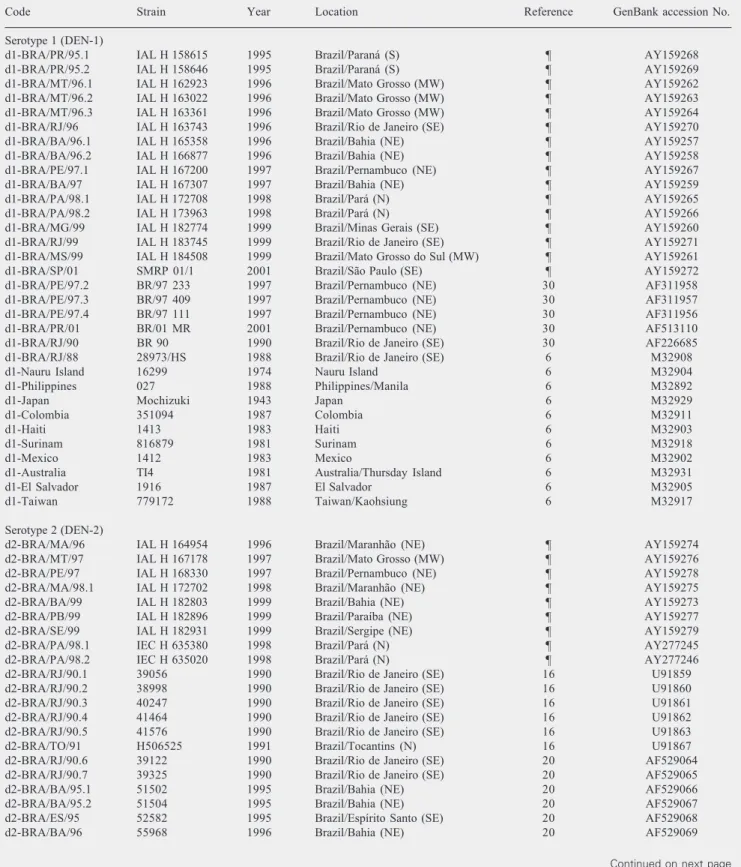
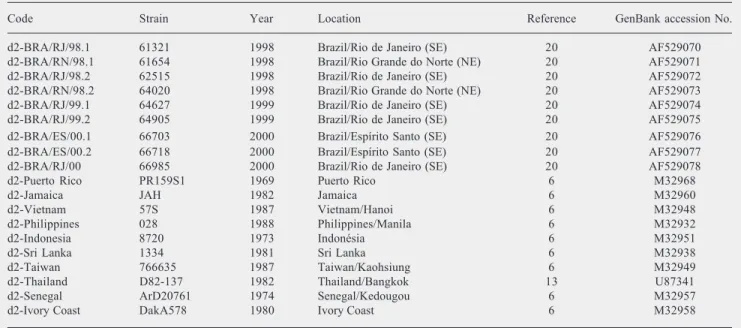
who had been infected in different states of Brazil from 1995 to 2001. Twenty-two of these strains were randomly selected from the collection of the Arbovirus Section, Adolfo Lutz Institute, São Paulo, São Paulo State, Brazil. Two other DEN-2 strains were obtained from the collection of Evandro Chagas Institute, Belém, Pará State, Brazil, and the most recent strain (D1-BRA/SP/01) was isolated by the investigators from a pa-tient with DF living in São Paulo State. Acute-phase sera were used to infect mono-layers of a mosquito cell line (C6/36 - Aedes albopictus) and serotypes were identified by indirect fluorescent antibody tests using type-specific monoclonal antibodies (15F3-1 and 3H5-1) kindly donated to Adolfo Lutz Insti-tute by the Centers for Disease Control and Prevention, Atlanta, GA, USA (21,22). All strains were submitted to a single passage in cell culture. After growth for 7 days at 28ºC, virus-infected supernatants were collected, clarified by centrifugation and stored at -70ºC until the time for use. The identifica-tion of viral strains and their distribuidentifica-tion in Brazilian regions are listed in Table 1.
Viral RNA extraction and RT-PCR amplification
Viral RNA was extracted from 140 µl supernatant medium of virus-infected cells using the QIAamp® Viral RNA system
ac-cording to the manufacturer’s protocol (Qiagen®, Chatsworth, CA, USA). Viral RNA
was reverse transcribed to cDNA in a 20-µl reaction volume with he SuperscriptII re-verse transcriptase system (Invitrogen, Carls-bad, CA, USA) and pd(N)6 random primers
(Amersham-Pharmacia, Piscataway, NJ, USA). Reverse transcription was allowed to proceed at 42ºC for 50 min followed by reverse transcriptase inactivation at 70ºC for 15 min. cDNA amplification was performed with synthetic primers as previously de-scribed (6). Both sense and antisense prim-ers were used to amplify a 408-bp fragment
of the E/NS1 junction region of the viral RNA; the 240-nucleotide segment for ge-netic comparison is comprised within this fragment (nucleotides 2.282 to 2.521 for DEN-1 and 2.311 to 2.550 for DEN-2). PCR amplifications consisted of 35 cycles of denaturation (94ºC for 1 min), annealing (55ºC for 1 min) and extension (72ºC for 2 min) for both DEN-1 and DEN-2 strains in a GeneAmp PCR System 2400 thermal cycler (Applied Biosystems, Foster City, CA, USA). A final extension step was carried out at 72ºC for 10 min. Each PCR was run with positive and negative controls and the frag-ments were separated by 2% agarose gel electrophoresis, stained with 1 µg/ml ethi-dium bromide, and detected under ultravio-let light.
Sequencing
Direct nucleotide sequencing of both strands was performed with an automated Sequence Detector System (ABI Prism 310 sequencer; Applied Biosystems) using a com-mercially available kit (BigDye Terminator Cycle Sequencing Ready Reaction®, Applied
Table 1. Dengue virus strains compared by sequence analysis.
Code Strain Year Location Reference GenBank accession No.
Serotype 1 (DEN-1)
d1-BRA/PR/95.1 IAL H 158615 1995 Brazil/Paraná (S) ¶ AY159268
d1-BRA/PR/95.2 IAL H 158646 1995 Brazil/Paraná (S) ¶ AY159269
d1-BRA/MT/96.1 IAL H 162923 1996 Brazil/Mato Grosso (MW) ¶ AY159262
d1-BRA/MT/96.2 IAL H 163022 1996 Brazil/Mato Grosso (MW) ¶ AY159263
d1-BRA/MT/96.3 IAL H 163361 1996 Brazil/Mato Grosso (MW) ¶ AY159264
d1-BRA/RJ/96 IAL H 163743 1996 Brazil/Rio de Janeiro (SE) ¶ AY159270
d1-BRA/BA/96.1 IAL H 165358 1996 Brazil/Bahia (NE) ¶ AY159257
d1-BRA/BA/96.2 IAL H 166877 1996 Brazil/Bahia (NE) ¶ AY159258
d1-BRA/PE/97.1 IAL H 167200 1997 Brazil/Pernambuco (NE) ¶ AY159267
d1-BRA/BA/97 IAL H 167307 1997 Brazil/Bahia (NE) ¶ AY159259
d1-BRA/PA/98.1 IAL H 172708 1998 Brazil/Pará (N) ¶ AY159265
d1-BRA/PA/98.2 IAL H 173963 1998 Brazil/Pará (N) ¶ AY159266
d1-BRA/MG/99 IAL H 182774 1999 Brazil/Minas Gerais (SE) ¶ AY159260
d1-BRA/RJ/99 IAL H 183745 1999 Brazil/Rio de Janeiro (SE) ¶ AY159271
d1-BRA/MS/99 IAL H 184508 1999 Brazil/Mato Grosso do Sul (MW) ¶ AY159261
d1-BRA/SP/01 SMRP 01/1 2001 Brazil/São Paulo (SE) ¶ AY159272
d1-BRA/PE/97.2 BR/97 233 1997 Brazil/Pernambuco (NE) 30 AF311958
d1-BRA/PE/97.3 BR/97 409 1997 Brazil/Pernambuco (NE) 30 AF311957
d1-BRA/PE/97.4 BR/97 111 1997 Brazil/Pernambuco (NE) 30 AF311956
d1-BRA/PR/01 BR/01 MR 2001 Brazil/Pernambuco (NE) 30 AF513110
d1-BRA/RJ/90 BR 90 1990 Brazil/Rio de Janeiro (SE) 30 AF226685
d1-BRA/RJ/88 28973/HS 1988 Brazil/Rio de Janeiro (SE) 6 M32908
d1-Nauru Island 16299 1974 Nauru Island 6 M32904
d1-Philippines 027 1988 Philippines/Manila 6 M32892
d1-Japan Mochizuki 1943 Japan 6 M32929
d1-Colombia 351094 1987 Colombia 6 M32911
d1-Haiti 1413 1983 Haiti 6 M32903
d1-Surinam 816879 1981 Surinam 6 M32918
d1-Mexico 1412 1983 Mexico 6 M32902
d1-Australia TI4 1981 Australia/Thursday Island 6 M32931
d1-El Salvador 1916 1987 El Salvador 6 M32905
d1-Taiwan 779172 1988 Taiwan/Kaohsiung 6 M32917
Serotype 2 (DEN-2)
d2-BRA/MA/96 IAL H 164954 1996 Brazil/Maranhão (NE) ¶ AY159274
d2-BRA/MT/97 IAL H 167178 1997 Brazil/Mato Grosso (MW) ¶ AY159276
d2-BRA/PE/97 IAL H 168330 1997 Brazil/Pernambuco (NE) ¶ AY159278
d2-BRA/MA/98.1 IAL H 172702 1998 Brazil/Maranhão (NE) ¶ AY159275
d2-BRA/BA/99 IAL H 182803 1999 Brazil/Bahia (NE) ¶ AY159273
d2-BRA/PB/99 IAL H 182896 1999 Brazil/Paraíba (NE) ¶ AY159277
d2-BRA/SE/99 IAL H 182931 1999 Brazil/Sergipe (NE) ¶ AY159279
d2-BRA/PA/98.1 IEC H 635380 1998 Brazil/Pará (N) ¶ AY277245
d2-BRA/PA/98.2 IEC H 635020 1998 Brazil/Pará (N) ¶ AY277246
d2-BRA/RJ/90.1 39056 1990 Brazil/Rio de Janeiro (SE) 16 U91859
d2-BRA/RJ/90.2 38998 1990 Brazil/Rio de Janeiro (SE) 16 U91860
d2-BRA/RJ/90.3 40247 1990 Brazil/Rio de Janeiro (SE) 16 U91861
d2-BRA/RJ/90.4 41464 1990 Brazil/Rio de Janeiro (SE) 16 U91862
d2-BRA/RJ/90.5 41576 1990 Brazil/Rio de Janeiro (SE) 16 U91863
d2-BRA/TO/91 H506525 1991 Brazil/Tocantins (N) 16 U91867
d2-BRA/RJ/90.6 39122 1990 Brazil/Rio de Janeiro (SE) 20 AF529064
d2-BRA/RJ/90.7 39325 1990 Brazil/Rio de Janeiro (SE) 20 AF529065
d2-BRA/BA/95.1 51502 1995 Brazil/Bahia (NE) 20 AF529066
d2-BRA/BA/95.2 51504 1995 Brazil/Bahia (NE) 20 AF529067
d2-BRA/ES/95 52582 1995 Brazil/Espírito Santo (SE) 20 AF529068
d2-BRA/BA/96 55968 1996 Brazil/Bahia (NE) 20 AF529069
Phylogenetic analysis
A data set of 72 E/NS1 junction sequences was used for comparison and phylogenetic analyses (Table 1). These data included the 25 sequences of Brazilian dengue viruses first described in the present study (16 DEN-1; 9 DEN-2) combined with 27 sequences of Brazilian dengue viruses previously reported (6 DEN-1; 21 DEN-2), and 20 global refer-ence sequrefer-ences of different genotypes of both serotypes (10 DEN-1; 10 DEN-2) de-posited in GenBank. None of the viruses compared had additions or deletions in the genomic region studied. Alignments were done manually using nucleotide sequences. Phylogenetic analyses and construction of phylogenetic trees for both 1 and DEN-2 strains were done using the neighbor-join-ing method and p-distance (MEGA software, version 2.1, Temple, AZ, USA) (23). Se-quences from representative strains of den-gue serotypes 3 and 4 (strain H87,
Philip-pines, 1956) and 4 (strain 814669, Domini-can Republic, 1981) obtained from GenBank (accession numbers M93130 and M14931, respectively) were used as an outgroup to root the trees. The bootstrap method, with 500 replicates, was used to estimate the reli-ability of the predicted trees.
Results
In the present study, we obtained and analyzed original partial nucleotide se-quences from 16 strains of DEN-1 and nine strains of DEN-2 selected to represent the viruses circulating in all five Brazilian geo-graphical regions. All viruses had under-gone only one passage in C6/36 cells and nucleotide sequences were deposited in GenBank (accession numbers AY159257-AY159279, AY277245 and AY277246). Analysis of these nucleotide sequences in comparison to reference virus sequences re-vealed new mutations for both DEN-1 and
Table 1 continued.
Code Strain Year Location Reference GenBank accession No.
d2-BRA/RJ/98.1 61321 1998 Brazil/Rio de Janeiro (SE) 20 AF529070
d2-BRA/RN/98.1 61654 1998 Brazil/Rio Grande do Norte (NE) 20 AF529071
d2-BRA/RJ/98.2 62515 1998 Brazil/Rio de Janeiro (SE) 20 AF529072
d2-BRA/RN/98.2 64020 1998 Brazil/Rio Grande do Norte (NE) 20 AF529073
d2-BRA/RJ/99.1 64627 1999 Brazil/Rio de Janeiro (SE) 20 AF529074
d2-BRA/RJ/99.2 64905 1999 Brazil/Rio de Janeiro (SE) 20 AF529075
d2-BRA/ES/00.1 66703 2000 Brazil/Espírito Santo (SE) 20 AF529076
d2-BRA/ES/00.2 66718 2000 Brazil/Espírito Santo (SE) 20 AF529077
d2-BRA/RJ/00 66985 2000 Brazil/Rio de Janeiro (SE) 20 AF529078
d2-Puerto Rico PR159S1 1969 Puerto Rico 6 M32968
d2-Jamaica JAH 1982 Jamaica 6 M32960
d2-Vietnam 57S 1987 Vietnam/Hanoi 6 M32948
d2-Philippines 028 1988 Philippines/Manila 6 M32932
d2-Indonesia 8720 1973 Indonésia 6 M32951
d2-Sri Lanka 1334 1981 Sri Lanka 6 M32938
d2-Taiwan 766635 1987 Taiwan/Kaohsiung 6 M32949
d2-Thailand D82-137 1982 Thailand/Bangkok 13 U87341
d2-Senegal ArD20761 1974 Senegal/Kedougou 6 M32957
d2-Ivory Coast DakA578 1980 Ivory Coast 6 M32958
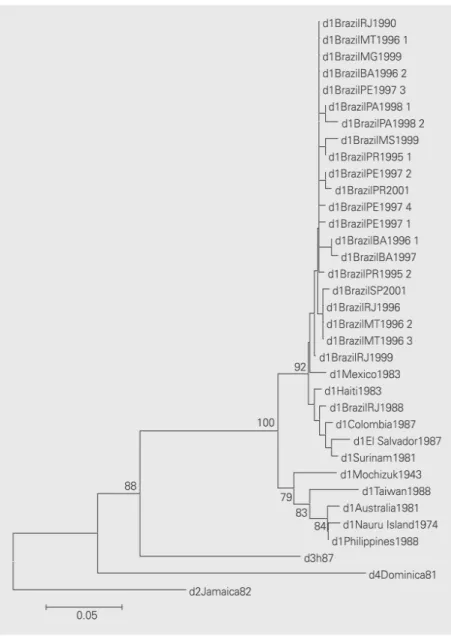
Figure 1. Phylogenetic relationships among dengue-1 (DEN-1) viruses. Phylogenetic tree generated by neighbor-joining analysis of nucleotide sequences from the E/NS1 junction of 32 strains of DEN-1 and representatives of serotypes 2, 3 and 4. Viruses are listed by strain abbreviation for state and year of isolation (see Table 1). Horizontal branch lengths are drawn to scale. Bootstrap values (500 replicates) are shown for some key nodes that connect the genotypic groups of DEN-1.
DEN-2, probably representing evolutionary mutations. The majority occurred in the third base of codons resulting in silent mutations. All mutations in the DEN-1 sequences were silent, whereas for DEN-2, mutations in three codons resulted in amino acid changes be-tween residues of the same non-polar hydro-phobic class.
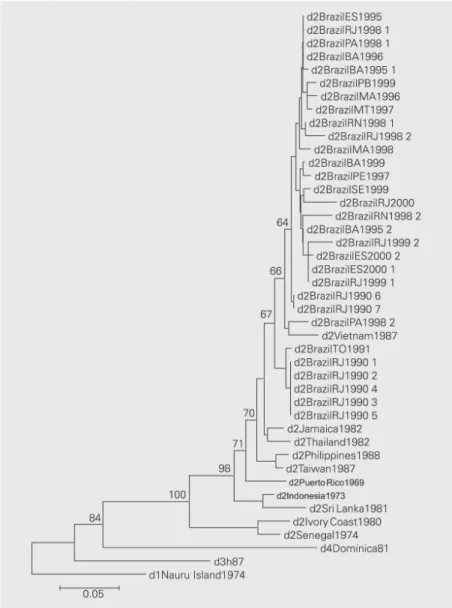
The phylogenetic trees generated by neighbor joining analysis of nucleotide se-quences are presented in Figures 1 and 2. Some reference nucleotide sequences of dif-ferent genotypes of both DEN-1 and DEN-2 viruses isolated in other countries and pub-lished in the literature, as well as nucleotide sequences from Brazilian isolates available in the GenBank database, were also included for phylogenetic purposes. Brazilian DEN-1 strains segregated into one large group along with reference strains from the Americas and the Caribbean (Colombia, Surinam, El Salvador, Haiti, and Mexico), whereas Bra-zilian DEN-2 segregated into a group along with reference strains from the Americas and Southeast Asia (Jamaica, Thailand, and Vietnam). Bootstrap values of statistical sig-nificance were obtained for these groups. There was no segregation of Brazilian DEN-1 viruses according to regions or states but some nucleotide variations were observed between viruses from the same regions. How-ever, for Brazilian DEN-2 viruses most strains isolated in 1990 from the Southeast region presented a distinct segregation pattern from the viruses isolated more recently. The Bra-zilian DEN-1 strains analyzed in this study presented 97.9% similarity amongst them-selves and 96.8% similarity to other samples belonging to the American/Caribbean geno-type, the same genotype as the sample iso-lated in Brazil in 1988 (6). Brazilian DEN-2 isolates presented 97.3% similarity amongst themselves and 94.2% similarity to other samples of the Asian/American-Asian geno-type, the same genotype of two viruses iso-lated in Brazil in 1990 and 1991 (16).
Discussion
met-and Alagoas classified them into the Asian/ American-Asian genotype (18). Similar re-sults were also obtained by nucleotide se-quence analysis of another E protein gene segment (nucleotides 85 to 282) of three DEN-2 samples isolated in Brazil in 1990 (7). Nucleotide sequence analysis of the NS5/ 3’NC junction area of two DEN-1 samples isolated in 1990 and 1994 from Rio de Janei-ro and São Paulo States, respectively, classi-ropolitan area of Rio de Janeiro and then
spread towards the urban areas in the North-east and Midwest regions of Brazil. In 1990, a new epidemic broke out in Rio de Janeiro, now related to the introduction of DEN-2. Since then, with the spread and circulation of more than one serotype, several Brazilian regions have reported outbreaks with severe illness and deaths (17,24-26). From 1995 to 2001, an increasing number of DF and DHF cases has been observed in several urban areas of the country (17). Recently, DEN-3 has been isolated in Brazil but its association with DHF has not been clearly established (27,28).
In a country of continental proportions and incredible heterogeneity of people and environment such as Brazil, phylogenetic studies of dengue isolates must represent all regions of the country. The present study contributes to this viewpoint in the sense that viral strains from Brazilian endemic regions poorly studied before (North and South) were also analyzed. Although all strains were iso-lated from patients with DF, they represent a sample of the dengue viruses circulating in Brazil during the study period, and we as-sume that they would also carry the ability to cause DHF/DSS. Supporting this assump-tion, evolutionary divergence of DF- versus DHF-associated viruses (serotype 2) from Thailand was not observed, denoting that one particular strain has the potential to cause both DF and DHF in different hosts (13).
Different genomic regions of Brazilian dengue viruses have been previously studied by comparative analysis of partial nucleo-tide sequences for both serotypes 1 and 2. For DEN-1, comparative analysis of a pro-tein E gene segment (nucleotides between 52 and 288) of two DEN-1 samples isolated in Brazil, one in 1986 and another in 1990, classified them into the American/Caribbean genotype (9). Analysis of the DEN-2 E pro-tein gene (nucleotides 1685 to 2504) of twelve samples isolated between 1990 and 1995 in the States of Rio de Janeiro, Ceará, Bahia,
bean since 1970, only in 1981 was the first outbreak of DHF/DSS observed in Cuba. Epidemiological studies in Latin America have demonstrated that sequential infections and co-circulation of different serotypes in a population at risk are not sufficient for DHF/ DSS occurrence and other factors related to virus, host, vector, and environment must be involved (2,31-39).
Phylogenetic studies of many different dengue virus samples have led to the asso-ciation between specific genotypes and the presentation of more or less severe disease. In Cuba, the 1981 outbreak was associated with the introduction of a new DEN-2 geno-type, different from the genotype that had been circulating in that country. The DEN-2 genotype circulating in Central America be-fore 1981 was associated with DF. The intro-duction of a different genotype imported from Southeast Asia coincided with the ap-pearance of DHF/DSS in four different American countries (Venezuela, Brazil, Co-lombia, and Mexico; 6,16). Even though specific dengue genotypes have been associ-ated with DHF/DSS, our study shows that the growing number of DHF/DSS cases in Brazil in the last years seems not to be asso-ciated with the introduction of a new geno-type. Of note, the DEN-2 genotype circulat-ing in Brazil since the 90’s is the Southeast Asian genotype but there was no explosive outbreak of DHF/DSS during the first years after its introduction into the country. There are no clear data accurately showing when the Southeast Asian DEN-2 genotype was introduced into Brazil. Rico-Hesse et al. (16) analyzed two DEN-2 viruses isolated in Ven-ezuela and Colombia some time around 1987, and concluded that they belonged to the Southeast Asian genotype. In Brazil, this genotype was probably introduced either at the same time or at some point during 1988, like in other areas of the Americas (6,8,16, 18,20,38,40).
The present study is the largest one in-volving serotypes 1 and 2 of Brazilian den-fied these viruses into the
American/Carib-bean genotype (19). Recently, a nucleotide sequence of the entire genome from a Brazil-ian DEN-2 virus was determined for the first time, and a phylogenetic analysis also classi-fied it into the Asian/American-Asian geno-type (29). Nucleotide sequences of the entire genome were also determined recently from four Brazilian DEN-1 viruses (30).
Regarding the E/NS1 junction region, many authorities advocate it as one of the best segments for molecular epidemiology and phylogenetic studies of dengue viruses, since it is a genomic region not involved in immune recognition/stimulation and char-acterized by a uniform rate of random muta-tions that occur most frequently in the third base of codons (silent mutations) (6,8,12). Only two DEN-1 viruses isolated in Brazil in the mid-80’s and 21 DEN-2 viruses isolated in the 90’s have been previously studied regarding the E/NS1 junction region (6, 16,20). Comparing all these sequences with others of different origins and genotypes it becomes clear that, in spite of the detection of new evolutionary mutations in the ge-nome of Brazilian dengue viruses in the last 15 years, phylogenetic analysis did not iden-tify the circulation of new genotypes for either DEN-1 or DEN-2 in our country.
Carib-gue viruses regarding genomic variability. The 25 new nucleotide sequences determined in this study allowed us to expand consider-ably the number of Brazilian dengue virus strains evaluated so far regarding their ge-nomic variability and molecular epidemiol-ogy. As a huge tropical country with many frontiers, a high rate of A. aegypti infestation and a growing migration flow, Brazil has been recognized as a high risk for the intro-duction and circulation of new serotypes and/or genotypes of dengue virus (25,27). To date, this has been true for the introduc-tion and circulaintroduc-tion of new serotypes, but not for new genotypes, as demonstrated by the present study. The reasons why introduc-tion of new genotypes did not occur in Brazil in the last years are not understood. In other tropical countries the co-circulation of two or more genotypes of dengue virus is com-monplace (36). Actually, we cannot rule out the possibility that new genotypes of dengue virus have already been introduced in Brazil but, for reasons not clearly defined, they were not successful in establishing them-selves and consequently spreading to the whole country. Ecological, vector and host
factors may be involved and should be ad-dressed in further studies. Efforts should be directed at obtaining the complete genomic sequence of Brazilian dengue viruses so that a more detailed comparative analysis could be done. The genomic variability of Brazil-ian dengue virus strains isolated from pa-tients with DHF/DSS should also be studied. Continuous monitoring of the introduction of new serotypes as well as new genotypes in Brazil is necessary so that control measures can be promptly implemented in order to reduce the potential risk for more serious epidemics.
Acknowledgments
The authors thank Dr. Wilson A. Silva Jr., Center for Cell Therapy and Regional Blood Center (Hemocentro), School of Medi-cine of Ribeirão Preto, University of São Paulo, Brazil, for help with the bioinformation analysis. We also thank Dr. Pedro Fernando da Costa Vasconcelos, Evandro Chagas In-stitute, Belém, PA, Brazil, for donating the DEN-2 strains (IEC H 635380 and IEC H 635020).
References
1. Gubler DJ (1998). Dengue and dengue hemorrhagic fever. Clinical Microbiology Reviews, 11: 480-496.
2. Rothman AL & Ennis FA (1999). Immunopathogenesis of dengue hemorrhagic fever. Virology, 257: 1-6.
3. McBride WJH & Bielefeldt-Ohmann H (2000). Dengue viral infec-tions: Pathogenesis and epidemiology. Microbes and Infection, 2: 1041-1050.
4. Henchal EA & Putnak JR (1990). The dengue virus. Clinical Microbi-ology Reviews, 3: 376-396.
5. Lindenbach BD & Rice CM (2001). Flaviviridae: the viruses and their replication. In: Knipe DM & Howley PM (Editors), Fields Virology. Lippincott Williams & Wilkins, Philadelphia, PA, USA.
6. Rico-Hesse R (1990). Molecular evolution and distribution of den-gue viruses type 1 and 2 in nature. Virology, 174: 479-493. 7. Deubel V, Nogueira RMR, Drouet MT, Zeller M, Reynes J & Ma DQ
(1993). Direct sequencing of genomic cDNA fragment amplified by polymerase chain reaction for molecular epidemiology of dengue 2 viruses. Archives of Virology, 129: 197-210.
8. Lewis JA, Chang G-J, Lanciotti RS, Kinney RM, Mayer LW & Trent
DW (1993). Phylogenetic relationships of dengue-2 viruses. Virol-ogy, 197: 216-224.
9. Chungue E, Cassar O, Drouet MT, Guzman MG, Laille M, Rosen L & Deubel V (1995). Molecular epidemiology of dengue 1 and dengue 4 viruses. Journal of General Virology, 76: 1877-1884.
10. Lanciotti RS, Gubler DJ & Trent DW (1997). Molecular evolution and phylogeny of dengue-4 viruses. Journal of General Virology, 78: 2279-2286.
11. Shurtleff AC, Beasley DWC, Chen JJY et al. (2001). Genetic varia-tion in the 3' non-coding region of dengue viruses. Virology, 281: 75-87.
12. Wang E, Ni H, Xu R, Barrett AD, Watowich SJ, Gubler DJ & Weaver SC (2000). Evolutionary relationships of endemic/epidemic and syl-vatic dengue viruses. Journal of Virology, 74: 3227-3234.
13. Rico-Hesse R, Harrison LM, Nisalak A, Vaughn DW, Kalayanarooj S, Green S, Rothman AL & Ennis FA (1998). Molecular evolution of dengue type 2 virus in Thailand. American Journal of Tropical Medi-cine and Hygiene,58: 96-101.
Anti-body-dependent enhancement of dengue virus growth in humans’ monocytes as a risk factor for dengue hemorrhagic fever. American Journal of Tropical Medicine and Hygiene,40: 444-451.
15. Halstead SB (1997). Epidemiology of dengue and dengue hemor-rhagic fever. In: Gubler DJ & Kuno G (Editors), Dengue and Dengue Hemorrhagic Fever. CAB International, Oxford, New York, 23-44. 16. Rico-Hesse R, Harrison LM, Salas RA, Tovar D, Nisalak A, Ramos C,
Boshell J, De Mesa MTR, Nogueira RMR & Da Rosa AT (1997). Origins of dengue type 2 viruses associated with increased patho-genicity in the Americas. Virology, 230: 244-251.
17. Schatzmayr HG (2000). Dengue situation in Brazil by year 2000.
Memórias do Instituto Oswaldo Cruz, 95 (Suppl I): I-179-I-181. 18. Miagostovich MP, Nogueira RMR, Schatzmayr HG & Lanciotti RS
(1998). Molecular epidemiology of Den-2 virus in Brazil. Memórias do Instituto Oswaldo Cruz, 93: 625-626.
19. Batista WC, Kashima S, Marques AC & Figueiredo LTM (2001). Phylogenetic analysis of Brazilian Flaviviruses using nucleotide se-quences of parts of NS5 gene and 3' non-coding regions. Virus Research, 75: 35-42.
20. Miagostovich MP, Sequeira PC, Dos Santos FB, Maia A, Nogueira RM, Schatzmayr HG, Harris E & Riley LW (2003). Molecular typing of dengue virus type 2 in Brazil. Revista do Instituto de Medicina Tropical de São Paulo, 45: 17-21.
21. Gubler DJ, Kuno G, Sather E, Valez M & Oliver A (1984). Mosquito cell cultures and specific monoclonal antibodies in surveillance for dengue viruses. American Journal of Tropical Medicine and Hy-giene,33: 158-165.
22. Igarashi A (1985). Mosquito cell cultures and the study of arthropod-born togaviruses. Advances in Virus Research, 3: 21-39.
23. Kumar S, Tamura K, Jakobsen IB & Nei M (2001). MEGA2: molecu-lar evolutionary genetics analysis software. Bioinformatics, 12: 1244-1245.
24. Nogueira RM, Zagner SM, Martins IS, Lampe E, Miagostovich MP & Schatzmayr HG (1991). Dengue haemorrhagic fever/dengue shock syndrome (DHF/DSS) caused by serotype 2 in Brazil. Memórias do Instituto Oswaldo Cruz, 86: 269.
25. Nogueira RMR, Miagostovich MP, Lampe E, Souza RW, Zagne SMO & Schatzmayr HG (1993). Dengue epidemic in the State of Rio de Janeiro, Brazil, 1990-1: co-circulation of dengue 1 and dengue 2 serotypes. Epidemiology and Infection,111: 163-170.
26. Figueiredo LTM (2000). The Brazilian flaviviruses. Microbes and Infection, 2: 1643-1649.
27. Rocco IM, Kavakama BB & Santos CLS (2001). First isolation of dengue 3 in Brazil from an imported case. Revista do Instituto de Medicina Tropical de São Paulo, 43: 55-57.
28. Miagostovich MP, Dos Santos FB, De Simone TS, Costa EV, Filippis AM, Schatzmayr HG & Nogueira RM (2002). Genetic characteriza-tion of dengue virus type 3 isolates in the State of Rio de Janeiro,
2001. Brazilian Journal of Medical and Biological Research, 358: 869-872.
29. Dos Santos FB, Miagostovich MP, Nogueira RMR, Edgil D, Schatz-mayr HG, Riley LW & Harris E (2002). Complete nucleotide se-quence analysis of a Brazilian dengue virus type 2 strain. Memórias do Instituto Oswaldo Cruz, 97: 991-995.
30. Duarte dos Santos CN, Rocha CFS, Cordeiro M, Fragoso SP, Rey F, Deubel V & Desprès P (2002). Genome analysis of dengue type-1 virus isolated between 1990 and 2001 in Brazil reveals a remarkable conservation of the structural proteins but amino acid differences in the non-structural proteins. Virus Research, 90: 197-205.
31. Mangada MNM & Igarashi A (1998). Molecular and in vitro analysis of eight dengue type 2 viruses isolated from patients exhibiting different disease severities. Virology, 244: 458-466.
32. Leitmeyer KC, Vaughn DW, Watts DM, Salas R, De Chacon IV, Ramos C & Rico-Hesse R (1999). Dengue virus structural differ-ences that correlate with pathogenesis. Journal of Virology, 73: 4738-4747.
33. Watts DM, Porter KR, Putvatana P, Vasquez B, Calampa C, Hayes CG & Halstead SB (1999). Failure of secondary infection with Ameri-can genotype dengue 2 to cause dengue hemorrhagic fever. Lan-cet, 354: 1401-1402.
34. Pandey BD, Morita K, Haseb F, Parquet MC & Igarashi A (2000). Molecular evolution, distribution and genetic relationship among the dengue 2 viruses isolated from different clinical severity. South-east Asian Journal of Tropical Medicine and Public Health, 31: 266-272.
35. Uzcategui NY, Camacho D, Comach G, Cuello de Uzcategui R, Colmes EC & Gould EA (2001). Molecular epidemiology of dengue type 2 virus in Venezuela: evidence for in situ virus evolution and recombination. Journal of General Virology, 82: 2945-2953. 36. Halstead SB, Streit TG, Lafontant JG, Putvatana R, Russell K, Sun
W, Kanesa-Thasan N, Hayes CG & Watts DM (2001). Haiti: absence of dengue hemorrhagic fever despite hyperendemic dengue virus transmission. American Journal of Tropical Medicine and Hygiene, 65: 180-183.
37. Goncalvez AP, Escalante AA, Pujol FH, Ludert JE, Tovar D, Salas RA & Liprandi F (2002). Diversity and evolution of the envelope gene of dengue virus type 1. Virology, 303: 110-119.
38. Rico-Hesse R (2003). Microevolution and virulence of dengue vi-ruses. Advances in Virus Research, 59: 315-341.
39. Aviles G, Meissner J, Mantovani R & St Jeor S (2003). Complete coding sequences of dengue-1 viruses from Paraguay and Argen-tina. Virus Research, 98: 75-82.