Pe rfo rm ance o f a Brazilian po pulatio n
sam ple in the Bo sto n D iagno stic
Aphasia Exam inatio n. A pilo t study
Departamentos de 1Neurologia and 2Fisioterapia, Fonoaudiologia e Terapia
O cupacional, Faculdade de Medicina, Universidade de São Paulo, São Paulo, SP, Brasil
M. Radanovic1 and
L.L. Mansur1,2
Abstract
Brazilian researchers and health professionals often face the challenge of having to use tests developed in foreign languages and standardized for populations of other countries, especially in the fields of Neuro-psychology and Neurolinguistics. This fact promotes a feeling that some scoring systems may be inadequate for our sociocultural reality. In the present study, we describe the performance of a Brazilian population sample submitted to a translated and adapted version of the Boston Diagnostic Aphasia Examination (BDAE). Sixty normal vol-unteers (21 men and 39 women), all Portuguese native speakers, ranging in age from 15 to 78 years (average 43.7) and with an educational level of 2 to 16 years (average 9.9), were tested using a translated and adapted Portuguese version of the BDAE. Cut-off scores are suggested for our population and the performance of the Brazilian sample is compared to that of American and Colombian samples, with the results being closely similar in all tasks.We also performed a correlation analysis between age, gender and educational level and the influence of these variables on the performance of the subjects. We found no statistically significant differences between genders. Educational level correlated positively with performance, especially in the subtests involving reading and writing. There was a negative correlation between age and performance in two subtests (Visual Confrontation Naming and Sentences to Dictation), but a coexisting effect of educational level could not be ruled out.
Co rre spo nde nce
M. Radanovic
R. Cristiano Viana, 163/92 05411-000 São Paulo, SP
Brasil
Fax: + 55-11-3088-9708 E-mail: radano@ tecway.com.br
Publication supported by FAPESP.
Received July 17, 2001 Accepted December 11, 2001
Ke y wo rds
·Aphasia
·Diagnosis
·Portuguese
Intro ductio n
One of the great difficulties faced by Brazilian health professionals is the absence of diagnostic tools standardized in Portu-guese and adapted to their sociocultural real-ity. This is particularly true in the area of Neurolinguistics and in others related to Neu-ropsychology, since professionals and re-searchers use imported diagnostic resources
mar-gin of interpretive error. Besides, for the most part the performance of the local nor-mal population to the test in question is unknown. Foreign cut-off scores are used, increasing the distortion of the conclusions. Furthermore, the use of language is consid-erably influenced by gender, age and educa-tional level.
The main questions we propose to dis-cuss in this paper are:
- What is the standard performance of the Brazilian population in the Boston Diagnos-tic Aphasia Examination (BDAE)?
- Does the standard differ substantially from the performance of other populations where this test is the norm?
- What is the impact of low education (very common in the public we usually at-tend) on the scores of the various subtests?
- What adaptations should be made to make the test more compatible with our real-ity?
The BDAE was developed by Goodglass and Kaplan in 1972 (1) and reviewed in 1983 (2). These investigators suggest its ap-plication to detect and classify aphasic syn-dromes, determine their severity (transversely and longitudinally) and to supply indicators for language therapy. When the initial and more recent versions are compared, the main modifications in the most recent one are the inclusion of the Body-Part Identification sub-test, the stimulus re-ordination, the method for recording and computing data and the statistical analysis (considering percentiles instead of Z-scores). This new version also includes subcortical aphasia analysis based on recent views about the role of subcortical structures in language. In the Spanish adap-tation (3,4), criteria closely similar to those used in the Portuguese adaptation were ap-plied: stimuli with strong cultural connota-tions (texts for comprehension) and those which failed to fulfill the aims of the task after translation (due to syllabic and phone-mic constitution changes) were replaced. In addition, the characteristics of some visual
stimuli were modified.
The development of neuroimaging made the use of BDAE less important to infer lesion sites (as initially proposed), but did not invalidate its potential to establish a common language among the several areas involved in aphasia evaluation. In other words, the BDAE can reflect the view of those interested in neuropathological corre-lations as much as psycholinguistic analysis. Although conceived a number of decades ago, the BDAE still maintains many cur-rently valid characteristics. This fact par-ticularly applies to the semantic treatment of items by categories proposed in the test. Goodglass et al. (5), observing 72 fluent and non-fluent aphasics, pointed out differences in the performance of recognizing and nam-ing the different semantic categories of the BDAE. Fluent aphasics presented a better performance in letter naming, but had great difficulty in object naming, whereas the in-verse was detected in non-fluent aphasics. The categories relative to colors, shapes and actions all contributed less notably to differ-entiating subgroups. At that time the author considered the possibility of the lexical ac-cess system being anatomically subdivided according to the psychological character-istics of the different categories and also according to the sensory input modality through which naming is constructed.
fre-quently revisited in publications (9-12) that present ever more data to answer the com-plex questions about the neural substrate supporting the thinking process.
In the still emergent field of Neurolin-guistics, possibly the strongest arguments for the use of the BDAE are its sensitivity in detecting aphasia (being a scanning test) and the possibility of comparison with stud-ies performed in many countrstud-ies, given that the test is widely accepted and frequently cited in the literature (13).
The test was standardized in an Ameri-can population of 147 subjects ranging in age from 25 to 85 years and with an educa-tional level ranging from less than 9 years through college. Normative studies for Span-ish-speaking people have also been pub-lished (3,4). The test seeks to evaluate lan-guage aspects that can be altered due to left hemispheric lesions, namely articulation, flu-ency, word-finding difficulty, repetition, au-tomatized speech, loss of grammar and syntax, paraphasias, auditory comprehension, reading, and writing.
Pro ce dure s, Po pulatio n and Me tho ds
Te st characte ristics
The BDAE examines comprehension and production procedures in oral and written modalities. Most of the subtests consider the stimuli within deliberately decontextualized situations. Stimuli are presented through au-ditory or visual input in order to assure the analysis of oral and written comprehension. The tasks require greater or lesser emphasis on automatic information or semantic pro-cessing. Cards are used for the purpose of narration or to represent concepts of six semantic categories, phrases of different de-grees of probability and length and texts that differ in complexity and length for interpre-tation. Semantic categories include nouns related to objects, shapes, numbers, letters and colors. The test considers not only nouns
but also transitive and intransitive action verbs. One last category includes stimuli related to parts of the body.
Although all language production subtests lend themselves to the evaluation of patholo-gies frequently associated with aphasia, such as apraxia of speech and dysarthria, some are more specific, involving tasks such as movements of phonoarticulatory organs and the repetition of words which seek control of emission time for items with different pho-nological density and syllabic extension. The stimuli are presented in such a way as to permit the differentiation of linguistic and nonlinguistic factors from perception to the integration of elements which constitute the meaning. The recognition of geometric shapes, letters and syllables is required, as well as the recognition and interpretation of words, phrases and texts. Some subtests are concerned with residual abilities regarding their potential role in language therapy. This is the case for recitation, singing and rhythm, which are skills presumably linked to the non-dominant hemisphere.
Sco ring
All subtests are scored. The production subtests (which are included in the catego-ries Oral Agility, Repetition, Naming and Oral Reading)are scored in a more rigorous way, considering qualitative data, answer delay and sensitivity to phonemic or seman-tic clues. Other qualitative data relative to language production (articulation, praxis, semantic and phonemic exchanges) are com-puted throughout the evaluation in such a manner that it is possible to discriminate the influence of variables such as programming and articulatory difficulties on linguistic per-formance. Partial answers are also consid-ered.
au-ditory presentation of the semantic charac-teristics of the target stimuli. The output can be written or oral. The same stimuli pre-sented for recognition are also used to verify the preservation of their representation in the semantic system.
Po rtugue se translatio n and adaptatio n
The Portuguese version and adaptation of the BDAE (Mansur LL and Mor L, unpub-lished results) were based on the most cur-rent original English version (2). The pro-cess primarily took into account the aims of each subtest, looking for similar resources in Portuguese, which made the simple transla-tion of all stimuli impossible. We will briefly present the criteria used for translating and/ or adaptating the subtests.
Translation. The following subtests were composed using the original English stimuli, where only translation into Portuguese was used: Word Discrimination (the items pre-sented on the cards used in this task were selected according to the frequency of oc-currence in English and there is no similar linguistic study in Brazil), Body-Part Identi-fication, Commands, Nonverbal Agility, Automatized Sequences, Oral Reading (words), Responsive Naming, Visual Con-frontation Naming, Animal Fluency, Word-Picture Matching, Serial Writing (although the absence of K, W and Y is not considered as an error), Written Confrontation Naming, Narrative Writing and Sentences to Dicta-tion.
Translation and adaptation. The follow-ing subtests had to be adapted in order to assure that the purpose of the task was main-tained:
- Complex Ideational Material: the sen-tences used for the semantic judgment task and the canonical narratives were only trans-lated. Three of the texts were adapted, with attributes of proposition organization, lexi-cal complexity, number of explicit infer-ences and macrostructure of the original text
being maintained. Texts demanding world knowledge distinct from Brazilian reality (as in the trumpeter in the quarters and a fire in the hotel, both humorous and with greater implicit information) were replaced, keeping the characteristics of humor and using popular stories.
- Verbal Agility: stimuli were adapted to maintain syllabic extension and phonologi-cal density similar to the original.
- Reciting and Singing: stimuli were re-placed with Brazilian popular songs and sto-ries.
- Repetition of Words: the expression Episcopal Methodist was replaced with Apostolic Catholic (católico apostólico), considered more suitable to the frequency of the phrase in Portuguese.
- Repetition of Phrases: the phrases were replaced, keeping the predictability effect and its possible facilitation role in lexical production. Attributes such as coordinated or subordinated constructions, the presence of lexicon or grammatical words and lexical complexity were respected.
- Oral Sentence Reading: the same stimuli adapted to the repetition task were used, as in the English version.
- Symbol Discrimination: translation would invalidate the monosyllabic quality of stimuli, so they were replaced.
- Word Recognition: the target word, with two syllables, should be inserted into an option set related in terms of phonological and semantic criteria as well as aleatory distractors.
- Comprehension of Oral Spelling: stimuli were changed respecting the necessity for an increasing length and different degrees of irregularities in the phoneme-grapheme con-version.
syntactic and lexical complexity, in addition to the degree of inferences involved in the comprehension.
- Primer-Level Dictation: the item se-quence according to increasing complexity was maintained: letters, numbers and words (mono- or disyllabic) of high frequency and with strong phoneme-grapheme correspon-dence.
- Spelling to Dictation: this task was com-posed of disyllabic, trisyllabic or polysyl-labic words with a greater number of irregu-larities.
Brazilian sam ple
The Portuguese version of the BDAE was applied to 60 Brazilian volunteers (39 women and 21 men), who were healthy, independent for daily life activities, without neurological or psychiatric antecedents and all Portuguese native speakers living in São Paulo for more than 10 years. Subjects were recruited among speech pathology students relatives, hospital employees and outpatients relatives or caregivers, aleatorily, but trying to form subgroups which could represent preliminary references regarding gender, age and schooling influences on the performance of normal individuals.
Subject age ranged from 15 to 78 years (mean ± SD: 43.7 ± 17.3 years), and educa-tional level, defined as time devoted to for-mal study, was 2 to 16 years (9.9 ± 3.7 years). The functional and conversational fluency evaluations were not considered for this study. Testing was performed by speech pathology students trained in the administra-tion of the BDAE and instructed to apply the tasks in a uniform procedure, while a speech therapy professor reviewed the scores ob-tained. Data were analyzed statistically us-ing the MedCalc®
version 6.00.114 and GraphPad InStat®
version 3.05 software. Data distribution was tested by the Kolmogorov-Smirnov method, resulting in a non-normal distribution. Since normal distribution could
not be obtained after attempts at conversion, analysis was done using the nonparametric Kruskal-Wallis and Mann-Whitney tests for the comparison of subgroup performance in the various subtests regarding gender, age and schooling. To evaluate the effect of for-mal education, the subjects were divided into two groups: up to 8 years of study (N = 19) and above 8 years (N = 35). To evaluate the age effect on performance, the subjects were divided into three age groups: up to 30 years (N = 18), from 31 to 50 years (N = 20) and more than 51 years (N = 22). The age groups were compared for mean educational level by ANOVA followed by the Tukey-Kramer post-test. We then compared our results with those previously reported in the literature for English- and Spanish-speaking populations (2,14). A value of P<0.05 was considered statistically significant for all analyses.
Re sults
Table 1 shows the data obtained for our sample in the 30 BDAE subtests. The items showing greater heterogeneity were Word Discrimination, Nonverbal Agility, Visual Confrontation Naming, Animal Fluency and Serial Writing. Based on the means obtained, we present a suggested cut-off score for use in Brazil calculated from the means obtained for the subjects for the several subitems, -2 SD. Table 2 shows the distribution of the results as percentiles.
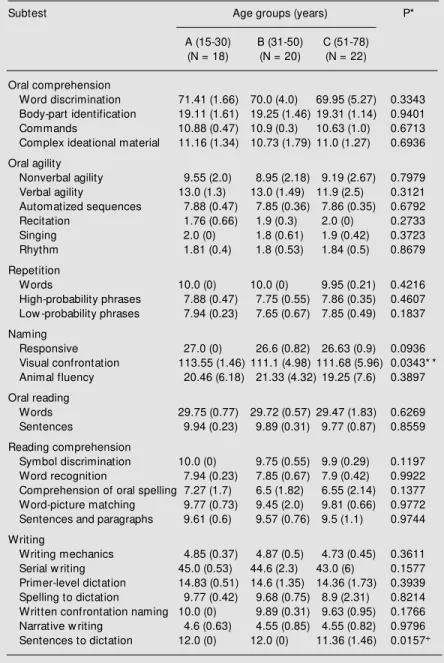
Confron-female (N = 39) groups in the Brazilian sample did not reveal any significant differ-ences (Table 4). There was no difference in educational level between men and women (Table 5). Analysis of performance among the three age groups revealed a significant difference in the Visual Confrontation Nam-ing and Sentences to Dictation subtests (Table 6). There was no difference in average edu-cational level among these groups (Table 7). Educational level (from 1 to 8 years and 9 years or more) influenced performance only in the following items: Word Discrimination and Body-Part Identification (Table 8). We will also discuss some of the answer varia-tions found in this population, as they repre-sent a source of knowledge about the lan-guage processes in normal subjects.
D iscussio n
Answe r variatio ns
Oral comprehension. Deviations noted for this item reflect knowledge from the culturally diversified universe of the indi-viduals. In the identification of semantic fields, the largest number of deviations oc-curred in geometric forms (particularly spi-ral and cone), numbers (7 and 7000) and details of body parts (such as eyelid and thorax). However, response delay occurred randomly. In Commands, complex sequences that involved a larger number of items and actions were the most impaired. In the Com-plex Ideational Material (phrases) item, the low frequency of the item galosh may be the root of the errors verified in phrase 4, these being the major source of deviation in the subtest. Likewise, phrases that demand anal-ysis of quantitative concepts provoked wrong answers. In the comprehension of texts, we observed that most individuals gave wrong answers in the subtest which involved non-literal sense interpretation. Another text that presented difficulty was one for which inter-pretation was not based on common world
Table 1. Performance of a Brazilian population sample in the Boston Diagnostic Aphasia Examination.
Subtest M ean (SD) 95% CI Range Suggested
cut-off score
Oral comprehension
Word discrimination 70.4 (4.0) 69.3-71.5 48-72 62
Body-part identification 19.2 (1.4) 18.9-19.6 14.5-20 16
Commands 10.8 (0.7) 10.6-11 7-11 9
Complex ideational material 10.9 (1.4) 10.6-11.3 5-12 8
Oral agility
Nonverbal agility 9.2 (2.3) 8.6-9.8 4-12 4
Verbal agility 12.6 (1.9) 12.1-13.1 7-14 8
Automatized sequences 7.8 (0.4) 7.8-8 6-8 7
Recitation 1.9 (0.4) 1.8-2 0-2 1
Singing 1.9 (0.4) 1.8-2 0-2 1
Rhythm 1.8 (0.4) 1.7-2 0-2 1
Repetition
Words 9.9 (0.1) 9.9-10 9-10 9
High-probability phrases 7.8 (0.4) 7.7-7.9 6-8 7
Low -probability phrases 7.8 (0.5) 7.7-7.9 6-8 6
Naming
Responsive 26.7 (0.7) 26.5-26.9 24-27 25
Visual confrontation 112.0 (4.7) 110.8-113.3 86-114 102
Animal fluency 20.3 (6.1) 18.5-22.1 11-36 8
Oral reading
Words 29.6 (1.2) 29.3-30 22-30 27
Sentences 9.8 (0.6) 9.7-10 6-10 8
Reading comprehension
Symbol discrimination 9.8 (0.4) 9.8-10 8-10 9
Word recognition 7.9 (0.5) 7.8-8 5-8 7
Comprehension of oral spelling 6.7 (1.9) 6.2-7.2 1-8 3
Word-picture matching 9.7 (1.3) 9.3-10 1-10 7
Sentences and paragraphs 9.5 (0.8) 9.3-9.8 5-10 7
Writing
Writing mechanics 4.8 (0.4) 4.7-5 3-5 4
Serial w riting 44.0 (3.9) 43-45 20-45 36
Primer-level dictation 14.5 (1.3) 14.2-14.9 7-15 12
Spelling to dictation 9.4 (1.5) 9-9.8 2-10 6
Written confrontation naming 9.8 (0.6) 9.7-10 6-10 8
Narrative w riting 4.5 (0.8) 4.3-4.8 2-5 3
Sentences to dictation 11.7 (0.9) 11.5-12 6-12 10
Data are reported as means (SD).
tation Naming subtest, 96 and 114 (the last includes the Body-Part Naming task). In Se-rial Writing (alphabet), there was a differ-ence of three points related to the letters K, W and Y, which were not considered in our scoring.
knowledge (to hunt lions/lion hunting).
Oral expression. In the test of oral move-ments, the female group performed slower than the male group, both in nonverbal and verbal situations. The nonverbal movements constituted the major source of deviation. In the Automatized Sequences, errors were mainly in the oral presentation of the alpha-bet. Errors that did not compromise the mean-ing were noted under High-Probability Rep-etition. The phrase containing adverbs re-lated to time and place, the final one being embedded (They heard him speak on the radio last night), was impaired. The High-Probability stimuli may permit a repetition without detailed analysis, inducing slight deviations. In Low-Probability Phrases, word omission and semantic changes occurred occasionally with meaning alteration. As in all other subtests, some deviations did not constitute errors, but denoted cultural depri-vation (they heard = they saw - in Portu-guese, these two verbs are similar in sound; Italian tie = Intalian tie - denotes low culture level). In Visual Confrontation Naming the largest number of deviations occurred in number and color categories. Cactus in-curred the most deviations among nouns and gray among colors. The verbs falling and dripping and the number 7000 as well as the body parts ankle and shoul-der also required a longer response time. In Word Reading, smoking, seven hundred and twenty-one and brown were read er-roneously, denoting an evident effect of edu-cational level, such as grapheme conversion which marks nasal traces and the graphic extension of the number, being related to the habit of writing checks. The writing of phrases revealed this effect more acutely. The changes introduced indicated plausible adaptations and constructions, although some were substantially distant from the target stimuli (O jiló é amargo = O Julio é amigo). Although the sound of these phrases is simi-lar in Portuguese, the first refers to a veg-etable being bitter and the second to Julio
being a friend.
Written comprehension. In the Symbol Discrimination subtest, there were devia-tions involving the graphemes, which repre-sent difficulties for Portuguese language speakers. Graphemes that do not represent a strict correspondence, such as J (which, together with e and i leave doubts
re-Table 2. Performance of the Brazilian population sample in the Boston Diagnostic Aphasia Examination in percentiles.
Subtest Percentile
10 20 30 40 50 60 70 80 90
Oral comprehension
Word discrimination 66.5 70 72
Body-part identification 18 18.5 19.5 20
Commands 11 11
Complex ideational material 9 10 11 12
Oral agility
Nonverbal agility 6 7 8 8.5 10 11 12
Verbal agility 10 11 12 13 14
Automatized sequences 7 8
Recitation 2
Singing 2
Rhythm 1 2
Repetition
Words 10
High-probability phrases 7 8 Low -probability phrases 7 8
Naming
Responsive 26 27
Visual confrontation 108 111 113 114
Animal fluency 14 15 17 19 20 23 25 27 35
Oral reading
Words 29 30
Sentences 10
Reading comprehension
Symbol discrimination 10
Word recognition 8
Comprehension of oral spelling 5 6 7 8
Word-picture matching 10
Sentences and paragraphs 9 10
Writing
Writing mechanics 4 5
Serial w riting 44 45
Primer-level dictation 14 15
Spelling to dictation 9 10
Written confrontation naming 10
Narrative w riting 4 5
garding choice), or those which are silent or represent a varying auditive representation such as H. Some monosyllables such as but (mas) and bar (involving an archi-phoneme with a corresponding varying
audiographeme) were also discriminated in-correctly. The item Oral Spelling presented great difficulty, especially for the polysyl-labic word elbow (cotovelo) for most of the subjects tested. The difficulty in spelling is directly related to the fact that the written Portuguese language is based on consistent rules of conversion for grapheme-phoneme. Due to this characteristic, spelling becomes less necessary.
Written expression. The deviations in the Primer-Level Dictation refer to the difficul-ties with the stimulus type (grapheme with a complex correspondent and numbers with a complex syntax, such as milhar. In Spell-ing to Dictation, besides the above devia-tions, there was the absence of accents. In the Written Confrontation Naming, a dis-creet difficulty for numbers and colors was constant. In Dictation, deviations were noted which involved clytic pronouns (vê-lo/see you), constructions with corresponding graphics which require the insertion of a diphthong or of nasal archiphonemes and a diphthong.
O ve rall analysis
The first question proposed refers to the necessity of knowing the normative data for the test target population. We cannot presup-pose a priori that foreign populations scores are necessarily valid due to the previously discussed variables involved. Individuals with low instruction, totally functional in their routines, can and frequently do present performances which overlap those of pa-tients with cerebral lesion when submitted to neuropsychological evaluation, increasing the probability of a mistaken diagnosis if the appropriate corrections are not made (15-18). Furthermore, the intuitive assumption that lower efficiency is expected from the population of lower educational level con-versely leads to underestimation of real patho-logical data. It should be noted, however, that the purpose of any neuropsychological
Table 3. Performances of Brazilian, North American and Colombian population samples in the Boston Diagnostic Aphasia Examination.
Subtest Language
Portuguese English Spanish
(N = 60) (N = 147) (N = 156)
Oral comprehension
Word discrimination 70.4 (4.0) 71.8 (0.6) 70.54 (2.67)
Body-part identification 19.2 (1.4) 19.7 (0.5) 18.65 (2.07)
Commands* 10.8 (0.7) 14.9 (0.4) 14.39 (1.15)
Complex ideational material 10.9 (1.4) 11.2 (1.1) 9.05 (1.66)
Oral agility
Nonverbal agility 9.2 (2.3) 10.4 (1.5)
Verbal agility 12.6 (1.9) 13.7 (0.6)
Automatized sequences 7.8 (0.4) 7.9 (0.3)
Reciting 1.9 (0.4) 1.9 (0.3)
Singing 1.9 (0.4) 1.8 (0.5)
Rhythm 1.8 (0.4) 1.8 (0.5)
Repetition
Words 9.9 (0.1) 9.9 (0.3) 9.98 (0.11)
High-probability phrases 7.8 (0.4) 7.9 (0.4) 7.8 (0.48) Low -probability phrases 7.8 (0.5) 7.7 (0.6) 7.82 (0.41)
Naming
Responsive* 26.7 (0.7) 29.9 (0.5) 29.32 (3.64)
Visual confrontation* 112.0 (4.7) 94.93 (2.67)
Animal fluency 20.3 (6.1) 22.5 (6.8) 25.88 (6.45)
Oral reading
Words 29.6 (1.2) 29.87 (1.22)
Sentences 9.8 (0.6) 9.9 (0.4) 9.87 (0.78)
Reading comprehension
Symbol discrimination 9.8 (0.4) 9.71 (1.21)
Word recognition 7.9 (0.5) 7.9 (0.3) 7.89 (0.63)
Comprehension of oral spelling 6.7 (1.9) 7.7 (0.7) 6.58 (1.68)
Word-picture matching 9.7 (1.3) 9.98 (0.13)
Sentences and paragraphs 9.5 (0.8) 9.5 (0.8) 9.41 (0.9)
Writing
Writing mechanics 4.8 (0.4) 4.94 (0.42)
Serial w riting* 44.0 (3.9) 46.27 (5.08)
Primer-level dictation 14.5 (1.3) 13.66 (1.57)
Spelling to dictation 9.4 (1.5) 8.9 (1.2) 9.8 (0.97)
Written confrontation naming 9.8 (0.6) 9.7 (0.6) 9.8 (0.99)
Narrative w riting 4.5 (0.8) 3.7 (0.5) 4.86 (0.65)
Sentences to dictation 11.7 (0.9) 11.9 (0.4) 11.78 (1.36)
Data are reported as means (SD).
test is to separate normal individuals from those with brain lesions. Some authors be-lieve that sociocultural factors do not play such an important role in the performance of subjects with cerebral disorders, or, in other words, brain lesions mask any possible difference owing to their great capacity to disrupt cerebral functioning (19,20).
Our impression from these preliminary data leads us to believe that the performance of the Brazilian population does not differ greatly from that of the American and Co-lombian samples. This is interesting when we consider that the comparison was be-tween a Latin language and an Anglo-Saxon one and between two other Latin languages. We can then infer that the BDAE is not compromised in its applicability as a result of linguistic factors, and eventual differ-ences between populations can probably be attributed to other demographic factors.
It is known that aging can have some detrimental impact on cognitive functions, including language; however, these alter-ations are in general restricted to some do-mains which are supported by attention, memory and executive functions and are sometimes due to sensory dysfunction (21, 22). Rosselli et al. (23) found a worsening in performance with increasing age in the subtests Word Discrimination, Body-Part Identification, Complex Ideational Material, Visual Confrontation Naming, Animal Flu-ency, Oral Sentence Reading Repetition of High- and Low-Probability Phrases, all subtests of Reading Comprehension, Serial Writing, Primer-Level Dictation, Written Confrontation Naming and Spelling to Dic-tation. Borod et al. (24) also found differ-ences in the Commands and Automatized Sequences subtests but not in Body-Part Iden-tification, Comprehension of Oral Spelling and Spelling to Dictation. Our data did not reproduce these results. Although we have found differences in scores for the items Visual Confrontation Naming and Sentences to Dictation when comparing subjects by
Table 4. Performance in the Boston Diagnostic Aphasia Examination by gender.
Subtest Gender P*
M ale Female
(N = 21) (N = 39)
Oral comprehension
Word discrimination 71.14 (2.59) 70.0 (4.67) 0.2766
Body-part identification 19.35 (1.39) 19.16 (1.38) 0.4244
Commands 10.9 (0.43) 10.74 (0.78) 0.5984
Complex ideational material 11.28 (1.1) 10.79 (1.61) 0.1896
Oral agility
Nonverbal agility 9.8 (2.11) 8.9 (2.35) 0.1935
Verbal agility 12.9 (1.77) 12.47 (2.0) 0.4023
Automatized sequences 7.95 (0.21) 7.82 (0.45) 0.4756
Recitation 1.85 (0.47) 1.92 (0.35) 0.7799
Singing 1.9 (0.43) 1.89 (0.44) 0.9867
Rhythm 1.88 (0.33) 1.8 (0.55) 0.8976
Repetition
Words 9.95 (0.21) 10.0 (0) 0.1906
High-probability phrases 7.95 (0.21) 7.77 (0.53) 0.3731
Low -probability phrases 8.0 (0) 7.71 (0.61) 0.7625
Naming
Responsive 26.8 (0.68) 26.69 (0.76) 0.5907
Visual confrontation 112.66 (2.43) 111.73 (5.6) 0.8651
Animal fluency 21.33 (7.6) 19.83 (5.38) 0.6560
Oral reading
Words 29.9 (0.3) 29.48 (1.52) 0.5997
Sentences 9.9 (0.3) 9.84 (0.67) 0.9328
Reading comprehension
Symbol discrimination 9.9 (0.3) 9.87 (0.4) 0.9540
Word recognition 7.95 (0.21) 7.87 (0.57) 0.9734
Comprehension of oral spelling 6.9 (2.12) 6.67 (1.79) 0.2871
Word-picture matching 9.66 (0.79) 9.69 (1.5) 0.3830
Sentences and paragraphs 9.57 (0.67) 9.55 (0.95) 0.7881
Writing
Writing mechanics 4.83 (0.38) 4.8 (0.49) 0.9868
Serial w riting 44.38 (3.32) 44.0 (4.29) 0.5344
Primer-level dictation 14.8 (0.4) 14.46 (1.62) 0.9612
Spelling to dictation 9.2 (1.54) 9.56 (1.46) 0.2310
Written confrontation naming 9.8 (0.51) 9.83 (0.68) 0.6928
Narrative w riting 4.6 (0.82) 4.54 (0.75) 0.6642
Sentences to dictation 11.6 (1.35) 11.82 (0.61) 0.9354
Data are reported as means (SD). * M ann-Whitney test.
Table 5. Correlation betw een educational level and gender.
Gender P*
M ale (N = 21) Female (N = 39)
Schooling (years) 10.38 (4.17) 9.66 (3.5) 0.1903
age, a case-by-case analysis of the worst scores does not allow us to exclude a co-participation of the low educational level factor. These two variables were superim-posed in five of the eight worst scores for Visual Confrontation Naming and in two of the four worst scores for Sentences to Dicta-tion. This issue could be properly reconsid-ered in a study on a larger number of sub-jects. Correlation between a decrease in spon-taneous language production and aging with superimposed effects of educational level by sex was reported by Ardila and Rosselli (25) in a study based on the oral description of The Cookie Theft picture.
Gender differences are controversial in the literature (26,27). When positive, they show a better performance of women in some subtests, especially in naming, reading and writing tasks. Our results did not repro-duce these findings.
Illiteracy can compromise different as-pects of language, such as meta-phonologi-cal analysis, oral comprehension, short-term memory and grammatical judgment (28), leading to a poorer performance in language and other neuropsychological batteries (29, 30). There are few consistent studies on low educational level such as those commonly seen in public health assistance services in Brazil. Correlation between schooling and language abilities was found in studies in-volving the BDAE in the English and Span-ish versions. In these studies the authors verified that scores were impaired especially among subjects with less than 9 years of education. In the Colombian population, ac-ademic achievement affected the scores in the items Animal Fluency, Word Reading, Oral Sentence Reading, Symbol Discrimina-tion, Oral Spelling, Word-Picture Matching, Serial Writing, Written Confrontation Nam-ing, Spelling to Dictation and Sentences to Dictation (24,26).
We identified an influence of number of years of formal study and performance on two items: Word Discrimination and
Body-Table 6 - Performance in the Boston Diagnostic Aphasia Examination by age group.
Subtest Age groups (years) P*
A (15-30) B (31-50) C (51-78) (N = 18) (N = 20) (N = 22)
Oral comprehension
Word discrimination 71.41 (1.66) 70.0 (4.0) 69.95 (5.27) 0.3343 Body-part identification 19.11 (1.61) 19.25 (1.46) 19.31 (1.14) 0.9401
Commands 10.88 (0.47) 10.9 (0.3) 10.63 (1.0) 0.6713
Complex ideational material 11.16 (1.34) 10.73 (1.79) 11.0 (1.27) 0.6936
Oral agility
Nonverbal agility 9.55 (2.0) 8.95 (2.18) 9.19 (2.67) 0.7979 Verbal agility 13.0 (1.3) 13.0 (1.49) 11.9 (2.5) 0.3121 Automatized sequences 7.88 (0.47) 7.85 (0.36) 7.86 (0.35) 0.6792
Recitation 1.76 (0.66) 1.9 (0.3) 2.0 (0) 0.2733
Singing 2.0 (0) 1.8 (0.61) 1.9 (0.42) 0.3723
Rhythm 1.81 (0.4) 1.8 (0.53) 1.84 (0.5) 0.8679
Repetition
Words 10.0 (0) 10.0 (0) 9.95 (0.21) 0.4216
High-probability phrases 7.88 (0.47) 7.75 (0.55) 7.86 (0.35) 0.4607 Low -probability phrases 7.94 (0.23) 7.65 (0.67) 7.85 (0.49) 0.1837
Naming
Responsive 27.0 (0) 26.6 (0.82) 26.63 (0.9) 0.0936
Visual confrontation 113.55 (1.46) 111.1 (4.98) 111.68 (5.96) 0.0343* * Animal fluency 20.46 (6.18) 21.33 (4.32) 19.25 (7.6) 0.3897
Oral reading
Words 29.75 (0.77) 29.72 (0.57) 29.47 (1.83) 0.6269
Sentences 9.94 (0.23) 9.89 (0.31) 9.77 (0.87) 0.8559
Reading comprehension
Symbol discrimination 10.0 (0) 9.75 (0.55) 9.9 (0.29) 0.1197 Word recognition 7.94 (0.23) 7.85 (0.67) 7.9 (0.42) 0.9922 Comprehension of oral spelling 7.27 (1.7) 6.5 (1.82) 6.55 (2.14) 0.1377 Word-picture matching 9.77 (0.73) 9.45 (2.0) 9.81 (0.66) 0.9772 Sentences and paragraphs 9.61 (0.6) 9.57 (0.76) 9.5 (1.1) 0.9744
Writing
Writing mechanics 4.85 (0.37) 4.87 (0.5) 4.73 (0.45) 0.3611 Serial w riting 45.0 (0.53) 44.6 (2.3) 43.0 (6) 0.1577 Primer-level dictation 14.83 (0.51) 14.6 (1.35) 14.36 (1.73) 0.3939 Spelling to dictation 9.77 (0.42) 9.68 (0.75) 8.9 (2.31) 0.8214 Written confrontation naming 10.0 (0) 9.89 (0.31) 9.63 (0.95) 0.1766 Narrative w riting 4.6 (0.63) 4.55 (0.85) 4.55 (0.82) 0.9796 Sentences to dictation 12.0 (0) 12.0 (0) 11.36 (1.46) 0.0157+
Data are reported as means (SD). * Kruskal-Wallis w ith M üller-Dunn post-test. * * Group difference: A-B. +Group difference: A-C and B-C.
Table 7. Correlation betw een educational level and age group.
Age (years) P*
15-30 (N = 18) 31-50 (N = 20) 51-78 (N = 22)
Schooling (years) 11.14 (1.9) 10.42 (4.1) 8.52 (3.9) 0.0894
Part Identification. The attempt to compare individuals by dividing them into groups with less and more than 8 years of formal study (as done in the American and Colom-bian studies reported) failed to reproduce their findings. This observation indicates that such a division was not able to show the critical number of years of formal education that exerts the greatest impact on subject performance. This, in turn, points to the necessity of studying in greater depth the group with less than 8 years of education. This was not done in the present study due to the small sample size for this category. We should also note that this correlation be-tween educational level and performance in neuropsychological tests does not occur lin-early: the two years from 0 to literacy obvi-ously have much more impact than the inter-val from 6 to 8 years and so on, which calls for caution in the interpretation of data rela-tive to this variable.
The principal purpose of the BDAE is to detect aphasia. We understand that its appli-cation in Portuguese will reach the sensitiv-ity already demonstrated in English only when precise indicators of our sociocultural reality are considered, an objective that was partially reached in the present study. The present adaptation respects the authors aims and proposed coherence. It allows the scan-ning of several aspects related to compre-hension and production processing, quanti-fication of the intensity of impairment and a qualitative analysis of functional interactions among different language system compo-nents. The limits of its application are those inherent to aphasia diagnostic tests: the an-swers obtained represent only a sample of the relevant aspects of subject performance. Using this test, it is not possible to assess the language disorder in its entirety and the pre-served language domain. When the purpose of assessment is counseling the patients family and specifying a therapeutic plan, it is necessary to apply other tools to obtain complementary information about the
un-derlying cognitive deficits and communica-tion competence. The scores obtained should not be analyzed separately, but within the set of tasks, in order to appreciate the nature of the deficit and its impact on the language disorder. Variations for normal subjects that may represent attention lapses or cultural
Table 8. Performance in the Boston Diagnostic Aphasia Examination by educational level.
Subtest Schooling (years) P*
1-8 (N = 19) >9 (N = 35)
Oral comprehension
Word discrimination 68.32 (6.21) 71.44 (1.92) 0.0108
Body-part identification 18.63 (1.65) 19.61 (0.94) 0.0201
Commands 10.57 (1.07) 10.88 (0.4) 0.6041
Complex ideational material 10.31 (1.91) 11.26 (1.0) 0.0623
Oral agility
Nonverbal agility 8.57 (2.52) 9.42 (2.17) 0.2038
Verbal agility 11.78 (2.5) 13.0 (1.4) 0.1045
Automatized sequences 7.78 (0.41) 7.91 (0.37) 0.3518
Recitation 1.94 (0.22) 1.85 (0.5) 0.8121
Singing 1.68 (0.74) 2.0 (0) 0.3416
Rhythm 1.66 (0.72) 1.92 (0.27) 0.4647
Repetition
Words 9.94 (0.23) 10.0 (0) 0.7513
High-probability phrases 7.73 (0.56) 7.85 (0.43) 0.5481 Low -probability phrases 7.72 (0.66) 7.82 (0.45) 0.8356
Naming
Responsive 26.52 (0.84) 26.8 (0.72) 0.1716
Visual confrontation 109.94 (7.47) 112.94 (2.14) 0.0653
Animal fluency 17.78 (5.71) 20.86 (5.71) 0.0567
Oral reading
Words 29.18 (2.0) 29.78 (0.65) 0.4336
Sentences 9.66 (0.97) 9.94 (0.23) 0.4844
Reading comprehension
Symbol discrimination 9.73 (0.56) 9.94 (0.23) 0.3227
Word recognition 7.73 (0.8) 7.97 (0.17) 0.6132
Comprehension of oral spelling 5.7 (2.56) 7.0 (1.44) 0.0745
Word-picture matching 9.26 (2.15) 9.85 (0.55) 0.6108
Sentences and paragraphs 9.22 (1.21) 9.65 (0.64) 0.1604
Writing
Writing mechanics 4.66 (0.61) 5.0 (0) 0.1931
Serial w riting 42.15 (6.68) 44.97 (0.17) 0.1248
Primer-level dictation 14.0 (2.19) 14.82 (0.51) 0.2081
Spelling to dictation 8.52 (2.47) 9.82 (0.38) 0.1658
Written confrontation naming 9.55 (1.0) 9.94 (0.23) 0.2942
Narrative w riting 4.29 (1.1) 4.7 (0.52) 0.3924
Sentences to dictation 11.29 (1.61) 12.0 (0) 0.1765
variations serve as guidelines for the qualita-tive analysis of errors in aphasic patients. To guarantee uniform scoring criteria for the answers, instructions must be supplied to the professionals administering the test, so that they will accept the lexicon (that allows variations in the naming tasks) and disregard graphemes that are not contained in our al-phabet. We believe that the preliminary find-ings for this sample can contribute as a refer-ence and be used as guidelines to determine both quantitative and qualitative errors. The standard deviations obtained in the tasks indicate the possibility of a reliable use of
scores from the adapted version of the BDAE in the State of São Paulo, without distortion, but normative data obtained for a larger popu-lation sample from other regions of Brazil and especially of low educational level would provide more reliable normal-pathologic boundaries.
Ackno wle dgm e nts
The authors would like to thank the stu-dents of the Speech Pathology Graduation Course, University of São Paulo, for their important participation in collecting the data.
Re fe re nce s
1. Goodglass H & Kaplan E (1972). The As-sessment of Aphasia and Related Disor-ders. Lea & Febiger, Philadelphia, PA, USA.
2. Goodglass H & Kaplan E (1983). The As-sessment of Aphasia and Related Disor-ders. 2nd edn. Lea & Febiger, Philadel-phia, PA, USA.
3. Goodglass H & Kaplan E (1979). Evalua-ción de la Afasia y de Trastornos Similares
(The Assessment of Aphasia and Related Disorders). Editorial M édica Panameri-cana, Buenos Aires, Argentina.
4. Goodglass H & Kaplan E (1986). Evalua-ción de la Afasia y de Trastornos Similares
(The Assessment of Aphasia and Related Disorders). 2nd edn. Editorial M édica Pan-americana, M adrid, Spain.
5. Goodglass H, Klein B, Carey PW & Jones KJ (1972). Specific semantic w ord cat-egories in aphasia. In: Sarno M T (Editor),
Aphasia: Selected Readings. Appleton-Century-Crofts, New York, NY, USA. 6. Caram azza A, Hillis AE, Rapp BC &
Romani C (1990). The multiple semantics hypothesis: multiple confusions? Cogni-tive Neuropsychology, 7: 161-189. 7. Warrington E & Shallice T (1984).
Cat-egory-specif ic sem ant ic im pairm ent s.
Brain, 107: 829-854.
8. Gainotti G (1998). Category-specific disor-ders for nouns and verbs: a very old and very new problem. In: Stemmer B & Whitaker H (Editors), Handbook of Neuro-linguistics. Academic Press, San Diego, CA, USA.
9. Dam asio H, Grabow ski TJ, Tranel D,
Hichw a RD & Damasio A (1996). A neural basis for lexical retrieval. Nature, 380: 499-505.
10. M urtha S, Cherkow H, Beauregard M & Evans A (1999). The neural substrate of picture naming. Journal of Cognitive Neu-roscience, 11: 399-423.
11. Federmeier KD, Segal JB, Lombrozo T & Kut as M (2000). Brain responses t o nouns, verbs and class-ambiguous w ords in context. Brain, 123: 2552-2556. 12. M ummery CJ, Patterson K, Hodges JR &
Price CJ (1998). Functional neuroanatomy of the sem antic system : divisible by w hat? Journal of Cognitive Neuroscience, 10: 766-777.
13. Willmes K (1998). M ethodological and sta-tistical considerations in cognitive neuro-linguistics. In: Stemmer B & Whitaker H (Editors), Handbook of Neurolinguistics. Academic Press, San Diego, CA, USA. 14. Pineda DA, M ejia SE, Rosselli M , Ardila A,
Romero G & Pérez C (1998). Variabilidad en la prueba de Boston para el diagnóstico de las afasias en adultos laboralmente activos. Revista de Neurología, 26: 962-970.
15. Strub RL & Black FW (1993). Higher cog-nitive functions. In: The M ental Status Ex-amination in Neurology. 3rd edn. F.A. Davis Company, Philadelphia, PA, USA. 16. Rosselli M & Ardila A (1990). Effects of
age, education and gender on the Rey-Osterrieth complex figure. Clinical Neuro-psychology, 5: 370-376.
17. Ostrosky F, Canseco E, Quintanar L, Navaro E, M eneses S & Ardila A (1985).
Sociocultural effects in neuropsychologi-cal assessment. International Journal of Neuroscience, 27: 53-66.
18. Stern Y, Andrew s H & Pitman J (1992). Diagnosis of dementia in a heterogeneous population: Development of a neuropsy-chological paradigm-based diagnosis of dementia and quantified correction for the effects of education. Archives of Neurol-ogy, 40: 8-14.
19. Reitan RM & Wolfson D (1995). Influence of age and education on neuropsychologi-cal test results. Clinical Neuropsychology, 9: 151-158.
20. Heaton RK, Grant I & M atthew s CG (1986). Differences in neuropsychological test performance associated w ith age, education, and sex. In: Grant I & Adams KM (Editors), Neuropsychological Assess-ment of Neuropsychiatric Disorders. Ox-ford University Press, New York, NY, USA. 21. M ittenberg W, Sidenberg M , O’Leary DS & DiGiulio DV (1989). Changes in cerebral functioning associated w ith normal aging.
Journal of Clinical and Experimental Neu-ropsychology, 11: 918-932.
22. Ryan E (1995). Normal aging and lan-guage. In: Lubinski R (Editor), Dementia and Communication. Singular-Publishing, San Diego, CA, USA.
23. Rosselli M , Ardila A, Florez A & Castro C (1990). Normative data on the Boston Di-agnostic Aphasia Examination in a Span-ish-speaking population. Journal of Clini-cal and Experimental Neuropsychology, 12: 313-322.
Normative data on the Boston Diagnostic Aphasia Exam ination and the Boston Naming Test. Journal of Clinical Neuro-psychology, 2: 209-215.
25. Ardila A & Rosselli M (1996). Spontane-ous language production and aging: sex and educational effects. International Journal of Neuroscience, 87: 71-78. 26. Pineda DA, Rosselli M , Ardila A, M ejia SE,
Romero M G & Pérez C (2000). The Boston Diagnostic Aphasia Examination
-Spanish Version: Inf luence of dem o-graphic variables. Journal of the Interna-tional Neuropsychological Society, 6: 802-814.
27. Kremin H, Deloche G, M etz-Lutz M -N, Hannequin D, Dordain M , Perrier D, Cardebat D, Ferrandi I, Larroque C, Naud E, Pichard B & Bunel G (1991). The ef-fects of age, educational background and sex on confrontation naming in normals; principals f or t est ing nam ing abilit y.
Aphasiology, 5: 579-582.
28. M atute E (1998). Neuropsicologia del anal-fabetismo. Neuropsychologia Latina, 4: 38-47.
29. Rosselli M (1993). Neuropsychology of il-literacy. Behavioural Neurology, 6: 107-112.
30. Rosselli M , Ardila A & Rosas P (1990). Neuropsychological assessment in illiter-ates. II. Language and praxic abilities.