Journal of Engineering Science and Technology Review 2 (1) (2009) 12-17
Research Article
Development
and
Performance
Evaluation of Manually and Motorized
Operated Melon Shelling Machine using Impact Technique
A. S. Adekunle*, I.O Ohijeagbon, H. D. Olusegun
Mechanical Engineering Department, Faculty of Engineering and Technology University of Ilorin, P.M.B. 1515, Ilorin, Nigeria.
Received 13 December 2008; Accepted 23 February 2009
___________________________________________________________________________________________
Abstract
Melon shelling in most part of the world is usually done manually by hand, and like all other manual operations it is time consuming and strenuous. The design and construction of manually and motorized operated melon shelling machine using impact method was done in order to meet the domestic, commercial and industrial requirement of melon for food processing. Two of the main cultivars of melon found in Western part of Nigeria; which are Bara and Serewe can be shelled properly by this machine; the machine is made up of three sections namely the hopper, the shelling chamber which consists of the shelling disc and the shaft, and the gear system. The machine was made from locally sourced materials and it can be used in both urban and rural areas even where there is no power supply. The percentage of melon been shelled in either manual or motorized operation in two successive runs of the two types of melon (Bara and Serewe) was found to be above eighty percent (80%) and the shelling efficiency of the machine is above 68%.
Keywords: Melon, Design, Impact, shelling, Manually, Motorized.
___________________________________________________________________________________________
1. Introduction
Melon (Citrullus vulgaris or lanatus) is one of the most popular vegetable crops grown in Africa. It is a tendril climbing herbaceous annual crop which grows better in some parts of the Savannah belt region of Nigeria, Denton et-al [1]. The seed belongs to the cucumber family, which is used for extraction of oil, and is popularly called “Egusi” a name widely used throughout West Africa.
The crop had been in cultivation for at least 4000 years mainly for seeds Schippers [2]. The crop does well on a sandy free draining soil. It can also be planted as an intercrop with crops like maize, okro and also with cassava or yam because they are weed suppressor. When planted it can be harvested between two and half to three months and with good management, there can be a seed yield of 350-400 kg per hectare.
The main cultivars found in Nigeria are Bara, Serewe and Sofin. Bara also known as papa has large brown seeds with thick black edges thickened towards the apex, about 16 x 9.5 mm and is common in the northern and westhern part of Nigeria. The 100 seed weight is about 14g Denton et-al [1] while serewe seeds are smooth, light brown, with a light whitish edge that is not thickened, about 15 x 9 mm in dimension. They are mainly found in eastern Nigeria. The 100 seed weight is about 12g. Analysis made on melon seed by Ajilola et-al [3] indicated that melon seed consist about 50% oil by weight, 37.4% of protein, 2.6% fibre, 3.6% ash
and 6.4% moisture. Out of the oil content of the seed, 50% is made of unsaturated fatty acids, which are Linoleic (35%) and oleic (15%) and 50% saturated fatty acids, which are stearic and palmitic acids. The presence of unsaturated fatty acid makes melon nutritionally desirable and suggests a possible hypocholestroleric effect (lowering of blood cholesterol). Research has shown that the consumption of melon seeds and its product reduces the chances of developing terra arterial or heart deseases Ajilola et-al [3]. Melon has an amino acid profile that compares favorably with that of soyabeans and even white of egg; Oyenuga et-al [4]. Also USDA Nutrient Database [5] shows that melon is rich source of Sodium (Na), Iron (Fe), Manganese (Mn), Copper (cu), Zinc (Zn) and fat. The nutritional value for melon per 100g are : Carbohydrate - 7.6g, Dietary fiber - 0.4g, Fat - 0.2g, Protein - 0.6g, and Vitamin C - 8mg. The melon seed has a lot of advantages among which are the following: the oil extracted from it can be used in manufacturing of margarine, shortening and cooking oils,while the residual cake is a useful source of protein for livestock feed. Also it is used for producing melon snacks known as “robo”.
Despite the large productivity and nutritional potentials of this crop, there has been a hindrance to the use of melon for large-scale production of oil and protein sources. This is as a result of the inability to shell melon to meet the capacity required for industrial use over a specified period of time. In other to address the problem associated with melon shelling, Odigbo [5] designed and constructed a melon shelling machine using the centrifugal impact method. Likewise, Fadamoro [7] design and constructed another machine based on the principle of friction between a rotating discs and a stationary disc positioned to be parallel to the rotating disc.
J
estr
JOURNAL OF Engineering Science andTechnology Review
www.jestr.org
______________
* E-mail address: [email protected]
13
Also Obienwe [8] designed and constructed a melon shelling machine using the principle of extrusion and in kwara State, Nigeria, there is a Federal government sponsored organization that is focused on designing a machine that can shell melon seeds as reported by Rotimi [9]. However, the efficiency obtained by each of these machines been designed was a little above 30% (percent).
Processing of melon include fermentation, coring, washing, drying, shelling and oil extraction. Traditional method of shelling melon appears to be too slow, time consuming, tedious, inefficient and involve drudgery, thus limiting the availability of the product in the market. This has given concern to scientists and researchers in the recent past particularly, since women are the major processors of melon especially at shelling stage Olayiwola [10].
Therefore, taking a careful look at the usefulnesses of melon, there is a need for efficient means of processing it, so as to increase its productivity, improve the quality of its end product and so encourage more farmers to be involved in its growth and production.
The aims of this work is to design a melon shelling machine that can effectively shell two of the major types of melon found in Nigeria, bara (also known as papa) and serewe through the electrical (motorized) and manual operation, without wasting the cotyledon either through breakage or crushing. Also to establish an operating procedure which does not require skilled labour to operate the machine and fabricating the machine at an affordable price.
2. Principle of operation
The working principle of the machine was based on the principle of energy absorbed by a seed as a result of impact (collision) between the seed and a stationary wall which did cause the cracking and removal of the seed coat. Unshelled melon seeds were fed into the machine through the hopper which opened directly into the shelling unit. The unshelled seeds which were supplied with initial velocity by the impeller blades bent at an angle of 45 degrees and rotated anticlockwise, in order to enhance the collision of the unshelled seeds with the rough body of the shelling unit, then caused the breakage of the shell and the removal of cotyledon from the coat. The shelled seeds and the chaffs were blown out of the impellers through the convey chute which was designed to incline at an angle to facilitate cleansing under gravity. Also a cast bevel gear component that consisted of a handle on which effort was applied to give the necessary torque when the machine was driven manually or an electric motor of one horse power (hp) rotating with 1400 rpm was selected which transmitted rotation to the shelling unit through the belt-pulley connection arrangement.
2.1 Materials and Methods
Engineering practice involved utilizing scientific principles to design components and systems that performed reliably and satisfactorily. The materials for the fabrication of the machine were based on strength, suitability and local availability.
2.2 Equipment Description
The melon shelling machine is made up of three sections, the hopper, the shelling chamber which consists of the shelling disc and the shaft, the gear system fig 1. The hopper is made up of four welded mild steel metal sheets slanting towards the smaller opening. It has two openings that can hold a reasonable amount of unshelled melon seeds and the inlet throat connects the hopper to the shelling drum. The shelling chamber consists of the shelling drum, the shelling vanes, the shelling disc and the spacer. The shelling drum is made from mild steel and the inner part of the drum is lined with rods, while the shelling disc is made from galvanized steel and has vane slots at the edges. The shelling vanes are made from galvanized sheet and are arranged side by side at an angle of 120°; the gear on the other hand is made from cast iron and is used to operate the machine manually, it has a key (cone-like) connected to the shaft which can be easily disconnected when switching to automatic operation of the machine. The bevel gear is used to transfer power from the driving shaft to the shelling section. The frame is the support on which the machine rests, i.e. acting as a stand that supports the shelling drum and the bevel gear. The materials used in the construction of this machine are easily available, cost effective and possess the required properties.
Fig 1: Pictorial side view of the melon shelling machine from two
different positions
2.3 Design Computations
2.3.1 Determination of Pulley Diameter
The pulley was designed by considering the power to be transmitted between the electric motor and the shelling shaft. The ratio of the pulley for the electric motor to that of the shelling shaft was 1:2. and the allowable diameter of the pulley was calculated using the expression of Spotts [11]. Neglecting belt thickness,
2 2 1
1
D
N
D
N
=
(1)Where, N1 is speed of the driving motor. N2 is speed of
the shelling shaft. D1 is pulley diameter of the driving motor,
D2 is pulley diameter of the driven machine.
With N1 = 1400 rev/min, N2 = 700 rev/min, D1 = 50 mm,
D2 was calculated as 100 mm
The belt speed (V) was obtained from equation (2) as
1
1
D
N
14
With N1=1400 rev/min, D1=50 mm, and
π
=3.142,was calculated as 219.94 m/s
V
Determination of belt length
The belt length was obtainable using equation (3) as given by Khurmi et-al [12]
(
)
C
D
D
D
D
C
L
4
2
2
2 12 1
−
−
+
+
=
π
(3)and center distance (C) was obtained from equation (4)
1 1 2
2
D
D
D
C
⎟
+
⎠
⎞
⎜
⎝
⎛
+
=
(4)
thus, C = 125 mm and L = 485.6 mm
The angle of wrap of the belt was calculated using equation (5)
C
r
R
Sin
β
=
−
(5)Where, R is pulley radius of shelling shaft, r is radius of motor shaft,
C= centre distance,
With R = 50 mm, r = 25 mm and C =125 mm, angle of wrap
( )
β
was calculated as 11.4202.3.2 Gear Design
The bevel gear which consisted of a gear system made from cast iron rotates at ratio 12:1 with the pitch diameter of the pinion and crank being 152.4 mm and 304.8mm respectively.
Using Buckingham’s equation as stated by Allens et-al [13], the dynamic load of the gear was calculated from equation (6)
(
)
F
F
bc
V
F
bc
V
F
d+
+
+
+
=
21
21
(6)
where,
D
M
F
=
2
t(7)
c
KP
b
=
(8)The allowable stress for the gear was obtained using Barth’s equation, for V less than 10m/s, Khumi et-al [12]
⎥⎦
⎤
⎢⎣
⎡
+
=
V
S
S
o3
3
(9)
Where, Fd is Dynamic load, V is pitch line velocity, b is
face width of the gear, c is constant which depends on the tooth form, material and the degree of accuracy with which the tooth was cut, Fis transmitted force, Mt is torque on
weaker gear, D is pitch radius of gear,
K
≤
4
, S is allowable stress, So is endurance strength for releasedloading.
With, b = 0.15 m, c = 228 KN/m, Mt = 62.8 Mpa, D =
0.152 m, V = 2.2 m/s, the transmitted force F and dynamic load Fd were calculated as 824.15N and 1516.5N
respectively.
2.3.3 Shaft Design
The shaft, which was made from wrought iron which carried combined load of bending moment and torque; hence the design of the shaft was calculated from the formula given by Spotts [11]
2 2 3
16
T
M
d
s
s=
+
π
(10)Where T is torque, M is bending moment of shaft, d is shaft diameter of the machine, SS is maximum shear stress.
With M = 62.8 Mpa, T = 7.5 Nm, SS = 108.33 Mpa, shaft
diameter d was calculated as 14.4 mm.
2.4Fabrication Procedures
The construction works were carried out in the Central Engineering Workshop, faculty of Engineering and Technology, University of Ilorin. The manufacturing procedures adopted for the fabrication of the machine include cutting, shaping, turning, welding and painting.
Table 1: Shelling Values for Manual Operations Seeds dry weight (g) Shelling operation
Sequence
Number of seeds Shelled seed Broken shelled Partially shelled
Unshelled
Broken unshelled
Crushed
Bara Serewe Bara Serewe Bara Serewe Bara Serewe Bara Serewe Bara Serewe Bara Serewe Bara Serewe
70 - 60 - 1 2 500 160 500 126 242 69 236 52 70 31 36 17 60 21 90 24 100 19 127 26 7 3 3 0 13 0 4 0 140 - 120 - 1 2 1000 366 1000 257 557 132 585 170 59 85 146 21 124 50 162 26 242 64 95 30 3 10 2 2 15 25 10 8 210 - 180 - 1 2 1500 476 1500 532 905 275 802 372 106 43 146 53 149 62 202 38 327 90 330 54 0 3 6 5 13 3 14 10 280 - 240 - 1 2 2000 531 2000 739 1242 318 1055 556 197 80 170 68 222 78 286 61 309 31 453 37 18 11 10 8 12 13 20 9 350 - 300 - 1 2 2500 694 2500 853 1512 410 1235 601 278 127 189 116 359 96 381 72 335 46 472 44 11 9 22 12 5 6 34 8
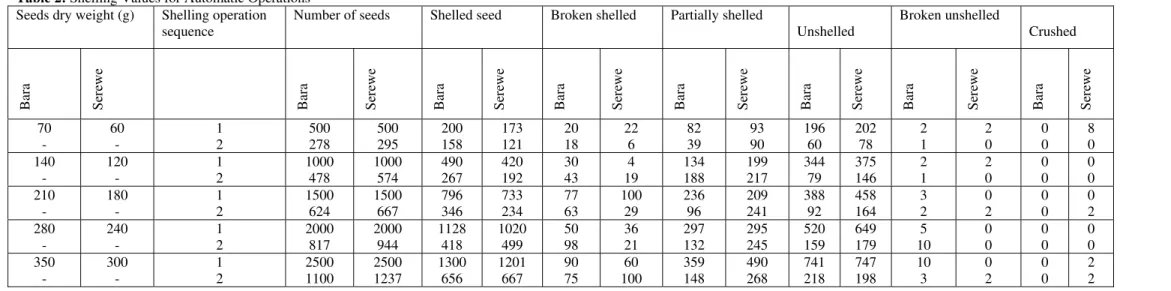
Table 2: Shelling Values for Automatic Operations Seeds dry weight (g) Shelling operation
sequence
Number of seeds Shelled seed Broken shelled Partially shelled
Unshelled
Broken unshelled
Crushed
Bara Serewe Bara Serewe Bara Serewe Bara Serewe Bara Serewe Bara Serewe Bara Serewe Bara Serewe
16 3. Results and Discussion
3.1 Machine Test and Evaluation Procedure
The performance evaluation of the machine was carried out manually and with a 1 horse power [1400 rpm] electric motor, using melon seeds of various quantities and of two different varieties i.e Bara and Serewe as shown in the tables below. The unshelled melon seeds used were weighed, sprinkled with water and partially dried with natural air for 10 minutes, so that the skin coat became slightly softened and the cotyledon was detached from the shell, thus making shelling more efficient Olusegun et-al [14]. The melon shelling machine was fed with 500 samples of each variety i.e Bara and serewe, the shelling operation was then performed twice in successions using the manual handle and motorized processes for each variety. The number of seeds shelled, broken shelled, partially shelled, unshelled, broken unshelled and crushed were counted separately in the first and second shelling operation respectively Table 1 and Table 2. The experiment was repeated for 1000, 1500, 2000 and 2,500 seeds of each melon variety.
3.2 Shelling Efficiency Estimation
The Machine shelling efficiency on each variety of melon with respect to the mode of shelling operation was effected by using the relation:
( )
machine in
fed melon Total
machine by
shelled melon Total Efficiency
Shelling η =
Thus for the manual and automated shelling operation,
( )
68.9%7500 5168=
=
MB Bara on Efficiency Shelling
Manual η
( )
61.3%7500 4600=
=
MS Serewe on Efficiency Shelling
Manual η
( )
55.8% 7500 4181==
AB
Bara on Efficiency Shelling
Automated η
( )
50.3% 7500 3769 ==
AS
Serewe on Efficiency Shelling
Automated η
3.3 Discussion
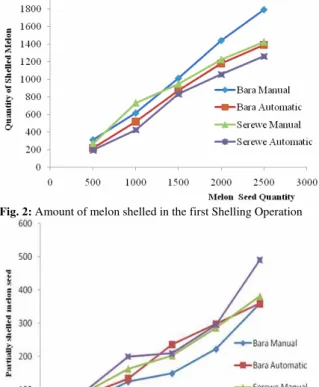
The first shelling operation on the melon seeds using the constructed machine either manually or electricaly showed that the shelled seeds increased as the numberof melon seeds to be shelled increased for both variety Fig 2. The average percentage of shelled melon seed for Bara and Serewe during manual operation were 67% and 61.8% respectively, while for automated operation it was 53.7% and 48% respectively. Further analyses of the result revealed that 13.7% and 14.9% was broken but shelled for Bara and Serewe, during manual operation while for automated shelling operation it was 6.4% for Bara and 5.9% for Serewe. Also the quantity of partially shelled melon seed in the two varieties increased as the input melon seed increased during shelling operation Fig 3. However, the percentage of
the partially shelled melon decreased as the quantity of the melon to be shelled increased Fig 4; with the highest value being 19.6% during auto shelling of Serewe melon and the lowest being 9.9% in manual shelling of Bara. In all of the first shelling operation for the two varieties of melon seed, the percentage of unshelled broken melon and that of crushed melon was less than 0.9%.
Fig. 2: Amount of melon shelled in the first Shelling Operation
Fig 3: Quantity of Partially shelled melon seed in first shelling
operation
Fig 4: Percentage of Partially shelled melon seed in first shelling
17
Fig 6: Percentage of Unshelled melon after two successive shelling
operations
Fig 5: Melon Seed Shelled in two successive shelling operations
In the shelling operation carried out on the remaining unshelled melon seed, the total quantity of melon seed shelled for the two varieties increased as the input seeds fed into the machine increased Fig 5. The overall percentage of melon shelled in two succesive operations during manual operation was 89.8% and 88.4% for Bara and Serewe respectively, while it was 84.3% and 75.4% for Bara and Serewe during automated operation. Moreover, analysis of the total melon seed shelled also showed that less than 7.5% was broken shelled during automated shelling while it was less than 14.5% during manual shelling. Similarly, the percentage of unshelled melon decreased with incresing quantity of melon fed into the machine for shelling, and the value varied between 1.2 – 15.6% with the highest occuring during auto shelling of Serewe Melon and the lowest in Bara variety during manual shelling operation Fig 6. Comparing the overall performance of the machine, it was found that the efficiency of the machine was a little higher in manual operation than in automated shelling, and also the machine was more efficient in shelling Bara melon than Serewe Variety.
4. Conclusion
Aviable equipment for shelling two varieties of melon seed commonly found in Nigeria was developed from the available locally sourced materials. The melon shelling machine was very applicable for local production, operation, repair and maintenance. The operation of this machine manually and electrically makes it a unique type compare to others. The automatic operation saved energy and did not require high skilled labour. The operational and process performance showed that the equipment shelled well over 80% of melon seeds in two successive shelling and the percentage of broken shelled melon in any shelling operation was less than 14.5%. Also a melon shelling plant based on this technology could provide employment and at the same time make available quality melon seeds at low cost for domestic use and for melon oil processing industry.
5. Acknowledgement
The authors are grateful to Omoniyi O, Abolarin O.S, Abu Enock for their assistance in data collection and tests. Also the authors acknowledge the workshop staff for their support during the fabrication exercise.
______________________________ References
1.L. Denton, and M.O.Adeiran, Geographical performance and distribution of the major seed types of Egusi. 10th Annual
conference of Horticultural Society of Nigeria. p. 5-8 (1988).
8.D.S.Obienwe, Design, Construction and Testing of an Electrically Powered Melon Sheller, M. Eng. Thesis.University of Ilorin, Department of Mechanical Engineering (2002) .
2.R.R.Schippers, African Indigenous Vegetables. An overview of the cultivated species. Chartham, UK; Technical centre for Agricultural and Rural Cooperation. p. 55- 63 (2005).
9.O.O.Rotimi, Design and Construction of Melon Shelling Machine. University of Ilorin, B. Eng. Project work, Department of Mechanical Engineering (2006).
3.O.O.Ajilola, S.E.Eniyemo, O.O.Fasina, and K.A.Adeeko, Mechanical extraction of oil from melon seeds. Journal of Agricultural Engineering Research, 45, 1. (1990).
10.C.B.Olayiwola, Women in Agriculture. Paper presented at the workshop on women in Development, sponsored by DFRRI, Abuja. 14th
– 16th September, p. 6 -9 (1987).
11.11. M.F.Spotts, Design of Machine Elements (1948). 4.V.A.Oyenuga and B.A.Faluga, Some aspects of biochemistry and
nutritional value of the water melon seed. Journal of Science Food and Agriculture. 26, 6 (1975).
12.R.S.Khurmi and J.K.Gupta, Theory of Machines, Eurasia Publishing house, New Delhi (2004).
13.H.Allens, A.R.Holowenko, and H.G.Laughlin, Theory and Problems of Machine Design. McGraw-Hill Book Co; Singapore. Schaum’s outline series (1961).
5.http//www. Health-garden.com/melon.html
6.E.U.Odigbo, Impact Melon Shelling Machine. Transaction of the ASAE, p. 1264 -1269. (1979).
14.H.D.Olusegun and A.S.Adekunle A. S. The design, Construction and Testing of Melon Sheller. Global journal of Engineering and Technology, 1. 4. p. 361 -368 (2008)