PSIHOLOGIJA, 2013, Vol. 46 (3), 229–243 316.644:606:604.6](560) © 2013 by the Serbian Psychological Association DOI: 10.2298/PSI130416002P
Disease-threat model explains acceptance
of genetically modified products
Pavol Prokop1,2, Murat Ozel3, Muhammet Usak4, and Ibrahim Senay5
1Institute of Zology, Slovak Academy of Sciences 2Department of Biology, Trnava University, Bratislava 3Department of Science Education, Gazi University, Ankara, Turkey 4Department of Primary Education, Dumlupinar University, Kutahya, Turkey
5Department of Psychology, Istanbul Sehir University, Istanbul, Turkey
Natural selection favoured survival of individuals who were able to avoid disease. The behavioural immune system is activated especially when our sensory system comes into contact with disease-connoting cues and/or when these cues resemble disease threat. We investigated whether or not perception of modern risky technologies, risky behaviour, expected reproductive goals and food neophobia are associated with the behavioural immune system related to specific attitudes toward genetically modified (GM) products. We found that respondents who felt themselves more vulnerable to infectious diseases had significantly more negative attitudes toward GM products. Females had less positive attitudes toward GM products, but engaging in risky behaviours, the expected reproductive goals of females and food neophobia did not predict attitudes toward GM products. Our results suggest that evolved psychological mechanisms primarily designed to protect us against pathogen threat are activated by modern technologies possessing potential health risks.
Keywords: behavioural immune system, disgust, gender, genetic modification, pathogens
Natural selection has led to adaptations that influence survival of all living organisms including humans (Darwin, 1859). These adaptations influence the human brain and consequently human behaviour (for an overview see Liddle, Bush, & Shackelford, 2011). Evolutionary approach in studying behaviour is therefore focused on its adaptive value which means that we are asking why a particular behaviour has evolved and what benefits and costs it brings to living organisms. This approach can be applied to all areas of psychological research (Buss, 2011; Gaulin & McBurney, 2008).
One of the most striking weapons of natural selection is pathogen threat. Looking at historical data, in the 1300s, the plague was estimated to have killed between 25% and 50% of the populations of Europe, Asia, and Africa (Gottfried, 1983). Current estimates suggest that one to two million people
die from malaria annually (Crompton, 1999; Sachs & Malaney, 2002) and the same number of people died in 2008 due to diseases associated with AIDS (World Health Organization (WHO), 2010). When the human sensory system is faced with disease-connoting cues, for example with people who are ill, two defensive systems are activated: the immune system (Schaller, Miller, Gervais, Yager, & Chen, 2010) and the behavioural immune system (Schaller, 2006). The mobilization of immunological defences is costly in terms of energy (Ilmonen, Taarna, & Hasselquist, 2000) and it is required only after pathogens are in physical contact with an individual’s body. However, the behavioural immune system activates our basic emotions, like disgust and fear, and behaviours that prevent contact with subjects or objects that are potentially dangerous in terms of disease transmission (Schaller & Duncan, 2007)
A body of research has shown that the behavioural immune system does not need to respond specifically to disease-connoting stimuli, but instead it is also activated when the stimuli resemble cues of pathogens (reviewed by Schaller & Park, 2011). For example, people who think themselves vulnerable to disease transmission show a relatively greater level of averse response to physically disabled individuals (Park, Faulkner, & Schaller, 2003), towards older adults (Duncan & Schaller, 2009), towards immigrants (Faulkner, Schaller, Park, & Duncan, 2004), towards obese people (Park, Schaller, & Crandall, 2007) or towards some animals (Prokop, Fančovičová, & Fedor, 2010a; Prokop, Usak, & Fančovičová, 2010b; Prokop, Usak, & Fančovičová, 2010c).
Openness to experience and extraversion is associated with larger social networks, but also with higher risk of being infected by pathogens (Nettle, 2005; Mortensen, Vaughn Becker, Ackerman, Neuberg, & Kenrick, 2010). Similarly to the behavioural avoidance of disfigured people (Park et al., 2007) triggered by the smoke detector principle (Nesse 2005), modern technologies, albeit absent in our ancestral past, would activate specific kinds of cognitive structures that facilitate behavioural avoidance. In particular, modern technologies may pose potential threat, because they are novel, and, thus, people lack sufficient experiences with them.
prohibited due to the unknown impact of genetic engineering on human health and the environment (Bredahl, 1999) and prefer natural or alternative therapies over traditional medical treatments (Kaptein, Helder, Kleijn, Rief, Moss-Morris, & Petrie, 2005). These concerns are more pronounced in females (e.g., Siegrist, 2003, Magnusson & Hursti Koivisto, 2002; Moerbeek & Casimir, 2005; Prokop, Lešková, Kubiatko, & Diran, 2007). From an evolutionary perspective, higher concerns of risky technologies by females would reflect their greater investment in their offspring (Napolitano & Ogunseitan, 1999; Simon, 2009).
One would therefore expect that GM foods should be more acceptable to people who feel themselves less vulnerable to diseases, and who engage in more risky behaviours. Devcich, Pedersen, and Petrie (2007) found that consumers with a higher number of modern health worries, such as ‘‘depletion of the ozone layer”, ‘‘drug-resistant bacteria”, ‘‘pesticides in food” or ‘‘cell phones” showed a stronger preference for foods that had only natural ingredients (Devcich et al., 2007). A study conducted in Sweden showed that people who had health concerns had more negative attitudes toward the gene technology as compared with people without health concerns (Magnusson & Hursti Koivisto, 2002). Most recently, Prokop and Kubiatko (in press) found that school children who were more sensitive to cues of pathogen transmission showed greater environmental concerns. Collectively, evidence suggests that the perceived disease threat influences preferences for natural products and for a safe environment. However, it is not clear whether or not an individual’s vulnerability to infectious diseases predicts acceptance of GM foods.
An avoidance of novel foods (food neophobia) (Pliner, 1994) is also thought to be a mechanism that serves to protect the individual by making him or her avoid physical threat from consumption of potentially toxic or nutritionally inadequate foods (Martins & Pliner, 2005). Since food neophobia can influence preferences toward novel foods (Tuorila, Lähteenmäki, Pohjalainen, & Lotti, 2001; Choe & Cho, 2011), understanding its potential impact on consumers’ food selections is an important issue not only from the theoretical, but also from the practical perspective (especially for developers of food products, etc.). To date, however, little is known about relationships between food neophobia and the acceptance of GM products, and very little (based on only one study) is known about food neophobia in Asia (Choe & Cho, 2011). Some researchers have shown that food neophobia is associated with negative attitudes toward GMO (Bredahl, 2001; Tuorila et al., 2001), while some others have not found any similar associations (Lähteenmäki et al., 2002). In addition, these associations were found to vary from country to country (Bredahl, 2001).
OBJECTIVES OF THE STUDY AND HYPOTHESES
– Hypothesis `1: The vulnerability to diseases will correlate with negative attitudes toward GM products.
– Hypothesis `2: The negative attitudes toward GM products will correlate with the sensitivity to pathogen disgust because this emotion protects us against risky events in terms of disease transmission.
– Hypothesis `3: Females would have more negative attitudes toward GM products than males.
– Hypothesis `4: Respondents who engage in risky behaviours that correlate with extraversion (Schmidt, 2004; Zietsch, Verweij, Bailey, Wright, & Martin, 2010), would show lower concerns with GM products, thus their negative attitudes toward GM products would negatively correlate with risky behaviours.
– Hypothesis `5: Respondents with higher food neophobia would have more negative attitudes toward GM products.
– Hypothesis `6: Respondents with higher reproductive goals would have more negative attitudes toward GM products.
Method
Respondents. Respondents were 252 volunteers (168 females and 84 males) recruited from
three universities in Turkey. The mean age of respondents was 21.7 years (SE = 0.19, range 18 – 37). The respondents were enrolled in various fields including both humanities and natural sciences. All the respondents participated in this study were full-time students. Six questionnaires were administered by the researchers, two of whom visited the students in their classes and invited them to this study. The questionnaires were administered to students who agreed to participate voluntarily. The students completed the questionnaires in 25–30 minutes. Respondents were also asked to provide their age, sex, field of study, number of illnesses within the last year (How many times were you ill during the last 365 days?) and their desired number of children (How many children would you like to have in future?). The later variable was used to measure the expected reproductive goals (ERG) similarly as in Wang, Kruger and Wilke (2009). All respondents reported that they were childless.
Research Instruments
Attitudes toward genetically modified products: Attitudes toward GM products (GMO) were measured by 14 items (Cronbach’s alpha = 0.81) developed and previously validated by Erdogan, Özel, Uşak, and Prokop (2009). Most items were adopted from the “shopping of GM products”, “consumption of GMO products”, “ethics of genetic modifications”, and “use of genetic engineering in human medicine” subscales of the original questionnaire. The selection of these items reflects the (1) willingness to consume, (2) willingness to buy GM products, and (3) moral acceptance of GM products. Summed scores of questionnaire indicated whether or not the respondent was willing to purchase and/or eat GM products and whether or not he/ she supports the genetic modification of food products in general. Examples of items included: “I would eat GM tomatoes”; “I would not give GM food to children”; “Eating GM foods regularly could result in health problems in a few years”. Items were rated on a five-point Likert scale ranging from 1 (strongly disagree) to 5 (strongly agree). We calculated individual scores for this dimension by summing the responses to the constituent item and controlling for the effect of age, using SPSS software. Negatively worded items were scored in reverse order.
The questions were taken from the Eurobarometer 52.1 (Melich, 2006). Respondents were asked whether twelve statements regarding concepts and facts about biotechnology were true or false. The following questions are some examples: “Ordinary tomatoes do not contain genes while genetically modified tomatoes do”; “Genetically modified animals are always bigger than ordinary ones”; “It is impossible to transfer animal genes into plants”; “By eating a genetically modified fruit, a person’s genes could also become modified”. We calculated individual scores for this dimension by summing the responses to the constituent item and controlled for the effect of age. Since the acceptance of GMO could be influenced by study combination, age or knowledge (Bal, Keskin-Samanci, & Bozkurt, 2007; Chen & Raffan, 1999; Chen & Li, 2007; Dawson, 2007; Erdogan, Özel, BouJaoude, Lamanauskas, Uşak, & Prokop, 2012; Prokop, Leškova, Kubiatko, & Diran, 2007; Šorgo, Ambrožič-Dolinšek, Usak, & Özel, 2011; Turkmen & Darçın, 2007; Usak, Erdogan, Prokop, & Ozel, 2009), the mean score of the acceptance of GMO dimension was regressed against these variables and the residuals of regression (one variable) were defined as the dependent variable.
Perceived vulnerability to diseasequestionnaire. This questionnaire (PVD) (Duncan,
Schaller, & Park, 2009) was used to assess the respondents’ self-perceived vulnerability to disease. This scale consisted of 15 items (Cronbach’s alpha = 0.75); one subscale assessed beliefs about one’s own susceptibility to infectious diseases (Perceived Infectability [PI] with 7 items); the second subscale assessed emotional discomfort in contexts that suggest an especially high potential for pathogen transmission (Germ Aversion [GA] with 8 items). Items were rated on a five-point Likert scale ranging from 1 (strongly disagree) to 5 (strongly agree). We calculated individual scores for these dimensions by summing the responses to the constituent items. Negatively-worded items were scored in reverse order.
We used the PI subscale to assess inter-personal differences in perceived vulnerability to infectious diseases (item example: “In general, I am very susceptible to colds, flu and other infectious diseases”). The GA subscale assessed some behaviours and emotional avoidance of some pathogen-relevant stimuli (item example: “I prefer to wash my hands soon after shaking someone’s hand”). Thus, the GA subscale reports pathogen avoidance behaviours rather than perceived vulnerability to diseases. High mean scores in these dimensions indicate high vulnerability to diseases. Summed scores of both dimensions were controlled for the effect of age. To support the reliability of the two subscales, the total number of illnesses significantly correlated only with the PI subscale, but not with the GA subscale (r = 0.40 and 0.07, p <.0001 and 0.25, respectively) similarly as in Prokop, Uşak, and Fančovičová (2010c).
The pathogen disgust questionnaire: The Pathogen Disgust (PD) questionnaire was adopted from the Disgust Sensitivity Scale developed and validated by Tybur, Lieberman, and Griskevicius (2009). We used 7 items from the original questionnaire (Cronbach’s alpha = 0.78) that were rated from 1 (not at all disgusting) to 5 (extremely disgusting) following the recommendation of Tybur et al. (2009). The PD questionnaire was designed specifically to measure disgust elicitors caused by sources of various pathogens (e.g., stepping on dog poo). High mean scores in this dimension indicated high disgust sensitivity. We calculated individual scores for this dimension by summing the responses to the constituent items and controlled for the effect of age because disgust sensitivity was found to vary with age (Curtis, Aunger, & Rabie, 2004).
boyfriend/girlfriend during the past 12 months”). These items were rated from 1 (absolutely disagree) to 5 (totally agree). High mean scores in this questionnaire indicated engaging in risky behaviours. We calculated individual scores for this dimension by summing the responses to the constituent items after controlling for the effect of age.
The food neophobia questionnaire: The food neophobia questionnaire (FN) was adopted from Pliner (1994). This questionnaire investigated behavioural reluctance to feed and/or reject novel foods. It contained 10 items (Cronbach’s alpha = 0.73) that were rated from 1 (absolutely disagree) to 5 (totally agree). Examples of items included: “I am afraid to eat things I have never had before”; “I am very particular about the foods I will eat”; “I will eat almost anything”. High mean scores in this dimension indicated high food neophobia. We calculated individual scores for this questionnaire by summing the responses to the constituent items after controlling for the effect of age because food neophobia was found to vary with age (Dovey, Staples, Gibson, & Halford, 2008). Negatively-worded items were scored in reverse order.
Results
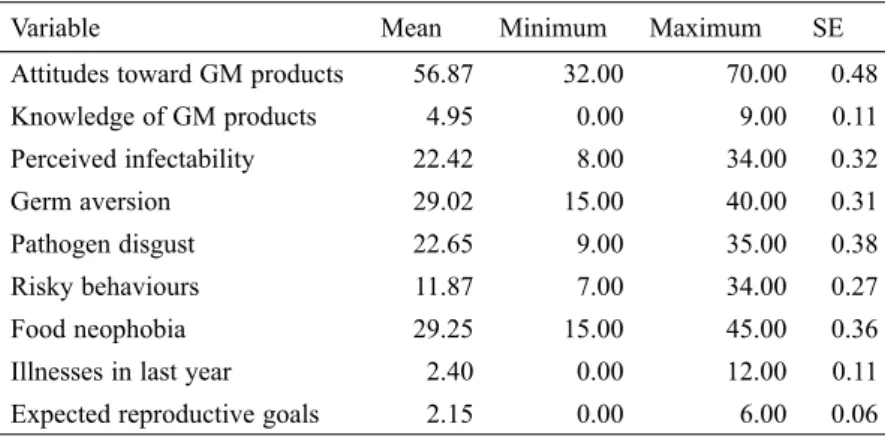
Descriptive analysis of measured variables is summarised in Table 1. Overall, respondents showed relatively higher PVD scores, relatively lower FN and KGMO scores, relatively supportive attitudes toward GMO and moderate means in other domains.
Table 1. Descriptive Data for Attitudes toward GM Products and Their Possible Predictors (N = 252)
Variable Mean Minimum Maximum SE
Attitudes toward GM products 56.87 32.00 70.00 0.48 Knowledge of GM products 4.95 0.00 9.00 0.11 Perceived infectability 22.42 8.00 34.00 0.32
Germ aversion 29.02 15.00 40.00 0.31
Pathogen disgust 22.65 9.00 35.00 0.38
Risky behaviours 11.87 7.00 34.00 0.27
Food neophobia 29.25 15.00 45.00 0.36
Illnesses in last year 2.40 0.00 12.00 0.11 Expected reproductive goals 2.15 0.00 6.00 0.06
GMO scale (Pearson r = 0.10, p = 0.13) providing no support for Hypothesis 5. ERG correlated weakly with the GMO scale (Pearson r = –0.13, p = 0.04) providing no support for Hypothesis 6.
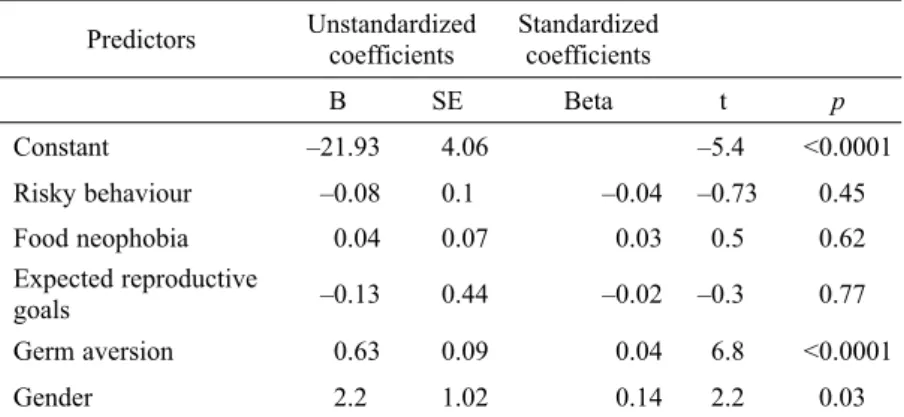
We then conducted multiple regression analysis (forward stepwise method) to investigate whether or not any of the individual difference variables uniquely predicted attitudes toward GMO. The list of independent variables in all regression analyses is shown in Table 2. The multiple regression model was significant (R2 = 0.25, F(2,249) = 41.74, p <0.0001). Two variables were entered into the model: the GA subscale and gender (β = 0.42 and – 0.16, t(248) = 7.08 and –2.61, p <.0001 and 0.009, respectively; see Table 2). This suggests that respondents with high aversion against disease-connoting cues had more negative attitudes toward GMO and that males had more positive attitudes toward GMO than females. Other predictors were removed from the model.
Table 2. Final model of the hierarchical multiple regression analysis on the GMO scale controlled for the effect of age, knowledge of GMP and study course. The PI and PD
subscales were excluded from the model (N = 252)
Predictors Unstandardized coefficients Standardized coefficients
B SE Beta t p
Constant –21.93 4.06 –5.4 <0.0001
Risky behaviour –0.08 0.1 –0.04 –0.73 0.45
Food neophobia 0.04 0.07 0.03 0.5 0.62
Expected reproductive
goals –0.13 0.44 –0.02 –0.3 0.77
Germ aversion 0.63 0.09 0.04 6.8 <0.0001
Gender 2.2 1.02 0.14 2.2 0.03
Hierarchical multiple regression (stepwise method) was used to test the mediation. The mediations tested the relationship between attitudes toward GMO (dependent variable) and predictors listed in Table 2. We defined gender, PD, GA and PI subscales as predictors of attitudes toward GMO and RB, FN and ERG as mediators of these relationships. Out of three models derived by hierarchical multiple regression, we present the strongest model that explains the largest variability of results (R2 = 0.25, F(5,246) = 16.7, p <.0001). As shown in Table 2, the GA subscale and gender differences significantly contributed to the model. The RB, FN and ERG scales showed a non-significant contribution and other predictors were excluded. This model fully corroborated results of multiple regression analysis presented above.
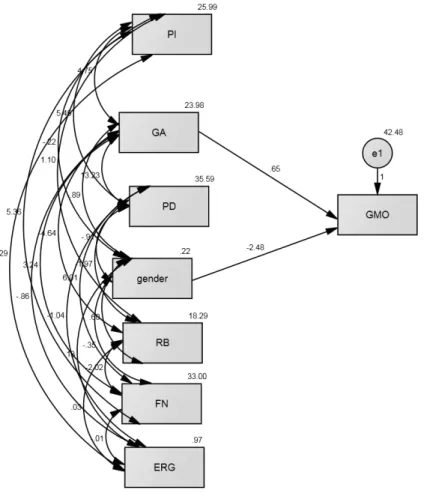
model we also allowed for a covariation among any two variables. The results showed that our restricted model fitted the data equally well as the full model (it did not significantly differ from the saturated model) (χ(5) = 2.078, p = 0.838). The fit parameters had the values of 1, 0.992, 0.001 for NFI, CFI and RMSEA indices, respectively. Thus, this model had a good fit. Restricting this model further by removing the GA subscale variable from it, did not produce a good fit (χ(6) = 48.127, p <0.0001). The resulting model with gender as the only predictor significantly deviated from the saturated model. NFI, CFI and RMSEA indices of this latter model had the respective values of 0.821, 0.825 and 0.167, suggesting a poor fit. In a third alternative model, we included GA as the only predictor. This third model also fitted the data well (χ(6) = 8.861, p = 0.182). NFI, CFI and RMSEA indices of this last model suggested a good fit with the respective values of 0.967, 0.988 and 0.044. In summary, GA seems to be the single most important factor in determining the attitudes toward GMO.
DISCUSSION
This study shows that the behavioural avoidance of disease-connoting cues is associated with negative attitudes toward GM products. These results add to findings in the research literature focusing on how the evolved psychological mechanisms protect us against risky events, especially how the vulnerability to infectious diseases influences the acceptance of GM products. Six hypotheses were explicitly tested: Perceived vulnerability to diseases (Hypothesis 1) and sensitivity to pathogen disgust (Hypothesis 2) have been considered to predict negative attitudes toward GM products. Both hypotheses were statistically supported, but the GA subscale derived from the perceived vulnerability to diseases scale (Duncan et al., 2009) showed strongest associations with the attitudes toward GMO. Both aversive affective responses to situations that connote a relatively high likelihood of pathogen transmission and sensitivity to pathogen disgust were activated when respondents expressed their attitudes toward GM products. From a broader evolutionary perspective, the activation of disease-protecting mechanisms is adaptive because controversial products like GM foods (Magnusson & Hursti Koivisto, 2002; Huotilainena, Pirttilä-backman, & Tuorila, 2006; Carlsson, Frykblom, & Lagerkvist, 2007; Knight, Mather, Holdsworth, & Ermen, 2007; Siegrist, 2008; Aerni, Scholderer, & Ermen, 2011) are perceived to be risky for personal health (e.g., Miles et al., 2005; Einsele, 2007; ConsumerChoice, 2008). One would argue, however, that GM products have nothing to do with infectious diseases, thus correlations are haphazard and have nothing to do with disease protection. In agreement with Nesse (2005), Schaller and Duncan (2007) and Schaller and Park (2011), we suggest that the behavioural immune system is activated when respondents are asked to rate GM products, because these products are novel and differ from traditional products. The same mechanism, basically influenced by smoke detector principle, accounts for the aversion toward disfigured people (Park et al., 2003, 2007) or toward harmless animals that resemble insect larvae on corpses (Prokop & Fančovičová, 2010d; Prokop, Fančovičová, & Fedor, 2010a; Prokop, Uşak, & Fančovičová, 2010b; Prokop, Uşak, & Fančovičová, 2010c).
men in six out of seven related items relating to reproductive biotechnologies (Napolitano & Ogunseitan, 1999). In their study, Napolitano and Ogunseitan (1999) pointed out that “it is important to recognize that many of the applications [of biotechnology] towards human health issues will likely affect foetuses, mothers, and young children more than adult males and non-childbearing female members of society” (p. 202). However, it must be noted that measures of expected reproductive goals in this study could not reflect the real reproductive goals. Unfortunately, the respondents of this study were childless, thus real reproductive goals could not be investigated properly in this study. Further research should therefore involve women with dependent children and/or pregnant women in analyses and compare their attitudes toward GM products with single women.
Engaging in risky behaviours was expected to correlate with lower concerns for GM products (Hypothesis 4). We suggested that risky behaviours that generally correlate with extraversion (Schmidt, 2004; Zietsch et al., 2010) – a personality trait associated with the risk of being infected (Mortensen et al., 2010; Nettle, 2005; Schaller & Murray, 2008) – would correlate with acceptance of GM products. We found some support for this hypothesis, because there was a negative correlation (albeit small) between the ERG and attitudes toward GMO. Importantly, however, the multiple regression and path analysis showed that this association is weaker than associations between the GA subscale and GMO attitudes. It is possible that this result is influenced by limited types of risky behaviours in the RB scale. For example, engaging in risky sports (Røskaft, Hagen, Hagen, & Moksnes, 2004) and risky sexual behaviours (Schmidt, 2004; Wang et al., 2009; Zietsch et al., 2010) have not been included in our analyses. Further research examining a wide range of risky behaviours is needed to confirm relationships between risky behaviours and the acceptance of controversial technologies.
(17 – 21) in a large sample of people with the mean age of about 37 – 45 years which suggests that the age of participants probably did not play a role in low correlations between attitudes toward GM products and the FN scale. Second, visual stimuli evoking disgust or acceptance of potential foods are primarily associated with food neophobia (Dovey et al., 2008), but these stimuli have not been investigated in our research. In the future, one might, for example, test how combining visual stimuli with different types of additives (natural vs. GM) influences the acceptance of these foods in younger respondents.
Limitations of the study
This study suffers from several limitations that do not allow for a definite generalization of the results obtained. First, our sample consisted exclusively of university students who are not considered representative of Turkish people. Second, the sample was female-biased, which is a typical problem in data collected from prospective teachers (e.g. Prokop et al., 2007). Third, the age range of selected participants was limited to 18 – 37 years old, childless students. This suggests that the demographic group of customers that buy food for their families, and therefore is crucial for further recommendations for food policy, was not involved in this study. Fourth, the research was carried out in a country where purchasing GM products is still banned by law and, therefore, responses of people who have real experiences with GM products were not obtained. In summary, future research should involve more diverse, unbiased samples of participants from various age groups and/or from countries that differ in GM policy and the availability of GM products. Still, however, the scores of research scales showed considerable variation in our study sample and provide some preliminary and meaningful results, suggesting that this study has merits.
CONCLUSION
To conclude, our study shows that psychological mechanisms that evolved under natural selection to minimize the risk of being infected by pathogens play an important role in the modern world. Technologically novel GM products that are associated with some health risks activate the behavioural immune system and, as a result, people and especially females who feel themselves more vulnerable to disease transmission reject GM foods more than their less vulnerable counterparts. We found however no strong support for the association between the food neophobia, risky behaviours, the expected reproductive goals, on one hand, and the acceptance of GM products on the other. Future research should consider the role of evolved psychological mechanisms primarily designed to protect us against pathogen threat in the acceptance of risky technologies.
Acknowledgement
REFERENCES
Aerni, P., Scholderer J., & Ermen D. (2011). How would Swiss consumers decide if they had freedom of choice? Evidence from a field study with organic, conventional and GM corn bread. Food Policy, 36, 830–838. doi: 10.1016/j.foodpol.2011.08.002
Bal, S., Keskin-Samanci, N., & Bozkurt, O. (2007). University students’ knowledge and attitude about genetic engineering. Eurasia Journal of Mathematics, Science & Technology Education, 3(2), 119–126.
Bredahl, L. (1999). Consumers’ cognitions with regard to genetically modified foods: results of a qualitative study in four countries. Appetite, 33(3), 343–360.
Bredahl, L. (2001). Determinants of consumer attitudes and purchase intentions with regards to genetically modified foods – Results of a cross-national survey, Journal of Consumer Policy, 24(1), 23–61. doi: 10.1023/A:1010950406128
Brener, N. D., Kann, L., McManus, T., Kinchen, S. A., Sundberg, E. C., & Ross, J. G. (2002). Reliability of the 1999 youth risk behavior survey questionnaire. Journal of Adolescent Health, 31, 336–342. doi: 10.1016/S1054–139X(02)00339–7
Buss, D. (2011). Evolutionary psychology: The new science of the mind (4th ed). New York: Prentice Hall.
Carlsson, F., Frykblom, P., & Lagerkvist, C. J. (2007). Consumer benefits of labels and bans on GM foods-choice experiments with Swedish consumers. American Journal of Agricultural Economics, 89(1), 152–161.
Chen, S.Y., & Raffan, J. (1999). Biotechnology: Student’s knowledge and attitudes in the UK and Taiwan, Journal of Biological Education, 34, 17–23. doi: 10.1080/00219266.1999.9655678
Chen, M. F., & Li, H. L. (2007). The consumer’s attitude toward genetically modified foods in Taiwan. Food Quality and Preference, 18, 662–674. doi: 10.1016/j.foodqual.2006.10.002 Christoph, I. B., Bruhn, M., & Roosen, J. (2007). Knowledge, attitudes towards and
acceptability of genetic modification in Germany. Appetite, 51, 58–68. doi: 10.1016/j. appet.2007.12.001
Choe, J.Y., & Cho, M. S. (2011). Food neophobia and willingness to try non-traditional foods for Koreans. Food Quality and Preference, 22, 671–677. doi: 10.1016/j. foodqual.2011.05.002
ConsumerChoice, 2008. Do Europeans buy GM foods? European Commission: Framework 6, Project No. 518435. Final Report. King’s College, London.
Crompton, D. W. T. (1999). How much human helminthiasis is there in the world? Journal of Parasitology, 85, 397–403. doi: http:10.2307/3285768
Curtis, V., Aunger, R., & Rabie, T. (2004). Evidence that disgust evolved to protect from risk of disease. Biology Letters, 272, 131–133. doi: 0.1098/rsbl.2003.0144
Darwin, C. (1859). The origins of species by means of natural selection or the preservation of favoured races in the struggle for life. London: John Murray.
Dawson, V. (2007). An exploration of high school (12–17 year old) students’ understandings of, and attitudes towards biotechnology processes. Research in Science Education, 37, 59–73. doi: http:10.1007/s11165–006–9016–7
Devcich, D. A., Pedersen, I. K., & Petrie, K. J. (2007). You eat what you are: Modern health worries and the acceptance of natural and synthetic additives infunctional foods. Appetite, 48, 333–337. doi: 10.1016/j.appet.2006.09.014
Dovey, T. M., Staples, P. A., Gibson, E. L., & Halford, J. C. G. (2008). Food neophobia and ‚picky/fussy‘ eating in children: A review. Appetite, 50, 181–193. doi: 10.1016/j. appet.2007.09.009
implications. Analyses of Social Issues and Public Policy, 9, 97–115. doi: 10.1111/j.1530– 2415.2009.01188.x
Duncan, L. A., Schaller, M., & Park. J. H. (2009). Perceived vulnerability to disease: development and validation of a 15-item self-report instrument. Personality and Individual Differences, 47, 541–546. doi: 10.1016/j.paid.2009.05.001
Einsele, A., (2007). The gap between science and perception: the case of plant biotechnology in Europe. Advances in Biochemical Engineering Biotechnology, 107, 1–11.
Erdogan, M., Özel, M., Uşak, M., & Prokop, P. (2009). Development and validation of an instrument to measure university students’ biotechnology attitude. Journal of Science Education & Technology, 18, 255–264. doi: 10.1007/s10956–009–9146–6
Erdogan, M., Özel, M., BouJaoude, S., Lamanauskas, V., Usak, M., & Prokop, P. (2012). Assessment of preservice teachers’ knowledge of and attitudes regarding biotechnology: A cross-cultural comparison. Journal of Baltic Science Education, 11(1), 78–93.
Faulkner, J., Schaller, M., Park, J. H., & Duncan, L. A. (2004). Evolved disease-avoidance processes and contemporary xenophobic attitudes. Group Processes and Intergroup Behavior,
7, 333–353. doi: 10.1177/1368430204046142
Gaulin, S. J. C., & McBurney, D.H. (2008). Evolutionary psychology (2nd ed.). Upper Saddle, River, New Jersey: Prentice Hall.
Gottfried, R. (1983). Black Death. Dictionary of the Middle Ages, 2, 257–267.
Huotilainena, A., Pirttilä-backman, A.-M., & Tuorila, H. (2006). How innovativeness relates to social representation of new foods and to the willingness to try and use such foods. Food Quality and Preference, 17, 353–361. doi: 10.1016/j.foodqual.2005.04.005
Ilmonen, P., Taarna, T., & Hasselquist, D. (2000). Experimentally activated immune defence in female pied flycatchers results in reduced breeding success. Proceedings of The Royal Sociaety B, 267, 665–670. doi: 10.1098/rspb.2000.1053
Kalaitzandonakes, N., Marks, L.A., & Vickner, S.S. (2005). Sentiments and acts towards genetically modified foods. International Journal of Biotechnology, 7, 161–177.
Kaptein, A. A., Helder, D. I., Kleijn, W. C., Rief, W., Moss-Morris, R., & Petrie, K. J. (2005). Modern health worries in medical students. Journal of Psychosomatic Research, 58, 453– 457.
Khishfe, R. (2012). Nature of science and decision-making. International Journal of Science Education, 34(1), 67–100. doi: 10.1080/09500693.2011.559490
Knight, J. G., Mather, D. W., Holdsworth, D. K., & Ermen, D. F. (2007).Acceptance of GM food-an experiment in six countries. Nature Biotechnology, 25, 507–508. doi:10.1038/ nbt0507–507
Lähteenmäkia, L., Grunert, K., Ueland, Ø., Aströmd, A., Arvola, A, & Bech-Larsen, T. (2002). Acceptability of genetically modified cheese presented as real product alternative. Food Quality and Preference, 13, 523–533.
Liddle, J. R., Bush, L. S., & Shackelford, T. K. (2011). An introduction to evolutionary psychology and its application to suicide terrorism. Behavioral Sciences of Terrorism and Political Aggression, 3(3), 176–197. doi: 10.1080/19434472.2010.512157
Magnusson, M. K., & Hursti Koivisto, U.-K. (2002). Consumer attitudes towards genetically modified foods. Appetite, 39, 9–24. doi: 10.1006/appe.2002.0486
Martins, Y., & Pliner, P. (2005). Human food choices: An examination of the factors underlying acceptance/rejection of novel and familiar animal and nonanimal foods. Appetite, 45, 214–224. doi: 10.1016/j.appet.2005.08.002
Cologne, Germany: Zentralarchiv fur Empirische Sozialforschung/Ann Arbor, MI: Inter-university Consortium for Political and Social Research (distributors), 2007–02–12. Miles, S., Ueland, O., & Frewer, L. J. (2005). Public attitudes towards genetically modified
food. British Food Journal, 107, 246–262. doi: 10.1108/00070700510589521
Moerbeek, H., & Casimir, G. (2005). Gender differences in consumers acceptance of genetically modified foods. International Journal of Consumer Studies, 29, 308–318. doi: 10.1111/j.1470–6431.2005.00441.x
Mortensen, C. R., Vaughn Becker, D., Ackerman J. M., Neuberg, S. L., & Kenrick, D. T. (2010). Infection breeds reticence: The effects of disease salience on self-perceptions of personality and behavioral avoidance tendencies. Psychological Science, 21, 440–447. doi: 10.1177/0956797610361706
Napolitano, C.L., & Ogunseitan, O.A. (1999). Gender differences in the perception of genetic engineering applied to human reproduction. Social Indicators Research, 46, 191–204. doi: 10.1023/A:1006845025370
Nesse, R. M. (2005). Natural selection and the regulation of defenses: A signal detection analysis of the smoke detector principle. Evolution and Human Behavior, 26, 88–105. doi:10.1016/j.evolhumbehav.2004.08.002
Nettle, D. (2005). An evolutionary approach to the extraversion continuum. Evolution and Human Behavior, 26, 363–373. doi: 10.1016/j.evolhumbehav.2006.06.002
Park, J. H., Faulkner, J., & Schaller, M. (2003). Evolved disease-avoidance processes and contemporary anti-social behavior: Prejudicial attitudes and avoidance of people with physical disabilities. Journal of Nonverbal Behavior, 27, 65–87. doi: 10.1023/A:1023910408854
Park, J. H., Schaller, M., & Crandall, C. S. (2007). Pathogen-avoidance mechanisms and the stigmatization of obese people. Evolution and Human Behavior, 28, 410–414. doi: 10.1016/j.evolhumbehav.2007.05.008
Pliner, P. (1994). Development and measures of food neophobia in children. Appetite, 23, 147–163. doi: 10.1016/j.evolhumbehav.2007.05.008
Prokop, P., Lešková. A., Kubiatko, M., & Diran, C. (2007). Slovakian students‘ knowledge of and attitudes toward biotechnology. International Journal of Science Education, 29(7), 895–907. doi: 10.1080/09500690600969830
Prokop, P., Fančovičová, J., & Fedor, P. (2010a). Health is associated with anti-parasite behavior and fear of disease-relevant animals in humans. Ecological Psychology, 22(3), 222–237. doi: 10.1080/10407413.2010.496676
Prokop, P., Uşak, M., & Fančovičová, J. (2010b). Health and the avoidance of macroparasites: A preliminary cross-cultural study. Journal of Ethology, 28(2), 345–351. doi: 10.1007/ s10164–009–0195–3
Prokop, P., Uşak, M., & Fančovičová, J. (2010c). Risk of parasite transmission influences perceived vulnerability to disease and perceived danger of disease-relevant animals. Behavioural Processes, 85(1), 52–57. doi: 10.1016/j.beproc.2010.06.006
Prokop, P., & Fančovičová, J. (2010d). The association between disgust, danger and fear of macroparasites and human behaviour. Acta Ethologica, 13(1), 57 –62. doi: 10.1007/ s10211–010–0075–4
Prokop, P., & Kubiatko, M. Perceived vulnerability to diseases predicts environmental attitudes. Eurasia Journal of Mathematics, Science & Technology Education, in press. Røskaft, E., Hagen, M. L., Hagen, T. L., & Moksnes, A. (2004). Patterns of outdoor recreation
activities among Norwegians: an evolutionary approach. Annales Zoologici Fennici, 41, 609–618. Retrieved from http://www.sekj.org/PDF/anzf41/anzf41–609.pdf
Sachs, J., & Malaney, P. (2002). The economic and social burden of malaria. Nature, 415, 680–685. doi: 10.1038/415680a
Schaller, M., & Duncan, L. A. (2007). The behavioral immune system: its evolution and social psychological implications. In J. P. Forgas, M. G. Haselton, & W. von Hippel (Eds.), Evolution and the social mind (pp 293–307). New York: Psychology.
Schaller, M., Miller, G. E., Gervais, W. M., Yager, S., & Chen, E. (2010). Mere visual perception of other people’s’ disease symptoms facilitates a more aggressive immune response. Psychological Science, 21, 649–652. doi: 10.1177/0956797610368064
Schaller, M., & Murray, D.R. (2008). Pathogens, personality, and culture: Disease prevalence predicts worldwide variability in sociosexuality, extraversion, and openness to experience. Journal of Personality and Social Psychology, 95, 212–221. doi: 10.1037/0022– 3514.95.1.212
Schmidt, D. P. (2004). The Big Five related to risky sexual behaviour across 10 world regions: Differential personality associations of sexual promiscuity and relationship infidelity. European Journal of Personality, 18, 301–319. doi: 10.1002/per.520
Siegrist, M. (2003). Perception of gene technology, and food risks: Results of a survey in Switzerland. Journal of Risk Research, 6, 45–60. doi: 10.1080/1366987032000047798 Siegrist, M. (2008). Factors influencing public acceptance of innovative food technologies
and products. Trends in Food Science & Technology, 19, 603–608. doi: 10.1016/j. tifs.2008.01.017
Simon, R. M. (2009). Gender differences in knowledge and attitude towards biotechnology. Public Understanding of Science, doi: 10.1177/0963662509335449
Šorgo, A., Ambrožič-Dolinšek, J., Usak, M., & Özel, M. (2011). Knowledge about and acceptance of genetically modified organisms among pre-service teachers: A comparative study of Turkey and Slovenia. Electronic Journal of Biotechnology, 14(4), 1–16. doi: 10.2225/vol14-issue4-fulltext–5
Tuorila, H., Lähteenmäki, L., Pohjalainen, L., & Lotti, L. (2001). Food neophobia among the Finns and related responses to familiar and unfamiliar foods. Food Quality and Preference, 12, 29–37. doi: 10.1016/S0950–3293(00)00025–2
Turkmen, L., Darçın, E. S. (2007). A comparative study of Turkish elementary and sciences education major students’ knowledge levels at the popular biotechnological issues. International Journal of Environmental and Science Education, 2(4), 125–131.
Tybur, J. M., Lieberman, D., & Griskevicius, V. (2009). Microbes, mating, and morality: Individual differences in three functional domains of disgust. Journal of Personality and Social Psychology, 97, 103–122. doi: 10.1037/a0015474
Usak, M., Erdogan, M., Prokop, P., & Ozel, M.(2009). High school and university students‘ knowledge and attitudes regarding biotechnology: A Turkish experience. Biochemistry and Molecular Biology Education, 37(2), 123–130.
Wang, X. T., Kruger, D. J., & Wilke, A. (2009). Life history variables and risk-taking propensity. Evolution and Human Behavior, 30, 77–84. doi: 10.1016/j.evolhumbehav.2008.09.006 World Health Organization (WHO) (2010). World Health Statistics. France: WHO.