The effects of anticipated regret on risk preferences of social and
problem gamblers
Karin Tochkov
∗Texas A&M University-Commerce
Abstract
Anticipated regret is an important determinant in risky decision making, however only a few studies have explored its role in problem gambling. This study tested for differences in the anticipation of regret among social and problem gamblers and examined how these differences affect risk preferences in a gambling task. The extent of problem gambling was assessed using the South Oaks Gambling Screen and participants were randomly assigned to one of two conditions. In the risky feedback condition, the feeling of regret was avoided by choosing the risky gamble, whereas in the safe feedback condition the safe gamble was the regret-minimizing option. Problem gambling was associated with the choice of the risky gamble in both conditions indicating less sensitivity to anticipated regret. It was also associated with risk seeking across feedback conditions when the stakes of winning and loosing were higher. These findings suggest that less regret or the poor anticipation of regret might contribute to excessive gambling and thus need to be addressed in cognitive treatments of problem gambling.
Keywords: anticipated regret; risk taking; problem gambling.
1
Introduction
Cognitive distortions have been identified in the research literature as a key contributing factor to the instigation and maintenance of problem gambling (Ladouceur et al., 2002; Sharpe, 2002). Numerous studies have shown that gamblers hold irrational beliefs and suffer from cogni-tive biases such as the illusion of control, the gambler’s fallacy, and the attribution bias, which lead to inaccu-rate inferences about outcome probabilities (Delfabbro & Winefield, 2000; Gaboury & Ladouceur, 1989; Sundali & Croson, 2006; Toneatto et al., 1997). The resulting over-estimation of the chances to win and the underover-estimation of possible losses propel individuals to place more risky bets and encourage persistent gambling.
Besides erroneous beliefs about probabilities, gam-bling persistence and risk taking may also be affected by the anticipation of emotions associated with gambling outcomes. The role of anticipated emotions is well docu-mented in the literature on decision making, with antici-pated regret receiving particular attention (Mellers et al.,
∗The author would like to thank Jonathan Baron, two anonymous
reviewers, and conference participants at the 2008 ABCT Annual Con-vention and the 2009 meeting of the British Psychological Society for helpful comments and suggestions on an earlier draft of the paper. Tina Clark provided excellent research assistance. Financial support from the Faculty Research Enhancement Grant by the Graduate School at Texas A&M University-Commerce is gratefully acknowledged. Address: De-partment of Psychology and Special Education, P.O. Box 3011, Com-merce, TX 75429. Email: [email protected].
1999; Zeelenberg et al., 2000). However, relatively few studies have examined anticipated regret in the context of gambling. Wolfson and Briggs (2002) investigated the intentions of 485 lottery players to participate in a newly introduced lottery in the United Kingdom and found that 38% were willing to purchase tickets because they antici-pated feeling regret if their numbers came up. This share increased to 54% for those who played regularly with the same set of numbers.
In a comprehensive study of the Dutch postcode lot-tery, Zeelenberg and Pieters (2004) showed that the re-gret people expected to feel if they decided not to play and discovered that their neighbor had won significantly contributed to their intention to participate in the lottery in the near future. Rae and Haw (2005) assessed the ef-fects of anticipated regret, disappointment, and elation, on the persistence in gambling of 93 gamblers and found that anticipated emotions did not predict gambling persis-tence. Although all three studies examine the relationship between anticipated regret and gambling, their results do not allow to draw conclusions about the clinical implica-tions of regret for excessive gambling. This is due to the fact that none of the studies screened the participants for gambling problems making it impossible to assess how many of them actually met the criteria for problem or pathological gamblers.
The present study examined the role of anticipated re-gret in problem gambling by focusing on two issues. First, it estimated the effect of gambling preference on
the anticipation of regret. Previous research has sug-gested that although erroneous beliefs and distorted cog-nitions are common among all types of gamblers, patho-logical gamblers seem to suffer more cognitive illusions (Baboushkin et al., 2001), endorse more irrational beliefs (Joukhador et al., 2003) and to be more convinced in their irrational beliefs than social gamblers (Ladouceur, 2004). In a recent study, Tochkov (2009) showed that high-frequency gamblers were less able to anticipate re-gret than low-frequency gamblers indicating that inaccu-rately anticipated regret is a possible contributing factor to persistent gambling. Participants were asked to choose gambles with fictitious monetary outcomes and imagine how they would feel once they learn the outcome of their decision. A week later, the same participants were asked to play the same gambles for real with actual monetary wins and losses and rate their regret. Tochkov (2009) re-ported that the difference between anticipated and actual regret was significantly larger for high-frequency gam-blers as compared to that of low-frequency gamgam-blers.
These findings suggest that when gamblers do not an-ticipate the negative feelings of regret they might expe-rience once they learn the outcome of their bet, they are more tempted to continue gambling. In contrast, the an-ticipation of regret about gambling outcomes could serve as a natural inhibitor to continuous gambling. This line of reasoning is supported by evidence from a number of studies which found that the anticipation of regret de-creases the intentions of engaging in risky and potentially addictive behaviors (Richard et al., 1996; Van Empelen et al., 2001). In a recent study, Fernandez-Duque and Lan-ders (2008) showed that individuals experienced more re-gret than they had anticipated, which in turn made them more risk averse in a subsequent gambling task.
The present study explores the relationship between anticipation of regret and gambling preferences by giv-ing gamblers the choice between two gambles, one of which promised to reveal the outcome of the selected op-tion only (partial feedback) and the other the outcome of both the selected and the rejected options (complete feed-back). It was hypothesized that a stronger gambling pref-erence would be adversely associated with regret antici-pation and would thus result in the more frequent choice of the gamble with partial feedback.
The second goal of the study was to assess the effect of gambling preferences on risk attitudes. Previous studies have demonstrated that problem gamblers exhibit higher degrees of risk taking than normal subjects because they suffer from cognitive biases that make risky bets more attractive (Gaboury & Ladouceur, 1989; Toneatto, 1999) or because they feel overconfident in their skills (Goodie, 2005). Accordingly, it was hypothesized that the risk attitude associated with a stronger gambling preference would be skewed towards risk seeking due to lower
lev-els of regret anticipation. Following Zeelenberg et al. (1996), two experimental conditions were created, each of which contained a partial and a complete feedback op-tion. In the risky feedback condition, partial feedback was associated with the risky gamble, whereas in the safe feedback condition the regret-minimizing option was the safe gamble. I hypothesized that a weaker gambling pref-erence would trigger regret avoidance and thus a prefer-ence for the partial feedback which would lead to risk seeking or risk aversion depending on the feedback con-dition. In contrast, a stronger gambling preference would be related to risk seeking regardless of the expected feed-back. Moreover, I examined risk preferences for gambles with low and high variation in outcome probabilities to test for the robustness of the results with respect to the different stakes involved in winning and losing.
2
Method
2.1
Participants
Participants (n=108) were undergraduate psychology stu-dents who responded to a recruiting message seeking in-dividuals who like to gamble. Sixty-two of the partici-pants (57%) were female, and 46 (43%) were male. The majority (85%) were between the ages 18–25, 10% were between 26–30, and 5% were older than 30.
2.2
Measures
The South Oaks Gambling Screen (SOGS; Lesieur & Blume, 1987) was used to assess the extent of gambling problems and preferences. The SOGS is a 20-item ques-tionnaire based on the DSM-III criteria for pathological gambling and is one of the most widely used measures in studies on gambling for both clinical and non-clinical populations. It has well-established psychometric prop-erties, including high internal reliability and a 1-month test-retest reliability. SOGS scores range from 0 to 20, with a score below 3 indicating no gambling problems, a score of 3 or 4 indicating a problem gambler, and a score of 5 or higher suggesting a probable pathological gam-bler. For the purposes of the current study, participants with a SOGS score of 1 or 2 were classified as social gamblers, and those with scores of 3 and higher as prob-lem gamblers. Higher levels of gambling preference were expected to be negatively associated with regret anticipa-tion and to contribute to more risk seeking.
sexy.” Responses are recorded on a 4-point Likert-type scale. High scores on GABS suggest that participants view gambling as exciting and socially meaningful, and that luck and strategies (even illusory ones) are important, which in turn was hypothesized to impede the feelings of regret and regret anticipation and encourage risk taking.
The Competitiveness Index — Revised (CI-R; Hous-ton et al., 2002) is a 14-item measure designed to assess the desire to win in interpersonal situations. Respondents rate the extent to which they agree with the items using a 5-point Likert scale. Competitiveness as measured by the CI-R has been shown to be an important risk factor for pathological gambling (Parke et al., 2004), and was thus hypothesized to encourage risk seeking.
The Eysenck Impulsiveness Questionnaire (EIQ; Eysenck et al., 1985) is a 63-item measure with 3 sub-scales targeting different aspects of impulsivity. Only the first two subscales focusing on impulsiveness and ven-turesomeness were used as it was assumed that these traits affect the risk preference of participants. The re-sponses of the two subscales were combined into one measure with each given equal weight. Impulsivity is a common trait of problem gamblers and was expected to result in more risk taking as it impedes the assessment of anticipated emotions and probabilities.
2.3
Computerized gambling task
The task involved 20 pairs of gambles displayed on a computer screen in a sequence randomized separately for each subject. Each gamble had two possible payoffs with different probabilities. Probabilities were either .3 and .7 (low variance) or .1 and .9 (high variance). Within each pair of gambles, only gambles with the same variance were included in order to examine whether variation in the probability of a payoff across gambling pairs affected risk preference. Each pair of gambles included one rel-atively safe (small payoff with high probability) and one risky gamble (high payoff with low probability).1
Pos-sible monetary outcomes involved wins and losses rang-ing between $0 and $15 and were designed so that when gambles were paired they would have the same expected value. Each gamble displayed on the screen was repre-sented by a pie chart, which visualized the different prob-abilities. Payoffs and their corresponding probabilities
1The pairs of gambles included in the task were:
([.3/$10;.7/$0], [.3/$0;.7/$4]), ([.3/$2;.7/$6], [.3/$15;.7/$2]), ([.3/$4;.7/$1], [.3/$10;.7/$1]), ([.3/$6;.7/$0], [.3/$15;.7/$0]), ([.3/$1;.7/$5], [.3/$10;.7/$1]), ([.3/$10;.7/$2], [.3/$2;.7/$5]), ([.3/$2;.7/$8], [.3/$15;.7/$2]), ([.3/$10;.7/$2], [.3/$2;.7/$3]), ([.3/$15;.7/$1], [.3/$1;.7/$7]), ([.3/$15;.7/$1], [.3/$1;.7/$6]), ([.1/$2;.9/$0], [.1/$15;.9/$2]), ([.1/$1;.9/$0.20], [.1/$10;.9/$1]), ([.1/$10;.9/$2], [.1/$2;.9/$3]), ([.1/$0;.9/$1.70], [.1/$15;.9/$0]), ([.1/$10;.9/$0], [.1/$0;.9/$1]), ([.1/$2;.9/$3.40], [.1/$15;.9/$2]), ([.1/$15;.9/$1], [.1/$1;.9/$0.80]), ([.1/$10;.9/$2], [.1/$2;.9/$0]), ([.1/$15;.9/$1], [.1/$2.50;.9/$1]), ([.1/$1;.9/$2], [.1/$10;.9/$1]).
were also shown beneath each gamble, along with a mes-sage informing participants that they would learn only the outcome of their chosen gamble or the outcome of both gambles, depending on whether the gamble was associ-ated with partial or complete feedback, respectively.
2.4
Feedback conditions
Participants were randomly assigned to one of two exper-imental conditions designed by Zeelenberg et al. (1996). In the risky feedback condition participants learned the outcome of the risky gamble regardless of whether they preferred the safe or the risky gamble. In contrast, the outcome of the safe gamble was revealed only if it was the preferred one. The partial feedback on the risky gam-ble thus ensured that regret was not possigam-ble, whereas the complete feedback associated with the choice of the safe gamble guaranteed that regret was felt given the possibil-ity of comparing the outcomes of the two gambles. In the safe feedback condition, it was the outcome of the safe gamble that was disclosed regardless of the choice of gamble. On the other hand, participants learned the outcomes of both gambles only if they preferred the risky gamble. In this condition, only the choice of the risky gamble could result in regret as it was associated with complete feedback.
2.5
Procedure
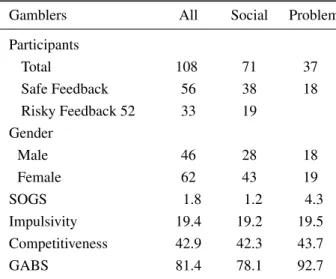
Table 1: Descriptive statistics of the entire sample and by gambler type.
Gamblers All Social Problem Participants
Total 108 71 37
Safe Feedback 56 38 18 Risky Feedback 52 33 19
Gender
Male 46 28 18
Female 62 43 19
SOGS 1.8 1.2 4.3
Impulsivity 19.4 19.2 19.5 Competitiveness 42.9 42.3 43.7
GABS 81.4 78.1 92.7
2.6
Data analysis overview
The data were analyzed using linear regression. The de-pendent variable was the strength of risk preference and was modeled after Zeelenberg et al. (1996) by converting the preference scores for the selected gambles to a scale evenly spaced around zero. For this purpose the pref-erence scores were multiplied by 1 for the risky gamble and−1 for the safe gamble and then 1/2 was subtracted to create a scale that is evenly spaced around zero. The risk preference variable thus ranged from−11.5 (strong risk aversion) to 11.5 (extreme risk seeking). The inde-pendent variables included the strength of gambling pref-erence as measured by the SOGS score and feedback con-dition (safe vs. risky feedback). The interaction between strength of gambling preference and feedback condition was included in the regression equation along with addi-tional control variables such as competitiveness, impul-sivity, gender, and the level of gambling biases and dis-tortions concerning gambling (as measured by GABS). Lastly, a lag variable was introduced to estimate the ef-fect of the risk preference indicated on the previous trial.
3
Results
Descriptive statistics of the sample are displayed in Table 1. Out of a total sample of 108 participants, 66% were classified as social gamblers (1≤SOGS≤2) and 34% as problem gamblers (SOGS≥3). To test for differences in the anticipation of regret, I examined the choices made by social and problem gamblers in each of the two feed-back conditions. To avoid regret, participants were ex-pected to choose the safe gamble in the safe feedback
Table 2: Results of the multiple regression analysis for variables predicting risk preference.
Predictor All gambles
Low variance
High variance Constant −1.35* −1.89* −0.74 Gambling preference 0.56* 0.43* 0.91* Feedback condition 2.07*** 2.21*** 1.72*** Interaction −0.82* −0.45* −0.23 Gender 0.61* 1.04* 0.13 Impulsivity 0.18*** 0.19** 0.16*** Competitiveness −0.03 −0.05 −0.02 GABS −0.01 −0.02 0.01 Lagged risk
preference 0.01 0.04 −0.05 *p<0.05 **p<0.01 ***p<0.001
condition and the risky gamble in the risky feedback con-dition. In the risky feedback condition, the risky gamble was the preferred option by both types of gamblers with about two thirds of all gambles. Although this share was higher for problem gamblers as compared to social gam-blers (66.3 vs. 64.7), the difference was not statistically significant. In the safe feedback condition, the safe gam-ble was chosen more often than the risky gamgam-ble for both categories of gamblers. Again, the share of risky gambles selected by problem gamblers was higher than for social gamblers (47.2 vs. 41.6), however this time the differ-ence was statistically significant (p<.05). Furthermore, in the safe feedback condition the difference between the shares of safe and risky gambles for social gamblers was significantly larger (p<.001) than for problem gamblers, indicating that problem gamblers are less sensitive to the effects of anticipated regret.
The results of the regression analysis examining the ef-fect of gambling preference on risk attitudes are shown in the first column of Table 2. The constant represented the average risk preference in the safe feedback condition and was statistically significant. The negative sign of the coefficient indicated that participants exhibited risk aver-sion in the safe feedback condition. The feedback vari-able which had also a significant coefficient denoted the difference in the levels of risk preference between the two feedback conditions. The sum of the feedback coefficient and the constant indicated the presence of risk seeking in the risky feedback condition.
one led to an increase in risk seeking by 0.56. The inter-action between gambling preference and feedback con-dition represented the adcon-ditional marginal effect in the risky feedback condition. Accordingly, a one point in-crease in the SOGS score resulted in a 0.26 (0.56–0.82) points decrease in risk seeking (or alternatively increase in risk aversion). Higher SOGS scores were correlated with risk seeking in the safe feedback and risk aversion in the risky feedback. This is the opposite of what should be expected if regret minimization was a primary concern. These findings suggest that individuals with a stronger gambling preference are less susceptible to the effects of anticipated regret. Among the control variables, only gender and impulsivity showed a significant and positive effect suggesting that higher levels of impulsivity and be-ing male contribute to more risk seekbe-ing.
The estimation was also performed separately for gam-ble pairs with a relatively low (.3 vs. .7) and a relatively high (.1 vs. .9) variation in outcome probabilities to test whether an increase in the riskiness of gambles affected regret minimization. The estimates are shown in the sec-ond and third column of Table 2, respectively. In the low-variance model the statistical significance and the signs of the coefficients were largely identical to the estimates of the model that included all gambles. The only excep-tion was that the magnitude of the decrease in risk pref-erence in the risky feedback condition was much smaller as compared to the overall model. In the high-variance model participants did not exhibit a significant risk aver-sion in the safe feedback condition. Moreover, the effect of gambling preference on risk attitudes did not differ sig-nificantly across the two feedback conditions, suggesting that higher SOGS scores were associated with increases in risk seeking regardless of the possibility to experience regret.
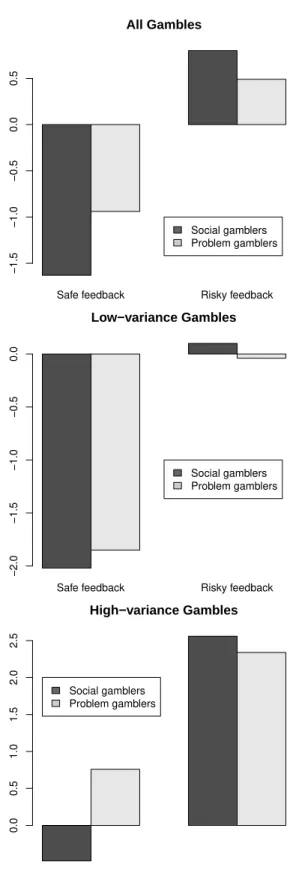
Figure 1 illustrates the average risk preference levels for each of the four experimental groups. In the model including all gambles, risk preferences for the two groups of gamblers had the same direction within each feedback condition: risk aversion in the safe feedback condition and risk seeking in the risky feedback condition. How-ever, the gap between the mean levels of risk aversion exhibited by social (M=−1.63) and problem gamblers (M=−0.94) in the safe feedback condition was statisti-cally significant. Similarly, the magnitude of risk seeking in the risky feedback condition differed significantly be-tween social (M=0.80) and problem (M=0.49) gamblers. In the high and low variance models, social gam-blers continued with their pattern of risk aversion in the safe feedback and risk seeking in the risky feedback condition, however the magnitude of risk aversion was much stronger in the low variance model (M=−2.02 vs.
M=−0.48) and the risk seeking was much more intense
Safe feedback Risky feedback All Gambles
−1.5
−1.0
−0.5
0.0
0.5
Social gamblers Problem gamblers
Safe feedback Risky feedback Low−variance Gambles
−2.0
−1.5
−1.0
−0.5
0.0
Social gamblers Problem gamblers
Safe feedback Risky feedback High−variance Gambles
0.0
0.5
1.0
1.5
2.0
2.5
Social gamblers Problem gamblers
when there was a large variation in outcome probabilities (M=2.56 vs. M=0.10). By comparison, problem gam-blers exhibited risk aversion in the low variance model and risk seeking in the high variance model regardless of the feedback condition.
4
Discussion
Previous research has suggested that anticipated regret is important in decision making. This study investigated the role of anticipated regret in problem gambling, arguing that it might be a contributing factor to excess gambling and risk taking. It found a negative correlation between the strength of gambling preferences and regret anticipa-tion. Weaker gambling preference was associated with the choice of the safe gamble in the safe feedback con-dition and the risky gamble in risky feedback concon-dition, suggesting that those with less gambling problems antic-ipated regret as they selected the regret-minimizing alter-native. Such behavior is consistent with the findings of Zeelenberg et al. (1996) and Ritov (1996).
In contrast, stronger gambling preference led to risky gambles being chosen more often regardless of the feed-back condition. Furthermore, despite the higher share of safe gambles in the safe feedback condition, the differ-ence between the two types of gambles was not statis-tically significant for those exhibiting stronger gambling preference. These findings suggest that complete feed-back and the resulting threat of experiencing regret did not lead to the adoption of a regret-minimizing strategy across the two experimental conditions for individuals with more gambling problems, and did not deter them from seeking out the risky gamble more often than indi-viduals with a weaker gambling preference.
Given that stronger gambling preference was associ-ated with less responsiveness to possible regret, it seems that weak anticipation of negative emotions might fuel excessive gambling. Although future research needs to shed more light on this issue, it is possible that the expec-tation of experiencing a negative emotion such as regret over losing the next round of betting can serve as a nat-ural inhibitor to prolonged gambling. Hills et al. (2001) showed for instance that current negative mood did in fact result in shorter gambling sessions for non-pathological gamblers. In contrast, the failure to take into account the possibility of dealing with an unpleasant emotion after the outcome of the bet has been revealed could amplify the lack of self control and result in excessive gambling.
The second hypothesis of this study, which addressed the link between the strength of gambling preference and risk taking was also supported by the findings. Higher levels of gambling preference were associated with risk
seeking in the safe feedback condition and risk aversion in the risky feedback condition. This indicates that the failure to identify the regret-minimizing option has an adverse effect on risk taking behavior. Moreover, when the difference in probabilities of gambling outcomes in-creased, magnifying the chances of experiencing losses and thus feeling regret, stronger gambling preference tended to result in risk seeking regardless of the feedback condition.
One of the limitations of the study is that it used students rather than community gamblers which weak-ens the applicability of the results to the population of pathological gamblers. A second limitation was that the study was not able to determine whether problem blers were less able to anticipate regret than social gam-blers or whether they simply experienced less regret. Al-though previous studies have shown that it is the inac-curate anticipation of regret (Tochkov, 2009), more re-search is needed to examine this issue in more detail. Despite these limitations, the findings of the study could have important implications for the clinical practice as it is likely that weaker anticipation of regret affects gam-bling behavior in combination with other cognitive dis-tortions. Cognitive treatments for pathological gamblers have focused on challenging the irrational beliefs and faulty cognitions involved in gambling fallacies and pro-viding educational advice on the nature of randomness and probabilities (Ferland et al., 2002; Ladouceur et al. 2001, 2003). A better anticipation of negative emotions could be promoted in a similar framework by identifying, challenging, and correcting faulty perceptions about neg-ative emotions associated with the outcomes of gambles. In particular, the salience of regret needs to be increased whereby the therapist would for instance depict the pos-sible consequences of excessive gambling by describing the financial and social issues involved. The goal of this technique would be to teach patients to focus on a more realistic assessment of the consequences of their behav-ior and the concomitant negative feelings including regret before making the decision to continue gambling.
References
Baboushkin, H., Hardoon, K., Derevensky, J., & Gupta, R. (2001). Underlying cognitions in gambling behav-ior amongst university students.Journal of Applied So-cial Psychology, 31, 1–23.
Breen, R. & Zuckerman, M. (1999). Chasing in gambling behavior: personality and cognitive determinants. Per-sonality and Individual Differences, 27, 1097–111. Delfabbro, P. H., & Winefield, A. H. (2000). Predictors
of irrational thinking in regular slot machine gamblers.
Journal of Psychology, 134, 117–28.
Eysenck, S., Pearson, P., Easting, G., & Allsopp, J. (1985). Age norms for impulsiveness, venturesome-ness and empathy in adults.Personality and Individual Differences, 6, 613–619.
Ferland, F., Francine, Ladouceur, R. & Vitaro, F. (2002). Prevention of problem gambling: Modifying miscon-ceptions and increasing knowledge. Journal of Gam-bling Studies, 18, 19–30.
Fernandez-Duque, D. & Landers, J. (2008). “Feeling more regret than I would have imagined”: Self-report and behavioral evidence.Judgment and Decision Mak-ing, 3, 449–456.
Floyd, K., Whelan, J. P., & Meyers, A. W. (2006). Use of warning messages to modify gambling beliefs and behavior in a laboratory investigation. Psychology of Addictive Behaviors, 20, 69–74.
Gaboury, A. & Ladouceur, R. (1989). Erroneous percep-tions and gambling. Journal of Social Behavior and Personality, 4, 411–20.
Goodie, A. S. (2005). The role of perceived control and overconfidence in pathological gambling. Journal of Gambling Studies, 21, 481–502.
Hills, A. M., Hill, S., Mamone, N., & Dickerson, M. (2001). Induced mood and persistence at gaming. Ad-diction, 96, 1629–1628.
Houston, J. M., Harris, P., McIntire, S., & Francis, D. (2002). Revising the Competitiveness Index using fac-tor analysis,Psychological Report, 90, 31–34. Josephs, R. A., Larrick, R. P., Steele, C. M. & Nisbett, R.
E. (1992) Protecting the self from the negative conse-quences of risky decisions.Journal of Personality and Social Psychology, 62, 26–37.
Joukhador, J., Maccallum, F., & Blaszczynski, A. (2003). Differences in cognitive distortions between problem and social gamblers.Psychological Reports, 92, 1203– 14.
Ladouceur, R. (2004). Perceptions among pathological and nonpathological gamblers. Addictive Behaviors, 29, 555–565.
Ladouceur, R., Sylvain, C., Boutin, C., Lachance, S., Doucet, C., & Leblond, J. (2001). Cognitive treatment
of pathological gambling.Journal of Nervous & Men-tal Disease, 189, 773–80.
Ladouceur R, Sylvain C, Boutin C, & Doucet C. (2002).
Understanding and treating pathological gamblers.
London: Wiley.
Ladouceur, R., Sylvain, C., Boutin S., Lachance, C., Doucet, C., & Leblond, J. (2003). Group therapy for pathological gamblers: a cognitive approach.Behavior Research and Therapy, 41, 587–96.
Lesieur, H. R., & Blume, S. B. (1987). The South Oaks Gambling Screen (SOGS): A new instrument for the identification of pathological gamblers. American Journal of Psychiatry, 144, 1184–1188.
Mellers, B. Ritov, I., & Schwartz, A. (1999). Emotion-based choice. Journal of Experimental Psychology: General, 128, 332–345.
Murgraff, V., McDermott, M. R., White, D., & Phillips, K. (1999). Regret is what you get? The effects of manipulating anticipated affect and time perspective on riskier single-occasion drinking. Alcohol & Alco-holism, 34, 590–600.
Parke, A., Griffiths, M., & Irwing, P. (2004). Personal-ity traits in pathological gambling: Sensation-seeking, deferment of gratification and competitiveness as risk factors.Addiction Research and Theory, 12, 201–212. Parker, P., Manstead, A. S. R., & Stradling, S. G. (1995) Extending the theory of planned behaviour: the role of personal norm. British Journal of Social Psychology, 34, 127–137.
Rae, D. & Haw, J. (2005). The effect of depression and perceived skill on anticipated emotions and persistence in off-course betting.International Gambling Studies, 5, 199–208.
Richard, R., van der Pligt, J. and de Varies, N. (1996) An-ticipated regret and time perspective: changing sexual risk taking behavior.Journal of Behavioural Decision Making, 9, 185–199.
Ritov, I. (1996). Probability of regret: Anticipation of uncertainty resolution in choice. Organizational Be-havior and Human Decision Processes, 66, 228–236. Sharpe, L. (2002). A reformulated cognitive-behavioral
model of problem gambling: A biopsychosocial per-spective.Clinical Psychology Review, 22, 1–25. Sheeran, P, & Orbell, S. (1999). Augmenting the theory
of planned behavior: Roles for anticipated regret and descriptive norms.Journal of Applied Social Psychol-ogy. 29, 2107–2142.
Sundali, J., & Croson, R. (2006). Biases in casino bet-ting: The hot hand and the gambler’s fallacy.Judgment and Decision Making, 1, 1-12.
Toneatto, T. (1999). Cognitive psychopathology of prob-lem gambling. Substance Use and Misuse, 34, 1593– 604.
Toneatto, T., Blitz-Miller, T., Calderwook, K., Drag-onetti, R., Tsanos, A. (1997) Cognitive distortions in heavy gambling. Journal of Gambling Studies, 13, 253–66.
Van Empelen, P., Kok, G. J., Jansen, M. W. J. & Hoebe C. J. P. A. (2001). The additional value of anticipated re-gret and psychopathology in explaining intended con-dom use among drug users.AIDS Care, 13, 309–318. Williams, R. J. & Connolly, D. (2006). Does learning
about the mathematics of gambling change gambling behavior?Psychology of Addictive Behaviors, 20, 62– 68.
Wolfson, S. & Briggs, P. (2002). Locked Into gambling: Anticipatory regret as a motivator for playing the na-tional lottery.Journal of Gambling Studies, 18, 1–17.
Zeelenberg, M., Beattie, J., van der Pligt, J., & de Vries, N. K. (1996). Consequences of regret aversion: Effects of expected feedback on risky decision making. Orga-nizational Behavior and Human Decision Processes, 65, 148–158.
Zeelenberg, M. & Pieters, R. (2004). Consequences of regret aversion: The case of the Dutch postcode lot-tery. Organizational Behavior and Human Decision Processes, 93, 155–168.