EPGE
FUNDAÇÃO
GETULIO VARGAS
Escola de Pós-Graduação em Economia
Seminário de almoço:
Payoff Interdependence and
Information Externalities
Kaj Martensen
(Stockholm School of Economics)
sa
feira, dia 14 de janeiro às 12 horas, sala 3, 10° andar
"Free lunch"
para alunos e professores: sanduíches, refrigerantes e
..
Payoff Interdependence and Information
Externalities
Preliminary and incomplete
Kaj Martensen
Stockholm School of Economics
January
12, 2000
Abstract
This paper studies entry under information and payoff externalities. We consider a sequential investment game with uncertain payoffs where each
firm is endowed with a private signal about profitability. It is shown
that both over- and under-investment characterize the equilibria and that under-investment only occurs when investments are complements. Further we find that a reverse informational externality is present.
1
1
Introd uction
1 We are used to think about payoff externalities in entry and resulting sub-optimal investment. When for exarople an industrialist invests in a paper mill she considers the market structure but not the negative impact her investment might have on the investors already on the market. As it is commonly known, the private and the social returns from investment might be different when an externality is present. li all investors in our exarople have some private infor-mation about the profitability in the paper industry, our industrialist will try to infer the private information of the other firros by looking at the one thing visible: their entry decisions. li some other investor's decision does not convey
its information, for example if the investor invests regardless of his private in-formation, our investor will not learn anything from this firm's decision. In this case we say that there is an "information externality".2
As market-situations where the interaction has a strategic element and it is rational to draw inferences from others' decisions are generic, it is interesting to study entry where firros' choices not only affect the payoffs to other firros but also their information. This paper examines equilibrium and efficiency aspects of how information is socially utilized such a strategic environment. When combined, are the effects of information externalities and payoff interdependence separate? How is investment affected and is the leveI of investment socially optimal? In terros of our example: Will there be an excess of paper mills even if the outlook in the paper industry is good?
To answer these questions, the basic informational externality model (ex-plained below) is extended to allow for payoff interdependence. Moreover, to maintain generality we parametrize the payoff interdependence, which enables us to study investments when they are either substitutes or complements. The model is as straightforward as our exarople. Two firms, both endowed with private payoff relevant information consider an investment opportunity with uncertain outcome. One firm invests before the other, which makes the first investment potentially valuable as a signal to the subsequent investing firmo Potentially, since in equilibrium information may or may not be conveyed by investment. Further, we extend this basic informational setting by making the ex post payoff depend on the number of investing firros.3 Complementarity in investment means for exarople that a firm that invests when investment has already been made, increases the payoff for the other firmo
Our main result is that there is both over- and under-investment in our in-vestment garoe, and that under-inin-vestment only occurs when there are positive payoff externalities (investments are complements). We find that the informa-tion externality comes into play only when investments are complements whereas
II would like to thank Tore Ellingsen, Karl W ãrneryd, Jõrgen W. Weibull and seminar participants at The Research Institute for Industrial Economics and Stockholm School of Economics for helpful comments. Further, I am grateful to the Wallandcr and Hedelius foun-dation for financiai support.
2See Bikhchandani et aI. (1992). For overview of how information externalities can give rise to for example herd behavior and other phenomena, see the survey by Bikhchandani et aI. (1998).
the payoff externality only has effect when investments are substitutes.
The investment decisions of the firms are further shown to have a reverse information externality that comes from the beneficial effect of B making its
decision contingent on information.
There are five propositions established in the paper. The first characterizes the equilibria. The inefliciencies that follows are given in Proposition 2. In the third proposition we show that there is a reverse information externality present for weak investment substitutes. Proposition 4 shows from where the inefliciencies stems. Finally, Proposition 5 gives a result on the feasibility of intervention for an informationally constrained social planner.
Three papers (that combine information and payoff externalities) are directly related. Choi (1997) and Zhang (1997) consider effects from complementary in-vestments on the choice between two network goods. Both assume that the payoff uncertainty is resolved when an investment is made.4 Thus they limit themselves to study complementary investments under decreasing returns to in-formation. Alexander et alo (1999) has a similar setup but studies the choice of one network good.5 Hence, although these models are more general in the
num-ber of players and allow for endogenous timing of entry, they have limitations in the generality of the payoff interdependence. While our exogenous timing may seem artificial, we can show that every equilibrium we derive is also an equilibrium in the simultaneous move game under some additional assumptions when a suflicient cost of waiting is introduced. A further motivation for the model is that it captures what happens if the second entrant only discovers the market after entry has taken place.
This paper is also related to Farrell and Saloner (1985) who show how
COOf-dination failures can occur when firms can choose to invest in a network good. When firms' preferences for adoption are unknown there will be "excess iner-tia" which happens if firms wait too long (from a first best perspective) before investing in the network good. In a similar vein we show that when invest-ments are compleinvest-ments (i.e. network goods) a small cost of waiting increases the probability of under-investment.
The model is set up in section 2 and we limit ourselves to two risk neutral and rational firms, A and B. Two firms are suflicient to show whether there is an information externality. Firm A receives a private signal about the value of a risky investment opportunity and chooses whether to make the risky in-vestment or invest in a risk-free asset, knowing that firm B's choice will affect its own payoff. Firm B observes firm A's choice, receives a private signal, and decides where to invest. To simplify, the timing and order of entry is assumed to be exogenous. When investments are substitutes, firm B must take into ac-count that firm A has an incentive to avoid investing in the risky asset although it would be profitable for one investor to invest. Of course, when making its decision, firm A knows that firm B takes this into consideration, etc. Le. with payoff interdependence a firm has to take into account the informational
con-4 In Choi's model ali information about a particular good is revealed when someone buys
it. In Zhang's model there are two sources of uncertainty; costs and inherent quality, where onlv costs are revealed when someone invests.
..
sequences of its actions to firms investing after them. This contrasts with the informational cascades and "reputational cascades" models where the firms only look at the actions' of previous decision-makers.6
The first best investments where the firms share information and profits are derived in section 3. The equilibria are characterized in section 4 where we show that there is incomplete information aggregation with positive probability independently of whether investments are substitutes or complements and in-formativeness of the signals. By comparing with the first best solution we find that the firms' strategies are indeed socially detrimental for some equilibria. In sub section 4.1 we allow for endogenous timing of entry. By removing the pay-off externality and the information externality respectively, we investigate the sources of the inefficiencies in section 5.
The paper by Bolton and Farrell (1990) compares the benefit of a centralized solution to a decentralized solution in a situation where firms with privately known costs consider entering into a natural monopoly. They show there is scope even for an uninformed social planner to improve welfare if firms "wait too long" before investing. In section 5 we further analyze the equilibrium outcomes of our model in this spirit by contrasting to what happens if only one firm is allowed to invest in order to internalize the payoff externalities (an option for an informationally constrained social planner). Here it is shown that the over- and under-investment problems remains for some parameters. Again, under-investment occurs only when investments are complements. The firms' incentives ex ante given the equilibria outcomes are discussed in section 6 and we conclude in section 7.
2
The Model
Two firms, A and B, each with one unit to invest, both consider an investment opportunity. The payoff is uncertain and there may be positive or negative externalities from multiple participation. There are two states of the world,
H and L, and the two firms share the common prior belief that both states are equally likely so that Pr(H)
=
Pr(L)=
0.5. There are two parameters of the mode!. The payoff externality is captured by the parameter t which relates the ex post payoff of one single investing firm to the profit it would obtain if two firms invested. Further, each firm receive a private signal a about the truestate of the world where a E E = {aH,ad.7 The firms' signals are drawn independently from the conditional Bernoulli distribution
Pr(aHIH) Pr(aLIH)
Pr(aLIL) =p,
Pr(aHIL) = 1-p.
where p
>
0.5. The informativeness of the signals are thus given by theparam-eter p and the signals are informative and of equal precision.8
6 In a reputational cascades model agents' actions are driven by their desire to signal that theyare "smart". See Scharfstein and Stein (1990).
7With a slight abuse of notation we let u denote both the stochastic variable and its
realizations. Which applies will be clear from the contexto
8If p < 1/2 this would only mean that the firms reversed the meaning they attach to their
The tinúng is as follows: At date
°
nature chooses the state of nature x E{H, L}.
At date 1 firm A receives a private signal aA about the state of natureand chooses whether to invest or to stay out (the outside option is assumed to have zero value to the firms). At date 2 firm B receives the signal aB, observes
A's choice and contingent on this information decides whether to invest. Finally, at date 3 the profits are realized.
The firms are assumed to invest if the expected profit of investing is strictly positive. Note that the action space is "fine enough" to be a suflicient statistics for the signal so that herd behavior is not introduced into the mode1 via the informational cascades mechanism.9
Firm A's (pure) strategy sA : セ@ -+ {O, I} is a mapping from its signal to an
investment decision where 1 is taken to mean investment. Simi1ar1y, firm B's (pure) strategy is a mapping SB : セ@ x {O, I} -+ {O, I} from its signal and from
its observation y E {O, I} of A's decision. To facilitate reading, a strategy where
e.g. firm A always invests will be written sA = "Always invest".
The ex post payoff n(x, n) to a firm depends on the state x and the number n of investing firms. The high state is profitab1e and the 10w state gives a 10ss
to the investing firmo Thus
n(L, n)
<
°
<
n(H, n) for n = 1,2.We assume that when an investment is "bad" (the 10w state is realized), then it is bad independently of the number of firms investing, i.e.
n(L)
=
n(L, 2)=
n(L, 1).Further we assume that the private signa1 is valuab1e. That is, a sing1e investing firm without a signal gets the same ex post profit as from the outside option given that the states are a priori equally likely
n(L) = -n(H, 1).
To formalize the payoff interdependence we 1et
t
>
1(t
<
1) signify that invest-ments are comp1einvest-ments (substitutes)n(H, 2)
= tn(H, 1).
Hence, when
t
= 1 there is no payoff interdependence between the firms'invest-ment decisiollS. Finally we normalize n( H, 1) = 1.10
We 1et nA (sA, sB; aA ) be firm A's is the expected value of n( x, n) given its
signa1 and the strategy profile. Simi1arly firm B's payoff is n B (sA, sB; a B , y)
where it also takes into account its signa1 (observation) y.
3
First Best
Assume that the signals are made public in period one. If the firms cooperated by sharing profits the firms would always invest given signals (a H, a H) . Two
9The indivisibility introduced by only letting the finns either nat invest ar invest a fixed amaunt can hawever be a saurce af herd behaviar as shawn by Lee (1993). Further, with this setup, firm A can nat strategically invest in such a manner that its signal is anly partially revealed which might be in its illtercst when investments are substitutes.
units would be invested if
Thus the firms invests two units if
and one unit otherwise. Given mixed signals (a H, a L) the firms would invest
two units given
t
>
1 and zero otherwise. Similarly, if (a L, a L) is obtained the firms invests two units ift
>
p2/ (1 - p)2 and else zero. The figure belowgives the number of units invested in the first best solution for p E (0.5,1] and
tE
[0,4].
4 3
t :l
Always 2 units
2 units if high Of mixe d signals 2 units if high signals 1 unit if high signals
005 0.6 0.7 p 0.8 09
Figure 1. First best investment.
From a first best perspective it is thus optimal to invest two units even for (weak) investment substitutes. The gain from an additional investment out-weighs the substitution effect. For sufficiently strong complementaries relative to the informativeness of the signals it is optimal to invest regardless of signals.
4
The Equilibria
Formally we define the game G as the triplet G = (N, S, 7r) where N = {I, 2},
S
=
SA X SB and7r
=
(7r
A (sA,sB;a A),7r
B(sA,sB;a B ,y)). We vary theparameters p and t and examine the existence of Perfect Bayesian Equilibria of G.
Proposition 1 The Perfect Bayesian Equilibria of G are the strategy projiles
(a): ("Always invest", "Invest ify=l ora B =aH")
(b): ("Invest ifaA
= aH", "FollowA 's decision")
(c): ("Invest ifa A
= aH", "Invest ify=l and aB=aH")
(d): ("Invest ifaA = aH", "Never invest")
fort
>
セ@for 1
<
t::; セ@{1_p)2
for セ@
<
t::; 1{1_p)2
Proof. See appendix. •
Each region in figure 2 thus corresponds to a unique Perfect Bayesian Equi-librium of G.
3
a
b
t
2
c
p 0.8 0.9
Figure 2. The equilibria.
If the world is characterized by for exampIe t = 2 and p = 0.9, A invests if it gets a high signaI and B follows A's decision regardless of its signal (equilibrium (b)). For high complementaries reIative to the informativeness of the signal (region (a)), the furos invest regardless of signals. When the signals are more informative (region (b)), fum A takes his signal into account whiIe fum B does noto If investments are substitutes, fum A always uses its signal whiIe fum B only use its signaI when investments are not too strong substitutes. Note that there is no equilibrium where B invests when A did not since the only equilibrium where A's strategy does not convey his signal is under strong complementaries to investments. In region (c) fum B invests if it receives a high signal and, somewhat surprisingIy in a region where investments are substitutes, only if fum A has invested.
For clarity Iet us define the meaning normally adhered to an "information externality" .
Definition 1 lf an agent i 's strategy is such that an action does not reveal payoff relevant information to a subsequent decision maker j, we say that i 's strategy has an informational externality on j.
Remember that since both the signals and the actions are binary there are no information externalities present when payoff are independent
(t
= 1), the investment decisions are a sufficient statistics for the agents' signals.In equilibrium (a), A's action does not reveaI its signaI so A's strategy has an informational externality on B. Note, that when investments are strong com pIe-ments, B actually prefers A's strategy to aIways invest to one where A's action conveys its signal. Then the positive payoff externality outweighs the negative informational externali ty.
,
if firm A receives a low signal, B's decision will not convey information. More generally we have the following corollary to Proposition L
Corollary 1 There is non-revelation of information with positive probability.
In particular, it is sufficient that aA = a L to have non revelation of B's signal regardless of equilibria.11
By comparing with the first best we can see that the equilibria of G are indeed ineflicient.
Proposition 2 Under-investment occurs under weak complementaries in
in-vestment and over-inin-vestment when inin-vestments are stronger complements or substitutes.
Comparing the equilibria with the first best solution shows that the firms under-invest in region (b) and over-invest in sub-regions (aa) and (cc) ofregions (a) and (c), where (aa) is characterized by
tE
and (cc) by
tE
The regions are depicted for t E [0,4] and p E (0.5,1] in figure 3 below.12
4
Iover inv.
/aa
3
a
Under investmentt J
cc Over investment
00.5 0.6 0.1 p 0.8 09
Figure 3. First best as benchmark.
II The first best solution does not aggregate more information. In for example the
equi-librium of region (b), we can partition the world in the states {(a H, a d ,(a H, a H)} or
{( a L, a L) , (a L, a H)} depending on whethcr investment has taken place. The first best gives the partitions {(aH,ad,(aH,aH),(aL,aH)} and {(aL,aL)}· To study the value of in-formation aggregation in our model we necd some third part which also has access to the investment opportunity. Of course, to a hypothetical third firm, the first best partition is better.
t
An "investment boom" could thus occur even when the outlook is bad: In-vestors, each facing negative news about the economy (in terms of our model - two low signals) wiU fail to aggregate information in sub region (aa).13 We would like to think that this inefficiency could be overcome since if the firms shared their information they would not invest. What if firm A could commu-nicate its signal to firm B? This depends on the timing. Given the assumption that B's signal is received after A has sllflk its investment, firm A has no incen-tive to reveal that it received a low signal. Thus any statement from A would not be credible.14 There can also be over-investment when the outlook is good
(sub region (cc)).
It is also possible for investors to forego a profitable investment. There is under investment in equilibrium (b) given that the first investor receives a low signal.
4.1
Endogenous Timing
Here we check whether the firms would behave differently if the firms can choose freely whether to invest in period one or two. Thus, in period O the state of nature is realized and the firms receive their private signals. In period one the firms can choose to invest or stay out. If a firm has not invested in the first period it has a second investment opportunity in the second period. First the case with out any costs of delay (discounting) is considered. Then we look at the case with a cost of delaying action. Since profits are realized in period 3, a more realistic assumption would be a profit of delaying as opposed to a cost. A cost of delaying action is here an artificial construct to study the value of information.
4.1.1 No delay costs
In region (a) excluding sub-region (aa), both firms wiU invest regardless of signal which is efficient In the sub-region (aa), the firms would prefer knowing the signals to be able to avoid investment under the unprofitable signals
(at,
af).
A high signal would induce a firm to invest in the first period since it knows that it wiU be followed in the second period. Hence this inefficiency is resolved by the ability for a firm with a low signal to wait without cost.
In region (b) a firm with a low signal would not invest in the first period since it would be the sole investor given that the other firm also receives a low signal. Similar with region (aa), a high signal would induce a firm to invest in the first period since it knows that it wiU be followed in the second period. Hence the inefficiency coming from not investing under
(at, aZ)
is resolved.In region (c) a high firm is indifferent to entry by another firm given that it does not know the other firm's signal. Thus, the inefficiency of sub-region (cc) remains.
\Vhen firms receive (a H, a H) they both want to compete for being first in region (d) and consequently a new inefficiency is created.
13It is indeed the case that the over-investment in (aa) is due to information externalities (and not payoff externalities). See Propositioll 4.
14In Choi (1997) the uncertainty is resolved when one investment as been made. In our
Thus endogenizing the timing of entry removes the inefficiencies when invest-ment are compleinvest-ments but creates an inefficiency when investinvest-ments are strong substitutes. The result that the entry time of a firm is a function of the firm's type (here signal) and that this leads to efficiency, is found also in Gul and Lundholm (1995) and Zhang (1997).
4.1.2 With delay costs
Introducing a cost of delay makes the firms face a trade off between the cost of delay and the benefit of waiting for the other firm to convey its signal by investing. First consider the case ofinvestments complements and let
b
= 8 (p,t)
be the cost of delay that makes a low signal firm just indifferent between ・ョエ・イゥョセ@
in period 2 and staying out given that a firm invested in the first period. li 8
2':
8 it is now less profitable for a high signal firm to enter in the first period since it does not know whether it will be followed or noto A low firm enters in the first period ifwhich is equivalent to
t> _p_.
1-p
Now, assume that
t
::;
pl
(1 -p)
so that a low signal firm will not enter in any period. A high firm enters if15which gives the condition
Since (1 - p)2
I
p2<
1, the high signal firm's behavior will not be changed:The high firm(s) will enter in period 1 and the low firm(s) stays out. Thus, in region (b) a 8
2':
b
will cause the any high signal firm to invest in the first period and any low signal firm to abstain. Given that the same delay cost is introduced in G, this is how the firms behave in G for region (b).Now, assume that we are in region (a)
(t
>
pl
(1 -p))
so that a low signal firm enters in the first period. Since a high signal gives a higher expected profit a firm with a high signal enters as well. Thus, in region (a) the firms will behave as in the equilibrium of G in that both firms enter always.li investments are substitutes, each firm would like to be the only firm to invest. A low signal firm will not enter since profits will be negative in every case. A high signal firm enters in period 1 if
As before this implies that in region (c), any firm will enter in the first period. In region (d), there is only room for one high signal firm and two high signal
..
firms both want to compete for being first in region (d). The same inefficiency as in the case of no deIay costs thus arises.
In regions (a) and (c) the introduction of a sufficient cost of deIay thus creates similar behavior as in the equilibria of G. Given an asymmetric equilibrium in pure strategies in (d) the entry will also be as in G. In (b), entry will be Iower than in G but given the same cost of deIay, the equilibrium in G would have the same feature.
5
Externalities and Welfare
5.1 Externalities
To isolate the effects of the payoff and information externality respectiveIy we consider two alterations of our mode!. In the first, we remove the payoff exter-nality by Ietting profits be shared by the two firms. The second alteration takes the signals as public so that there are no information externalities.
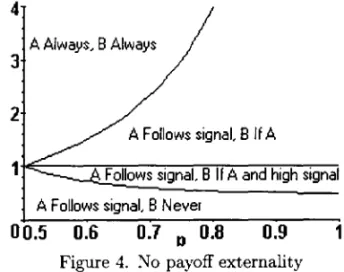
5.1.1 Effects of the payoff externality
In a model without payoff externalities (a pure informational externaIity model) the following equilibria obtains.
4
A Always, B Always
3
2
A Follows signaL B If A
QセMMMMセセMMセセセセセセセセ@
F ollows signaL B 11 A and high signal
A Follows signal, B NeveI
ッッセ@ oセ@
03
D oセ@0.9
1
Figure 4. No payoff externality
By comparing with the equilibria of G we conclude that the over investment in sub region (cc) stems from payoff externalities.
So far an information externality (see Definition 1) has referred to whether one decision maker's strategy makes Iearning possible for a subsequent decision maker. The equilibrium in region (c) excluding sub region (cc) in figure 4 suggests a different definition: In equilibrium, B uses its information which is beneficiaI to A.16
Definition 2 lf agent i 's payoJJ is aJJected by the way a subsequent agent 's strategy is contingent on information we say that there is a reverse information externality.
•
..
Hence we have a case where the information externality works in the opposite direction of what is found in the literature.
Proposition 3 There is a positive reverse information externality for weak in-vestment substitutes.
5.1.2 Effects of the information externality
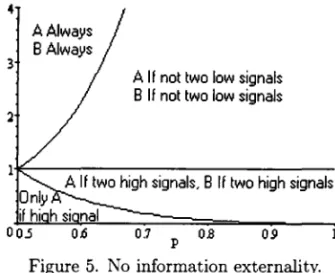
It is straightforward to calculate the equilibria given that the signals are public in period one so that no information externalities are present. The equilibria are given by the figure below.
4
3
AAlways B Always
A If not two low signals B If not two low signals
Figure 5. No information externality.
Comparing with the equilibria of G, the region of investment complements
(t
>
1) is now efficient. Both the over investment in sub region (aa) and the under investment in region (b) is corrected.Proposition 4 Inefficiencies comes from information externalities when in-vestments are complements and from payoff externalities when inin-vestments are substitutes.
5.2 Welfare
The first best outcome was examined in section 3. Here we examine whether a regulating authority (a social planner) that is informationally constrained has incentive to reduce entry by comparing the outcome of the game G with two regimes. One where a single firm can invest one or two units without access to any signal and a second, where a single firm can decide whether to invest one or two units given sequential signals as in
G.
Both cases make the firm internalize the external effect created by the payoff interdependence. Thus, we can obtain further results on where the inefficiencies stems from and on how payoff and information externalities interact.t-1 p(t
+
1) - 1p2
t
_
(1 _ p)21
p-
2'
5.2.1 Benchmark with no signals
Let 7rs
(z)
be the expected social profit of investingz
units wherez
E{O,
1, 2} and7r
S(z)
=
z (Pr(H)7r(H, z)
+
Pr(L)7r(L)).
Hence, the planner will then invest two units when t
>
1 and zero units other-wise. With the indexation of figure 1Wイセ@ 7rb =
t
-
1Wイセ@ 7rd
=
o.
For each region, the profit is not greater than what is obtained in G. Hence an uninformed social planner does not have any incentives to interfere with the market by for example curtailing entry when investments are substitutes. While not a surprising result, it gives a general reason for caution since it is reasonable to assume that there is some kind of learning similar to the one modelled in every investment - entry game.
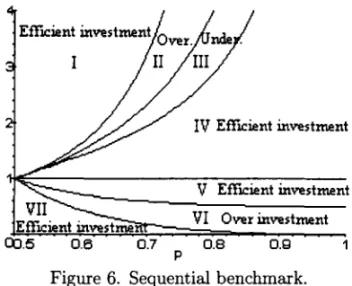
5.2.2 Benchmark where information is revealed sequentially
Consider the investment problem in G faced by only one firmo Here the firm has two investment opportunities and information is revealed sequentially. Each pe-riod the firm has one unit to invest. In pepe-riod one the firm receives the signal aI
and can choose whether to utilize the investment opportunity. Subsequently, in period two, the same firm receives a2 and has a second investment opportunity. Let
Y
={O,
I} andn
= {aL,
aH}'
Optimality requires that the firm in period two for each history h E Y xn
and signal a2 compares the expected profit of investing with the outside opportunity. Given the optimal choice con-ditioned on h and a2 in period two, the firm's expected profit of utilizing thefirst investment opportunity given aI can be compared with the value of the
outside opportunity.17 Again, we obtain the firm's optimal investment choices as a function of the parameters p and t (see appendix for calculations).
Taking the one firm case as a benchmark, we can characterize the investments made by the two firms:
17 Note that the social planner is allowed to remember its signal aI to period 2. Thus
this benchmark does not in full isolation study what happens when the payoff externality is
IV EfÍlCi.ent investment
V EfflCi.ent investment
VI Over investment
0.8 0.9 p
Figure 6. Sequential benchmark.
Thus ali the inefficiencies of G remain but for the sub region IV of region
(b).
5.3 Other welfare aspects
If the social planner is able to affect p, for instance by publishing reports about a
technology's inherent traits, it immediately follows from the figure 3 and figure 6 that this should be done carefully.
Proposition 5 Increasing the informativeness of the signals changes welfare non-monotonously when investment are complements or substitutes.
E.g. a move from region (a) to (b) in figure 3 or a move from region I to region n or In in figure 6 accomplished by an increase of p would be socialiy
detrimental. This says that a centralized solution should only be chosen when the social planner is well informed about the parameters. So far we have assumed that the planner has full knowledge about t. Instead, iffor example the planner's belief about t is captured by an uniform distribution with support [O, 2], an increase of p is beneficiaI.
Claim 1 Given ex ante uncertainty about t, it can pay to increase p even at a high cost.
Loosely this works as follows: From an aggregation of information perspec-tive, regions (a) and (d) are the worst. From the figure above we see that given any uncertainty about what t prevails, a higher p makes it more probable that
the equilibrium is in (b) or (c) and that information aggregates better. There is thus a twofold effect of increasing p given uncertainty about t: The direct
increase in informativeness and the increased probability that we end up in a more informative equilibrium.
6 The Firms' Ex Ante Incentives
the game given certainty of the parameters. So far "investing" has meant simply to buy a lottery ticket in a world described by
t
and p. In the real world, there are typically several ways an investment can be made and there is some scope for a firm to increase or decreaset.
A change in p could come for example comefrom any research activity done by one firm that immediately "spills over" . The firms' ex ante equilibrium profits are (see appendix for calculations):
which shows:
-B 1
7r(a)=2(t-1)
-B 1
7r(b)
=
2
(pt - (1 - p))-B 1 (
2
2)
7r(c) =
2
tp - (1 - p)1
2
(p - (1 - p)) and WイセI@ = OClaim 2 For not too strong investment substitutes, a firm's ex ante profit is
independent of whether it enters first or second.
Thus firm B gains nothing by the revelation of A's signal and the negative externality that firm B imposes on firm A by entering in equilibrium (c) affects both firms symmetrically. The intuition is that in the non-revealing equilibrium (a), no firm takes any information into account and they are thus on equal terms. In equilibrium (b), the expected outcome is only depending on firm A's signal which is revealed in equilibrium and the firms again are on equal terms. In (c), the expected profit of the outcome
(H,
a1I,t
)
is zero so that both firms calculate their expected profit based only on the probability of the outcome(H,
a1I,1I
).
Further we have that:
Claim 3 For not too strong investment substitutes, the firms ex ante incentives
are aligned in the sense that if t or p could be changed, both firms would agree on how.
This comes from the equivalent ex ante payoffs which tells us that firms value the equilibria in the same way and has the same marginal valuations of raising either p or t. This implies that if firms can cooperate to change
t
or p they willdo it. Of course, both firms have incentive to free ride on the other firm's effort given any costs of changing
t
or p. In what direction would the firms like to change p and t?Claim 4 Stronger complementarity and/or a more informative signal is better
for the firms given that investments are not too strong substitutes. That is we have 7r(a)
>
7r(b)>
7r(c) independently what parameter is used to attain another equilibrium.6.1
Implications for investment decisions
From the above section we can conclude that if the firms have the possibility to change either the payoff interdependence
t
or the informativeness of the signalsp, they would have incentive to do so and that their incentives are misaligned
in regions (c) and (d). Given exogenous parameters
(Pc, te),
such that the firms would be in equilibrium (c), firm A would have incentive to lower Pc andte
ex ante to deter entry by B. Can A credibly commit itself to lower t when the
investment opportunity arises?
Claim 5 Firm A can credibly commit itself to lower
t
given exogenouspamm-eters
(Pc, te).
Proof. The expected profit at the time of the investment opportunity is
higher in (d) given a high signal. •
This shows that strong substitutes can lead to even stronger substitutes, which is socially detrimental. If the investment opportunity is such that firm A can achieve this by for example ''ruthless exploitation of natural resources" the adverse effects are even greater. Hendricks and Kovenock (1989) study the effects of private information and information externalities in oi! exploration where they show that over-investment can not be overcome by bargaining over the information externality but they do not include any payoff interdependence in their mode!. The problem in oil-exploration is that two adjoining lots typ-ically have connected tracts. Thus by buying a lot you diminish the value of the neighboring lots which in our mo deI is the same as lowering
t
to someone considering buying nearby (i.e. someone that has benefit from observing your drilling decision).7
Conclusions
This paper contributes to the literature on entry by showing that information and payoff externalities can not be thought of separately. Proposition 4 clearly shows that these externalities come in asymmetrically. That under-investment only occurs for positive payoff externalities is a novel finding. Further, we show the existence of a reverse information externality that later decision makers impose on decision makers taking an early action.
We have shown that there are "herding equilibria" where the second investor disregards his own signal for some values of the parameters of the mo de!. Thus we can give an alternative explanation to for example the herd behavior of investment managers than the reputational concern that drives the model in Scharfstein and Stein (1990).
In the spirit of Bolton and Farrell's (1990) analysis of coordination failures in the entry into a natural monopoly (which would correspond to investment substitutes in our model), the outcome of the sequential investment game is compared with the outcome of realistic benchmarks to study the issue of "cen-tralization versus decen"cen-tralization". In the game G with exogenous timing we have the result that a decentralized solution is preferred if the social planner is uniformed. Given that the planner receives the signals sequentially as in
G we find that a centralized solution is preferred for some values of
t
and p..,
by information externalities when investments are complements and by payoff interdependence when investments are substitutes.
Given endogenous timing and a cost of delay, Bolton and Farrell argues that a centralized solution can be more efficient even if the social planner is uninformed since firms can have incentives to delay their investment decisions. We touch briefly on how the firms interaction would be altered by endogenous timing. Given that there is no cost of delay we find that firms behave more efficient when investment are complements. The intuition is that a firm with a high signal invests in the first period since it knows that it will be followed. Thus, when firms' entry time is endogenous we can extend the results of Gul and Lundholm (1995) to apply for positive payoff externalities. Introducing a cost of delay makes the firms face a trade off between the cost of delay and the benefit of waiting for the other firm to convey its signal by investing. For a sufficient cost of delay the firms are of back in the game G.18 Thus, it is justified
to use the equilibria of G for exactly the comparisons Bolton and Farrell do. This paper thus contributes to the ongoing discussion of whether centralization or decentralization is preferred. A further motivation for our model is that it also captures what happens if B gets his signal only if A invests. Thus, the
results apply to questions about "entry in to new markets" which for example has some scope for the current investment boom in the Internet industry.
We can draw further parallels with the literature on network externalities. Farrell and Saloner (1985) shows that "excess inertia" and "excess momentum" can occur in adoption of new standards (new techniques). We give a new mech-anism for inertia when we show that under-investment can occur when invest-ments are compleinvest-ments and that it is the information externality that comes into play. Further, we can also give an alternate explanation of excess momentum since over-investment can also occur when investments are complements.
A natural extension would be to allow for the firms to receive signals of dif-fering quality for example coming from a partial revelation of the state between investment opportunities. Then it might be in the interest of a second mover that is uncertain about the quality of his signal ex ante to commit himself to use his information in equilibrium. In the model studied this would only happen in ( c). In this case, the second mover would ex ante prefer that investments have more of a substitution character given a not too high exogenous complementar-ity. If the partial revelation of states took place only if A invested, there would be less aggregation of information.19
Further, more work has to be done on the robustness of the results to the specification of action space and payoffs. As long as there are indivisibilities in the model they contribute to inefficiencies (see Lee 1993). Another important extension would be to model the "returns to information" as a parameter.20 A new leveI of generality would be attained if we could mo deI both the payoff interdependence and the returns to information.
18The firms behave similar to the equilibria of G. See secion 4.1.2.
19Zeira 1987, studies an investment process that is accompanied by resolution of"structural uncertainty" .
..
8
Appendix
8.1 Calculations of equilibria
To find the equilibria of G we first look at firm B's best response to its signal and observation of A's decision for different beliefs about A's strategy. Specifically, the case where A invest only if it gets a high signal and the case where A always invests regardless of signal are considered. Then, given B's best response for different beliefs, firm A's best response to its signal and B's beliefs is derived.
8.1.1 B's best response
Case: Firm A invests only if it obtains a high signal
Sub-case: y
=
1, aB= aH:
Firm B invests ifPr (HlaH, aH) t - Pr (LlaH, aH)
>
O,i.e. firm B invests if
Sub-case: y = 1, uB = u L: By similar computation, B invests if
t>
1.For the remaining cases where y
=
°
firm B will not invest.Case: Firm A invests regardless of signal
Sub-case: y = 1, uB = UH: Firm B invests if
i.e. firm B invests if
1-p
t > - - .
p
Sub-case: y
=
O, uB=
UH: B invests.Sub-cases: y E {O, I} , uB = u L: B will not invest.
8.1.2 A's best response
Case: Firm B invests only if it obtains a high signal
Sub-case: uA = UH: Firm A invests if
Pr
(H,
uZ
luM
t+
Pr(H,
uf luM -
Pr(Lluj})
>
O,i.e. firm A invests if
(1 _ p)2
Sub-case: aA = a L: Sirnilarly, fum A invests if
p _ (1 _ p)2 t
>
'---;-':---''':-'-p (1 - p)
Case: Firm B invests regardless of signal
Sub-case: aA = a H: Firm A invests if
that is, if
1-p
t >
-p
Sub-case: aA = a L: Firm A invests if
that is, if
8.1.3 The equilibria
Pr
(Hlad
t - Pr(L
IaI.)
>
O,t>
_p_.1-p
Comparing the best responses it is easy to find for which parameters the fums hold the correct beliefs in equilibrium. Thus Proposition 1 follows.
8.2 The ex ante profits of the game
The ex ante profits of G are defined to be, for each equilibrium, the sum of the ex ante profits for the two fums.
Wイセ@ = 2 (Pr
(H) 7r(H,
2)+
Pr(L) 7r(L))
= t - 17rf
=
2 (Pr(H,
。セI@7r(H,
2)+
Pr(L,
。セI@7r(L))
=
pt - (1 - p)7rf
= 2Pr HhL。セL。ヲd@7r(H,
2)+
Pr HhL。セL。ヲI@+
2Pr HlL。セL。セI@7r(L) +
Pr
(L,
。セL@af) 7r(L)
= p2t - (1 _ p)2Wイセ@
=
Pr(H,
。セI@+
Pr(L,
。セI@7r(L)
= セ@
(2p
-
1)8.3 The firms' ex ante expected profits
Profits to A ex ante for each equilibrium are:7i'c;) = セ@ (t - 1)
WゥGセI@ = Pr HhL。セI@ t - Pr HlL。セI@ = セ@
(pt
-
(1-p))
WゥGセI@ = (Pr HhL。セL。セI@ t - Pr HlL。セL。セIIKpイ@ HhL。セL。ヲIMpイ@ HlL。セL。ヲI@ =
セ@ (tp2 _ (1 _ p)2)
7i'td) = セ@ (p - (1 - p))
Profits to A ex ante for each equilibrium are:
8.4 Incentives to change
t
and
p,and the proof of claim 4.
Imagine P can be manipulated by either party (keeping
t
fixed) What incentive has A to move from (c) to (d)?Let E
=
Pc - Pd then WイセI@ - 7rt)=
-E+
ーセ@ (t+
1) /2 which is>
O ifーセ@
(t
+
1) /2
>
E. For example with Pc =k
and Pd = セL@ we must havet
E (1/49,9/25) to be in the two different regions (c) and (d). The conditionセーセ@ (t
+
1)>
E then becomes t>
-17/49 which is always true.Le. when investments are substitutes, A can have incentive to "obfuscate" while firm B prefers higher p.
What incentive has A and B to move from (a) to (b)?
WイセI@ - WイセI@
= (t
(1 - Pb) - Pb) /2 which is>
O if t<
Pb/ (1 - Pb) which holdsfor Pb. Thus the firms prefer (b).
Imagine
t
can be manipulated by either party (keeping P fixed) Whatincentive has A and B to move from (b) to (c)?
7r(b) - 7r(e)
=
P «tb - 1) - P (te - 1)) /2> O. So the firms always prefer (b).What incentive has A and B to move from (a) to (b)?
7r(a) -7r(b) = (ta - ptb - p) /2> O since the maximum value that tb can take
is p/ (1 - p) and evaluation gives 7r(a) - 7r(b)
=
セ@
(ta -セI@
>
O. What incentive has A to move from (c) to (d)?7rtd) - 7rt)
= p
2 (1 - te) /2> O thus A prefers (d).8.5 Benchmark when information is revealed sequentially
To find the optimal contingent plan we use backward induction and begin by determining the optimal period two action given history h E Yx
O. Then, given the second period optimal decisions, we can calculate the expected profit of investing in period one.Optimal period two action given history h
= (y,
aI)Case h
=
(1, a H): If a2=
a H invest one more unit iffthat is, iff
If a2
= a
L invest one more unit iff t>
1.Case h = (O, a H): If a 2 = a H invest one unit always.
If a2 = aL never invest.
Case h = (O,aL): Never invest.
Optimal period one action given second period contingency plano
Case aI
=
aH:In vest 'f 4p-I-2p2 Ab . 'f t
<
4p-I-2p21 t
>
2p(l-p)' stam 1 - 2p(l-p) .Thus the decisions are
4 3
v
00.5 0.6 0.1 P 0.8 09
denoted (i) in figure above.
h (4P-I-2p2 P2+(I_P)2] d ed (")
w en t E 2p(l-p)' 2(I-p)2 , enot 11.
h ( 4p-I-2 p2 ] d d (".)
w en t E 1, 2p(l-p) , enote 111.
( 2
2]
when t E p KセセRpI@ ,1 , denoted (iv).
when t E
(
セL@(l-p)<2 2
p KHQセーI@2]
denoted (v).9
References
Alexander-Cook K., Bernhardt D. and, Roberts J. (1998): "Riding free on the signals of others", Journal of Public Economics, 1998, No. 67, pages 25-43. Bikhchandani, S., Hirschleifer D. and Welch L (1992): "A theory of fads, fash-ions, customs and cultural change as informational cascades", JPE, 100, pages
992-1026.
Bikhchandani, S., Hirshleifer, D., Welch, 1.,(1998): "Learning from the Behavior of Others: Conformity, Fads, and Informational Cascades" , Joumal of Economic
Perspectives 1998, 12-3, pages 151-170.
Bolton P. and Farrell J. (1990): "Decentralization, Duplication and Delay",
Joumal of Political Economy, 1990, VoI. 98, No. 4, pages 803-826.
Chamley, C. and Gale D.: "Information Revelation and Strategic Delay in In-vestment", Econometrica, VoI. 62, No. 5, 1994, pages 1065-1085.
Choi, J.P. (1997): "Herd Behavior, the "Penguin Effect," and the Suppression of Informational Diffusion: Ao Analysis of Informational Externalities and Payoff Interdependency", RAND Joumal of Economics, 28(3), Autumn 1997, pages
407-25.
Farrell J. and Saloner G. (1985): "Standardization, Compatibility, and Innova-tion", RAND Joumal of Economics, 16, 1985, pages 70-83.
Fudenberg D. and Tirole, J. (1986) "A Signal Jamming Theory of Predation ",
RAND Joumal of Economics, 17, 1986, pages 366-376.
Gul F. and Lundholm R. (1995): "Endogenous Timing and the Clustering of Agents' Decisions", JPE, 103, pages 1039-1066.
Hendricks K. and Kovenock D. (1989): "Asymmetric information, information externalities, and efficiency: the case of oil exploration", RAND Joumal of Economics, 20(2), Summer 1989, pages 165-182.
Lee I.H. (1993): "On the Convergence of Informational Cascades", JET, 61,
1993, pages 395-411.
Milgrom P. and Roberts J., "Limit Pricing and Entry Under Incomplete Infor-mation: An Equilibrium Analysis"
Scharfstein, D.S. and Stein, J.C. (1990): "Herd Behavior and Investment", AER,
June 1990, pages 465-479.
Zeira J. (1987): "Investment as a Process of Search", JPE, 95, pages 204-210.