Research Article
Identifying and Assessing Effective Factors in the Efficiency of
Performance Appraisal System in Social Security
Organization of Markazi Province
Amir Abottorab Avanloo1, Leila Saber2 and Masoumeh Saber3 1Department of educational management, college of Human Science,
Saveh Branch, Islamic Azad University, Saveh, Iran ([email protected]) 2Department of educational management, college of Human Science,
Saveh Branch, Islamic Azad University, Saveh, Iran ([email protected]) 3Department of public management, college of Management and economics,
Science and Research Branch, Islamic Azad University, Tehran, Iran ([email protected])
ABSTRACT
The present study aimed at identifying and assessing the effective factors in the efficiency of performance appraisal system in in Social Security Organization of Markazi province in 2015. The statistical population of the study consists of 430 managers and employees of Social Security Organization of Markazi Province. Using simple random sampling and Cochran’s formula, 203 of them were selected as the research sample. To gather data, a researcher-made questionnaire on the examination of the effective factors in the efficiency performance appraisal system was used. Some of the questions were derived from Andrei Dival’s questionnaire and the rest of the questions were designed based on the components of the study.
After distributing the questionnaires and collecting the required data, the analysis of the data and testing hypotheses were carried out using Structural Equation Model and with the help of Smart PLS 2 in two parts of measurement model and structural model. In the first part, the technical features of the questionnaire including reliability, convergent and divergent validity specific to PLS were examined, and in the second part the significant coefficients of the software were used to examine the hypotheses.
In the end, the findings indicated that the components such as the exact definition of appraisal operation, employees’ adoption, supervisors and employees’ commitment and agreement, senior managers’ support, and continuous examination of appraisal system affect the efficiency of the performance appraisal system in the studied population.
Keywords: Efficiency, Appraisal System, Performance, Commitment and Agreement
INTRODUCTION
With the expansion of communities,
organizations and corporations, institutions have been created to meet the needs of people, and all scientific achievements show that the simplest to
Today, the management in the organization, to attain its objectives, looks for the establishment of systems to ensure the appropriate environment to increase productivity.
One of the most important systems is the performance appraisal system which is used to examine the behavior and capabilities of the organization and its growth and prosperity to attain the goals and the clarification of the employees’ needs and providing necessary feedback on them, finally, the performance appraisal would further the organization’s objectives, missions, policies and awareness of the performance appraisal system and cause to promote the organizations (2).
On the other hand, as mentioned earlier, the appraisal method is largely based on appraisal purpose. It is worth noting that although the simplest and the least expensive methods often provide information with the least precision, it does not necessarily mean that complicated methods and the methods which are very time-consuming always provide the most useful information (19).
Performance appraisal is something that is yearly done in governmental organizations by spending a lot of time and money. Obviously, if the objectives of performance appraisal are met for the improvement, many problems of the organizations will be solved. Today, the role of appraisal systems and efficient monitoring is well known in improvement and excellence of organizations.
Conducted studies show that in many large Iranian organizations (especially in the public section) appraisal and monitoring systems are in priority after the need to efficient planning and development systems.
Appraisal is a means that helps organizations and employees meet these needs, and managers should consider although productivity is a function of technological, human and capital resources, performance improvement through
proper performance appraisal of activities leads to the increase of productivity in an organization (13).
To understand the concept of performance appraisal, we must first understand the concept of performance. Performance refers to the degree of doing tasks that complete an employee’s job (4). And shows how an employee accomplishes the requirements of a job.
Performance is often equated with "effort" which refers to the energy spent, but performance is measured based on the results of activities. For example, a student may try hard to prepare for a test but get a low score, in this case a lot of effort has been made but performance has been low. In Byars and Rue’s (2008) view, individuals’ performance in a situation may be considered as the result of interaction between:
a) efforts, b) abilities and
c) perceptions of the role.
"Effort", which is derived from the excitation, refers to the amount of energy (physical or mental) that a person uses during doing a task. "Abilities" are the personal characteristics used in doing a job and "perceptions of a role" refer to the paths that people believe they should guide their efforts in order to do their jobs.
New et al. (2008) performance due to personal characteristics, skills and know like it. Noe et al. (2008) consider performance as the result of personal characteristics, skills such things.
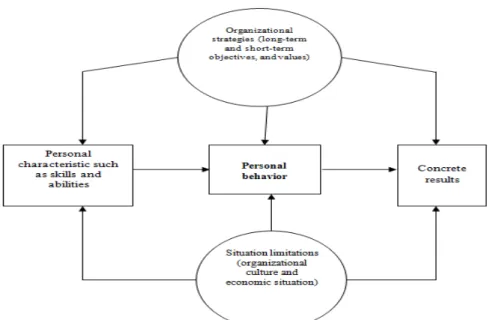
As the figure below illustrates, these
characteristics change into concrete results through employees’ behavior. In fact, employees can show their behavior only if they have the
knowledge, skills, abilities and other
Figure 1. Performance appraisal model in organizations (15)
Other major components of Noe’s model are organizational strategies. The relationship between performance management and strategies and goals of the organization is often ignored. Finally, the model above notes that situation limitations also play a major role in individual’s performance. As previously mentioned, the individuals may do proper behavior but do not gain good results. Therefore, employees should have specific properties to do a set of behaviors and achieve some results and to achieve competitive advantages, characteristics, behavior and results should be tied to organizational strategies. Performance appraisal can be defined as an appraisal communicative process with employees in the way to do a job and the application of its improvement program (4). Each organization is in need for a performance appraisal system to determine the extent of the appropriateness and quality of its activities,
especially in complex and dynamic
environments. This system also plays an important role in the implementation of strategic
plans, because the lack of an appraisal and control system in a system means the lack of communication with internal and external environment of the organization that whose consequence is the senility and the death of the organization (2).
Although the concept of performance
management is a new concept, performance appraisal during the last decades has been among the most controversial personnel services and management practices and it can be said that performance management, with the introduction of a range of views and provoking mixed feelings, is one of the most complex human resources management activities and processes. In many organizations, performance appraisal is an integral part of human resource management programs and a very effective means in professional development and is used for multiple purposes.
According to Bernardian (2003), data from performance measurement is widely used for
compensation, service, improvement of
promotion, transfer, exclusion and dismissal from
service) analysis of educational needs,
development, research and program evaluation. Ivancevich (2007) has mentioned evaluation objectives in the development, motivation, and planning of human resources and recruitment and
creating effective communication between
employees and supervisors.
Snell and Bohlander (2007) and Noe et al. (2008) divided personnel appraisal purposes into two categories of developmental purposes and executive administrative purposes. The following table shows application of the results of performance appraisal for developmental and administrative executive purposes separately.
Table 1. Performance appraisal purposes
Administrative executive purposes
Developmental purposes
- documentation of decisions
- determining promotion of candidates
-determining assignments and duties
-identifying poor performance
-deciding about exclusion or maintanance
-validating selection criteia
-evaluation of educational programs
-deciding about reward and compensation for services
-meeting legal regulations -personnel planninng
-prividing performance feedback
-identifying personal weaknesses and strength
-recognizing individuals’ performance
-helping to identify purposes
-evaluating the achievement of purposes
-identifying personal educational needs
-identifying organizational educational needs
-reinforcing power structure
-improving communications
-providing grounds to help managers
Performance management appraisal systems that are directly linked to the organizational reward system, provide a strong motivation for employees to creatively try to achieve annual organizational goals. While the performance management system is properly designed and implemented, not only does it let employees know their performance quality, but it also clarifies actions that should be done to improve their performance.
López and Hicks (2015) ,in their study, state that using monitoring is necessary in appraisal process to design and develop performance and can make appraisal framework in human and institutional capacity more effective.
According to the experts, an effective
performance appraisal system can bring so many
advantages for organizations and their
employees. Longenecker and Nykodym (1996) stated that the performance appraisal system; a) provides specified feedback to improve the performance, b) determines employee’s training
requirements c) provides and facilitates the grounds for development, d) provides close relationship between personnel conclusion and
performance e) increases motivation and
productivity.
In addition, Roberts and Pavlak (1996) believe that the performance appraisal is used for
multiple supervising and developmental
purposes, including: a) appraising performance based on organizational needs, b) anticipating employees’ feedback to reform or strengthen their behavior and c) allocation of rewards and job promotion.
methods should be reconsidered so that the educational quality can be increased.
Madani (2009) conducted a research entitled “the comparing the relationship between performance
appraisal system and human resources
productivity in Tax Affaires and
Telecommunications Company of Ardebil
province”. According to the obtained results, there is a significant difference between different levels of performance appraisal and efficiency of human resources in the organization. Besides, the average productivity in Tax Affairs is greater than Telecommunications Company but is not statistically significant.
Nemati (2005) did a study entitled “the effect of performance appraisal system on labor force productivity in detergent industry”. According to
the obtained results from distributed
questionnaires, the performance appraisal system has a positive effect on the human resources and all three hypotheses were confirmed.
Tavari (2001) conducted a study entitled “identification and prioritization of effective factors in human resource productivity using MADM technique” in one of Jeans companies in the province. The results of the study showed that management factor has the most importance or prioritization and personal-cultural and psycho-social factors are in the next places, and the environmental factor has the least importance. Social security organization of Markazi province has annually suffered many material and immaterial losses from non-identifying and assessing the factors affecting the efficiency of performance appraisal system at various levels, and because of that, has dealt with the issue as a fundamental weakness and challenge in the Strategic Plan of Organizational Development and has decided to conduct a scientific research to measure the effective factors in the efficiency if performance appraisal system in Social Security Organization of Markazi province. Therefore, in this paper, after reviewing the
literature of the research, with respect to the above-mentioned, main question of this study is: what are the effective factors in efficiency of the performance appraisal system in Social Security Organization of Markazi province?
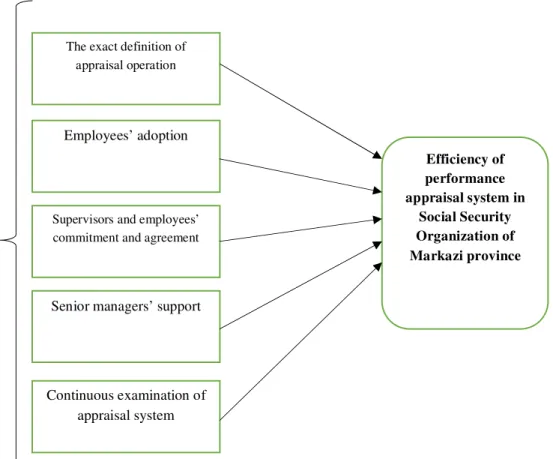
Based on the results of different studies (Baliga, 1994; and Madler, 1997, cited in Abili, 2002), the effective factors in the efficiency of performance appraisal system are as follows:
1. Exact definition of
the effective appraisal operation of
management performance, including:
performance planning and continuous
monitoring of performance and providing feedback to employees about how to improve their performance.
2. The support of senior
management from performance appraisal system that encourages supervisors to configure effective appraisal behavior, in
order to guarantee satisfaction and
investigate appraisal system complaints.
3. Acceptance of
organization’s employees of performance appraisal system and their tendency to do it.
4. The commitment of
supervisors and employees for appropriate performing of organization’s performance appraisal system and also the agreement of
employees and supervisors to define
desirable performance and the way of
interpreting performance appraisal
information.
5. Continuous and
systematic examination of performance appraisal system itself
In this regard, the following research hypotheses are raised:
Sub-hypothesis 2: employees’ adoption affects the efficiency of performance appraisal system in
Social Security Organization of Markazi
province.
Sub-hypothesis 3: supervisors and employees’ commitment and agreement affect the efficiency of performance appraisal system in Social Security Organization of Markazi province. Sub-hypothesis 4: senior managers’ support affects the efficiency of performance appraisal
system in Social Security Organization of Markazi province.
Sub-hypothesis 5: the continuous examination of appraisal system affects the efficiency of performance appraisal system in Social Security Organization of Markazi province.
In the end, the conceptual model of the study is presented below:
Figure 2. The conceptual model of the research
METHODOLOGY
The method used in the study is practical in terms of objective and descriptive-causal in terms of data collection. Besides, the study, based on the type of the collected data, is quantitative. In this regard, a questionnaire to get the opinions of the managers and employees of
Social Security Organization of Markazi province in 2015 was distributed and the data were collected. Since there is a cause-effect relationship in the study, the research method is causal in terms of relationships between variables and Structural Equation Model was used for a comprehensive review of the conceptual model. This model is the best means
Efficiency of performance appraisal system in
Social Security Organization of Markazi province
The exact definition of appraisal operation
Employees’ adoption
Supervisors and employees’ commitment and agreement
Senior managers’ support
for the analysis of research in which the observed variables are measured with errors, and also the relationships between variables is complex. Using this method, on one hand, the precision of indices or observable variables can be measured and on the other hand, the relationships between latent variables and the specified variance can be examined. Structural Equation Model is composed of two parts of measurement model and structural mode and the variables of the model are classified into two groups of latent and observed variables which are considered the effective factors in the efficiency of performance appraisal system of latent variable and dimensions of each of observed variables.
The statistical population of the study consists of 430 managers and employees of Social Security Organization of Markazi Province. To use the Cochran formula, its assumptions must be considered. The assumptions of Cochran’s formula are as follows: P=q=50% (based on convenience sampling); Z is normal distribution statistic which is 1.96 at 95% confidence level; d is the maximum permissible error which is considered 5%, and N is the number of managers and employees of Social Security Organization of Markazi Province. The size of the statistical sample (n) is calculated by the following formula (20):
(Formula 1) n=
Therefore, using formula 1, according to four-hundred-thirty-member statistical population,
203 were selected based on simple random sampling. To gather data, a researcher-made questionnaire on examination of the effective factors in the efficiency performance appraisal system was used. Some of the questions were derived from Andrei Dival’s questionnaire and the rest of the questions were designed based on the components.
The researcher-made questionnaire was
designed to examine the effective factors in the efficiency of performance appraisal system based on the key components, that is, exact definition of appraisal operation, employees’
adoption, supervisors and employees’
commitment and agreement, senior managers’ support, continuous examination of appraisal system. It consists of 35 questions, 7 questions for each component. In this questionnaire, 35 questions, based on Likert scale, have been rated in five scale from “strongly disagree” to “strongly agree”.
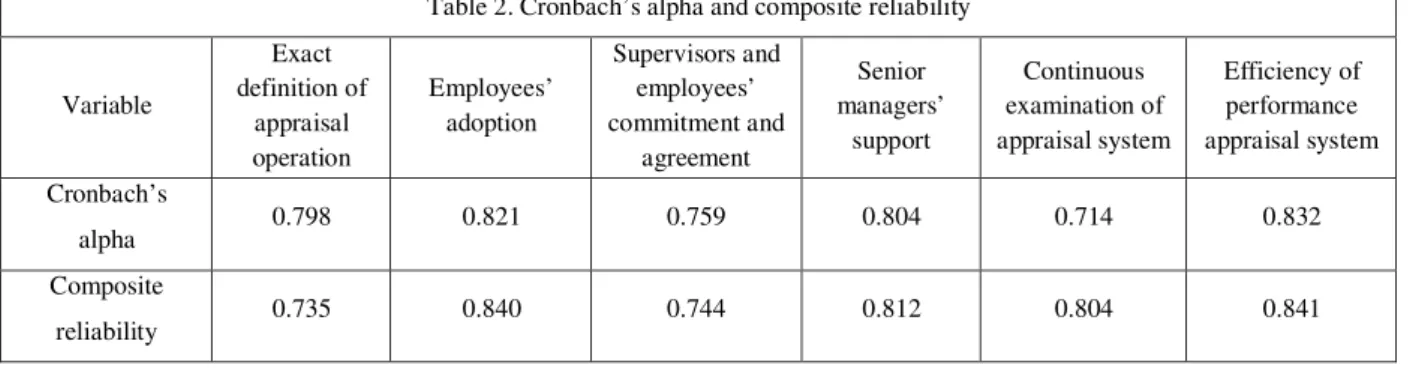
To measure the reliability of the questionnaire, SPSS and Smart PLS were used. In PLS, the reliability is measured by assessing composite reliability and in SPSS the reliability is assessed by calculating Cronbach’s alpha that the obtained 0.7 in both methods indicate the acceptable reliability of the questionnaire. In the present study, the results of these two methods are presented in table 3, and as it is evident, all the values are above 0.7 confirming the reliability of the questionnaire.
0.841 0.804
0.812
0.744
0.840
0.735
Composite
reliability
The validity of the questionnaires were examined by both convergent and divergent validity criteria specific to structural equation model. For the convergent validity, AVE (Average Variance Extracted) was used. The acceptable value for AVE is 0.5 (7).
Results indicated that all AVE related to the constructs were greater than 0.5, and it showed
acceptable convergent validity of the
questionnaire. The divergent validity, the difference between the indices of a structure and indices of other structures is compared. It is calculated by comparing the square root of the AVE of each construct with the correlation coefficient of constructs. In so doing, a matrix should be formed that values of main matrix diagonal is each construct’s square root of AVE coefficients and lower and higher values of the
main diagonal are the coefficients of correlation between construct with other constructs. The findings showed that each construct’s square root of the AVE (main diagonal values) has become more than correlation coefficients of that structure with other structures (row and column values). This shows the divergent validity of the constructs is acceptable.
Findings
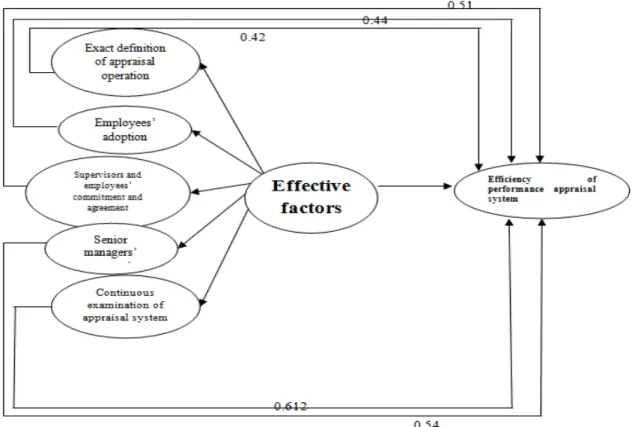
At this point, the cause-effect relationship of effective factors in the efficiency of performance appraisal system of Social Security Organization of Markazi province is measured in terms of the structural model. As shown in the figure below, the role of these factors on the efficiency of performance appraisal system of Social Security Organization of Markazi province is meaningful
Figure 3. Causal effect coefficients of the model of the study
Figure 3 indicates the causal effect coefficient of the model of the study, and the role of variables in the efficiency of performance appraisal system in Social Security Organization of Markazi province.
The PLS output proves the hypothesis of the study which is evident in table 3. Since t-values are greater than 1.96, all hypotheses are confirmed.
Table 3. Examining the hypotheses of the study
Result t-value Standardized
coefficients
hypotheses
Confirmed
13.46 0.44
Exact definition of appraisal operation= efficiency of performance appraisal
system
Confirmed
13.05 0.42
Employees’ adoption= efficiency of performance appraisal system
Confirmed
16.11 0.51
Supervisors and employees’ commitment and agreement= efficiency of
performance appraisal system
Confirmed
15.67 0.54
Senior managers’ support= efficiency of performance appraisal system
Confirmed
16.98 0.612
Continuous examination of appraisal system= efficiency of performance
appraisal system
RESULTS AND DISCUSSION
Generally, the modern world is full of complexities that bring about many problems for the organizations in terms of growth and
using performance appraisal system to overcome the difficulties and obstacles in the way of the efficiency of performance appraisal system can be helpful for greater productivity of country’s organizations. In this part, after analyzing the data in this study and testing each of the hypotheses, some results were obtained that will
be precisely interpreted considering the
hypotheses.
Hypothesis 1: exact definition of appraisal operation affects the efficiency of performance appraisal system in Social Security Organization of Markazi province. The findings of the study confirmed the effects of the exact definition of appraisal operation on the efficiency of performance appraisal system in Social Security Organization of Markazi province. Since the " performance appraisal system Plan " that
includes: clearly defined objective,
understandable and useful for appraising performance, and extensive input of employees and supervisors on how to appraise can help the efficiency of the performance appraisal system in organizations. Undoubtedly, the exact definition
of effective appraisal operation of the
management performance, including: planning performance and continuous examination of
performance and providing feedback to
employees about how to improve their
performance. They result in a well-defined roadmap for performance appraisal and all ambiguities are completely removed and the required grounds for effectively and efficiently implementing performance appraisal system are created. Finally, this finding is in line with the results of the studies by Baliga (1994) and Abili (2002).
Hypothesis 2: employees’ adoption affects the efficiency of performance appraisal system in
Social Security Organization of Markazi
province. The findings of the study confirmed the employees’ adoption on the efficiency of
performance appraisal in Social Security
Organization of Markazi province. Obviously,
employees’ adoption of the performance
appraisal system of organization and their tendency to do so can make a significant contribution to the efficiency of the system. Acceptance of performance appraisal system by employees leads to their motivation and accompanying them in the process of efficient implementation of the performance appraisal system and eliminates possible resistance in the organization. Ultimately these findings are in line with the results of studies conducted by researchers such as Baliga (1994) and Madler (1997).
Hypothesis 3: supervisors and employees’ commitment and agreement affect the efficiency of performance appraisal system in Social Security Organization of Markazi province. The findings of the study confirmed the effects of commitment and agreement of supervisors and employees on the efficiency of performance appraisal system in Social Security Organization of Markazi province. Since the commitment of supervisors and employees for appropriate
performing of organization’s performance
appraisal system can provide the grounds for more collaboration and interaction about more appropriate implementation of performance appraisal system, and also on the other hand, the agreement of employees and supervisors on the definition of desirable performance and the way of interpreting performance appraisal information provides the required grounds for efficient implementation of performance appraisal system. Finally, this finding is in line with the results of the research done by Abili (2002).
Hypothesis 4: senior managers’ support affects the efficiency of performance appraisal system in
Social Security Organization of Markazi
province. The finding of this study confirmed the effects of senior managers’ support on the efficiency of performance appraisal system in
province. This finding is worth discussing because the organization’s senior managers’ support for performance appraisal system encourages supervisors to perform effective appraisal behavior in order to guarantee satisfaction and investigation of complaints, and provides the grounds for efficiency of this system. In the absence of required support, the performance appraisal system cannot attract the necessary resources and information and its efficiency reduces. The results of the studies conducted by Baliga (1994), Madler (1997) and Abili (2002) confirm this finding.
Hypothesis 5: continuous examination of appraisal system affects the efficiency of performance appraisal system in Social Security Organization of Markazi province. The findings of the study confirm the effects of continuous examination of appraisal system on the efficiency of performance appraisal system in Social Security Organization of Markazi province. According to the fact that performing any appraisal system can have some weaknesses and
deficiencies, continuous examination and
monitoring on appraisal system can highlight its problems and find solutions to remove them, and finally provide the grounds for the efficiency of performance appraisal system in the relevant organization. This finding is in line with the results of a study conducted by López and Hicks (2015).
Based on the research findings
According to the results of similar studies and this study, factors such as the exact definition of
appraisal operation, employees’ adoption,
supervisors and employees’ commitment and agreement and continuous examination of appraisal system can facilitate the route to achieving an efficient performance appraisal system in Social Security Organization of Markazi province. Social Security Organization of Markazi province, in this fierce competition, should create performance appraisal system in its
structure and among its deputies and
institutionalize proper productivity and
performance in it and take it to desirable level by selecting an appropriate performance appraisal system with its structure. Hence, the following suggestions are made for better implementation: 1. Holding briefing sessions for employees and
supervisors of Social Security Organization of Markazi province to identify the importance, area , objectives and approaches of performance appraisal system. By holding such sessions, the awareness of employees and supervisors of the subject increases and
their commitment and agreement are
guaranteed, leading to the allocation of sufficient organizational resources and the removal of the organizational obstacles towards efficiency of performance appraisal system.
2. Creating committees comprising of key
members of different units of Social Security Organization of Markazi province in order to be present in implementation project of performance appraisal system in Social Security Organization of Markazi province which leads to the ease of implementation, the lack of resistance to changes resulting from the implementation of the program and the comprehensiveness of the program from the viewpoint of involving different units. 3. Providing the necessary training for those
involved in the performance appraisal system about the validation of operations and internal processes of the performance appraisal system.
4. • Improving the structure of Social Security
Organization of Markazi province to
coordinate the efficient performance
appraisal system for its success. 5.
REFERENCES
employees. Management Knowledge, 58: 5-20.
2. Atarod, A.; Noorbakhsh, M.; & Fathi, S. (2014). The effect of performance appraisal system of employees on the effective factors in the productivity of human resources of
Isfahan’s Municipality. Management
Comprehensive Website, Modiryar.
3. Bernardin, H.J. (2003). Human Resource
Management: an experiential approach. 3rd Edition. New York: Mc GrawHill.
4. Byars, L.I & Rue, L.W. (2008). Human Resource Management: ninth Edition. New York: Mc GrawHill.
5. Carell Michael R and et al. (1992).
Personnel/ Human Resource Management. Mac Millan. Publishing.
6. Foot. M and Hook. C (1999). Introducing Human Resource Management. Longman. 7. Hulland, J. (1999). ‘Use of partial least
squares (PLS) in strategic management research: A review of four recent.
8. Ivancevich, J. M. (2007). Human Resource Management. New York: Mc GrawHill. 9. López, Ingrid Guerra, Hicks, Karen (2015).
The participatory design of a performance oriented monitoring and evaluation system in an international development environment, Evaluation and Program Planning, Volume 48, Pages 21–30.
10. Longenecker, Clinton O. and Nykodym, Nick
(1996). Public Sector Performance appraisal
effectiveness: A Case Study, Public
Personnel Management. Vol. 25. No. 2, summer.
11. Mahmoodi, Y. (2014). The examination of new performance appraisal system of the employees of Education Department from the viewpoint of principals and teachers of elementary schools of Yazd’s district 1. M.A.
Thesis. Islamic Azad University of
Marvdasht.
12. Moghimi, S. M. & Ramezani, M. (2011). Journal of Management, 1. Tehran: Rahdan Pub.
13. Mohseni, S. (2014). The effect of appraisal system on the performance of the employees of Administrative and Financial Deputy of Islamic Republic of Iran Broadcasting. M.A. Thesis, Islamic Azad University, Tehran’s Central Branch.
14. Nemati, R. (2005). The effect of performance appraisal system on the efficiency of human resources in detergent industries. M.A. Thesis.
15. Noe, R.A, Hollenbeck, J. R, Gerhurt, B & Wright, P.M. (2008). Human Resource
Management: gaining Competitive
advantage. New York: Mc GrawHill.
16. Pohjola, M., (2010). Information
Technology, Productivity, and Economic
Growth: International Evidence and
Implications for Economic Development, Oxford: University Press, Vol., No 1.
17. Roberts, Gary E. and Pavlak, T. (1996).
Municipal government Personnel
Professional and Performance appraisal: Is there a consensus on the characteristics of an effective appraisal system? Public Personnel Management, Vol. 25. No. 3, fall
18. Saraee, H. (2010). An Introduction to Sampling in Research. Tehran: SAMT Pub. 6th Ed.
19. Snell, S. A & Bohlander, G. W. (2007). Managing Human Resources. Thomson Publishing Company.
20. Stredwick John (2005). An Introduction to Human Resource Management. Elsevier Ltd.
21. Tavari, M. (2001). Identifying and