Some Aspects Regarding “Sense and Avoid” Requirements
for UAV Integration in the National Air Space
Adrian MURARU*
*Corresponding author
Air Force Academy "Henri Coanda"
Std. Mihai Viteazul 160, Bra
ş
ov, 500187
,
Romania
[email protected]
Abstract: The purpose of this article is to show the importance of mission planning in a fully automatic flight and the critical role of implementing Sense & Avoid (S&A) procedures at different categories of UAVs. Modern operation of UAVs implies the capability to handle separation provision and collision avoidance in a way similar to the manned aircrafts. The main contributions are: the analysis of the importance of organizing a special course dedicated to the technical knowledge of the procedures for mission planning and utilization of UAVs; a critical analysis of the possibilities of integration S&A procedures for small UAVs and the perspective of obtaining low-cost solution, especially for emerging countries.
Key Words: UAV - Unmanned Aerial Vehicle, UAS - Unmanned Aircraft System, S&A – Sense and Avoid
1. INTRODUCTION
An unmanned aerial vehicle is an aircraft that flies without a human pilot on board. The responsibility for the control of this type of aircraft falls on either a human operator on the ground or its flight is autonomously based on pre-programmed flight plans using more complex dynamic automation systems. At first, UAVs were simply target drones for military aircrafts or artillery. Nowadays, the technology has advanced to the point where human pilots could be replaced by the sense and avoid systems.
The problem of sense & avoid can be divided into two separate functions: the sense function and the avoid function, each with several sub-functions (either allocated to a technical system or to a human operator). The development of a Sense & Avoid System raises a couple of questions, each of which requiring its own dedicated experimental design. According to a FAA (Federal Aviation Administration) definition in 2009 “Sense and Avoid (SAA) is the capability of an UAV to remain well clear and avoid collisions with other airborne traffic”. The task of identifying possible conflicts and avoiding them is still in the responsibility of the human operator. Studies show, that even for an experienced pilot, it takes already a few seconds to identify possible conflicts after detecting an intruder.
Future unmanned systems within the armed forces will be highly heterogeneous in nature, with vehicles from multiple domains: air, underwater, and land, working in collaborative teams to complete a variety of missions. The complexity of supervising these teams will be enormous and will rely on human creativity, judgment, and experience. Therefore, the design and development of mission planning and monitoring technologies must be rooted in a deep understanding of the human operator’s role as mission manager, and must effectively address the reasoning skills and limitations of both the human and autonomous intelligent system.
2. CURRENT SITUATION OVERVIEW
The sense & avoid capability is considered to be essential for the operation of UAV in non segregated airspaces. The primary distinction of Unmanned Aircraft Systems (UAS) from manned aircraft, the removal of the pilot from the cockpit, raises the issue of how collisions are to be avoided. Many research initiatives are exploring concepts and technologies for the “Sense & Avoid” function (S&A), including adapting some already used onboard manned aircraft. The current procedure for a UAS to operate in national airspace (NAS) requires a Certificate of Authorization (COA) to be applied through the FAA for every mission. Obtaining a COA is in depth process often taking more than a month and requiring a chase aircraft to observe the UAS while it is flying in the NAS. This lengthy process is not in line with the emergency response, high tempo, and continually evolving role where the UAS needs a “file and fly” status in order to accomplish its mission. In order to achieve this status, UAS must meet an “equivalent level of safety” to that of general manned aviation. It is currently unclear what is the exact FAA “equivalent level of safety” in dealing with Unmanned Aerial Systems, but one element of the standard is undoubtedly the UAS ability to detect, sense and avoid other aircraft.
Different organizations are developing requirements for the introduction of UAVs in the Operational Air Traffic (OAT) and the General Air Traffic (GAT) respectively, the most prominent being EUROCAE WG 73 in Europe and its counterpart RTCA SC 203 in the US. Their goal is to define regulations which should ensure a level of safety equivalent to the one reached currently by manned air traffic. According to the EUROCONTROL Specifications for example, three basic principles should be followed: “Firstly, UAV operations should not increase the risk to other airspace users; secondly, Air Traffic Management procedures should mirror those applicable to manned aircraft; and, thirdly, the provision of air traffic services to UAVs should be transparent to air traffic controllers.”However if one considers the UAV system as a whole, it becomes clear that there are differences in operating UAVs compared to manned aircraft, be it only that there are special data links to remote control stations or the use of remote control stations as such. Therefore, part of the regulations will lead to requirements for procedures and functionalities which are particularly adapted to the operation of UAVs in different airspaces and at different flight conditions. For instance, technical means should support or even guarantee the detection of potential collision threats in flight and, if necessary, subsequently give the possibility to avoid them by informing the remote pilot or by an automatism on-board. Special avoidance algorithms will have to be implemented to recognize conflicts and propose resolutions.
3. BASIC ASPECTS OF S&A TECHNOLOGY
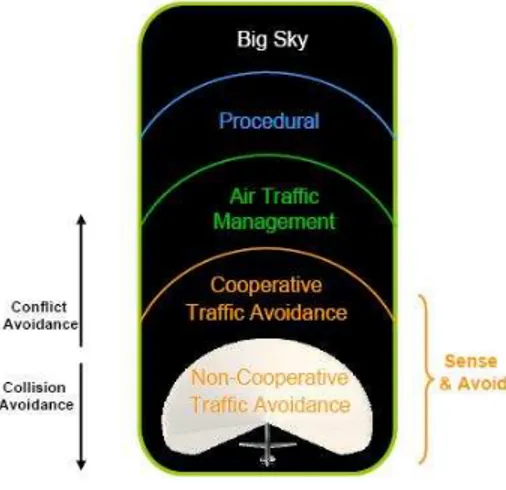
Figure 1: Types of air traffic encounter
The FAA does not provide a quantitative definition of see-and-avoid, largely due to the number of combinations of pilot vision, collision vectors, sky background, and aircraft paint schemes involved in seeing oncoming traffic. Having a sufficient field of regard (FOR) for a UAV S&A system, however, meeting the goal of assured air traffic separation is fundamental.
Although an elusive issue, one fact is apparent. The challenge with the S&A issue is based on a capability constraint, not a regulatory one.
A possible definition for S&A systems emerges: sense-and-avoid is the onboard, self-contained ability to:
Detect traffic that may be a conflict Evaluate flight paths
Determine traffic right-of-way
Maneuver well clear according to the rules in Part 91.113, or Maneuver as required in accordance with Part 91.111.
3.1 Detection requirements and methods
According to the right-of-way rules (14 CFR 91.113), aircrafts must detect traffic that might be a conflict and then move according to the right of way rules. Prudence suggests that the search volume should include 90 degrees left of the nose as well. NASA studies have shown for climbing or descending traffic, plus or minus 15 degrees search in elevation will adequately scan for converging aircraft which are using as much as 20 degree angles of climb [2].
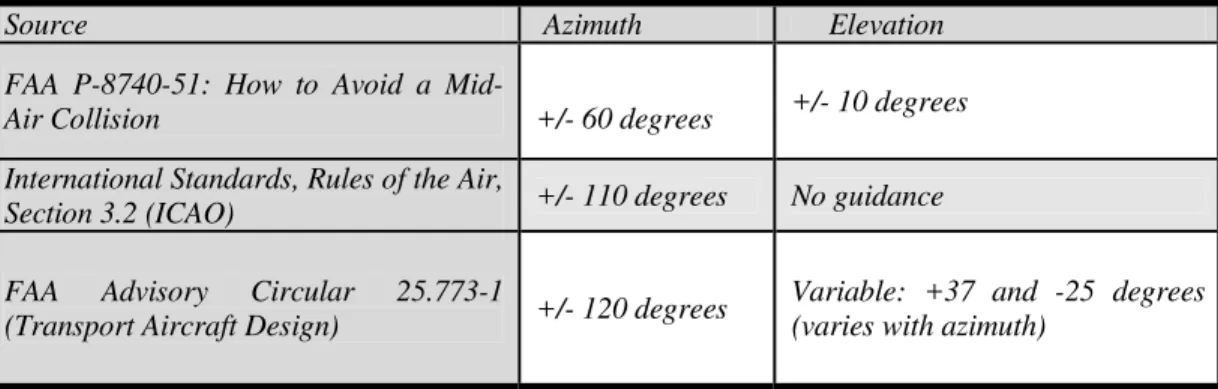
The main requirements for the S&A standard system, as shown in Table 1, are the following: it should provide a minimum traffic detection capability of plus or minus 110 degrees in azimuth measured from the longitudinal axis and plus or minus 15 degrees in elevation from the cruise speed level line.
The 15 degree elevation value is based on independent NASA and OSD analysis to detect climbing or descending threats.
3.2 Range Requirement
process the information, determine the conflict, and execute the maneuver according to the right-of-way rules. The Department of Defense (DoD) has conducted computer based simulations and analysis that confirm independent NASA findings that the time needed to complete the avoidance maneuver depends primarily on the bank angle of the maneuver for speeds greater than about 80 knots. Because ROA will limit the angle of bank for preplanned maneuvers, the time required to perform the limited angle of bank maneuver is determined. Any additional time necessary for processing and/or operator response can be added to the maneuver time to determine the total time necessary to detect the traffic prior to collision.
Table 1 The main requirements
Source Azimuth Elevation
FAA P-8740-51: How to Avoid a
Mid-Air Collision +/- 60 degrees +/- 10 degrees International Standards, Rules of the Air,
Section 3.2 (ICAO) +/- 110 degrees No guidance FAA Advisory Circular 25.773-1
(Transport Aircraft Design) +/- 120 degrees
Variable: +37 and -25 degrees (varies with azimuth)
Once this total time required is determined, the range is calculated depending on the ROA velocity and a representative traffic closing velocity vector. For example, traffic below 10,000 feet is generally limited to 250 knots indicated air speed, while higher traffic might travel at 0.9 Mach. The range required of the detection system is then a function of the maneuverability and velocity of the ROA and its operational traffic. The Air Combat Command-sponsored joint working group mentioned above, using the terminology remotely operated aircraft, has proposed that:
The sense-and-avoid system must detect the traffic in time to process the sensor information, determine if a conflict exists, and execute a maneuver according to the right-of-way rules. If the pilot interaction with the system is required, the transmission and decision time must also be included in the total time between the initial detection and the point of minimum separation.
3.3 Sensor Requirement
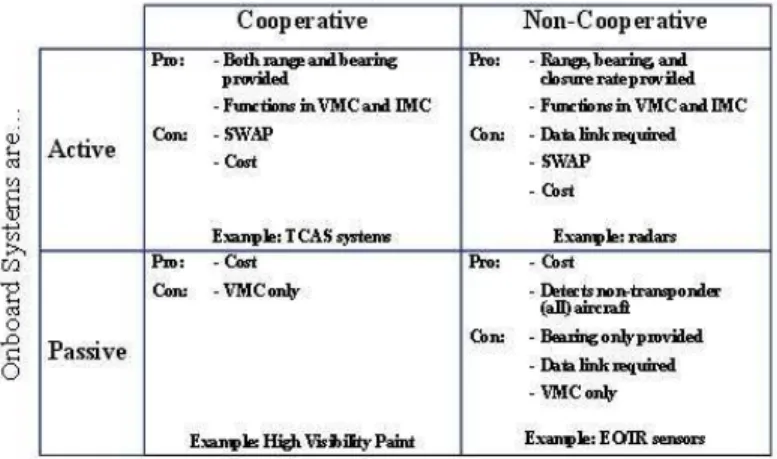
The non-cooperative systems do not require other aircraft or obstacles in area to support the detection methodology. They can be used to detect ground-based obstacles. They split in active and passive systems. Active systems transmit a signal to detect obstacles in flight path (radar, laser). Passive systems do not transmit a signal but rely upon detection of signals emanating from the obstacle (Motion detection sensors (MD), Electro-optical sensors (EO), Infrared sensors (IR). The Motion Detection (MD) sensors are designed to sense direction and velocity of specific objects in the sensing field, having multiple cameras placed at different angles to create multiple views (allowing for calculation of object vectors when combined). The Electro-Optical (EO) sensors require light for detecting objects. EO algorithms allow visual display of the images to show differences or changes.
Infrared sensors detect heat and can display the information in two forms: white-hot objects and black-hot objects and they also require a visible heat source for the obstacle (night use).
3.3.1 Active, cooperative, cooperative
The active, cooperative scenario involves an interrogator monitoring a sector ahead of the ROA to detect oncoming traffic by interrogating the transponder on the other aircraft. Its advantages are that it provides both range and bearing to the traffic and can function in both visual and instrument meteorological conditions (VMC and IMC). The disadvantages are its relative cost. Current systems available in this category include the various Traffic-alert and Collision Avoidance Systems (TCAS).
3.3.2 Active, non-cooperative
The active, non-cooperative scenario relies on a RADAR or laser-like sensor LIDAR scanning a sector ahead of the ROA to detect all traffic, whether transponder-equipped or not. The returned signal provides range, bearing, and closure rate, allowing prioritization of oncoming traffic for avoidance, in either VMC or IMC. Its potential drawbacks are its relative cost, the bandwidth requirement to route its imagery (for non-autonomous systems), and its weight. An example of an active, non-cooperative system that is currently available is a combined microwave radar and infrared sensor originally developed to enable helicopters to avoid power lines.
3.3.3 Passive, cooperative
The passive cooperative scenario, like the active cooperative one, relies on everyone having a transponder, but with everyone's transponder broadcasting position, altitude and velocity data. The advantages are its lower relative cost (no onboard interrogator required to activate transponders) and its ability to provide S&A information in both VMC and IMC. The disadvantage is its dependence on all traffic carrying and continuously operating transponders. In this scenario, ROA should have the capability to change transponder settings while in flight.
3.3.4 Passive, non-cooperative
if they are looking at the ground for reconnaissance then they are not available to perform S&A [3]. An emerging approach that would negate the high bandwidth requirement of any active system is optical flow technology, which reports only when it detects an object showing a lack of movement against the sky, instead of sending a continuous video stream to the ground controller. Imagery from one or more inexpensive optical sensors on the UAV is continuously compared to the last image by an onboard processor to detect minute changes in pixels, indicating traffic of potential interest.
3.4 Avoidance Requirements and Methods
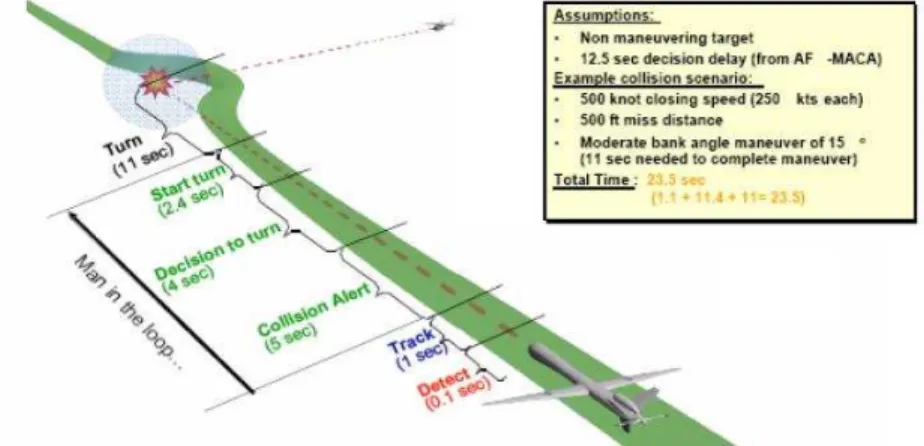
Once the "sense" portion of S&A is satisfied, the UAV must use this information to execute an avoidance maneuver. The latency between seeing and avoiding for the pilot of a manned aircraft ranges from 10 to 12.5 seconds according to FAA and DoD studies.
If relying on a ground operator to see and avoid, the UAV incurs the same human latency, but adds the latency of the data link bringing the image to the ground for a decision and the avoidance command back to the ROA [4].
This added latency can range from less than a second for line-of-sight links to more for satellite links, see figure 2.
3.4.1 Pilot-in-the-loop
Current UAVs are flown with varying degrees of human control and/or oversight. When flying in the NAS this oversight must adhere to the requirements of 14 CFR Part 91 and its intent for pilots to see and avoid other aircraft. For reference, the regulations, including right-of-way rules for pilots, are provided below. These regulations apply to all aircraft (civil and military).
Section 91.111 (a) makes it clear that the intent of this statutory language is to ensure that operators avoid creating “a collision hazard.” Section 91.113 provides the right-of-way rules to clarify which aircraft should yield. In order of decreasing priority, right-of-way is granted to vehicles 1) in distress, 2) landing, 3) a balloon, 4) a glider, 5) an airship, 6) towing or air-air refueling, 7) on the right-hand, 8) in-front, and 9) below.
From “How to Avoid a Midair Collision” (FAA document P-8740-51), “Collision avoidance involves much more than proper eyeball techniques. You can be the most conscientious scanner in the world and still have an in-flight collision if you neglect other important factors in the overall see-and-avoid picture” [5]. The document describes a “see-and-avoid checklist” that includes proper procedures on the ground (e.g., flight planning, adding high-visibility features to the aircraft, etc.) to good en-route practices (e.g., avoiding crowded airspace, using radios effectively, etc.).
3.4.2 Autonomous
The pilot-in-the-loop scenario is one possible way to recognize an impending collision and initiate the required resolution maneuver. For beyond line-of-sight ROA operations, however, other methods to initiate action are required. The sense-and-avoid system or an acceptable alternative must be developed and must work throughout all phases of flight. In the case of ROA, where the operator and crew are off-board and connected via a data-link, the sense-and-avoid system must work even if the data-link malfunctions [6].
An alternative is to empower the ROA to determine autonomously whether and which way to react to avoid a collision once it detects oncoming traffic, thereby removing the latency imposed by data links. This approach has been considered for implementation on TCAS II-equipped manned aircraft, since TCAS II already recommends a vertical direction to the pilot; but simulations have found the automated maneuver worsens the situation in a fraction of the scenarios. For this reason, the FAA has not certified automated collision avoidance algorithms based on TCAS resolution advisories; doing so would set a significant precedent for ROA S&A capabilities.
4. WAYS OF DEVELOPMENT IN THE MATTER
In order to be able to evaluate still in greater depth the performance of sensors and object recognition algorithms for the Sense and Avoid task, the subject will have to be treated in more detail. Thus, more factors will have to be considered and changing weather conditions will have to be experimentally analyzed. Sensor technology will have to be extended as well. For instance, up to now only poor experience exists from automatically exploiting infrared (IR) sensor data for the Sense and Avoid task. For cost reasons uncoiled bolometer technology is considered. But, at the present time, bolometer cameras allow only for moderate angular resolution. Similar processing algorithms as for the visible domain could be used for object recognition in IR image data.
One can certainly argue that simulation will also play an essential role in the evaluation of the performance of Sense and Avoid solutions and equipment. However simulation models will have to be established first. Sensor and processing capabilities will have to be cast into parameterized formal models. To verify the obtained generalizations after the variation of parameters in simulation runs, experimental data will be needed again. In this respect, there is also the issue of the environmental impact on equipment. Thus, the equipment resilience is therefore an issue as well.
Last but not least, the fusion of data and in particular processing results from sensors, which are based on different and complementary physical properties, e.g. optronic (EO/IR) sensors with RADAR, will have to be tackled in practice.
5. CONCLUSIONS
UAVs present major challenges for the task of S&A, especially in the case of miniatural systems. It is necessary better implementing procedures that require new and innovative technologies, with better and safer capabilities in the automation and optimization of mission planning in unstructured environments within the entire flight envelope. It is also necessary to accommodate subsystem/component failure modes without major performance degradation (the maximal takeoff weight and the aerodynamics of small vehicles are very sensitive to all the additional equipments) or loss of vehicle and to perform extreme maneuvers without violating stability limits. An integrated / hierarchical approach to vehicle instrumentation, computing, modeling and control seems to provide possible solutions. The UAV community is accomplishing major milestones towards this goal. More recently, researchers have been concerned with multiple and heterogeneous UAVs flying in formation to take advantage of their complementary capabilities.
The future work regarding the swarm problem opens new avenues of research where the intelligent control community can contribute significantly in terms of smart coordination cooperation technologies.
The importance of mission planning in a fully automatic flight and the critical role of implementing (S&A) procedures at different categories of UAVs was presented. The focus was on the emerging capability to handle separation provision and collision avoidance in a way similar to the manned aircrafts.
REFERENCES
[1] Airspace Integration Plan for Unmanned Aviation November, 2004.
[2] BOŞCOIANU, M., Optimal Path Control for Small UAVs equipped with VTO system, International Conference UAV World, 3rd International Conference UAV World, Frankfurt, Germany, 2009 www.airtec.aero.
[3] BOSCOIANU, M., AXENTE, C., PAHONIE, R.: Some aspects regarding the cooperative control problem
for flying wing air vehicles, Computational Methods and Intelligent Systems, 10th WSEAS Int. Conf on
Mathematical Methods and Computational Techniques in Electrical Engineering (MMACTEE'08), Sofia, Bulgaria, May 2-4, 2008, ISSN 1790-5117, ISBN 978-960-6766-60-2.
[4] MCCALMONT, J., UTT, J., DESCHENES, M.: Sense and Avoid Phase 1 (Man-in-the-Loop), 2001. [5] Prospective Unmanned Aerial Vehicle Operations in the Future National Airspace System, 2002