Abstract— In this paper, a simulation study has been done for control of the reactive distillation column for producing isopropyl acetate using quadratic dynamic matrix control (QDMC). The isopropyl acetate composition in the organic phase in decanter is selected as the controlled variable and the reflux ratio as the manipulated variable. QDMC has been found to be satisfactory to control the top product composition subject to the specified constraints on the manipulated and controlled variables. The effects of the move suppression factor and prediction horizon have also been investigated on the control behavior.
Keywords—:Isopropyl acetate, MATLAB, quadratic dynamic matrix control, reactive distillation.
I. INTRODUCTION
Reactive distillation (RD) column combines the key operations of most chemical processes into one unit: chemical reaction and distillation. The combination of reaction and distillation helps in achieving products of higher purity and higher conversion of reactants as compared to the conventional processes but these processes also exhibit complex behavior such as process nonlinearity, significant interactions, process gain bidirectionality (i.e., process gain sign change), steady-state multiplicity, and strong interactions between process variables. This complex dynamics makes process control of the reactive distillation column a challenging task. Due to the complexity of the RD process dynamics, conventional control techniques, e.g., PI control, cannot provide satisfactory control performance, while the application of advanced control techniques such as model predictive control have been propounded in the RD control literature.
Industrially popular model predictive control algorithms such as Dynamic Matrix Control (DMC) use a linear convolution model of the process for control algorithm. Kawathekar and Riggs [1] studied the nonlinear model predictive control on reactive distillation column. Quadratic dynamic matrix control (QDMC) is an improved version of Dynamic Matrix Control (DMC) multivariable algorithm, which provides a direct and efficient method for handling process constraints. The algorithm utilizes a quadratic Manuscript received July 26, 2010.
Neha Sharma is a PhD student in the Department of Chemical Engineering, Malaviya National Institute of Technology Jaipur, India – 302017 (email: [email protected]).
Kailash Singh is currently working as a Reader at the Department of Chemical Engineering, Malaviya National Institute of Technology Jaipur, India – 302017 (corresponding author, phone: +91-141-2713392 (office), +91-9887867605 (Mobile); e-mail: [email protected])
program to compute moves on process manipulated variables, which keep controlled variables close to their targets while preventing violations of process constraints. Balasubramhanya and Doyle III [2] used the approach of Nonlinear Quadratic Dynamic Matrix Control with State Estimation (NLQDMC/SE) to study the nonlinear behavior of batch reactive distillation column. They used a reduced wave model to predict outputs into the future. In the present work, QDMC methodology is implemented to control the isopropyl acetate purity. Simulation study has been performed for QDMC to study the control behavior of the acetic acid esterification reactive distillation column. The information related to isopropyl acetate synthesis with acetic acid in a reactive distillation column is rarely found in the literature except for the vapor-liquid equilibrium (VLE) and kinetics data [3], [4]. A MATLAB® program was written for simulation studies. The controlled variable has been selected as isopropyl acetate composition in the organic phase in decanter having distillate as the feed rate and the manipulated variable as reflux ratio.
II. PROCESS DESCRIPTION
The esterification of acetic acid with isopropanol is considered inside a RD column. The column has a total condenser and reboiler. The theoretical stages are numbered from top to bottom. The equations for 14 stages for the system and four-component system were solved in MATLAB by ODE45 solver. Dynamic model of reactive distillation column was developed assuming ideal trays and phase splitting in the decanter incorporating tray to tray mass and energy balance. A MATLAB® code was written for solving the resulting ordinary differential equations-initial value problems. The data defining the column configuration, feed composition, column holdup, etc. is given in Table I. This data corresponds to the steady state of RD Column at reflux ratio of 4.
Feed location for heavy reactant acetic acid (HAc) is stage 3 and the reactant isopropanol is fed into reboiler, because we have a largest catalyst holdup in the reboiler. Overhead column containing an isopropyl acetate plus water produced by the esterifications reaction and small amount of unreacted alcohol is condensed and directed to decanter which serves to separate the organic and aqueous layers of the reaction product mixture. The organic phase contains isopropyl acetate and small amount of water and alcohols whereas the aqueous phase contains about 90-99% water and the remaining is alcohol and acetate.
Isopropyl acetate system exhibit non-ideal phase behavior and has four azeotropes in this system. The NRTL (non-random two-liquid) activity coefficient model
Quadratic Dynamic Matrix Control of Isopropyl
Acetate Reactive Distillation Column
parameters are taken from the Venimadhavan et al [5]. The esterification of acetic acid (HAc) with isopropanol (IPOH) can be expressed in the following form:
Acetic acid + Isopropanol ↔ Isopropyl acetate + water The chemical reaction kinetic model is adopted from Tang et al [6]. They used a solid acid catalyzed reaction with acidic ion-exchange resin (Amberlyst 35 wet, Rohm and Hass). Isopropyl acetate synthesis process flow sheet using reactive distillation in MATLAB is presented in Figure 1.
Table 1: Column specification data for isopropyl acetate synthesis
Feed flow rate of acetic acid 0.4166 mol/s Feed flow rate of
isopropanol
0.4166 mol/s
Pressure 1 bar
Reflux ratio 4
Total number of stages 14
Reactive zone 3-15
Feed stage location of acetic acid
3 Feed stage location of isopropanol
15 (reboiler) Volume on each tray 15 liters Initial volume of reboiler 1200 liters
Distillate rate, D 0.6388 mol/s
Bottoms rate, B 0.1944 mol/s
Isopropyl Acetate + Isopropanol + Water
Reflux ratio = 4
Rectifying Section: 2 Theoretical stages
Reaction Section: 13 Theoretical stages
Isopropanol 1.5 kmol/hr Acetic Acid 1.5 kmol/hr
Organic Phase product Aqueous Phase Decanter
Fig.1 Process flowsheet for the synthesis of isopropyl acetate in reactive distillation column
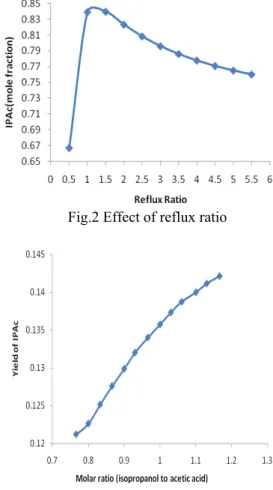
Effect of reflux ratio and feed ratio of isopropanol to acetic acid on product purity is shown in Figures 2 and 3. As seen in these figures, isopropyl acetate initially increases very rapidly and then becomes almost constant up to reflux ratio of 1.5 and then decreases rapidly with increase in reflux ratio. An explanation for this phenomenon can be derived from separation characteristics of the column. At low reflux ratio, insufficient separation of the products from the reaction zone limits the conversion. At high reflux ratios, the reactants are separated much effectively from each other, thus limiting
conversion. The result shows that reflux ratio of 1.5 is found to be optimum for getting the highest composition. In Figure 3, isopropyl acetate yield increases continuously with increase in molar ratio of isopropanol to acetic acid in feed. The result shows that a slight excess of isopropanol is favorable because it facilitates liquid-liquid separation.
Fig.2 Effect of reflux ratio
Fig.3 Effect of feed ratio of isopropanol to acetic acid
III. QUADRATIC DYNAMIC MATRIX CONTROL Dynamic Matrix Control (DMC) cannot be applied for constrained control of the process as it is based on the unconstrained optimization of current and future moves. The combination of a linear model and a quadratic objective function lead to an analytical solution for the control moves. However in practice, constraints on manipulated inputs can be very important. Fortunately, DMC is easily formulated to explicitly handle constraints by using quadratic programming (QP); the method is known as quadratic dynamic matrix control. QDMC is based on the following quadratic programming problem [7]:
u F u u) A Γ(E u) A
(E
2 ,...
,
,min1 2 ( )
0
T T
u u u
(1) subject to
umin≤ui≤umax , i=0,1,…, Nc -1
(constraint on manipulated variable)
Δumin≤Δui≤Δumax , i=0,1,…, Nc -1
(constraint on control move) ymin≤yi≤ymax, i=1,…, Np
where E is the error vector defined as follows:
E=ysp - yP – ε (2)
ysp is the set point, ε is the error between measured and predicted value of y(t0). yP is the prediction vector, which
consists of the effects of past manipulated variable changes on future controlled variable values. A is the dynamic matrix consisting of step response coefficients.
Γ and F are the weight matrix and move suppression matrix, respectively; Γ penalizes the error between set point and the controlled variable whereas F suppresses the control moves.Γ and F are diagonal matrices containing Γi and fi on their diagonal respectively. Ncand Np are the control horizon and prediction horizon. The first constraint can be written in terms of control moves as follows:
1 1 min 1 min 1 min 1 1 1 0 . . . . 1 ... 1 1 1 . . 0 ... 0 1 1 0 ... 0 0 1 c c c c
c N N N N
N u u
u u u u u u u
or, –BΔu ≤ -umin + u-1 (3)
and 1 1 max 1 max 1 max 1 1 1 0 . . . . 1 ... 1 1 1 . . 0 ... 0 1 1 0 ... 0 0 1 c c c c
c N N N N
N u u
u u u u u u u or, BΔu ≤ umax – u-1 (4)
where u-1 is the manipulated variable one time interval
before the current instant. The constraint on output variable can be simplified as follows:
Since ŷ = ysp – E + AΔu
Therefore ymin ≤ ysp – E + AΔu ≤ ymax
–AΔu ≤ ysp – E - ymin and AΔu ≤ ymax - ysp + E
These constraints can be written in the compact form as follows: E y y y E y u u u u u A A B B sp sp max min 1 max min 1 (5) Np, Nc, Γ, and f can be treated as tuning parameters for QDMC.
In the present study, the lower and upper bounds on manipulated variable (reflux ratio) were taken as -2 and 2, the lower and upper bounds on control moves as -0.2 and 0.2, and the lower and upper bounds on controlled variable (ethyl acetate composition in the distillate) as -0.2 and 0.2, respectively.
IV. RESULTS AND DISCUSSION
The control scheme of the distillation column is as shown in Figure 4. The distillate composition is controlled by the reflux rate. The liquid levels in the reboiler and reflux drum are assumed to be controlled perfectly by employing a suitable PID controller. The feed is assumed to enter on a single tray. However, the product purity can be enhanced by having different feed locations for acetic acid and isopropanol. AT FC FT AC LT LC L D B Feed
Fig. 4. Schematic diagram of distillation column control
A MATLAB® code was written for QDMC of the reactive distillation column. Figure 5 shows the QDMC response of reactive distillation column for a step change (0.2, 0.1, -0.1, -0.2) in the set point of the isopropyl acetate mole fraction in the top product. The result shows that QDMC control the distillate composition in the presence of set point changes (ysp). The value of move suppression factor, control horizon,
and prediction horizon were taken as 0.03, 3, and 5, respectively. A sampling interval of 100 seconds was chosen. QDMC brings and maintains the controlled variable around the set point after some time. A +5% load change (Figure 6 a) was given in the methanol feed flow rate from 0.4166 to 0.43743 mol/s at 10000 seconds and then again the step change of -5% (Figure 6b) was given in the feed flow rate from 0.4166 to 0.39577 mol /s at time 10000 seconds. When acetic acid feed flow rate increases then initially isopropyl acetate composition increases from 77.7% to78.5% and then after some time is maintained around the set point (77.7%). Similarly, when acetic acid feed flow rate decreases then initially isopropyl acetate composition decreases from 77.7% to 77% and then after some time is maintained around the set point (77.7%). However, the settling time will be less for higher throughput.
(a)
(b)
Fig. 5 QDMC response for several set point changes in isopropyl acetate composition
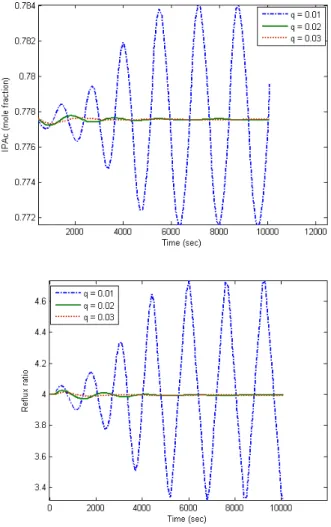
Figure 7 shows a comparison between the responses for different values of the prediction horizon, i.e., 5, 7, and 10. The move suppression factor was taken the same as 0.03 in all these three cases. The higher the value of the prediction horizon, the more aggressive is the controller. For Np=10, the controller shows undesirable sustained oscillations, suggesting the lower value of Np to be used. Figure 8 shows the effect of move suppression factor on the QDMC behavior. The move suppression factor retards the control move and therefore the higher the value of move suppression factor, the more sluggish is the response.
V. CONCLUSIONS
A dynamic simulation was developed for reactive distillation column. Quadratic dynamic matrix control was applied for studying the control methodology on this column. QDMC was found to be efficient for disturbance rejection and set-point tracking. The effects of the prediction horizon and move suppression factor were studied on the control behavior. A good set of the prediction horizon and move suppression factor was found to be 5 and 0.03, respectively.
(a)
(b)
Fig. 6. QDMC response for load change (a) +5% (b) -5%
Fig. 8. Effect of move suppression factor
REFERENCES
[1] R. Kawathekar, J.B. Riggs, “Nonlinear model predictive control of a reactive distillation column”, Control Engineering Practice, vol.15 , 2007, pp. 231–239.
[2] L. S., Balasubramhanya, F. J., Doyle III, "Nonlinear model-based control of a batch reactive distillation column", Journal of Process Control, 2000, vol. 10, pp. 209-218.
[3] M. F., Doherty, M.F., Malone, "Conceptual design of distillation systems", McGraw-Hill, 2001.
[4] L. S., Lee, M.Z., Kuo, "Phase and reaction equilibria of the acetic acid-isopropanol-isopropyl acetate-water system at 760 mmHg ", Fluid Phase Equilibria, 1996, vol. 123, pp. 147-165
[5] G., Venimadhavan, M.F., Malone, and M.F., Doherty, “Bifurcation study of kinetic effects in reactive distillation”, AIChE Journal, vol. 45, 1999, pp. 546-556.
[6] Y., Tang, Y., Chen, H.P., Huang, C.C., Yu, "Design of reactive distillations for acetic acid esterification", AIChE, vol. 51, 2005, pp. 1683-1699.