Printed in Brazil - ©2006 Sociedade Brasileira de Química 0103 - 5053 $6.00+0.00
A
r
ti
c
le
* e-mail: [email protected]
Simultaneous Determination of Palladium, Platinum and Rhodium by On-Line Column
Enrichment and HPLC with 2,4-Dihydroxybenzylidenethiorhodanine as Pre-Column
Derivatization Reagent
Xuechang Dong,a Yong Han,a Qiufen Hu,a,b Jing Chenb and Guangyu Yang*,b
a
Department of Chemistry, Yunnan Institute of the Nationalities, Kunming, 650031, P.R. China
b
Department of Chemistry, Yunnan University, Kunming, 650091, P.R. China
Um novo método para determinação simultânea de íons paládio, platina e ródio, como quelatos metal-DHBTR foi desenvolvido. Os íons paládio, platina e ródio foram derivatizados (pré-coluna) com 2,4-dihidroxibenzilidenotiorodanina (DHBTR) para formar quelatos coloridos. Os quelatos Pd-DHBTR, Pt-DHBTR e Rh-DHBTR são absorvidos na coluna de enriquecimento, quando injetados e transportados por uma fase móvel composta por solução tampão de ácido acético-acetato de sódio 0,05 mol L-1 (pH 3,5). Após o término do enriquecimento, ao acionar
uma válvula de seis vias, os quelatos retidos foram carregados pela fase móvel, para a coluna analítica. A separação dos quelatos na coluna analítica foi satisfatória com acetonitrila 62% (v/ v) (contendo solução tampão de ácido acético-acetato de sódio (0,05 mol L-1, pH 3,5) e 0,1%
(m/v) de tritonX-100) como fase móvel. Os limites de detecção de paládio, platina e ródio são 3,6 ng L-1, 3,2 ng L-1 e 4,5 ng L-1, respectivamente. Este método foi aplicado para a determinação
de paládio, platina e ródio em água, urina e amostras de solo, com bons resultados.
A new method for the simultaneous determination of palladium, platinum and rhodium ions as metal-DHBTR chelates was developed. The palladium, platinum and rhodium ions were pre-column derivatized with 2,4-dihydroxybenzylidenethiorhodanine (DHBTR) to form colored chelates. The Pd-DHBTR, Pt-DHBTR and Rh-DHBTR chelates can be absorbed onto the front of the enrichment column when they were injected into the injector and sent to the enrichment column with a 0.05 mol L-1 sodium acetate-acetic acid buffer solution (pH 3.5) as
mobile phase. After the enrichment had finished, by switching the six ports switching valve, the retained chelates were back-flushed by mobile phase and traveling towards the analytical column. These chelates separation on the analytical column was satisfactory with 62% (v/v) acetonitrile (containing 0.05 mol L-1 of pH 3.5 sodium acetate-acetic acid buffer salt and 0.1% (m/v) of
tritonX-100) as mobile phase. The Limits of detection of palladium, platinum and rhodium are 3.6 ng L-1, 3.2 ng L-1 and 4.5 ng L-1, respectively. This method was applied to the determination
of palladium, platinum and rhodium in water, urine and soil samples with good results.
Keywords: palladium, platinum, rhodium, 2,4-dihydroxybenzylidenethiorhodanine, high
performance liquid chromatography, on-line enrichment
Introduction
Environmental contamination by the platinum group elements (PGEs), mainly related to automotive catalytic converters, is exponentially increasing and reliable and accurate quantification is a mandatory task.1–4 The wide
use of palladium, platinum and rhodium not only in automotive catalytic converters but as a drug (Pt) and in food production (Pd) 5 has led to a more uncontrolled
release of those metals in the environment, with respect to the one due to the traditional chemical industry. Moreover, the platinum group elements derived from automotive catalytic converters are released as nano-crystallites (particles with less than 3 mm in diameter) due to thermal cracking of the catalyser structure and to mechanical abrasion.6,7 Those particles are not blocked
an increase of their level.8,9 The heterogeneous
compo-sition of samples and the low concentration levels of palladium, platinum and rhodium involved make the direct measurement of analytes really difficult. Several analytical techniques have been employed with this matrix in recent years and most of the advantages and drawbacks have
been reviewed.10-20 In previous work, some high
performance liquid chromatography method for the determination of platinum group metals with deriva-tization has been reported. This has been proved to be a favorable and reliable technique.17-23 However, the routine
chromatographic methods have some disadvantages. The used derivatization reagents can not react with palladium, platinum and rhodium simultaneously,17,18 or with low
sensitivity,19,20 or need long time heating for a complete
reaction.23
In our previous work, 2,4-dihydroxybenzylidene-thiorhodanine (DHBTR) was synthesized, and it color reaction noble metal ions was carefully studied. This reagent is high sensitivity for noble metal ions.24 In this
paper, the DHBTR was used as pre-column derivatization regents for palladium, platinum and rhodium, and a
ZORBAX Stable Bound analysis column (4.6×150 mm,
5 μm) was used for the separation of Pd-DHBTR,
Pt-DHBTR and Rh-Pt-DHBTR chelates on a high performance liquid chromatography equipped with on-line enrichment technique. This method can be applied to the deter-mination μg L-1 (ppb) level of palladium, platinum and
rhodium ions in water, human urine and soil samples.
Experimental
Apparatus
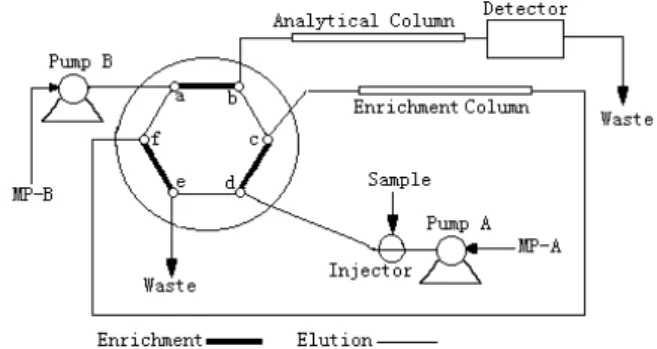
On line column enrichment system used is shown in Figure 1. This system includes a Waters quadripump, Waters 515 pump, Waters 996 photodiode array detector, six ports switching valve, large volume injector (Sample loop is 10 mL) and column. The enrichment column is ZORBAX Stable Bound pre-column (4.6×150 mm, 5 μm)
and the analytical column is ZORBAX Stable Bound
column (4.6×150 mm, 5 μm). The pH value was
determined with a Beckman Φ-200 pH meter.
Chemicals
All of the solutions were prepared with ultra-pure water obtained from a Milli-Q50 SP Reagent Water System (Millipore Corporation, USA). Palladium, platinum and rhodium standard solution (1.0 mg mL-1) was obtained
from Chinese Standards Center, and a working solution
of 0.2 μg mL-1 was prepared by diluting this standard
solution. HPLC grade acetonitrile was obtained from Fisher Corporation, USA. A sodium acetate-acetic acid buffer solution (0.5 mol L-1, pH 3.5) was used. The
DHBTR was synthesized according to our previous work.24
and a DHBTR solution (2.0×10⁻⁴ mol L-1) was prepared
by dissolving DHBTR with 95% ethanol. Mobile phase A: 0.05 mol L-1 pH 3.5 sodium acetate-acetic acid buffer
solution. Mobile phase B: 62% (v/v) acetonitrile (containing 0.05 mol L-1 of pH 3.5 sodium acetate-acetic
acid buffer salt and 0.1% of tritonX-100). All other reagents used were of analytical reagent-grade. The glass and Teflon ware used were soaked in 5% of nitric acid for at least 2 h, and then thoroughly wash with pure water.
Spectrophotometric properties
The absorption spectrum of metal-DHBTR chelates was obtained by measured with a Shimidzu UV-2401 spectrophotometer. Results show that the maximum absorption is 514 nm for Pd-DHBTR chelate, 518 nm for Pt-DHBTR and 512 nm for Rh-DHBTR chelate. Therefore, the 515 nm was selected as detecting wavelength. The molar absorptivity was calculated to be 8.21×10⁴ L mol-1 cm-1 for Pt-HNTR chelate, 7.86×10⁴ L
mol-1 cm-1 for Pd-HNTR chelate, 6.85
×104 L mol-1 cm-1
for Rh-HNTR chelate.
Sample preparation
For water and human urine samples, taking an appropriate volume (planting effluents 20 mL, river water 200 mL, human urine 50 mL) of sample in a 500 mL flask. The samples were concentrated to about 5 mL by Figure 1. On-line enrichment system using the valve-switching technique Pump A, Waters 15 Pump. Pump B, Waters 2690 Alliance quadripump. Sample loop is 10 mL. Six ports switching valve (Waters Corporation). Enrichment Column, ZORBAX (4.6×10 mm, 5 μm). Analytical column,
ZORBAX (4.6×150 mm, 5 μm). Detector, Waters 996 photodiode array
detector. MP A, 0.05 mol L-1 of pH 3.5 sodium acetate-acetic acid buffer
solution. MP B, 62% (v/v) acetonitrile (containing 0.05 mol L-1 of pH=3.5
heating on a hot plate, and transferred into the 25 mL PTFE high-pressure microwave acid-digestion bomb (Fei Yue Analytical Instrument Factory, Shanghai, China). To which, 2.0 mL of concentrated nitric acid and 3.0 mL of 30% (v/v) hydrogen peroxide was added. The bombs were sealed tightly and then positioned in the carousel of the microwave oven (Model WL 5001, 1000 W, Fei Yue Analytical Instrument Factory, Shanghai, China, twelve samples can be digested simultaneously). The system was operated at full power for 6.0 min. The digest was evaporated to near dryness. The residue was dissolved with 5 mL of 5% (m/v) of hydrochloric acid and transferred into a 25 mL of calibrated flask quantitatively, then diluted the solution to volume with 5% (m/v) hydrochloric acid. For soil samples, a 1.0000 g of sample was weighed into a 50 mL of PTFE high-pressure microwave acid-digestion bomb (Fei Yue Analytical Instrument Factory, Shanghai, China). To which, 10 mL of aqua regia was added. The bombs were sealed tightly and then positioned in the carousel of the microwave oven (Model WL 5001, 1000 W, Fei Yue Analytical Instrument Factory, Shanghai, China). The system was operated at full power for 30 min. The digested material was evaporated to incipient dryness. Then, 10 mL of 5% (m/v) hydrochloric acid was added and heated close to boiling to leach the residue. After cooled, the residue was filtrated and the undissolved residue was washed with 5% (m/v) hydrochloric acid for 2 times. The leachate was collected into a 25 mL of calibrated flask quantitatively and diluted to the volume with 5% hydrochloric acid.
Standard procedure
A 0~15 mL of 0.2 μg mL-1 standard or sample solution
was transfered into a 25 mL of volumetric flask. To which, 4.0 mL of 1.0×10⁻⁴ mol L-1 DHBTR solution, 3 mL of 0.5
mol L-1 sodium acetate-acetic acid buffer solution (pH
3.5) and 1.0 mL of 1% (m/v) TritonX-100 solution were added. The solution was diluted to volume with water and mix well. After 10 min, a 10.0 mL of solution was introduced into injector and sent to enrichment column with mobile phase A at flow rate of 2.0 mL min-1. When
the enrichment had finished, by switching the valve of six ports switching valve, the metal-DHBTR chelates, which absorbed onto the foreside of enrichment column, were eluted by mobile phase B at the flow rate of 1.5 mL min-1 in reverse direction and traveled towards the
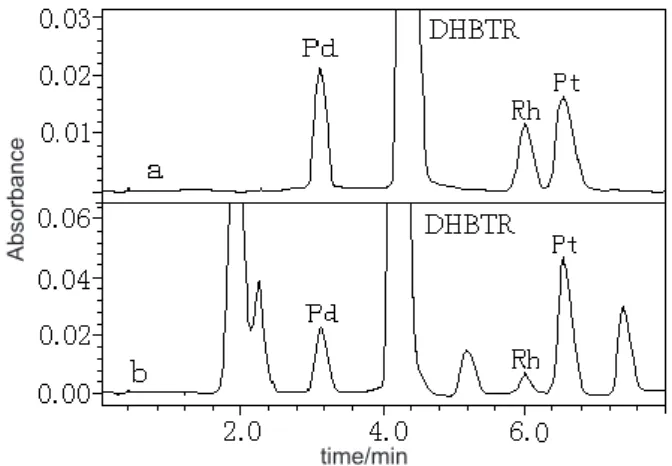
analytical column. The chelates were separated on the analytical column. A three-dimensional (X axis: retention time, Y axis: wavelength, Z axis: absorbance) chroma-togram was recorded from 400~650 nm with photodiode
array detector and the chromatogram of 515 nm is shown in Figure 2.
ICP-MS analysis
The ICP-MS analysis was carried out on a PlasmaQuad-3 ICP-MS instrument (Micromass Corporation, UK) as described according to the liturature.24 The operating
conditions as following: Frequency (MHz) 40.68; R.F. power (KW) 1.2; Sampling depth (mm) 12; Carrier flow (L min-1); Dwell time (ms) 100; Replicate accumulation
20; Channel Width 3; Replicate measurements 3.
Result and Discussion
Precolumn derivation
According to the literature,25 the optimal pH for the
DHBTR reacts with metal ions is 1.6 ~ 5.2 for palladium, 1.4 ~ 3.9 for platinum, and 1.2 ~ 4.2 for rhodium. Therefore, a pH 3.5 sodium acetate-acetic acid buffer solution (0.5 mol L-1) was recommended to control pH.
The experiments show that 0.5 mL of 1.0×10⁻⁴ mol
L-1 DHBTR solution was sufficient to complex 5.0 mg of
palladium, platinum and rhodium, respectively. But in real samples, the foreign ions, such as Hg2+, Pb2+, Cu2+, Ag+
and the like, form complex with DHBTR and consume reagents. Therefore, the amount of DHBTR must be in excess. In this experiment, a 4.0 mL of 1.0×10⁻⁴ mol L-1
DHBTR solution was recommended.
Tween-20 > CTMAB > CPB. Therefore, TritonX-100 was selected as additive in this experiment. The experiments show that the use of 0.6~1.4 mL of TritonX-100 solution give a constant and maximum absorbance in this experiment. Accordingly, 1.0 mL TritonX-100 solution was recommended in this experiment.
The experiment show that DHBTR can react with Pd(II), Pt(II) and Rh(III) rapidly at room temperature. The reaction was complete for 5 min at room temperature, and the complex was stable for at least 6 h.
On-line enrichment
Because the Pd-HNMTD and Pt-HNMTD chelates are stable in weak acid medium. To avoid the chelates decomposing during the enrichment, a 0.05 mol L-1 of
sodium acetate-acetic acid buffer solution of pH 3.5 (mobile phase A) was selected as mobile phase to send the chelates to the enrichment column and a ZORBAX Reversed Phase Stable Bound C18 pre-column (4.6×10 mm, 5 μm) with pH
range 1~11.5 was selected as enrichment column. The aim of the present research was to determine trace metal ions by injecting a large volume of sample. Therefore, the effect of the injection volume was investigated. The proper injection volume is 0.1 ~ 20 mL. If the injection volume was over 20 mL, the chromatographic peaks were obviously broadened or the enrichment column would be overloaded. The volume of 10 mL sample injected was sensitive enough to determine palladium and platinum in samples of this experiment, and 10 mL sample injection was recommended.
Chromatographic separation
The experiments showed that the Pd-DHBTR, Pt-DHBTR and Rh-Pt-DHBTR chelates have a good stability in the presence of weak acid buffer solution and TritonX-100 medium. The pH of mobile phase within 2.9~3.8 and containing a 0.05% ~ 0.2% of TritonX-100 in the mobile phase can avoid the metal-chelate decomposing in the course of separation and get a good peak shape. So acetonitrile/water (62/38, v/v) (containing 0.05 mol L-1 of
pH 3.5 sodium acetate-acetic acid buffer salt and 0.1% of tritonX-100) was selected as mobile phase, and a ZORBAX Stable Bound analysis column (4.6×150 mm, 5 μm) was
selected as analytical column in this experiment.
Calibration graphs
Under optimum conditions, the regression equations of metal-DHBTR chelates were established based on the standard sample injected and its peak areas. The Limits of detection were calculated according to the IUPAC recommendation ((3 x standard deviation blank) / (slope of the analytical calibration curve)). The results were shown in Table 1. The reproducibility of this method was also examined for 10 μg L-1 of Pd(II), Pt(II) and Rh(III). The relative standard
deviations (n=11) were also shown in Table 1.
Interference
According to the literature,25 the pre-column
derivatization conditions, the foreign ions of Cu(II), Hg(II), Pb(II), Tl(III), Bi(III), Ag(I), Au(III) which can reacts with DHBTR to form color chelates. To examine the selectivity of this method, the interference of these foreign ions was investigated. When 4.0 mL of 1.0×10⁻⁴ mol L-1 DHBTR
was used, with 10 μg L-1 of Pd(II), Pt(II) and Rh(III)
respectively, the tolerance amount with an error of ±5% was 2000 μg L-1 for Cu(II), Hg(II), Pb(II), Ag(I) and 800
μg L-1 for Tl(III), Bi(III), Au(III).
Application
This method was applied to determination of palladium, platinum and rhodium in water, human urine and soil samples. The samples were prepared according to the sample preparation section, and the palladium, platinum and rhodium contents were analyzed by using a proper volume of this solution according to general procedure. The results (deducted the reagents blank) were also shown in Table 2. An ICP-MS method as described according to the literature 24 was used as reference method.
The results were also shown in Table 3.
Conclusions
The proposed method has the following characteristic: DHBTR is a sensitive and convenience pre-column derivatization regents for palladium, platinum and rhodium. By on-line enrichment system, a large volume of sample (10 mL) can be injected, and the sensitivity of the method was
Table 1. Limits of detection and linear correlation coefficients
Components Regression Equation Linearity Range (ng L-1) Coefficient Limits of Detection / (ng L-1) RSD% (n=11)
Pd-DHBTR A = 4.58×10⁶ C -1542 12 ~ 8500 r=0.9989 3.6 2.5
Pt-DHBTR A = 4.32×10⁶ C -1647 14 ~ 7600 r=0.9991 3.2 2.9
greatly improved. The Limits of detection of palladium, platinum and rhodium are 3.6 ng L-1, 3.2 ng L-1 and 4.5 ng
L-1, respectively. For the determination of palladium, platinum
and rhodium in water, human urine and soil sample, the relative standard deviations for five replicate samples are 2.8-3.5% for platinum, 2.9-3.1% for palladium, 3.2-3.4% for rhodium. The standard recoveries are 92-94% for platinum, 91-93% for palladium, 89-94% for rhodium. The determination results agree with the reference method (ICP-MS method). The relative standard deviations and the standard recoveries are better then that of reference method. The results are satisfactory.
Acknowledgments
This work was supported by the National Natural Science Foundation of China (20471051) and the Key Natural Science Foundation of Yunnan Province (2005K021).
References
1. Farago, M. E.; Kavanagh, P.; Blanks, R.; Kelly, J.; Kazantzis, G.; Thornton, I.; Simpson, P.R.; Cook, J. M.; Delves, H. T.; Hall, G. E. M.; Analyst 1998, 123, 451.
2. Wei, C.; Morrison, G. M.; Sci. Total Environ. 1994, 146–147, 169.
3. Lucena, P.; Vadillo, J. M.; Laserna, J. J.; Anal. Chem. 1999, 71, 4385.
4. Helmes, E.; Environ.Sci. Pollut. Res. 1997, 4, 100.
5. Savchenko, V. I.; Makaryan, I. A.; Platinum Metals Rev. 1999, 43, 74.
6. Flynn, P. C.; Wanke, S. E.; J. Catal. 1975, 37, 432.
7. Wynblatt, P.; Gjostein, N. A.; Prog. Solid State Chem. 1975, 9, 22.
8. Konig, H.; Hertel, R.; Rosner, G.; Atmos. Environ. 1992, 26A, 741.
9. Palacios, M. A.; Gomez, M.; Sci. Total Environ. 2000, 182, 1. 10. Balcerzac, M.; Analyst 1997, 122, 67R.
11. Georgieva, M.; Pihlar, B.; Fresenius’ J. Anal. Chem. 1997, 357, 874.
12. Godlewska-Zylkiewicz, B.; Zaleska, M.; Anal. Chim. Acta 2002, 462, 305.
13. Krachler, M.; Alimonti, A.; Petrucci, F.; Irgolic, K. J.; Forastiere, F.; Caroli, S.; Anal. Chim. Acta 1998, 363, 1.
14. Jacubowski, N.; Feldmann, I.; Stuewer, D.; Spectrochim. Acta, Part B 1992, 47, 107.
15. Wollenweber, D.; Straaburg, S.; Wunsch, G.; Fresenius’ J. Anal. Chem. 1999, 364, 433.
16. Boulyga, S. F.; Dietze, H. J.; Becker, J. S.; Mikrochim. Acta 2001, 137, 93.
17. Philippeit, G.; Angerer, J.; J. Chromatogr., B. 2001, 760, 237. 18. Gregurek, D.; Reimannb, C.; Stump, E. F.; Environ. Pollut.
1998, 102, 221.
19. Parent, M.; Vanhoe, H.; Moens, L.; Dams, R.; Fresenius’ J. Anal. Chem. 1996, 354, 664.
20. Bruzzoniti, M. C.; Cavalli, S.; Mangia, A.; Mucchino, C.; Sarzanini, C.; Tarasco, E.; J. Chromatogr., A. 2003, 997, 51. 21. Barefoot, R. R.; Vanloon, J. C.; Anal. Chim. Acta 1996, 334, 5. 22. Hoshi, S.; Higashihara, K.; Suzuki, M.; Sakurada, Y.; Talanta
1997, 44, 571
23. Wang, H.; Zhang, H. S.; Cheng, J. K.; Talanta 1999, 48, 1. 24. Dong, S. A.; Chen, J.; Wu, R. L. Analysis Methods of Precious
Metals, 1st ed.; Chinese Science Press: Beijing, P.R. China, pp.
263-268, 2004
25. Yang, G. Y.; Hu, Q. F.; Yin, J. Y.; J. Chinese Chem. Agent (Huaxue Shiji) 2004, 26, 248
26. Yang, G.; Hu, Q.; Huang, Z.;Yin, J.;J. Braz. Chem. Soc. 2005, 6A, 1154.
Received: March 30, 2005
Published on the web: January 13, 2006 Table 3. Determination results of the samples by the ICP-MS method
Samples Found RSD% (n=5) Recovery% (n=5)
Pt Pd Rh Pt Pd Rh Pt Pd Rh
Human Urine a (Occupationally exposed) 0.642 0.263 0.175 3.1 3.4 3.6 92 88 89
Planting effluents a 0.839 1.841 0.178 3.3 3.2 3.5 86 91 87
Soil b (Nearby the highway) 70.2 95.8 26.9 3.4 3.6 3.8 84 94 86
aμg L-1; b ng g-1.
Table 2. Determination results of the samples by the proposed method
Samples Found RSD% (n=5) Recovery% (n=5)
Pt Pd Rh Pt Pd Rh Pt Pd Rh
Human Urine a (Occupationally exposed) 0.658 0.246 0.152 2.8 3.1 3.2 93 91 94
Planting effluents a 0.826 1.832 0.185 3.0 3.1 3.3 92 93 89
Soil b (Nearby the highway) 72.1 93.4 28.5 3.5 2.9 3.4 94 93 91