David P. Gluch
∗, Andrew J. Kornecki
∗AUTOMATED CODE GENERATION
FOR SAFETY-RELATED APPLICATIONS: A CASE STUDY
This paper addresses issues relating to the suitability of using automated code generation (ACG) technologies for the development of real-time, safety-critical systems. This research explored the characteristics of model-based software development methodologies and the au-tomated code generation tools that support them. Specifically, data related to the engineering challenges, skills, and effort associated with ACG practices and technologies were collected as part of a case study. Characteristics such as the generated code’s organization, size, read-ability, traceability to model, real-time constructs, and exception handling were identified. In addition, the case study involved software engineering practices that incorporate integrated analysis and design iterations throughout a model-based development process. The research investigated both the static and dynamic characteristics of the selected techniques and tools, identified characteristics of ACG tools with potential impact on safety, and considered the semantic consistency between representations.
Keywords: Software Enginnering Process, Software Tools, Automatic Code Generation
AUTOMATYCZNA GENERACJA PROGRAMÓW
DLA KOMPUTEROWYCH SYSTEMÓW BEZPIECZEŃSTWA:
PRZYKŁAD STUDIALNY
Artykuł opisuje możliwości zastosowań technologii automatycznej generacji programów (AGP) dla komputerowych systemów bezpieczeństwa. Przeprowadzone badania koncen-trowały się na charakterystykach systemów oprogramowania bazujących na modelowa-niu i automatycznych narzędziach oprogramowania. W szczególności studium pozwoliło na kolekcję danych dotyczących wymagań inżynieryjnych, wiedzy i wysiłku koniecznego do pomyślnej realizacji projektu wykorzystującego praktykę i technologię AGP. Takie charakterystyki, jak organizacja generowanego programu, rozmiar, łatwość czytania, rela-cja między programem a modelem, konstrukcje programu ułatwiające operacje w czasie rzeczywistym i generacja przerwań, były przedmiotem identyfikacji. Dodatkowo, projekt uży-wał metodologii inżynierii oprogramowania, gdzie analiza i konstrukcja były zintegrowane w procesie realizacji programu na bazie modelu. Analiza dotyczyła statycznych i dynami-cznych charakterystyk wybranych technik i narzędzi oprogramowania wpływających na bez-pieczeństwo systemu.
Słowa kluczowe: inżynieria oprogramowania, narzędzia oprogramowania, automatyczna generacja kodu
∗Embry Riddle Aeronautical University (ERAU), Daytona Beach, FL 32114, USA,
gluchd, kornecka @erau.edu
1. Introduction
Software development employing Model-Based Development (MBD) and automated code generation (ACG) from design models has the potential to enhance both the quality of the resulting system and efficiency of the development process. However, safety- and mission-critical systems in aviation, aerospace, medical equipment, trans-portation, nuclear, and weapons system applications require rigorous verification and validation, often under explicit guidelines and standards defined for the application domain. The suitability of ACG techniques for the implementation of such systems within regulated industries is still being discussed. This paper presents the results of investigations into the engineering challenges associated with the application of ACG technologies, specifically focusing on issues related to ensuring the correctness of the code for safety-critical applications.
The main objective of this work has been to investigate and compile software engineering observations on the use of ACG techniques and tools for safety-critical software development using case studies. The compiled data highlight important char-acteristics of MBD methodologies and the ACG tools that support them. The research explored the characteristics of model-based software development methodologies and the automated code generation tools that support them. Specifically, data related to the engineering challenges, skills, and effort associated with ACG practices and technologies were collected. These data can be used to determine whether ACG is a viable approach for the creation of safety-critical systems and whether ACG can provide improved efficiency and effectiveness in design, verification, and validation. The case studies involved software engineering practices that incorporate integrated analysis and design iterations throughout the MBD process.
The research focused on the implementation of generated code on a real-time target processing environment and assessing static and dynamic properties of the generated code. Static analysis involves inspections and reviews of the generated code files. Dynamic analysis uses tools to ascertain the executable run-time parameters. The collected metrics included the number of files generated, lines of code generated, number of functions generated, readability of code, footprint, number of threads, execution time, etc. These data can be used to determine whether ACG is a viable approach for the creation of safety-critical systems and whether ACG can provide improved efficiency and effectiveness in design, verification, and validation.
2. Background
language format. Consistency of the requirements and correctness of specifications are critical issues explored in literature [4, 5]. Model-Based Development languages have became the de factoLingua Francaof modern software engineering. Modern software design tools typically address the use of modeling throughout the development lifecy-cle. These practices rely on the capabilities of Integrated Development Environments (IDE) to produce target software (e.g. automated code generators and compilers).
Software IDE based on various abstract modeling languages (e.g. UML, state machines, finite automata, CSP) are widely used for software development in di-verse applications [2]. In addition, they offer the potential to reduce or eliminate the software construction phase of development by providing automated code generation capabilities. However, the use of these technologies for the development of safety-critical systems presents formidable engineering challenges and design concerns. The issues of assurance and correctness of code generation, specifically as applied to safety critical systems, have been explored widely in literature [1, 3, 7, 11, 13, 14].
The introduction of ACG technologies and practices into safety-critical applica-tions must provide support for traceability throughout the development process and design transparency (visibility and clear definition of the formal foundations for de-sign representations and the transitions among them) at a level sufficient to enable effective independent review and certification. Automated systems often limit the vis-ibility into the engineering processes, specifically restricting observation by human reviewers to pre- and post-transformed artifacts. Sometimes visibility is augmented with narrow access to interim representations. However, the rationale and supporting formalism for transitions are often not evident to a reviewer. For example, in trac-ing/reviewing the transition of a design from source to the machine code produced by a compiler, only the input source text and output compiled source text are available to a reviewer. Occasionally, (e.g. multi-pass compilers) there is some visibility into intermediate representations. However, the core compiler algorithms and optimiza-tion strategies are not evident in the design artifacts and must be determined from tool user guides, on-line help, etc. A misinterpretation of compiler transformation algorithms may result in a failure to recognize design errors.
As models are translated into source code, particularly for real-time safety-critical systems, a significant challenge is to ensure unambiguous, traceable, and transparent mapping of a modeling language’s constructs and constraints into those of source code. In addition to this application model mapping, there must be an unambiguous, traceable, and transparent mapping to a target runtime environment. This execution model mapping involves both general and target specific considerations.
3. Automated Code Generation
In Automated Code Generation well-formed input representations (models) are formed into “source text” using a tool with ACG functionality to facilitate the trans-formation. The process is conceptually comparable to one used in compilation of the source code to machine representation [12]. For the ACG, a well-formed representa-tion may be a set of UML class diagrams, state transirepresenta-tion diagrams, an architecture description language model, or a variety of other modeling artifacts. Various levels of support for this transformation can be provided. The target source code languages (e.g. Ada, C/C++, Java) can be compiled into machine code for download and exe-cution within an application environment.
ACG can be considered as the next logical step in specifying and describing a software system. In earlier computing eras, developers used binary machine guage to represent the required software functionality. Subsequently, assembly lan-guage provided the developers with more human-readable form (which was auto-matically translated into binary code). Another level was introduced with high-level languages (automatically translated into binary through compilers/interpreters). Cur-rently, the use of formalized modeling languages in form of diagrams and other visual representations provide higher levels of abstraction in software engineering. This en-ables developers to focus on the vital elements of the system rather than on mundane coding. Code generators handle the translation from graphical model to high-level language representation. The level of abstraction is now raised to the point where the system/software architects and designers can contribute more to the engineering solution.
the detailed implementation code. Several tools are based on a proprietary internal language, a formal notation supporting a specific code generation paradigm.
The tools allow a user to create models of the software structure and behavior that the tools convert into modules of source code. The accepted approach is to create dedicated modules for each graphical block that could be used in the model. The generated program instantiates the macros and stitches together the inputs to the outputs of the blocks. The code generation needs to be analyzed to show direct mapping of the model as entered by the designer and the generated code. For many modern tools one needs to select only a subset of the available modeling components to assure easy mapping to the generated code. It is necessary to analyze the limits and constraints in terms of the number of components, connections, hierarchy levels, etc.
Despite widespread use of ACG tools, such issues as inconsistency of the behav-ior of the modeled system due to the nature of the model representation [10] and effectiveness of the ACG tools use in safety critical systems [8, 9] still require further investigation.
4. Project methodology
A Power Boat Autopilot (PBA), a system that controls the dynamics of a small pow-ered watercraft, was selected as the case study for the project. The PBA involved concurrency, real-time constraints, and closed-loop behavior as well as safety-critical requirements. To implement the system, three commercial tools with ACG function-ality were selected. The selection was based on the tools availability, level of use in industry, and modeling approach. The tools represented both object-oriented (UML 2.0) and structured approaches but all three are capable of producing C-language code.
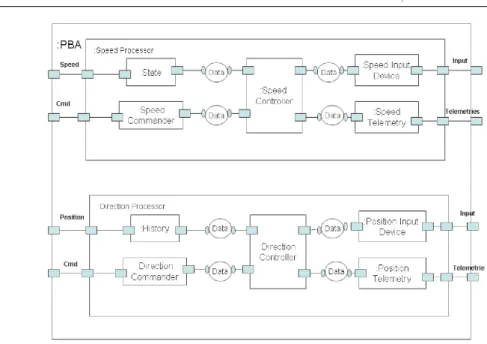
Common software architecture for the PBA was created (Fig. 1). Three de-velopers, graduate students of software engineering program, usedStatemate 3.3, Rhapsody 5.2and Matlab 7.0.1to implement this common design and generate C-language code. Each developer was responsible for modeling the system, generat-ing, compilgenerat-ing, and downloading the code to a real time target environment, and conducting the planned static and dynamic analysis on the model.
The primary representation of the common architecture was different in each of the tools. In Matlab, Stateflow diagrams and finite state machine representa-tions were used to model the system. InStatemate, the common architecture was mapped into an activity diagram. InRhapsody for C, class diagrams are required to represent a top-level view of the system, even though the tool does not generate object-oriented code. While there are differences in their modeling approaches, all of the tools generate source code in the C language.
Fig. 1.Case Study Common Architecture
Static inspections and reviews of the code generated by the tools were conduct-ed. These provided quantitative and qualitative (including readability, organization, modularity) information about the generated code. The quantitative metrics (e.g. lines of code, number of functions) were determined from the code. The code inspec-tion also provided informainspec-tion on real-time and concurrency constructs. For instance, scheduling approaches (priority based or cyclic execution) can be identified in the code. Multithreading and concurrency, synchronization and mutual exclusion could be explored and identified in the code.
Dynamic analysis included exploration of the run-time environment. The gener-ated code was compiled and downloaded to a real-time target and executed. Some characteristics of the executable (footprint, number of threads, timing) were assessed by tool-supported observation of the run-time behavior, monitoring the presence of multitasking, and assessment of priorities, memory utilization, etc.
5. Considerations in safety-critical systems
Table 1
Tool characteristics supporting rigorous development with a focus on safety
Category Description/Question
Exception Handler Design Support
Does the tool facilitate creation of exception handlers? Is the imple-mentation of those handlers visible to the developer?
Fault Tolerance Constructs Does the tool support or facilitate creation of fault tolerance con-structs?
Safety Components Library Does the tool have any pre-built component libraries with components applicable to safety critical applications?
Range Enforcing Does the tool support, in design and/or runtime, range limitations on variables?
Message Passing What message passing and communication methods does the tool use? Are they visible to the developer?
Formal Language Does the tool use a formal language? If so, what it is it? Is it a standard?
Legacy Import Can the tool import legacy code or integrate with it in some way?
Real Time Support Does the tool have any timing constructs? Does it facilitate testing the meeting of deadlines?
Analysis Support What support does the tool include for analysis of the models?
Syntax Checking What syntax checking capabilities does the tool have?
Loop Condition Checking Does the tool check for infinite loops?
Deadlock and Livelock Can the tool detect deadlock or livelock in the behavioral models?
Dead Code Checking Does the tool check for dead code or unreachable states in state ma-chines?
Deterministic Checker Does the tool check the behavioral models for determinism?
Memory Usage Prediction and Analysis
Can the tool predict overall memory usage? Can it track actual memory usage?
Memory Protection Does the tool allow for memory protection and separation of processes in the design?
Performance Prediction and Analysis?
Can the tool predict performance? Can it track actual performance?
Simulation Based Analysis Does the tool have simulation capabilities?
Extended Simulation Support
Does the tool support long-term and multi-run execution simulation?
Simulation Coverage Tracker
Does the tool track coverage in the simulation, inputs, outputs, condi-tions, paths, etc.?
Stress Testing Support Does the tool perform stress testing?
Fault Injection Analysis Does the tool support fault injection?
Testing Support Does the tool integrate with any testing tools?
Hazard Analysis Tools Does the tool integrate with any hazard analysis tools?
Requirements Management Tools
Does the tool integrate with any requirements management tools?
Reliability Analysis Tools Does the tool integrate with any reliability analysis tools?
Traceability Does the tool provide any traceability between requirements and mod-els?
Requirements Validation Does the tool support verification or validation to check models against requirements?
Compiler Selection Can the developer to choose a specific compiler to work with the tool?
Compiler Integration Is the tool flexible to allow developers select the compile options?
6. Experimental results
The use of MBD allowed system structure and functions to be captured quickly and enabled the production of easily understood models. The models facilitated commu-nication of key architectural issues among team members. Team members could help each other since the representations of the system were straightforward, even though team members used different tools and methodologies. Problems with the system were quickly found and eliminated using the analysis features of the tools.
Each tool required varying levels of detail, yet all demanded too much detail for the architectural level. For example, when creating a class with one tool, the developer is required to express the exact type of an attribute (even though it may not be known or prudent to decide upon the type so early in the design). The separation of concerns and judicious postponement of design decisions are not strictly enforced in the tools. A common thread among all of the tools was that a visual representation of a system, at any given point, may or may not represent the complete model of the system resident in the tool. However, at times a developer may be convinced that what is being shown is everything that exists. This may lead to misunderstandings and errors in the system design. An example is creating an association between classes. When the association line is drawn, changes occur to the model and the classes are associated. If that line is then deleted in the visual representation, the only change is that the line is no longer shown in the visual presentation. The association and all that it implies still exist in the system model unless it is removed via another explicit action. This demonstrates the need for a sound knowledge of the tool.
For qualitative measures code readability, traceability to the model, location and content of comments were used. For quantitative analysis the number of lines of code, total size of object file, and the number of functions generated were measured. For this particular example,Statemategenerated the least amount: 680 LOC, with Rhap-sodyand Matlab generating 1,356 LOC and 3,656 LOC respectively. In addition, many of the comments in the generated code did not clearly explain the original design constructs. For example, they specify the beginning and end of files. To fully under-stand the generated code, a user must underunder-stand how each function is generated, since this information is not provided in comments.
Table 2 summarizes these results.
Downloading executable code to a target system for each of the tools involves different procedures and requires substantial knowledge of the target execution en-vironment (e.g. the target operating system). Two of the tools allowed the user to connect and run directly from them. Another required running the code directly from the target using an addition to the dedicated target. One key lesson learned in the research is the importance of interoperability. Each of the tools should have clearly defined and working interfaces with other tools and environments (compilers, linkers, loaders, operating system etc.).
the system could be identified. Similarly, in another case, when running the software on a real-time target and using a logic analyzer it was clear what concurrent threads corresponded to the active objects defined in the model. In others, the user cannot see what task corresponds to what active class. In general low level transparency is much less effective. For example, when trying to determine when individual functions are called, started or stopped, the user cannot see these events. In general, a supporting tool was required to identify the code execution sequence.
Table 2
Aggregate Results of the Analysis
Statemate3.3 Rhapsody5.2 Matlab7.0.1 # of .c and .h files 4(.h) and 3(.c) 5(.h) and 5(.c) 6(.h) and 3(.c)
Readability
Consistent naming Yes Yes Yes
# of Comments Low Low Low
Comment rationale Yes Yes Yes
Location of Comments End of function and files
Per attribute and methods section
Start of every function
Explanatory No No No
Model to Code
Constructs Evident Evident Evident
LOC 680 1356 3656
Concurrency Constructs No No No
# of Tasks Spawned 1∗ 3 3
ForMatlab, the number of tasks in the target software is equal to the number of different sample time rates defined for Stateflow bloks expressed as a statechart in the model. It may have a separate thread of execution associated with each thread. However, a block cannot have multiple sub threads for parallel states inside the stat-echart. Matlab requires specific parameters to be set during model configuration to generate code handling multitasking. The tasking mode in configuration settings needs to be set to multitasking. An interesting observation while experimenting with this facility was that if the model does not have different sample rates, the multitask-ing functionality does not work. It gives a compilation error requestmultitask-ing to use at least two different sample rates.
One general observation is the importance of documentation. The documenta-tion must be specific and well understood, especially regarding how the code generator works and how to interface with other environments and tools. This is the key for efficiently using the tool and in understanding, manipulating, and analyzing the gen-erated code.
Table 3
Effort Analysis
TOOL Modeling Compiling and Downloading
Static
and Dynamic Analysis Administrative
Statemate 15% 39% 16% 30%
Rhapsody 10% 42% 15% 33%
Matlab 20% 50% 12% 18%
It is interesting to note the relatively high effort on creating the code and down-loading to the target. While tools make the model development and analysis activities quite user-friendly, the creation of executable code requires good knowledge of run-time environment and the idiosyncrasies of the host-target. We anticipate that for more experienced users of the tools, the percentage of time in the compiling and downloading category would be less. Many of the problems encountered in this case study resulted from mistakes with and misunderstandings of the tool. This situation was not unexpected, since the researchers did not have experience with the tools prior to the start of the project.
A number of technical problems occurred during the compiling process with the tools. In one case, it was possible to generate ANSI C code from the model but the generated make files did not work. This resulted mismatches of syntax, for example ‘/’ is used as path recognition instead of ‘\’ and options are identified by ‘opt’ and not as ‘-opt’ (therefore options are treated as folders and not as compiler options). Once these problems were identified and addressed, scheduler libraries were recognized.
7. Conclusions
Increasingly, handcrafting of source code is being replaced by more sophisticated development practices (e.g. MBD) that are supported by tools with some form of automated code generation capabilities. Features of these practices and tools that en-sure determinism, correctness, robustness, and conformance to standards are crucial to overall system quality. In addition, for the development of safety-critical systems, traceability and transparency of the design and implementation artifacts throughout the complete engineering process are vital to complying with industry and certifica-tion standards. In adopting new technologies or practices, management and technical members of organization must recognize these requirements.
de-velopment phase to another can be a starting point to make the arguments about tool quality and usability in a regulated industry.
Different skills and knowledge will be required for the adoption of the MBD practices. The expert at abstract modeling (abstractionists) will be a dominant pro-fessional within MBD practices, supplanting the central position held by a skilled programmer in manual code development practices. These abstractionists understand the foundations of software systems architecture, modeling techniques, the implication of the selected solution on the resulting code, and the relation between the abstract development environment and the runtime execution environment of a target system.
Acknowledgements
The authors acknowledge the support of the CRM Guidant and the contribution of Ste-fano Grimaldi, Soma Mitra, and Sona Johri, graduate students in the ERAU Master of Software Engineering program, in the research leading up to this paper.
References
[1] Denney E., Fischer B., Schumann J.: Adding Assurance to Automatically Gen-erated Code. Proceedings of Eighth IEEE International Symposium on High As-surance Systems Engineering (HASE’04), March 2004
[2] Federal Aviation Administration, Software Tools Forum, Embry Riddle Uni-versity, Daytona Beach, Fl., May 2004 http://www.erau.edu/db/campus/ softwaretoolsforum.html
[3] Halbwachs N., Raymond P., Ratel C.: Generating efficient code from data-flow programs. Third International Symposium on Programming Language Implemen-tation and Logic Programming, Passau (Germany), August 1991
[4] Heitmeyer C. L., Jeffords R. D., Labaw B. G.: Automated Consistency Checking of Requirements Specifications. ACM Transactions of Software Engineering and Methodology, 5(3):231–261, July 1996.
[5] Hohman W.: Supporting Model-Based Development with Unambiguous Specifica-tions, Formal Verification and Correct-By-Construction Embedded Software. SAE World Congress, Detroit, MI, 2004, March 8–11
[6] Humphrey W.: Introduction to the Personal Software Process. Addison-Wesley, Reading, Mass, 1994
[7] Keenan D. J., Heimdahl M.:Code Generation from Hierarchical State Machines. Proceedings of the International Symposium on Requirements Engineering, 1997 [8] Kornecki A., Zalewski J.:Experimental Evaluation of Software Development Tools for Safety Critical Real-Time Systems. NASA Journal Innovations in Systems and Software Engineering, July 2005
[10] Kornecki A., Erwin J.:Characteristics of Safety Critical Software. Proceedings of the 22nd International System Safety Conference, System Safety Society, ISBN 0-9721385-4-4, Providence, RI, August 2004
[11] O’Halloran C.: Issues for the Automatic Generation of Safety Critical Soft-ware. 15th IEEE International Conference on Automated Software Engineering (ASE’00), 2000
[12] Stepney S.:High Integrity Compilation. Prentice Hall, 1993