REVISTA
BRASILEIRA
DE
ANESTESIOLOGIA
OfficialPublicationoftheBrazilianSocietyofAnesthesiologywww.sba.com.br
SCIENTIFIC
ARTICLE
Changes
in
the
distance
between
carina
and
orotracheal
tube
during
open
or
videolaparoscopic
bariatric
surgery
Giovani
de
Figueiredo
Locks
a,∗,
Maria
Cristina
Simões
de
Almeida
a,
Maurício
Sperotto
Ceccon
b,
Karen
Adriana
Campos
Pastório
aaUniversidadeFederaldeSantaCatarina(UFSC),Florianópolis,SC,Brazil
bUltralithoCentroMédico,Florianópolis,SC,Brazil
Received14December2012;accepted1March2013
Availableonline3April2014
KEYWORDS
Endotracheal intuba-tion/complications; Obesity;
Bariatricsurgery; Pneumoperitoneum; Laparotomy
Abstract
Objective: Toexaminewhethertherearechangesinthedistancebetweentheorotrachealtube andcarinainducedbyorthostaticretractorplacementorbypneumoperitoneuminsufflationin obesepatientsundergoinggastroplasty.
Methods:60 patientsundergoingbariatricsurgerybytwo techniques:open(G1)or videola-paroscopic(G2)gastroplastywerestudied.Aftertrachealintubation,adequateventilationof bothhemitoraxeswasconfirmedbylungauscultation.Thedistanceorotrachealtube---carina wasestimatedwiththeuseofafiberbronchoscopebeforeandafterinstallationoforthostatic retractorsinG1orbeforeandafterinsufflationofpneumoperitoneuminpatientsinG2. Results:G1wascomposedof22andG2of38patients.Nocasesofendobronchialintubation weredetectedineithergroup.Themeanorotrachealtube---carinadistancevariationwas esti-matedin−0.03cm(95%CI0.06to−0.13)inthegroupofpatientsundergoingopengastroplasty andin−0.42cm(95%CI−0.56to−1.4)inthegroupofpatientsundergoingvideolaparoscopic gastroplasty.Theextremesofvariationineachgroupwere:0.5cmto−1.6cminpatients under-goingopensurgeryand0.1cmto−2.2cminpatientsundergoingvideolaparoscopicsurgery. Conclusions: Therewasnosignificantchangeinorotrachealtube---CAdistanceafterplacement oforthostaticretractorsinpatients undergoingopengastroplasty.Therewasareductionin orotrachealtube---CAdistanceafterinsufflationofpneumoperitoneuminpatientsundergoing videolaparoscopicgastroplasty.We recommendattentiontolungauscultationandtosignals of ventilation monitoringand reevaluation oforotracheal tube placement after peritoneal insufflation.
© 2014SociedadeBrasileirade Anestesiologia.Publishedby ElsevierEditoraLtda.Allrights reserved.
∗Correspondingauthor.
E-mail:[email protected](G.deFigueiredoLocks).
Obesidade; Cirurgiabariátrica; Pneumoperitônio; Laparotomia
Resumo
Objetivo:Analisar sehá mudanc¸as nadistância entre o tuboorotraqueal (TOT) ea carina (CA)induzidaspeloafastadorortostáticooupelopneumoperitônioempacientesobesos sub-metidosagastroplastia.
Métodos: foramestudados60 pacientessubmetidos à cirurgia bariátricaporduastécnicas: aberta(G1)ouvideolaparoscópica(G2).Apósaintubac¸ãoorotraqueal,aventilac¸ãoadequada deambososhemitóraxfoiconfirmadapormeiodaauscultapulmonar.AdistânciaTOT-CAfoi esti-madacomousodeumfibrobroncoscópioanteseapósainstalac¸ãodosafastadoresortostáticos noG1ouanteseapósainsuflac¸ãodopneumoperitônionospacientesnoG2.
Resultados: IntegraramoG1 22 pacientese 38 oG2. Nãohouve casosde intubac¸ão endo-brônquicaemnenhumdosgrupos.Amédiadevariac¸ãodadistânciaTOT-CAfoi-0,03cm(95% IC0,06a −0,13)nogrupodospacientessubmetidosàgastroplastiaaberta e−0,42cm(95% IC−0,56a−1,4)nogrupodospacientessubmetidos àgastroplastiavideolaparoscópica.Os extremosdevariac¸ãoemcadagrupoforam:0,5cma−1,6cmnodospacientessubmetidosà cirurgiaabertae0,1cma−2,2cmnodospacientessubmetidosàcirurgiavideolaparoscópica. Conclusões:Nãohouvealterac¸ãosignificativanadistânciaTOT-CAapósinstalac¸ãodos afasta-doresortostáticosnospacientessubmetidosàgastroplastiaaberta.Houvereduc¸ãonadistância TOT-CAapósainsuflac¸ãodopneumoperitônionospacientessubmetidosàgastroplastia videola-paroscópica.Sugerimosatenc¸ãoàauscultapulmonareaossinaisdemonitorac¸ãodaventilac¸ão ereavaliac¸ãodoposicionamentodoTOTapósinsuflac¸ãoperitoneal.
©2014SociedadeBrasileiradeAnestesiologia.PublicadoporElsevierEditoraLtda.Todosos direitosreservados.
Introduction
Afterintubation,theadvancementoftheorotrachealtube (OTT)beyondthecarinaresultsinventilationofonlyoneof thelungs.Thiscondition,knownasendobronchialintubation or selective intubation, can cause hypoxemia, hypercap-nia or excessive intrapulmonary pressure and potentially causesecondary damage,suchasbrain injuryor tracheo-bronchial rupture, especially in the presence of other comorbidities,suchaspneumothorax, shock or trauma.1,2
Endobronchialintubationisthemostcommoncauseof arte-rial desaturation.3 The chest five-point auscultation has
beenthetraditionalmethodofconfirmingOTTposition.4
A method developed for the study of the tracheo-bronchial tree is fiberoptic bronchoscopy. It is considered arapid,safe,andcost-effective diagnosticmethod.5 Asa
confirmatorymethodforOTTposition,theprocedureis con-ductedthroughOTT,andthedirectvisualization ofcarina candetectanincorrectpositioningofthetube.6
The aim of this study was to examine whether there are changes in the distance between OTT and carina (OTT---CA) induced by the orthostatic retractor or by pneumoperitoneumin obese patients undergoing open or videolaparoscopicgastroplasty,respectively.
Method
After approval of the protocol by the Ethics and Human Research Committee (00232.1208-11) and after the sig-nature of informed consent, patients of both genders between 18 and 60 years, ASA physical status I, II or III andbodymassindexgreaterthan35kgm−2whounderwent bariatricsurgeryunder generalanesthesiawere included.
The sample consisted ofpatients undergoingopen gastro-plasty in a university hospital and of patients undergoing videolaparoscopic gastroplasty in a private institution, accordingtotheroutinesurgicaltechniquesinthe respec-tiveinstitutions.Pregnantorlactatingwomen,patientswith tracheobronchialdeformity,patientswithimpaired preop-erative lung auscultation and patients with a history of hypersensitivitytothedrugsasperprotocolwereexcluded fromthestudy.
Patients did not receive premedication. All were pos-itionedwithpillowsinthechest,neckandheadtoalignthe sternalnotchandtheexternalauditorymeatus.7Monitoring
with pulse oximetry, noninvasive blood pressure, capnog-raphy and cardioscopy were used. All patients received 100%oxygenbyfacemaskfor 3min.Inductionof anesthe-sia consisted of remifentanil 0.3gkg−1min−1 (according
to idealweight) andpropofol 2mgkg−1 (according to the actualweight).Afterlossofconsciousness,succinylcholine wasadministeredat adose of1mgkg−1 (accordingtothe actualweight).
Figure1 Bronchoscopepositionedadjacent tothetracheal carina.
lidocainehydrochloride2%gel byan anesthesiologistwith more than two years of experience with the procedure. We used one valve connector, allowing that the fiberop-tic bronchoscopy was done without interrupting patient’s ventilation.
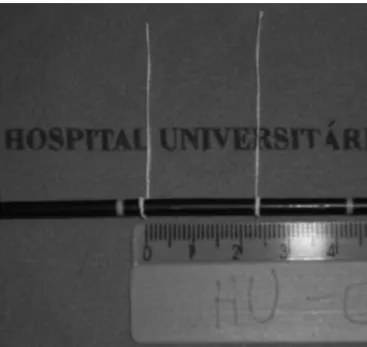
Thecorrectpositionofthetubewasconfirmedby visu-alization of the tracheal carina and the introduction of fiber bronchoscopein both main bronchi. The upper lobe bronchusorificeoftherightlungafterthetrachealcarina bifurcationwasusedastheprimaryanatomicrepair.The dis-tancefromthetipoftheendotrachealtubetothetracheal carinawasestimatedasfollows:thefiberbronchoscopewas placedonthecarina(Fig.1)andwasmarkedwithastripof adhesivetapeintheproximalportionneartheproximalend ofOTT.Then,thebronchoscopewaspulleduntilthedistal tipof OTT wasvisualized and the fiberscopewas marked by the same method (Fig. 2). The OTT---CA distance was estimatedasthedistancebetweenthetwotapes(Fig.3).
The lung auscultation and the estimated OTT---CA dis-tance were repeated after the installation of orthostatic retractorsinG1patientsorafterpneumoperitoneum insuf-flationinG2patients.
The sample size was estimated to be of at least 22 patients for each group,the numberrequired for a alpha error of5% anda betaerror of 20%,according toan ear-lier study that found an OTT drive of 0.7±1.4cm after insufflation ofpneumoperitoneum andaiming todetect a reductionof1cminOTT-CAdistance.8Thedatawerestored
inadatabaseinMicrosoftOfficeExcelv.7.0(Microsoft, Seat-tle).Subsequently,theanalyseswereperformedusingIBM SPSSStatisticsv.17.0software.Statisticalsignificancewas consideredatp<0.05.
Figure2 Endoscopicviewofthedistalendoftheorotracheal
tubeintothetrachea.
Figure3 Estimateddistancebetweentheorotrachealtube
andthecarina.
Dataare shown as mean(standard deviation) or abso-lutefrequency(relativefrequencyorpercentage).Toverify theassociationamongqualitativevariablesbetweengroups, theFischer ttest wasused.To analyze the differenceof quantitativevariablesbygroups, Student’sttest was per-formed.TostudythedifferencebetweenOTT---CAdistance measurements before and after orthostatic retractors or pneumoperitoneum,thettestforpairedmeasurementsand Bland---Altmananalysiswereused.
Results
Ofthe60enrolledpatients,38underwentopengastroplasty and22underwentvideolaparoscopicbariatricgastroplasty. No patient was excluded from analysis for orotracheal intubation (OTI) or fiberoptic bronchoscopy failure. The demographic characteristics of the sample are shown in Table 1. Significant differences were observed between groupsin BMIandgendervariables. Thegroup ofpatients undergoingopensurgeryhadhighermeanBMIandahigher proportionof women in relation tothe group of patients undergoingvideolaparoscopicsurgery,withatrendtoolder age.
In this study, nochanges in lung auscultation or cases ofselectiveintubationwereobserved atany timein both groups.
Table2showsdataconcerningmeasurementsofOTT---CA distanceshortlyafterOTIandafterplacementoforthostatic retractorsorpneumoperitoneuminsufflation.
Age(years) 35±9.8 31.41±5.9 0.12
Gender(M/Fa) 6(16%)/32(84%) 8(36%)/14(64%) 0.001
BMIb(kgm−1) 46.9±6.1 38.7±4.7 <0.0001
aM/F,male/female. b BMI,BodyMassIndex.
Table2 Distancebetweentheorotrachealtubeandthecarinainbothgroupsimmediatelyafterintubationandafterplacement oforthostaticretractorsorinsufflationofpneumoperitoneum.
Afterintubation Afterretractor/pneumoperitonium p-Value
Opensurgery(n=38) 3.3±1.3 3.2±1.3 0.37
Videolaparoscopicsurgery(n=22) 2.8±0.7 2.4±0.6 <0.001
variations of OTT---CA distance after placement of ortho-static retractors and peritoneal insufflation, respectively, arearranged.
Discussion
In this study,the most strikingfinding is the significantly greaterreduction inthe distance betweenthe tipof OTT andthe carina after insufflation of pneumoperitoneumin videolaparoscopicgastroplasty,whencomparedtoopen gas-troplasty.Asaconsequence, onecanspeculatethatthere isahigherriskofendobronchialintubationinthe transop-eratoryphaseofa videolaparoscopicsurgerycomparedto patientsundergoingopensurgery.
Endobronchial intubation is an important problem in anaesthesiology and is closely associated with increases in morbidity.1---3 This condition is the fourth most
com-monincident ofgeneralanesthesiaandthemostcommon incident involving OTT.3 Among the more severe
conse-quences,hypoxemia,atelectasisofthenon-ventilatedlung andhyperinflationoftheventilatedlungwiththepossibility ofpneumothoraxareobserved;3tracheobronchialruptures,
unilaterallungedemaandhemodynamicchangesfollowed bybraindamageanddeathhavealsobeendescribed.1,2
Althoughlungauscultationisthemain clinicalcriterion forthediagnosisofendobronchialintubation,studieshave suggestedcertaininaccuracyofthemethod.6,8---11OTTshifts
without changes in the pattern of lung auscultation were observed in patients whose tip of the tube exceeded the carina up to 3.2cm.9 When compared to other
diagnos-ticmethod,bilateralauscultationofthechestwasableto detect only twocases of selective intubation in patients undergoingvideolaparoscopiccholecystectomyamongeight cases confirmed by chest radiography.11 The low
sensitiv-ity of lung auscultation can be explainedby thethoracic transmissionof lung sounds when theybecomeof a more bronchial qualityduring mechanical ventilation --- a situa-tionthatmaybeexacerbatedinthepresenceofanatomical abnormalities of the chest, suchaslarge breasts, obesity andpiriformchest.3
Signs of selective intubation include changes in peak inspiratory pressure, arterial desaturation and changes in concentrationsofcarbondioxideincapnography.3,6,12These
changes,however,areconsiderednonspecificandtheirfirst manifestations maybesubtle, not causing alarm.3,13 Only
11.5% of cases of selective intubation presented capno-graphicchanges,withoutconcomitantrecordingofchanges inpeakinspiratorypressure.Theuncertaintyofthe symme-tryoflungauscultation,thepresumptionofthepossibilityof
Open surgery Videolaparoscopic surgery
1.0
0.0
−1.0
−2.0 1.0
0.57 0.59
−0.43
−1.45
−0.03
−0.63 0.0
−1.0
−2.0
OTT-carina distance variation (cm)
OTT-carina distance variation (cm)
Figure4 Variationsofthedistancefromthetipoftheendotrachealtube(OTT)tothecarinainpatientsundergoingopenor
anydeviceorinstrumentfailureandthedesirenotto inter-rupt thesurgery, aswell asthedifficultyof accesstothe thoracicregionduringsurgery,contributetoalatediagnosis ofthecomplication.3
During the transoperatory, the migration of OTT may occurafteritscorrectplacementatthebeginningof anes-thesia,resultingfromchangesinthetiltingoftheoperating table,peritonealinsufflation,flexionoftheheadandneckof thepatientorrepositioningingeneral.Neurological, gyne-cologicalandvideolaparoscopicsurgerieshavehigherrates ofendobronchialintubation,andathirdofcasesare associ-atedwithsurgeriesinvolvingtheheadandnecksegment.3
The high incidence of selective intubation in neuro-surgery is mainly related to the prone position and/or movement of the head and neck of the patient by the surgeon during surgery. On the other hand, gynecological videolaparoscopicsurgerieshavesignificantassociationwith endobronchial intubation as a result of the pneumoperi-toneuminsufflationwiththepatientinhead-downposition. In these surgeries, a mean reduction of 1.6cm of dis-tancebetweenOTTtipandthecarinaafterinstallationof thepneumoperitoneum(from2.1±0.8cmto0.54±1.4cm) wasreported,witheightcasesofselectiveintubationina sampleof30patientsundergoingvideolaparoscopic gynae-cologicsurgery.14Inthesameline,inastudythatexamined
chestradiographsbeforeandafterperitonealinsufflationat 10mmHg,cephalicdrivesofOTTof1.1±0.4cmasaresult ofincreasedintra-abdominalpressureweremeasured.15
In our study, the use of pneumoperitoneum in obese patients undergoing videolaparoscopic gastroplasty was responsiblefor an OTTdriveof −0.42±0.5cminrelation to the carina, with an extreme reduction of more than 2cm.Besidestheriskofselectiveintubation, pneumoperi-toneumcausesotherimportantconsequencesonpulmonary function. Cephalic migration of the diaphragm is associ-atedwithbothdecreasedfunctionalresidualcapacityand the increased volume of closure of the small airways, which leads toa disturbanceof ventilation/perfusion and toanincreaseofintrapulmonaryshunt.Furthermore, ven-tilatory mechanisms are altered in view of the decrease in lung compliance, with consequent increase in airway resistance.16,17 Obese patients during anesthesia
consti-tute a risk group, since these people already have a reduced functional residual capacity, withairway closure anddisturbanceofventilation/perfusionduringnormaltidal ventilation.7,18,19Thissituationisfurtheraggravatedinthe
presence of comorbidities associated with low pulmonary reservesorheartdisease.18
Studies report that the tip of OTT come close to the carinaafterinstallationofthepneumoperitoneum, witha significantriskofcausingendobronchialintubation.8,14,20---22
Our results are consistent with other studies, in find-ing greater drive of the tip of OTT after insufflation of pneumoperitoneum,whencomparedtopatientsundergoing open surgery. Thus, it appears that the increase in intra-abdominal pressure is a major risk for accidental endobronchialintubationalsoinobesepatientsundergoing videolaparoscopicgastroplasty.
In ourstudy, the use of orthostatic retractors in open gastroplastywasnotassociatedwithsignificantchangesin thedistancebetweenthetipofOTTandthecarina. How-ever, our results should be evaluatedwith caution, since
videolaparoscopicsurgeryhasbeenassociatedwithseveral benefitsinthepostoperativeperiod,suchaslessneed for analgesics,betterlungfunction,bettercosmeticresults,23
lowerrate ofperioperativecomplications,24 minorrateof
abdominalwall complications and shorter hospital stay.25
Adverseeffectsarisingfromtheuseoforthostatic retrac-torsareperipheralnerveinjury,26lesionsofthecolon,27liver
injury28andchronicpain.29
In summary, inobese patients undergoinggastroplasty, insufflationofthepneumoperitoneuminvideolaparoscopic procedures provides greater reduction of the distance betweenthetipofOTTandthecarinacomparedwiththe placement of orthostatic retractors in open gastroplasty. Theresultspointtotheneedforspecialattentiontolung auscultationandtothesignalsofventilationmonitoring,as wellasthe reassessmentof OTTposition afterperitoneal insufflation.
Conflicts
of
interest
Theauthorsdeclarenoconflictsofinterest.
References
1.GoodmanBT,RichardsonMG.Casereport:unilateralnegative pressurepulmonaryedema---acomplicationofendobronchial intubation.CanJAnaesth.2008;55:691---5.
2.EngorenM,deStVictorP.Tensionpneumothoraxand contralat-eralpresumedpneumothoraxfromendobronchialintubationvia cricothyroidotomy.Chest.2000;118:1833---5.
3.McCoyEP,RussellWJ,WebbRK.Accidentalbronchial intuba-tion. AnanalysisofAIMSincidentreports from1988 to1994 inclusive.Anaesthesia.1997;52:24---31.
4.DronenS,ChadwickO,NowakR.Endotrachealtippositionin thearrestedpatient.AnnEmergMed.1982;11:116---7. 5.PattnaikSK,BodraR.Ballotabilityofcufftoconfirmthecorrect
intratrachealpositionoftheendotrachealtubeintheintensive careunit.EurJAnaesthesiol.2000;17:587---90.
6.RudrarajuP,EisenLA.Confirmationofendotrachealtube posi-tion:anarrativereview.JIntensiveCareMed.2009;24:283---92. 7.EbertTJ,ShankarH,HaakeRM.Perioperativeconsiderationsfor patientswithmorbidobesity.AnesthesiolClin.2006;24:621---36. 8.LobatoEB,PaigeGB,BrownMM,etal.Pneumoperitoneumas ariskfactorforendobronchialintubationduringlaparoscopic gynecologicsurgery.AnesthAnalg.1998;86:301---3.
9.SugiyamaK,YokoyamaK,SatohK,etal.DoestheMurphyeye reducethereliabilityofchestauscultationindetecting endo-bronchialintubation?AnesthAnalg.1999;88:1380---3.
10.Sitzwohl C,Langheinrich A, Schober A, et al. Endobronchial intubationdetectedbyinsertiondepthofendotrachealtube, bilateralauscultation,orobservationofchestmovements: ran-domisedtrial.BMJ.2010;341:c5943.
11.EzriT,KhazinV,SzmukP,etal.UseoftheRapiscopevschest auscultationfordetectionofaccidentalbronchialintubationin non-obesepatientsundergoinglaparoscopiccholecystectomy.J ClinAnesth.2006;18:118---23.
12.BrunelW,ColemanDL,SchwartzDE,etal.Assessmentof rou-tine chestroentgenograms and the physical examination to confirmendotrachealtubeposition.Chest.1989;96:1043---5. 13.Kato H, Suzuki A, Nakajima Y, et al. A visual stethoscope
stratescephaladmovementofthecarinaduringlaparoscopic cholecystectomy.Anesthesiology.1994;81:1301---2.
16.JorisJ,CigariniI,LegrandM,etal.Metabolicandrespiratory changesafter cholecystectomyperformed via laparotomyor laparoscopy.BrJAnaesth.1992;69:341---5.
17.Cunningham AJ. Anesthetic implications of laparoscopic surgery.YaleJBiolMed.1998;71:551---78.
18.LorentzMN,AlbergariaVF,LimaFA.Anesthesiaformorbid obe-sity.RevBrasAnestesiol.2007;57:199---213.
19.EichenbergerA,ProiettiS,WickyS,etal.Morbidobesityand postoperativepulmonaryatelectasis:anunderestimated prob-lem.AnesthAnalg.2002;95:1788---92.
20.Mendonca C, BaguleyI,Kuipers AJ, et al. Movement ofthe endotracheal tube during laparoscopic hernia repair. Acta AnaesthesiolScand.2000;44:517---9.
21.Bottcher-HaberzethS,DullenkopfA,GitzelmannCA,etal. Tra-cheal tube tip displacement during laparoscopyin children. Anaesthesia.2007;62:131---4.
22.HwangJY,RheeKY,KimJH,etal.Methodsofendotrachealtube placementinpatientsundergoingpelviscopicsurgery.Anaesth IntensiveCare.2007;35:953---6.
opengastricbypassformorbidobesity:amulticenter, prospec-tive,risk-adjustedanalysisfromtheNationalSurgicalQuality ImprovementProgram.AnnSurg.2006;243:657---62.
25.LujanJA, Frutos MD, Hernandez Q, etal. Laparoscopic ver-susopengastricbypassinthetreatmentofmorbidobesity:a randomizedprospectivestudy.AnnSurg.2004;239:433---7. 26.Celebrezze Jr JP, Pidala MJ,Porter JA, et al. Femoral
neu-ropathy:aninfrequentlyreportedpostoperativecomplication: reportoffourcases.DisColonRectum.2000;43:419---22. 27.Noldus J, Graefen M, Huland H. Major postoperative
complicationssecondarytouseoftheBookwalterself-retaining retractor.Urology.2002;60:964---7.
28.Saranita J, Soto RG, PaoliD. Elevated liver enzymes as an operativecomplication of gastricbypass surgery. ObesSurg. 2003;13:314---6.