REVISTA
BRASILEIRA
DE
ANESTESIOLOGIA
OfficialPublicationoftheBrazilianSocietyofAnesthesiology www.sba.com.brSCIENTIFIC
ARTICLE
Preoperative
patient
education:
can
we
improve
satisfaction
and
reduce
anxiety?
Jaime
Ortiz
a,∗,
Suwei
Wang
b,
MacArthur
A.
Elayda
b,
Daniel
A.
Tolpin
caDepartmentofAnesthesiology,BaylorCollegeofMedicine,Houston,USA
bDivisionofBiostatisticsandEpidemiology,TexasHeartInstitute,St.Luke’sEpiscopalHospital,Houston,USA cDepartmentofAnesthesiology,TexasHeartInstitute,St.Luke’sEpiscopalHospital,Houston,USA
Received24June2013;accepted15July2013 Availableonline29October2013
KEYWORDS
Preoperative assessment;
Patienteducation;
Patientsatisfaction;
Anxiety
Abstract
Backgroundandobjectives: Patients’knowledgedeficitsconcerninganesthesiaandthe anes-thesiologist’sroleintheircaremaycontributetoanxiety.Theobjectiveofthisstudywasto developanesthesiapatienteducationmaterialsthatwouldhelpimprovepatient’ssatisfaction regardingtheirknowledgeoftheperioperativeprocessanddecreaseanxietyinacommunity hospitalwithalargeSpanish-speakingpopulation.
Methods:Asurvey(SurveyA)inEnglishandSpanishwasadministeredtoalladultanesthesiology preoperativeclinicpatientsduringa4-weekperiod.Thedatawereanalyzedandthenapatient educationhandoutwasdevelopedinbothEnglishandSpanishtoassistwithourpatients’major concerns.Asecondsurvey(SurveyB)wasadministeredthatwascompletedaftertheeducation handouthadbeenputintouseattheclinic.Thesurveyaskedforbasicdemographicinformation andincludedquestionsonsatisfactionwithregardtounderstandingofanesthesiaaswellas worriesregardingsurgeryandpain.
Results:In thepatients whoreceivedthehandout,statisticallysignificantimprovementwas found inthequestionsthataskedaboutsatisfactionwithregardtounderstandingoftypeof anesthesia,optionsforpaincontrol,whatpatientsaresupposedtodoonthedayofsurgery, andtheamountofinformationgivenwithregardtoanestheticplan.Therewasnodifference inanxietyrelatedtosurgeryinpatients whoreceivedtheeducationalhandoutcompared to thosepatientswhodidnot.
Conclusions: Patienteducationhandoutsimprovedpatient’ssatisfactionregardingtheir knowl-edgeoftheperioperativeprocessbutdidnotreduceanxietyrelatedtosurgery.
© 2013SociedadeBrasileirade Anestesiologia.Publishedby ElsevierEditoraLtda.Allrights reserved.
∗Correspondingauthor.
E-mails:[email protected],[email protected](J.Ortiz).
Informac¸ãoao paciente;
Satisfac¸ãodo
paciente; Ansiedade
Resumo
Justificativaeobjetivos: Afaltadeconhecimentodospacientesemrelac¸ãoàanestesiaeao papeldoanestesiologistaemsuaassistênciapodecontribuirparaaansiedade.Oobjetivodeste estudofoidesenvolvermateriaisexplicativosparaopacientesobreaanestesiaquepoderiam ajudaramelhorarasatisfac¸ãodopacienteemrelac¸ãoaoseuconhecimentodoprocesso peri-operatórioeadiminuiraansiedadeemhospitalcomunitáriocomumagrandepopulac¸ãode línguaespanhola.
Métodos: Durante um período de quatro semanas, uma pesquisa (Pesquisa A) em inglês e espanholfoirealizadanoperíodopré-operatóriocomtodosospacientesadultosqueseriam submetidos àanestesia. Osdados foramanalisados e, posteriormente, um folheto explica-tivo foi desenvolvidoem inglês e espanhol para esclarecer as principais preocupac¸ões dos pacientes.Umasegundapesquisa(PesquisaB)foirealizadaeconcluídaapósacolocac¸ãodo folhetoexplicativoemusonaclínica.Apesquisainvestigouasinformac¸õesdemográficas bási-caseincluiuperguntassobreasatisfac¸ãorelacionadaàcompreensãodaanestesia,bemcomo aspreocupac¸õescomacirurgiaeador.
Resultados: Nospacientesquereceberamofolhetohouvemelhoraestatisticamente significa-tivaemrelac¸ãoàsperguntassobreasatisfac¸ãocomacompreensãodotipodeanestesia,as opc¸ões para ocontroleda dor,oque ospacientes deveriamfazer nodia da cirurgia,bem comoaquantidadedeinformac¸õesprestadassobreoplanoanestésico.Nãohouvediferenc¸ana ansiedaderelacionadaàcirurgiaentreospacientesquereceberameosquenãoreceberamo folhetoeducativo.
Conclusões:Osfolhetosexplicativosmelhoraramasatisfac¸ãodopacienteemrelac¸ãoao con-hecimentodoprocessoperioperatório,masnãoreduziramaansiedaderelacionadaàcirurgia. ©2013SociedadeBrasileiradeAnestesiologia.PublicadoporElsevierEditoraLtda.Todosos direitosreservados.
Introduction
Oneofthegoalsofpreoperativeanesthesiaconsultationis
reassuring the patientand reducing anxiety.1 Anxiety has
beenassociated withseveral pathophysiologicalresponses suchashypertensionanddysthrythmias,whichcanincrease perioperativemorbidity.2Patients’knowledgedeficits
con-cerning anesthesiaandthe anesthesiologist’srolein their care may contribute to these fears and anxieties. Previ-ous patient surveys concerning anesthesia revealed that patientsareveryfearfulofdeathduringanesthesia(8---55%), awakening during anesthesia (5---54%), experiencing post-operative pain (5---65%), and experiencing postoperative nausea(5---48%).1,3
Patientstypicallyhaveonlyonepreoperativevisitwitha memberoftheanesthesiateampriortosurgery.Thistakes placeeitherinapreoperativeclinicvisitorthenightbefore theirsurgery if theyare inpatients. Some patients, espe-ciallythosedeemed healthyor undergoinguncomplicated procedures, may only meet a member of the anesthesia teamimmediately priortosurgery.Becauseofthelimited interactionsbetweenpatientsandanesthesiologists, differ-entmethodsof communicationhave beenutilizedtopass oninformationregarding anesthesiatopatients, including handouts,videos, and the internet.Fitzgerald and Elder4
reportedthataone-pagehandoutthatexplained anesthe-sia and discussed common patient fears associated with anesthesiaandsurgeryresultedinastatisticallysignificant reductionin patientfears inover40% ofpatientsstudied.
Otherinvestigatorshavereportedbeneficialoutcomesafter presentingavideo withinformationconcerninganesthesia topatientsbeforetheirsurgery.1,5,6
Weareunawareofanypreviousstudiesthathave exam-ined patient’s knowledge of anesthesia and their fears associatedwithanesthesiaconductedinacommunity hospi-talwithalargeSpanish-speakingpopulation.Ourhypothesis wasthatthedevelopmentanduseofanesthesiapatient edu-cationmaterialsinEnglishandSpanishgiventopatientsin theanesthesiologypreoperative clinicwouldhelpimprove patient’s satisfaction regarding their knowledge of the perioperativeprocessanddecreaseanxietywithinthe com-munityhospitalsetting.
Methods
Anesthesia
What is anesthesia?
Is anesthesia safe?
Anesthesia is medicine given to caus loss of sensation and put the entire body to sleep. There are four types of anesthesia:
1. General anasthesia - Medicines are given that will cause you to fall asleep and keep you asleep during surgery. During the surgery you will not feel anything.
2. Regional anesthesia - Medicines are given to block pain from a part of the body without causing you to fall asleep.
3. Local anesthesia - Medicines are given in the surgical site to help numb a small area of the body. 4. Monitored Anesthesia Care (MAC) anesthesia - Medicines are given to help you relax during the
procedure. You are awake and breathing on your own.
In general, anesthesia is very safe. However, each person is different and the risk will vary depending on your medical history and the type of surgery. A member of your healthcare team will explain the risks and benefits of anesthesia during your preoperative visit. your healthcare team will develop a plan that is safest for you.
Who gives anesthesia?
Anesthesia is given by a team of doctors and nurses who specialize in anesthesia. You will be under the care of a doctor at all times during your procedure or surgery. the team will also take care of you in the recovery room. Additional members of the healthcare team may include:
Will I wake up during the procedure or surgery?
It is normal for individuals to remember parts of the procedure or surgery when under certain types of anesthesia. When general anesthesia is used, it is rare for one to wake up or remember any part of the procedure or surgery. Please talk to your healthcare team if you have any concerns prior to your procedure or surgery.
Who will look after me while I am under anesthesia?
At least one member of the anesthesia team will be with you at all times during your surgery. The team member will monitor your blood pressure, heart, and oxygen levels in your blood. They make sure you are safe during the surgery.
• Anesthesia resident - a doctor in training to become an anesthesiologist.
• Medical student - a student in training to become a doctor may be assigned to help take care of you. They are learning about the practice of anesthesia.
• Certified registered nurse anesthetist (CRNA) - a registered nurse who has completed specialized training in the practice of anesthesia.
• Student registered nurse anesthetist (SRNA) - registered nurse who is receiving specialized training in anesthesia.
Figure1 Whatisanesthesia?Patienteducationhandout.
consentforthestudy.Allpatientsaged18yearsandolder weregiventhissurveyuponarrivaltothepreoperativeclinic andbefore meetingwitha memberof theanesthesiology team.TherewerebothEnglishandSpanishversionsofthe survey toaccommodate the large Spanish-speaking popu-lationin our hospital,which is around40% ofour patient population.Patientsweregivenachoiceastowhichversion tocompleteiftheyspokebothlanguages.
The purposeofSurveyA(Fig.1)wastoobtainbaseline data on our patients’ knowledge base and anxieties that wehopedwouldimproveoncethehandoutswereputinto use.ThequestionswerecreatedbyDr.OrtizandDr.Tolpin with the goal of addressing potential areas of weakness. Localfacultyalsogaveinput onthecontentofthesurvey
questions.Survey A asked questions concerning age, sex, primary language, and education level. There were also multiplequestionsonpatient’ssatisfactionwithregard to understandingofanesthesiaaswellastheirworries regard-ingsurgeryandpainassociatedwithsurgery.
1. How satisfied are you with your understanding of the role of your anesthesiologist)
2. How satisfied are you with your understanding of the type of anesthesia that you will be receiving?
3. How satisfied are you with your understanding of your options for pain control after surgery?
4. How satisfied are you with your understanding of what you are supposed to do the dat of surgery?
5. How worried or concerned are you about undergoing anesthesia?
6. How worried or concerned are you about your surgery?
7. How worried or concerned are you about being awake during the surgery?
8. How worried or concerned are you about being in pain after surgery?
9. What are you most worried or concerned about today?
10. How would you rate the amount of information given to you about your anesthetic plan?
11. How easy or difficult was it for you to find information about anesthesia on the internet? If this question does not apply to you, please leave it blank
12. How satisfied are you with the written materials in helping your understanding of the type of anesthesia that you will be receiving? anesthesiologist, you are consenting to the research study.
AGE:___
HIGHEST LEVEL OF EDUCATION OBTAINED:
Please answer the following questions:
SEX: Male__ Female__
1 – Less than 8th grade 2 – Less than 12th grade 3 – High School
1-Not Very Satisfied 2- Somewhat Satisfied 3- Neutral 4- Satisfied 5- Very Satisfied
1-Not Very Satisfied 2- Somewhat Satisfied 3- Neutral 4- Satisfied 5- Very Satisfied
1-Not Very Satisfied 2- Somewhat Satisfied 3- Neutral 4- Satisfied 5- Very Satisfied
1-Not Very Satisfied 2- Somewhat Satisfied 3- Neutral 4- Satisfied 5- Very Satisfied
1-Not Very Worried 2- Somewhat Worried 3- Neutral 4- Worried 5- Very Worried
1-Not Very Worried 2- Somewhat Worried 3- Neutral 4- Worried 5- Very Worried
1-Not Very Worried 2- Somewhat Worried 3- Neutral 4- Worried 5- Very Worried
1-Not Very Worried 2- Somewhat Worried 3- Neutral 4- Worried 5- Very Worried
1-Surgery 2- Anesthesia 3- Pain 4- Nausea 5- Other
1-Very Poor 2- Poor 3- Neutral 4- Good 5- Excellent
1-Very Difficult 2- Difficult 3- Neutral 4- Easy 5- Very Easy
1-Not Very Satisfied 2- Somewhat Satisfied 3- Neutral 4- Satisfied 5- Very Satisfied 5 – Graduate School 4 – College graduate
PRIMARY LANGUAGE: English__ Spanish__Other__
Figure2 SurveysAandB.Asnoted,SurveyBhadtheadditionalQuestion#12.
preoperative clinic. Fig.2 shows a copy of the education handoutthatwasdevelopedandgiventoourpatients.
A second survey, Survey B, was administered to our patientsover afour-week periodin September2011. This surveywascompletedbypatientsafterreviewingthe edu-cationmaterialsbutbeforemeetingwithamemberofthe anesthesiateam.AsseeninFig.1,SurveyBdifferedfrom
SurveyAinthatitincludedQuestion#12,whichreferredto thenewhandout.
Table1 Surveydemographics.
Variable SurveyA(N=206) SurveyB(N=145) p
Age---mean(SD) 51(16) 51(14) 0.59
Gender%
Male 42 46
Female 58 54 0.44
Educationlevel(scale1---5)
Mean(SD) 2.6(1.1) 2.7(1.1) 0.42
Language%
English 59 61
Spanish 41 39 0.57
surveydata,differencesof surveyscorebetweentwo
sur-veys were compared using Student t-test. Nonparametric
test(Wilcoxontest)wasusedtocomparesurveydatathat
were not normally distributed. To investigate the
differ-encesaboutsatisfactionorworrybetweentwosurveys,the
surveydatawerecategorizedintoeithersatisfactory(survey
score≥4) or not satisfactory (score≤3) for survey
ques-tionsaboutsatisfaction.Forsurveyquestionsaboutworry,
thesurveydataweredividedintoeither worry(score≥4)
or notworry(score≤3).Chi squaretestswereperformed
for comparing the frequency of satisfactionand/or worry
betweentwosurveys.AllanalyseswereperformedusingSAS
9.1software(SASInstitute,CaryNC).Avalueofp<0.05was
consideredstatisticallysignificantforallanalyses.
Results
Demographics for both survey populations are shown in
Table1.Therewerenosignificantdifferencesbetweenthe twogroups surveyed.Theagedistributionfor thepatients included in both surveys was similar and is displayed in
Table 2. The average education score was 2.6 and 2.7, indicating that the average patientin our study lacked a highschooldiploma.Inaddition,40%ofthepatientswere primarily Spanish-speaking and received the Spanish ver-sionofthesurveyandmaterials.Ofnote,Spanish-speaking patientsandEnglish-speakingpatientsdidnotdifferbased onmeanage(51yearsoldvs.50.2yearsold,p=0.7). How-ever,Spanish-speakingpatientswerelesslikelytobemale (33.5%vs. 47.8%,p=0.02)and weremorelikelytoreport
Table2 Surveyagedistribution.Numberofpatientswithin eachagegroup(percent).
Agegroup SurveyA(N=206) SurveyB(N=145)
18---20 8(3.9) 3(2.1)
21---30 16(7.8) 14(9.7)
31---40 18(8.7) 14(9.7)
41---50 50(24.3) 36(24.8)
51---60 58(28.6) 43(29.7)
61---70 34(16.5) 25(17.2)
>70 22(10.7) 10(6.9)
feweryearsofeducation(2.23vs.2.86,p<0.001)thanthe
English-speakingpatientsinthestudycohort.
AfterSurveyAwascompleted,apatienteducation
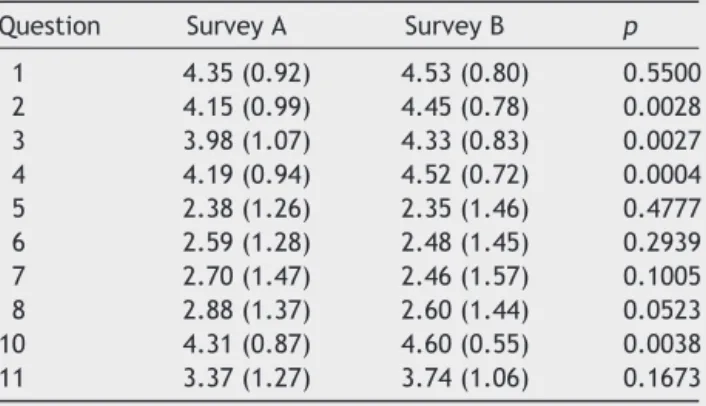
hand-out wasdeveloped and Survey B was performed. Table 3
showsthesummarizedsurveyresults.Thegroupofpatients who completed the survey after reviewing the handout reportedsignificantly highersatisfactionwiththeir under-standingofthetypeofanesthesiatheywouldbereceiving (Question 2, 4.15 vs. 4.45, p=0.0028). Additionally, they weresignificantlymoresatisfiedwiththeirunderstandingof theiroptionsforpaincontrolaftersurgery(Question3,3.98 vs.4.33,p=0.0027)andwithwhattheyweresupposed to dothedayofsurgery(Question4,4.19vs.4.52,p=0.0004). Thesecondgroupofpatientsratedtheamountof informa-tiongiventothemconcerningtheiranestheticplanhigher thanthepatientswhodidnotreceivethehandout(Question 10,4.31vs.4.60,p=0.0038).
DatafromQuestion9,regardingwhatworried patients the most, signified that in both Survey A and B, worries about surgery (33.2% vs. 35.8%, p=0.62) and pain (36.5% vs.34.3%,p=0.96)werethe mostcommonanswers. Wor-riesaboutanesthesiawerethirdonthelist(14.4%vs.9.0%,
p=0.16).Question 11, which asked about ease of finding informationontheinternet,wasonlyansweredby 32%of thosesurveyed. We instructed those who do not use the internet to search for medical information to leave that questionblank.TherespondentsinSurveyBratedtheir sat-isfactionwiththeeducation handouthighly (Question12, mean4.23±0.89).
Table 3 Survey results (Question Scale 1---5). Data pre-sentedasmean(SD).
Question SurveyA SurveyB p
1 4.35(0.92) 4.53(0.80) 0.5500
2 4.15(0.99) 4.45(0.78) 0.0028
3 3.98(1.07) 4.33(0.83) 0.0027
4 4.19(0.94) 4.52(0.72) 0.0004
5 2.38(1.26) 2.35(1.46) 0.4777
6 2.59(1.28) 2.48(1.45) 0.2939
7 2.70(1.47) 2.46(1.57) 0.1005
8 2.88(1.37) 2.60(1.44) 0.0523
10 4.31(0.87) 4.60(0.55) 0.0038
Question SurveyA satisfaction%
SurveyB satisfaction%
p-Value
#1 85.3 95.2 0.002
#2 80.6 91.8 0.0034
#3 73.5 86.3 0.004
#4 80.6 94.5 0.0002
Question SurveyA worried%
SurveyB worried%
p-Value
#5 21.8 24.7 0.52
#6 28.4 28.1 0.94
#7 32.7 30.7 0.61
#8 37.9 30.1 0.12
Table4reportsthepercentageofpatientswhichgavea scoreof4or5 (satisfiedor verysatisfied,worriedorvery worried)for Questions1---8. Thereweresignificantlymore respondentswhoreportedtobesatisfiedor very satisfied inQuestions1---4onSurveyB(p<0.05).Theaverage satis-factionfor thefourquestionscombinedwentfrom80%in SurveyAto92%inSurveyB.Therewasnostatistically sig-nificantdifferencefoundinthepercentageofrespondents whoreportedbeingworriedorveryworriedbetweenSurvey AandSurveyB.
Discussion
The authors surveyed a generalsampling of patients at a communityhospitalwithalarge Spanish-speaking popula-tion and found the need for providing more information concerninganesthesiaandtheperioperativeperiod.These surveyresults ledtothedevelopmentofa patient educa-tionhandout thatresultedina significantimprovementin patientsatisfactionconcerningtheir understanding ofthe anesthesiologist’srole,typesofanesthesia,optionsforpain control,andinstructionsforthe dayofsurgery.The study didnotfindasignificantdifferenceintheamountofanxiety relatedtosurgeryinthetwogroupssurveyed.
Limited health literacy in thiscountry is an increasing problem.7Itisestimatedthat90millionpeopleintheUnited
Stateshave difficultiesunderstandinghealthinformation.8
Additionally,theaverageAmericanreadsatthe8thto9th gradelevel,andoneinfiveAmericansreadatafifthgrade levelorbelow.9Thislowlevelofhealthliteracyisestimated
to contribute 50---70 billion dollars to the annual cost of healthcareinthiscountry.10Therefore,itisimperativethat
allhealthcareprovidersputmoreeffortintoeducationof patientsbyanyavailablemeans,atallavailable opportuni-ties.Inaddition,specialeffortshouldbeputintoproviding medicalinformationat areadinglevelappropriateforthe averagepatient.Atourhospital,allpatientdocumentsare writtenatnohigherthana6thgradelevel.
The2010census11reportedthattheHispanicpopulation
inthe UnitedStates hasrisen to16% withestimatesof it increasingto24%by2050.InthestateofTexas,wherethis
and40%spokeprimarilySpanish.Combiningthelower edu-cationlevelofourhospital’spopulationwithanincreasing Spanish-speaking population is achallenge whenit comes to communicating important health information to our patients.
AstudybyZachetal.12foundthatevenpatientsin
med-icallyunderservedpopulationshaveaccesstotheinternet throughcomputers and cellphones, but areless likelyto utilizetheinternettoseekhealthinformationthanthe gen-eralpublic.Although72%ofthepatientssurveyedintheir studyhadaccesstotheinternet,only21%usedthe inter-net to search for health information.12 In our survey, we
instructedpatientswhodidnotutilizetheinternettosearch forhealthinformationtonotanswerthatspecificquestion. Only32%ofourpatientsrespondedtothatquestion.Despite thefactthattherearecountlesswebsitesdedicatedto pro-vidinghealth information, ourfindingsaswell asprevious findingssuggestthatthepeoplewhomaybenefitthemost arenotaccessingthisinformation.Althoughsomepatients maybenefitfromaccessinghealthinformation,suchas edu-cationhandouts,ontheinternet,thereisnoguaranteethat itwillbereadorunderstoodbypatientsinthecommunity hospitalsetting.Therefore,apaperhandoutmaystillbethe mostefficientwaytocommunicatewithpatients.
While this study investigated patient’s knowledge and anxietyintheperioperativesetting,itisnotwithout limita-tions.First,thesurveydidnotincludeinformationregarding previous anesthesiaexperienceor baselineanxietylevels. Althoughwechosenottoincludethosequestionsinthis sur-vey,theywouldbebeneficialinanyfuturein-depthsurveys onthistopic.Second,thequestionsonoursurveywerenot formally validated.Although usinga validatedsurveytool would add tothe strengthof our conclusions, we believe theresultsofthisinvestigationremainsubstantiated.
We conclude that a patient education handout writ-tenattheappropriatereadinglevelandavailable intheir primarylanguageresulted in asignificant improvement in patientsatisfactionconcerning theirunderstanding of the anesthesiologist’srole,typesofanesthesia,optionsforpain control, and instructions for the day of surgery. Future studies are needed to explore the impact of improving patient’s knowledge of the perioperative process in the communityhospitalsetting.Additionally,futurestudiesare neededtofurtherunderstandhowtobestcommunicatewith patients.
Conflicts
of
interest
Theauthorsdeclarenoconflictsofinterest.
References
1.KlaftaJM,RoizenMF.Currentunderstandingofpatients’ atti-tudestowardandpreparationforanesthesia:areview.Anesth Analg.1996;83:1314---21.
3.MattheyP,FinucaneBT,FineganBA.Theattitudeofthegeneral publictowards preoperative assessmentand risks associated withgeneralanesthesia.CanJAnaesth.2001;48:333---9. 4.Fitzgerald BM, Elder J. Will a 1-page informational
hand-outdecreasepatients’mostcommonfearsofanesthesiaand surgery?JSurgEduc.2008;65:359---63.
5.BondyLR, Sims N, SchroederDR,et al. Theeffect of anes-theticpatienteducationonpreoperativeanxiety. RegAnesth PainMed.1999;24:158---64.
6.Jlala HA, French JL, Foxall GL,Hardman JG, Bedforth NM. Effectof preoperativemultimediainformationon periopera-tiveanxietyinpatientsundergoingproceduresunderregional anaesthesia.BrJAnaesth.2010;104:369---74.
7.HawkinsAO,KantayyaVS,Sharkey-AsnerC.Healthliteracy:a potentialbarrierincaringforunderservedpopulations.DisMon. 2010;56:734---40.
8.Kirsh I, Jungeblut A, Jenkins L, et al. Adult literacy in America: a first look at the results of the national adult literacysurvey (NALS).Washington, DC: National Cen-ter of Educational Statistics, US Department of Education; 1993.
9.CommitteeonHealth Literacy,Institute ofMedicine,Health, Literacy. A Prescription to End Confusion. Washington, DC: NationalAcademiesPress;2004.
10.DoakCC,DoakLG,RootJH.Teachingpatientswithlowliteracy skill.3rded.Philadelphia,PA:J.B.LippincottCompany;1996. 11.2010 US Census Data. United States Census Bureau.
www.census.gov[accessed16Apr2012].