Patient with stroke: hospital discharge planning,
functionality and quality of life
Doente com acidente vascular cerebral: planeamento de alta, funcionalidade e qualidade de vida
Paciente con accidente cerebrovascular: planifi cación del alta, funcionalidad y calidad de vida
REVIEW
Henrique José Mendes Nunes
I, Paulo Joaquim Pina Queirós
II
Escola Superior de Enfermagem de Coimbra. Coimbra, Portugal.
How to cite this article:
Nunes HJM, Queirós PJP. Patient with stroke: hospital discharge planning, functionality and quality of life. Rev Bras Enferm [Internet]. 2017;70(2):415-23. DOI: http://dx.doi.org/10.1590/0034-7167-2016-0166
Submission: 05-16-2016 Approval: 11-20-2016
ABSTRACT
Stroke still causes high levels of human inability and suffering, and it is one of the main causes of death in developed countries, including Portugal. Objective: analyze the strategies of hospital discharge planning for these patients, increasing the knowledge related to hospital-home transition, discharge planning processes and the main impact on the quality of life and functionality. Method: integrative literature review using the PICOD criteria, with database research. Results: 19 articles were obtained, using several approaches and contexts. For quality of life, the factors related to the patient satisfaction with care and the psychoemotional aspects linked with functionality are the most signii cant. Conclusion: during the hospitalization period, a careful hospital discharge planning and comprehensive care to patients and caregivers – in particular the functional and psychoemotional aspects – tend to have an impact on the quality of life of patients. Descriptors: Stroke; Quality of Life; Patient Discharge; Rehabilitation; Nursing.
RESUMO
O acidente vascular cerebral ainda origina elevados níveis de incapacidade e sofrimento humano, sendo das primeiras causas de morte nos países desenvolvidos, incluindo em Portugal. Objetivo: analisar as estratégias adotadas no planeamento da alta destes doentes, aprofundando o conhecimento inerente à transição hospital-domicílio, aos processos de preparação de alta assim como às principais repercussões na qualidade de vida e funcionalidade. Método: revisão integrativa de literatura, pelos critérios orientadores PICOD, com pesquisa em base de dados. Resultados: obtidos 19 artigos, com diversas abordagens e contextos. Para a qualidade de vida importa a satisfação com os cuidados recebidos e a consideração dos aspetos psico-emocionais, ligados à funcionalidade. Conclusão: no tempo de internamento, o planeamento cuidado da alta, o cuidado abrangente a doentes e cuidadores – nomeadamente aspectos funcionais e psico-emocionais – tendem a ter impacto na qualidade de vida dos doentes.
Descritores: Acidente Vascular Cerebral; Qualidade de Vida; Alta do Paciente; Reabilitação; Enfermagem.
RESUMEN
El accidente cerebrovascular todavía lleva a elevados niveles de incapacidad y sufrimiento humano, y es una de las primeras causas de muerte en los países desarrollados, incluido Portugal. Objetivo: analizar las estrategias adoptadas en la planii cación del alta de estos pacientes profundizando en el conocimiento inherente a la transición del hospital al domicilio, a los procesos de preparación del alta, así como a las principales repercusiones en la calidad de vida y la funcionalidad. Método: revisión integradora de la literatura por los criterios orientadores PICOD con una búsqueda en bases de datos. Resultados: se obtuvieron 19 artículos con diversos enfoques y contextos. Para la calidad de vida importa la satisfacción con los cuidados recibidos y la consideración de los aspectos psicoemocionales ligados a la funcionalidad. Conclusión: en el tiempo de internamiento, la planii cación cuidada del alta, el cuidado integral a los pacientes y cuidadores –en particular los aspectos funcionales y psicoemocionales– tienden a tener un impacto en la calidad de vida de los pacientes. Descriptores: Accidente Cerebrovascular; Calidad de Vida; Alta del Paciente; Rehabilitación; Enfermería.
Henrique José Mendes Nunes E-mail: [email protected]
INTRODUCTION
An increase in the average life expectancy of the popula-tion worldwide has been followed by an increased incidence of chronic diseases, reaching statistical dimensions that force specific actions by health professionals, in particular nurses. To understand this, it is important to learn the issues of hos-pital discharge planning and their impact on the functionality and quality of life (QoL) of patients, contributing to better care.
In the sphere of an ongoing study on ischemic stroke – also called cerebrovascular accident (CVA) – and converging con-cepts such as of functionality, QoL, length of hospital stay and hospital discharge processes/post-hospital referral (among oth-ers), we wanted to frame what the literature has presented and emphasized in recent years in this field into a methodologi-cally organized and focused study. Aware of its social impacts on mortality(1) and morbidity indicators, levels of inability and
suffering typically caused by stroke, the negative impact on the quality of life of patients and their families(2), and the
dif-ficult control of several risk factors(3-4), we have conducted an
integrative literature review to clarify the study question:“Are the impacts on QoL and functionality of patients after a stroke related to length of stay and hospital discharge planning?”.
The resulting studies were analyzed to provide a response to the concerns above, based on the study title and question. The study conducted observed the framework of the Meleis’ Theory of Transitions(5) and considered a nonlinear view of the
complex processes addressed by Morin(6).
The general objective of this study was to increase the knowl-edge on the theme, particularly by means of analyzing the con-cerns related to the hospital-home transition, focused on the hospital discharge and the clarification of impacts on QoL, func-tionality and cognitive-emotional aspects of patients.
METHOD
Regarding the methodology, several study strategies or ap-proaches (arrangements of key words) were used in the integrative literature review. In the beginning of the fourth quarter of 2014, we analyzed the scientific literature published in the search engine EB-SCO, checking the main databases (MEDLINE with Full Text, CI-NAHL Plus with Full Text, MedicLatina and Psychology and Behav-ioral Sciences Collection), and we selected the studies that generally respected some inclusion criteria, although without an inflexible limitation or condition that could result from an elaborated strategy; however, following a consensual methodology that could fulfill the needs of participants and be used in the interventions, comparisons, results and design of the studies [PICOD]. The criteria are presented in Chart 1, not considering the lines of comparisons [C].
The exclusion criteria considered were studies not con-ducted in the period defined for each approach, studies that did not address impacts or analysis vectors requested, stud-ies that did not address the specific scope of the underlying pathology, studies that did not have their full text available or that had not been written in Portuguese, English or Spanish.
Exceptions were admitted, as indicated in Chart 2.
Chart 1 – Criteria for inclusion of studies in the integrative review
PI[C]OD Description
Participants Patients, services and care processes, caregivers of patients with CVA (acute brain injury and consequences).
Interventions Approaches and dimensions like functionality, quality of life, depressive symptoms, hospitalization processes and length of stay, hospital discharge and discharge planning, caregivers, rehabilitation and its mechanisms.
Results of the
investigation Evidence and relationships among the variables, regarding the strategies implemented and presented as the results or outcomes.
Design of the study It did not constitute an inclusion/exclusion criterion.
Note: PI[C]OD = Participants, Intervention, [Comparisons], Results, Design; CVA = cerebrovascular accident.
Chart 2 – Strategies (S1 to S7) used in the search for studies, regarding the key words used, the study fields specified, the period defined, options of text availability, number of resulting articles and final number of articles (selected)
S Key words Fields specified Period Full text? RES RES/ Final
S1 stroke/quality of life/discharge planning Abst/Abst/--- 2000-2014 Yes 12 10
S2 length of stay/stroke/quality of life Abst/Abst/Abst 2012-2014 Yes 13 7
S3 after stroke/quality of life/length of stay Abst/Abst/Abst 2012-2014 Yes 05 0 S4 stroke/quality of life/length of stay/functionality Abst/Abst/Abst/--- 2012-2014 Yes + No 0+0 0 S5 stroke patients/quality of life/functionality Abst/Abst/Abst 2012-2014 Yes + No 0+1 1
S6 stroke/length of stay/functionality Abst/Abst/Abst 2012-2014 Yes 0 0 S7 stroke/discharge planning/functionality Abst/Abst/Abst or --- 2012-2014 Yes + No 0+0 0
For example, in the first study strategy (S1) we used the key
words “stroke”, “quality of life” and “discharge planning”, with the Boolean operator “and” (searched in the “abstract”, or without a field definition), and we obtained 12 articles (with a link for full texts) but in a period of 14 years (2000-2014). Of these 12 articles, 10 were retained, after excluding repeated articles and studies addressing aspects that were not of our interest. Only one article, of 2013, was obtained when we defined the period of 2012-2014 and kept the re-maining criteria. A similar reading was conducted with the other strategies (S2 aS7).
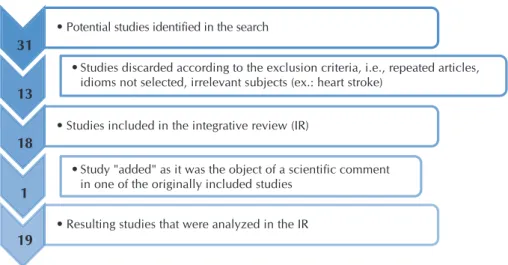
This methodology, summa-rized and explained above, re-sulted in the selection of 18 arti-cles, to which we added another one – a commented article – to-taling 19 articles, as illustrated in Figure 1 below. We highlighted the different nature of the studies compiled in terms of type, ob-jectives, and methods, making it difficult to perform the com-parison processes and eventual meta-analysis, which was not intended here. The search terms were stroke, quality of life, dis-charge planning, length of stay,
and functionality, in a cross-sectional analysis of Chart 1. Chart 3 presents the studies selected for this integrative literature review, classified by numerical order, title, publi-cation year and country, method and context where it was conducted and participants involved. The logic of the nu-merical order is related to the sequence of study strategies adopted.
These studies were analyzed according to the concerns men-tioned in the introduction of this study, based on the essential and most relevant aspects of each study.
Chart 3 – Distribution of selected articles according to their title, publication year/country, method and context/participants
Nº Title Year/
country Design/method Context and participants
E1(7) A clinical trial of an individualised intervention programme for family caregivers of older stroke victims in Taiwan.
2010;
Taiwan Randomized study Hospital and homes of patients; elderly patients with CVA (n= 158; EG=72; CG=86) and their family caregivers.
E2(8) A Randomized Trial Testing the Superiority of a Postdischarge Care Management Model for Stroke Survivors.
2009; United States
Randomized study Hospital/specialized centers and community; 380 patients (n=380; EG=190; CG=190).
E3(9) Discharged after stroke - important factors
for health-related quality of life. Sweden2010; Cross-sectional study Home interviews with patients or in nursing homes; 188 patients (n= 188), consecutively included.
E4(10) Early discharge plus home based rehabilitation reduced length of initial hospital stay but did not improve health-related quality of life in patients with acute stroke.
2000; United Kingdom
Comment and analysis of scientii c articles
Comment and analysis of 2 scientii c articles: Article 1 and Article 2 (S5).
E5(11)
[E4.1] Home or hospital for stroke rehabilitation? Results of a randomized controlled trial. I: health outcomes at 6 months
2000;
Australia Randomized study Hospital/home of patients/rehabilitation units; 398 patients with stroke were evaluated. The study involved 86 patients (n=86; EG=42; CG=44).
E6(12) Effectiveness of a postdischarge care management model for stroke and transient ischemic attack: a randomized trial.
2002; United States
Randomized
study Home of patients; 96 patients with CVA/TIA* were included. In the i nal analysis, 93 patients (n= 93) were distributed in two groups (EG=47; CG=46).
E7(13) Family conferences in stroke rehabilitation:
a literature review. Australia2013; Literature review (n.a./ n.a.); 23 articles were obtained, 14 of which with level of evidence between I and III-3, addressing with merit the problems presented in this i eld. Figure 1 – Diagram illustrating the study selection process for the integrative review
31
• Potential studies identified in the search
13
• Studies discarded according to the exclusion criteria, i.e., repeated articles, idioms not selected, irrelevant subjects (ex.: heart stroke)
18
• Studies included in the integrative review (IR)
1
• Study "added" as it was the object of a scientific comment in one of the originally included studies
19
• Resulting studies that were analyzed in the IR
Nº Title Year/
country Design/method Context and participants
E8(14) Long-term effects of the intensiication of the transition between inpatient neurological rehabilitation and home care of stroke patients.
2006;
Germany Controlled study Hospital; telephone contact and interview, for 3 years (community/homes). The study involved 71 patients (n=71; EG=36; CG=35).
E9(15) Randomized controlled trial of integrated (managed) care pathway for stroke rehabilitation.
2000; United Kingdom
Randomized
prospective study Hospital and community; the study involved 152 patients (n=152; EG=76; CG=76).
E10(16) The trajectory of minor stroke recovery for men and their female spousal caregivers: literature review.
2007;
Canada Narrative literature review (n.a./ n.a.); 34 articles were found and included.
E11(17) Training informal caregivers of patients with stroke improved patient and caregiver quality of life and reduced costs.
2004; United Kingdom
Comment and analysis of scientiic articles
Comment and analysis of one scientiic article: (Enot selected).
E12(18) Community-applied research of a traditional Chinese medicine rehabilitation scheme on Broca’s aphasia after stroke: study protocol for a randomized controlled trial.
2014;
China Multi-center, randomized study, with blind evaluation
Hospital and community health centers; the study involved 290 patients (n=290; EG=145; CG=145).
E13(19) Cost avoidance associated with optimal
stroke care in Canada. Canada2012; Literature review / “Evidence from the literature”
(n.a./ n.a.)
E14(20) Fabry’s disease: A prospective multicenter cohort study in young adults with cryptogenic stroke.
2012;
Canada Multi-center, prospective cohort study [study protocol]
Hospital and follow-up; all patients* with stroke, aged 18 to 55 years, will be included in the study. (*At facilities enrolled as participating centers and working within the broad guidance of the Canadian Best Practice for Stroke Care).
E15(21) First-Year Outcomes after Stroke Rehabilitation: A Multicenter Study in Thailand.
2013;
Thailand Prospective cohort study Hospital and follow-up (1 year) after hospital discharge. Of 327 patients*, only 214 (65.4%) were followed up for at least one year.
E16(22) Intracerebral hemorrhage and delirium symptoms. Length of stay, function, and quality of life in a 114-patient cohort.
2013; United States
Prospective study Hospital and follow-up; the study involved 114 patients.
E17(23) Is it beneicial to increase the provision of thrombolysis? -- a discrete-event simulation model.
2012; United Kingdom
Retrospective study (5 years: Jan. 2003 to Dec. 2007)
Analysis of data extracted from the Patient Administration System (PAS), of the Belfast City Hospital (BCH), and transferred from the BCH to the South-East Belfast Community Stroke Scheme (rehab)]; in total, 419 patients were included in the study.
E18(24) Satisfaction with care as a quality-of-life predictor for stroke patients and their caregivers.
2012;
Netherlands Cross-sectional study Hospital. In total, 251 dyads (patient and caregiver couples) were involved in the study.
E19(25) Depressive symptoms and disability in chagasic stroke patients: Impact on functionality and quality of life.
2013;
Brazil Cross-sectional study Hospital. In total, 21 patients with Chagas disease and prior diagnosis of stroke.
Note: S – study and numerical order (ex.: S18); EG – experimental group; CG – control group; n.a. – not applicable; *CVA = cerebrovascular accident/ TIA = transient ischemic attack.
Chart 3 (concluded)
RESULTS
Chart 4 shows the main results and conclusions of the studies, presented as central topics or “descriptive
Chart 4 – Studies included in the integrative review,
highlighting the main results and conclusions
Nº Results and conclusions: descriptive aspects - summary
S1(7)
In the postdischarge period (12-month follow-up), the caregivers of elderly patients with stroke who participated in the experimental group provided care of better quality (ß=0.45; p=0.03) than those of the control group; between month 6 and 12 after discharge, the probability of re-hospitalization was higher for control group patients than for the experimental group patients (X2=5.11; p=0.03). Conclusion: early attention and care, training, evaluation and follow-up of patients and their families (caregivers) during hospitalization and after discharge, improve the quality of care provided to patients and reduces re-hospitalization.
S2(8)
Considering all domains analyzed related to stroke […], the effect size of the treatment was close to 0 […] for all of them, except for the domain “knowledge and lifestyle”, which showed a signiicant effect resulting from the intervention (p=0.0003). Only the domain “knowledge and lifestyle” improved with the intervention, not demonstrating the superiority of any model (
“comprehen-sive postdischarge care management”) in relation to others (“organized acute stroke department care with enhanced discharge
planning”). However, in both groups, discharge planning and follow-up were guaranteed.
S3(9)
The depressive symptoms were associated with a lower health-related quality of life (HRQoL). The ability to perform personal and social activities, the interests, younger age, education (basic, elementary education) and reduced length of stay were associated with higher HRQoL. The perception of participation in their own discharge planning was positively and negatively associated with HRQoL. Several variables contribute to HRQoL in two to three weeks after the discharge, particularly fewer depressive symptoms and involve-ment/participation in social activities (such as outdoor activities and interest-driven activities).
The participation in their own discharge planning was positively and negatively perceived by the patients.
S4(10)
This comment by Grifiths (E4) regarding the study conducted by Anderson et al. (S5) highlights important aspects related to pa-tients with stroke and the hospital-home transition process (ex.: rehabilitation, length of stay, discharge).
It highlights that early discharge does not lead to signiicantly better results (at month 6) for the patients and it may cause worse results in terms of QoL and mental health for their caregivers. It also reminds that the care provided at stroke centers is more effec-tive than the care provided by general inirmaries. Conclusion: this comment states reduced length of stay (accelerating hospital discharge) may occur without apparent damage to relatively independent patients with stroke; it also states weak evidence of the advantages of early discharge and lower costs related to patients (staying) in the (habitual) general care units; it also states further studies should be conducted on impacts on caregivers […].
S5(11) [S4.1]
Study commented by Grifiths [S4], which presents the following results and conclusions: in general, the clinical results at month 6 after randomization, did not differ signiicantly in the comparison between the groups, but the total length of stay in the ex-perimental group was signiicantly reduced (15 versus 30 days; p=0.001). The caregivers from the “home rehabilitation” group presented signiicantly lower levels of mental health (SF-36) […].
S6(12)
The groups were analyzed through different approaches: habitual care versus discharge intervention through care planning (interdis-ciplinary teams) and strict collaboration with primary care units (clinical centers).
A signiicant improvement was presented in all 5 domains evaluated (with each domain showing a positive effect of the interven-tion), leading to a better proile of health and secondary prevention (p <0.0001), at month 3 after CVA and after TIA. Thus, this care management model resulted in signiicant improvement of the proile of health and secondary prevention at month 3 after discharge.
S7(13)
The studies/articles suggest that the stroke survivors and their families have additional education and support needs besides the typical attention, and this intervention may be leveraged by adopting more active (and not reactive) actions, preventing crises or potentially preventable ruptures. This review provides information about the ideal methods of communication and planning and identiies how to beneit from these opportunities. Conclusions: there is much to be performed by the multidisciplinary team; additional investigation and experimental studies […] will allow improved and better-informed clinical practice and develop bet-ter practical guidelines to ensure reduced stress and anxiety of caregivers, at admission and discharge; additional investigation is needed on the effects of education and emotional support provided at hospitals and primary care clinics.
S8(14)
Two and a half years after hospital discharge (t3), signiicantly fewer patients of the experimental group were hospitalized (2 versus 5) or died (4 versus 11) [p=0.010]. Participation in an intensive training/work program and hospital discharge process planning leads to better results in general, even in the long term (t3), representing a signiicant predictor (the 3rd, related to better functional quality at discharge and younger age) for lower hospitalization and mortality rates. The effects of participation in a program with these characteristics may persist in the long term, leading to care maintenance at home and reducing hospitalization and mortality rates.
S9(15)
Despite the numerous results, the study concluded that a well-structured and monitored program, especially in terms of objec-tives and duration (ICP - Integrated Care Pathway), did not show any advantage over a conventional multidisciplinary approach (regarding the functional recovery and indicators of quality of life), in patients with stroke followed up at stroke rehabilitation units. Such indicators of functional recovery and quality of life (QoL) were better and reached more quickly in the group that received a conventional multidisciplinary approach.
S10(16)
The results of this study showed that patients with minor stroke and their spouses and caregivers may experience great challenges in postdischarge adaptation. Recovery from a minor stroke may require a reformulation of life plans and priorities, and the inclu-sion of resulting inabilities in current and future situations, for the patients and their spouses and caregivers. In many cases, such adaptations are aggravated by transitions associated with the normal aging process.
The study concluded that there is not enough information about the recovery process (and the role of caregivers) of patients with minor stroke in relation to the normal aging process. Therefore, further investigation is required to analyze this transition, to sup-port discharge planning actions performed by nurses and other health professionals.
Nº Results and conclusions: descriptive aspects - summary
S11(17)
This comment by Stevenson (S11) to the study conducted by Kalra, Evans, Perez et al.(Snot selected) highlights the main results and conclusions, among other important aspects. This comment provided under the title “Training informal caregivers of patients with stroke improved patient and caregiver QoL and reduced costs” states that, at month 12, the patients from the group of trained caregivers improved their mood and quality of life, but no difference was observed in relation to the patients from the usual care group, in terms of mortality, hospitalization and functionality. Regarding the caregivers from the experimental group, they im-proved their mood and QoL, with reduced overload due to care provision, when compared to the control group of usual care […]. In brief, the provision of training to caregivers of patients with stroke improves their QoL and mood/vigor, reduces health care costs without, however, impacts on mortality, hospitalization and functionality of patients, when compared to usual procedures of the caregivers without a speciic training.
S12(18) An ongoing experimental study that started in November 2013, and whose last patient was included on August, 1st, 2015. A study with acupuncture acting as an experimental variable in the therapeutic process, which comprises speech/language therapy plus initial therapy (for patients with post-stroke aphasia).
S13(19)
An analysis was conducted (a literature review) of 4 central aspects in care provision to patients with stroke (fast evaluation and treatment start; thrombolytic therapy; organized stroke units; early controlled discharge, with community supporting services). The authors state it would be possible to have substantially better results. They indicate it would be possible to reduce the num-ber of annual hospital episodes (3.3%), reduce the numnum-ber of days in intensive care units (25.9%), reduce the numnum-ber of days in home care (12.8%), reduce the number of deaths in hospitals (14.9%), and reduce the amount of direct and indirect costs in the country. Conclusion: they state that it would be possible to substantially reduce costs and improve clinical results if the effective and largely known treatment types were more intensively used.
S14(20)
This study addresses the problem of stroke in young people (aged 18 to 55 years), relating it to the Fabry disease, in a prospective study whose objective was to estimate and determine the prevalence of Fabry disease in adult and young patients with stroke. Conclusion: they assume that this was the irst initiative in the country (at the time) developed to determine the prevalence of a positive result for Fabry disease in young adults with stroke. In addition, this initiative (Canadian Fabry Stroke Screening Initiative) will provide information about recurrent vascular events, inability present at month 6 (via modiied Rankin scale), and predisposi-tion of this poorly studied populapredisposi-tion.
S15(21)
This prospective study without any explicitly deined objectives intended to determine long-term effects of intensive rehabilita-tion therapy in patients with CVA. In summary, the results indicated low funcrehabilita-tionality at month 12 was signiicantly correlated with longer length of stay, longer time between stroke and being transferred from acute care to a rehabilitation unit, and higher levels of depression at month 12. Conclusion: about half the patients recovered at least one degree in the level of inability mea-sured in the follow-up; however, they emphasize that low functionality at month 12 is associated with longer length of stay (1st admission), delay in rehabilitation program and psychological depression.
S16(22)
Approach to the prognostic value of delusion symptoms in patients hospitalized in intensive care units (ICUs), with brain injury caused by intracerebral hemorrhage (not by ischemic stroke). The presence of such symptoms of delusion was associated with higher probability of negative functional results (poor functionality) and lower QoL in the future, in the domains of cognitive-executive function, after corrections for brain damage at admission, age, therapeutic measures (benzodiazepines), among others. Conclusion: they state that, after focal brain injury, the symptoms of delusion are frequent, despite low infection rates and the sedative therapy, and act as predictors of poor functional results and lower QoL.
S17(23)
A retrospective study that questions and demonstrates how an intensiied thrombolytic therapy (thrombolysis) reduces health care costs (leading to moderate savings) and improves the scores/levels of QoL of patients. Results: the study states the costs (of thrombolysis) make up for the reduced hospital costs of rehabilitation and hospitalization, with corresponding improvement in QoL. An increase of 10% to 50% in thrombolytic therapy in eligible patients potentially corresponds to 8.26% savings in (com-munity) rehabilitation costs and 12.3% savings in hospitalization costs, per patient.
S18(24)
The age of patients was signiicantly related to their QoL. Also, the age and level of instruction of their caregivers were signiicant-ly related to QoL. The inability of patients at hospital admission and length of stay were associated with QoL, and the inability of patients at hospital admission was also related to the QoL of caregivers. No relation was observed between length of stay and QoL of caregivers. Patient satisfaction with care provision was associated with the QoL of both patients and caregivers. Using the APIM model, which can consists in an Actor – Partner (patient – caregiver) Interdependence Model, the authors conclude that patient satisfaction with care provision was the most important indicator and determinant of QoL of patients and caregivers.
S19(25)
Although the study analyzed a particular group of patients – with stroke and Chagas disease, the authors attempted to investigate a correlation between inability and depressive symptoms (associated with stroke) with functional performance and QoL. A cor-relation was observed between the functional scores (mRS and BI), but not with the subscales of QoL; with these subscales, a correlation was observed between the scores in the depression scale, although depression was not associated with basic func-tionality. They also observed a stronger correlation and inluence on QoL with the depressive symptoms than with the motor consequences of stroke, although these motor sequelae affect functionality more than the depressive symptoms.
Note: S – study and its numerical order; mRS – modified Rankin scale; BI – Barthel index; CVA = cerebrovascular accident; HRQoL = Health-related quality of life; ICUs = intensive care units; QoL = quality of life; APIM = Actor – Partner Interdependence Model.
DISCUSSION
The selected articles present geographical diversity and use different methodologies (Chart 3), from a simple comment about scientific articles (made by experts) to randomized stud-ies with dual randomization, prospective studstud-ies, retrospec-tive studies, cross-sectional studies, literature review and even an ongoing study. Likewise, the number of participants (Chart 2) also presents a high variation, even when not using ‘pa-tients’ as sample units, but the number of articles in a litera-ture review. Despite such diversity, an effective convergence is observed in the topics addressed, as the authors desired, according to the initial selection of study terms.
Chart 4 provides the main contribution for this discussion, as it presents a summary of the main results and conclusions of each study. Thus, focused on clinical spheres and preparatory, prior or subsequent circumstances (terms used in the search: dis-charge planning; length of stay; after stroke), we can state, just like S1(7), that the best health care results are obtained with more
attention dedicated to the hospital-home transition process, with lower probability of re-hospitalization, despite having no direct impact on the QoL of the patient or caregiver. Moreover, S2(8)
does not present significant differences in the five domains ana-lyzed when comparing two replicable health care models; of these domains, only the one related to knowledge and lifestyle improved with the model, always ensuring discharge planning and follow-up. Another approach used in the studies was the participation of patients in the discharge planning and the rela-tion with a perceprela-tion of higher or lower HRQoL; S3(9) shows
that such participation can be positively or negatively perceived. In a comment to two studies in this regard, E4(10) highlights that
early discharge does not produce significantly (necessarily) bet-ter results for patients, and it may present worse results in bet-terms of quality of life and affect the mental health of caregivers. This important moment of the therapy process (hospital discharge) is also addressed by other studies (S6,8,11(12,14,17)), studied or
com-mented in different perspectives, but always aligned with the need to involve all stakeholders, that is, hospital, patient, pa-tient’s family, caregivers, healthcare services and patient reha-bilitation guarantee. Stroke recovery processes, with increased functionality and QoL, represent multiple transitions of situ-ational and health-disease conditions, where the final process of subjective well-being, well-being in the relationship with others and mastery is relevant(5).
Another aspect to be analyzed and discussed refers to func-tionality, which may be interpreted in different ways but is un-questionably a dimension usually affected in a patient with stroke. Seven of all 19 studies (~37%) selected for this review address it explicitly in terms of results and conclusion, although only 3 studies use such functionality as a concept in their objectives.
When associating functionality with the perception of HRQoL, S3(9) confirms functional, personal/motor and social
preservation (among other variables) is related to a better per-ception of HRQoL, being a significant predictor (S8(14)) for lower
hospitalization and mortality rates, also in the long term; on the other hand, it seems insensitive to the approaches experimen-tally used in one study (S9(15)), whose objective was to evaluate
the effectiveness of a structured program (ICP) in the reduction of length of stay, without affecting such functionality. Other studies/comments agree in these different realities; in S11(17),
the provision of training to caregivers of patients with stroke improves importantaspects of their own lives but has no im-pact on the functionality of patients (when compared to usual procedures of caregivers without specific training). In S16(22), this
dimension is correlated to prior focal symptomatology; in S15(21),
there seems to be a relation with a very long length of stay (af-fecting functionality at month 12), among other aspects related to and resulting from health care as a process.
Another focus is on QoL, which is almost always, or al-ways, affected in patients with stroke or their caregivers. Of the reviewed studies, about 32% address it in their objectives, assuming it as a focus or measurement of analysis and treat-ment (S3,10,16,17,18,19), but more than half of these studies (10 out of 19) use this dimension to measure results or make com-parisons, integrating and analyzing it a result and/or conclu-sion (refer to the tables presented above).
Although S1(7) identifies some limitations, it also assumes that,
even with several improvements in health care, more training, more attention, evaluation and follow-up, the results did not pres-ent better QoL of caregivers or patipres-ents. Likewise, S2(8) and S
9 (15)
presented similar results in this sense; quality of life did not im-prove with the application of an intervention when comparing two health care models; and a well-structured and monitored pro-gram did not show any advantage over a conventional multidisci-plinary approach in terms of improved indicators of QoL.
As addressed before in a reference to S3(9), this study, which
evaluates the participation and integration of patients in their own discharge planning, shows some variables (preservation of personal and social functionality, interests, young age, level of education/instruction and shorter length of stay) have a re-lation with higher HRQoL. Some studies specifically address the sphere of caregivers (S7(13), S
11
(17)) or, like S 18
(24), address
pa-tient-caregiver pairs. One of the conclusions of S7(13) requires
“additional investigation about the effects of educational and emotional support on hospital and outpatient clinics, on QoL of caregivers and prevention of re-hospitalization or admission to continuous care units (home care)”, while S11(17) states that,
“at month 12, the patients from the group of trained caregiv-ers presented better mood and quality of life” and concludes as follows: “the provision of training to informal caregivers of patients with stroke improves the mood and the QoL of both patients and caregivers,” among other equally important as-pects. In S18(24), in brief, “the authors conclude that patient
sat-isfaction with care provision was the most important indicator and determinant of quality of life of patients and caregivers”.
Three other studies showed results and conclusions related to this dimension: S16(22) correlates QoL to focal neurological
symptomatology (in a particular clinical situation), ensuring that such symptom (delusion) was associated with lower QoL in the future, in the domains of cognitive-executive function; S18(24)
shows how an intensified thrombolytic therapy (thrombolysis) produced better scores/levels of quality of life of patients; and S19(25) correlates this dimension with depressive symptoms rather
Lastly, we analyzed and discussed some of the approaches to depression used by the studies, a dimension perceived and interpreted in the context of psychoemotional manifestations resulting from this neurovascular pathology. It was not used as an objective of studies or search term, but it is often used in studies involving these patients and their family members, particularly in the context of this review. Although only S19(25)
assumes it in its title and/or objectives (depressive symptoms), this manifestation is addressed by S3(9), S
15
(21) and S 19
(25).
De-pressive symptoms were related to QoL in two cross-sectional studies (S3(9), S
19
(25)) and to functionality in a prospective study
(S15(21)), exploring its interactions, often with losses (lower QoL
and lower functionality) due to the manifestations or levels of the depressive symptoms evaluated.
FINAL CONSIDERATIONS
A healthy brain involves the idea of a complex global mechanism and a mystery in constant revelation(26-31); many of
the effects of brain injury and pathology are likewise diversi-fied, complex and present high interindividual variability(32).
As discussed above and presented in the tables of this re-view, there is no single sense that could be applied to all reali-ties and all patients. It may even contradict some of the results and topics presented in this study, in particular those related to QoL; however, we emphasize an idea discussed above: “pa-tient satisfaction with care provision was the most important indicator and determinant of QoL of patients and caregivers”.
After a more comprehensive reading of these studies, the rela-tion between a funcrela-tional-physical and psychoemorela-tional (depres-sion) dimension and QoL perceived seems clearly intricate; we have not evaluated specifically this psychoemotional dimension, but it was referred to and correlated in several studies, as indicated above. Contradicting possible “technicist” trends in the current care provision, this reference to “satisfaction with care provision”, eventually based on a relational dimension, should be highlight-ed for the definition of a good health system, for patient-centerhighlight-ed supporting services, patients in transition, or in the sphere of edu-cation, particularly in nursing training programs.
In summary, given the study question and objectives defined for this integrative review, we can conclude that length of stay and, particularly, a careful, timely and personalized discharge planning tend to have an impact on the QoL of patients (and their caregiv-ers) and on their functionality, understood in lato sensu, when analyzing references to the persistence of psychoemotional altera-tions extending over a long time and constituting a characteristic and a potential alert to the need for a therapeutic intervention. This transition is critical in a complex physical and psychological process of adaptation to a different condition.
ACKNOWLEDGMENT
The authors would like to thank the institution to which they are affiliated: ESEnfC - Escola Superior de Enfermagem, in Co-imbra, Portugal, for the support to conduct this study under an ongoing project and for the resources assigned to its publication.
REFERENCES
1. Silva S, Gouveia M. Program “Via verde do AVC”: analysis of the impact on stroke mortality. Rev Port Saude Pub. 2012;30(2):172-9. 2. Almeida ADL. A eficácia do proFamílias em doentes de Acidente Vascular Cerebral (AVC) e cancro e seus familiares. Rev Port
Saude Pub. 2011;29(1):47-52.
3. NewsFarma. DGS apresenta resultados do relatório “Hipertensão Arterial nos Cuidados de Saúde Primários”[Internet]. 2015[cited 2016 May 10]. Available from http://www.newsfarma.pt/noticias?start=15
4. O’Donnell MJ, Xavier D, Liu L, Zhang H, Chin SL, Rao-Melacini P, et al. Risk factors for ischaemic and intracerebral haemorrhagic stroke in 22 countries (the INTERSTROKE study): a case-control study. Lancet[Internet]. 2010[cited 2016 May 10];376(9735):112-23. Available from: http://www.thelancet.com/journals/lancet/article/PIIS0140-6736(10)60834-3/abstract
5. Meleis AI. Transitions theory: middle-range and situation-specific theories in nursing research and practice. New York: Springer; 2010. 641 p.
6. Morin E. Introdução ao Pensamento Complexo. 5ª ed. Lisboa, Portugal: Instituto Piaget; 2008. 178 p.
7. Shyu Y-IL, Kuo L-M, Chen M-C, Chen S-T. A clinical trial of an individualised intervention programme for family caregivers of older stroke vic-tims in Taiwan. J Clin Nurs[Internet]. 2010[cited 2016 May 10];19(11-12):1675-85. Available from: http://onlinelibrary.wiley.com/doi/10.11 11/j.1365-2702.2009.03124.x/abstract
8. Allen K, Hazelett S, Jarjoura D, Hua K, Wright K, Weinhardt J, et al. A randomized trial testing the superiority of a post-discharge care man-agement model for stroke survivors. J Stroke Cerebrovasc Dis[Internet]. 2009[cited 2016 May 10];18(6):443-52. Available from: https:// www.ncbi.nlm.nih.gov/pmc/articles/PMC2802837/pdf/nihms-161670.pdf
9. Almborg A-H, Ulander K, Thulin A, Berg S. Discharged after stroke: important factors for health-related quality of life. J Clin Nurs[Internet]. 2010[cited 2016 May 10];19(15-16):2196-206. Available from: http://onlinelibrary.wiley.com/doi/10.1111/j.1365-2702.2010.03251.x/ abstract
11. Anderson C, Rubenach S, Mhurchu CN, Clark M, Spencer C, Winsor A. Home or hospital for stroke rehabilitation? results of a randomized controlled trial - I: Health outcomes at 6 months. Stroke. 2000;31(5):1024-31.
12. Allen KR, Hazelett S, Jarjoura D, Wickstrom GC, Hua K, Weinhardt J, et al. Effectiveness of a postdischarge care management model for stroke and transient ischemic attack: a randomized trial. J Stroke Cerebrovasc Dis[Internet]. 2002[cited 2016 May 10];11(2):88-98. Avail-able from: http://www.strokejournal.org/article/S1052-3057(02)00019-8/abstract
13. Loupis YM, Faux SG. Family Conferences in Stroke Rehabilitation: a literature review. J Stroke Cerebrovasc Dis[Internet]. 2013[cit-ed 2016 Jul 10];22(6):883-93. Available from: http://www.strokejournal.org/article/S1052-3057(12)00408-9/abstract
14. Graesel E, Schmidt R, Biehler J, Schupp W. Long-term effects of the intensification of the transition between inpatient neurological rehabilitation and home care of stroke patients. Clin Rehabil. 2006;20(7):577-83.
15. Sulch D, Perez I, Melbourn A, Kalra L. Randomized controlled trial of integrated (managed) care pathway for stroke rehabilitation. Stroke. 2000;31(8):1929-34.
16. Green TL, King KM. The trajectory of minor stroke recovery for men and their female spousal caregivers: literature review. J Adv Nurs[Internet]. 2007[cited 2016 May 10];58(6):517-31. Available from: http://onlinelibrary.wiley.com/doi/10.1111/j.1365-2648.2007.04321.x/abstract 17. Stevenson D. Training informal caregivers of patients with stroke improved patient and caregiver quality of life and reduced costs.
Evid Based Nurs[Internet]. 2004[cited 2016 May 10];7(4):118. Available from: http://ebn.bmj.com/content/7/4/118.long
18. Tao J, Fang Y, Wu Z, Rao T, Su Y, Lin L, et al. Community-applied research of a traditional Chinese medicine rehabilitation scheme on Broca’s aphasia after stroke: study protocol for a randomized controlled trial. Trials[Internet]. 2014[cited 2016 May 10];15. Available from: https://www.ncbi.nlm.nih.gov/pmc/articles/PMC4223562/
19. Krueger H, Lindsay P, Cote R, Kapral MK, Kaczorowski J, Hill MD. Cost avoidance associated with optimal stroke care in Canada. Stroke[Internet]. 2012[cited 2016 May 10];43(8):2198-U366. Available from: http://stroke.ahajournals.org/content/43/8/2198.long 20. Saposnik G, Lanthier S, Mamdani M, Thorpe KE, Melo M, Pope K, et al. Fabry’s disease: a prospective multicenter cohort study in young adults with
cryptogenic stroke. Int J Stroke[Internet]. 2012[cited 2016 May 10];7(3):265-73. Available from: http://journals.sagepub.com/doi/pdf/10.11 11/j.1747-4949.2011.00734.x
21. Kuptniratsaikul V, Kovindha A, Piravej K, Dajpratham P. First-Year Outcomes after Stroke Rehabilitation: a multicenter study in Thai-land. ISRN Rehabil[Internet]. 2013[cited 2016 May 10];2013 (ID 595318):[6 pages]. Available from: https://www.hindawi.com/journals/ isrn/2013/595318/
22. Naidech AM, Beaumont JL, Rosenberg NF, Maas MB, Kosteva AR, Ault ML, et al. Intracerebral hemorrhage and delirium symp-toms length of stay, function, and quality of life in a 114-patient cohort. Am J Resp Crit Care Med[Internet]. 2013[cited 2016 May 10];188(11):1331-7. Available from: https://www.ncbi.nlm.nih.gov/pmc/articles/PMC3919076/pdf/rccm.201307-1256OC.pdf 23. Barton M, McClean S, Gillespie J, Garg L, Wilson D, Fullerton K. Is it beneficial to increase the provision of thrombolysis? a discrete-event
simulation model. Qjm-an Intern J Med[Internet]. 2012[cited 2016 May 10];105(7):665-73. Available from: http://qjmed.oxfordjournals.org/ content/105/7/665.long
24. Cramm JM, Strating MMH, Nieboer AP. Satisfaction with care as a quality-of-life predictor for stroke patients and their caregivers. Qual Life Res[Internet]. 2012[cited 2016 May 10];21(10):1719-25. Available from: https://www.ncbi.nlm.nih.gov/pmc/articles/PMC3496478/ pdf/11136_2011_Article_107.pdf
25. Souza ACd, Rocha MOdC, Teixeira AL, Dias Junior JO, Sousa LAPd, Nunes MCP. Depressive symptoms and disability in chagasic stroke patients: impact on functionality and quality of life. J Neurol Sci[Internet]. 2013[cited 2016 May 10];324(1-2):34-7. Avail-able from: http://www.jns-journal.com/article/S0022-510X(12)00525-4/abstract
26. Nunes HJM, Queirós PJP. Exploratory study of patients’ life situation after a stroke. International J Caring Sci[Internet]. 2015[cited 2016 May 10];8(1):101-7. Available from: http://www.internationaljournalofcaringsciences.org/docs/12-Nunes-Original.pdf 27. Damásio AR. Descartes error and the future of human life. Scientific Am. 1994;271(4):144.
28. Pires JC. De Profundis, Valsa Lenta. 4ª ed. Lisboa: Dom Quixote; 1997. 69 p. 29. Damásio AR. Descartes’ error revisited. J Hist Neuroscienc. 2001;10(2):192-4.
30. Sacks O. O Homem que Confundiu a Mulher com um Chapéu e outros contos clínicos. Lisboa: Relógio D’Água; 1990. 256 p. 31. Damásio A. O Livro da Consciência: a construção do cérebro consciente. Lisboa: Temas e Debates; 2010. 437 p.