179
MRI for the diagnosis of chondral, meniscal and cruciate ligaments injuries of the knee
Radiol Bras 2007;40(3):179–182
Original Article
MAGNETIC RESONANCE IMAGING FOR THE DIAGNOSIS
OF CHONDRAL, MENISCAL AND CRUCIATE LIGAMENTS
INJURIES OF THE KNEE*
Francisco Consoli Karam1
, Jefferson Luís Braga da Silva2
, Marcos William Fridman3
, Armando Abreu4
, Rodrigo Di Mare Arbo5
, Marcelo Abreu6
, José Francisco Vieira7
, Luiz Antônio Simões Pires8
OBJECTIVE: To evaluate the diagnostic accuracy of magnetic resonance imaging (MRI) of the knee. MATE-RIALS AND METHODS: Seventy-two patients have been submitted to MRI previously to arthroscopy of the knee performed by a single surgeon and utilized as a comparative standard method. Sensitivity, specificity, values of likelihood and rate of interobserver agreement have been evaluated. RESULTS: The kappa agree-ment coefficient between MRI and arthroscopy was very good for lesions in the anterior cruciate ligaagree-ment (0.84), good for lateral meniscus (0.75), reasonable for medial meniscus (0.50) and poor for chondral le-sions (< 0.50). MRI has demonstrated high sensitivity for tears in the anterior cruciate ligament (94%) and in the medial meniscus (92%), good sensitivity for lesions in the lateral meniscus (80%), and low sensitivity for lesions in all of the chondral zones (< 50%), while the specificity has been excellent for all the chondral, and ligamentous structures, besides the lateral menisci analyzed (more than 97%), and reasonable (65%) for the medial meniscus. CONCLUSION: MRI is an useful tool in the clinical diagnosis of intra-articular knee lesions, as already demonstrated by similar results reported both in the Brazilian and international literature. Keywords: Arthroscopy; Magnetic resonance imaging; Knee; Lesions; Sensitivity; Specificity.
A ressonância magnética para o diagnóstico das lesões condrais, meniscais e dos ligamentos cruzados do joelho.
OBJETIVO: Avaliar o valor diagnóstico da ressonância magnética (RM) do joelho. MATERIAIS E MÉTODOS: Setenta e dois pacientes foram submetidos a RM previamente à artroscopia do joelho realizada por um único cirurgião e considerada como método padrão. Verificou-se a sensibilidade, a especificidade, os valores de verossimilhança e a concordância entre o radiologista e o ortopedista em classificar as lesões. RESULTA-DOS: O coeficiente de concordância kappa entre a RM e a artroscopia, em classificar as lesões, foi muito bom para lesões de ligamento cruzado anterior (0,84), bom para o menisco lateral (0,75), razoável para o menisco medial (0,50) e baixo para lesões condrais (menor que 0,50). A RM mostrou ter alta sensibilidade para rupturas de ligamento cruzado anterior (94%) e menisco medial (92%), boa sensibilidade para lesões de menisco lateral (80%) e baixa sensibilidade para lesões em todas as zonas condrais (menor que 50%), enquanto a especificidade foi excelente para todas as estruturas condrais, ligamentares e para o menisco lateral estudadas (maior que 97%) e razoável para o menisco medial (65%). CONCLUSÃO: A RM é uma ferramenta útil para subsidiar o diagnóstico clínico de lesões intra-articulares do joelho, como já foi mostrado em resultados semelhantes encontrados na literatura produzida no Brasil e no exterior.
Unitermos: Artroscopia; Ressonância magnética; Joelho; Lesões; Sensibilidade; Especificidade. Abstract
Resumo
* Study developed at Hospital São Lucas da Pontifícia Univer-sidade Católica do Rio Grande do Sul (PUCRS), Porto Alegre, RS, Brazil.
1. PhD of Medicine and Sciences of Health, Traumatologist and Orthopedist in the Group of Knee at Pontifícia Universidade Católica do Rio Grande do Sul (PUCRS), Porto Alegre, RS, Brazil. 2. Private Docent in Hand Surgery, Head for the Service of Hand Surgery and Microsurgery at Hospital São Lucas da Ponti-fícia Universidade Católica do Rio Grande do Sul (PUCRS), Porto Alegre, RS, Brazil.
3. PhD of Orthopedics, Head for the Group of Pediatric Ortho-pedics at Pontifícia Universidade Católica do Rio Grande do Sul (PUCRS), Porto Alegre, RS, Brazil.
4. MD, Radiologist, Musculoskeletal Specialist, Head for the Service of Radiology at Hospital Mãe de Deus, Porto Alegre, RS, Brazil.
5. MD, Orthopedist and Traumatologist, Trainee in the Group of Knee, Service of Orthopedics and Traumatology at Pontifícia Universidade Católica do Rio Grande do Sul (PUCRS), Porto Ale-gre, RS, Brazil.
6. Master, MD, Radiologist in the Service of Radiology at Hos-pital Mãe de Deus, Porto Alegre, RS, Brazil.
INTRODUCTION
Magnetic resonance imaging (MRI) has been considered as the imaging method of choice for evaluating knee joints, almost completely replacing arthrography in the
last decade(1). This is due the fact that this
technique represents a both non-invasive and accurate alternative to arthroscopy in the diagnosis of internal knee derange-ments(2).
Notwithstanding the controversies about MRI cost-benefit ratio(3), it is
impor-tant to note that the technological develop-ment has brought higher precision to this method, allowing a reduction in the need for diagnostic arthroscopies.
The present study is aimed at investigat-ing if MRI of the knee followinvestigat-ing the glo-bal protocol (without specific sequences for the different parts of the knee joint)
7. MD, Radiologist, Professor at Faculdade de Medicina da Pontifícia Universidade Católica do Rio Grande do Sul (PUCRS), Porto Alegre, RS, Brazil.
8. Master in Science of Movement, Orthopedist and tologist in the Group of Knee, Service of Orthopedics and Trauma-tology at Hospital São Lucas da Pontifícia Universidade Católica do Rio Grande do Sul (PUCRS), Porto Alegre, RS, Brazil.
Mailing address: Dr. Francisco Consoli Karam. Rua Araponga, 70, Bairro Chácara das Pedras. Porto Alegre, RS, Brazil, 91330-130. E-mail: [email protected]
180
Karam FC et al.
Radiol Bras 2007;40(3):179–182
reproduces the results found in the litera-ture(2,4–8), and defining for which
intra-ar-ticular structures this imaging method could be useful as a diagnostic tool. For this purpose, we performed a transversal study with a prospective collection of data from 72 patients submitted to MRI in a service of imaging diagnosis. Arthroscopy per-formed by a single surgeon was utilized as a comparative standard method.
MATERIALS AND METHODS
Transversal study with prospective data collection performed in the period between January/2003 and December/2005, evalu-ating 72 patients submitted to MRI of the knee, whose findings were compared with those from subsequent arthroscopy of the knee considered as the standard method. The sample included 37 MRI of the right knee and 35 of the left knee of 65 men and seven women in the age range between 19 and 67 years (mean age, 35.4 years).
Inclusion criteria were the following: patients of both sexes; age ≥ 18 years (skel-etal maturity); patients’ complain of symp-toms in the knee joint and previous history compatible with intra-articular disease; the patient has been examined by the main author of the present study who, after a standard physical examination of the knee and specific tests for lesions of intra-articu-lar structures, has indicated arthroscopy and requested MRI as a complement for the clinical diagnosis; the patient has under-gone arthroscopy in the period between one and 90 days after MRI, and has not experi-enced any episode of trauma in this period. Patients whose lesions could not be clas-sified because of dubious description or interpretation of MRI reports have not been included in the present study.
A GE Signa, 1.5 tesla MRI equipment was utilized in the present study. The stan-dard protocol for investigation of the knee utilized in all of the patients included the following steps: positioning of the patient in dorsal decubitus with slight external ro-tation of the knee (about 5º); utilization of specific surface coil; 4 mm slice thickness at 0.4 mm intervals; small field of view (FOV) for resolution maximization (14 to 16 cm, depending on the size of the pa-tient), 256 × 192 or 256 × 256 matrices;
planes and sequences: sagittal T1, sagittal PD-T2, coronal PD-T2, axial gradient-echo, axial T2, and sagittal PD with thin sections to evaluate the anterior cruciate ligament.
All the studies were blindly evaluated by a single radiologist who has collabo-rated in the present study.
All of the arthroscopic evaluations were performed in a surgical center by the same orthopedist — main author of the present study with a 15-year experience in this type of procedure —, several of them also with the assistance of a colleague of Hospital São Lucas and collaborator in the present study with a 25-year experience in arthro-scopy of the knee. Arthroscopies were per-formed through the classic antero-lateral and antero-medial parapatellar portals. After insertion of the arthroscope through the lateral parapatellar portal, a routine in-spection was performed in the whole joint for evaluation of medial and lateral com-partments (condyles, tibial plateaus and menisci), intercondyle (cruciate ligaments), and finally femoropatellar joint (patellar and synovial cartilages). Investigation through medial and lateral suprapatellar portals was performed as necessary. Results from this initial analysis where compared with the MRI findings described by the radiologist and a new inspection was made to search for any lesion detected by the MRI which may have been missed in the first inspection. Finally, lesions were sur-gically corrected as necessary.
Videoarthroscopy was not performed in patients who had not an indication for sur-gical treatment (videosurgery), and, be-cause of ethical reasons, this procedure could not be blindly performed, consider-ing that the availability of a previous MRI obliges the orthopedist to confirm its find-ings. Lesions in the following sites were analyzed: both menisci (medial and lateral), cruciate ligaments (anterior and posterior), and five different cartilaginous — medial and lateral condyles, medial and lateral plateaus, and patella.
Meniscal lesions were classified ac-cording to changes in Tyrrel et al.(9) and
Stoller et al.(10) classifications as follows:
grade 0 (absence of lesions, or grade 1 and 2 lesions of Stoller et al.), grade 1 (lesion in one side or grade 3 lesion of Stoller et
al.) and grade 2 (lesion in both sides of acute and complex lesions).
Ligamentous lesions were classified ac-cording Heron & Calvert(4) into grade 0
(absence of lesion or minimal extension) grade 1 (partial lesion), and grade 2 (com-plete lesion).
Finally, chondral lesions also were clas-sified according changes in Outerbridge(11)
and Tyrrel et al.(9) classifications, as
fol-lows: grade 0 (absence of lesion), grade 1 (superficial lesion or grade 1 Outerbridge lesion), grade 2 (superficial or deep, partial lesion not reaching the subchondral bone, or Outerbridge’s grades 2 and 3), and grade 3 (complete lesion up to the chondral bone or Outerbridge’s grade 4).
The present study was designed in com-pliance with the guidelines and rules on research in humans (Resolution 196/1996 of National Council of Health), and was approved by the Committee on Ethics in Research of Hospital São Lucas of Ponti-fícia Universidade Católica do Rio Grande do Sul, where arthroscopies were per-formed and the present study was devel-oped. All the patients submitted to arthro-scopy were given information and guid-ance on the procedure, its risks and ben-efits, and agreed to be submitted to the surgical treatment, besides agreeing that their data was utilized in the present study. Microsoft Excel 2002 was utilized in the statistical analysis for data tabulation and charts, and SPSS 11.5 version for the global data analysis. Interobserver agree-ment as regards lesions classification, sen-sitivity, specificity, positive and negative likelihood values were analyzed. The con-fidence interval was 95%.
RESULTS
Results regarding the number of dis-eased and healthy patients, true-positive and true-negative, and false-positive and false-negative diagnoses are shown in Table 1.
181
MRI for the diagnosis of chondral, meniscal and cruciate ligaments injuries of the knee
Radiol Bras 2007;40(3):179–182
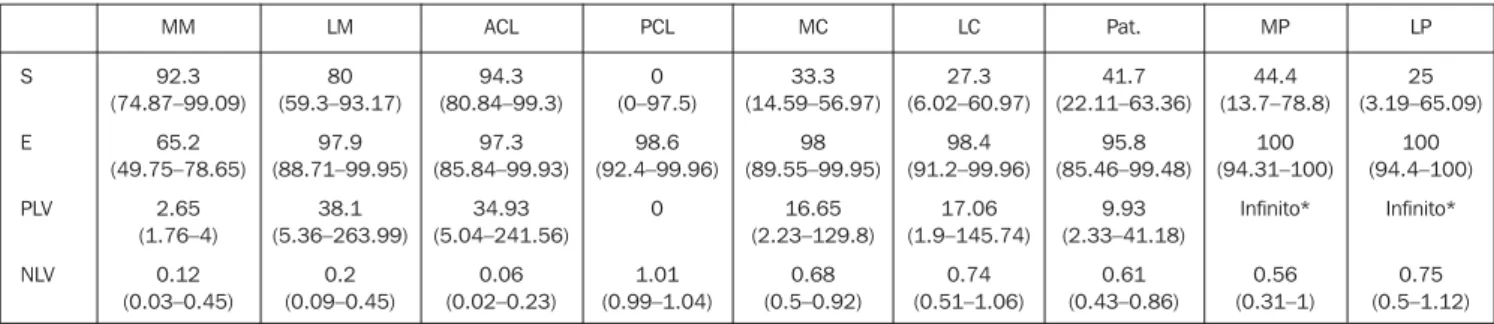
MRI demonstrated high sensitivity for identifying anterior cruciate ligament tears (94%) and medial meniscal tears (92%), good sensitivity for lateral meniscal lesions (80%), and low sensitivity for all chondral lesions (< 50%) (Table 2). The positive likelihood value was near of above 10 for all the chondral lesions, anterior cruciate ligament lesions, and lateral meniscal le-sions, and 2.65 for medial meniscal lesions (Table 2).
DISCUSSION
As in the greatest majority of similar studies, arthroscopy was utilized as com-parative standard method to evaluate the accuracy of MRI in the detection of intra-articular lesions of the knee(1,4,9,12,13). In the
present transversal study with prospective data collection, a same team evaluated MRIs of 72 patients aiming at allowing the elaboration of a prior protocol including the methodology for analysis and classifi-cation of lesions. In the Brazilian literature, four studies are found with the same
objec-Table 1 Results regarding number of diseased patients, true-positive, true-negative, false-positive and false-negative per structure evaluated.
Structure
MM
LM ACL
PCL MC
LC Pat.
MP LP
Patients
72
72 72
72 72
72 72
72 72
Diseased patients
26
25 35
1 21
11 24
9 8
TP
24
20 33
0 7
3 10
4 2
FN
2
5 2
1 14
8 14
5 6
Healthy patients
46
47 37
71 51
61 48
63 64
TN
30
46 36
70 50
60 46
63 64
FP
16
1 1
1 1
1 2
0 0
MM, medial meniscus; LM, lateral meniscus; ACL, anterior cruciate ligament; PCL, posterior cruciate ligament; MC, medial condyle; LC, lateral condyle; Pat., patella; MP, medial plateau; LP, lateral plateau; TP, true-positive; FN, false-negative; TN, true-negativo; FP, false-positive.
Table 2 Sensitivity, specificity, positive likelihood value, and negative likelihood value. (Confidence interval of 95%).
S
E
PLV
NLV
MM
92.3 (74.87–99.09)
65.2 (49.75–78.65)
2.65 (1.76–4)
0.12 (0.03–0.45)
LM
80 (59.3–93.17)
97.9 (88.71–99.95)
38.1 (5.36–263.99)
0.2 (0.09–0.45)
ACL
94.3 (80.84–99.3)
97.3 (85.84–99.93)
34.93 (5.04–241.56)
0.06 (0.02–0.23)
PCL
0 (0–97.5)
98.6 (92.4–99.96)
0
1.01 (0.99–1.04)
MC
33.3 (14.59–56.97)
98 (89.55–99.95)
16.65 (2.23–129.8)
0.68 (0.5–0.92)
LC
27.3 (6.02–60.97)
98.4 (91.2–99.96)
17.06 (1.9–145.74)
0.74 (0.51–1.06)
Pat.
41.7 (22.11–63.36)
95.8 (85.46–99.48)
9.93 (2.33–41.18)
0.61 (0.43–0.86)
MP
44.4 (13.7–78.8)
100 (94.31–100)
Infinito*
0.56 (0.31–1)
LP
25 (3.19–65.09)
100 (94.4–100)
Infinito*
0.75 (0.5–1.12)
* Infinite refers to a value divided by zero. PLV = S/1 – E (since E was 100%, 1 – 1 = 0 and calculation is unfeasible). Use a value > 100.
S, sensitivity; E, specificity; PLV, positive likelihood value; NLV, negative likelihood value; MM, medial meniscus; LM, lateral meniscus; ACL, anterior cruciate ligament; PCL, posterior cruciate ligament; MC, medial condyle; LC, lateral condyle; Pat., patella; MP, medial plateau; LP, lateral plateau.
tive(8,14–16), only the last of them presenting
an appropriate methodology, although not utilizing a classification for lesions or a prospective data collection.
Similarly to many studies in the litera-ture, the MRI system utilized was a 1.5 tesla equipment(4,17–19), the images
acquisi-tion protocol was the same for all the pa-tients, and no special section of sequence for any particular anatomical structure of the knee could be added.
The kappa agreement coefficient as re-gards the classification of the lesions was very good for the anterior cruciate liga-ment, good for the lateral meniscus, reason-able for the medial meniscus, and low for chondral lesions. It is important to note that this coefficient of agreement is very rigor-ous when compared with the number of correct diagnoses by the method over the total number of patients. These results would be better if we had quantified the error in percentage (weighted kappa coef-ficient), likewise Potter et al.(19) who,
study-ing sequences specific for the joint carti-lage, have defined four levels of
discor-dance in classification of lesions, corre-sponding to 75% accuracy (1 level), 50% (2 levels), 25% (3 levels), and zero (com-plete discordance). Jee et al.(20) have
al-ready highlighted the relevance of classi-fying meniscal lesions and evaluating, by means of MRI, the level of stabilization or possibility of suture of these lesions, with consequent aid in the surgical planning and guidance for the patient on his postopera-tive course of treatment and recovery. The rationale is the same for chondral lesions, since the previous evaluation allows de surgeon to choose the most appropriate method of treatment, debridement or mosaicoplasty, for example. It is predict-able that the future will require from MRI this level of performance.
In the present study, rates of sensitivity, specificity and likelihood values (Table 2) were similar to those reported in the litera-ture. Specificity was high (> 90%) for lat-eral meniscal lesions, medial and latlat-eral condylar lesions, lesions in the posterior and anterior cruciate ligaments and in the medial and lateral tibial plateaus. For pa-tellar lesions, specificity was very good, and merely good for medial meniscal le-sions. The positive likelihood value was high for lesions in condyles, tibial plateaus, anterior cruciate ligaments and lateral me-niscus, strongly indicating the presence of lesion, particularly when clinical studies point to the same direction. In the presence of a previous clinical suspicion, positive likelihood values > 10 strongly indicate the presence of disease(21). A merely reasonable
182
Karam FC et al.
Radiol Bras 2007;40(3):179–182
ranged between one and 90 days, or due to the impossibility of visualizing peripheral lesions in the posterior horn of the medial meniscus, because of the difficult access in the arthroscopy, as suggested by Mackenzie et al.(22), with a resulting increase in the
number of false-positive results.
The negative likelihood value was low, especially for lesions in the medial menis-cus and anterior cruciate ligament. In this case, de absence of lesion on the MRI study is a strong indicator that it really is not present, especially if the pretest probabil-ity is low. Because of the low prevalence of posterior cruciate ligament injury, i.e., only one patient affected among the 72 patients of the sample, an appropriate analysis of this structure was unfeasible.
The lateral meniscus presented a good sensitivity and a negative likelihood value of 0.34, possibly contraindicating arthro-scopy in the presence of poor clinical sus-picion associated with a negative MRI.
On the other hand, for chondral lesions, low sensitivity and negative likelihood value > 0.5 indicate that the absence of MRI findings does not exclude the pres-ence of a lesion, added of the low efficacy of the physical examination for the diagno-sis of these lesions. Spiers et al.(2) have
al-ready demonstrated the MRI low sensitiv-ity and high specificsensitiv-ity for chondral le-sions, while contrast-enhanced MRI as well as arthrotomography seem to present higher accuracy, according to the litera-ture(17). The utilization of specific protocols
for visualization of cartilaginous tissues seems to considerably improve the MRI accuracy in the evaluation of these lesions. Potter et al.(19) have demonstrated that
spe-cial MRI images for cartilages may result in considerable improvement in the accu-racy of the method, since they have found a sensitivity of 87%, specificity of 94%, and accuracy of 92% in their study. In the present study, the patellar cartilage was the region where MRI presented the best per-formance, with reasonable sensitivity and a very good specificity, leading us to con-sider that, with the utilization of a special coil and a specific protocol, even without the use of contrast, MRI will significantly improve the diagnosis of patellar syn-dromes.
Finally, it is important to note that mis-takes may occur in the interpretation of di-agnostic images, and so does it with MRI(23).
This should be kept in mind, since MRI should not supersede the anamnesis and the physical examination, but should comple-ment them in the search an accurate diag-nosis. A diagnosis of intra-articular knee injury must be based on the aggregate of findings from anamnesis, physical exami-nation (with specific tests for each struc-ture), and analysis of radiological studies (plain radiographs, stress radiographs, ar-thrography, tomography and MRI).
CONCLUSIONS
Magnetic resonance imaging is a useful tool in the clinical diagnosis of intra-articu-lar knee injuries, as already demonstrated by similar results reported both in the Bra-zilian and international literature.
MRI specificity, sensitivity, positive and negative likelihood values found for ante-rior cruciate ligament and meniscal injuries demonstrate the significant contribution of this method for the clinical diagnosis of such lesions.
Considering the high positive likeli-hood value of the method, the visualization of a chondral lesion in a MRI study is a strong indicator of the presence of the dis-ease. Since the negative likelihood value is not sufficiently low, the absence of an im-age of the lesion does not mean that such a lesion may be present.
REFERENCES
1. Oei EH, Nikken JJ, Verstijnen AC, Ginai AZ, Myriam Hunink MG. MR imaging of the menisci and cruciate ligaments: a systematic review. Ra-diology 2003;226:837–848.
2. Spiers AS, Meagher T, Ostlere SJ, Wilson DJ, Dodd CA. Can MRI of the knee affect arthroscopic prac-tice? A prospective study of 58 patients. J Bone Joint Surg Br 1993;75:49–52.
3. Rangger C, Klestil T, Kathrein A, Inderster A, Hamid L. Influence of magnetic resonance imag-ing on indications for arthroscopy of the knee. Clin Orthop Relat Res 1996;330:133–142. 4. Heron CW, Calvert PT. Three-dimensional
gradi-ent-echo MR imaging of the knee: comparison with arthroscopy in 100 patients. Radiology 1992; 183:839–844.
5. Bui-Mansfield LT, Youngberg RA, Warme W, Pitcher JD, Nguyen PL. Potential cost savings of MR imaging obtained before arthroscopy of the knee: evaluation of 50 consecutive patients. AJR Am J Roentgenol 1997;168:913–918.
6. Jackson DW, Jennings LD, Maywood RM, Berger PE. Magnetic resonance imaging of the knee. Am J Sports Med 1988;16:29–38.
7. Brooks S, Morgan M. Accuracy of clinical diag-nosis in knee arthroscopy. Ann R Coll Surg Engl 2002;84:265–268.
8. Vaz CE, Camargo OP, de Santana PJ, Valezi AC. Accuracy of magnetic resonance in identifying traumatic intraarticular knee lesions. Clinics 2005;60:445–450.
9. Tyrrell RL, Gluckert K, Pathria M, Modic MT. Fast three-dimensional MR imaging of the knee: comparison with arthroscopy. Radiology 1988; 166:865–872.
10. Stoller DW, Martin C, Crues JV, Kaplan L, Mink JH. Meniscal tears: pathologic correlation with MR imaging. Radiology 1987;163:731–735. 11. Outerbridge RE. The etiology of chondromalacia
patellae. J Bone Joint Surg Br 1961;43:752–757. 12. Polly DW, Callaghan JJ, Sikes RA, McCabe JM, McMahon K, Savory CG. The accuracy of selec-tive magnetic resonance imaging compared with the findings of arthroscopy of the knee. J Bone Joint Surg Am 1988;70:192–198.
13. Vande Berg BC, Malghem J, Poilvache P, Malda-gue B, Lecouvet FE. Meniscal tears with frag-ments displaced in notch and recesses of knee: MR imaging with arthroscopic comparison. Ra-diology 2005;234:842–850.
14. Schneider I, Schueda MA, Demore AB. Análise comparativa da ressonância magnética com a ar-troscopia no diagnóstico das lesões intra-articula-res do joelho. Rev Bras Ortop 1996;31:373–376. 15. Severino NR, Camargo OP, Aihara T, et al. Com-paração entre a ressonância magnética e a artros-copia no diagnóstico das lesões do joelho. Rev Bras Ortop 1997;32:275–278.
16. Yousef WJ, Thiele ES, Scuisato DL. Correlação diagnóstica da ressonância magnética com artros-copia nas lesões intra-articulares do joelho. Rev Bras Ortop 1999;34:375–380.
17. Gagliardi JA, Chung EM, Chandnani VP, et al. Detection and staging of chondromalacia patel-lae: relative efficacies of conventional MR imag-ing, MR arthrography, and CT arthrography. AJR Am J Roentgenol 1994;163:629–636. 18. Lundberg M, Odensten M, Thuomas KA,
Mess-ner K. The diagnostic validity of magnetic reso-nance imaging in acute knee injuries with hemar-throsis: a single-blinded evaluation in 69 patients using high-field MRI before arthroscopy. Int J Sports Med 1996;17:218–222.
19. Potter HG, Linklater JM, Allen AA, Hannafin JA, Haas SB. Magnetic resonance imaging of articu-lar cartilage in the knee. An evaluation with use of fast-spin-echo imaging. J Bone Joint Surg Am 1998;80:1276–1284.
20. Jee WH, McCauley TR, Kim JM, et al. Meniscal tear configurations: categorization with MR im-aging. AJR Am J Roentgenol 2003;180:93–97. 21. Deeks JJ, Altman DG. Diagnostic tests 4:
likeli-hood ratios. BMJ 2004;329:168–169. 22. Mackenzie R, Keene GS, Lomas DJ, Dixon AK.
Errors at knee magnetic resonance imaging: true or false? Br J Radiol 1995;68:1045–1051. 23. Muglia VF, Simão MN, Elias Jr J, Trad CS.