Treatment of low-risk gestational
trophoblastic neoplasia comparing biweekly
eight-day Methotrexate with folinic acid
versus bolus-dose Actinomycin-D, among
Brazilian women
Tratamento da neoplasia trofoblástica gestacional de baixo-risco,
comparando aplicação quinzenal de oito dias de Metotrexato com
ácido folínico versus Actinomicina D em bolo, em mulheres brasileiras
adriana GErHardt ViEirada CUnHa2SirlEnE SoarES Frota3 antônio braGa4 antonio CElSo KoEHlEr ayUb5
Abstract
PURPOSE: To compare two single-agent chemotherapy (ChT) regimens evaluating, in first-line treatment, response and side effects and, in final single-agent treatment, the outcomes, among Brazilian patients with low-risk gestational trophoblastic neoplasia (GTN), according to International Federation of Gynecology and Obstetrics (FIGO) 2002. METHODS: Retrospective analysis of two concurrent cohorts with 194 low-risk GTN patients: from 1992 to 2012, as first-line treatment, 115 patients received 4 intramuscular doses of methotrexate alternated with 4 oral doses of folinic acid (MTX/FA) repetead every 14 days and, since 1996, 79 patients received an endovenous bolus-dose of actinomycin D (Act-D), biweekly. At GTN diagnosis, patient opinion was taken into consideration when defining the initial single-agent ChT regimen, and when there was resistance or toxicity to one regimen, the other drug was used preferentially. This study was approved by the Irmandade da Santa Casa de Misericórdia de Porto Alegre Ethical Committee. RESULTS: Both groups were clinically similar (p>0.05). In first-line treatments, frequency of complete response was similar (75.7% with MTX/FA and 67.1% with bolus Act-D); the number of ChT courses —median 3 (range: 1–10) with MTX/FA and 2 (range: 1–6) with bolus Act-D — and the time to remission —median 9 weeks (range: 2–16) with MTX/FA and 10 weeks (range: 2–16) with bolus Act-D) — were not different between the groups. In both groups, first-line side effects frequency were high but intensity was low; stomatitis was higher with MTX/FA (p<0.01) and nausea and vomit with Act-D (p<0.01). Final single-agent ChT responses were high in both groups (94.8% with MTX/FA and 83.5% with bolus Act-D; p<0.01) and 13% higher in the group initially treated with MTX/FA. Rates of hysterectomy and of GTN recurrence were low and similar. No patient died due to GTN. CONCLUSION: The two regimens had similar first-line ChT response. Final single-agent response rates were high and similar in both groups but the final single-agent remission rate was higher in the MTX/FA group.
Resumo
OBJETIVO: Em mulheres brasileiras com neoplasia trofoblástica gestacional (NTG) de baixo-risco, de acordo com a Federação Internacional de Ginecologia e Obstetrícia (FIGO) 2002, comparar dois regimes de quimioterapia (Qt) por agente único avaliando resposta e efeitos colaterais no tratamento de primeira linha, e a eicácia no tratamento inal por agente único de Qt. MÉTODOS: Análise retrospectiva de duas coortes concorrentes com 194 pacientes com NTG de baixo risco: de 1992 a 2012; como primeira linha, 115 pacientes receberam 4 doses intramusculares de metotrexato alternado com 4 doses orais de ácido folínico (MTX/FA) repetidos a cada 14 dias e, desde 1996, 79 pacientes receberam quinzenalmente dose em bolo de actinomicina D (Act-D) por
Centro de Doenças Trofoblásticas, Irmandade da Santa Casa de Misericórdia de Porto Alegre – ISCMPA – Porto Alegre (RS), Brazil.
1Trophoblastic Disease Center, Irmandade da Santa Casa de Misericórdia de Porto Alegre – ISCMPA – Porto Alegre (RS), Brazil. 2Radiology Service, Irmandade da Santa Casa de Misericórdia de Porto Alegre – ISCMPA – Porto Alegre (RS), Brazil. 3Santa Rita Hospital, Irmandade da Santa Casa de Misericórdia de Porto Alegre – ISCMPA – Porto Alegre (RS), Brazil.
4School of Medicine, Universidade Federal do Rio de Janeiro – UFRJ – Rio de Janeiro (RJ); School of Medicine, Universidade Federal
Fluminense – UFF – Niterói (RJ), Brazil.
5Mário Totta Maternity, Irmandade da Santa Casa de Misericórdia de Porto Alegre – ISCMPA – Porto Alegre (RS), Brazil.
Conlict of interests: none.
Keywords
Methotrexate/administration & dosage Methotrexate/therapeutic use Methotrexate/adverse effects Dactinomycin/administration & dosage Dactinomycin/therapeutic use Dactinomycin/adverse effects Gestational trophoblastic disease/drug therapy
Palavras-chave
Metotrexato/administração & dosagem Metotrexato/uso terapêutico Metotrexato/efeitos adversos Dactinomicina/administração & dosagem
Dactinomicina/uso terapêutico Dactinomicina/efeitos adversos Doença trofoblástica gestacional/quimioterapia
Correspondence Elza Maria Hartmann Uberti Hospital Santa Clara (Recepção 5 do Ambulatório Central), Irmandade da Santa Casa de Misericórdia de Porto Alegre Rua Professor Annes Dias, 295 Zip code: 90020-090 Porto Alegre (RS), Brazil
Received 04/28/2015
Introduction
Gestational trophoblastic disease (GTD) describes a rare and highly curable group of tumors pathologies that arise from tissues of placental origin and results from abnormal conception caused by aberrant fertilization1.
Most GTD cases include the two types of hydatidiform moles (HM) that have a variable potential to progress into the rare malignant disease, called gestational tro-phoblastic neoplasia (GTN)2,3. GTN has become a highly
curable tumor, with an overall 90% of patient survival, due to the possibility of early diagnosis and treatment monitoring, ideally in Reference Centers (RC), and the individualized chemotherapy (ChT) based on prognostic factors, according scoring system of the International Federation of Gynecology and Obstetrics (FIGO) 20021-7.
The FIGO 2002 deined that low-risk GTN could be treated with single-agent ChT, resulting in inal survival rates approaching 100%3,7. Several studies with Methotrexate
(MTX) and Actinomycin D (Act-D) protocols have been used for treatment of low-risk GTN8-12; nevertheless, few
studies compared these two drugs in the management of low-risk GTN13-16. Osborne et al.16 has recently published a
randomized study that suggests that the use of a bolus dose of Act-D every 15 days might be more effective than the administration of a weekly dose of MTX16. A randomized
multi-center trial (GOG0275) is underway to compare pulsed Act-D with other MTX administration schemes17.
To our knowledge, no study has evaluated the use of bi-weekly 8-day MTX alternated with folinic acid (MTX/FA) and bolus-dose Act-D. This retrospective study compared the results of these regimens, administered as irst-line and as total single-agent ChT, to two concurrent cohorts of Brazilian patients with FIGO 2002 low-risk GTN.
Methods
From March 1985 to September 2012, from 1,678 cases with GTD and after excluding 70 patients (4.2%) due
to pre-remission loss to follow-up (45 cases — 2.7%) and due to transfers to other RC (25 cases — 1.5%), 300 GTN patients (17.9 %) were retrospectively analysed in the Trophoblastic Disease Center of Irmandade da Santa Casa de Misericórdia de Porto Alegre (ISCMPA), in Southern Brazil.
The GTN patients met FIGO 2002 criteria and had an hCG plateau of ±10% for at least 3 consecutive weeks, a rise of hCG >10% for 2 consecutive weeks, a high hCG for 6 months or longer7,18, or other Charing
Cross Hospital indications for ChT in GTD1,3. After the
diagnosis of GTN was established, a staging evaluation was performed, using clinical, laboratorial and radiology resources, as recommended by FIGO 2002. Then, patients with GTN were categorized according to the FIGO 2002 criteria into a low (≤6) or high-risk (≥7) group. FIGO stage and score were retrospectively determined in patients treated prior to 2002. Complete response or remission was diagnosed after 3 consecutive weekly hCG levels were within normal range (<5 mIU/mL) and sustained remission, when the hCG level remained at that same level for 1 year1,2,4,5,7,18.
Our management protocol is shown in Figure 1. We excluded 106 patients: 35/300 patients (11.7%), due to high-risk GTN; 38/300 patients (12.7%), due to hysterectomy before ChT; 10/300 patients (3.3%), due to emergency treatment with bolus Act-D, immediately followed by 8-day MTX/FA; 23/300 patients (7.7%), due to other therapy than the studied ChT regimens.
plus 0.1 mg/kg to 15 mg of oral folinic acid in the inter-vening day, recycled every 14 days until hCG remission and then, after one normal hCG value (<5 mUI/mL), treatment was maintained for 6 weeks post-remission. Group B (GB): from September 1996 to September 2012; for 79 patients (40.7%), the irst-line single-agent ChT was the pulsed Act-D regimen, which consisted of administration of intravenous Act-D (1.25 mg/m2;
maximum dose: 2.0 mg), recycled every 14 days until hCG remission and then, after one normal hCG value, ChT treatment was maintained for more 6 weeks post-remission. When there was resistance or toxicity to one regimen, the other drug was used preferentially.
GTN surveillance during treatment included bi-weekly measurements of serum hCG levels on the irst day of each course of treatment. The regression hCG curve for each patient was compared with the stan-dard curve established by Schlaerth et al.19. Regardless
of hCG serum levels, when evidence of resistance or toxicity to irst-single-agent ChT was identiied, pa-tients received the other single-agent ChT regimen. All patients required advice about pregnancy preven-tion and they generally received contraceptive pills every month. After the irst normal hCG, the patients received two to three cycles of the last ChT regimen as treatment consolidation18,20. After ChT completion,
Figure 1. Management and outcome of patients with low-risk gestational trophoblastic neoplasia treated with single-agent high-dose Methotrexate alternated with folinic acid or bolus dose of Actinomycin D, repeated each two weeks
1678 Patients with GTDa
(March 1985 to September 2012)
Exclusion: 70 cases (4.2%)
45 – pre-remission loss to follow up (2.7%)
25 – transfers to other RC (1.5%)
1211/1608 – Spontaneous remission (75.3%)
35/300: High-risk GTN FIGO ≥ 7 (11.7%)
38/300: Hysterectomy
before ChT (12.7%) Exclusions: 106 Patients
Inclusion cohort: 194 Patients with low-risk GTN (FIGO ≤ 6)
115 patients: First-line treatment with MTX/FA (59.3%)
All alive and healthy
79 patients: First-line treatment with Act-D (40.7%) 10/300: Emergency
treatment with bolus Act-D, immediately
followed by MTX/FA (3.3%)
23/300: Other therapy than studied ChT regimens (7.7%)
300/1608 – Evolution to GTNc(18.6%)
the patients underwent clinical examination and hCG measurements as recommended by Bagshawe20. One year
after ChT completion, the patients were released to become pregnant1,2,5,7,18.
When a third-line GTN treatment was necessary, most patients received the EMA/CO multi-agent ChT regimen (etoposide + MTX/FA + Act-D + vincristine + cyclophosphamide)1,2,5,7,but a few patients chose to
undergo secondary hysterectomy associated with single-agent ChT18,21.
Patient and disease characteristics, including age, parity and hCG serum level before treatment, FIGO 2002 anatomic staging and risk score, response rate with irst-line single-agent ChT (time to achieve GTN remission, number of ChT courses, frequency and intensity of toxic treatment effects according to the National Institute of Health standard toxicity criteria), response rate to alternative single-agent ChT in second-line ChT, overall percentage of response to irst- and second-line ChT treatment were analysed. Finally, data about secondary hysterectomy rates, discharge conditions, duration of follow-up and compliance to treatment were also col-lected, as well as GTN recurrence. Patient adherence to follow up was evaluated up to December 2013.
Categorical variables were analyzed and described using frequency rates, followed by the analysis of quan-titative variables; results were described as means and standard deviations or medians and inter-quartile ranges. The Pearson χ2 test was used to compare qualitative
variables and to identify possible associations between them. The Student’s t-test was used to compare means between two independent groups; in case continuous variables had an asymmetric distribution, the Mann-Whitney test was used. The level of signiicance was set at p<0.05 for all tests. All analyses were conducted using the Statistical Package for the Social Sciences 17.0 (IBM, Armonk, NY, USA). This study was approved by the Institutional Review Board of ISCMPA (Registration number: 3625/11), and an institutional conidentiality term was adopted.
Results
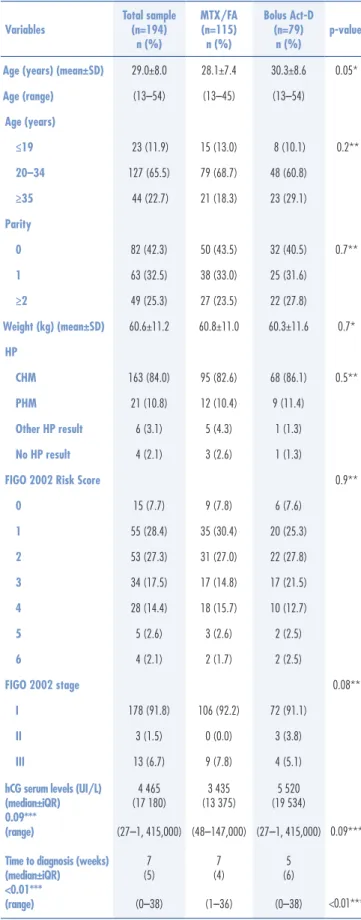
In both groups, most patients were classiied as FIGO 2002 stage I (GA=92.2% and GB=91.1%), and risk scores were lower than 5 (GA=95.6% and GB=94.9%). There were no differences between groups in age, par-ity, weight, histopathology, FIGO 2002 stage/score and serum hCG levels at the beginning of treatment (Table 1). Because in the three cases of FIGO 2002 stage II patients the chosen initial treatment was with bolus-Act-D, the time to diagnosis was signiicantly shorter in GB than in GA.
Table 1. Sample characteristics
*Student’s t-test; **Pearson χ2 test; ***Mann-Whitney test.
MTX/FA: 8-day high-dose Methotrexate with folinic acid rescue; Act-D: Actinomycin D; SD: standard deviation; CHM: complete hydatidiform mole; PHM: partial hydatidiform mole; HP: Histopathology; FIGO: International Federation of Gynecology and Obstetrics; hCG: human chorionic gonadotropin;iQR: interquartile range.
Variables
Total sample (n=194)
n (%)
MTX/FA (n=115) n (%)
Bolus Act-D (n=79)
n (%)
p-value
Age (years) (mean±SD) 29.0±8.0 28.1±7.4 30.3±8.6 0.05*
Age (range) (13–54) (13–45) (13–54)
Age (years)
≤19 23 (11.9) 15 (13.0) 8 (10.1) 0.2**
20–34 127 (65.5) 79 (68.7) 48 (60.8)
≥35 44 (22.7) 21 (18.3) 23 (29.1)
Parity
0 82 (42.3) 50 (43.5) 32 (40.5) 0.7**
1 63 (32.5) 38 (33.0) 25 (31.6)
≥2 49 (25.3) 27 (23.5) 22 (27.8)
Weight (kg) (mean±SD) 60.6±11.2 60.8±11.0 60.3±11.6 0.7*
HP
CHM 163 (84.0) 95 (82.6) 68 (86.1) 0.5**
PHM 21 (10.8) 12 (10.4) 9 (11.4)
Other HP result 6 (3.1) 5 (4.3) 1 (1.3)
No HP result 4 (2.1) 3 (2.6) 1 (1.3)
FIGO 2002 Risk Score 0.9**
0 15 (7.7) 9 (7.8) 6 (7.6)
1 55 (28.4) 35 (30.4) 20 (25.3)
2 53 (27.3) 31 (27.0) 22 (27.8)
3 34 (17.5) 17 (14.8) 17 (21.5)
4 28 (14.4) 18 (15.7) 10 (12.7)
5 5 (2.6) 3 (2.6) 2 (2.5)
6 4 (2.1) 2 (1.7) 2 (2.5)
FIGO 2002 stage 0.08**
I 178 (91.8) 106 (92.2) 72 (91.1)
II 3 (1.5) 0 (0.0) 3 (3.8)
III 13 (6.7) 9 (7.8) 4 (5.1)
hCG serum levels (UI/L) (median±iQR) 0.09*** (range)
4 465 (17 180)
(27–1, 415,000)
3 435 (13 375)
(48–147,000)
5 520 (19 534)
(27–1, 415,000) 0.09***
Time to diagnosis (weeks) (median±iQR) <0.01*** (range)
7 (5)
(0–38)
7 (4)
(1–36)
5 (6)
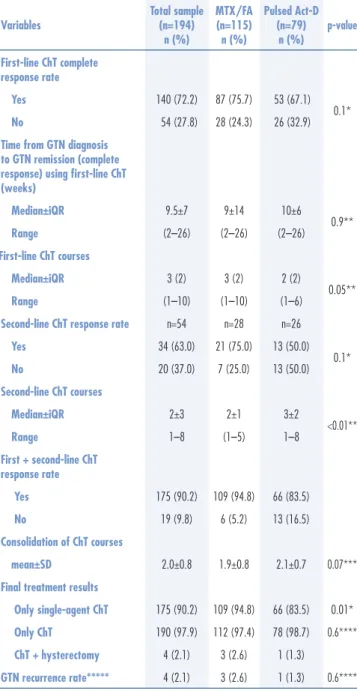
complete response to sequential single-agent ChT was 94.8% in GA and 83.5% in GB (p=0.02). According to the Poisson regression, after adjustments to the hCG serum levels, time to diagnosis, age and FIGO 2002 stage, a higher response to first + second line remained significantly associated with GA (p=0.02). Patients who begin the GTN treatment with MTX/ FA have 13% more probability of response in first + second line (RR=1.1; confidence interval of 95% – 95%CI 1.0–1.2). As a third-line treatment in the total sample, 15/194 patients (7.7%) received the EMA/CO multi-agent ChT regimen as salvage treatment after both single-agent ChT failure and the EMA/CO use rate was higher in GB (2.6% in GA and 15.2% in GB, p<0.01). In both groups, the frequency of surgical treatment with secondary hysterectomy and the GTN recurrence rate — respectively, 2.6% (3 patients) in GA and 1.3% (1 patient) in GB — were low and similar.
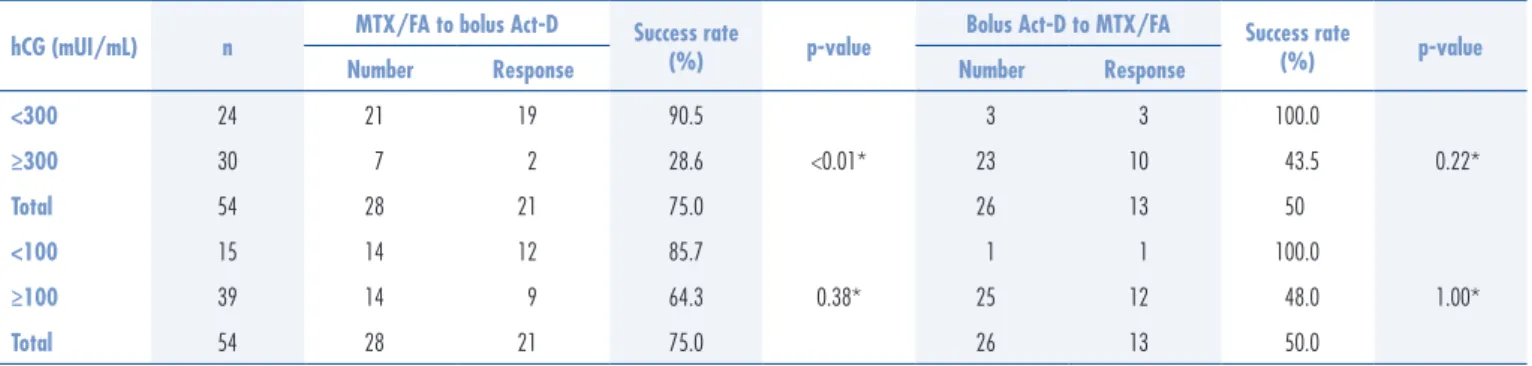
The frequency of response to irst-line single-agent ChT according to the drug used and FIGO 2002 showed similar response rate between groups when FIGO 2002 score was below 5 (GA=77.3%, GB=69.3%). When second-line response according the hCG serum levels (Table 3) was evaluated, even when these levels were above 300 mIU/mL and although the case numbers were few (GA=7 pa-tients; GB=23 patients), the frequency of response to the alternative single-agent ChT was good and similar (GA=28.6%; GB=43.5%), averting in these cases the use of multi-agent ChT.
Only 3 patients (2.6%) required a change from MTX/FA to pulsed Act-D due to grade 3 mouth ulcers, but no patients required hospital admission for treatment of toxicity. In both groups, total percentage of collateral effects was high, but their intensity was low (grade 1 or 2); they were easy to manage and more frequent in the pulsed Act-D group (p=0.04), especially nausea and vomits (p<0.01). However, in the MTX/FA group, there were higher percentages of mild stomatitis (mouth ulcers) (66.7%; p<0.01), pleuritis (14.8%; p<0.01) and sore eyes (33.3%; p=0.03) (Table 4).
In the total sample, the follow-up duration was high and similar between the groups — median (range): GA=5 years (1.4–16.6) and GB=4.5 years (1.1–11.3). Also, the frequency of medical discharge and of adherence to complete follow-up were elevated and not different among both groups (respectively, 86.9x96.2% and 93.1x96.3%). Almost all patients were alive and healthy (99.5%). The only death occurred in a patient in the Act-D group: it occurred 10 months after GTN remission and was due to adult immuno-deiciency syndrome’s gastrointestinal complications (bowel hemorrhage).
Table 2. Treatment results
*Pearson χ2 test; **Mann-Whitney test; ***Student’s t-test; ****Fisher exact test;
*****4/5 (80%) patients also underwent hysterectomy.
MTX/FA: 8-day high-dose Methotrexate with folinic acid rescue; Act-D: Actinomycin D; ChT: chemotherapy; GTN: gestational trophoblastic neoplasia; iQR: interquartile range.
Variables
Total sample (n=194)
n (%)
MTX/FA (n=115)
n (%)
Pulsed Act-D (n=79)
n (%)
p-value
First-line ChT complete response rate
Yes 140 (72.2) 87 (75.7) 53 (67.1) 0.1*
No 54 (27.8) 28 (24.3) 26 (32.9)
Time from GTN diagnosis to GTN remission (complete response) using irst-line ChT (weeks)
Median±iQR 9.5±7 9±14 10±6
0.9**
Range (2–26) (2–26) (2–26)
First-line ChT courses
Median±iQR 3 (2) 3 (2) 2 (2)
0.05**
Range (1–10) (1–10) (1–6)
Second-line ChT response rate n=54 n=28 n=26
Yes 34 (63.0) 21 (75.0) 13 (50.0) 0.1*
No 20 (37.0) 7 (25.0) 13 (50.0)
Second-line ChT courses
Median±iQR 2±3 2±1 3±2
<0.01**
Range 1–8 (1–5) 1–8
First + second-line ChT response rate
Yes 175 (90.2) 109 (94.8) 66 (83.5)
No 19 (9.8) 6 (5.2) 13 (16.5)
Consolidation of ChT courses
mean±SD 2.0±0.8 1.9±0.8 2.1±0.7 0.07***
Final treatment results
Only single-agent ChT 175 (90.2) 109 (94.8) 66 (83.5) 0.01*
Only ChT 190 (97.9) 112 (97.4) 78 (98.7) 0.6****
ChT + hysterectomy 4 (2.1) 3 (2.6) 1 (1.3)
GTN recurrence rate***** 4 (2.1) 3 (2.6) 1 (1.3) 0.6****
Table 3. Second-line single-agent chemotherapy success rate according to human chorionic gonadotropin serum levels
*Fisher exact text
MTX/FA: 8-day high-dose Methotrexate with folinic acid rescue; Act-D = Actinomycin D; hCG: human chorionic gonadotropin.
hCG (mUI/mL) n MTX/FA to bolus Act-D Success rate (%) p-value Bolus Act-D to MTX/FA Success rate (%) p-value
Number Response Number Response
<300 24 21 19 90.5
<0.01*
3 3 100.0
0.22*
≥300 30 7 2 28.6 23 10 43.5
Total 54 28 21 75.0 26 13 50
<100 15 14 12 85.7
0.38*
1 1 100.0
1.00*
≥100 39 14 9 64.3 25 12 48.0
Total 54 28 21 75.0 26 13 50.0
Table 4. Treatment toxicity during irst-line chemotherapy on low-risk gestational trophoblastic neoplasia patients
*Most patientshad toxicity grade 1 or 2; **Pearson χ2 test;***three patients
(3.8%) changed the ChT due to this toxicity (grade 3); ****Fisher exact test. MTX/FA: 8-day high-dose Methotrexate with folinic acid rescue; Act-D: Actinomycin D.
Variables
Total sample (n=131)
n (%)
MTX/FA (n=77)
n (%)
Pulse Act-D (n=54)
n (%)
p-value
Side effects
Yes* 101 (77.1) 54 (70.1) 47 (87.0) 0.04**
No 30 (22.9) 23 (29.9) 7 (13.0)
Side effects type
Mouth ulcers 53 (52.5) 36*** (66.7) 17 (36.2) <0.01**
Nausea and vomit 37 (36.6) 9 (16.7) 28 (59.6) <0.01**
Diarrhea 10 (9.9) 3 (5.6) 7 (14.9) 0.1****
Pleuritic pain from
serositis 8 (7.9) 8 (14.8) 0 (0.0) <0.01****
Stomach ache 15 (14.9) 8 (14.8) 7 (14.9) 1.0**
Sore eyes 24 (23.8) 18 (33.3) 6 (12.8) 0.02**
Discussion
To our knowledge, no study had evaluated the two analysed single-agent ChT regimens in low-risk GTN patients as we did in this concurrent cohort retrospective analysis. In this study, the irst-line results for biweekly 8-days MTX/FA and pulsed Act-D among patients with a similar low-risk GTN FIGO 2002 were resemble. The hCG levels normalized in both groups in the same time and the patients received similar number of treat-ment cycles (p=0.06).
For nearly all low-risk GTN patients, single-agent ChT with either MTX or Act-D is the preferred treat-ment1,2,5,7,9,18. A variety of regimens have been developed,
in which non-randomized, mostly retrospective studies demonstrate a 50–90% chance of inducing remission22.
Osborne et al.16 have suggested that pulsed Act-D is more
likely to induce remission than weekly MTX but this randomized study has been underpowered. We are waiting
for the results of an larger international trial run by the Gynecology Oncology Group in the United States, begun in 2013 (NCT01535053), evaluating quality of life and acceptability of treatment with the objective of helping to deine the optimum single-agent approach17,23. However,
this trial did not include the chosen MTX regimen as we used in this study.
As the success rates of treating GTN with known agents are high, investigators have evaluated modiied protocols for administering MTX to limit systemic toxic-ity, to reduce overall time to remission and costs, with no hospitalization2-7. According to Osborne and Gerulath24,
the MTX regimen, most commonly used in Europe and the rest of the world, excluding North America, is the Charing Cross modiied Bagshawe 8-day regimen: a ixed dose of 50 mg MTX repeated every 14–16 days; on the results of 10 studies using MTX/FA in 1,238 patients, they reported a primary resistance in 20.3% (our results, 24.3%); a number of ChT series ranging from 1.4 to 8.0 (our results, median 3(2)); a toxicity that required a change of ChT regimen in 1% (our results, 2,6%) and total primary cure of 79.2% (our results, 75.7%).
Act-D is one of the two most used drugs in the treatment of low-risk GTN1,2,5. Usually, it is
adminis-tered using a 5-day EV schedule in the cases of MTX resistance or toxicity8,11,12. In order to reduce the high
rate and intensity of collateral effects with 5-day Act-D schedule, several authors have investigated the use of the so-called pulsed Act-D regimen15,16.When used as
irst-line ChT for low-risk GTN patients, pulsed Act-D had the following results in 4 studies: mean number of courses was 4.9 — our results, median 2; resistance was 8–24% — our results, 32.9%; and cure rate ranged from 76% (low-risk metastatic GTN) to 86% (non-metastatic GTN) —our results, 67.1%, with most patients in stage I of FIGO 200212,13,16.
Kohorn25 and others10,11 recommended abandoning
his recommendation and we have tried to use the alterna-tive single-agent ChT regimen, irrespecalterna-tive of the hCG level, before the administration of multi-agent ChT. We had a high overall response rate of 94.8 and 83.5% in patients respectively initially treated with MTX/FA and pulsed Act-D (p=0.019); and patients that begin the GTN treatment with MTX/FA have 13% more probability of response in irst + second line (RR=1.1; 95%CI 1.0–1.2). Although a few patients were submitted to a second-line treatment (respectively, 28 with MTX/FA and 26 with pulsed Act-D), in Act-D group the response to alternative second-line treatment was not different when serum hCG levels were above or below 300 mIU/mL (p=0.2); neverthe-less, with this management of second-line treatment, we could avoid the multiagent ChT in 2/7 patients (28.6%) in GA and in 10/23 patients (43.5%) in GB. In our RC, we will continue evaluating the second-line treatment re-sponses to the studied single-agent ChT in low-risk GTN patients12,25, which may protect some patients against the
effects of the more toxic multi-agent ChT.
Adverse events were relatively modest on either regi-men. There was an observed increase in grades 1 and 2 gastrointestinal adverse effects in patients receiving pulsed Act-D. In patients receiving MTX/FA, there were higher grade 2 stomatitis, pleural pain due to serositis, and sore eyes, especially after the irst cycle of ChT. Alopecia was not observed with MTX/FA and was not signiicant with pulsed Act-D.
To reduce the rate of recurrence, we used a mean of 2–3 consolidation ChT with the last used ChT scheme (re-spectively, 1.9±0.8 cycles with MTX/FA and 2.1±0.7 cycles with pulsed Act-D; p=0.07), and our recurrence rates (MTX/ FA=2.6%, pulsed Act-D=1.3%; p=0.64) were similar to the overall recurrence rate of 4–8% reported in the literature1,2,4.
In our patients with low-risk GTN, clinical treatments with only ChT, without hysterectomy, promote excellent healing rates — in inal treatment, 97.4% in the MTX/FA group and 98.7% in the pulsed Act-D (p=0.64). Our results strongly suggest that the single-agent ChT for low-risk GTN, as studied here, had good and similar irst-line single-agent treatment effectiveness, and inal irst + second-line single-agent ChT response rate was high in both groups, but higher in the group of initial MTX/FA. We are waiting for the GOG0275 randomized trial results17, hoping that
the single-agent ChT remission rates be similar or better than ours results, clarifying this GTN treatment challenge: higher eficiency associated with lower morbidity.
Acknowledgements
To multidisciplinary team of the Mario Totta Maternity Ward of ISCMPA for their kind and eficient participation in the treatment of patients. We are indebted to Silvia Villa Verde Ribeiro Ferreira, Ceres Oliveira and Anelise Burmeister for their assistance in psychological support, statistical analyses and text translation, respectively.
1. Seckl MJ, Sebire NJ, Fisher RA, Golier R, Massuger L, Sessa C, et al. Gestational trophoblastic disease: ESMO clinical practice guidelines for diagnosis, treatment and follow-up. Ann Oncol. 2013;24 Suppl 6:vi39-50.
2. May T, Goldstein DP, Berkowitz RS. Current chemotherapeutic management of patients with gestational trophoblastic neoplasia. Chemother Res Pract. 2011;2011:806256.
3. Froeling FE, Seckl MJ. Gestational trophoblastic tumours: an update for 2014. Curr Oncol Rep. 2014;16(11):408.
4. Biscaro A, Braga A, Berkowitz RS. Diagnosis, classiication and treatment of gestational trophoblastic neoplasia. Rev Bras Ginecol Obstet. 2015;37(1):42-51.
5. Lurain JR. Gestational trophoblastic disease II: classiication and management of gestational trophoblastic neoplasia. Am J Obstet Gynecol. 2011;204(1):11-8.
6. FIGO Oncology Committee. FIGO staging for gestational trophoblastic neoplasia 2000. Int J Gynaecol Obstet. 2002;77(3):285-7.
7. Ngan HY, Kohorn EI, Cole LA, Kurman RJ, Kim SJ, Lurain JR, et al. FIGO report 2012: trophoblastic disease. Int J Gynaecol Obstet. 2012;119 Suppl 2:S130-6.
8. Chapman-Davis E, Hoekstra AV, Rademaker AW, Schink JC, Lurain JR. Treatment of nonmetastatic and metastatic low-risk gestational neoplasia: factors associated with resistance to single-agent methotrexate chemotherapy. Gynecol Oncol. 2012;125(3):572-5.
9. Growdon WB, Wolfberg AJ, Goldstein DP, Feltmate CM, Chinchilla ME, Lieberman ES, et al. Evaluating methotrexate treatment in patients with low-risk postmolar gestational trophoblastic neoplasia. Gynecol Oncol. 2009;112(2):353-7.
10. Covens A, Filiaci VL, Burger RA, Osborne R, Chen MD; Gynecologic Oncology Group. Phase II trial of pulse dactinomycin as salvage therapy for failed low-risk gestational trophoblastic neoplasia: a Gynecologic Oncology Group study. Cancer. 2006;107(6):1280-6.
11. Lurain JR, Chapman-Davis E, Hoekstra AV, Schink JC. Actinomycin D for methotrexate-failed low-risk gestational trophoblastic neoplasia. J Reprod Med. 2012;57(7-8):283-7.
12. Petrilli ES, Twiggs LB, Blessing JA, Teng NH, Curry S. Single-dose actinomycin D treatment for nonmetastatic gestational trophoblastic disease. A prospective phase II trial of the Gynecologic Oncology Group. Cancer. 1987;60(9):2173-6.
13. Lertkhachonsuk AA, Israngura N, Wilailak S, Tangtrakul S. Actinomycin d versus methotrexate-folinic acid as the treatment of stage I, low-risk gestational trophoblastic neoplasia: a randomized controlled trial. Int J Gynecol Cancer. 2009;19(5):985-8.
14. Abrão RA, de Andrade JM, Tiezzi DG, Marana HR, Candido dos Reis FJ, Clagnan WS. Treatment for low-risk gestational trophoblastic disease: comparison of single-agent methotrexate, dactinomycin and combination regimens. Gynecol Oncol. 2008;108(1):149-53.
15. Mousavi A, Cheraghi F, Yarandi F, Gilani MM, Shojaei H. Comparison of pulsed actinomycin-D versus 5-day methotrexate for the treatment of low-risk gestational trophoblastic neoplasia. Int J Gynecol Obstet. 2012;116(1):39-42.
16. Osborne RJ, Filiaci V, Schink JC, Mannel RS, Alvarez Secord A, Kelley JL, et al. Phase III trial of weekly methotrexate or pulsed dactinomycin for low risk gestational trophoblastic neoplasia: a gynecologic oncology group study. J Clin Oncol. 2011;29(7):825-31.
17. Schink J. Methotrexate or dactinomycin in treating patients with low-risk gestational trophoblastic neoplasia [Internet]. 2015 [cited 2015 Jan 15]. Available from: <http://www.cancer.gov/about-cancer/treatment/clinical-trials/search/view?cdrid=725211&ve rsion=HealthProfessional>
18. Uberti EMH, Diestel MCF, Guimarães FE, Lacerda ME, Rosa MW, Nápoli G, et al. Conduta no Tumor Trofoblástico Gestacional (TTG): experiência de 10 anos de um centro de referência. Acta Oncol Bras. 2000;20(2):53-62.
19. Schlaerth JB, Morrow CP, Kletzky AO, Nalick RH, D’Ablaing GA. Prognostic characteristics of serum human chorionic gonadotropin titer regression following molar pregnancy. Obstet Gynecol. 1981;58(4):478-82.
20. Bagshawe KD. Choriocarcinoma: a model for tumour markers. Acta Oncol. 1992;31(1):99-106.
21. Pires LV, Uberti EM, Fajardo MC, da Cunha AG, Rosa MW, Ayub AC, et al. Role of hysterectomy in the management of patients with gestational trophoblastic neoplasia: importance of receiving treatment in reference centers. J Reprod Med. 2012;57(7-8):359-68.
22. Alazzam M, Tidy J, Hancock BW, Osborne R, Lawrie TA. First-line chemotherapy in low-risk gestational trophoblastic neoplasia. Cochrane Database Syst Rev. 2012;7:CD007102.
23. Taylor F, Grew T, Everard J, Ellis L, Winter MC, Tidy J, et al. The outcome of patients with low risk gestational trophoblastic neoplasia treated with single-agent intramuscular methotrexate and oral folinic acid. Eur J Cancer. 2013;49(15):3184-90.
24. Osborne R, Gerulath A. What is the best regimen for low-risk gestational trophoblastic neoplasia? A review. J Reprod Med. 2004;49(8):602-16.