Use of chromosome microdissection in fish molecular cytogenetics
Frederico Henning
1, Vladimir Trifonov
2,3and Lurdes Foresti de Almeida-Toledo
11
Departamento de Genética e Biologia Evolutiva, Universidade de São Paulo, São Paulo, SP, Brazil.
2Institute of Cytology and Genetics, Siberian Branch of the Russian Academy of Sciences,
Novosibirsk, Russia.
3
Centre for Veterinary Science, University of Cambridge, Cambridgeshire, UK
Abstract
Chromosome microdissection is a technique in which whole chromosomes or chromosomal segments are dissected under an inverted microscope yielding chromosome-specific sequences. Several protocol modifications introduced during the past 15 years reduced the number of chromosomes required for most applications. This is of particular in-terest to fish molecular cytogenetics, since most species present highly uniform karyotypes which make impossible the collection of multiple copies of the same chromosome. Probes developed in this manner can be used to investi-gate chromosome homologies in closely related species. Here we describe a protocol recently used in the gymnotiform species groupEigenmannia and review the major steps involved in the generation of these markers fo-cusing on protocol modifications aiming to reduce the number of required chromosomes.
Key words:fluorescencein situhybridization, chromosome painting, sex chromosomes, cross-FISH.
Received: August 21, 2006; Accepted: April 18, 2007.
Chromosome-specific sequences are highly desired in studies focusing on comparative genomics and genomic organization. The two most straightforward paths for ob-taining chromosome-specific makers are flow-sorting, commonly referred to as FACs (fluorescence activated cell sorting), and chromosome microdissection. In flow-sorting, chromosomes are sorted using a laser system that distinguishes chromosomes depending on their size and fluorochrome affinity (AT, GC base content) while in chro-mosome microdissection chrochro-mosomes or chromosomal segments are literally scraped and collected.
It is generally assumed that flow-sorting generates paints of greater complexity and coverage because this method allows the collection of massive amounts of chro-mosomes (around 300-500) in a highly automated proce-dure (Ferguson-Smithet al., 1998). However, the costs of equipment and need of high quality cell cultures make this technique not suitable for most fish cytogenetics laborato-ries. Specifically concerning genetic studies in fish, a new difficulty arises, since most fish species present a highly uniform karyotype regarding chromosomal size and base content.
Chromosome microdissection was originally devel-oped in studies involving Drosophila polytene
chromo-somes as a way to obtain DNA markers from specific chro-mosomal regions and was quickly applied to mammalian genomes during the 80s (Fan, 2002). The subsequent devel-opment ofin situhybridization procedures and establish-ment of DOP-PCR (Telenius et al., 1992) allowed the application of chromosomal probes obtained by micro-dissection in FISH (fluorescencein situhybridization) pro-cedures (sometimes referred to as microFISH). This technique has been applied in several studies involving fish species, and has been particularly useful in studies focused on sex-chromosomes (Reed et al., 1995; Harvey et al., 2002; Liuet al., 2002).
Microdissection is commonly regarded as a labor in-tensive method since most protocols require the collection of 20 chromosomal copies. However, protocol modifica-tions have been made in order to reduce the number of chro-mosomes (one to five chrochro-mosomes are sufficient depending on the application), turning microdissection into a routine procedure whilst maintaining probe quality (Guan
et al., 1994; Engelen et al., 1998; Christianet al., 1999; Weimeret al., 1999).
Amplification of the chromosomal libraries is done by degenerate oligonucleotide primed PCR (DOP-PCR) (Teleniuset al., 1992). A pre-amplification step (eight cy-cles) has been found to increase probe coverage (Guanet al., 1994). Pre-amplification involves the use of alternative DNA polymerases, particularly T7 DNA polymerase (com-mercially available as Sequenase) due to its higher
pro-www.sbg.org.br
Send correspondence to Frederico Henning. Departamento de Ge-nética e Biologia Evolutiva, Universidade de São Paulo, Rua do Matão 277, Sala 237, 05508-090 São Paulo, SP, Brazil. E-mail: [email protected].
cessivity, particularly in the 25 to 35 °C range, which are the temperatures used in primer annealing and extension. Since Sequenase is not thermo-stable, small quantities (0.3 U) must be added at each of the eight cycles during annealing. The use of Thermosequenase has also been re-ported (Christianet al., 1999). Since this enyme is ther-mostable, its use minimizes risk of contamination involved in adding additional enzyme each cycle. It should be noted however, that Thermosequenase is a modifiedTaq poly-merase, and therefore presents highest processivity at ele-vated temperatures. Therefore, the use of temperature ramps between annealing and extension is recommended. The final 20 cycles (high-stringency cycles) can be per-formed using regular Taq polymerase, since incorporation of the 5’ non-degenerate sequence of the primer insures specific amplification at high extension temperatures. (Guanet al., 1994)
Here we describe a protocol, slightly modified from Weimeret al.(1999), recently used to microdissect and am-plify autosome and X-linked sequences ofEigenmannia virescens. Samples used for microdissection and FISH present 2n = 38 XY and 31/32, as previously described by Almeida-Toledoet al.(2001). Direct kidney preparations was obtained from individuals collected at small tributaries of the Tietê and Parapanema river basins (Brazil) in 2006, and have been stored in fixative at -20 °C.
Suspensions were dropped on coverslips and sub-jected to regular Giemsa staining. The use of coverslips is necessary since the objectives and material are positioned underneath and on top of the coverslip, respectively, in an inverted microscope. Slide thickness impairs such cross fo-cusing with 40x and 100x objectives. Cell suspensions should be diluted to ensure good distribution of meta-phases, and special attention should be given to spreading and pre-treatment. Usually, fresh suspensions can be used without any treatment. (Henegariuet al., 2001).
The needles were prepared from borosilicate rods (Harvard Apparatus – Massachusetts, USA) using a two-step pipette puller (Narishige, Tokyo, Japan). Glass capil-laries can also be used, although they are less stable and more susceptible to breakage. Needles were loaded to a micromanipulator attached to the microscope. Siliconized pipettes were also prepared with the pipette puller or by manual pulling after heat exposure, and the tip was gently broken in order to create a small opening where the chro-mosomes and collection solution should are stored during microdissection. The pipette was fixed to the microscope table using commercially available modeling clays. All equipment was exposed to UV light prior to use.
Centralizing the needle and pipette before loading the coverslip has been found to considerably facilitate proce-dures. While manipulating the coverslip and microscope ta-ble, it is recommended to maintain the needle at the high position to avoid breakage. Detachment of the chromo-somes from the coverslip was achieved by gently scraping
the chromosome along its vertical axis, causing the chro-mosome to fold around itself and finally bind to the needle.
Chromosomes were transferred to the pipette contain-ing a collection solution (10 mM NaCl, 10 mM Tris-HCl pH 7.5, 1 mM EDTA pH 7.5-8.0, 0.1% SDS, 0.1% Triton X100, 500µM proteinase K, and 30% glycerol). The col-lection solution was added by capillarity to the pipette prior to use. The use of topoisomerase instead of proteinase has also been reported (Guan, 2002).
The chromosomes were transferred by inserting the tip of the needle into the pipette containing the collection solution. The same needle was used to pick up further chro-mosomes. The pipette containing the chromosomes was in-cubated in a humid chamber at 60 °C for one hour. Incubation in a humid chamber and the use of glycerol are both effective in controlling evaporation. The chromo-somes were then transferred to the pre-amplification mix-ture described bellow by breaking the tip of the pipette inside the microtube containing the PCR solution.
The pre-amplification PCR mix used consisted of 24 mM Tris- pH 7.5, 12 mM MgCl2, 30 mmol/L NaCl (0.6x
Reaction Buffer), 0.2 mM dNTP’s, 5µM 6-MW primer (5’ CCG ACT CGA GNN NNN NAT GTG G 3’), in a 5µL fi-nal volume. The reaction profile used is 90 °C for 1 min, 25 °C for 2 min, and 4 °C for 2 min. As mentioned before, 0.3 U of Sequenase should be added at each cycle during annealing. A first step of denaturation (5 min at 90 °C) is necessary to inactivate proteinase activity in the collection solution.
For the standard DOP amplification after the pre-amplification step (30 cycles), 50µL of the following mix is added to the previous PCR product: 10µL of 10x NH4
Reaction Buffer (160 mM (NH4)2SO4, 670 mM Tris-HCl,
0.1% Tween-20), 0.2 mM dNTP’s, 5µM 6-MW primer and 0.1 U Taq polymerase. The high-temperature reaction pro-file is 92 °C for 1 min, 56 °C for 2 min, and 70 °C for 2 min. A final 5 min extension step at 72 °C should be added.
The probe was PCR labeled with Biotin-16-dUTP (Roche) in 28 DOP-PCR cycles using as template DNA-deletar 1µL of the primary DOP-PCR product as template DNA. Control of non-specific signals was achieved using salmon sperm DNA (15 mg) and a pre-hybridization step (15-30 min at 37 °C).
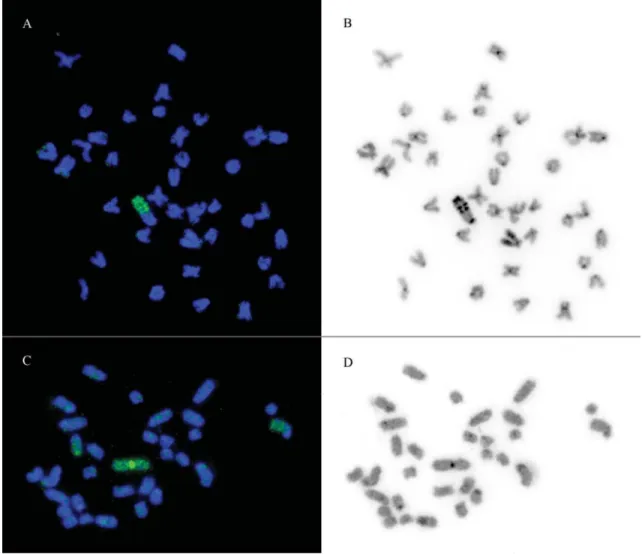
Furthermore, DAPI (4’-6-Diamidino-2-phenylin-dole) counterstain onE. virescens(Figure 2B) revealed a distinct striped pattern of X heterochromatin, where AT-rich sequences seem to be alternated with GC-AT-rich se-quences. The Y-derived probe hybridizes to the Y, X1,and
X2chromosomes (Figure 2C). Hybridizations to X
chromo-somes, as seen in Figure 2C, were not total, adding further evidence to the presumable a loss of repetitive sequences during the fusion event that originated the Y chromosome (Almeida-Toledoet al., 2000).
Recent modifications from the original protocols have made the microdissection procedure applicable for molecular-cytogenetics and comparative genomic re-search. Probes developed using microdissection have been reported to show properties similar to those obtained by flow-sorting (Griffinet al., 1999), although this may not hold in cross-FISH experiments with distant species micro-dissection is a suitable procedure for comparison of closely related species groups. Probes obtained using this protocol have successfully revealed chromosome homologies in
Figure 2- Hybridization patterns using A) a probe developed from three copies of X chromosome heterochromatin ofEigenmannia virescens; B) DAPI counterstain of A; C) a probe derived fromEigenmanniasp. 2 Y chromosome; D) DAPI counterstain of C.
Eigenmanniaspecies (Henning F, Trifonov V, Ferguson-Smith MA and Almeida-Toledo, unpublished data).
An interesting application of microdissection is the construction of plasmid library from the DOP-amplified fragments. DOP-PCR fragments are, however, consider-ably small (200-500 bp) and fragmented (the 5’ sequence of the 6-MW primer is expected to occur at each 4 kb). These libraries can however, be useful for isolation and sequenc-ing of repetitive DNA ussequenc-ing a combination of FISH and blotting techniques (Southern, dot or slot blotting) for scre-ening (Shibataet al., 1999; Madalena and Gorab, 2005) or as probes for retrieving region specific sequences from a BAC library. This procedure is highly desired in studies fo-cused on B-chromosome investigations, since sequence data can help assessing the evolutionary origins of supernu-merary chromosomes (Bugrovet al., 2004, Rubstovet al., 2004) and is of potential use in fish breeding (Yi et al., 2003).
Despite being a numerous and highly diverse group, chromosome painting has been applied to only a handful of species (Phillipset al., 2001; Harveyet al., 2002; Liuet al., 2002). The possibility of developing paints from few, or even single microdissected chromosomes is promising, considering common characteristics of fish chromosomes such as uniformity in size and morphology.
Acknowledgments
We thank the anonymous reviewers for the helpful suggestions and Dr. Eduardo Gorab (University of São Paulo) and Dr. Malcolm Ferguson-Smith (University of Cambridge) for permission to use facilities and equipment. This work was supported by CNPq and FAPESP.
References
Almeida-Toledo LF, Foresti F, Daniel-Silva MF and Toledo Filho AS (2000) Sex chromosome evolution in fish: The forma-tion of the neo-Y chromosome in Eigenmannia (Gymnotiformes). Chromosoma 109:197-200.
Almeida-Toledo LF, Foresti F, Pequignot EV and Daniel-Silva MF (2001) XX:XY sex chromosome system with X hetero-chromatinization: An early stage of sex chromosome differ-entiation in the Neotropic electric eel Eigenmannia virescens. Cytogenet Cell Genet 95:73-78.
Bugrov AG, Karamysheva TV, Rubtsov DN, Andreenkova OV and Rubtsov NB. (2004) Comparative FISH analysis of dis-tribution of B chromosome repetitive DNA in A and B chro-mosomes in two subspecies of Podisma sapporensis (Orthoptera, Acrididae). Cytogenet Genome Res 106:284-288.
Christian AT, Garcia HE and Tucker JD (1999) PCRin situ fol-lowed by microdissection allows whole chromosome paint-ing probes to be made from spaint-ingle microdissected chromo-somes. Mamm Genome 10:628-631.
Engelen JJ, Albrechts JC, Hamers GJ and Geraedts JP (1998) A simple and efficient method for microdissection and microFISH. J Med Genet 35:265-268.
Fan YS (2002) Molecular Cytogenetics: Protocols and Applica-tions. Humana Press, Totowa, 411 pp.
Ferguson-Smith MA, Yang F and O’Brien PC (1998) Compara-tive mapping using chromosome sorting and painting. Ilar J 39:68-76.
Garcia C, Moreira-Filho O, Bertollo LAC and Centofante L (2003) B chromosomes and natural triploidy inRhamdiasp. (Pisces, Siluriformes, Heptapteridae). Cytologia 68:403-411.
Griffin DK, Haberman F, Masabanda J, O’Brien P, Bagga M, Sazanov A, Smith J, Burt DW, Ferguson-Smith MA and Wienberg J (1999) Micro- and macrochromosome paints generated by flow cytometry and microdissection: Tools for mapping the chicken genome. Cytogenet Cell Genet 87:278-281.
Guan X-Y (2002) Chromosome microdissection. In: Fan Y-S (ed) Molecular Cytogenetics: Protocols and Applications. Hu-mana Press, New Jersey, pp 67-76.
Guan X-Y, Meltzer PS and Trent JM (1994) Rapid generation of whole chromosome painting probes (WCPs) by chromo-some microdissection. Genomics 22:101-107.
Harvey SC, Masabanda J, Carrasco LA, Bromage NR, Penman DJ and Griffin DK (2002) Molecular-cytogenetic analysis re-veals sequence differences between the sex chromosomes of Oreochromis niloticus: Evidence for an early stage of sex-chromosome differentiation. Cytogenet Genome Res 97:76-80.
Henegariu O, Heerema NA, Lowe Wright L, Bray-Ward P, Ward DC and Vance GH (2001) Improvements in cytogenetic slide preparation: Controlled chromosome spreading, chem-ical aging and gradual denaturing. Cytometry 43:101-109. Liu JD, Yi MS, Zhao G, Zhou F, Wang DQ and Yu QX (2002) Sex
chromosomes in the spiny eel (Mastacembelus aculeatus) revealed by mitotic and meiotic analysis. Cytogenet Ge-nome Res 98:291-297.
Madalena CR and Gorab E (2005) A chromosome end satellite of Rhynchosciara americana(Diptera, Sciaridae) resembling nematoceran telomeric repeats. Insect Mol Biol 14:255-262. Moreira-Filho O, Galetti PM and Bertollo LA (2004) B
chromo-somes in the fish Astyanax scabripinnis (Characidae, Tetragonopterinae): An overview in natural populations. Cytogenet Genome Res 106:230-234.
Phillips RB, Konkol NR, Reed KM and Stein JD (2001) Chromo-some painting supports lack of homology among sex chro-mosomes in Oncorhynchus salmo and Salvelinus (Salmonidae). Genetica 111:119-123.
Reed KM, Bohlander SK and Phillips RB (1995) Microdissection of the Y chromosome and fluorescence in situ hybridization analysis of the sex chromosomes of lake trout,Salvelinus
namaycush. Chromosome Res 3:221-226.
Murinae) performed by chromosome microdissection and FISH. Cytogenet Genome Res 106:289-294.
Shibata F, Hizume M and Kuroki Y (1999) Chromosome painting of Y chromosomes and isolation of a Y chromosome-spe-cific repetitive sequence in the dioecious plant Rumex acetosa. Chromosoma 108:266-270.
Telenius H, Carter NP, Bebb CE, Nordenskjold M, Ponder BA and Tunnacliffe A (1992) Degenerate oligonucleotide-primed PCR: General amplification of target DNA by a sin-gle degenerate primer. Genomics 13:718-725.
Weimer J, Kiechle M, Senger G, Wiedemann U, Ovens-Raeder A, Schuierer S, Kautza M, Siebert R and Arnold N (1999) An easy and reliable procedure of microdissection technique for the analysis of chromosomal breakpoints and marker chro-mosomes. Chromosome Res 7:355-362.
Yi MS, Li YQ, Liu JD, Zhou L, Yu QX and Gui JF (2003) Molec-ular cytogenetic detection of paternal chromosome frag-ments in allogynogenetic gibel carp, Carassius auratus gibelioBloch. Chromosome Res 11:665-671.
Associate Editor: Luiz Antonio Carlos Bertollo