Rearrangements by Multiplex Ligation–Dependent
Probe Amplification
Jason E. Chan1,2,3, Richard D. Kolodner2,3*
1Bioinformatics and Systems Biology Graduate Program, University of California San Diego, La Jolla, California, United States of America,2Ludwig Institute for Cancer Research, Cancer Center and Departments of Medicine and Cellular and Molecular Medicine, Moores–UCSD Cancer Center, School of Medicine, University of California San Diego, La Jolla, California, United States of America,3Institute of Genomic Medicine, School of Medicine, University of California San Diego, La Jolla, California, United States of America
Abstract
Aneuploidy and gross chromosomal rearrangements (GCRs) can lead to genetic diseases and the development of cancer. We previously demonstrated that introduction of the repetitive retrotransposonTy912onto a nonessential chromosome arm ofSaccharomyces cerevisiaeled to increased genome instability predominantly due to increased rates of formation of monocentric nonreciprocal translocations. In this study, we adapted Multiplex Ligation–dependent Probe Amplification (MLPA) to analyze a large numbers of these GCRs. Using MLPA, we found that the distribution of translocations induced by the presence ofTy912in a wild-type strain was nonrandom and that the majority of these translocations were mediated by only six translocation targets on four different chromosomes, even though there were 254 potential Ty-related translocation targets in theS. cerevisiaegenome. While the majority ofTy912-mediated translocations resulted fromRAD52-dependent recombination, we observed a number of nonreciprocal translocations mediated byRAD52-independent recombination between Ty1 elements. The formation of these RAD52-independent translocations did not require the Rad51 or Rad59 homologous pairing proteins or the Rad1–Rad10 endonuclease complex that processes branched DNAs during recombination. Finally, we found that defects in ASF1-RTT109–dependent acetylation of histone H3 lysine residue 56 (H3K56) resulted in increased accumulation of both GCRs and whole-chromosome duplications, and resulted in aneuploidy that tended to occur simultaneously with GCRs. Overall, we found that MLPA is a versatile technique for the rapid analysis of GCRs and can facilitate the genetic analysis of the pathways that prevent and promote GCRs and aneuploidy.
Citation: Chan JE, Kolodner RD (2012) Rapid Analysis of Saccharomyces cerevisiae Genome Rearrangements by Multiplex Ligation–Dependent Probe Amplification. PLoS Genet 8(3): e1002539. doi:10.1371/journal.pgen.1002539
Editor:Gregory P. Copenhaver, The University of North Carolina at Chapel Hill, United States of America
ReceivedOctober 5, 2011;AcceptedDecember 29, 2011;PublishedMarch 1, 2012
Copyright:ß2012 Chan, Kolodner. This is an open-access article distributed under the terms of the Creative Commons Attribution License, which permits unrestricted use, distribution, and reproduction in any medium, provided the original author and source are credited.
Funding:This work was supported by NIH Grants GM26017 and CA23100. The funders had no role in study design, data collection and analysis, decision to publish, or preparation of the manuscript.
Competing Interests:The authors have declared that no competing interests exist.
* E-mail: [email protected]
Introduction
Genome stability is important for normal cellular survival and growth. In contrast, genome instability is associated with abnormal cellular growth. For example, tumor cells often contain multiple genome rearrangements and/or exhibit aneuploidy, and such events are thought to contribute to the development and pro-gression of cancer [1–4]. Genome rearrangements are also associated with inborn genetic diseases. For instance, copy number changes mediated by segmental duplications are associated with a diversity of genetic diseases [5] and whole chromosome aneuploidy can cause diseases like Down Syndrome [6]. While the association of genome rearrangements and aneuploidy with human genetic disease is well established, the genetic factors that suppress or enhance genome rearrangements and aneuploidy are less well understood.
We previously developed quantitative genetic assays for measur-ing the rates at which GCRs occur inSaccharomyces cerevisiae. These assays, and modified versions of them, select for progeny that lose a nonessential chromosome arm due to a GCR mediated by either non-repetitive [7–10], low-copy repeat [9,11], or high-copy repeat
and 5) next-generation DNA sequencing, which has the potential to provide considerable detail about the structure of genome rearrangements [29]. However, all of these methods fail to scale when analyzing a large number of rearranged genomes, due to either high costs or the tedious natures of the methods. In this study, we adapted a PCR-based method, Multiplex Ligation-dependent Probe Amplification (MLPA), to supplement the analysis of Ty1-mediated GCRs in a manner that scales well in terms of both cost and time.
MLPA is a multiplex ligation-dependent amplification tech-nique that has been used to identify duplications, deletions, and aneuploidy in human cells [30–32]. Briefly, multiple pairs of oligonucleotide probes are designed such that each probe in a pair hybridizes next to the other member of the pair at regions of interest in the genome. The total length of each pair of probes is distinct and is used to identify specific regions in the genome on the basis of the length of the final MLPA product. The probes are hybridized to genomic DNA, and then adjacent probes are ligated and amplified using a common pair of fluorescently labeled oligonucleotide primers. Products are separated and their length and fluorescent intensities measured using capillary electrophore-sis. Analysis of the fluorescent intensities allows the determination of copy number differences between control and experimental samples. The main advantage of MLPA is its ability to provide copy number variation data for targeted regions in a rapid, inexpensive, and highly parallel manner. While MLPA does not provide the dense genome-wide coverage of aCGH or next-generation sequencing, it can cover multiple regions of interest simultaneously at a density sufficient for many types of genetic studies. In the present study we demonstrate the utility of MLPA for analyzing GCRs by investigating the target site bias of Ty1-mediated GCRs,RAD52-independent formation of Ty1-mediated translocations, and aneuploidy induced by deletion ofRTT109, a gene encoding a histone acetyltransferase.
Results
Adaptation of MLPA to identify non-reciprocal translocations
In previous work we demonstrated that insertion of Ty912 between CIN8 and NPR2 in a nonessential terminal region of chromosome V (the +Ty912 GCR assay) (Figure 1a), led to an increase in the rate of accumulating GCRs [12]. When we screened 88 independent GCR-containing strains derived from either wild-type or one of 11 different mutant strains, we found that all (88 of 88) of these GCR-containing strains contained a deletion of chromosome V from Ty912 to TEL05L (the left telomere of chromosome V) and almost all (82 of 88) of these GCR-containing strains also contained a duplicated region from another chromosome arm bounded by an ectopic Ty1, Ty2, or solo delta sequence at one end and a telomere at the other end. Structural studies demonstrated that these duplication-containing strains each contained a translocation consisting of the centro-mere-containing fragment of chromosome V joined to the duplicated region of the target chromosome, with a junction involving Ty912 and the bounding ectopic Ty element of the duplicated region. 94% of the translocations were simple translocations with a single junction involvingTy912and a single target ectopic Ty element and 6% appeared to involve a dicentric translocation intermediate that underwent secondary rearrange-ments. In addition, each GCR-containing strain also contained a wild-type copy of the chromosome from which the duplicated sequence was derived. Overall, this analysis indicated that all of the Ty912-mediated translocations observed were formed by a non-reciprocal recombination-mediated translocation mechanism. To better characterize the distribution of the observed chromosome arm duplications, we developed a MLPA probe set capable of identifying duplicated and deleted chromosome arms. A ‘‘telomeric’’ probe set was designed to identify copy number changes at genomic loci located at the ends of each chromosome arm inS. cerevisiae. The probes were designed to hybridize between the telomeres of each chromosome and their closest respective Ty1, Ty2, or solo delta element (Figure 1b, 1c); however, four probes (chrII-L, chrIV-R, chrIX-R, and chrXV-L) could not be designed to meet this criterion due to the lack of suitable non-repetitive DNA regions near the telomeres of these chromosome arms, and were instead designed to hybridize immediately centromeric to the terminal Ty elements present at the 4 chromosome ends (Table S1). As a result, the telomeric probe set theoretically detects 98.4% (250/254) of the possible translocation-associated duplications resulting from Ty912 -medi-ated nonreciprocal translocations targeting ectopic Ty-rel-medi-ated elements in the S288C reference genome.
Using this telomeric MLPA probe set, we first reanalyzed 5 isolates that were derived from the wild-type+Ty912 GCR assay strain and that were each previously identified by aCGH to contain a translocation chromosome associated with a chromo-some arm duplication [12]. The MLPA results concurred with the previous aCGH results and, in each case, identified both the chromosome V-L deletion and the associated chromosome arm duplication identified previously (Figure 1d). We next screened 112 newly isolated independent GCR-containing strains derived from the wild-type+Ty912 GCR assay strain. The MLPA data revealed that all (112 of 112) GCR-containing strains lost the left arm of chromosome V, and almost all (106 of 112) contained a duplicated region of another chromosome arm (Table S2). The remaining isolates either had no detectable duplication (5 of 112) or could not be unambiguously assigned to a rearrangement class (1 of 112).
Author Summary
Duplication of chromosome arms in the wild-type
+Ty912 assay was nonrandom
We calculated a pair of expected distributions for the chromosome arm duplications based on the assumption that Ty912 could recombine with either all annotated ectopic Ty1 elements at equal frequency or all annotated ectopic Ty1 and delta elements (in this analysis, each of the 13 Ty2 elements were included as 2 separate delta elements; see Methods) at equal frequency (Figure 2a, 2b). Analysis of the 106 observed duplicated chromosome arms isolated in the wild-type +Ty912 assay strain (Figure 2c; Table S2) revealed numerous chromosome arm duplications that did not contain any annotated full length Ty1 sequences in the S288c reference sequence (chrIII-L, chrIII-R, chrIX-L, chrXIII-L, chrXIV-R, chrXV-L, and chrXVI-L), indicating that, consistent with our previous results [12], both ectopic Ty1 and delta elements are likely to have mediated the observed chromosome arm duplications. We found the distribu-tion of observed chromosome arm duplicadistribu-tions to be significantly different from a theoretical distribution that assumed that all Ty1 and delta elements acted as translocation targets (Monte Carlo Sampling of a Multinomial Distribution; 2000 replicates; Empir-ical p = 5.0061024). Several chromosome arm duplications were significantly overrepresented in the observed distribution com-pared to the theoretical distribution, including duplications of chrIII-R (28 times; exact binomial; p = 5610218), chrV-R (27 times; exact binomial; p = 161029), chrXIV-L (8 times; exact binomial; p = 461025), and chrX-R (10 times; exact binomial; p = 261023). Together these 4 classes of chromosome arm duplications represented 69% (73 of 106) of the observed duplications.
We next sought to identify if there was any bias in this analysis due to the orientation ofTy912on chromosome V. We and others have previously shown that translocations targeting centromere-oriented Ty elements yield dicentric chromosomes that must undergo secondary rearrangements to eliminate a centromere [12,16,23]. Due to this requirement of secondary rearrangements, these events are likely to be under-represented relative to the proportion of recombinations involving telomere-oriented Ty elements. Thus, it is possible that inclusion of centromere-oriented Ty elements in the list of possible recombination targets biased our analysis.. To check for such bias, we compared the observed distribution of chromosome arm duplications to the distribution of potential telomere-oriented Ty1 and delta element translocation targets (Figure S1). The chrIII-R, chrV-R, chrXIV-L, and chrX-R duplications were still significantly over-represented when com-pared to this theoretical distribution (exact binomials; p = 2610213, 161028, 461024, and 161022, respectively). Thus, our MLPA analysis of a large number of GCRs isolated from a single genetic background confirmed the chromosome arm duplication bias we previously noted when we used aCGH to analyze a smaller number
of GCR-containing strains isolated from 12 different wild-type and mutant strains [12].
Identification of individual Ty-related elements mediating recurrent nonreciprocal translocations
In order to investigate the possibility that specific Ty-related elements were responsible for the observed chromosome arm duplication bias in the wild-type+Ty912 GCR assay, we created a series of MLPA probe sets specific for chrIII-R, chrV-R, chrX-R, and chrXIV-L. These probe sets contained one or two pairs of primers designed to hybridize between every pair of Ty1, Ty2, solo delta, centromeric, and telomeric element along each chromosome arm, except for a few cases of closely collocated Ty loci (Figure 3a–3d; Tables S3, S5, S6, S7).
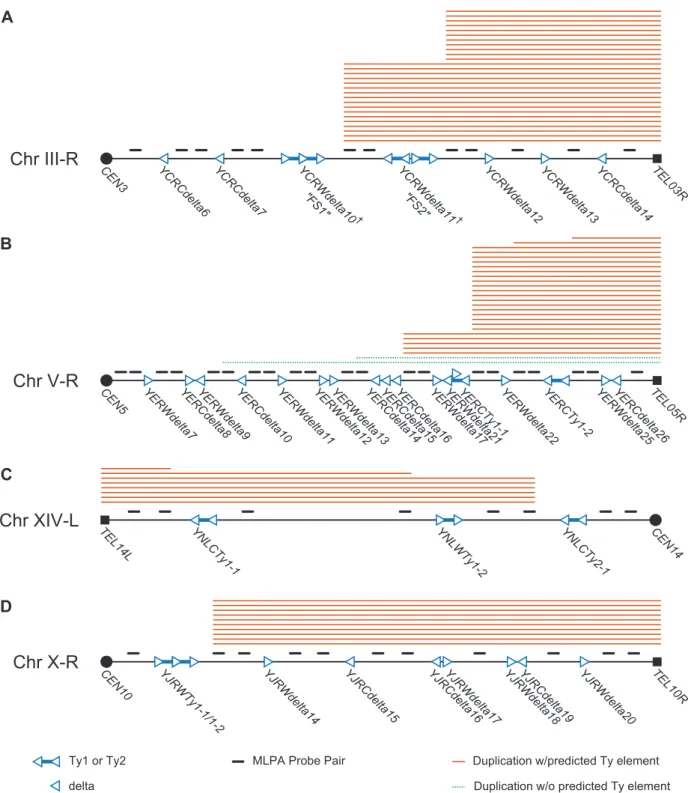
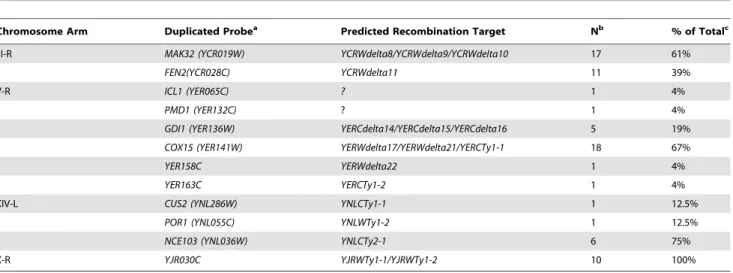
We first used the chrIII-R MLPA probe set (Figure 3a; Table S3) to analyze the 28 GCRs involving chromosome III right arm duplications. Two patterns of chromosome arm duplications were observed: those in which the chrIII-R probes telomeric, but not centromeric, to the YCRWdelta8-YCRWdelta9-YCRWdelta10 locus (61%; n = 17) were duplicated and those in which the chrIII-R probes telomeric, but not centromeric, to theYCRWdelta11locus (39%; n = 11) were duplicated (Figure 3a; Table 1). These loci have been previously termed fragile site 1 (FS1) and fragile site 2 (FS2) and were originally identified as hotspots of Ty recombina-tion under condirecombina-tions of DNA replicarecombina-tion stress caused by reduction of the levels of different replicative DNA polymerases [15]. FS1 was found to replace the SRD1 and YCRWdelta8-YCRWdelta9-YCRWdelta10loci in the S288c annotated sequence with a pair of tandem full length Ty1s oriented in a direct repeat orientation. FS2 was found to contain two Ty1s oriented in an inverted head-head configuration with a 283 bp spacer sequence in between the two Ty1s instead of the single annotated YCRWdelta11locus. Other studies have also confirmed that these loci show differences from the SGD S288c reference sequence [27,33]. We confirmed the presence of both the tandem direct repeat pair of full length Ty1s at FS1 and the pair of inverted repeat Ty1s at FS2 in our strains by PCR and sequencing. These results demonstrate that MLPA can be used to identify specific translocation fusion junctions and that FS1 and FS2, even in the presence of normal rates of DNA replication, likely have fragile site activity that results in increased frequencies of Ty-mediated translocations.
We next analyzed the GCR-containing strains associated with other overrepresented chromosome arm duplications (chrV-R, XIV-L, and X-R) using the remaining chromosome arm-specific MLPA probe sets (Tables S5, S6, S7). The MLPA data revealed the existence of Ty-mediated translocation hotspots on each of the chromosome arms (Figure 3b–3d; Table 1). The majority of duplications (18 of 27) of the right arm of chromosome V appeared to target the linked YERWdelta17, YERWdelta21, and YERCTy1-1 loci (note that this region also contains an Figure 1. Assay model, design of MLPA telomeric and centromeric probe sets, and verification of results obtained using MLPA.A. Overview of the chromosome V+Ty912 assay strain. TheTy912was inserted betweenNPR2andCIN8oriented so that it was transcribed towards the
telomere.Ty912and other genes are not drawn to scale. B. Schematic of the MLPA telomeric and centromeric probes. Telomeric and centromeric probes are designated by solid black and grey lines above the chromosomes, respectively. Ty delta elements are represented as hollow blue triangles, and Ty1 and Ty2 elements are designated as pairs of hollow blue triangles connected by solid blue lines. The orientation of the triangles represent the transcriptional orientation of the elements. Tys and chromosome arms are not drawn to scale. C. Schematic of the MLPA process (1: chromosomal DNA, 2: MLPA probes, 3: universal PCR primers). MLPA probes (2) are hybridized to the chromosomal DNA (1), ligated, amplified by PCR using universal primers (3) and analyzed using capillary electrophoresis. D. Graphical display of MLPA data generated using telomeric MLPA probes. Chromosome arms are represented by peaks in either a wild-type isolate or GCR-containing isolate. Ratios of the normalized peak areas compared to a relative set of wild-type control isolates are given above the indicated peaks of interest. Black vertical arrows indicate either a chromosome V-L deletion (left arrow) or a chromosome XIII-L duplication (right arrow) in the GCR-containing isolate and normal chromosome arm complements in the wild-type isolate.
unannotated partial Ty sequence [12]), with a smaller proportion (5 of 27) of duplications targeting the region containing the linked YERCdelta14, YERCdelta15, and YERCdelta16 loci. This is in agreement with several studies that observed the involvement of the linkedYERWdelta17,YERWdelta21, andYERCTy1-1loci in Ty-mediated repair of DNA double strand breaks (DSBs) [9,26], including our own prior observation of a translocation in which Ty912of our assay targeted the centromere-orientedYERCTy1-1 on chrV-R and resulted in a dicentric translocation chromosome. This dicentric chromosome then underwent additional rounds of rearrangements to yield a monocentric translocation that had duplicated the telomeric end of chrV-R [12]. Likewise, 75% (6 of 8) of the chromosome arm duplications involving the left arm of chromosome XIV appeared to target YNLCTy2-1. All of the duplications on the right arm of chromosome X (10 of 10) appeared to involve the YJRWTy1-1/YJRWTy1-2 tandem Ty1 locus. Overall, these results indicate that 63.2% (67 of 106) of the total Ty-mediated chromosome arm duplications identified in the wild-type+Ty912 assay strain could be accounted for by only 6 Ty
target regions on 4 chromosome arms, which contrasts with the presence of 254 potential targets in theS. cerevisiaegenome.
Anmsh2Dmutation does not greatly affect the distribution of chromosome arm duplications
Figure 3. Schematic of MLPA probes designed for hotspot chromosome arms and MLPA data generated from GCR–containing isolates derived from a wild-type strain.Filled squares represent telomeres and filled circles represent centromeres. Hollow triangles represent delta sequences and pairs of hollow triangles connected by blue lines represent Ty1 or Ty2 sequences. The transcriptional orientation of the elements is represented by the direction of the triangles. Solid orange lines above the chromosome arms represent chromosome arm duplications predicted to be mediated by a Ty element; dotted green lines represent duplications predicted to be mediated by a non-Ty element. A. MLPA data for chromosome III-R. Hotspots exist at FS1 and FS2. FS1 represents a tandem pair of Tys replacing the sequence between the 59end ofSRD1to YCRWdelta10. FS2 replaces YCRWdelta11with an inverted pair of Tys separated by a short spacer sequence. See Ref [15]. B. MLPA data for chromosome V-R. Hotspots exist at or nearYERWdelta17/YERWdelta21/YERCTy1-1and the YERCdelta14/YERCdelta15/YERCdelta16loci. C. MLPA data for chromosome IXV-R. A hotspot exists at theYNLCTy2-1Ty2 locus. D. MLPA data for chromosome X-R. A hotspot occurs at theYJRWTy1-1/YJRWTy1-2 locus.
homologies drive the target distribution bias seen for Ty-mediated translocations, an msh2Dmutation that eliminates suppression of homeologous recombination should alter the distribution of target Ty elements and chromosome arm duplications.
Anmsh2Dmutation resulted in an approximately 3-fold increase in the rate of Ty912-mediated GCRs (Table 2). All 44 GCRs isolated in themsh2Dmutant were associated with a chromosome V-L deletion and 43 of these GCRs were also associated with a chromosome arm duplication. In order to look for significant changes between themsh2Dstrain relative to the wild-type strain, we calculated the fold change between the observed duplication rate of each chromosome arm in themsh2Dmutant relative to an expected duplication rate for each chromosome arm (see Methods). The expected duplication rate assumed that themsh2D
mutation evenly increased the duplication rates of all chromosome arms by the bulk-fold change between themsh2Dmutant and wild-type GCR rates and hence themsh2Dmutation was expected to increase the rate of each duplication 3-fold (Table 2); in other words, we assumed the msh2D mutation did not preferentially affect the rate of any specific translocation (see Methods). The duplication rates for each chromosome arm in themsh2Dmutant were generally within the 95% confidence interval of the predicted msh2D rates and were approximately three-fold higher than the wild-type rates, consistent with the idea that themsh2Dmutation increased both the average GCR rate and the translocation rate of each chromosome arm by 3-fold. The only exceptions were the duplication rates of chromosome arms II-R, XVI-R, and V-R. Chromosome arm II-R and XVI-R duplications were not previously seen among the 112 wild-type GCRs analyzed and occurred at about a five-fold higher rate in themsh2Dmutant than predicted from the maximum wild-type rate calculated for these 2 sites. The duplication rate of chromosome V-R was approximately four-fold lower than predicted from the wild-type rate (Figure 2c). The duplication rates of all three of these chromosome arms were outside the 95% confidence interval of their predicted duplication rates calculated from the measuredmsh2Dbulk rate (p,0.05). In addition, the number of chromosome V duplications observed in the msh2D mutant was significantly lower than that seen in the wild-type strain (Fisher’s Exact Test; p = 0.0122). However, GCRs associated with duplicated chromosome arms containing the
translocation hotspots (chrIII-R, V-R, X-R, and XIV-L) were seen in both the msh2D +Ty912 assay strain and the wild-type +Ty912 assay strain in roughly equal proportions (70% vs. 69%). Table 1.Localization of translocation hotspots by MLPA in a wild-type strain.
Chromosome Arm Duplicated Probea Predicted Recombination Target Nb % of Totalc
III-R MAK32 (YCR019W) YCRWdelta8/YCRWdelta9/YCRWdelta10 17 61%
FEN2(YCR028C) YCRWdelta11 11 39%
V-R ICL1 (YER065C) ? 1 4%
PMD1 (YER132C) ? 1 4%
GDI1 (YER136W) YERCdelta14/YERCdelta15/YERCdelta16 5 19%
COX15 (YER141W) YERWdelta17/YERWdelta21/YERCTy1-1 18 67%
YER158C YERWdelta22 1 4%
YER163C YERCTy1-2 1 4%
XIV-L CUS2 (YNL286W) YNLCTy1-1 1 12.5%
POR1 (YNL055C) YNLWTy1-2 1 12.5%
NCE103 (YNL036W) YNLCTy2-1 6 75%
X-R YJR030C YJRWTy1-1/YJRWTy1-2 10 100%
aThe most centromeric probe with increased copy number. bNumber of isolates identified with the given recombination target.
cTotal is defined as the number of isolates with the indicated chromosome arm duplication. doi:10.1371/journal.pgen.1002539.t001
Table 2.GCR rates.
Strain RDKY GCR Ratea
wild-type 6076 8.4 [5.9–9.6]61028(1)b
msh2D 6607/6608 2.2 [0.8–10]61027(3)b
rad51D 6555/6556 5.9 [2.5–9.2]61027(7)b
rad59D 6599/6600 6.1 [5.0–8.4]61028(0.7)b rad51Drad59D 7083/7084 7.9 [5.9–17]61028(0.9)b
rad52D 6503/6504 1.3 [0.7–2.5]61028(0.2)b
rad52Drad51D 7187/7188 1.9 [0.3–5]61028(0.2)b rad52Drad59D 7191/7192 7.0 [2.5–17]61029(0.1)b
rad52Drad51Drad59D 7085/7086 1.7 [0.7–4.2]61028(0.2)b
rad1D 7356/7357 7.5 [3.4–17]61028(0.9) rad52Drad1D 7358/7359 1.7 [0.4–3.4]61028(0.2)
rtt109D 7492/7493 1.7 [0.9–2.5]61026(20)
rtt109D 7492 1.7 [1.4–1.9]61026(20)
without chromosome duplications 1.7 [1.3–1.9]61026(20)
with chromosome duplications 1.9 [1.2–3.3]61026(23)
rtt109D+8 * 2.2 [1.6–3.1]61026(27)
vps75D 7354/7355 7.8 [2.5–17]61028(0.9) asf1D 6519/6520 1.6 [1.1–3]61026(19)b
rlf2D/cac1D 7183/7184 1.8 [0.8–3.4]61027(2)b
asf1Drlf2D/cac1D 7352/7353 1.0 [0.5–2.1]61025(120) hht1-hhf1Dhht2-hhf2::H3K56G 7366/7367 8.8 [5.9–15]61027(10)
hht1-hhf1Dhht2-hhf2::H3K56R 7364/7365 5.4 [3.4–11]61027(6)
aNumbers in brackets represent the 95% confidence interval of the median; numbers in parenthesis represent fold over wild-type.
bSee Ref. [12].
*MATartt109D+8 mutants were generated by sporulating from 2n+1 diploid strains RDKY7709-7711.
These results indicate that while an MSH2-dependent function may both modestly affect the rate of specific translocations and be potentially important for the formation of translocations involving the chromosome V-R hotspot, mismatch repair is largely not responsible for the biased distribution of translocations in the wild-type+Ty912 assay strain. This supports the idea that the sequence homology relationships betweenTy912and the other Ty elements in the S. cerevisiae genome are unlikely to be the sole, or major, determinant of translocation target site selection.
Translocation target selection is not associated with physical proximity toTy912
One possible reason for the fact that six hotspots comprise nearly 70% of the observed chromosome duplications is that the six hotspots lie in close physical proximity to Ty912, as such physical proximity may determine the ease with which homolo-gous sequences can be targeted by HR. Using previous data that mapped the 3-dimensional spatial relationship of all chromosomes in wild-type cells [36], we analyzed whether any of the six observed hotspots as well as the 20+kb regions containing each hotspot were in close proximity to the region of chromosome V where Ty912 was inserted. Analysis of the Chromosome Conformation Capture-on-Chip (4C) data generated with HindIII indicated that 2 of the 6 hotspots showed limited association with Ty912on the left arm of chromosome V, whereas analysis of the data generated with EcoRI indicated that none of the hotspots were located adjacent to chrV-L (Table S4). Thus, we found minimal to no interactions between the region surroundingTy912 and the observed hotspot locations. Consequently, it is unlikely that physical proximity plays a large role in the selection of the most commonly used translocation targets.
rad51Dandrad59Dmutations alter the distribution of chromosome duplication targets
Most of the GCRs identified using the+Ty912 assay appear to result fromRAD52-dependent Ty-mediated HR resulting in non-reciprocal translocations [12]. In S. cerevisiae, RAD52-dependent HR is primarily mediated by two pathways, which are dependent uponRAD51andRAD59, respectively [37]. Surprisingly, arad51D
single mutant had a significantly increased rate of Ty-mediated GCRs compared to wild type (Wilcoxon rank sum test; p = 4.8961027), whereas arad59Dmutation decreased the GCR rate of therad51Dmutant strain to one equivalent to the GCR rate of the wild-type +Ty912 assay strain (Wilcoxon rank sum test; p = 0.89) (Table 2; Table S2). The rad59 smutation had no significant effect on the Ty-mediated GCR rate of a wild-type strain (Wilcoxon rank sum test; p = 0.34). Interestingly, our previous results indicate that the GCR rate of therad51Drad59D
+Ty912 assay strain was 53-fold higher that that seen for the rad51D rad59D 2Ty912 assay strain, suggesting that Ty912 -mediated GCRs occur at low rates in therad51Drad59Dmutant (Wilcoxon rank sum test; p = 2.0961026) [12].
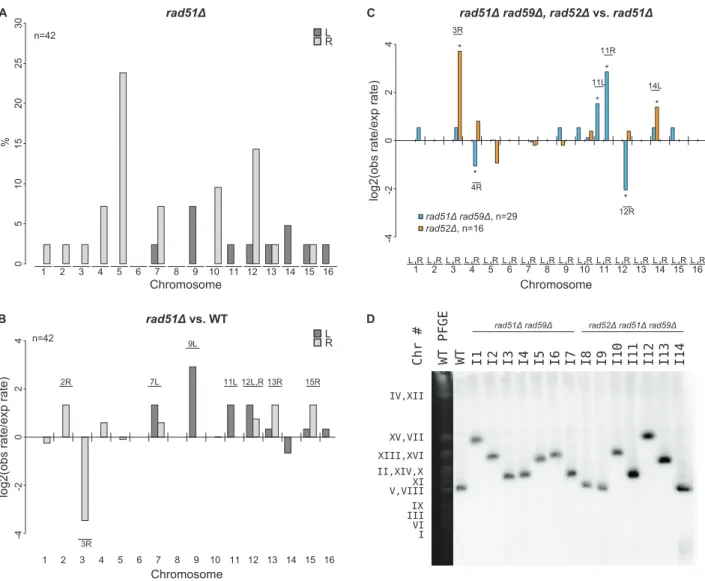
To investigate how arad51Dmutation affected the formation of GCRs, we analyzed 46 GCR-containing isolates derived from a rad51D+Ty912 assay strain (Table S2). All 46 isolates contained a chromosome V-L deletion, and 42 of these isolates each contained a chromosome arm duplication (Figure 4a). Four isolates did not have any accompanying chromosome arm duplications, which was a small, but statistically significant, increase compared to the bulk fold increase in the total GCR rate (p,0.05). This suggests that arad51Dmutation results in a small increase in the rate of formation of broken chromosomes that are subsequently healed by de novotelomere addition [19]. There was a statistically significant
decrease in the proportion of GCRs associated with chromosome III-R duplications arising from therad51Dmutant compared to a wild-type strain (Fisher’s exact test; p = 4.1661024) and, using the same method that was used to analyze the effect of an msh2D
mutation on the rate of individual chromosome arm duplications, we found that the rate of chromosome III-R duplications was significantly decreased as well (p,0.05; Figure 4b). In contrast, the rates of the chromosome arm duplications involving the chromosome V-R, X-R, and XIV-L hotspots were not preferen-tially affected by therad51Dmutation. Additionally, chromosome IX-L and XII-R duplications were statistically significantly increased in the rad51D mutant compared to the relative bulk effect of arad51Dmutation. There were also statistically significant increases in the rates of duplication of several chromosome arms not originally observed among the 112 wild-type derivedTy912 -mediated GCRs (chromosomes II-R, VII-L, XI-L, XII-L, XIII-R, and XV-R) (Figure 4b; p,0.05). Overall, these results suggest that RAD51 is important for the formation of GCRs involving the hotspots on chromosome III-R and is important for the suppression of GCRs involving many other Ty-related transloca-tion targets.
To better understand the function of RAD59 in promoting GCRs in arad51Dmutant, we analyzed 30Ty912-mediated GCRs obtained from arad51Drad59Ddouble mutant (Table S2). We did not analyze a large number of GCRs isolated from arad59Dsingle mutant as a rad59D mutation did not significantly change the GCR rate in the+Ty912 assay (Wilcoxon rank sum test; p = 0.343) (Table 2). All 30 GCRs derived from therad51Drad59Ddouble mutant contained the chromosome V-L deletion and 29 of these GCRs were also associated with single chromosome arm duplications. Compared to the bulk fold increase in the GCR rate relative to the wild-type GCR rate, therad51Drad59Ddouble mutant had statistically significant decreases in the duplication rates of chromosomes III-R, IV-R, and XII-R, and an increase in the duplication rate of chromosome IX-L (p,0.05). We also noted chromosome X-L (n = 1), chromosome XI-L (n = 2) and chromo-some XI-R (n = 5) duplications, which were not seen in the wild-type chromosome arm distribution. The rad51D rad59D double mutant had a lower overall GCR rate than the rad51D single mutant (Wilcoxon rank sum test; p = 1.1361025) (Table 2). Compared to the bulk affect of a rad59D mutation in a rad51D
verify the nature of several such translocation junctions identified in rad52Dsingle andrad52Drad51Drad59Dtriple mutants.
RAD52-independent GCRs can be formed by HR
There was a 5-fold decrease in the GCR rate of therad52D
+Ty912 assay strain compared to that of the wild-type +Ty912 assay strain (Wilcoxon rank sum test; p = 1.69610205), consistent with the bulk of theTy912-mediated GCRs being formed by HR (Table 2). The GCR rate of the rad52D +Ty912 assay strain, however, was previously determined to be slightly, but not strictly significantly, higher than the GCR rate of therad52D2Ty assay strain (Wilcoxon rank sum test; p = 0.0625) [12], suggesting that Ty912-mediated GCRs may still occur at low rates in therad52D
+Ty912 assay strain. To further investigate the role ofRAD52in the formation of Ty1-mediated GCRs, we used MLPA to analyze 50 independent GCRs derived from arad52D+Ty912 assay strain
(Table S2). All 50 GCRs were associated with the chromosome V-L deletion. We did not detect any additional genome alterations in 34 (68%) of these isolates, a finding consistent with a high rate of GCRs mediated byde novotelomere additions in arad52Dmutant [11,19,38]. In 16 (32%) of the isolates, we observed additional chromosome arm duplications, with each isolate containing one chromosome arm duplication (Figure 5a). This represented a significant decrease in the proportion of GCRs associated with chromosome arm duplications when compared those obtained from a wild-type strain (Fisher’s Exact test; p =,2.2610216). Interestingly, the rad52D mutant shared none of the significant chromosome arm duplication changes seen in therad51Drad59D
double mutant when these two mutant strains were compared with a rad51D single mutant, although this may be due to the small number of chromosome arm duplications analyzed in the case of therad52Dmutant (Figure 4c).
Figure 4. MLPA analysis of GCRs derived in arad51Dstrain.A. Distribution of chromosome arm duplications observed in therad51Dstrain. B. Duplication rates of different chromosome arms from arad51Dstrain compared to that of wild type. Log2 ratios of the observed duplication rates compared to the expected duplication rates are plotted for each chromosome arm. Labeled chromosome arms had significantly increased or decreased rates of duplication in therad51Dmutant than the bulk increase in GCR rate in therad51Dmutant compared to the wild type GCR rate. Chromosome III-R appears significantly reduced in therad51Dmutant strain. C. Comparison ofrad51Drad59Dandrad52Dmutant strains relative to a rad51Dmutant strain. * represents chromosome arms with significantly increased or decreased rates of duplication for the given strain compared to a rad51Dstrain. D. Southern blot of a Pulse Field Gel with separated chromosomes from GCR-containing isolates derived fromrad51Drad59Dand rad51Drad59Drad52Dmutant strains reveals chromosome Vs that are larger than wild type (I1–I7 and I10–I13).MCM3, an essential gene on chromosome V, was used as the probe.
To confirm that the observed chromosome arm duplications seen in therad52Dmutant were associated with the formation of nonreciprocal translocations involving chromosome V-L and the duplicated chromosome arms, we further analyzed 7 rad52D -derived GCR-containing isolates, two of which (I15 and I18) did not have chromosome arm duplications as determined by MLPA and five of which had single arm duplications (I16 [chrIII-R], I17 [chrIV-R], I19 [chrX-R], I20 [chrX-R], and I21 [chrV-R]). Analysis of these isolates by PFGE followed by Southern blotting utilizing a probe to the chromosome V geneMCM3revealed that each of the isolates without chromosome arm duplications contained a smaller than wild-type chromosome V (consistent with the known chromosome V-L deletion associated with ade novo telomere addition) and that the isolates with chromosome arm duplications each had a larger than wild-type chromosome V (Figure 5b). No other chromosomes appeared to have altered lengths. Analysis of these same 7 GCR-containing strains by aCGH revealed that all 7 had a deletion of the left arm of chromosome V between TEL05L and Ty912 (Figure S2). Additionally, each of the 5 strains identified by MLPA to contain a chromosome arm duplication had an additional duplicated region of DNA bounded by a full length Ty1 or solo delta element
at one end and a telomere at the other end (Figure S2; Table S8); the amplified chromosome arms identified by MLPA were the same as those identified by aCGH. PCR amplification of the breakpoints of 3 of the GCRs (I17, I19 and I20) associated with chromosome arm duplications confirmed that these GCRs were the result of a fusion between chromosome V-L atTy912and the Ty or delta element bounding the duplicated region associated with each GCR (Figure 5c; Table S8); the other 2 breakpoints could not be amplified. In addition, PCR amplification and sequencing of the breakpoints of four independent translocations (I22–25) occurring in the rad52D +Ty912 assay strain and identified by MLPA to be associated with a chromosome arm duplication similarly demonstrated the presence of translocation chromosomes that resulted from fusions between chromosome V-L atTy912and the Ty or delta elements bounding the duplicated region associated with each GCR (Figure 5c; Table S8). Thus, deletion ofRAD52decreases, but does not completely eliminate, HR that promotes Ty-mediated nonreciprocal translocations [19,38].
We next examined whetherRAD51andRAD59, which encode homologous pairing proteins [37], and the Rad1–Rad10 complex, which processes non-homologous single-stranded DNA tails that Figure 5. MLPA, Southern blot, and sequencing analyses of GCRs derived from arad52Drecombination-deficient mutant strain.A. MLPA data reveals duplicated chromosome arms associated with GCRs derived in arad52Dmutant strain. B. Southern blot of a Pulse Field Gel with separated chromosomes from GCR-containing isolates from arad52Dmutant strain also reveals larger than wild-type chromosome Vs (I16, I17, and I19–I21). C. Pseudo multiple sequence alignment of sequenced breakpoint junctions fromrad52Dderived GCRs. Italicized base pairs flankingTy912 on chromosome V represent nonreference-sequence restriction sites used for cloning and insertingTy912on chromosome V. * - sequence upstream of the 59end of the Ty- element mediating the translocation matches part of the reference sequence supposedly deleted by FS2; this suggests that the FS2 loci is not completely identical to that described originally in [15].{Amplified fragment is consistent with two tandem Tys in FS1; however, the 59flanking sequence displayed is part of the tandem Ty1 construct and was what was read when the 59primer used to amplify the fragment was used to sequence the fragment.
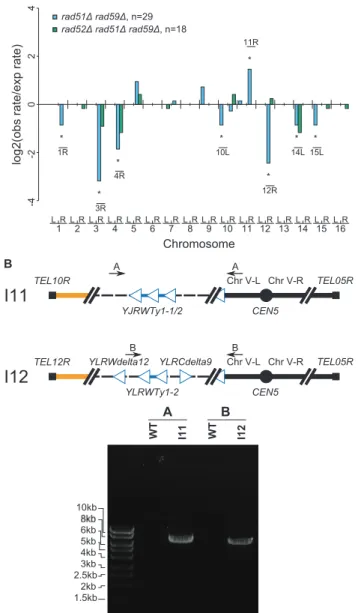
form during single-stranded annealing [39], were required for the formation of Ty912-mediated translocations formed by RAD52– independent HR. To this end, we investigated to differing degrees the rate and structure of Ty912-mediated GCRs inrad52Dand rad52Drad59D double mutants, therad52Drad51D rad59Dtriple mutant, and the rad52D double mutant. All four mutant strains had GCR rates that were statistically similar to the GCR rate of a rad52Dsingle mutant (Table 2) (Wilcoxon rank sum test; p = 0.21, 0.10, 0.95 and 0.79, respectively) and had statistically similar frequencies of GCRs containing and lacking chromosome arm duplications (Fisher’s Exact Test with Bonferroni correction for multiple hypothesis testing; all p values.0.0167) (Figure 6a; Figure
S3; Table S2) [40]. The chromosome arm duplication patterns of therad52Ddouble and triple mutants were also highly similar to that of therad52Dsingle mutant (Figure 6a; Figure S3), unlike that of therad51Drad59Ddouble mutant (see above).
To confirm that the chromosome arm duplications seen in the rad52Drad51Drad59Dmutant were associated with the formation of nonreciprocal translocations involving chromosome V-L and the duplicated chromosome arms, we analyzed 7 GCRs isolated from this mutant by PFGE followed by a Southern blotting utilizing a probe toMCM3. Four GCRs were shown by MLPA to be associated with single chromosome arm duplications (I10 [chrIV-R], I11 [chrX-R], I12 [chr-XIIR], I13 [chrXII-R]) and three were not associated with a chromosome arm duplication (I8, I9, I14) (Figure 4d). The results revealed that the four GCRs associated with chromosome arm duplications (I10, I11, I12, I13) were each associated with an abnormally large chromosome V and the three GCRs that did not involve a chromosome arm duplication (I8, I9, I14) were each associated with a smaller than wild-type chromosome V. The smaller than wild-type chromo-some Vs were consistent with the formation of GCRs mediated by de novotelomere addition. No other chromosomes appeared to be altered in these 7 GCR-containing strains. PCR amplification of the breakpoints of 2 of the GCRs derived in therad52Drad51D
rad59D+Ty912 assay strain (I11 & I12) confirmed the presence of translocation chromosomes that were the result of a fusion between chromosome V-L at Ty912 and the Ty1 element bounding the duplicated region associated with each GCR (Figure 6b). Thus, deletion of RAD51 and RAD59 in a rad52D
mutant does not completely eliminate HR that promotes Ty-mediated nonreciprocal translocations.
rtt109D mutants have increased rates of aneuploidy and
Ty912-mediated GCRs. Rtt109 is a histone acetyltransferase that acetylates lysine 56 on histone H3 [41,42] and is thought to be important for DNA repair and DNA damage responses [43,44]. We previously observed that an rtt109D mutation increased the rate of Ty912-mediated GCRs 20-fold relative to wild type (Table 2) and we also observed whole chromosome duplications among the GCR-containing isolates studied [12]. To further analyze such whole chromosome duplications, we created a ‘‘centromeric’’ MLPA probe set by designing primer pairs that hybridized on either side of the centromere of eachS. cerevisiae chromosome and that were centromeric to the first Ty1 and solo delta element on each chromosome arm (Figure 1b; Table S9). The telomeric and centromeric MLPA probe sets were then used to determine the incidence of whole chromosome duplications in an rtt109D mutant, with whole chromosome duplications being defined as the simultaneous duplication of all of the probed regions along a chromosome. We screened 49 independent rtt109D
mutants grown on GCR selective media and found that 11 of the mutants contained whole chromosome duplications (Table S2; Table S10). In addition, we observed that 2 out of 49 rtt109D
mutants grown on nonselective media had whole chromosome duplications (Table S10).
In order to measure the correlation between GCRs and whole chromosome duplications in anrtt109Dmutant, we performed a fluctuation test to measure the GCR rate of anrtt109Dmutant using 49 independent cultures. From these 49 independent cultures, we obtained 49 pairs of matched isolates consisting of one single colony grown on the nonselective media and one single GCR-containing colony grown on the GCR-selecting media. We observed that 11 of the 49 GCR-containing isolates had an abnormal whole chromosome count (Figure 7a; Tables S2 and S10). This was a significant difference compared to the 112 independent wild-type strains grown on GCR selective media, Figure 6. Further MLPA and PCR analyses of GCRs derived from
recombination-deficient mutant strains.A. Comparison of chro-mosome arm duplication rates in various HR deficient strains to those from arad52Dmutant strain. Therad51Drad59Drad52Ddistribution was almost identical to the rad52D distribution, indicating that the rad52Dmutation was epistatic to therad51Drad59Dmutations. B. PCR amplification of the breakpoint junction from two rad51D rad59D rad52DGCR-containing isolates (I11 & I12). Primer pairs used were A (JCP392 & JCP310) and B (JCP670 & JCP310) [12].
none of which had any whole chromosome duplications (Fisher’s Exact test; p = 8.7561027). Of these 11 isolates, 10 contained single whole chromosome duplications, while 1 isolate contained extra copies of two different chromosomes (chromosomes VIII and IX). In contrast to the set of GCR-containing isolates, we identified only 2 isolates among the 49 independent isolates picked from the nonselective media with whole chromosome duplications (Table S10). These 2 isolates did not contain GCRs
and the observed whole chromosome duplications were not detected in their matched GCR-containing isolates. These results suggest that anrtt109Dmutation increases the rate of accumulat-ing whole chromosome duplications, consistent with prior observations that an rtt109D mutant had increased rates of chromosome loss [45]. The results also indicate that there was a statistically significant association of whole chromosome duplica-tions with the presence of GCRs (Exact binomial substitute for Figure 7. Analysis of GCRs isolated inrtt109Dand related mutants.A. Distribution of chromosome arm duplications. Aneuploidy appears to be uncorrelated with specific GCRs. ‘‘X’’ represents chromosome arm duplications. Blue boxes represent whole chromosome duplications. Note that all strains had a terminal deletion of the left arm of chromosome V (not depicted). B. Log2 ratios between observed and expected chromosome arm duplication rates for mutants deficient for H3K56 acetylation. C. Comparison ofvps75Dand a wild-type strain. Thevps75Dmutation appears to have little effect on the distribution of GCRs compared to wild type.
McNemar’s Test; p = 0.0225). However, the GCR rate calculated using the 11 cultures containing whole chromosome duplications was not statistically different from the GCR rate calculated using the other 38 cultures lacking whole chromosome duplications (Wilcoxon rank sum test; p = 0.871) (Table 2), indicating that the association between GCRs and whole chromosome duplications was likely not due to genetic differences between these two groups of isolates.
It has been suggested that aneuploidy can result in increased genome instability [46]. To determine if aneuploidy causes increased GCR rates, we created aneuploidrtt109Dhaploids by first crossing anrtt109Dhaploid mutant containing a chromosome VIII duplication with a wild-type haploid strain of the opposite mating type and then sporulating and genotyping the resultant haploids. Of the spore clones containing thertt109Dmutation and the markers required for the GCR assay, 71.4% (15/21) contained a duplicated chromosome VIII; additionally, 14.3% (3/21) lacked the chromosome VIII duplication and instead had a chromosome XII duplication, and 4.8% (1/21) lacked the chromosome VIII duplication but instead contained a duplicated chromosome IX (Table S11). There was no significant difference in the GCR rates of an rtt109Dmutant containing a duplicated chromosome VIII and an rtt109D mutant with a normal complement of chromo-somes (Wilcoxon rank sum test; p = 0.141) (Table 2), indicating that the chromosome VIII duplication did not alter the GCR rate. This is consistent with the observation above that the group of matched cultures with and without whole chromosome duplica-tions had the same GCR rate. Therefore, it seems unlikely that aneuploidy in the rtt109D mutant increased the rate of accumulating GCRs. To determine if the presence of a GCR increased the rate of accumulating whole chromosome duplica-tions, we used MLPA to screen independent colonies from 3 different strains for the presence of whole chromosome duplications: 1) anrtt109lamutant without detectable GCRs, 2) anrtt109Dmutant containing a chrX-R duplication GCR (one of the recurrent GCRs seen in a wild-type strain), and 3) anrtt109Dmutant containing a chrXII-R duplication GCR (the most frequent GCR seen among the 11 rtt109D aneuploids (Figure 7a)). The number of whole chromosome duplications observed for these 3 mutant strains were 2 out of 49 colonies, 1 out of 48 colonies, and 1 out of 50 colonies analyzed, respectively. The frequencies of aneuploidy in thertt109D
mutant strains with either a chrX-R duplication or a chrXII-R duplication were not statistically different from that observed in an rtt109Dmutant strain lacking a GCR (Fisher’s Exact test; p = 1 and 0.617, respectively). These results indicate that the presence of a GCR in anrtt109Dmutant did not increase the rate of accumulating whole chromosome duplications.
We also used MLPA to analyze the distribution of the chromosome arm duplications present in the 49 GCR-containing strains derived from thertt109Dmutant (Tables S2 and S10) (see Methods). All 49 isolates contained chromosome V-L deletions associated with single chromosome arm duplications. Compared to the bulk increase in the GCR rate caused by thertt109Dmutation relative to that of the wild-type strain, thertt109Dmutant increased the relative rates of chromosome III-L, VIII-L, XII-R, and XVI-R duplications (Figure 7b; Table S2). Of the chromosome arm duplications involving known translocation hotspots, chromosome III-R and V-R duplications had decreased relative rates in the rtt109D mutant whereas the increases in the duplication rates of chromosomes X-R and XIV-L were the same as the bulk increase in GCR rate of the rtt109D mutant relative to wild type. We also observed chromosome VIII-L and VIII-R arm duplications that were not seen in the wild-type strain. In contrast, chromosomes III-R, IV-III-R, V-III-R, and VII-R duplications were all seen in the wild-type
strain and occurred at a reduced rate in the rtt109D mutant. Overall, these results suggest that RTT109 is important for the suppression of Ty912-mediated GCRs and that suppression of translocations mediated by certain target sites, notably those involved in chromosome III-L, VIII-L, VIII-R, XII-R, and XVI-R duplications, are more dependent on XVI-Rtt109 than other targets.
Aneuploidy occurs due to loss ofASF1-RTT109– dependent H3K56 acetylation
We next investigated the potential role of two different pathways involving Rtt109 in suppressing GCRs and aneuploidy. Both Vps75, a histone chaperone, and Asf1, a nucleosome assembly factor, form separate complexes with Rtt109 that acetylate H3K56 in vitro, although only the Asf1-Rtt109 complex appears to be required for acetylation of H3K56in vivo[47]. We found that a vps75D single mutant had essentially the same rate of Ty912 -mediated GCRs as the wild-type strain, whereas anasf1Dsingle mutant had an increased rate ofTy912-mediated GCRs similar to that seen for artt109Dmutant (Table 2). Analysis of 45vps75Dand 55asf1Dderived GCR-containing isolates for whole chromosome duplications revealed no whole chromosome duplications among the vps75D-derived GCR-containing isolates and 7 instances of asf1D-derived GCR-containing isolates containing whole chromo-some duplications (Figure 7a; Table S2). The frequency of whole chromosome duplications in theasf1Dmutant was not significantly different from that of an rtt109D mutant (Fisher’s Exact test; p = 0.207). Additionally, the distribution of chromosome arm duplications seen for the GCRs derived from thevps75Dmutant (40/45 GCRs) was strikingly similar to that seen with the wild-type strain, while the distribution of chromosome arm duplications seen for the GCRs derived from theasf1Dmutant (50/55 GCRs) more closely reflected that of the rtt109D mutant (Figure 7b, 7c; Table S2).
RLF2 (also known as CAC1) encodes a subunit of CAF-1, a chromatin assembly complex that mediates nucleosome assembly in cooperation with ASF1 [48]. Consistent with this, an asf1D
double mutant was previously demonstrated to have a synergistic increase in the rate of single copy sequence-mediated GCRs compared to bothrlf2Dandasf1Dsingle mutants [49]. Therlf2D
single mutant strain was similar to the wild-type strain and had only a small 2-fold increase in the Ty912-mediated GCR rate (Table 2). When we analyzed 46rlf2D derived GCR-containing isolates by MLPA, we detected no whole chromosome duplications and a chromosome arm duplication pattern similar to that seen in the wild-type strain, except for increased rates of chromosome III-L, IX-L, XI-L, and XVI-R arm duplications (Figure S4; Table S2). Similarly, there was no significant increase in the frequency of whole chromosome duplications in anasf1Drlf2Ddouble mutant compared to anasf1Dsingle mutant (Fisher’s Exact test; p = 0.483) (Figure 7a), even though the double mutant had a synergistic 120-fold increase in the GCR rate compared to theasf1Dand rlf2D
single mutants (Table 2). Moreover, 75% (9/12) of the chromosome arm duplications seen in the asf1D rlf2D mutant (29/30 GCRs) were seen in anasf1Dmutant, while the remaining 25% (3/12) chromosome arm duplications were observed in the profile of anrlf2Dmutant. Thus, despite the synergistic increase in GCR rate observed in anasf1Drlf2Dmutant, the distribution of chromosome arm duplications appeared to be additive, with the increase in aneuploidy likely a result of only the asf1D
Acetylation of histone H3K56 suppresses aneuploidy To investigate whether aneuploidy results from the inability of the ASF1-RTT109 complex to acetylate histone H3K56, we tested mutations that altered histone H3K56 for their effect on the accumulation of whole chromosome duplications. For this analysis, we constructed strains with chromosomal hht1-hhf1D hht2-hhf2D
double deletions carrying plasmids encoding various unacetylatable mutant alleles of HHT2and a wild-type copy of HHF2. In this manner, we were able to construct hht1-hhf1D hht2-hhf2D HHF2 hht2::H3K56G and hht1-hhf1D hht2-hhf2D HHF2 hht2::H3K56R mutant strains. The strain containing thehht2::H3K56Gmutation and the strain containing thehht2::H3K56Rmutation both exhibited increased GCR rates that were slightly lower than that of anrtt109D
mutant (Table 2). All (46/46) and 97.8% (44/45) of the GCR-containing isolates derived from the hht2::H3K56G mutant and hht2::H3K56R mutant, respectively, were associated with single chromosome arm duplications; there were 6 and 2 isolates of the hht2::H3K56Gand hht2::H3K56Rmutant strains, respectively, that had both a whole chromosome duplication as well as a GCR (Figure 7a). The frequency of whole chromosome duplications in thehht2mutants was either not significantly different (hht2::H3K56G, Fisher’s Exact test; p = 0.289) or slightly reduced (hht2::H3K56R, Fisher’s Exact test; p = 0.0155) compared to thertt109Dmutant. We further investigated the distribution of chromosome arm duplica-tions for the GCRs derived from thehht2 mutant strains to the distribution seen for the wild-type strain. We focused on seven chromosome arm duplications (chrIII-R, IV-R, V-R, VII-R, VIII-L, XII-R, and XVI-R) that shared duplication differences in the rtt109Dandasf1Dsingle mutants when compared to the distribution observed for the wild-type strain (Figure 7b; Table S2). The profile seen for the hht2::H3K56G mutant shared 4 of the 7 changes (Hypergeometric test; p = 0.0187), while the profile seen for the hht2::H3K56Rmutant shared 5 of the 7 changes (Hypergeometric test; p = 7.7261026), supporting the view that these two hht2 mutations are similar to thertt109Dand asf1D in regard to their effects on the suppression of GCRs. Overall, these results suggest that the loss of acetylation at histone H3K56 results in high rates of GCRs and whole chromosome duplications.
Discussion
In this study, we adapted MLPA to identify chromosome arm duplications and deletions, as well as whole chromosome duplications, in order to provide insights into the processes that suppress and promote GCRs inS. cerevisiae. Compared to previous methods used to analyze GCRs [7,11,12,14,15,20–29], this method is rapid, affordable, and of sufficiently high resolution to provide useful structural insights to guide subsequent analysis. We validated the utility of this method by investigating bias in target site selection of Ty1-mediated translocations,RAD52-independent Ty1-mediated translocations that appear to occur by HR, and whole chromosome duplications that occur at increased rates in an rtt109Dmutant. This ability to generate structural information for a large numbers of GCRs allowed us to demonstrate the existence of a number of translocation target hotspots and demonstrate that these hotspots likely mediate translocations by different mecha-nisms. In addition, we obtained evidence for aRAD52 -indepen-dent HR pathway that can promote Ty1-mediated translocations, as well as evidence for an association between whole chromosome duplications and GCRs in an rtt109D mutant. These results demonstrate that the methods developed here will facilitate future analysis of GCR structures in other mutant backgrounds, which will likely reveal yet other unanticipated aspects of the mechanisms that prevent GCRs.
We previously observed that GCRs isolated in the presence of Ty912 located on a nonessential arm of chromosome V were almost exclusively associated with a loss of the region of chromosome V-L from the Ty912 to the left telomere and a duplication of a terminal region of another chromosome arm [12]. In nearly all cases, these GCRs were the products of nonreciprocal translocations mediated by HR betweenTy912on chromosome V-L and an ectopic Ty element on a target chromosome. Using MLPA probes hybridizing to the telomeric ends of the chromosomes, we identified four chromosome arms (the right arm of chromosome III, the right arm of chromosome V, the left arm of chromosome XIV, and the right arm of chromosome X) that were the target of approximately 70% of the translocations in a wild-type strain and thus appeared to contain hotspots for HR events resulting in Ty912-mediated translocations. Detailed analysis using MLPA probes specific to these chromosome arms demonstrated that there were only 6 hotspots that mediated these translocations versus at least 254 potential targets for Ty-mediated translocations in the S. cerevisiae genome, and that furthermore, these hotspots were composed of Ty elements.
We considered a number of potential explanations to account for the existence of the observed translocation hotspots; however, no single factor could explain the observed translocation target distributions. First, sequence homology withTy912did not explain the hotspots, as the target Ty elements at the hotspots did not share the highest degree of homology withTy912. Additionally, the target site distribution was relatively unaffected by anmsh2Dmutation that increased the efficiency of homeologous recombination, suggesting that the hotspot distribution was not determined by sequence homology. Second, the location of essential genes likely played little or no role in generating the target site distribution. The region of the left arm of chromosome V that is deleted in the GCRs detected by the assay contains only non-essential genes, and all of the translocations detected were non-reciprocal translocations that only duplicated other regions of the genome. Hence, no essential gene was ever observed to be deleted or would be expected to be deleted in this assay. Third, the distribution of centromere- (52.4% of Ty elements) vs. telomere- (47.6% of Ty elements) oriented Ty elements does not explain the distribution of target hotspots as almost all of the chromosome arms contain centromere- and telomere-oriented Ty elements, and the hotspot usage observed was significantly different compared to the distribution of all Ty elements as well as the distribution of only telomere-oriented Ty elements. Furthermore, translocations mediated by centromere-oriented Ty elements, which result in intermediate dicentric translocation chromosomes, were recovered using our assay, and at least 1 of the 6 observed translocation hotspots has been previously demonstrated to mediate the formation of dicentric translocations that undergo additional rounds of rearrangements [12]. Finally, analysis of the data from 4C experiments [36] showed that the spatial proximity of the hotspot targets relative toTy912on the left arm of chromosome V was also unable to explain the hotspots. Thus, target selection seems likely to reflect structural features of either individual Ty elements that are the targets of Ty-mediated translocations, or structural features of the region of the genome in which they reside.
identified these same two fragile sites using our assay that detects spontaneous rearrangements implies that these sites are also fragile under conditions of normal DNA replication. We previously suggested that Ty912-mediated translocations might occur by a mechanism in which a broken chromosome V was repaired by break-induced replication (BIR) in which theTy912 on a broken chromosome V promotes strand invasion at the site of ectopic Ty elements and primes DNA synthesis, resulting in copying the terminal region of the target chromosome from the target Ty element to the telomere onto the end of the broken chromosome V [12]. However, the observation that FS1 and FS2 are hotspots forTy912-mediated translocations suggests at least two other possible mechanisms: HR between two DSBs, one on chromosome III-R and one on chromosome V-L, or BIR initiated by a DSB at either FS1 or FS2 that then invades chromosome V at Ty912 and is followed by loss of the intact chromosome V left by BIR during the selection for the GCR. The fact that another Ty hotspot on chromosome X-R also appears to contain tandem Ty1 elements (YJRWTy1-1 and YJRWTy1-2) (Table 1) suggests that this site might also represent a fragile site, although other there are Ty1 loci in the genome that also contain tandem Ty1 sequences and these did not appear to be translocation target hotspots sites. The hotspot on chromosome XIL and the two hotspots on chromosome V-R, one of which has previously been observed as a target of Ty-mediated translocations [9,12,26], are not annotated to contain tandem or inverted Ty elements and it is not clear what causes these sites to act as translocation hotspots.
We previously observed that a large proportion of Ty912 -mediated translocations were -mediated byRAD52-dependent HR and we obtained genetic evidence that aRAD51–dependent HR pathway primarily suppressed Ty-mediated translocations in wild-type strains, whereas aRAD59–dependent HR pathway promoted Ty-mediated translocations in the absence of RAD51. In agreement with this, we found that arad51Dmutation increased both the rate of accumulation and the diversity of chromosome arm duplications, and that arad59Dmutation decreased the rate of most of the individual types of GCRs that occurred in arad51D
mutant. Interestingly, in the rad51D mutant, several of the chromosome arms that were duplicated at increased rates did not have full-length Ty1 elements but only contained solo delta elements (chrVII-L, chrIX-L, chrXI-L, and chrXII-L). AsRAD59 -dependent HR promotes SSA between short repeat sequences [50] this raises the possibility that some of the translocation targets that show increased targeting in the rad51D mutant may reflect increased rates of HR between short repeated sequences mediated byRAD59-mediated HR. The majority of the GCRs isolated from rad51D and rad59D single mutants and rad51D rad59D double mutant strains were the result of nonreciprocal translocations betweenTy912and ectopic Tys like those seen in wild-type strains. A striking finding was the almost complete elimination of translocations mediated by the chromosome III-R hotspots in therad51Dmutant in contrast to the other GCRs, including those mediated by the other translocation hotspots whose rates were increased in the rad51D mutant and decreased in the rad51D
rad59Ddouble mutant. This suggests that structural features of the translocation targets affect the mechanism of translocation. For example, the chromosome III-R hotspot may be a particularly good substrate for BIR given that the translocations mediated by this hotspot were highly dependent on RAD51, consistent with prior results [16,24,51], whereas the other translocation targets might be more amenable to aberrant repair byRAD59-dependent single-stranded annealing (SSA) of broken chromosomes at the site of Ty elements [50,52,53].
The results described here also support the idea that Ty-mediated translocations can occur via aRAD52-independent HR pathway. Deletion of RAD52 reduced the rate of Ty-mediated GCRs significantly below the wild-type rate, although not completely to the level observed in a rad52D mutant in the absence of theTy912element. Consistent with this, a significant proportion of GCRs in arad52Dmutant with theTy912present appeared to result fromde novo telomere addition after chromo-some breakage. However, there was also a significant fraction of translocations mediated by HR betweenTy912 and ectopic Ty elements in arad52D mutant. These Ty-mediated translocations were the same types of translocations seen in wild-type strains. At first glance, our data suggest that theTy912-mediated GCRs in a rad52D mutant might occur by the same type of RAD52 -independent recombination seen for other repetitive elements, which is believed to involve SSA followed by half-crossover mechanism [54,55]. However, simultaneous deletion of both RAD51andRAD59, or deletion ofRAD1(which can promote SSA by removal of nonhomologous DNA flaps [56]), in the rad52D
mutant did not reduce the GCR rate further and resulted in distributions of GCRs that were similar to that seen in therad52D
single mutant. Furthermore, we demonstrated that several of the translocations seen in the rad52D rad51D rad59D triple mutant were due to HR betweenTy912and ectopic Ty elements. This suggests that there might be other mechanisms for promoting recombination or that other nucleases besides Rad1–Rad10 can cleave off non-homologous tails that form during SSA [57,58].
Previous studies have observed occasional examples of strains containing GCRs and independent whole chromosome duplica-tions [12,18,23]. In the present study, we used MLPA to detect whole chromosome duplications in large numbers of independent GCR-containingrtt109D-derived isolates. We found a statistically significant association of GCRs and whole chromosome duplica-tions in these isolates. Because an rtt109D mutation caused an increase in the accumulation of whole chromosome duplications, but the presence of a whole chromosome duplication did not increase the GCR rate of an rtt109D mutant, and because the presence of GCRs did not increase the accumulation of whole chromosome duplications in anrtt109Dmutant, it seems likely that in an rtt109D mutant, whole chromosome duplications tend to arise with GCRs. RTT109 encodes a histone H3 lysine 56 acetylase [41,42] and our analysis demonstrated that the suppression of GCRs and the suppression of whole chromosome duplications associated with GCRs was due to the role of the Rtt109-Asf1 complex in the acetylation of H3K56. The mecha-nism by which acetylation of H3K56 suppresses GCRs and aneuploidy is currently unclear; however, the observation that rtt109D mutants have defects in recovery from DNA damage induced checkpoint activation [43,44,59], but are not DNA repair defective per se, suggests aberrant recovery from arrest due to the DNA damage that results in GCRs might also result in mis-segregation of chromosomes during mitosis.
Methods
DNA isolation, PCR, mutant strain construction, GCR rate calculations, aCGH, and plasmids