Antifungal susceptibility of clinical and environmental
Cryptococcus neoformans
and
Cryptococcus gattii
isolates in Jabalpur, a city of Madhya Pradesh in Central India
Ruchi Sethi Gutch
1,2, Shesh Rao Nawange
1,2, Shankar Mohan Singh
1,2,
Ruchika Yadu
1,2, Aditi Tiwari
1,2, Richa Gumasta
1,2, Arvind Kavishwar
3 1Department of Biological Sciences, Rani Durgavati University, Madhya Pradesh, India. 2
Centre for Medical Mycology, Fungal Disease Diagnostic and Research Center, Madhya Pradesh, India. 3
National Institute For Research In Tribal Health, Madhya Pradesh, India.
Submitted: July 8, 2014; Approved: December 28, 2014.
Abstract
In this study, we present antifungal susceptibility data of clinical and environmental isolates of Cen-tral IndianCryptococcus neoformans(Serotype A, n = 8 and n = 50 respectively) andCryptococcus gattii(Serotype B, n = 01 and n = 04 respectively). Susceptibilities to fluconazole, itraconazole and ketoconazole were determined by using NCCLS broth micro-dilution methodology. The total num-ber of resistant strains for fluconazole in case ofC. neoformansandC. gattiishowed a significant dif-ference by using chi-square test (p < 0.05*), while considering fisher’s exact p value was non-significant (p > 0.05). However, the total number of resistant strains for itraconazole and ketoconazole was not found statistically significant.A comparison of geometric means of clinical and environmental strains ofC. gattiiandC. neoformanswas not found statistically significant using student ‘t’ test (p value > 0.05 NS). Though less, the antifungal data obtained in this study suggests that primary resistance among environmental and clinical isolates ofC. neoformans andC. gattii against tested antifungal was present and C. gattii comparatively was less susceptible than C. neoformansvar.grubiiisolates to fluconazole than to itraconazole and ketoconazole. A continuous surveillance of antifungal susceptibility of clinical and environmental isolates ofC. neoformansand C. gattiiis desirable to monitor the emergence of any resistant strains for better management of cryptococcosis patients.
Key words:Cryptococcus neoformans,Cryptococcus gattii, minimum inhibitory concentration, az-oles, Central India.
Introduction
Cryptococcus neoformans(Serotype A, D, AD) and C. gattii(Serotype B and C) are opportunistic fungal patho-gens that cause cryptococcosis predominantly in compromised patients with AIDS, and also in immuno-compromised patients with the underlying predisposing factors, such as haematological malignancies and organ transplantation (Mitchell and Perfect, 1995). Epidemio-logically these species differ from each other mainly in geographic distribution, natural habitat, host infectivity and genetics (Casadevall and Perfect, 1998; Kwon-Chung and Varma, 2006). On the basis of molecular studies C.
neoformansandC. gattiihave been classified into several distinct genotypes.
Major antifungals available for therapy of crypto-coccosis are limited to amphotericin B, 5 - flurocytosine and fluconazole. However, side effects associated with amphotericin-B and flurocytosine restrict their use. Azoles, on the other hand, offer a safer and efficacious option. Yet, one major concern with azole use has been the possible emergence of clinical resistance (Frieseet al., 2001). Clini-cal resistance may be the result of infection with a resistant strain, or a relapse of infection due to natural selective pres-sure exerted on the pathogen by routine, inappropriate or excessive use of antimicrobial drugs are major factors in
Send correspondence to S.R. Nawange. Centre for Medical Mycology, Fungal Disease Diagnostic and Research Center, SRDTHFD L-3/1Kachnar City Lamti Marotal Near Kachnar Club Jabalpur (M.P.), 482002 Madhya Pradesh, India. E-mail: [email protected], [email protected].
the development of antimicrobial resistance (Archibaldet al., 2004). In tropical developing countries, availability of drugs without prescription, sub-optimal therapeutic re-gimes, blind empirical prescribing practices that are not epidemiologically directed and lack of laboratory capacity or skilled personnel for susceptibility testing contribute to the antimicrobial resistance (Shears, 2001).
Although numerous studies have examined bacterial and mycobacterial resistance in tropics, less is known about the susceptibility profiles of medically important fungi to antifungal drugs (Daveyet al., 1998; Pfalleret al., 1998; Pfalleret al., 1999;). In developing countries like India, be-cause of limited resources or cost restrictions, the continu-ous surveillance for resistance to available antifungal drugs treatment is essential for appropriate patient care and im-proved patient’s outcome.
The purpose of the present investigation was to ana-lyse the in vitro susceptibilities of clinical and environmen-tal isolates ofC. neoformansandC. gattiito three azole antifungal drugs. The reference micro-dilution method (NCCLS-M27A) proposed by the National Committee for Clinical Laboratory Standards (presently CLSI-Clinical and Laboratory Standards Institute) was used for suscepti-bility testing.
Materials and Methods
Fungal strains
A total of 63Cryptococcusisolates was used, in the study of which 9 were recovered from blood, urine, sputum and cerebrospinal fluid of HIV +ve patients. Out of these 9 clinical isolates, 8 wereC. neoformans(Serotype A) and 1 was C. gattii. There were 54 environmental isolates, 50 wereC. neoformans(Serotype A) and 4 were isolates ofC. gattii.These isolates were isolated from the trunk hollows of (Tamarindus indica, Mangifera indica and Syzygium cumini) living trees in Jabalpur, Madhya Pradesh in Central India. These isolates were isolated and cultured over a pe-riod of seven years at Jabalpur city (Nawangeet al., 2006; Groveret al., 2007; Nawangeet al., 2011). For identifica-tion, the isolates were grown on niger seed agar medium for developing characteristic brown pigment. Physiological characteristics were determined as per Kwon-Chung and Bennett (Kwon-Chung and Bennett, 1992). Confirmation ofC. gattiiisolates was done by their ability to grow on canavanine glycine bromothymol blue medium, which was marked by a change in colour of the medium from greenish yellow to blue. Serotyping was done by crypto check kit. (Iatron laboratory Inc. Tokyo, Japan).
Minimum inhibitory concentration (MIC) determination
Antifungal susceptibilities were assessed using broth micro-dilution method of NCCLS/CLSI (National Com-mittee for Clinical Laboratory Standards) M27-A
guide-lines. (NCCLS/CLSI-M27A). There were 58 C. neoformans and 5 C. gattii (environmental and clinical) strains. The MIC was determined for the three commonly used azoles (fluconazole, ketoconazole, itraconazole). A serial dilution was made from the stock solution of the antifungal agents to have final concentration ranges of 0.03-64mg/mL for ketoconazole, fluconazole and itraco-nazole. The following antifungal drugs were used as assay powders: fluconazole (FlustanTM; Dr. Reddy’s Lab. Ltd.)TM - trademark under registration, itraconazole (Candistat; E Merck India Ltd.; Licensed user of T.M.), ketoconazole (Nizral-Johnson and Johnson Ethnor).
The yeast inocula were adjusted to a concentration of 0.5 x10³-2.5 x 10³cfu/mL in RPMI medium as measured by spectrophotometer, and an aliquot of 0.1 mL was added to each well containing various concentrations of antifungal drugs. These plates were incubated at 35 °C in air ambient incubator with positive (drug free well) and negative (broth well) control. End-points were read visually after 72 hours; the MIC’s of ketoconazole, itraconazole and fluconazole were defined as the lowest concentration at which there was 50% inhibition of growth (i.e.slightly hazy) compared with that of drug free controls (NCCLS/CLSI M27-A). Interpre-tative break-points are as follows: Fluconazole -£8mg/mL - susceptible, 16-32mg/mL - intermediate,³64mg/mL - re-sistant. Itraconazole- £ 0.125 mg/mL - susceptible, 0.25-0.5mg/mL - intermediate,³1mg/mL - resistant. Keto-conazole-0.0625mg/mL - susceptible,³0.125mg/mL - re-sistant. The results were tabulated and analyzed with the version 5.5 of the software WHONET.
Quality control strains
Quality control and reference strains incorporated during every testing batch of broth micro-dilution were Candida albicans-ATCC 90028,C. tropicalis-ATCC-750 andC. glabrata-90030. The MICs of these strains were compared with the published control limits and used to guide antifungal susceptibility testing and validation ac-cording to National Committee for Clinical Laboratory Standards (presently CLSI) guidelines.
Clinically relevant break points for azoles were not available forC. neoformans, hence tentative break points available forC. albicanshave been used for interpretation. (Pfalleret al., 1995; Rexet al., 1996; Rodriquez-Tudelaet al., 1995).
Statistical analysis
The Chi-square test was applied to find significance between number of resistantC. neoformansandC. gattii strains for all the three azoles (fluconazole, itraconazole and ketoconazole). Fisher’s exact p value was calculated when number of isolates was less. Student ‘t’ test was ap-plied to find the level of significance between clinicalvs. environmentalC. neoformansandC. gattiistrains.
Results
Table 1 shows the MIC results of fluconazole drug for 58C. neoformans.The results revealed that 8.6% were re-sistant, 31.1% were intermediately susceptible, 60.3% were susceptible, the MIC50 was 8mg/mL, the MIC90 was 32
mg/mL, geometric mean was 6.93mg/mL, and MIC range was 0.063-64 mg/mL. The MIC results for C. gattii (5) strains were as follows: 40% were resistant, 20% were in-termediately susceptible, 40% were susceptible, the MIC50 was 16mg/mL and the MIC90 64mg/mL, geometric mean was 13.93mg/mL and the MIC range was 2-64mg/mL.
The MIC results for itraconazole for 58 C. neoformans strains exhibited that 5.2% were resistant, 24.1% were intermediately susceptible, 70.7% susceptible, 0.125 was the MIC50mg/mL and the MIC90 0.5mg/mL. The geometric mean was 0.124 mg/mL and MIC range 0.03-1 mg/mL. The MIC values for C. gattii (5) strains
against itraconazole showed no resistance and 40% were intermediately susceptible. However, 60% were suscepti-ble, 0.125 mg/mL was the MIC50, the MIC90 was 0.5mg/mL, geometric mean was 0.125mg/mL and the MIC range was 0.03-0.5mg/mL. The MIC results for drug keto-conazole for 58C. neoformansstrains exhibited 6.9% resis-tance, 55.2% were intermediately susceptible, 37.9% were susceptible, the MIC50 was 0.064mg/mL, the MIC90 was 0.064mg/mL, geometric mean was 0.051mg/mL, the MIC range was 0.03-0.25mg/mL. The MIC results ofC. gattii (5) strains for ketoconazole exhibited 20% resistance, 20% were intermediately susceptible, 60% were susceptible, the MIC50 was 0.032mg/mL, the MIC90 was 0.125 mg/mL, geometric mean was 0.047mg/mL and the MIC range was 0.03-0.125mg/mL.
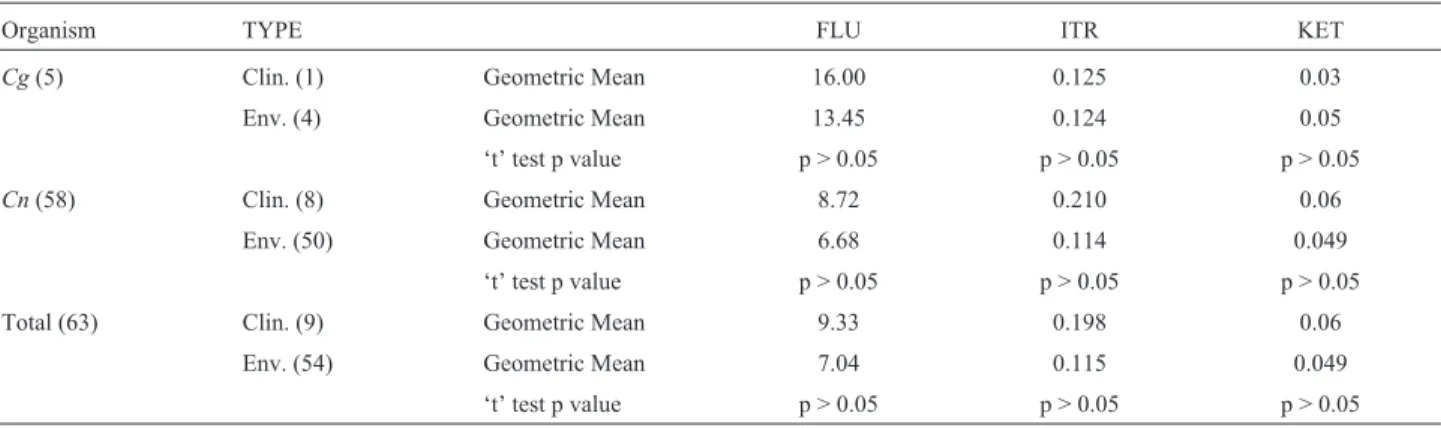
Table 2 shows a comparative data of geometric means ofC. gattiiclinical (1) and environmental strains (4). The geometric mean of clinicalC. gattiistrains for fluconazole
Table 1- Antifungal susceptibility results of three azoles against 58C. neoformansand 5C. gattiiisolates in Jabalpur Madhya Pradesh Centaral India.
Antifungal agent & organism No. Tested MIC (mg/mL)
% R % I-S % S MIC 50 MIC90 Geom. Mean MIC Range
Fluconazole
C. neoformans 58 8.6 31.1 60.3 8 32 6.93 0.063-64
C. gattii 5 40* 20 40 16 64 13.93 2-64
Itraconazole
C. neoformans 58 5.2 24.1 70.7 0.125 0.5 0.124 0.03-1
C. gattii 5 0 NS 40 60 0.125 0.5 0.125 0.03-0.5
Ketoconazole
C. neoformans 58 6.9 55.2 37.9 0.064 0.064 0.051 0.03-0.25
C. gattii 5 20 NS 20 60 0.032 0.125 0.047 0.03-0.125
*c2= 4.589, (p = 0.01609), p < 0.05* (Significant) and fisher’s exact p value = 0.09077 (NS).
NS - Not significant; % R - Percent resistant; % I-S - Percent intermediate susceptible; % S - Percent susceptible.
Table 2- A Comparisons of geometric means of clinical and environmental isolates ofC. gattiiandC. neoformansisolates in Jabalpur Madhya Pradesh Central India.
Organism TYPE FLU ITR KET
Cg(5) Clin. (1) Geometric Mean 16.00 0.125 0.03
Env. (4) Geometric Mean 13.45 0.124 0.05
‘t’ test p value p > 0.05 p > 0.05 p > 0.05
Cn(58) Clin. (8) Geometric Mean 8.72 0.210 0.06
Env. (50) Geometric Mean 6.68 0.114 0.049
‘t’ test p value p > 0.05 p > 0.05 p > 0.05
Total (63) Clin. (9) Geometric Mean 9.33 0.198 0.06
Env. (54) Geometric Mean 7.04 0.115 0.049
‘t’ test p value p > 0.05 p > 0.05 p > 0.05
was 16mg/mL, itraconazole 0.125mg/mL and ketoconazole 0.03 mg/mL. Likewise, the geometric means of environ-mental isolates for fluconazole was 13.45mg/mL, itraco-nazole 0.124 mg/mL and for ketoconazole, it was 0.05mg/mL. On comparison, the geometric means for all the three drugs was not found statistically significant for both clinical and environmental strains.
Likewise, forC. neoformansclinical (8) strains, the geometric mean for fluconazole was 8.72mg/mL, for itra-conazole was 0.21 mg/mL and for ketoconazole, it was 0.06 mg/mL. For C. neoformans environmental isolates (50), the geometric mean for fluconazole was 6.68mg/mL, for itraconazole, it was 0.114mg/mL, and for ketoconazole, 0.049mg/mL. In comparison, the geometric means for all the three drugs was not found statistically significant for both clinical and environmental strains.
The MIC geometric means of clinical strains (9) for fluconazole was 9.33, for itraconazole was 0.198, and for drug ketoconazole was 0.06. Similarly, the environmental strains (54) had a geometric mean of 7.04 for fluconazole, 0.115 for itraconazole and for drug ketoconazole 0.049 re-spectively. The comparison of geometric means for all the three drugs was not found statistically significant for total clinical (9) and environmental (54) strains.
Table 3, categorizes the sources of strains, the abun-dance ofC. neoformansandC. gattii,with their mean MIC values and the MIC range of fluconazole, itraconazole and ketoconazole drugs. There were 54 environmental strains, out of which 50 wereC. neoformansand 4 wereC. gattii.
There were 6C. neoformansstrains isolated from soil contaminated by house hold garbage; 12.66mg/mL was the mean MIC value for the drug fluconazole and 4-16mg/mL was the range. The mean MIC for itraconazole was 0.22 mg/mL and 0.03-1 mg/mL was the MIC range. The mean MIC for the drug ketoconazole was 0.08mg/mL and the MIC range was 0.03-0.25 mg/mL. There were 4 C. neoformansstrains isolated from soil contaminated by hos-pital waste; 18.5 mg/mL was the mean MIC and 2-32mg/mL was the range for the drug fluconazole. The mean MIC value for the drug itraconazole was 0.06mg/mL and 0.03-0.125mg/mL was the range. The mean MIC for the drug ketoconazole was 0.03mg/mL. There were 2 C. neoformansstrains isolated from soil soaked with human urine; 4.25mg/mL was the mean MIC for the drug fluco-nazole and 0.5-8mg/mL was the MIC range; 0.125mg/mL was the mean MIC value for the drug itraconazole; 0.045mg/mL was the mean MIC for the drug ketoconazole and the range was 0.03-0.06 mg/mL. There were 8 C. neoformansstrains collected from soil contaminated by pi-geon droppings; 25.75mg/mL was the mean MIC value for the drug fluconazole and 2-64mg/mL was the range for this drug. The mean MIC for the drug itraconazole was
0.16 mg/mL and 0.03-0.125 mg/mL was the range. The mean MIC value for the drug ketoconazole was 0.085mg/mL and 0.03-0.06mg/mL was the range for this drug. There were 6 strains ofC. neoformansisolated from soil contaminated by other bird excreta; 14.01mg/mL was the mean MIC value for fluconazole and 0.063-32mg/mL was the MIC range for this drug. The mean MIC for the drug itraconazole was 0.29mg/mL and 0.032-0.125mg/mL was the range for this drug. The mean MIC value for the drug ketoconazole was 0.06 mg/mL. There were 11 C. neoformans strains isolated from pigeon excreta; 20.47mg/mL was the mean MIC value for the drug fluco-nazole with the MIC range of 0.125-64mg/mL for this drug. The mean MIC value for the drug itraconazole was 0.15mg/mL and the range was 0.06-0.25mg/mL. The mean MIC value for the drug ketoconazole was 0.052mg/mL and 0.03-0.06 mg/mL was the range. There were 3 C. gattii strains isolated from tree trunk hollows fromTamarindus indica; 23.3mg/mL was the mean MIC for the drug fluco-nazole and 2-64 mg/mL was the range. The mean MIC value for itraconazole was 0.34mg/mL and 0.03-0.5mg/mL the range for this drug. The mean MIC value for ketoco-nazole was 0.072mg/mL and 0.03-0.125 mg/mL was the range for this drug. There were 2C. neoformansstrains iso-lated from tree trunk hollows of Mangifera indica; 8.25 mg/mL was the mean MIC for fluconazole and 0.5-16mg/mL was the range for this drug. The mean MIC for itraconazole was 0.155mg/mL and 0.06-0.25mg/mL was the range for this drug. The mean MIC range for ketoconazole was 0.06mg/mL. There were 4 strains iso-lated from tree trunk hollow ofSyzygium cumini; 1 wasC. gattiiand 3 wereC. neoformans; the mean MIC values for C. gattiistrains for the three drugs fluconazole, itracona-zole and ketoconaitracona-zole were 64, 0.032, and 0.032mg/mL re-spectively. The mean MIC value forC. neoformansstrains, for fluconazole was 3.67mg/mL and 1-8mg/mL was the range for this drug. The mean MIC for drug itraconazole was 0.072mg/mL and 0.03-0.125mg/mL was the range. The mean MIC for the drug ketoconazole was 0.05mg/mL and the range was 0.03-0.06mg/mL. There were 4 strains isolated fromEucalyptusspp.; 10.25mg/mL was the mean MIC for the drug fluconazole and 1-32 mg/mL was the range. The mean MIC for the drug itraconazole was 0.59mg/mL and 1-0.25mg/mL was the range for this drug. The mean MIC value for the drug ketoconazole was 0.06mg/mL. There was only a singleC. neoformansstrain isolated from the soil contaminated by bird droppings; 8mg/mL was the mean MIC for fluconazole, 0.125mg/mL was the mean MIC for itraconazole and 0.03mg/mL was the mean MIC for the drug ketoconazole. There were 3 C. neoformansstrains procured from the soil contaminated in poultry farm; 4.67mg/mL was the mean MIC for
C.
neoformans
&
C.
gattii
1129
Type (n); Strain (n) Individual Source (n) Strain (n); Serotype Mean (Range) Flu Mean (Range) Itra Mean (Range) Keto
Env.(54);C.n(50),C.g(4) House hold garbage contaminated Soila(6) C.n(6) 12.66 (4-16mg/mL) 0.22 (0.03-1mg/mL) 0.08 (0.03-0.25mg/mL)
Hospital waste contaminated soilb(4) C.n(4) 18.5 (2-32mg/mL) 0.06 (0.03-0.125mg/mL) 0.03 (-)mg/mL
Soil soaked with human urineg(2) C.n(2)
4.25 (0.5-8mg/mL) 0.125 (-)mg/mL 0.045 (0.03-0.06mg/mL) Soil contamintated by pigeon droppingsd(8) C.n(8)
25.75 (2-64)mg/mL 0.16 (0.03-0.125)mg/mL 0.085 (0.03-0.06)mg/mL Soil contaminated by other bird excretae(6) C.n(6) 14.01 (0.063-32mg/mL) 0.29 (0.032-0.125mg/mL) 0.06mg/mL (-)
Pigeon excretaz(11) C.n(11) 20.47 (0.125-64mg/mL) 0.15 (0.06-0.25mg/mL) 0.052 (0.03-0.06mg/mL)
Tree trunk hollows fromT. indicah(3) C.g(3)
23.3 (2-64mg/mL) 0.34 (0.03-0.5mg/mL) 0.072 (0.03-0.125mg/mL) Tree trunk hollows fromM. indicaq(2) C.n(2)
8.25 (0.5-16)mg/mL 0.155 (0.06-0.25)mg/mL 0.06mg/mL (-) Tree trunk hollows fromS. cuminii(4) C.g(1) Serotype B 64mg/mL 0.032mg/mL 0.032mg/mL
C.n(3) 3.67 (1-8)mg/mL 0.072 (0.03-0.125)mg/mL 0.05 (0.03-0.06)mg/mL
Isolates fromEucalyptusSpp.k(4) C.n(4)
10.25 (1-32)mg/mL 0.59 (1-0.25)mg/mL 0.06 (-)mg/mL Bird droppings contaminated soill(1) C.n(1)
8mg/mL 0.125mg/mL 0.03mg/mL
Poultry farm contaminated Soil (3) C.n(3) 4.67 (2-8)mg/mL 0.09 (0.03-0.125)mg/mL 0.06 (-)mg/mL
Clin.(9);C.n(8),C.g(1) CSF (3) C.n(1); Serotype D 0.5mg/mL 0.5mg/mLmg/mL 0.06mg/mL
C. n(2) Serotype A 4.25; (0.5-8)mg/mL 0.375; (0.5-0.25mg/mL 0.045; (0.03-0.06)mg/mL
Sputum (1) C.n(1) 16mg/mL 0.25mg/mL 0.03mg/mL
Blood (4) C.g(1); 16mg/mL 0.125mg/mL 0.03mg/mL
C.n(3) 33.33 (4-32)mg/mL 0.145 (0.06-0.25)mg/mL 0.176 (0.03-0.25)mg/mL
Urine (1) C.n(1) 8mg/mL 0.125mg/mL 0.03mg/mL
C.g-Cryptococcus gattii(B) ;C.n-Cryptococcus neoformans(A/D).
Flu - Fluconazole; Itra - Itraconazole; Keto - Ketoconazole; Clin. - Clinical; Env. - Environmental.
T. indica-Tamarindus indica.,M. indica-Mangifera indica.,S. cumini - Syzygium cumini.
a
BCCM/IHEM 20327, BCCM/IHEM 20328, MTCC 4414, MTCC 4413, MTCC 4415, MTCC 4417. bBCCM/IHEM 20332, MTCC 4423, MTCC 4424 MTCC 4425.
g
BCCM/IHEM 20334, BCCM/IHEM 21672.
dBCCM/IHEM 20335, BCCM/IHEM 21670, MTCC 4411, MTCC 4410, MTCC 4406, MTCC 4409, MTCC 4412, MTCC 6358. e
BCCM/IHEM 20336, MTCC 4418, MTCC 4419, MTCC 4420, MTCC 4421, MTCC 4422. z
BCCM/IHEM 20337, BCCM/IHEM 20338, BCCM/IHEM 20339, BCCM/IHEM 20340, BCCM/IHEM 20341, MTCC 4403, MTCC 4404, MTCC 4405, MTCC 4407. hBCCM/IHEM 22846.
q
BCCM/IHEM 22838, BCCM/IHEM 22845.
iBCCM/IHEM 22836, BCCM/IHEM 22837, BCCM/IHEM 22849. k
MTCC 6359, MTCC 6357, MTCC 6356. l
BCCM/IHEM 20336.
nazole and 2-8mg/mL was the range. The mean MIC for the drug itraconazole was 0.09mg/mL and 0.03-0.125mg/mL was the range. The mean MIC for the drug ketoconazole was 0.06mg/mL.
There were 9 clinical strains out of which 8 wereC. neoformans and 1 was C. gattii. There were 3 C. neoformans strains isolated from cerebrospinal fluid, in which 1 strain was serotype D; the MIC for the three drugs fluconazole, itraconazole and ketoconazole were 0.5mg/mL, 0.5mg/mL and 0.06mg/mL respectively. The other 2 strains from cerebrospinal fluid were serotype A; the mean MIC for fluconazole was 4.25mg/mL and the range was 0.5-8mg/mL. The mean MIC for itraconazole was 0.375 mg/mL and the MIC range for this drug was 0.5-0.25mg/mL. The mean MIC for the drug ketoconazole was 0.045mg/mL and the MIC range was 0.03-0.06mg/mL. There was a singleC. neoformansstrain isolated from spu-tum the MIC for the three drugs were 16, 0.25 and 0.03 mg/mL respectively. There were 4 strains isolated from blood (1C. gattiiand 3C. neoformans). The singleC. gattiistrain isolated from blood had the MIC values for the three drugs as follows: 16 mg/mL, 0.125 mg/mL and 0.03mg/mL respectively. The mean MIC values for 3C. neoformansstrains isolated from blood were 33.33mg/mL; the MIC range was 4-32 mg/mL for drug fluconazole, 0.145mg/mL was the mean MIC for the drug itraconazole with a range of 0.06-0.25mg/mL and 0.176mg/mL was the mean MIC for the drug ketoconazole with range of 0.03-0.25mg/mL.
There was only one C. neoformans strain isolated from urine. The MIC values for fluconazole, itraconazole and ketoconazole drugs for this isolate were 8, 0.125 and 0.03mg/mL respectively.
Statistical results
Antifungal susceptibility results of three azoles against 58C. neoformansand 5C. gattiiisolates have been summarized in Table 1.C. gattiishowed higher percentage of resistance (40%) compared with that ofC. neoformans for fluconazole and statistically this difference was signifi-cant (c2= 4.589; p = 0.01609*), while considering fisher’s exact p value = 0.09077, showed non-significance.
The total number of resistant cases for itraconazole and ketoconazole did not show any significant difference compared toC. neoformansandC. gattii.
A comparison of geometric means of clinical and en-vironmental isolates ofC. gattiiandC. neoformansshown in Table 2 was not statistically significant using student ‘t’ test (p value > 0.05 NS). Comparison of clinical (9)vs. en-vironmental (54) isolates was also not statistically signifi-cant using student ‘t’ test (p value > 0.05 NS).
Discussion
Review of literature on the subject revealed that in-vitro susceptibilities of C. neoformans and C. gattii strains to antifungal drugs have been studied by a number of investigators in India and abroad (Archibaldet al., 2004; Chowdharyet al., 2011; Govenderet al., 2011; Khanet al., 2009; Saret al., 2004; Souzaet al., 2005). However, few studies on the antifungal susceptibilities of clinical and en-vironmental strains ofC. neoformans andC. gattii have been reported (Chowdharyet al., 2011; Franzot and Ham-dan, 1996; Souzaet al., 2005). This study is noteworthy for documenting the antifungal susceptibility profiles of envi-ronmental and clinical isolates of C. neoformans and C. gattiiagainst fluconazole, itraconazole and ketoconazole in Central India employing micro-dilution method of CLSI/NCCLS-M27A guidelines (NCCLS-M27A). Earlier studies from India like that of Khanet al.(2007) reported antifungal susceptibility profiles of clinical and environ-mental isolates ofC. neoformans(serotype A) andC. gattii (serotype B) against amphotericin B, fluconazole, itraco-nazole, voriconazole and 5-flurocytosine from north-eastern India. Their data on geometric mean of MICs re-vealed thatC. gattiiwas significantly less susceptible than C. neoformans to fluconazole, itraconazole and vorico-nazole (p < 0.0001). In the same study MIC90 ofC. gattii was two fold higher than that ofC. neoformansfor fluco-nazole, itraconazole and voriconazole. In this study, a com-parison of the geometric mean of MIC revealed that envi-ronmental isolates ofC. neoformanswere less susceptible than environmental isolates of C. gattii to fluconazole. There was also no significant difference found between the antifungal susceptibilities profiles of clinical and environ-mental isolates ofC. neoformansandC. gattii(p < 0.05). On the contrary, Chowdharyet al.(2011) reported that en-vironmental C. neoformans variety grubii were signifi-cantly less susceptible to fluconazole, itraconazole than the clinical isolates. However, Souzaet al.(2005) reported that the MIC results obtained from their clinical and environ-mental isolates showed similar pattern of susceptibility and no resistance was found. Earlier similar results were ob-tained from Brazil (Franzot and Hamdan, 1996).
The present study demonstrated that susceptibilities ofC. neoformansvar.grubiiandC. gattiidiffered, withC. gattiiisolates showing high resistance for fluconazole and ketoconazole than those ofC. neoformansvar.grubii. This is in conformity with several earlier reports (Chowdharyet al., 2011; Fernandes et al., 2003; Gomez-Lopez et al., 2008; Trilleset al., 2004). However, contrary results show-ing no such differences in antifungal susceptibilities of the two species have been reported by some workers (Morgan et al., 2006; Tayet al., 2006; Thompsonet al., 2009). This could be due to a possible lack of uniformity in the method-ologies used by different workers. Chowdharyet al.(2011) reported lower susceptibility of environmental isolates of C. neoformansvar.grubiito fluconazole and itraconazole
than their clinical isolates. This is contrary to our results which exhibited that differences in the clinical and environ-mental isolates ofC. neoformansvar.grubiiwas not statis-tically significant. Thus, we corroborate the findings of some investigators who found that antifungal susceptibility was not related to the clinical or environmental origin of strains. (Franzot and Hamdan, 1996; Moraeset al., 2003; Trilleset al., 2004).
Interestingly, our results revealed that environmental isolates ofC. neoformans var. grubiifrom soil contami-nated by pigeon excreta, pigeon droppings and from the trunk hollows ofTamarindus indicatree exhibited lower susceptibility to fluconazole compared to other environ-mental sources and clinical isolates. This is quite similar to the finding of Chowdharyet al.(2011). However, on the contrary, the findings of some other investigators showed that antifungal susceptibility was not related to the clinical or environmental origin of strains (Franzot and Hamdan, 1996; Moraeset al., 2003; Trilleset al., 2004). In the pres-ent study, we have also found a solitary isolate ofC. gattii (serotype B) from the trunk hollow ofS. cuminitree to be resistant to fluconazole (MIC 64mg/mL). Similarly, Khan et al.(2009) and Chowdhary et al. (2011) have also re-ported thatC. gattiiisolates were significantly less suscep-tible than those ofC. neoformansvar.grubiito fluconazole.
Duttaet al.(2003) assessed fluconazole and itraco-nazole susceptibilities of clinical isolates ofC. neoformans in India. They reported that susceptibilities to fluconazole and itraconazole were 84.1% and 93.2% respectively. MIC50 and MIC90 values for fluconazole were 4 and 16 mg/mL respectively. In the present study, we found 60.3% and 70.7% susceptibilities of environmental isolates ofC. neoformansto fluconazole and itraconazole respec-tively. In our case, MIC 50 and MIC 90 values for fluco-nazole were 8 and 32 mg/L. It is just double the values reported by Duttaet al.(2003) for clinical isolates of C. neoformansfor fluconazole. Similarly, MIC50 value for itraconazole in the present study was 0.125mg/mL, much higher than 0.032mg/mL reported by Duttaet al.(2003). Khan et al. (2007) reported 4 mg/mL as MIC90 for C. neoformansisolates from decayed wood of trunk hollows against fluconazole. On the contrary, our environmental isolates exhibited much higher values 32mg/mL MIC90 value for fluconazole; likewise for itraconazole our MIC90 value was 0.05mg/mL much lower (0.094mg/mL) reported by Khanet al.(2007) respectively. Interestingly, our value of MIC90 for ketoconazole was similar,i.e.0.064mg/mL to that of Khanet al.(2007).
We conclude, that the susceptibilities of C. neoformansandC. gattii isolates differed, withC. gattii strains showing higher resistance percentages (for flucona-zole and ketoconaflucona-zole drugs) than those ofC. neoformans.
Trpkovic et al. (2012) reported lowest activity of fluconazolein vitro(48.4% susceptibility). Our results also indicate lowest activity of fluconazole forC. gattiistrains (40%), however lowest susceptibility of 37.9% was ob-served in case ofC. neoformansstrains for the drug keto-conazole.
Tangwattanachuleeporn et al. (2013) analyzed the prevalence and antifungal susceptibilities ofC. neoformans isolated from pigeon excreta from Eastern Thailand. This group studied 50 pigeon excreta samples; 100% of C. neoformansisolated from pigeon excreta were of serotype A. Tangwattanachuleepornet al.(2013) also observed de-creased susceptibility towards fluconazole; still all strains tested were sensitive towards fluconazole and itraconazole. However, in the present study we observed 8.6% resistance forC. neoformansand 40% forC. gattiistrains, while 5.2% resistance was observed for the drug itraconazole for C. neoformansstrains.
Antifungal susceptibilities and genotypes of clinical isolates were analyzed in Brazil by Matos et al. (2012). Their study revealed resistance to fluconazole (4.8%), which is lower than our results of 8.6% resistance in C. neoformans and 40% in case of C. gattii for the drug fluconazole. This study also revealed the high percentage ofC. gattiistrains belonged to VGII genotype and its low susceptibility to antifungal agents is worth considering.
The low susceptibility of VGII genotype was also shown by Trilleset al. (2012). In their study geometric means for the drugs fluconazole, itraconazole and ketoco-nazole for VGII genotype were 6.08, 0.15 and 0.06 respec-tively. Our results revealed geometric means for these three drugs forC. neoformansvs.C. gattii strains were as fol-lows: 6.93vs.13.93, 0.124vs.0.125 and 0.051vs.0.047 for fluconazole, itraconazole and ketoconazole respectively.
Favalessaet al.(2014) analyzed the molecular types and in-vitro antifungal susceptibilities of Cryptococcus spp. from patients in Mid west Brazil. Their MICs ranges for antifungal drugs were as follows fluconazole was 1-16 mg/L, itraconazole was 0.25-0.12 mg/L, while in the present study the MIC range for C. neoformans was 0.063-64mg/mL and was 2-64mg/mL forC. gattiifor the drug fluconazole. The MIC range for the drug itraconazole was 0.03-1mg/mL forC. neoformansand 0.03-0.5mg/mL forC. gattiistrains respectively. Favalessaet al.(2014) also concluded that the predominant genotype affecting HIV-negative individuals in Cuiaba is AFLP6/VGII.
these molecular types and to draw a valid conclusion about the same.
Acknowledgments
The authors wish to thank the Vice-Chancellor of R. D. University for providing laboratory facilities and to the Director-General of Indian Council of Medical Research (ICMR), New Delhi for awarding Senior Research Fellow-ship and Post Doctoral Research AssociateFellow-ship for this work. We are also grateful to the Government of India, Ministry of Science and Technology, DST for awarding SERC FAST Track Scheme for Young Scientist to one of the author (S.R.N).
References
Archibald LK, Tuohy MJ, Wilson DAet al.(2004) Antifungal susceptibilities ofCryptococcus neoformans. Emerg Infect Dis 10:143-145.
Casadevall A, Perfect JR (1998) Cryptococcus neoformans. Washington DC: American Society for Microbiology. Chong HS, Dagg R, Malik Ret al.(2010)In vitrosusceptibility of
the yeast pathogenCryptococcusto fluconazole and other azoles varies with molecular genotype. J Clin Microbiol 48:4115-4120.
Chowdhary A, Randhawa HS, Sundar Get al.(2011)In vitro antifungal susceptibility profiles and genotypes of 308 clini-cal and environmental isolates ofCryptococcus neoformans var.grubiiandCryptococcus gattiiserotype B from north-western India. J Med Microbiol 60:961-967.
Davey KG, Johnson EM, Holmes ADet al.(1998)In vitro suscep-tibility ofC. neoformansisolates to Fluconazole and Itra-conazole. Antimicrob Agents Chemother 42:217-220. Dutta K, Jain N, Sethi Set al.(2003) Fluconazole and itraconazole
susceptibility of clinical isolates of Cryptococcus neoformansat a tertiary care centre in India: a need for care. Antimicrob Agents Chemother 52:683-686.
Favalessa OC, de Paula DA, Dutra Vet al.(2014) Molecular typ-ing andin vitro antifungal susceptibility ofCryptococcus spp from patients in Midwest Brazil. J Infect Dev Ctries 8:1037-1043.
Fernandes de FL, Passos XS, Souza LKet al.(2003)In vitro sus-ceptibility characteristics ofCryptococcus neoformans vari-eties from AIDS patients in Goiania, Brazil. Memórias do Instituto Oswaldo Cruz 98:839-841.
Franzot SP, Hamdan JS (1996) In vitro susceptibilities of clinical and environmental isolates ofCryptococcus neoformansto five antifungal drugs. Antimicrob Agents Chemother 40:822-824.
Friese G, Discher T, Fussle Ret al.(2001) Development of azole resistance during fluconazole maintenance therapy for AIDS associated cryptococcal disease. AIDS 15:2344-2345. Gomez-Lopez A, Zaragoza O, Martins DAet al.(2008) In vitro susceptibility ofCryptococcus gattiiclinical isolates. Clin Microbiol Infect 14:727-730.
Govender NP, Patel J, WyK MVet al.(2011) Trends in Anti-fungal drug Susceptibility ofCryptococcus neoformans ob-tained through population based surveillance, South Africa, 2002-2003 and 2007-2008. Antimicrob Agents Chemother DOI: 10.1128/AAC.00048-11.
Grover N, Nawange SR, Naidu Jet al.(2007) Ecological niche of Cryptococcus neoformans var. grubii and Cryptococcus gattiiin decaying wood of trunk hollows of living trees in Jabalpur City of Central India. Mycopathol 164:159-170. Iqbal N, De Bass EE, Wohrle Ret al.(2010) Correlation of
geno-type and in-vitro susceptibilities of Cryptococcus gattii strains from the Pacific North west of the United States. J Clin Microbiol 48:539-544.
Khan ZU, Randhawa HS, Chehadeh Wet al.(2009)Cryptococcus neoformansserotype A andCryptococcus gattiiserotype B isolates differ in their susceptibilities to fluconazole and voriconazole. Intern J Antimicro Agent 33:559-563. Khan ZU, Randhawa HS, Kowshik Tet al.(2007) Antifungal
sus-ceptibility ofCryptococcus neoformansandCryptococcus gattiiisolates from decayed wood of trunk hollows ofFicus religiosaandSyzygium cuminitrees in north-western India. Antimicrob Agents Chemother 60:312-316.
Kwon-Chung KJ, Bennett JE (1992)Cryptococcusand Crypto-coccosis. In: Kwon-Chung KJ, Bennett JE (eds) Medical Mycology, Philadelphia. Lea and Febiger, London, pp 397-446.
Kwon-Chung KJ, Varma SA (2006) Do major species concepts support one, two or more species within Cryptococcus neoformans? FEMS Yeast Res 6:574-577.
Matos CS, Andrade AS, Oliveira NS, Barros TF (2012). Microbi-ological characteristics of clinical isolates ofCryptococcus spp. in Bahia, Brazil: molecular types and antifungal suscep-tibilities. Eur J Clin Microbiol Infect Dis 31:1647-1652. Mitchell TG, Perfect JR (1995) Cryptococcosis in the era of
AIDS- 100 years after the discovery of Cryptococcus neoformans. Clin Microbiol Rev 8:515-518.
Moraes EM, Prímola NS, Hamdan JS (2003) Antifungal suscepti-bility of clinical and environmental isolates ofCryptococcus neoformans to four antifungal drugs determined by two techniques. Mycoses 46:164-168.
Morgan J, McCarthy KM, Gould Set al.(2006)Cryptococcus gattiiinfection: Characteristics and Epidemiology of cases identified in a South African Province with high HIV sero-prevalence, 2002-2004. Clin Infect Dis 43:1077-1080. National Committee for Clinical Laboratory Standards (1997)
Reference method for broth dilution antifungal susceptibil-ity testing of Yeasts. M27-A NCCLS, Wayne Pa, USA. Nawange SR, Shakya K, Naidu Jet al.(2006) Decayed wood
in-side trunk hollows of living trees of Tamarindus indica, Syzygium cuminiandMangifera indicaas natural habitat of Cryptococcus neoformansand their Serotypes in Jabalpur city of Central India. Mycol Med 16:63-71.
Nawange SR, Singh SM, Naidu Jet al.(2011) Serotype distribu-tion ofCryptococcus neoformansandC. gattiiin patients and in the environment of Jabalpur, a City of Madhya Pradesh in India. Asian J Microbiol Biotechnol Environ Sci 13:735-742.
Pfaller MA, Bale M, Buschelman Bet al.(1995) Quality control guidelines for National Committee for Clinical Laboratory Standards recommended broth macrodilution testing of Amphotericin B, Fluconazole, and Flucytosine. J Clin Microbiol 33:1104-1107.
Pfaller MA, Zhang J, Messer SAet al.(1999)In vitroactivities of voriconazole, fluconazole and itraconazole against 566 clin-ical isolates ofCryptococcus neoformansfrom the United
States and Africa. Antimicrob Agents Chemother 43:167-171.
Pfaller MA, Zhang J, Messer SAet al.(1998) Molecular epidemi-ology and antifungal susceptibility of Cryptococcus neoformans isolates from Ugandan AIDS patients. Diag Microbiol Infect Dis 32:191-199.
Rex JH, Nelson PW, Lezane CMet al.(1996) Interpretation of trailing endpoints in antifungal susceptibility testing by Na-tional Committee for Clinical Laboratory Standards method. J Clin Microbiol 36:153-156.
Rodriguez-Tudela JL, Martinez-Suarez JV, Dronda Fet al.(1995) Correlation ofin-vitrosusceptibility test results with clinical response: a study of azole therapy in AIDS patients. Anti-microb Agents Chemother 35:793-804.
Sar B, Monchy D, Vann Met al.(2004) Increasingin vitro resis-tance to fluconazole inCryptococcus neoformans Cambo-dian isolates: April 2000 to March 2002. Antimicrob Agents Chemother 54:563-565.
Shears P (2001) Antibiotic resistance in the Tropics. Tran R Soc Trop Med Hyg 95:127-130.
Souza LKH, Fernandes OFL, Kobayashi CCBA et al.(2005) Antifungal susceptibilities of clinical and environmental isolates ofCryptococcus neoformansin Goiânia City Goiás Brazil. Rev Inst Med Trop Sao Paulo 47:253-256.
Tangwattanachuleeporn M, Somparn P, Poolpol Ket al.(2013). Prevalence and antifungal susceptibility of Cryptococcus
neoformansisolated from pigeon excreta in Chon Buri Prov-ince, Eastern Thailand. Med Mycol 54:303-307.
Tay ST, Tantay HT, Ng KPet al.(2006) In vitro susceptibilities of Malaysian clinical isolates ofCryptococcus neoformansvar. grubii and Cryptococcus gattii to five antifungal drugs. Mycoses 49:324-330.
Thompson GR III, Wiederhold NP, Fothergill AWet al.(2009) Antifungal susceptibilities among different serotypes of Cryptococcus gattii and Cryptococcus neoformans. Anti-microb Agents Chemother 53:309-311.
Trilles L, Fernández-Torres B, Lazéra MSet al.(2004) In vitro antifungal susceptibility of Cryptococcus gattii. J Clin Microbiol 42:4815-4817.
Trilles L, Meyer W, Wanke Bet al.(2012). Correlation of anti-fungal susceptibility and molecular type within the Cryptococcus neoformans/C. gattiispecies complex. Med Mycol 50:328-332.
Trpkovic A, Pekmezovic M, Barac A et al. (2012) In vitro antifungal activities of amphotericin B, 5-fluorocytosine, fluconazole and itraconazole against Cryptococcus neoformans isolated from cerebrospinal fluid and blood from patients in Serbia. Mycol Med 22:243-248.
WHONET Software Version 5.5. 2010. Available at: http://www.who.int/drugresistance/whonetsoftware/en. Ac-cessed 19 Aug 10.
Associate Editor: Karen Spadari Ferreira