ISG - Instituto Superior de Gestão
T
HE
G
REEN
E
NERGY
P
ROCUREMENT
P
OLICY
AND ITS
C
ONSEQUENCES
:
A
G
REEN
L
IGHT TO
M
AKE
B
USINESS
T
URN
S
MARTER
Dissertação apresentada no Instituto Superior de Gestão Para obtenção do Grau de Mestre em Gestão da Energia Orientador: Professor Doutor Rui Moreira de Carvalho
Co-orientador: Professor Nuno Gaspar Oliveira
LISBOA
V
T
HE
G
REEN
E
NERGY
P
ROCUREMENT
P
OLICY AND ITS
C
ONSEQUENCES
:
VII
ABSTRACT
Concepts such as Sustainable Development and Green Procurement are increasingly present today. Green Procurement has a great overall importance in reducing environmental impacts regarding consumer goods and services and, consequently, the way of living in society as well as the whole world, in a Sustainable Development perspective.
The general framework of the study focuses on the United Nations and the European
Union‘s Green Procurement policy that has consequences on the Portuguese Energy
Policy and affects purchases and businesses.
The main concepts to develop are the Sustainability, the Sustainable Development and the Green Procurement.
Green Procurement must be, implemented in a holistic way organizations and be in consumers concerns, by including environmental and social considerations into its acquisition practices.
Lacroix (2011) defines Green Procurement by the following way:
Green procurement is the purchasing of products or services which have a lower impact on the environment over their whole life cycle than the standard equivalent. (P. 2)
The main objective of the study is to identify the current policies of green procurement policies in the UN, EU and in Portugal and, consequently, in organizations, and to explore the issues that may affect the people‘s behavior and business and activity.
Key Words
IX
RESUMO
Conceitos como o de Desenvolvimento Sustentável e Green Procurement estão cada vez mais presentes nos dias de hoje. O Green Procurement tem uma grande importância na redução dos impactos ambientais do consumo de bens e serviços e, consequentemente, numa perspectiva de Desenvolvimento Sustentável na sociedade e no mundo.
O enquadramento geral do estudo centra-se na política de Green Procurement das Nações Unidas e da União Europeia que tem consequências na Política Energética Portuguesa, nas aquisições e negócios.
Os principais conceitos para o desenvolvimento são a Sustentabilidade, Desenvolvimento Sustentável e Compras Ecológicas.
O Green Procurement deve ser, implementado de uma forma holística nas organizações e estar presente nas opções dos consumidores, através da inclusão de critérios ambientais e sociais nas suas práticas de aquisição.
Lacroix (2011), define Compras Ecológicas pela seguinte forma:
Compra de produtos ou serviços que têm menor impacto ambiental, ao longo do seu ciclo de vida, comparado aos seus equivalentes standard (P. 2)
O principal objectivo do estudo é identificar as actuais Políticas de Compras Ecológicas na ONU, UE e em Portugal e, consequentemente, nas organizações, e analisar problemas que podem afectar o comportamento dos consumidores e das actividades de negócios.
Palavras-Chave
XI
ACKNOLEDGMENTS
First of all, I thank my family for the support, particularly, my nephew for the inspiration and company.
I also thank you, Professor Rui Moreira de Carvalho and Nuno Gaspar de Oliveira, for the support and commitment in the whole process of researching and writing this study
XIII
ACRONYMS AND ABBREVIATIONS
ES - Energy Sustainability EU - European Union
ICLEI - International Council for Local Environmental Initiative IRENA – International Renewable Energy Agency
GP Green Procurement
GPA - Government Procurement Agreement - GPP - Green Purchasing Policy
GSCM Green Supply Chain Management REP - Renewable Energy Policy
SD - Sustainable Development
SPP - Sustainable Public Procurement UN - United Nations
UNEP - United Nations Environment Programme WTO - World Trade Organization
XV TABLE OF CONTENTS
ABSTRACT ... 7
RESUMO ... 9
ACKNOLEDGMENTS ... 11
ACRONYMS AND ABBREVIATIONS ... 13
INDEX - FIGURES ... 19
INDEX – TABLES ... 20
INTRODUCTION ... 21
Definition of the Problem ... 21
Research Objectives ... 23
Dissertassion Structure ... 24
CHAPTER 1. DEFINITION OF THE MAIN CONCEPTS ... 25
1.1 The Relationship between Sustainable Development and Economic Development: a Good Reason for a Green Procurement Policy ... 26
1.2 The Concept of Green Procurement and Green Supply Chain Management ... 27
CHAPTER 2. GREEN PROCUREMENT POLICY ... 33
2.1. The United Nations Framework ... 33
2.2. The European Union Framework ... 35
2.3 The Portuguese Framework ... 37
CHAPTER 3. THE GREEN ENERGY FRAMEWORK WITHIN GREEN PROCUREMENT ... 41
3.1 General Framework ... 41
3.2. Renewable Energy Policy Landscape ... 41
3.3. Renewable Energy in the International Policy: UN and IRENA ... 42
XVI
3.5. Renewable Energy Procurement in the Portuguese Policy ... 45
CHAPTER 4. THE GREEN ENERGY ECONOMICS AND ITS EFFECTS ON CONSUMERS ... 49
4.1 Renewables Framework and Consumers‘ Choice Drivers ... 49
4.2 A Liberalized Market – A New Framework to Portuguese Consumers ... 52
CHAPTER 5.METHODS ... 53
5.1 Scope ... 53
5.2 Questionnaire Data Analysis ... 56
5.2 Characteristics of the Respondent ... 62
5.2.1. Gender ... 62
5.2.2. Age ... 63
5.2.3. Graduation ... 64
5.2.4. Residence ... 65
5.3 Study Compliant Data Analysis - Univariate Analysis ... 66
5.3.1. Information Collection ... 66
5.3.2. Energy Sustainability Information Collection ... 67
5.3.3. Organizations and the Energy Sustainability Concept ... 68
5.3.4. Green Procurement Concept ... 69
5.3.5. Green Procurement Research ... 69
5.3.6. Principal Energy Source to Contract in 2020 ... 70
5.4 Study Compliant Data Analysis - Bivariate Analysis ... 72
5.4.1. Information Collection & Energy Sustainability Information Collection 72 5.4.2. Energy Sustainability Information Collection & Green Procurement Concept ... 78
XVII 5.4.4. Energy Sustainability Information Collection & Principal Energy Source
to Contract in 2020 ... 80
5.4.5. Energy Sustainability Information Collection & Organizations and Energy Sustainability Concept ... 82
5.4.6. Green Procurement Concept & Green Procurement Research ... 84
5.4.7. Green Procurement Concept & Principal Energy Source to Contract in 2020 ... 85
5.4.8. Age & Green Procurement Concept ... 87
5.4.9. Age & Green Procurement Research ... 88
5.4.10. Gender & Green Procurement Concept ... 89
5.4.11. Gender & Principal Energy Source to Contract in 2020 ... 90
5.4.12. Residence & Green Procurement Concept ... 91
5.4.5. Study Analysis Summary ... 92
5.4.5.1. Respondents‘ Profile ... 92
5.4.5.2. Univariate Analysis Summary ... 92
5.4.5.3. Bivariate Analysis Summary ... 93
5.4.5.4. Green Procurement Concept - Analysis Summary – Open Question .... 96
CHAPTER 6. CONCLUSIONS ... 99
CHAPTER 7 FUTURE CONSIDERATIONS ... 107
BIBLIOGRAPHY ... 113
19
INDEX - FIGURES
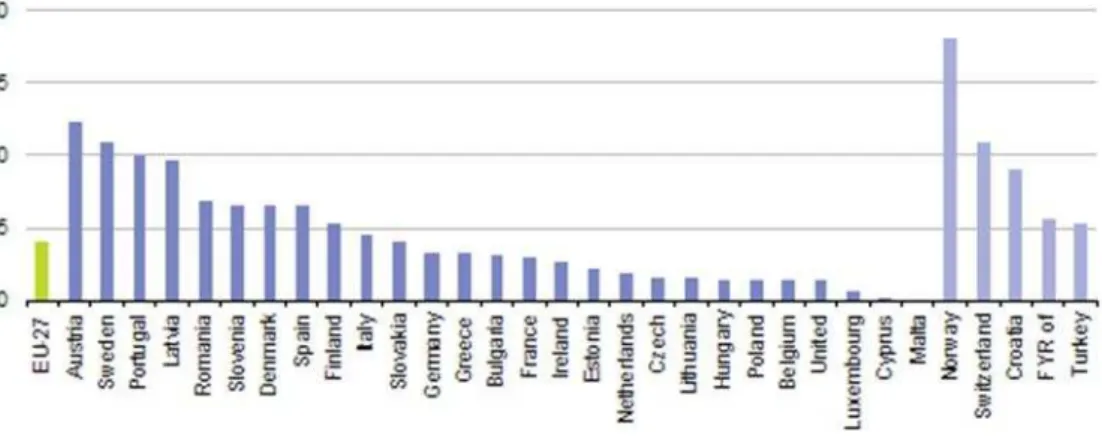
Fig. 1 - Proportion of electricity generated from renewable sources of 2010 (% of gross
electricity consumption) ... 49
Fig. 2 - Proportion of electricity generated from renewable sources of 2010 (% of gross electricity consumption) ... 50
Fig. 3 – Evolution of Energy Prices in Portugal ... 52
Fig. 4 - Gender ... 62
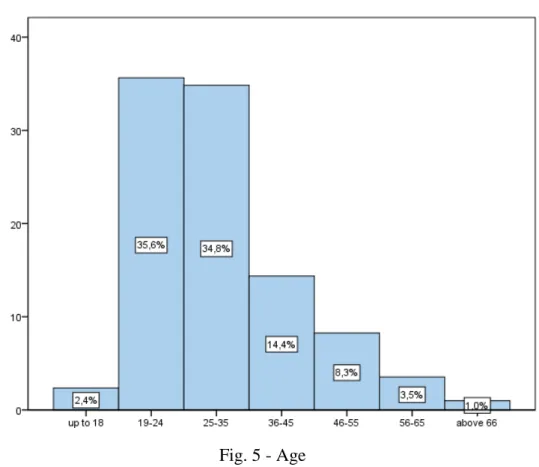
Fig. 5 - Age ... 63
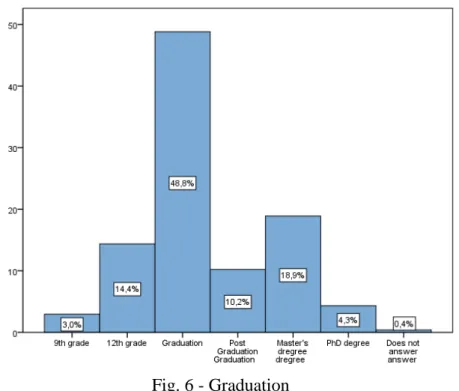
Fig. 6 - Graduation ... 64
Fig. 7 - Residence ... 65
Fig. 8 – Energy Sustainability Information Collection ... 67
Fig. 9 – Green Procurement Research ... 69
Fig. 10 – Gender & Nuclear ... 90
Fig. 11 – Estimated Renewable Energy Share of Global Electricity Production in 2011 ... 104
Fig. 12 – Power Growth by Sector and Fuel/Region ... 108
Fig. 13 – Energy Demand Growth ... 109
Fig. 14 – Energy Demand Growth and Supply ... 109
20
INDEX
–
TABLES
Table 1 – Variables Classification……….………...60
Table 2 –Information Collection……….………66
Table 3 –Organizations and the Energy Sustainability Concept……….……….…...68
Table 4 – Green Procurement Concept.……….………...69
Table 5 –Principal Energy Source to Contract in 2020………...70
Table 6 – Energy Sustainability Information Collection & Internet………..…..72
Table 7 - Energy Sustainability Information Collection & Newspapers/Magazines...73
Table 8 - Energy Sustainability Information Collection & Television…...…….……74
Table 9 - Energy Sustainability Information Collection & Conversation…...….…75
Table 10 - Energy Sustainability Information Collection & Journals.………...…...76
Table 11 - Energy Sustainability Information Collection & Other………….…....…77
Table 12 - Energy Sustainability Information Collection & GP Concept…..…...78
Table 13 - Energy Sustainability Information Collection & GP Research...……...79
Table 14 - ES Information Collection & Principal Energy Source in 2020...…...…80
Table 15 - ES Information Collection & Organizations and ES...………….…...82
Table 16 - GP Concept & GP Research...…………...84
Table 17 - GP Concept &Principal Energy Source in 2020...…………..…...85
Table 18 - Age & GP Concept ...………..…………...……...87
Table 19 - Age & GP Research...……….………...……...88
Table 20 - Gender & GP Concept...………...……...89
21
INTRODUCTION
Most people spend more time and energy going around problems than in trying to solve them.
Henry Ford
Definition of the Problem
The problem of the study is to understand how a Green Procurement (GP) policy and the change of attitudes and practices of institutions for social, economic and environmental development can benefit and enable Sustainable Development (SD). The problem defined is as follows:
How will the European Green Procurement Policy evolve between 2012 and 2020 and what could be the consequences for the Portuguese Energy Policy?
Other issues are:
- How will the UN‘s, EU‘s and the Portuguese Green Procurement Policy affect the energy acquisition of organizations and the market, considering two aspects: economic development and Sustainable Development (the economic, social and environmental) in Portugal?
- How will the procurement policy have an impact on value creation considering the environmental, economic and social development?
22 To stop this concerning framework, the EU, based on the UN‘s practices, establishes directives that undermine the decisions of public and private institutions, specifically in the procurement process. The emerging need to take into account the environmental value of products and services that meet the needs of populations, without compromising future generations, has become a fact.
The public and private institutions face several challenges which involve multiple organizational efforts of adaptation that meet the needs of today's society. The inclusion of environmental criteria in the hiring process facilitates the interconnection of the various actions and policies which in turn, enable a wider and more sustainable approach to environmental issues and charges and goals. According to Brammer & Walker (2010), the supply management profession is increasingly being called upon to contribute to broader organizational goals of sustainable development through the inclusion of social and environmental criteria within procurement processes
The issue of green purchasing can be an example for other sectoral areas that by showing a change in behaviors, processes of production of goods and services, more eco-efficient, towards sustainability.
The study focuses on the energy sector that is considered one of the most important
issues of the century: ―so energy is embodied in everything that we use, and in order to have economic growth, we need to have lots of energy and preferably nice and cheap
energy. So not only do we need carbon neutral energy, we need large quantities of it.‖
(Hall, 2012)
This study should be current and enable the understanding and realization that the actions of institutions more socially and environmentally responsible, can play a major role for SD and to interested parties on the subject: the scientific community and to the net of companies.
23 Research Objectives
The main objective of the study is to identify the current policies of environmental purchasing practices in the UN, EU and in Portugal and, consequently, in both public and private institutions, considering two vectors: the GP Policy and the SD. We want to understand their capabilities and connections that may affect the business and activity of the companies.
The secondary objectives of this work are:
Understand whether and how GP is, or is not, only possible and / or advisable and simple, in the perspective of creating value, increasing competitiveness, reducing costs and enhancing credibility for all stakeholders;
Comprehend the consequences of the UN‘s and the EU‘s frameworks to the
Portuguese Energetic Policy and how they will affect the businesses and companies of the country ;
Review the relevance and role of GP within an organization and the population in general that aim to purchase energy responsibly at the economic, social and environmental level.
24 Dissertassion Structure
The present study about Green Energy Procurement id divided in seven chapters. The first one defines the important concepts to development of the study. The second chapter refers to the Green Procurement Policy Framework and the following chapter is related to the energy sector within the Green Procurement framework. chapter four
defines how do Green Energy Economics affect consumer‘s choice. The fifth chapter
25
CHAPTER 1. DEFINITION OF THE MAIN CONCEPTS
Sustainability emerges as a central concept when focusing on the world‘s issues. The
essence of sustainability is related to what can be maintained over time (Tavares, 2009). Sustainability crosses some organizational fields: economic, social, cultural and environmental assets of human society. Therefore, it is understood that development issues are beyond economic growth.
Concerning social sustainability, Goodland & Daly (1996) argue that it is achieved by systematic citizen participation in community. Community cohesion, cultural identity, diversity, courtesy, tolerance, humility, compassion, patience, fellowship, brotherhood, love, honesty standards, discipline and law are the main components of social sustainability. Thus, to achieve a social sustainability stage, it is necessary to keep
―moral capital‖ and made up value and equal rights.
Regarding the economic area, Hicks (1946, in Goodland & Daly, 1996), argues that income is defined by the amount you spend over a certain period of time. Economic sustainability relates not only to the importance of why you are consuming and to the amount of capital that you will spend. There are three forms of capital: natural, social and human. The natural capital (eg, biodiversity, ecosystems) is what is most likely to be related to this concept by the fact that, due to human development, it is becoming increasingly scarce and, simultaneously, very important.
26 1.1The Relationship between Sustainable Development and Economic
Development: a Good Reason for a Green Procurement Policy
In the contemporary world, we find levels of unemployment, poverty and social exclusion. This represents, along with the climate change, a remarkable and socially shared challenge to reverse this situation, also attending to the quality of life within the limits of planet Earth (e.g., UNEP, 2013).
In this context, it is necessary to take into account two main assets: SD and the promotion of businesses and, therefore, try to promote a good management of their economic activity. Thus, the social and environmental responsibility must be clearly present in the policies of the companies of each country.
Rego et al. (2007), based on the work of Fergus & Rowney (2005), state the flowing:
Today, most companies include some aspects of sustainable development into their options, usually related to environmental and social assets. However, they are not implemented them consistently in all levels of the organization, considering a holistic view.1(P.169)
In our perspective, this analysis could also be applied to the Procurement Policy (PP) adopted by each organization. Today, it is urgent to define ways of creating synergies between SD and economic development. In order to succeed, companies must be aware of policies and best practices regarding ethical, social and environmental responsibility. Companies should rely on a central issue: transparency. Sustainability must be a part of their political, social and business agendas by reporting on environmental and social issues. Rego et al. (2007), subscribe this idea:
A major number of investors, traditionally called socially responsible investors, (…) are
convicted that sustainability must be integrated in the prior processes of a purchase
evaluation of a determinate organization. Calvert analysis (…) includes an assessment of a range of business practices in the following areas: environmental performance,
governance, work management, including evaluation of women’s representation and
27
minorities’ administration, human resources policies and the practices in abroad
activities: the rights of indigenous people and product safety.2(P.194)
According to Elkington (1994), the author that defined the concept of ‗Tripple Bottom Line‘, entrepreneurial success is taken into account not only by the profit generated, but
also by the integration of organizational performance in economic, social and environmental management through innovative solutions and the identification of the concepts of transparency and integrity, better defined as accountability (e.g., Bovens, 2007) .
Our analysis leads to some initial assumptions:
We need a global joint action locally focused towards more sustainable forms of production and consumption;
Organizations should make an effort to purchase products and services that are less harmful to local and global environments;
Both public and private sector organizations may implement purchasing practices that include environmental and social considerations—Green Procurement (GP).
1.2 The Concept of Green Procurement and Green Supply Chain Management
SD is critical and indispensable for organizations seeking value creation and, therefore, success in a global world: organizations are now at a point where they can decide to
follow the current ‗business as usual‘ model or recognize the opportunity to take the
essential steps that will move them forward to a sustainable economic, social and environmental future. (Pegram et al., 2009). This situation is characterized by great
28 challenges and opportunities for organizations, particularly with regard to its procurement policy. There is a major awareness of environmental protection which is
on the bases of the green trend to preserve Earth‘s resources in order to improve their
social, economic and environmental resources. According to Salam (2008), we assist watch nowadays increasing awareness of environmental protection worldwide, the
green trend towards conserving the Earth‘s resources and protecting the environment is
overwhelming. This awareness is consistent with the major guidelines followed by the GP efforts, commitments and policy trends.
The concept of GP has been suffering an improvement over the years as new concerns
emerge from the need to make it ―greener‖.
One of the definitions pointed out by the Report on Sustainable Procurement in the United Nations System (2004)3, the designation of GP may be considered as ―the process by which public or private organizations buy goods and/or services to fulfill
various needs of an organization.‖ (P.3)
As stated in the Background Paper on Sustainable Procurement and Environmental Management Programmes for the United Nations System (2004, P.1)4, the base values of procurement are the following: effectiveness, efficiency, competition, transparency, equitable distribution and development; the choices of goods and services that should be made are also important.
As far as the economic perspective the main considerations are: best value for money, price, quality availability and functionality.
Considering the environmental aspects in GP we must highlight the impacts on the environment that the product and/or service has after its whole life-cycle, from cradle to grave or, ideally, from cradle-to-cradle (e.g. Vermeulen & Ras, 2006)
3 Report prepared for the Environment Management Group as requested at 8th Meeting, 1st September 2004
4 This paper was prepared for the Environmental Management Group by UNEP/DTIE, with Annexes 1
29 The procurement social concerns are related to the effects of purchasing decisions on issues such as poverty eradication, international equity in the distribution of resources, labor conditions and human rights.
It must be underlined the social mark that integrates the definition of GP. An example is one given by the Report on Sustainable Procurement in the United Nations System
(2004), is that ―historically a direct or indirect link has always been made between the
performance of the procurement function and the collective fulfillment of social and
economic objectives.‖(P.3)
Considering GP the Business Council for Sustainable Development Portugal (2011),
emphasis once more ―the integration of environmental and social concerns in the
acquisition criteria that go beyond the economic ones.‖5 (P.3)
In the literature about the issue of GP, many authors state the importance of GP going far beyond the economic interests, giving a central role to environmental as well as social concerns and commitments. Here are some examples for the definitions of GP by different authors:
Carter et al. (1998, in Salam, 2008), defined GP as ―consisting involvement in activities
that include the reduction, reuse and recycling of materials in the process of
purchasing.‖ (P.1)
Carter & Jennings (2002), in Brammer & Walker (2010), argue that GP policy should consider five issues: the environment, diversity, human rights, philanthropy and security.
Zhu & Sakas (2006, in Salam, 2008), emphasize that with the increasing awareness of
environmental protection, the green trend towards conserving earth‘s resources is
5 Translated by the author:”Em suma, o
30
developing in order to improve the company‘s social, economic and environmental
performance by changing their strategies.
Salam (2008) refers the importance of an assessment made by organizations or companies in order to take in consideration the environmental consequences of a product at all the various stages of its lifecycle. In this perspective, GP implies a selection of products and services to be acquired, so that this process minimizes environmental impact.
Lacroix (2011) thinks that organizations adopt GP practices by taking four different
approaches: ―procuring eco-labeled products or services, in-house product or service
evaluations, third party product or service evaluations and supply chain initiatives‖
(P.3). According to him, GP can be defined as:
The purchase of environmentally preferable products and services in accordance with one or more of the established “green" procurement preference programs. Green procurement is the purchasing of products or services which have a lower impact on the environment over their whole life cycle than the standard equivalent.(P.3)
The concept of GP integrates the concept of Green Supply Chain Management (GSCM). Brammer & Walker (2010) express Vachon & Klassen (2006) ideas, by
saying that: ―As research concerned with green supply chain management developed, key themes included investigating the antecedents of engagement with environmental
issues in supply management‖ (P. 454) (Fashion Indie )
31 Srivastava (2007), quoted by Abdallah, Diabat & Simcha-Levi determines GSCM as the integration of environmental thinking in the chain, including product design, supply and selection of materials, manufacturing processes, as well as the distribution of the final product to consumers and product management, after its useful life.
We may consider the GPP and GSCM are reciprocal with a main focus on sustainability and also on SD. These concepts are particularly important in what concerns
33 CHAPTER 2. GREEN PROCUREMENT POLICY
2.1. The United Nations Framework
There are several global organizations that enhance GP through their programs and policies:
The United Nations (UN): Division for Sustainable Development - fosters GP through shifting consumption habits;
The UN: Division of Technology, Industry and Economics – Consumption and Production Programme - provides practical tools, information to support GP and facilitates global networking;
The International Green Purchasing Network - shares information internationally, promotes the increasing growth of greener product and service offers)
The World Trade Organization (WTO) – provides a forum for governments to negotiate trade agreements that designed the Government Procurement
Agreement (GPA) which aim is to ―open up to international competition as
much as possible the government procurement of its Parties‖6
. It is a plurilateral agreement which allows the inclusion green and sustainable assets into documentation.
Political discussions at UN level are reflected on procurement and SD work: Agenda 21;
The Johannesburg Plan of Implementation of World Summit on Sustainable Development (September 2002);
The 10 year framework of Programmes for Sustainable Consumption and Production;
6
34 The Marrakech Task Force on Sustainable Public Procurement;
The United Nations Environment Program‘s (UNEP) 23 rd Governing Council decision.
The Agenda 21 Programme motivates governments to achieve a greener procurement by changing consumption patterns. As stated in the Report on Sustainable Procurement in the United Nations System (2004)7, ―Agenda 21 recognized the need to work on the
inclusion of sustainable development considerations (chapter 4.23)‖(P.4). It also says
that this was reiterated in the expanded 1999 UN Guidelines for Consumer Protection in the 54th paragraph: ―Governments and international agencies should take the lead in introducing sustainable practices in their own operations, in particular through their
procurement policies‖ (P.4).
According to the same report, the Johannesburg Plan focus on the need to take sustainable considerations in procurement, to promote and diffuse of environmentally sound goods and services (chapter III. 19) (P.4).
In what concerns the International Expert Meeting, held in Marrakech (June 2003), on a 10 year framework of Programs for Sustainable Consumption and Production, it was
stated that ―UNEP and UNDESA (…) explore de possibilities of establishing a UN code on sustainable procurement and environmental management‖ (Sustainable Procurement in the United Nations System, 2004) (P.4).
The Marrakech Task Force on Sustainable Public Procurement, leaded by UNEP and UNDESA, is an international initiative, launched by the government of Switzerland in 2005, to promote Sustainable Public Procurement (SPP) in developing and developed countries. It promotes SPP through training and assistance and facilitates dialogue and work amongst stakeholders and countries on SPP.
7Report prepared for the Environment Management Group as requested at 8th Meeting, 1
35
Finally, the UNEP‘s 23rd
Governing Council decision requires, in order to report its own procurement practices, governments to share their sustainable procurement experiences.
These documents helped UN‘s organizations to develop the designation and definition
of GP. As settled in the International Council for Local Environmental Initiative‘s
(ICLEI) Green Purchasing Good Practice Guide (2000), GP ―is a strictly regulated area
and introduces specific criteria for choosing certain products and services or tender must respect the established in European policy and legislation‖ (P.14).
2.2. The European Union Framework
According to the Report on Europe 2020: a Strategy for Smart, Sustainable and Inclusive Growth (2010), the European procurement policy is supported by three objectives:
Smart growth: developing an economy based on knowledge and innovation;
Sustainable growth: promoting a more resource efficient, greener and more competitive economy;
Inclusive growth: fostering a high-employment economy delivering social and territorial cohesion. (P.3)
Focused on the second objective, the EU GP policy is formed by Procurement
Directives in the single market context: there are two directives that aim to ―simplify, clarify and modernize the existing European legislation in GP‖8
which, according to the Proposal for a Directive of the European Parliament and of the Council on Public Procurement (2011), are a product of an evolution that started in 1971(P.5):
Directive 2004-18-EC: The present directive is centered, firstly, on definitions and legal principles, rules and contracts, rules on public works concessions,
8
36 rules governing design contests and statistical obligations, executory powers and final provisions;
Directive 2004/17/EC: This directive is based on general provisions applicable to contracts, rules applicable to contracts, rules governing service design contests and statistical obligations and executory powers and final provisions;
Proposal for a Directive 2011/0438: In spite of making the rules better suited to deal with the evolving political, social and economic context, the public procurement directives were reviewed (through a consultation of stakeholders conducted by the Commission) in order to adapt them better to the new challenges faced by public procures and economic operators alike. The main contents of the document are: context of the proposal, consultation of interested parties and impact assessment, legal elements of the proposal, budgetary implication and additional information.
Towards a more sustainable Europe, the EU Sustainable Consumption and Production Action Plan (2008) considers the improvement of eco-innovation as a GP‘s key driver by and the Handbook on Environmental Public Procurement (2004) sets the essential of the step by step process of achieving GP.
The Sustainable Consumption and Production Action Plan can be characterized as following:
It includes a series of proposals on sustainable consumption and production that will contribute to improving the environmental performance of products and increase the demand for more sustainable goods and production technologies. It also seeks to encourage EU industry to take advantage of opportunities to innovate.9
9
37 The Environmental Public Procurement Handbook (2009) deals mainly with:
The essentials of GP; The strategies to buy green;
The organization of public procurement; The requirements of a contract;
How to select suppliers, service providers or contractors; The criteria to award a contract;
The clauses of the performance of the contract.
2.3 The Portuguese Framework
The Constitutional Government Program defines a National Strategy for Energy (ENE 2020), approved by the Council of Ministers No. 29/2010, based on energy efficiency, reducing energy consumption and the choices that represent lower consumption of energy.
This line of action is also a part of the National Strategy for Green Public Procurement, as well as its development strategy until 2013. The Strategy aims the constant information of environmental criteria in public procurement process to acquire goods, services and works in order to reduce the environmental impacts. The role of public procurement is undeniable when we reefer SD as there is a reciprocal relationship between economic growth, social development and environmental protection.
The legislative framework on Green Public Procurement includes:
38 The Council of Ministers Resolution No. 65/2007 of 7th May - approves the 2008/2010 National Strategy for Public Green Procurement, incorporating environmental criteria, sustainability policy and economic benefits.
The Law Decree No. 278/2009 of 2nd October - amends the Code of Public Contracts approved by the Law Decree No. 18/2008 of 29th January which puts across the Directives 2004/17/EC and 2004/18/EC. The Public Contract Code regulates the procurement regime within: the scope of public procurement, the procurement procedures, the substantive regime of administrative contracts and the breach of regulations.
Due to the lack of legislation focused on the private sector, we expect the implementation of GP practices which naturally depend on the commitment of top management of organizations.
According to the collected information, the legislation must be clearer and must set out some incentives that, based on the Report of the State of the Environment (2010), enhance the development of GP criteria in order to:
Ensure the supply market, products and services with an appropriate environmental performance and reduce the environmental impacts of the consumption of goods and services;
Encourage the improvement of procurement practices and procurement of goods and services respecting the environmental values;
Reduce consumption of materials and energy, waste and emissions to different environmental compartments and promote sustainable behavior patterns;
Provide incentives to economic sectors for the development of new technologies and innovative products;
Achieve greater efficiency in the financial sector state. (P.25)10
39 The efforts made at the international, European and national level, will together help to improve and upgrade the requirements to be used in GP procedures by means of shared efforts and resolutions towards a greener future. GP must be a conviction as well as an obligation.
- Estimular a melhoria das práticas de contratação e de aquisição de bens e serviços com respeito pelos valores ambientais;
- Reduzir o consumo de materiais e energia, a produção de resíduos e de emissões para diferentes compartimentos ambientais e promover padrões de comportamento sustentáveis;
- Fornecer aos diversos sectores económicos incentivos para o desenvolvimento de novas tecnologias e produtos inovadores;
41
CHAPTER 3. THE GREEN ENERGY FRAMEWORK WITHIN
GREEN PROCUREMENT
3.1 General Framework
Since ancient times, energy is one of the major factors in order to achieve SD. Although energy use contributes to socio and economic development, it also contributes to environmental degradation. So, considering the growth of energy demand (Abu-Ruman & Craminckel, 2009), accessing to reliable and affordable energy services is essential in order to improve development (economic and social) and eliminate poverty. (UN-Energy, 2005). It is also important to ensure that green power (electricity generated from clean, renewable sources like wind, solar, small hydroelectric, bio-energy and geothermal (Krembs & A. Maddox, 2004)) is procured: the renewable energy market needs a steady and sustainable growth.
Regarding the green energy procurement, there are obstacles that include capital constrains, lack of awareness, lack of incentives, regulation and financing mechanisms.
According the UN‘s Report ―Energy for a Sustainable Future‖, these barriers can be
overcome by a combination of measures: policy and regulation, codes and standards, financial incentives, access to finance, institutional capability and capacity development and informational programmes. (P.21)
3.2. Renewable Energy Policy Landscape
Weischer et. al. (2011), define Renewable Energy Policy (REP) as the set of rules, regulations and government actions that lead to an increased share of renewable in total
42 Growth of renewables is strongest where and when the policy-makers in charge have established favorable conditions. Today, we can benefit from a rich set of policy experiences that have been made at national and local levels11.
In the same line and considering the main driver of renewable energy growth is policy, the ones that promote those policies are:
Market barriers; Resource scarcity;
Diversification of the energy mix with a security premium; The damage of human health and local environment; Dynamic industrial policy prospect.
The renewable energy policy consists of instruments which can be regulatory policies, fiscal incentives and public financing:
Regulatory policies: feed-in tariffs, utility quota obligation, net metering, obligation and mandate and Tradable Energy Certificate (REC);
Fiscal Incentives: capital subsidy, grant or rebate, tax incentives and energy production payment;
Public Financing: public investment, loans or grants and public competitive bidding.
3.3. Renewable Energy in the International Policy: UN and IRENA
The theme ―energy‖ has gradually become an imperative issue on the top of
international political agenda. Environment and development are the major concerns
and that is why UN‘s agencies and IRENA are a key factor in what regards security of
energy supply, climate change, and poverty eradication. The agency of UN which delivers the most on energy: UN – Energy: the agency is formed by 21 members and its
43 activities are mainly based on energy access, renewable energy, and energy efficiency. The publications related with energy are: ―Large Scale Energy Efficiency Programs
based on CFL‘s Approaches, Design Issues and Lessons Learned‖ (World Bank, 2009)
which deals with residential energy efficiency programmes and important operational elements, documents, lessons, results and other relevant data; in what concerns the
services sector: ―Public Procurement of Energy Efficiency: Lessons from International Experience‖ (World Bank, 2009), that looks at a largely untapped energy efficiency
markets in the public sector; and related to the industrial sector: ―Policies and Measures
to Realize Industrial Energy Efficiency and Mitigate Climate Change‖ (K. Price & T. Mckane, 2009). We consider that this sector is a core concern and works that focus on
this issue add value and increase awareness: ―The industrial sector for a significant
share of global energy use and carbon dioxide, and this document shows based on the
three UN‘s – Energy Thematic Clusters, the policies and programmes to promote energy efficiency, as well as its procurement‖ (P. 5). There is no doubt about it, it gives emphasis to this sector on 53th paragraph of the Johannesburg Conference Report:
―Green Procurement (…)‖ (P.21)
3.4. Renewable Energy Procurement in the EU’s Policy
44 Regarding the electricity sector, the European policy includes the following documents:
The Energy Efficiency Directive: it regards the definitions and energy efficiency targets, the efficiency in energy use, the efficiency in energy supply, the horizontal provisions and the final provisions;
The Energy Service Directive - 2006/32/EC – it concerns the energy savings target, the promotion of energy end-use efficiency and energy services and the final provisions;
The Directive 2009/28/EC – it focuses on the promotion of the use of energy from renewable sources and amending and subsequently repealing directives 2001/77/EC and 2003/30/EC;
The Directive 2004/8/EC - it relates to the promotion of cogeneration based on a useful heat demand in the internal energy market and amending directive 92/42/EC;
The GPP for Electricity Criteria – it provides for each product or service group two sets of criteria:
45 The comprehensive criteria are for those who wish to purchase the best products available on the market. These may require additional verification effort or a slight increase in cost compared to other products with the same functionality;
The Guideline for Green Electricity – it was provided within the framework of
the European union project ―Buy Smart + - Green Procurement in Europe‖ funded by the Program ―Intelligent Energy – Europe‖. It also includes the considered products and related criteria, the relevant environmental labels and the practical instructions for Green Procurement and use phase;
The Electricity Technical Background – if references the background of the issue, the market availability, the key environmental impacts, the costs considerations, the public procurement needs, the conclusions, the relevant European legislations and policies and the existing standards and eco-labels and other info sources;
The Calculation Toolkit for Green Electricity – a data sheet which is applicable for the calculation of the electricity costs of different offers/contracts. It needs the flowing inputs: the provider name and title of the product, the basic information of the electricity consumption structure and the price structure of the electricity offer. In return, it outputs the total electricity costs per year, the total electricity costs per contract period and the total electricity costs per MWh
(€/MWh).
3.5. Renewable Energy Procurement in the Portuguese Policy
46 endogenous resources, to reduce environmental effects and to increase supply efficiency. One of the regulatory tools is the feed-in tariffs, which provide producers, under a special regime, using renewables and cogeneration, a higher remuneration. There are three main objectives: to improve new technologies, to adapt remuneration for mature technologies and to incorporate directives issued by the European Union (Brito & Neves, 2012). Another fiscal tool is the incentives: ―the grating incentives for energy
production using clean sources have been internalized in the remuneration models‖. It
aims to reduce the emission of greenhouse gases, to diminish energy losses and to protect the environment.
In what concerns the legislation scenery on the special regime of electricity production in Portugal, the following diplomas were developed:
In 1988, the Decree-Law 189/88 – for individuals or companies, private or public, under legal, technical and security requirements, to generate, electricity from any type and sell it to the grid – the special regime production;
In 1999, the Decree-Law 168/99- although with different models and formula (since its update is made trough economic indicators), it is applied to renewables and cogeneration and introduces three new items: the fixed remuneration (avoided investment costs), the variable remuneration (avoided operation costs) and the environment remuneration avoided greenhouse gases emissions). It also integrates an income related to the prevented energy losses in the grid;
47 Regarding renewable energy, the succeeding diplomas were published:
In 2005, the Decree-Law 225/2007 of May 31 – defined the structure for the remuneration of renewables, the bigger incomes were from biogas and biomass and, due to its technical maturity, wind has the lowest energy selling price;
In 2011, the Decree-Law 5/2011 – reinforced forestry and biomass incentives, producers should clean the woods (to avoid fires).
49
CHAPTER 4. THE GREEN ENERGY ECONOMICS AND ITS
EFFECTS ON CONSUMERS
4.1 Renewables Framework and Consumers’ Choice Drivers
The use of renewable energy has many potential benefits, including a reduction in greenhouse gases emissions, the diversification of energy supplies and a reduced dependency on fossil fuel markets (in particular, oil and gas). The growth of renewable energy sources may also be a motive which consumers consider important and may influence their energy procurement choices
Fig. 1 - Proportion of electricity generated from renewable sources of 2010 (% of gross
electricity consumption)
Source: http://epp.eurostat.ec.europa.eu/statistics_explained/index.php/Renewable_energy_statistics
50 Fig. 2 - Proportion of electricity generated from renewable sources of 2010 (% of gross
electricity consumption)
Source: http://epp.eurostat.ec.europa.eu/statistics_explained/index.php/Renewable_energy_statistics
In what concerns gross energy consumption, Portugal has, approximately, a 20 % share, mainly as a result of hydro (2,9%).and biomass (13,2%) So, 20% of the consumed gross energy comes from renewable sources.
51 So, it is relevant to understand which are the drivers that influence consumers to adopt green tariffs. According to Ozaki (2011), consumers are likely to adopt green tariffs when:
Perceived Benefits - Consumers see benefits and positive consequences from adopting
– what pushes people from intention to adopt and actual adoption;
Social Influence - Consumers feel enough social pressure or see many others adopt– needed to encourage adoption because environmental issues are seen and abstract and not immediate;
Perceived Compatibility - Consumers think that the service is compatible with their current practices and value, and with the identities and cultural references they like to express – personal and social identify are present on the adoption of green tariffs;
Controllability - Consumers think they can cope with the hassles associated with adopting and are willing to pay extra – adopting green tariffs can be seen as an inconvenience – requires time to feel a form, to contact the supplier, change payment settings, among other actions;
Perceived Uncertainty - Consumers do not perceive uncertainties and risks in terms of functionality and economics – consumers are uncertain if green electricity is really generated from renewable resources, if it is reliable. Other factors such as the contract nature and the costs can cause rejection. That is why it is needed to give information in order to consumers evaluate and make a wise decision.
52 4.2 A Liberalized Market – A New Framework to Portuguese Consumers
Since September 2006, all consumers in Portugal are able to choose their electricity supplier. This step represents an extension of the concept of liberalized market for a universe of about 6 million customers.
The liberalized market represents free competition in the electricity and gas, markets. It also allows the appearance of several energy traders and greater choice for consumers. It represents an opportunity: a changing in energy policies and a differentiation in the energy prices (the prices are different from supplier to supplier).
Although the new market represent some opportunities, it is important to define the components of the energy pricing calculation.
53
CHAPTER 5.METHODS
Case study research is part of the disciplines of medicine and law and have long been important in the development of other fields such as anthropology, psychology, sociology, management, social work, and political science. Since a case study is an accepted research design in many disciplines, articles on methodology and actual case study reports do exist in journals and texts and considering that is scattered across so many so many fields of study, we consider it a good method t approach Green Procurement.
5.1 Scope
The GP Policy of each government has effects on the energy policy and consequently on its objectives to achieve by, not only but also, the activity of the private and public companies of the different countries.
Furthermore, the study is descriptive: it describes a category, its concepts and its variables by specifying its properties, characteristics and phenomena. It focuses on the description of how the European GP Policy will evolve between 2012 and 2020 and what could be the consequences for the Portuguese Energy Policy in order to explain the problem.
The data to collect belongs to the primary and secondary type. As method of primary data collection we have chosen an on-line survey12.
According to Russ-Eft & Preskill (2001), there are several advantages in this kind of information collection tool:
- Administration is comparatively inexpensive and easy even when gathering data from large numbers of people spread over wide geographic area.
- Reduces chance of evaluator bias because the same questions are asked of all respondents
- Many people are familiar with surveys
12
54 - Some people feel more comfortable responding to a survey than participating in
an interview
- Tabulation of closed-ended responses is an easy and straightforward process. We considered the survey the most accurate since the queries are compliant with the objectives of the study and, at the same time, clarify them. We consider the sample representative since we have 508 respondents. We intend to assess how the Portuguese population access information in general and information about energy sustainability, in particular. We also want to assess if the Portuguese population is acquainted to the energy sustainability and GP areas:
- Regarding the economical opportunity, social responsibility, environment responsibility and competitive edge and innovation, how do the respondents
classify in terms of importance the organizations‘ relation with the energy
sustainability area;
- Considering GP, how familiar the respondents are to the theme and its concept and if they can write its definition;
- Appraise if the respondents know any research about GP;
- Assess, considering the 2020 scenery and in what concerns Government‘s energy supply services responsibilities, which are the most important energy sources to take into account.
We also chose the case study methodology: it is intended to observe phenomena in a real context and to present empirical data in order to answer the problem. The framework of this methodology is compliant with the theoretical framework, its aims and objectives. Thus, we assess if the energy market and its most relevant organizations consider the greener way to make purchases.
Regarding Pontes (1994):
A case study can be characterized as a well-defined study of a program, an
institution, an educational system, a person or a social unit. Intends to know in
depth the "how” and "whys" enhancing its own unity and identity. It is an
55
that is supposed to be unique in many ways, on trying to find out what's in it of
most essential and characteristic.13
The secondary type data is be based on a documentary research: on international and national statistics related to de energy in order to define, understand and compare the calculation energy tariffs, specifically the renewable energy tariffs. There is also
relevant information regarding UN‘s framework on GP and SD, the European GP
framework (the European Committee Directives) which is the basis of the Portuguese Energy framework (the Council Ministers Resolutions and Law Decrees, and other available policy instruments). We think this kind of data is important.
Regarding Grigolo and Silva (2002):
The documentary research is based on material that has not yet been submitted to any detailed analysis. This type of research requires the selection, process and interpretation of raw information with the aim of extracting aiming to introduce value. Thus, there is a contribution to the scientific community.14
The main objective of the survey on Green Energy Procurement compare and clarify by the analysis of the current status of the Portuguese Population, concerning their information collection practices and choices, to assess if their concern and research goes beyond the basic, is the green concepts are present and represent a concern.
The Case Study method aims to identify the organizations‘ policies and activities in
order to evaluate the environmental performance on energy GP, towards a greater social and environmental responsibility and therefore a greener development.
13
Translated by the author: ―Um estudo de caso pode ser caracterizado como um estudo de uma entidade bem definida como um programa, uma instituição, um sistema educativo, uma pessoa ou uma unidade social. Visa conhecer em profundidade o seu ―como‖ e os seus ―porquês‖ evidenciando a sua unidade e identidade próprias. É uma investigação que se assume como particularista, isto é, debruça-se deliberadamente sobre uma situação específica que se supõe ser única em muitos aspectos, procurando descobrir o que há nela de mais essencial e característico.‖
14 Translated by the author: ―A pesquisa documental baseia-se em materiais que ainda não receberam nenhuma
56 Finally, we will proceed to the data processing by descriptive statistics: we propose to summarize and describe the main assets of data in order to answer the problem, the objectives of the study and therefore formulate the conclusions.
5.2 Questionnaire Data Analysis
The information collection tool was an on-line questionnaire published on Survey Monkey15. The sample size was of 508 respondents and the error associated to this sample size is 4,348%., considering a level of confidence of 95%.
After the data collection, and trough SPSS, version 21.0, we have started the information analysis. Firstly, it was necessary to prepare the SPSS database, to define the variables, codify the variables and, finally, categorize the variables.
Variables definition
- Gender - Conversation
- Age - Journals
- Graduation - Other
- -Residence - Information collection about
- Internet - Organizations and the energy
- Television - GP Research
- Newspapers/Magazines - Principal energy source
15
57 After defining variables and in order to create the excel file, the database, to import to the SPSS software, we had to codify the variables as follows:
Gender Code
Feminine 1
Masculine 2
Age Code
Up to 18 1
19-24 2
25-35 3
36-45 4
46-55 5
56-65 6
Above 66 7
Graduation Code
9th grade 1
12th grade 2
Graduation 3
Post-graduation 4
Master degree 5
PhD degree 6
Does not answer 7
Residence Code
North 1
South 2
Overseas 3
Information Collection_Internet Code
Selected 1
58
Information Collection_Television Code
Selected 1
Not Selected 2
Information Collection_Newspapers/Magazines Code
Selected 1
Not Selected 2
Information Collection_Conversation Code
Selected 1
Not Selected 2
Information Collection_Journals Code
Selected 1
Not Selected 2
Information Collection_Other Code
Selected 1
Not Selected 2
Information Collection about Energy Sustainability Code
Yes 1
No 2
Does not answer 3
Organizations and the Energy Sustainability Code
Not Important 1
Slightly Important 2
Important 3
Very Important 4
Not Applicable 5
Green Procurement Concept Code
Yes 1
No 2
59
Principal Energy Source to Contract in 2020 Code
Not Important 1
Slightly Important 2
Important 3
Very Important 4
Not Applicable 5
Regarding the variable ―Residence‖, we divided it by three areas. Initially, we had the
options ―Lisbon‖, ―Porto‖ and―Other‖, but after we analyze the data we perceive that
some of the respondents were abroad and decided the best way to demonstrate their location was to classify them by North and South of Portugal and Overseas.
In what concerns the variable ―Information Collection‖, the query asks the respondents to indicate different ways of collecting information: internet, television, newspapers/magazines, conversation, journals and others. Consequently, the respondents could select more than one option and, because of that, we had to consider each option as a single variable and codify it like a binary variable, assuming that the
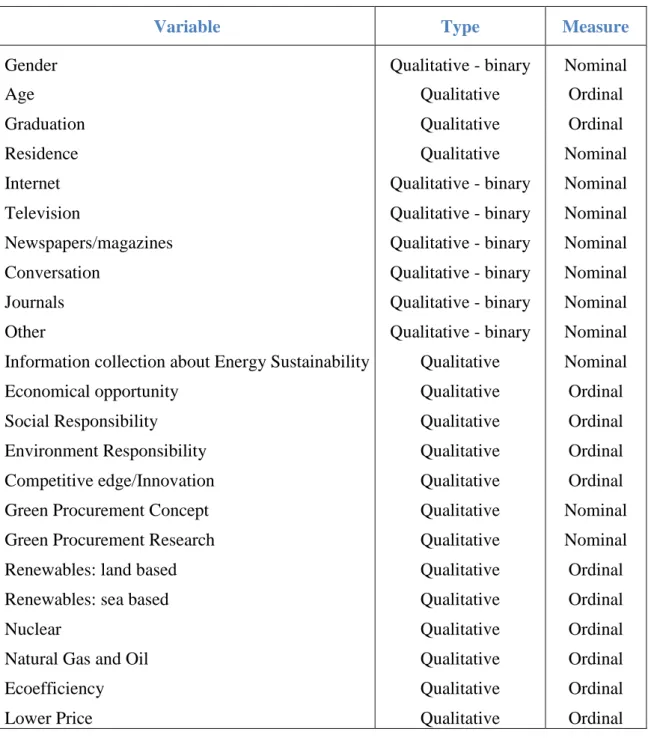
60 When the database, considering the codification presented, was completed, we
proceeded to the classification of the variables, made on the SPSS worksheet ―variable view‖, as follows:
Variable Type Measure
Gender Qualitative - binary Nominal
Age Qualitative Ordinal
Graduation Qualitative Ordinal
Residence Qualitative Nominal
Internet Qualitative - binary Nominal
Television Qualitative - binary Nominal
Newspapers/magazines Qualitative - binary Nominal
Conversation Qualitative - binary Nominal
Journals Qualitative - binary Nominal
Other Qualitative - binary Nominal
Information collection about Energy Sustainability Qualitative Nominal
Economical opportunity Qualitative Ordinal
Social Responsibility Qualitative Ordinal
Environment Responsibility Qualitative Ordinal
Competitive edge/Innovation Qualitative Ordinal
Green Procurement Concept Qualitative Nominal
Green Procurement Research Qualitative Nominal
Renewables: land based Qualitative Ordinal
Renewables: sea based Qualitative Ordinal
Nuclear Qualitative Ordinal
Natural Gas and Oil Qualitative Ordinal
Ecoefficiency Qualitative Ordinal
Lower Price Qualitative Ordinal
61 The variables are qualitative: they categorize but don‘t quantify. Seven of the variables are also binary: the gender and the ones related to information collection (internet, television, etc). We have also classified the variables by type considering each category: nominal and ordinal. The nominal variables represent categories that don‘t have a proper order and, consequently, the ordinal ones represent a determinate order, for example, the variable graduation (firstly, we have the 9th grade and finally the PhD degree) or the ones which, in order to categorize the variables by its importance, are represented by a 1 to 5 Likert scale16 (Not important, Slightly important, Important, Very important and Not Applicable).
We will proceed with the descriptive statistics, in order to understand, explain and meet the problem and objectives of the present study.
16
62 5.2 Characteristics of the Respondent
In this chapter we will define the respondents profile by analyzing their characteristics in what concerns gender, age, qualifications and place of living.
5.2.1. Gender
Fig. 4 - Gender
63
5.2.2. Age
Fig. 5 - Age
64
5.2.3. Graduation
Fig. 6 - Graduation
We can see that most of the respondents have higher education. The present graphic shows that 82,2% of surveyed have, at least, graduation.
Secondly, 18,9 % of the respondents have the master‘s degree and 14,4% have the 12th
65
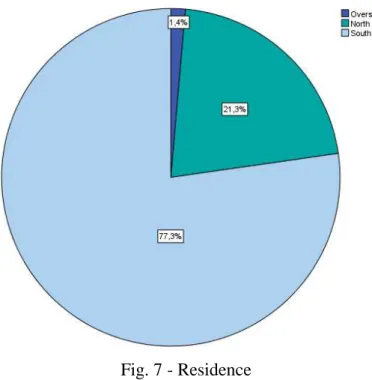
5.2.4. Residence
Fig. 7 - Residence
In what concerns the respondents‘ residence, we can see that most, 77,3%, live in the
66 5.3 Study Compliant Data Analysis - Univariate Analysis
5.3.1. Information Collection
Frequency Percentage
Internet 477 94,3%
Television 324 64,0%
Newspapers/Magazines 224 44,3%
Conversation 175 34,6%
Journals 83 16,4%
Other 7 1,4%
Answers 506 99,6%
Missing Answers 2 0,04%
Total 508 100%
Table - 2. Information Collection
In what concerns the information collection in general, it is clear that internet, followed by television and newspaper and magazines, are the ways that most of the inquired use to get information. As shown in table 2, 477 respondents out of 506 chose internet, 324 selected television and 224 surveyed chose newspapers and magazines.
Regarding, Conversation and Journals, 258 respondents selected these options.
Finally, the inquired (7 people) that chose the option ―Other‖ listed the following tools
67
5.3.2. Energy Sustainability Information Collection
Fig. 8 – Energy Sustainability Information Collection
Concerning the information collection about Energy Sustainability, 57,6% of the
68
5.3.3. Organizations and the Energy Sustainability Concept
Not
Important
Slightly
Important
Important Very
Important
N/A Frequency
Economical Opportunity
0,2% 6,7% 33,9% 58,8% 0,4% 507
Social Responsibility
0,4% 8,3% 38,0% 53,1% 0,2% 505
Environment Responsibility
0,0% 5,3% 27,9% 66,3% 0,4% 505
Competitive Edge/Innovation
0,2% 3,8% 37,8% 57,9% 0,4% 503
Answers 507
Missing
Answers 1
Total 508
Table - 3 Organizations and the Energy Sustainability Concept
69
5.3.4. Green Procurement Concept
Frequency Percentage
Yes 86 16,9%
No 390 76,8%
Does not Answer 30 5,9%
Answers 506 99,6%
Missing Answers 2 0,4%
Total 508 100%
Table - 4.Green Procurement Concept
In table 4 we can see that only 86 respondents (out of 506) know about the Green Procurement concept and 76,8% are not familiar with it.
5.3.5. Green Procurement Research
70 Regarding Green Procurement Research, it is clear the most, 83,7%, of respondents
don‘t know about any scientific works or research about Green Procurement.
Furthermore, it is important to refer that only 31 inquires know about the theme of the present study research
5.3.6. Principal Energy Source to Contract in 2020
Not
Important
Slightly
Important
Important Very
Important
N/A Frequency
Renewables Land Based
0,2% 3,0% 37,1% 58,2% 1,4% 493
Renewables Sea Based
0,0% 5,0% 28,9% 64,7% 1,4% 484
Nuclear 31,4% 33,8% 22,0% 8,2% 4,6% 477
Natural Gas and Oil
13,9% 37,6% 35,3% 10,7% 2,5% 476
Ecoefficiency 5,6% 10,5% 39,4% 34,0% 10,5% 465
Lower Price 10,5% 22,1% 43,4% 13,8% 10,3% 458
Answers 504
Missing
Answers 4
Total 508
71 The respondents classified the most important energy source are the energy from renewables with sea based (64,7%), followed by land based renewables and Ecoefficiency.
Although showing a different pattern, it is important to mention that 22% of the inquired consider the nuclear option as an important energy source.
Natural gas and oil and the lower price factor present the same model and the highest