RBCCV 44205-1504 DOI: 10.5935/1678-9741.20130082
Indicators of surgical treatment of patent ductus
arteriosus in preterm neonates in the irst week
of life
Indicadores para o tratamento cirúrgico na persistência do ducto arterial em neonatos prematuros na
primeira semana de vida
Renato Braulio
1, MD, MSc; Cláudio Léo Gelape
1, MD, PhD; Fátima Derlene da Rocha Araújo
2,
MD, MSc; Kelly Nascimento Brandão
2, MD; Luciana Drummond Guimarães Abreu
2, MD; Paulo
Henrique Nogueira Costa
1, MD, MSc; Flávio Diniz Capanema
1, MD, PhD
1 Federal University of Minas Gerais, School of Mediciney, Belo Horizonte, MG, Brazil.
2 Hospital Municipal Odilon Behrens, Department of Pediatrics, Belo Hori-zonte, Minas Gerais, Brazil.
Work carried out at Hospital das Clínicas da Universidade Federal de Minas Gerais (HC-UFMG), Belo Horizonte, MG, Brazil and Hospital Municipal Odilon Behrens (HOB), Belo Horizonte, MG, Brazil.
No inancial support.
Correspondence address: Renato Braulio
Hospital das Clínicas da UFMG
Av. Prof. Alfredo Balena, 110 – 5º andar – Santa Eigênia – Belo Horizonte, MG, Brazil – Zip code: 30130-100
E-mail: [email protected]
Article received on August 1st, 2013
Article accepted on October 8th, 2013 Abstract
Objective: To identify clinical and echocardiographic indicators of the necessity for early surgical closure of patent ductus arteriosus in preterm neonates.
Methods: The prospective study was conducted at the Neonatal Unit of Hospital Municipal Odilon Behrens between 2006 and 2010. The study population comprised 115 preterm
neonates diagnosed with patent ductus arteriosus in the irst
week after birth, of whom 55 (group S) were submitted to clinical and or surgical closure and 60 (group NS) received non-surgical treatment. The parameters analyzed were birth weight, diameter of the ductus arteriosus (DAD), left atrial-to-aortic root diameter ratio (LA:Ao), the quotient of DAD2 and birth
weight (mm2/kg), and ductal shunting.
Results: The study population comprised 58 males and 57 females. The average birth weight of group S (924 ± 224.3 g)
was signiicantly (P=0.049) lower than that of group NS (1012.3 ± 242.8 g). The probability of the preterm neonates being submitted to surgical closure was 62.1% (P=0.006) when the DAD2/birth weight index was > 5 mm2/kg, 72.2% (P=0.001)
when the LA:Ao ratio was > 1.5, and 61.2% when ductal shunting was high (P=0.025).
Conclusion: The parameters DAD2/birth weight index >
5 mm2/kg, LA:Ao ratio > 1.5 and high ductal shunting were statistically signiicant indicators (P<0.05) of the need for surgical closure of patent ductus arteriosus in low birth weight preterm neonates. Moreover, when an LA:Ao ratio > 1.5 was associated with the occurrence of shock, the probability of surgical closure increased to 78.4%.
Descriptors: Ductus arteriosus, patent. Echocardiography. Infant, premature, diseases.
Resumo
Objetivo: Identiicar parâmetros clínicos e ecocardiográicos para a indicação do tratamento cirúrgico precoce da persistência do ducto arterial.
precordium [7-9]. Considering that early surgical intervention can reduce morbidity and mortality among preterm neonates, it is of the utmost importance to recognize the signs and symptoms that support a surgical approach. Within this
context, the aim of the present study was to identify the
clinical and echocardiographic parameters that indicate the need for early surgical closure of PDA in preterm neonates
who have been found unresponsive to, or unsuitable to
receive, appropriate medication.
METHODS
Details of the project were submitted to and approved by
the Ethical Research Committee of the Hospital Municipal Odilon Behrens (CAAE 0012.0.216.000-06; FR99402; protocol no. 82/2006). The aims and objectives of the study
were explained to the parents or legal guardians of the infants, and written informed consent was obtained prior to the commencement of the study. All procedures were conducted
according to the ethical principles of research as embodied in
the Declaration of Helsinki.
The prospective study was conducted at the Neonatal Unit of the Hospital Municipal Odilon Behrens between
2006 and 2010. Clinical and echocardiographic data of
215 preterm neonates (gestational age ≤ 30 weeks) were analyzed and those diagnosed with PDA, according to the
echocardiogram acquired on the 3rd or 4th day after birth,
were selected for possible inclusion in the study. Neonates
presenting congenital cardiovascular pathologies other than INTRODUCTION
Patent ductus arteriosus (PDA) is a congenital heart
problem that affects some neonates in which the ductus
arteriosus, the blood vessel connecting the descending aorta and the pulmonary artery, fails to close after birth. Although
the disorder can affect full-term infants, it is signiicantly
more prevalent in preterm babies. The PDA in preterm
neonates has been associated with increased morbidity and
mortality if left uncorrected [1-3].
Correction of PDA in preterm neonates can be achieved via surgical methods (open surgery, video laparoscopy or endovascular approaches) or via clinical therapy [4-6]. The treatment of choice is the administration of nonsteroidal
anti-inlammatory drugs (such as indomethacin and ibuprofen) that inhibit the prostaglandins known to keep the ductus arteriosus (DA) open [1]. In cases where clinical treatment fails, the DA can be closed by surgical ligation. However, while early closure of the DA improves the long-term
cardiorespiratory functions of infants [2], the ideal time of application of the surgical procedure in preterm neonates
remains somewhat controversial [3].
Although premature surgical closure of DA has received
considerable attention in recent years, no deinitive criteria
of indication of this procedure have been established. The surgical indications most frequently applied appear to be related to the presence of heart anomalies (increased DA diameter and enlarged left atrium) and clinical signs such as
shock, high parasternal systolic murmur and hyperdynamic
Abbreviations, acronyms & symbols
DA Ductus arteriosus
DAD Diameter of the ductus arteriosus LA:Ao Left atrial-to-aortic root diameter ratio PDA Patent ductus arteriosus
ROC Receiver operating characteristic
e 2010. A população estudada compreendeu 115 neonatos prematuros diagnosticados com persistência do ducto arterial na primeira semana após o nascimento, dos quais 55 (grupo
S) foram submetidos ao tratamento clínico e ou cirúrgico e 60 (grupo NS) ao tratamento clínico. Os parâmetros analisados foram peso ao nascer, diâmetro do ducto arterial (DAD), relação diâmetro do átrio esquerdo pelo diãmetro da aorta (AE/Ao), índice DAD2/peso ao nascer e luxo no ducto.
Resultados: O estudo abrangeu 58 pacientes do sexo masculino e 57 do feminino. O peso médio ao nascer do grupo
S (924 ± 224,3 g) foi signiicativamente (P=0,049) menor do que do grupo NS (1012,3 ± 242,8 g). A probabilidade dos neonatos prematuros serem submetidos à cirurgia foi 62.1% (P=0,006)
quando o índice DAD2/peso ao nascer era > 5 mm2/kg, 72,2%
(P=0,001) quando a razão LA:Ao era > 1,5 e 61,2% (P=0,025)
quando o luxo no ducto era alto.
Conclusão: Os parâmetros DAD2/peso ao nascer > 5 mm2/ kg, razão LA:Ao > 1,5 e alto luxo no ducto foram preditores estatisticamente signiicativos (P<0,05) da necessidade de fechamento cirúrgico do persistência do ducto arterial em neonatos prematuros com baixo peso ao nascer. Adicionalmente, quando a razão LA:Ao > 1,5 estava associada ao choque, a probabilidade de tratamento cirúrgico aumentou para 78,4%.
Descritores: Permeabilidade do canal arterial.
PDA (as determined by echocardiography using a Toshiba
Nemio 30 ultrasound instrument) and infants who died during the irst week after birth were excluded from the study. The inal study population comprised 115 infants, all of whom received clinical treatment except for those who presented
contraindications for ibuprofen therapy or PDA-induced
shock. Sixty of the infants responded to the non-surgical treatment (group NS), while 55 were submitted to surgery for the correction of PDA (group S). The treatment with
ibuprofen consisted of intravenous perfusion of three doses at 24 h intervals: 1st dose 10 mg/kg, 2nd and 3rd doses 5 mg/kg. The surgical technique applied to the S group involved left posterior thoracotomy in the third or fourth intercostal space
via the triangle of auscultation, followed by extra pleural dissection of the DA and ligation with titanium clips under
general anaesthesia [9,10].
The data assessed for all patients included birth weight,
gestational age, clinical and echocardiographic signs of PDA
in the irst week after birth, treatment received to correct the
defect (surgical or non-surgical), diameter of the DA (DAD), left atrial-to-aortic root diameter ratio (LA:Ao), the quotient of DAD2 and birth weight (mm2/kg), and ductal shunting.
Shunting was evaluated on the parasternal short axis by
color Doppler from the pattern and magnitude of shunt of the arterial canal in the direction of the pulmonary artery, and
classiied as: low (low from the pulmonary branch up to the distal portion of the pulmonary artery), moderate (low up to the mid-third of the pulmonary artery), and high (low up to
the proximal portion of the pulmonary artery and reaching
the pulmonary valve). The diameter of the arterial canal was measured by two-dimensional echocardiography at the level
of the pulmonary vein ostium.
Univariate analyzes of the clinical and echocardiographic
data and their association with surgical closure was established using χ2 and Student t tests. Multivariate logistic regression
analysis was performed in order to evaluate cross inluences between the variables. Results were considered statistically signiicant at 5% probability (P<0.05). A receiver operating
characteristic (ROC) curve was constructed for each of the
variables in order to determine those that constituted good
predictors for the outcome of interest (surgical indication). According to the ROC curves, the cut off points for the DAD2/birth weight index was 5 mm2/kg and that for the
LA:Ao ratio was 1.5.
RESULTS
Of the 215 preterm neonates initially screened, 115
(53.5%) were diagnosed with PDA by echocardiography and
included in the study. While the numbers of males (58/115;
50.4%) and females (57/115; 49.6%) in the study population were similar, the percentage of males submitted to surgical intervention (31/58; 53.4%) was higher than that of females (24/57; 42.1%), although the difference was not statistically signiicant (P=0.223).
The mean gestational ages of the preterm neonates in
groups S and NS were 27.1 and 27.7 weeks, respectively, while the average birth weight of group S was signiicantly
(P=0.049) lower than that of group NS (Table 1). Of the neonates presenting low birth weight in the total study population, more than half (57.7%) were in group S but, according to the ROC curve, birth weight was not a good
predictor (P=0.107) of surgical closure. There was no signiicant difference (P=0.155) between the surgical and non-surgical groups regarding DAD, however, the two
groups were signiicantly (P=0.010) different with respect to
the index DAD2/birth weight (Table 1).
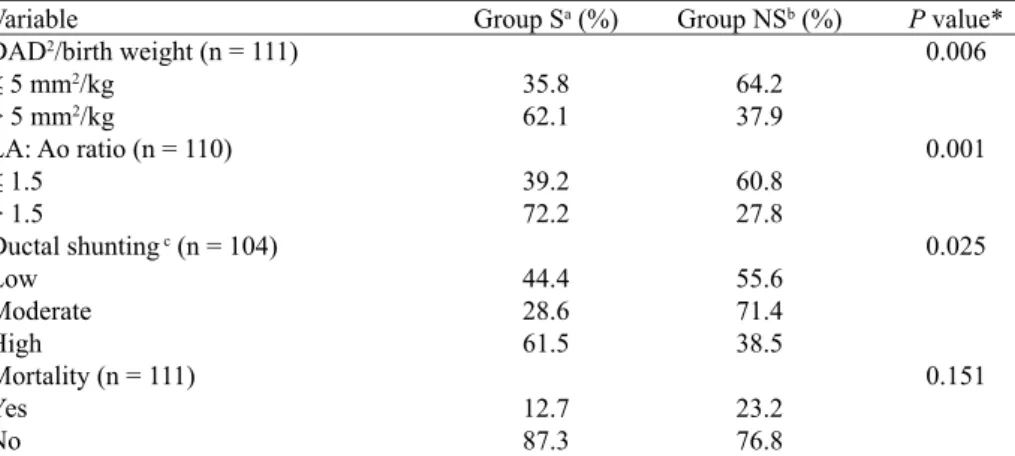
According to the percentage distributions shown in Table
2, preterm neonates with DAD2/birth weight index above 5
mm2/kg presented a 62.1% (P=0.006) probability of being
submitted to surgical closure of PDA. Elevated probabilities of receiving surgical treatment for the correction of PDA
were also associated with preterm neonates presenting
LA:Ao ratios above 1.5 (72.2 % probability; P=0.001) or
exhibiting high ductal shunting (61.2%; P=0.025). Mortality
was not directly associated (P=0.151) with surgical closure,
however, since the deaths of seven children from group S and of 13 children from group NS were caused by other
factors including sepsis, complex congenital malformations and cerebral ventricular hemorrhage.
Table 1. Main characteristics of the preterm neonates diagnosed with patent ductus arteriosus submitted to surgical (group S) or non-surgical
(group NS) treatment of the defect.
Variable
Birth weight (g)
Diameter of ductus arteriosus
(DAD; mm) DAD2/birth weight (mm2/kg)
Minimum 520
1.2 1.6
Maximum 1550
3.8 16.0
Mean ± SDa 924.0 ± 224.3
2.2 ± 0.5 5.8 ± 2.5
Minimum 520
0.9 0.8
Maximum 1540
3.2 11.9
Mean ± SDa 1012.3 ± 242.8
2.0 ± 0.7 4.5 ± 2.6 Group NS (n = 60)
Group S (n = 55) P value*
0.049 0.155 0.010
Multivariate logistic regression analysis of the predictors
of surgical closure in 115 preterm neonates with PDA
revealed that the variables LA:Ao ratio and ductal shunting
were signiicant predictors of surgical closure (P=0.0315 and
P=0.0370, respectively; Table 3). Moreover, the probability
of surgical closure increased to 78.4% when the markers LA:Ao > 1.5 and shock were associated (Table 4).
DISCUSSION
In the present study, 47.8% (55/115) of the preterm neonates diagnosed with PDA required surgical closure.
The necessity for surgical intervention is decided mainly on clinical and echocardiographic assessment, but this decision
is not always straightforward, particularly in the case of
borderline patients. The consideration of various parameters has been proposed in the selection of preterm neonates requiring early surgical correction of PDA in order to prevent future heart problems and to ensure better chances of survival. Tschuppert et al. [1] indicated that a DAD2/birth weight
index > 9 mm²/kg and a LA:Ao ratio > 1.5 represented good
predictors of the need for surgery. The cut-off points obtained
in the present study agree partially with the earlier proposals in that the suggested LA:Ao ratio cut-off was similar (> 1.5)
but that for the DAD2/birth weight index was much smaller (> 5 mm2/kg). Furthermore, our results indicated that high
ductal shunting is a relevant prognostic marker for surgical
closure. According to Chiruvolu et al. [7], high left-to-right
Table 4. Probability of surgical closure in preterm neonates with
patent ductus arteriosus considering the combined factors left atrial-to-aortic root diameter ratio (LA:Ao) and
occurrence of shock
LA:Ao ratio
Normal (≤ 1.5) Normal (≤ 1.5)
Increased (> 1.5) Increased (> 1.5)
Probability of surgical
intervention (%)
23.4 48.5 54.2 78.4
Shock
No Yes No Yes Table 3. Multivariate logistic regression analysis (complete model)
of the predictors of surgical closure among preterm
neonates with patent ductus arteriosus (N = 115)
Factor
Occurrence of shock
Drug therapy
Administration of ibuprofen
Birth weight
Gestational age DAD2/kg a (mm2/kg) LA:Ao ratio b Ductal shunting DA diameter
P value 0.1403 0.2474 0.5367 0.3899 0.2579 0.6405 0.0315 0.0370 0.3207 Estimated value
0.8705 - 1.7907
0.9665 -0.5099 - 0.6106 0.3211 1.2918 1.3257 - 0.7888
a Quotient of diameter of ductus arteriosus (DAD)2 and birth weight,
b Left atrial-to-aortic root diameter ratio (LA:Ao)
Table 2. Association between the indication for surgical closure of patent ductus arteriosus
in a population of preterm neonates (N = 115) and the variables quotient of diameter of ductus arteriosus (DAD)2 and birth weight, left atrial-to-aortic root diameter ratio
(LA:Ao), ductal shunting and mortality.
Variable
DAD2/birth weight (n = 111)
≤ 5 mm2/kg > 5 mm2/kg
LA: Ao ratio (n = 110)
≤ 1.5
> 1.5
Ductal shunting c (n = 104)
Low
Moderate High
Mortality (n = 111) Yes
No
P value* 0.006
0.001
0.025
0.151 Group NSb (%)
64.2 37.9
60.8 27.8
55.6 71.4 38.5
23.2 76.8 Group Sa (%)
35.8 62.1
39.2 72.2
44.4 28.6 61.5
12.7 87.3
a Group submitted to surgical treatment, b Group submitted to non-surgical treatment, c Ductal
shunt was classiied as low, moderate and high depending on the low up to the proximal third, mid and distal third of the pulmonary artery, respectively. * Associations between the variables
shunting is very aggressive to preterm neonates because it induces pulmonary hypertension, pulmonary congestion and enlargement of heart chambers. A hemodynamically
signiicant degree of ductal shunting may be a decisive factor
in the choice of a surgical approach.
The sample size employed in the present study was larger
than that reported in earlier studies, and this improved the precision of the statistical analysis of parameters. Thus, the results obtained herein may be considered appropriate for the
construction a checklist to serve as a guideline for pediatricians and cardiologists when arriving at decisions regarding surgical
closure of PDA. Obviously, meticulous medical assessment
on a case by case basis, coupled with sound and prudent judgment, must always prevail in decision making. However, it is important to stress that, while the short- and long-term beneits of PDA closure have been demonstrated by numerous
studies [1-3,7,8], delays in the treatment of PDA may lead to severe consequences for the neonate.
CONCLUSION
The parameters DAD2/birth weight index > 5 mm2/
kg and LA:Ao ratio > 1.5 along with high ductal shunting are statistically signiicant indicators (P<0.05) of the need
for surgical closure of PDA in low birth weight preterm neonates during the irst week of life. The probability of surgical intervention when any of these factors are present is greater than 60%. Moreover, when the LA:Ao ratio > 1.5 is associated with the occurrence of shock, the probability of surgical closure increases to 78.4%.
Author’s roles & responsibilities
RB Main author
CLG Coauthor, statistical analysis FDRA Performed the echocardiograms KNB Performed the echocardiograms LDGA Conducted the data collection PHNC Conducted the data collection FDC Coauthor
REFERENCES
1. Tschuppert S, Doell C, Arlettaz-Mieth R, Baenziger O, Rousson V, Balmer C, et al. The effect of ductal diameter on surgical and medical closure of patent ductus arteriosus in preterm neonates: size matters. J Thorac Cardiovasc Surg. 2008;135(1):78-82.
2. Vida VL, Lago P, Salvatori S, Boccuzzo G, Padalino MA, Milanesi O, et al. Is there an optimal timing for surgical ligation of patent ductus arteriosus in preterm infants? Ann Thorac Surg. 2009;87(5):1509-15.
3. Noori S, McCoy M, Friedlich P, Bright B, Gottipati V, Seri I, et al.
Failure of ductus arteriosus closure is associated with increased
mortality in preterm infants. Pediatrics. 2009;123(1):e138-44.
4. Laborde F, Folliguet TA, Etienne PY, Carbognani D, Batisse A, Petrie J. Video-thoracoscopic surgical interruption of patent ductus arteriosus. Routine experience in 332 pediatric cases. Eur J Cardiothorac Surg. 1997;11(6):1052-5.
5. Khelashvili V, Gogorishili I, Metreveli I, Tsintsadze A, Botsvadze T. Patent ductus arteriosus endovascular closure by amplatzer duct
occluder. Georgian Med News. 2006;(134):19-22.
6. Su PH, Chen JY, Su CM, Huang TC, Lee HS. Comparison of ibuprofen and indomethacin therapy for patent ductus arteriosus in preterm infants. Pediatr Int. 2003;45(6):665-70.
7. Chiruvolu A, Punjwani P, Ramaciotti C. Clinical and
echocardiographic diagnosis of patent ductus arteriosus in premature neonates. Early Hum Dev. 2009;85(3):147-9.
8. Aiune JY, Singer JM, Leone CR. Echocardiographic post-neonatal progress of preterm neonates with patent ductus arteriosus. J
Pediatr (Rio J). 2005;81(6):454-60.
9. Santos JLV, Braile DM, Ardito RV, Zaiantchick M, Soares MJF,
Rade W, et al. Ligadura do canal arterial: técnica extrapleural. Rev Bras Cir Cardiovasc. 1992;7(1):14-21.