*Correspondence: M. George. Pushpagiri College of Pharmacy, Kerala, India. E-mail: [email protected]
A
vol. 48, n. 3, jul./sep., 2012
Antidepressant and skeletal muscle relaxant effects of the aqueous
extract of the Prosopis cineraria
Mathew George
1,*, Lincy Joseph
1, Abishika Sharma
21Pushpagiri College of Pharmacy, Kerala, India, 2School of Pharmaceutical Sciences, SU, India
The aqueous leaves extract of Prosopis cineraria (AEPC) is used traditionally for the treatment of various CNS disorder. The purpose of this study was to evaluate the extract for antidepressant and skeletal muscle relaxant activity. The antidepressant effect of the extract was evaluated using Forced swim test (FST). The immobility periods of control and treated mice were recorded. The antidepressant-like effect of tested compound was compared to that of imipramine (15 mg/kg. p.o). Muscle relaxant property was studied using rotarod apparatus and total fall off time for standard and control group was recorded. Phytochemical
screening revealed the presence of saponins, lavonoids, alkaloids, glycosides, tannins and phenolic compounds. The leaf extract at doses of 200 mg/kg signiicantly decreased the duration of immobility time in FST. The eficacy of tested extract was found to be comparable to that of imipramine. Our results
suggested that the aqueous extract of Prosopis cineraria leaves exerts antidepressant-like effect.
Uniterms: Proposis cineraria/pharmacognosy. Proposis cineraria/extract/antidepressant effect.
Proposis cineraria/extract/relaxant property. Skeletal muscle. Imipramine/comparative study. Diazepam/ comparative study.
O extrato aquoso de folhas de Prosopis cineraria (AEPC) é utilizado, tradicionalmente, para o tratamento
de várias disfunções do SNC. O propósito desse estudo foi avaliar o extrato quanto às atividades antidepressiva e relaxante muscular esquelética. O efeito antidepressivo do extrato foi avaliado usando
o teste do nado forçado (FST). Registraram-se os períodos de imobilidade dos camundongos controle
e dos tratados. O efeito antidepressivo do composto testado foi comparado com a imipramina ((15 mg/ kg. p.o). A propriedade relaxante muscular foi estudada usando o cilindro giratório e o tempo total de queda para os grupos padrão e controle foram registrados. A triagem itoquímica revelou a presença de saponinas, lavonoides, alcaloides, glicosídeos, taninos e compostos fenólicos. O extrato da folha em doses de 200 mg/kg diminui signiicativamente a duração do tempo de imobilidade no FST. A eicácia do extrato testado foi comparável àquela da imipramina. Nossos resultados sugeriram que o extrato aquoso
das folhas da Prosopis cineraria exerce efeito semelhante ao antidepressivo.
Unitermos: Proposis cineraria/farmacognosia. Proposis cineraria/extrato/efeito antidepressivo.
Proposis cineraria/extrato/propriedade relaxante. Músculo esquelético. Imipramina/estudo comparativo. Diazepam/estudo comparativo.
INTRODUCTION
According to the World Health Organization report (WHO, Geneva; 2001) approximately 450 million people suffer from a mental or behavioral disorder. This amounts to 12.3% of the global burden of disease, and will rise to 15% by 2020 (Reynolds, Brain, Mind, 2003). Psychiatric
of monoamine oxidase-A (MAO-A), selective serotonin reuptake inhibitors (SSRIs) and selective noradrenaline reuptake inhibitors (SNRIs), depression continue to be a major medical problem (Yu, Kong, Chen, 2002). Ba-sic neuroscience offers the promise of improving our understanding of disease pathophysiology, identifying novel mechanisms that can be targeted by more effec-tive pharmacotherapies and screening of herbal sources of drugs. These considerations implicate the search for new antidepressant agents that have a fast onset of action. Various plants are being used in complementary and alter-native medicines for management of mood disorders. On the basis of the above information, the leaves of Prosopis cineraria was selected for evaluating its antidepressant and muscle relaxant activity due to its traditional use in the management of various CNS disorders.
Prosopis cineraria (Fabaceae), locally known as ‘Khejri’, has a long history of use in herbal medicine in arid and semi-arid regions in greater parts of India, Burma and Sri Lanka. Since all parts of the tree are useful, it is called ‘Kalptaru’ (Burkart, 1976). Ancient literature has reported the use of P. cineraria as folk medicine for various ailments like fever and pain. Its flowers mixed with sugar when administered orally prevent miscarriage (N.A.S., 1980). Dry pods of the plant help in preventing protein calorie malnutrition and iron calcium deiciency in blood. Smoke of leaves is used to cure eye infections (Chandrashekhar, 2010, Dehradun, 1993). Bark of the tree is used in the treat-ment of asthma, bronchitis, dysentery, leucoderma, leprosy (Shalini, 1997), muscle tremors and piles (Toky, 1999). Nu-merous bioactive compounds such as lavonoids, alkaloids, diketones, phenolic contents, free amino acids, patulitrin, spicigerin, prosogerin A, B, C, D, lipids, β-sitosterol, sug -ars and vitamins have been isolated from various parts of the plant. Some of these bioactive compounds have been worked out for one or the other medicinal attributes (Puro-hit, Ramawat, Arya, 1979; Rhoades, 1979). But till date, the antidepressant and muscle relaxant potential of P. cineraria has not been scientiically evaluated. Hence, in the present study, the effect of oral treatment with P. cineraria leaves extract at a dose of 200 mg/kg body wt on antidepressant and skeletal muscle relaxant activity has been studied.
MATERIAL AND METHODS
Preparation of extract
Leaves of P. cineraria was collected from the plants available locally (Dist. Tonk, Rajasthan, India). It was taxonomically identified. Dried leaves were subjected to size reduction to a coarse powder which was then
ex-tracted in soxhlet apparatus with water and concentrated to dryness under reduced pressure at 60±1°C in a vacuum rotatory evaporator. The extract was dried at 40-45°C in hot air oven till solid to semisolid mass was obtained. The yield of extract was 4.2% w/w (with respect to crude mate -rial). The suspension of extract of the leaves, prepared in distilled water was used in the experiment.
Phytochemical screening
The aqueous extract of Prosopis cineraria was
screened for various chemical constituents (simple sugars, tannins, alkaloids, cardiac glycosides, lavonoids, steroidal compounds, saponins, anthracene derivatives and simple sugars) using established methods (Purohit, Ramawat, Arya, 1979; Rhoades, 1979).
Animals
Swiss albino mice (6-8 weeks) of either sex weighing 25-30 g were used. They were housed in light controlled room (12:12h) and at constant temperature
(22+2OC) conditions. Animals were fed with standard
laboratory diet and water.
Toxicity studies
The acute toxicity study was done according to OECD guidelines, 407 (OECD, 1995). The compounds were administered orally in different doses, where 24h toxicity was recorded to identify the toxic does. The dose of the test compounds was then ixed on the basis of their acute toxicity as 200 mg/kg for evaluation.
Forced swim test (FST)
Mice were considered to be immobile when they ceased struggling and remained loating motionless in wa -ter, making only those movements necessary to keep their head above water. Following swimming session, mice were towel dried and returned to their housing conditions (Dhingra, Sharma, 2006).
Skeletal muscle relaxant activity
Mice were divided into three groups consisting of ive animals each. Group I served as control which received distilled water. Animals of group II received
standard drug Diazepam at a dose of (1mg/kg, i.p.).
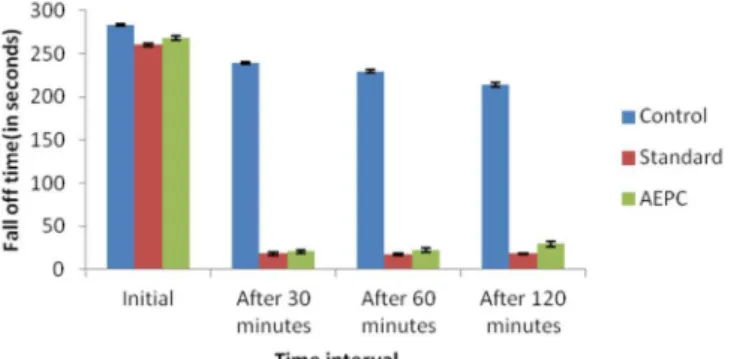
Group III received the AEPC orally at a dose of 200 mg/ kg. Animals remaining on Rota-Rod (20-25 rpm) 2 min or more in low successive trials were selected for testing. The test compounds can administer intraperitoneally or orally. Thirty minutes after intraperitoneal or 60 min after oral administration the mice were placed on the rotating rod. The fall off time from the rotating rod was noted after 30, 60 and 120 minutes after drug administration. The difference in the fall off time from the rotating rod between the control and the treated mice was taken as an index of muscle relaxation (Perez et al; 1998) (Nagger et al, 2003).
Statistical analysis
Statistical signiicance was analysed using one-way ANOVA followed by Bonferroni test and P<0.05 was considered signiicant.
TABLE II - Effect of P cineraria on fall off Time in rotarod test
Groups FALL OFF TIME (in seconds)
Initial After 30 min. After 60 min. After 120 min.
Control 283.37± 1.04 239.15±0.997 229.43± 1.780 213.45± 2.509
Diazepam 260.12± 2.28 18.04± 1.45** 17.23± 0.748** 18.06 ± 0.652**
AEPC 268.62± 2.09 20.96± 1.863** 22.12±2.68** 29.36±2.707*
Values expressed in Mean± SEM (n=5). *p<0.05; **- P<0.01 when compared with control group
TABLE I - Effect of P. cineraria on duration of immobility in forced swim test
S.no Treatment Dose (mg/kg) Immobility time
(Mean ± S.E.M) % decrease
1. Control --- 154.15±3.64
---2. Imipramine 15 35.7±1.347** 76.84
3. AEPC 200 46.3±1.96** 69.96
Each value is the Mean ± S.E.M. for 5 mice, **- P<0.01
FIGURE 1 - Effect of P. cineraria on duration of immobility in
forced swim test.
RESULTS
The preliminary phytochemical screening of the dry residue showed the presence of saponins, lavonoids, alkaloids, glycosides, tannins and phenolic compounds. In acute toxicity study, the aqueous extract of P. cineraria was found to be safe and no mortality was observed at a dose as high as 2 g/kg. The effects of extract on duration of immobility in FST in mice have been shown in Table I; Figure 1. P. cineraria at dose 200mg/kg b.w produced a signiicant (P<0.05) decrease in duration of immobil -ity (46.3±1.96) in comparison with the control group (154.15±3.64). Similarly animals treated with imipramine (15 mg /kg) shows a signiicant decrease in immobility time (35.7±1.347).
200 mg/kg b.w produced a signiicant (P<0.05) decrease in Fall off time (20.96±1.863, 22.12±2.68, 29.36±2.707) in comparison with control (239.15±0.997, 229.43± 1.780, 213.45± 2.509) after 30, 60 and 120 minutes of oral ad -ministration respectively. Similarly animals treated with Diazepam (1 mg/kg) shows a signiicant decrease in im -mobility time (18.04± 1.45, 17.23± 0.748, 18.06 ± 0.652).
DISCUSSION AND CONCLUSION
In the present work attempts were made to study detail phytochemical investigation and pharmacological action, particularly anti-pyretic and analgesic activity of leaf of P. cineraria. The phytochemical analysis of the dry residue showed the presence of saponins, lavonoids, alkaloids, glycosides, tannins and phenolic compounds.
The two most widely used animal models for an-tidepressant screening are the forced swimming and tail suspension tests. The Forced Swim is quite sensitive and relatively speciic to all major classes of antidepressants (Porsolt, Bertin, Jalfre, 1977). In the FST, mice are forced to swim in restricted space from which they cannot escape. This induces a state of behavioral despair in animals, which is claimed to reproduce a condition similar to human depression (Willner; 1984).
Results showed that the administration of the AEPC produced a diminution of immobility time of mice exposed to the forced swimming test. In the study, aqueous extract (200 mg/kg) administered to mice, produced signiicant antidepressant-like effect in FST and its eficacy was found to be comparable to imipramine (15 mg/kg).
For Skeletal muscle relaxant action rotarod test is used. The test is used to evaluate the activity of drugs in-terfering with motor coordination. In 1956, Dunham and Miya suggested that the skeletal muscle relaxation induced by a test compound could be evaluated by testing the ability of mice or rats to remain on a revolving rod. This forced motor activity has subsequently been used by many investigators. The dose which impairs the ability of 50%
of the mice to remain on the revolving rod is considered the endpoint. By this test the muscle relaxant potency in a series of compounds such as the benzodiazepines (Vogel et al) have been performed.
Results showed that the administration of the AEPC produced a significant decrease in fall off time and its efficacy was found to be comparable with Diazepam (1 mg/ kg).
Based on the results of the present study, we con-clude that the aqueous extract of P. cineraria possess signiicant antidepressant like effect and skeletal muscle relaxant activity. The activity may be due to the alkaloids, tannins and lavonoid which are present in the leaves ex -tract. However, furtherstudies are necessary to ind the exact mechanism of antidepresant and skeletal muscle relaxant effect and to isolatethe active compound(s) re-sponsible for this pharmacological activity.
REFERENCES
BURKART, A. A monograph of genus Prosopis (Leguminous).
J. Arnold Arboretum, v.57, p.450-525, 1976.
CHANDRASHEKHAR, C.H.; LATHA K.P.; VAGDEVI, H.M.; VAIDYA, V.P. In vitro anthelmintic eficacy of the Prosopis staphaniana extracts. Der Pharma Chemica, v.2, p.405-409, 2010.
DHINGRA, D.; SHARMA, A. Antidepressant-like activity of Glycyrrhiza glabra. Prog. Neuropsychopharmacol. Biol. Psych., v.30, p.449-454, 2006.
DUNHAM, N.M.; MIYA, T.S. A note on simple apparatus for detecting neurological deicit in rats and mice. J. Am. Pharm., v.46, p.208-209, 1957.
NAGGAR, T.B.A.L.; GÓMEZ-SERRANILLOS, M.P.; CARRETERO, M.E.; VILLAR, A.M. Seed Extract modulates the neurotransmitter amino acids release in cultured neurons in vitro. J. Ethnopharmacol.,v.88, p.63-68, 2003.
NATIONAL ACADEMY OF SCIENCES. N.A.S. Firewood
crops shrub and tree species for energy production.
Washington DC: National Academy Press, 1980. v.1, p.235.
ORGANIZATION FOR ECONOMIC CO-OPERATION AND DEVELOPMENT. OECD. Guidelines for testing of chemicals. section 4: Health Effects. Available at: <http:// oecd.org/chemicalsafety/assessmentofchemicals/1948386. pdf>. Acessed on: 10 Sep. 2012.
PEREZ, G.R.M.; PEREZ, L.J.A.; GARCIA, D.L.M.; SOSSA, M.H. Neuropharmacological activity of Solanum nigrum fruit. J. Ethnopharmacol., v.62, p.43-48, 1998.
PORSOLT, R.D.; BERTIN, A.; JALFRE, M. Behavioral despair in mice: A primary screening test for antidepressants. Arch. Int. Pharmacodyn. Ther., v.229, p.327-336, 1977.
PUROHIT, S.D.; RAMAWAT, K.G.; ARYA, H.C. Phenolics, peroxidase and phenolase as related to gall formation in some arid zone plants. Curr. Sci., v.48, p.714-716, 1979.
REYNOLDS, E.H. Brain and mind: a challenge for WHO.
Lancet, v.361, p.1924-1925, 2003.
RHOADES, D.F. Herbivores, evolution of plant chemical
defense against herbivores: their interaction with secondary plant metabolites. New York: Academic Press; p.3-54,1979.
SHALINI, K. Vedic leguminous plants: medicinal and microbiological study. New Delhi: Calssical Publishing Company, 1997. 96 p.
THASE, M.E.; HOWLAND, R.H. Biological processes in depression: an update and integration. In: BECKHAM, E.E.; LEBER, W.R. (Eds.). Handbook of depression. 2.ed. New York: Guilford, 1995. p.213-279.
TOKY, O.P . Medicinal values of Prosopis cineraria in arid and semi arid India. Bulletin of Society of chemical industry, Vol.1,p.1-10,1999.
WORLD HEALTH ORGANIZATION. WHO. Mental health:
new understanding new hope. Geneva, 2001. chap.2, p.29. (Report).
Received for publication on 23th August 2011