*Correspondence: T.E.G.K. Murthy. Bapatla College of Pharmacy, Bapatla- 522 101, India. E-mail: [email protected]
A
vol. 49, n. 2, apr./jun., 2013
Formulation and evaluation of CFC free inhalers for
beclomethasone dipropionate
Gopala Krishna Murthy Talasila
1,*, Bala Vishnu Priya Mukkala
1, Satyanarayana Vattikuri
21Department of Pharmaceutics, Bapatla College of Pharmacy, Bapatla, India, 2Natco Pharma Limited, Kothur, India
Beclomethasone dipropionate CFC free inhalation formulations were developed with a view to treat asthma prophylactically. Dry powder inhalers (DPI) for beclomethasone dipropionate were prepared with different grades of lactose monohydrate. The inluence of carrier and overages on performance of DPI was studied. Metered dose inhalers (MDI) with HFA based propellants were formulated with various doses, overages and different concentrations of alcohol. Formulated DPI and MDI were evaluated for various oficial and unoficial quality control tests. The inluence of over doses on valve delivery, effect of overages on emitted dose and inluence of alcohol on spray pattern from MDI were studied. The better ine particle fraction and emitted dose were obtained from the DPI formulated with 10:90 ratio of ine lactose: coarse lactose and with 20% w/w overages. The studies on MDI revealed that the 15% of overdoses are required for effective valve delivery and 20% overages are required for 100% drug delivery. 5-10%v/v alcohol was found to be preferable to get optimum emitted dose and ine particle fraction.
Uniterms: Beclomethasone dipropionate. Dry powder inhalers. Metered dose inhalers,, emmited dose. Fine particle fraction, overages
Desenvolveram-se formulações por inalação de dipropionato de beclometasona, livres de CFC, com o objetivo de tratar a asma proilaticamente. Prepararam-se inaladores de pó seco (DPI) para o dipropionato de beclometasona com diferentes gradações de lactose monoidratada. Estudou-se a inluência do transportador e dos excessos de fármaco em relação ao rotulado no desempenho do DPI. Inaladores de dose calibrada (MDI) com propelentes à base de hidroluoralcanos (HFA) foram formulados com várias doses, excessos de fármaco em relação ao rotulado e diferentes concentrações de álcool. Avaliaram-se as DPI e MDI formuladas por vários métodos oiciais e não oiciais de controle de qualidade. Estudaram-se a inluência da superdosagem na liberação da válvula, o efeito dos excessos na dose emitida e a inluência do álcool no padrão do spray do MDI. Obtiveram-se a melhor partícula ina e a dose emitida do DPI
formulado com proporção de 10:90 de lactose ina:lactose grossa e 20% p/p de excesso. Os estudos em MDI revelaram que 15% de sobredose são requeridos para a liberação efetiva da válvula e 20% de excessos, para a liberação de 100% dos fármacos. Álcool a 5-10% v/v permitiu alcançar ótima dose emitida e fração de partícula ina.
Unitermos: Dipropionato de beclometasona. Inaladores pó seco. Inalantes de dose cvalibrada, dose emitida. Fração de partículas inas, excessos.
INTRODUCTION
Nowadays, drugs are delivered via many portals into the body using a variety of dosage forms which allow medicines administration. Relatively recent pharmaceuti-cal development is the delivery of drug via the lung. The onset of action from this route is relatively fast compared
with the oral & external routes of administration. Metered dose inhalers were most widely used in the treatment of respiratory airway diseases (Bisgard et al., 2002; Williams et al., 2008). Metered dose inhaler was irst introduced in 1950s by Ricker laboratories with chlorofluorocarbons propellants. All MDIs marketed prior to 1995 contained chloroluorocarbons (CFC) as a propellant. CFC propel -lants damage the ozone layer present in stratosphere, which
protects the earth from ultraviolet radiation by iltering the
been banned since 1996 under the terms of the Montreal protocol (1994) and alternative formulation (Dry powder formulations and hydroluroalkane (HFA) propellant based
MDI formulations) development was started to replace the CFC formulations and to protect the ozone layer. Some re-formulated metered dose inhalers are designed to improve the proportion of drug delivered into the lungs and to reduce the dose. Dry powder inhalers (DPIs) are devices through which a dry powder form of an active drug is delivered for local or systemic effect via the pulmonary route.
Beclomethasone dipropionate is indicated for the maintenance and treatment of asthma. A major advance in asthma therapy is the development of inhalers that
tar-get the drug directly to the relevant site of inlammation.
These formulations greatly enhance the therapeutic index of the drugs, substantially diminishing the incidence of side effects without altering clinical utility (Sweetman,
2009; Merck index)
The performance of dry powder inhaler was
depend-ed on the morphology of carrier. The inluence of carrier
roughness on performance of dry powder inhalers was studied (Saint-Lorant et al., 2007; Flament et al., 2004). The metered dose inhalers of beclomethasone dipropionate
were developed with propellant R 134a (Hartwig et al.,
1998; Michael et al., 1996).
Beclomethasone dipropionate dry powder inhalers
were formulated with different grades of ine and coarse
lactose. Beclomethasone MDIs were prepared by incor-porating overdoses, overages and different proportions of
alcohol. The effect of formulation variables on eficiency
of DPIs and MDIs studied and results are reported herein.
MATERIAL AND METHODS
Beclomethasone dipropionate, various grades of
lactose monohydrate (alctoste), HFA 134a (Zephex 134a),
alcohol, Bespack metered valves, Bespack actuators were collected from NATCO, Hyderabad.
Dosage unit sampling apparatus (Erweka), Anderson cascade impactor (Mark-II, Erweka), Twin stage impinger
(Erweka), High performance liquid chromatography
(Empower, Waters), Vacuum pump (Erweka), Flow
me-ter (Erweka), Pamasol illing crimping machine (P2005, Pamsol ), and Capsules partial illing machine (AF25(T),
Pham) were used in this investigation.
Formulation of DPI
An accurately weighed amount of beclomethasone dipropionate (particle size>5µ) was blended in poly bag
for 5 minutes separately in each case with different quanti
-ties/various grades of lactose of monohydrate in geometric progress. The blend was passed through 60# mesh and illed in to size “3” hard gelatin capsules with partial ill
-ing manual capsule ill-ing machine. The total ill weight
of capsule is 25 mg per capsule.
Beclomethasone dipropionate (200 µg) formulations were prepared with 0-20% of overages. DPI was also pre
-pared with different proportions of ine lactose (0, 5, 10, 15, 20 and 30%) and coarse lactose. Further the inhalers containing two different grades of ine lactose (10%) and 90% of coarse lactose and inhalers containing various grades of coarse lactose along with 10% ine lactose were
also prepared.
Formulation of HFA based MDI
An accurately weighed 40 mg (equivalent to 200
doses to deliver 200 µg/dose) of beclomethasone dipro
-pionte was dissolved in 1.6 g of alcohol, transferred in to
aluminum cans crimped with metered valve by Pamasol
2005 and illed with the 16.4 g of HFA 134a by Pamasol 2005 propellant illing machine ( pressure illing method).
Beclomethasone dipropionate HFA MDI 200 µg formulations were prepared with overdoses (0-15%) to
study the effect of extra doses on valve delivery. The effect of overages on emitted dose was also studied from these
formulations by incorporating the (0-20%w/w) overages to the MDI formulation containing 15% overdose. To study
the effect of alcohol on spray pattern, leak rate, alcohol
ranging from 0-20%w/w was incorporated in the metered
dose inhaler formulations.
Evaluation
Drug compatibility studies
The compatibility of beclomethasone with lactose,
alcohol and HFA was investigated with HPLC technique
developed and validated in our Institution. Accurately 20 mg of beclomethasone was weighed and transferred
into 100 mL volumetric lask. The drug was dissolved in 60 mL of methanol:water (70:30) mixture (mobile phase).
It was sonicated and diluted with the mobile phase up to the mark. The resulting solution was suitably diluted and injected into the Nova-pak C18(3.9 mm x 150 mm, 4 µ)
column maintained at 30 °C. The low rate of mobile phase was maintained at 1.5 mL/min for 9 min runtime. The sample was detected at 239 nm.
Evaluation of dry powder inhaler formulations
Physical appearance
The capsules were visually inspected to identify the defects.
Average fill weight per capsule
Twenty capsules are collected randomly and their collective weight were recorded as W1.The contents of 20 capsules were removed and the weight of the empty cap-sule shells was determined as W2. The difference between
those two weights was the ill weight of 20 capsules. The average ill weight per capsule was determined with the
following formulae
Assay (drug content determination)
Drug content was determined by HPLC technique. The samples containing equivalent to 200 µg of beclo-methasone collected from 20 capsules were analyzed for drug content (Indian Pharmacopoeia, 2007).
Content uniformity
This test was performed on 10 capsules. Each
cap-sule was transferred separately into a volumetric lask and
the shell and the contents of the capsule were treated with 5 mL of water followed by a solvent mixture of 25 mL of methanol: water (70:30) mixture (diluent), sonicated for 10 minutes with intermittent shaking (for complete disper-sion) and the volume was made up to 50 mL with diluent.
It was then iltered through a 0.45 µ membrane ilter and the samples were analyzed by using HPLC technique for
drug content. The same procedure was repeated for the
remaining 9 capsules.
Uniformity of the delivered dose and emitted dose Uniformity of the delivered and emitted dose was
determined according to the oficial procedure speciied
in Indian Pharmacopoeia (2007). The samples were
ana-lyzed with HPLC technique. These tests were performed
repeatedly with 10 capsules in each case.
Fine particle dose
Fine particle dose (FPD) was determined by
em-ploying the procedure speciied in Indian pharmacopoeia
(2007) with the Andersen cascade impactor. The differ-ent sample sizes (10, 15 & 20 capsules) were employed
and the amount of ines retained in different stages was
eluted with acetonitrile and the samples were analyzed
using HPLC technique. The Mass Median Aerodynamic
Diameter (MMAD) and Geometric Standard Deviation (GSD) were calculated using following formulae:
MMAD = Particle size at 50% cumulative mass
GSD = (Size X/SizeY) 1/2 = (MMAD/Size Y) = (Size X/ MMAD)
Size X = Particle size at 84.13% cumulative mass Size Y = Particle size at 15.87% cumulative mass
Stability studies
The optimized beclomethasone dipropionate DPI
formulations were stored at 40 °C/75% RH and 25 °C/60%
RH for six months as per IGH guidelines. Later, the for-mulations were evaluated for assay of number of doses
delivered, deposition of emitted dose and net ill weight.
The observed data were compared with the initial results.
Evaluation of Metered dose inhaler formulations
The formulated MDI were evaluated for following parameters:
• Physical appearance
The inhalers were visually observed to identify the defects.
• Drug content determination
The irst 10, middle 10 and on the last 10 deliveries
were collected from the container and the drug content of these deliveries were estimated. The MDI was agitated for 30 s and kept them in inverted position in the beaker
containing diluent (acetonitrile: water (60:40)). Ten de -liveries were discharged in the beaker at intervals of 15 seconds. The retained contents from the MDI were col-lected by washing the MDI device with the diluent and the contents, washings were suitably diluted and analyzed by
using HPLC technique.
• Uniformity of the delivered and emitted dose
The uniformity of the delivered and emitted dose
were determined according to the oficial procedure speci
-ied in Indian Pharmacopoeia (2007). The sampling device was agitated vigorously for 2 min and the required number
of emitted doses delivered from the valve was collected,
transferred in to a 100 mL volumetric lask. The tube was
washed twice using the diluent and then the contents were
transferred to a 100 mL volumetric lask. The inal volume
was made up to the mark with diluents, sonicated for 5
minutes and iltered through 0.45 µ membrane ilter. The
same procedure was repeated on nine other containers. The
samples were analyzed with HPLC technique.
• Fine particle dose
determined by employing Andersen cascade impactor,
as speciied in Indian pharmacopoeia (2007). The ines
retained in different stages were eluted with acetonitrile
and the samples were analyzed using HPLC technique.
• Number of doses delivered
The contents of the MDI were discharged by actu-ating the valve at an interval of not less than 5 seconds and the number of doses discharged from the MDI was observed.
• Leak test
Randomly 12 aerosol containers were selected, and the date and time was recorded to the nearest half-hour. The container was weighed and the weight was recorded in mg in each case and denoted as W1. The containers were allowed to stand in upright position at room temperature for a period of three days. Then the weight of the container was observed in mg in each case denoted as W2. The time interval observed in between W1 and W2 was considered as time interval T. The leakage rate was calculated in mg per year by using the formulae:
• Spray pattern
The contents of the pressurized container were sprayed on a glass slide and the spray pattern was observed for shape and dimensions.
• Valve delivery
The aerosol container with a clean actuator was weighed and the weight was recorded. The actuator was re-moved and replaced with another actuator and a dose was
dispensed. It was again replaced with the original clean actuator and re-weighed. The weight of each individual dose dispensed was recorded. The same procedure was repeated on another nine containers. The average weight of the dose delivered through the valve was calculated and
reported as valve delivery (Cummings, 1999; McDonald et al., 2000).
• Stability studies
Beclomethasone dipropionate HFA MDI 200 mcg
packed in aluminum cans were stored at 40 °C/75% RH and 25 °C/60% RH for a period of six months as per
IGH guidelines and evaluated for assay, number of doses
delivered, deposition of emitted dose and net ill weight.
The samples were collected and analyzed at regular time intervals. The data were compared with the initial results.
RESULTS AND DISCUSSION
Drug compatibility studies with excipients were conducted by HPLC methods and results indicated the presence of identical chromatograms and were found to be compatible.
Physical properties such as bulk density, tapped density and particle size of various lactose grades were
evaluated and showed in Table I. Based on the low prop -erties lactose grades can be as Lactohale 300 < Sorbolac
400 < Respitose SV003 < Flowlac 100 < Inhalac 230 < DCL11. Lactohale 300 and Sorbolac 400 alone are not
suitable as carriers for dry powder inhalers; hence they
were blended with coarse lactose to improve the low
properties.
The inluence of overages in dry powder was carried
out on beclomethasone dipropionate DPI. All the
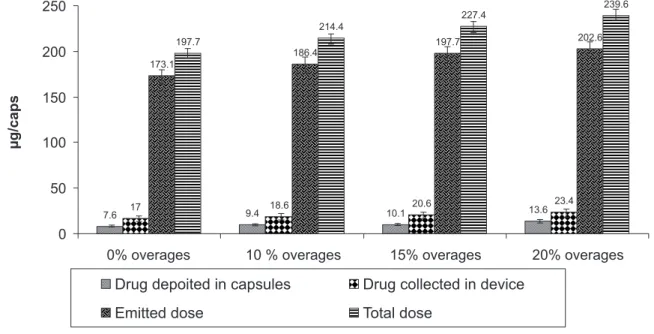
formula-tions were formulated with 0-20% extra quantity of active ingredient. The observed data indicated 8-10% of drug retention in capsule, 3-6% of drug deposition in device and 84-88% of the dose was emitted from the device. To
TABLE I - Physical properties of lactose grades used in DPI formulations
Lactose grade Bulk density (g/cc) Tapped density (g/cc) Hausner’s ratio
Carr’s
index (%)
Particle size
(90% particles
less than) (µ)
DCL11 0.614 0.720 1.19 15 250
Sorbolac 400 0.360 0.780 2.16 54 30
Inhalac 230 0.640 0.760 1.19 16 230
Respitose SV003 0.635 0. 780 1.22 19 100
Lactohale 300 0.350 0.770 2.20 55 10
FIGURE 1 - Histograms correlating emitted dose and overages of beclomethasone dipropionate DPI 200 µg.
overcome these problem 20% overages is recommended in dry powder inhaler formulations to deliver 100% of active
ingredient from the dry powder inhaler and to prevent in evitable retentive losses in DPI device. The emitted dose was increased with respect to the overages and results are shown in Figure 1. The emitted dose (delivered dose) was
within the ICH limits (80-120%). The experiments were
conducted in triplicate and the observed mean and standard deviation values are shown in Figure 1.
Beclomethasone dipropionate metered dose
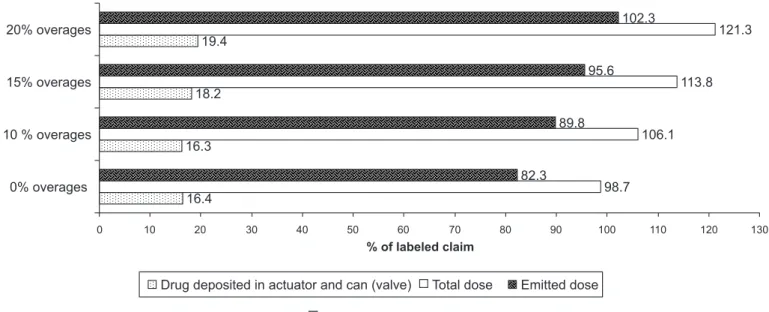
inhal-ers were incorporated with extra doses (10% and 15%)
to study the effect of extra doses on valve delivery. The
observed mean valve delivery rates (n=3) are shown in Figure 2. It was observed that 230 doses are needed to
deliver the required 200 metered doses. The additional doses required were found to be15% i.e 30 extra doses.
Further, the effect of overages on emitted dose was also studied from those formulations by incorporating
overages (0-20%w/w) to the MDI formulation containing 15% overdose. 20% overages are needed for 100% drug
delivery and to prevent the inevitable retained loses either from the inhaler device or from the valve. The observed mean emitted doses (n=3) in presence of overages are
shown in Figure 3. Thus an additional 35% of the formu
lation more than labeled claim is required to deliver the speciied doses completely from the MDI device.
Studies were carried out to evaluate the effect of
concentration of ine lactose sorbolac S400 (0-30%) and
coarse lactose Inhalac 230 on performance of DPI. All the formulations showed good content uniformity. Aero-dynamic particle size is a key parameter for all inhaled
products, directly inluencing regional deposition in the
lungs and respiratory tract. Its measurement is therefore critical during the product development cycle and for
quality control. Various sizing techniques are available, but cascade impaction is the method speciied for regula -tory approval, and hence the most widely usedCascade
impactors, including the multi-stage liquid impinger, are
by far the most widely encountered means for the in vitro determination of the particle size distribution of aerosols
from medical inhalers, both in product development, batch release and in applications with add-on devices. This is because they directly measure aerodynamic size, which is the most relevant parameter to describe particle transport within the respiratory tract. At the same time, it
is possible to quantify the mass of active pharmaceutical
ingredient in different size ranges independent of other non-physiologically active components of the formulation
(Mitchell, 2003). A signiicant difference was noticed in the emitted dose and ine particle deposition with respect
to composition of the formulation. The emitted dose was found to be decreased with increasing concentration of
ine lactose and the ine particle deposition was increased with the incorporation of ine lactose (Table II).The mean
of three observations along with the standard deviation values are shown in the following table. The low sd values
FIGURE 3 - Effect of overages on beclomethsaone dipropionate MDI.
TABLE II - Characterization of DPI formulation with various portions of ine lactose
Beclomethasone dipropionate DPI 200 µg
% of ine lactose
Parameters
Content uniformity
(% based on average) (–x±sd)
Weight variation (mg)
Assay (%)
Emitted dose
(%) (–x±sd)
Fine particle Dose (%) (–x±sd)
0 95.7-115.6 75.3-79.4 121.7 101.2 ± 6.1 7.9 ±1.6
5 91.7-109.3 76.3-79.6 116.6 98.6 ± 5.6 12.5 ± 0.9
10 94.6-112.0 72.7-82.4 109.4 97.8 ± 2.9 14.5 ± 0.8
15 97.5-106.1 72.4-76.9 109.6. 91.3 ± 5.8 15.1 ± 1.6
20 97.7-112.3 79.6-82.4 104.4 86.4 ± 6.7 15.0 ± 1.2
30 90.3-116.9 71.0-76.4 118.6. 75.9 ± 9.4 16.2 ± 2.0
–
TABLE III - Physical tests and drug distribution data from beclomethasone dipropionate DPI formulated with different grades of
ine lactose
Parameter
Beclomethasone dipropionate
µg per Capsules
Sorbolac 400 Lactohale 300
Content uniformity (% based on average) 84.9-109.4 91.8-109.0
Weight variation in mg 72.0-78.7 70.9-79.9
Assay (%) 108.1 114.4
Upper Chamber 183.2 ± 7.5 135.2 ± 6.7
Lower Chamber 31.2 ± 2.7 55.8 ± 3.1
Capsule 15.8 ± 1.6 21.8 ± 2.1
Device 7.6 ± 1.3 14.2 ± 1.4
Total dose 237.8 ± 6.2 227.0 ± 7.1
Emitted dose 214.4 ± 5.8 191.0 ± 6.4
in the parameters as emitted dose and ine particle dose
indicates that the results are reproducible.
Thus the proportion of ine and coarse lactose inlu -ences the performance of dry powder inhalers. Finally
it is concluded that 10% of ine lactose and 90% coarse
lactose is suitable as carrier for development of dry powder inhaler.
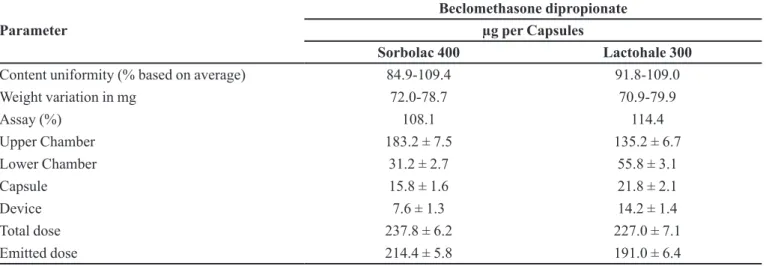
Effect of various ine lactose grades (Lactohale 300 and Sorbolac 400) on performance of dry powder formu -lation was evaluated. All the formu-lations were tested for weight variation, assay, content uniformity of dose,
emitted dose, uniformity of delivered dose; ine particle
fraction (Lung deposition) and the mean results along with
range/standard deviation values are shown in Table III. All the formulations complied content uniformity of emitted
dose and content of active ingredient, however signiicant difference in ine particle fraction were observed with re
-spect to lactose grades. Lactohale 300 showed better ine particle fraction than Sorbolac 400.
Effect of various coarse lactose grades on performance of dry powder formulation was studied.
All the formulations satisfied requirements of the
content uniformity of emitted dose and content of active
ingredient. The mean ine particle fraction (n=3) observed
from DPI formulated with different lactose grades is
shown in Figure 4. Respitose SV003 showed better
fine particle fraction than other coarse lactose grades (Inhalac230, DCL11 and Flowlac100).
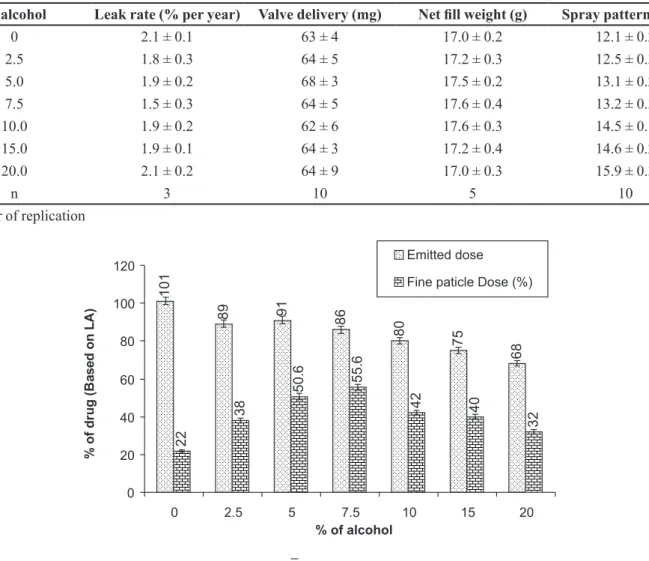
The alcohol may alter the vapor pressure of propel-lant, solubility of the drug in the propellant and hence spray pattern from the actuator may vary in metered dose inhalation formulation. The effect of alcohol on spray pat-tern and other parameters was studied and experimental
FIGURE 4 - Effect of coarse lactose grade on lactose grade on
beclomethasone diprionate DPI performance.
results are shown in Table IV. Lower concentrations of alcohol resulted in low valve delivery and higher concen-tration exhibited more leak rate. Hence, optimum alcohol
concentration (5-10%w/w) is necessary for effective valve
delivery and lower leak rate.
The HFA based beclomethasone dipropionate MDIs of 100 µg & 200 µg were evaluated for leak rate, valve de-livery, net ill weight and spray pattern. The experimental results indicated the leak rate of 2.1 ± 0.3 & 1.8± 0.1% per year, valve delivery of 63 ± 4 & 64 ± 6 mg, net ill weight
of 17.0 ± 0.2& 17.2 ± 0.3 g and spray pattern of 12.1 ± 0.2 & 12.5 ± 0.2mm.
MDI formulations were evaluated for emitted dose
dose, ine particle fraction were inversely proportional to alcohol content and indicated that the 5-10%w/w alcohol content is preferred to get optimum emitted dose and ine
particle fraction and results were given in Figure 5.
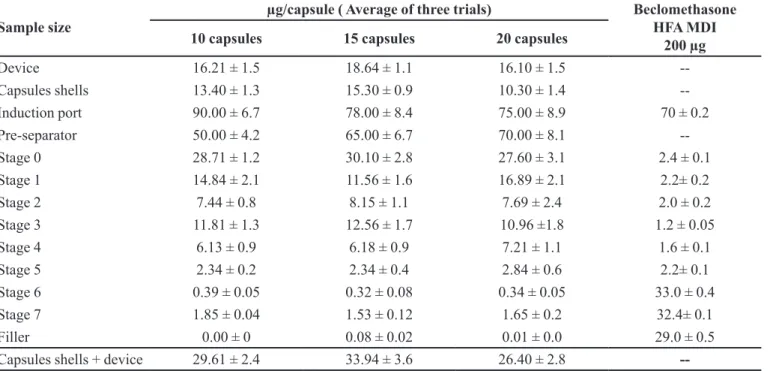
Drug distribution in various stages was observed with 10, 15 and 20 capsules of beclomethasone dipro-pionate DPI in Anderson cascade impactor and beclo-methasone dipropionate HFA MDIs containing 0.33 mm diameter actuator were tested for particle size distribution with Anderson cascade impactor. The observed mean drug distribution pattern in various stages of cascade impactor given is in Table V. The retentive losses were found to be less in sample size 20 capsules.
Fine particle fraction and emitted dose were bet-ter with 20 capsules sample size when compared with 10 and 15 samples size (Table VI) and drug distribution pattern was observed. There is no correlation observed in
between sample size and Anderson cascade data. Good recovery was observed for beclomethasone dipropionate with sample size 20.
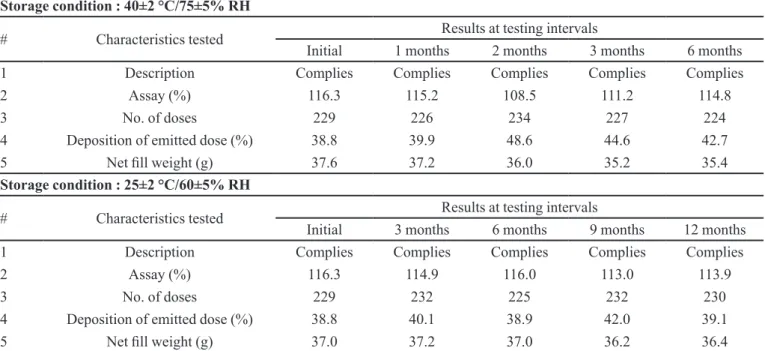
The stability studies were carried out as per ICH guidelines for HFA based MDI formulations of beclo-methasone 200 µg and beclomethasone DPI formulations stored at 40 °C/75% RH and 25 °C/60%RH as per ICH
guidelines and results showed that these products are
stable at 25 °C/60%RH (Table VII and Table VIII).
CONCLUSION
Dry powder inhalers and HFA based metered dose inhalers are developed for beclomethasone dipropionate. The performance of dry powder inhaler is found to be dependent on overages, proportion of fine and coarse lactose and the lactose grade employed in the preparation
TABLE IV - Characterization of MDI formulated with various concentrations of alcohol
% alcohol Leak rate (% per year) Valve delivery (mg) Net ill weight (g) Spray pattern (mm)
0 2.1 ± 0.1 63 ± 4 17.0 ± 0.2 12.1 ± 0.2
2.5 1.8 ± 0.3 64 ± 5 17.2 ± 0.3 12.5 ± 0.3
5.0 1.9 ± 0.2 68 ± 3 17.5 ± 0.2 13.1 ± 0.2
7.5 1.5 ± 0.3 64 ± 5 17.6 ± 0.4 13.2 ± 0.3
10.0 1.9 ± 0.2 62 ± 6 17.6 ± 0.3 14.5 ± 0.1
15.0 1.9 ± 0.1 64 ± 3 17.2 ± 0.4 14.6 ± 0.2
20.0 2.1 ± 0.2 64 ± 9 17.0 ± 0.3 15.9 ± 0.3
n 3 10 5 10
n: Number of replication
TABLE V - Anderson cascade distribution with various sampling sizes of beclomethasone dipropionate DPI 200 µg and beclometasone MDI 200 µg
Sample size
µg/capsule ( Average of three trials) Beclomethasone
HFA MDI 200 µg
10 capsules 15 capsules 20 capsules
Device 16.21 ± 1.5 18.64 ± 1.1 16.10 ± 1.5
--Capsules shells 13.40 ± 1.3 15.30 ± 0.9 10.30 ± 1.4
--Induction port 90.00 ± 6.7 78.00 ± 8.4 75.00 ± 8.9 70 ± 0.2
Pre-separator 50.00 ± 4.2 65.00 ± 6.7 70.00 ± 8.1
--Stage 0 28.71 ± 1.2 30.10 ± 2.8 27.60 ± 3.1 2.4 ± 0.1
Stage 1 14.84 ± 2.1 11.56 ± 1.6 16.89 ± 2.1 2.2± 0.2
Stage 2 7.44 ± 0.8 8.15 ± 1.1 7.69 ± 2.4 2.0 ± 0.2
Stage 3 11.81 ± 1.3 12.56 ± 1.7 10.96 ±1.8 1.2 ± 0.05
Stage 4 6.13 ± 0.9 6.18 ± 0.9 7.21 ± 1.1 1.6 ± 0.1
Stage 5 2.34 ± 0.2 2.34 ± 0.4 2.84 ± 0.6 2.2± 0.1
Stage 6 0.39 ± 0.05 0.32 ± 0.08 0.34 ± 0.05 33.0 ± 0.4
Stage 7 1.85 ± 0.04 1.53 ± 0.12 1.65 ± 0.2 32.4± 0.1
Filler 0.00 ± 0 0.08 ± 0.02 0.01 ± 0.0 29.0 ± 0.5
Capsules shells + device 29.61 ± 2.4 33.94 ± 3.6 26.40 ± 2.8
--TABLE VI - Effect of sample size on cascade impactor testing of beclometasone DPI
Product Beclomethasone DPI 200 µg
Sample size (capsules) 10 15 20
% FPF 14.98 ± 1.2 15.58 ± 2.1 15.35 ± 1.5
% of Emitted dose 106.76 ± 6.4 107.91 ± 5.8 110.10 ± 5.2
% of Total Dose 121.56 ± 5.9 124.88 ± 5.6 123.30 ± 6.2
MMAD 7.87 ± 0.2 7.45 ± 0.3 6.46 ± 0.2
GSD 3.31 ± 0.2 2.65 ± 0.1 2.34 ± 0.1
% Based on the Label Amount (LA)
TABLE VII - Stability data of Beclomethasone DPI 200 µg stored at 40±2 °C/75±5% RH & 25±2 °C/60±5% RH
Storage condition : 40±2 °C / 75±5% RH
# Characteristics tested Results at testing intervals
Initial 1 month 2 months 3 months 6 months
1 Description Complies Complies Complies Complies Complies
2 Assay (%) 114.3 112.2 108.5 111.2 114.8
3 Deposition of emitted dose (%) 15.7 16.2 17.8 16.9 15.5
Storage condition : 25±2 °C/60±5% RH
# Characteristics tested Results at testing intervals
Initial 3 months 6 months 9 months 12 months
1 Description Complies Complies Complies Complies Complies
2 Assay (%) 114.3 112.9 114.0 113.0 113.9
TABLE VIII - Stability data of Beclomethasone HFA based MDI 200 µg stored at 40±2 °C/75±5% RH & 25±2 °C/60±5% RH
Storage condition : 40±2 °C/75±5% RH
# Characteristics tested Results at testing intervals
Initial 1 months 2 months 3 months 6 months
1 Description Complies Complies Complies Complies Complies
2 Assay (%) 116.3 115.2 108.5 111.2 114.8
3 No. of doses 229 226 234 227 224
4 Deposition of emitted dose (%) 38.8 39.9 48.6 44.6 42.7
5 Net ill weight (g) 37.6 37.2 36.0 35.2 35.4
Storage condition : 25±2 °C/60±5% RH
# Characteristics tested Results at testing intervals
Initial 3 months 6 months 9 months 12 months
1 Description Complies Complies Complies Complies Complies
2 Assay (%) 116.3 114.9 116.0 113.0 113.9
3 No. of doses 229 232 225 232 230
4 Deposition of emitted dose (%) 38.8 40.1 38.9 42.0 39.1
5 Net ill weight (g) 37.0 37.2 37.0 36.2 36.4
of dry powder inhalers. The performance of dry powder inhalers containing beclomethasone dipropionate was found to be optimum when the DPI is formulated with
10:90 ratio of ine lactose (Lactohale 300):coarse lactose (Respitose SV003) and having 20% w/w overages. In
pressurized metered dose inhalation formulation,
over-ages are required to reach the 100% of target amount drug to the patient. An extra 20% is recommended in the
formulation. All the developed metered dose inhalers met
the pharmacopoeial requirements. The formulations are stable at recommended storage conditions i.e. 25 °C/60%
RH. This investigation successfully yielded an alterna-tive CFC metered dose inhaler for effecalterna-tive delivery of beclomethasone dipropionate.
ACKNOWLEDGEMENTS
The authors are thankful to the Management of Ba-patla College of Pharmacy andNATCO Pharma Limited, Kothur for providing appropriate facilities.
REFERENCES
BISGARD, H.; CALLAGHAN, C. O.; SMALDONE, G.C.
Drug delivery to the lung. New York: Marcel Dekker Inc, 2002. p.1-20, p.105-142, p.337-364, p.371-387.
GUIDANCE FOR INDUSTRY. Metered Dose Inhaler (MDI)
and Dry Powder Inhaler (DPI) Drug Products. Chemistry, Manufacturing, and Controls Documentation. Rockville:
Food and Drug Administration, 1998. 62 p. (Draft
Guidance).
FLAMENT, M.P.; LETERME, P.; GAYOT A. The inluence of
carrier roughness on adhesion, content uniformity and the in vitro deposition of terbutaline sulphate from dry powder inhalers. Int. J. Pharm, v.275, p.201-209, 2004.
HARTWIG, S.; BERND, W. M. Metered-dose inhaler formulations with beclomethasone-17, 21-dipropionate
using the ozone friendly propellant R 134a. Eur. J. Pharm. Biopharm., v.46, p.77-83, 1998.
INDIAN PHARMACOPOEIA. Ghaziabad: The Indian
Pharmacopoeia Commission, 2007. v.2, p.638-652.
KEITH, J. M.; GARY, P.M. Transition to CFC-free metered
dose inhalers into the new millennium. Int. J. Pharm , v.201,
p.89-107, 2000.
MERCK INDEX. An encyclopedia of chemicals, drugs and
MICHAEL, L.; RICHARD, K. P.; SUSAN, J. G.; ERIC, D. O. B.; HEATHER, A. B. Metered-dose inhalers I: drug content and particle size distribution of beclomethasone dipropionate. J. Pharm. Biomed. Anal., v.14, p.793-800,
1996.
JOLYON, P.; MITCHELL AND MARK W. NAGEL. Cascade
impactors for the size characterization of aerosols from medical inhalers: their uses and limitations. J. Aerosol Med.,
v.16, p.341-377, 2003.
SAINT-LORANT, G.; LETERME, P.; GAYOT, A.; FLAMENT,
M.P. Inluence of carrier on the performance of dry powder inhalers. Int. J. Pharm., v.334, p.85-91, 2007.
STEIN, S.W. Size distribution measurements of metered dose inhalers using Andersen mark II cascade impactors. Int. J. Pharm., v.186, p.43-52, 1999.
SWEETMAN, S.C. Martindale. The complete drug reference.
36.ed. London: Pharmaceutical Press, 2009. p.1516-1518.
MONTREAL Protocol on substances that deplete the ozone
layer. 1994 Report of the methyl bromide technical options committee. Nairobi: UNEP, 1994. p. 56276-56298.
WILLIAMS, R.O; TAFT, D.R.; MCCONVILLE, J.T. Advanced drug formulation design to optimize therapeutic outcomes.
New York: CBS Publishers, 2008. p.1-50.
Received for publication on 10th January 2011