*Correspondence: Mangesh R. Bhalekar. AISSMS College of Pharmacy. Ken-nedy Road, Pune 410001. Maharashtra, India. E-mail: [email protected]
A
vol. 49, n. 2, apr./jun., 2013
Synthesis and characterization of a cysteine xyloglucan conjugate
as mucoadhesive polymer
Mangesh Bhalekar
1,*,
Savita Sonawane
2, Shamkant Shimpi
31
AISSMS College of Pharmacy, Maharashtra, India, 2Jawaharlal Nehru Technological University, Hyderabad, 3
APL Research Centre, Aurobindo Pharma Ltd., Hyderabad
The aim of this study was to improve the mucoadhesive potential of xyloglucan polymer by the covalent attachment of cysteine as thiol moiety. The parent polymer xyloglucan was chemically modiied by introducing sulphydryl bearing compound L-cysteine HCl. Different batches of xyloglucan-cysteine conjugates were prepared at varying reaction pH (2-6) and evaluated for optimum thiol incorporation, disulphide group content, swelling behavior, rheological properties and mucoadhesive properties. The obtained conjugates characterized in vitroby quantiication of immobilized thiol groups; showed maximum thiol incorporation on xyloglucan (7.67 ± 0.14 %) at pH 5. The disulphide group content was found maximum (2.83 ± 0.12) at pH 6. The water uptake at end of 4 h was 5.0 for xyloglucan and was found to decrease in thiolated derivatives with increase in thiolation. Mucoadhesion studies revealed that mucoadhesion of xyloglucan-cysteine conjugate increased more than twice compared to the unmodiied polymer. The viscosity of thiomer was more than that of xyloglucan because of formation of disulphide bonds.
Uniterms: Mucoadhesion. Thiomer. Xyloglucan. L-cysteine HCl.
O objetivo deste estudo foi melhorar o potencial mucoadesivo do polímero xiloglicano pela ligação covalente de cisteína como unidade de tiol. O polímero xiloglicano foi quimicamente modiicado pela introdução de cloridrato de cisteína como grupo contendo sulidrila. Prepararam-se diferentes lotes de conjugados cisteína-xiloglicano em pH variando de 2 a 6, avaliando-se a incorporação ótima de tiol, o conteúdo de dissulfeto, o comportamento de inchamento, as propriedades reológicas e mucoadesivas. Os conjugados obtidos foram caracterizados in vitro pela quantiicação de grupos tiol, mostrando máxima
incorporação na xiloglicana (7.67 ± 0.14 %) em pH 5. O conteúdo de grupos dissulfeto foi máximo (2.83 ± 0.12) em pH 6. O índice de inchamento em % no im de 4 h foi 83.87 para o xiloglicano e diminuiu para os derivados tiolados. O conteúdo foi mínimo para TH2 (78.26), aumentou pouco até TH5 (83.33) e diminuiu, posteriormente, para TH6 (80.13). Os estudos de mucoadesão revelaram que o conjugado xiloglicano-cisteína aumentou mais que duas vezes comparativamente ao polímero não modiicado. A viscosidade do tiômero foi maior do que a do xiloglicano devido à formação das ligações dissulfeto.
Unitermos: Mucoadesão. Tiômero. Xiloglicano. Cloridrato de L-cisteína
INTRODUCTION
The concept of mucoadhesion was pioneered in the 1980s which led to formulation of mucoadhesive delivery systems to reduce the frequency of dosing by enhancing gastric residence and improving patient-compliance. In addition, mucoadhesive polymers are able to increase
the epithelial permeability for many drugs because of
intensiied contact to the mucosa (Borchard, Lueben et al., 1996) and can exclude an enzymatic degradation of perorally administered (poly) peptide drugs during their passage between the delivery system and the mucosa (Bernkop-Schnürch, Schwarz, Kratzel, 1997).
thought to be not suficient to guarantee the localization
of a drug delivery system at a given target site (Lehr,
1994; Tirosh, 1994). Numerous attempts to improve the adhesive properties of polymers; led to synthesis of
‘thiolated’ polymers or so-called thiomers have proven to be a promising new class of polymeric excipients in mucoadhesive drug delivery system. Thiomers are capable of forming covalent bonds leading to improved mucoadhesive properties (Bernkop-Schnürch, 1999). The thiomers process improved adhesion because of
formation of disulide bonds between thiol bearing side
chains of the polymer and cysteine-rich subdomains of mucus glycoproteins (Gum Jr. et al., 1992).
Xyloglucan is a natural mucoadhesive polymer derived from the seeds of Tamarindus indica Linn., and used as a additive in the paper industry. Refined xyloglucan is used as a thickening, stabilizing and gelling agent in the food industry. The polysaccharide is composed of glucose, xylose and galactose units present in the ratio of 2.8:2.25:1.0 (Gidley et al., 1991; Glicksman,1986). Use of xyloglucan has been reported as mucoadhesive agent in eye preparations (Ludwig, 2005) and as sustained release matrix for oral drug delivery systems (Sumathi, Ray, 2002).
The aim of this study was to synthesize thiomer of xyloglucan by attachment of cysteine and evaluate the influence of reaction pH on various properties of thiomer such as thiol content, disulphide content, swelling behavior, rheological properties and mucoadhesive properties.
EXPERIMENTAL
Isolation of xyloglucan
Xyloglucan was isolated as per the procedure reported in literature (Sumathi, Ray, 2002). Tamarind kernel powder (25 g) was added to 200 mL of cold distilled water and slurry was prepared. The slurry was poured into 800 mL of boiling distilled water and was heated for 20 minutes under stirring condition in a water bath at 70-80 oC. The resulting slurry after keeping overnight to
settle the proteins and ibers; was decanted and centrifuged
at 2000 rpm for 30 minutes. The supernatant was separated and poured into excess volume of absolute ethanol with continuous stirring. The precipitate of xyloglucan was pressed between felt, washed successively with absolute ethanol, diethyl ether and petroleum ether and then dried at 50-60 °C under vacuum. The dried material was ground and sieved to obtain powder and used as polymer for further study.
Synthesis of xyloglucan-cysteine conjugates
The covalent attachment of cysteine to xyloglucan was achieved by the formation of ester bonds between the hydroxyl group of the xyloglucan and a carboxylic acid group of the cysteine (Leitner et al., 2003; Bilicic et al., 2005). Xyloglucan-cysteine thiomer was prepared by adapting the procedure given in the literature (Constantia et al., 2001). Xyloglucan (2 g) was dissolved in 250 mL of de-mineralized water under constant mechanical stirring for 15 min. This solution was stirred for 30 min and cysteine hydrochloride (4 g) was added to reaction mixture in a weight-ratio of 1:2 (polymer: cysteine). In order to evaluate effect of pH on coupling reaction, the
pH was adjusted using 0.1 N NaOH to 2, 3, 4, 5 and 6
then reaction mixtures were incubated for 3 h under continuous stirring. After precipitation with acetone, the reaction product was rinsed with acetone: water (1:1) in
order to remove unreacted moieties and inally washed
with acetone before drying at room temperature followed by drying in a vacuum oven (-600 mm of Hg, 40 oC, 24 h).
Characterization
Fourier transform infra-red spectroscopy
FTIR study was performed using FT-IR spectrometer (FTIR, Jasco 460) on xyloglucan and thiomer
(xyloglucan-cysteine conjugate) to conirm the formation of conjugate
between xyloglucan and cysteine HCl.
Differential Scanning Calorimetry
D i ff e r e n t i a l s c a n n i n g c a l o r i m e t r i c ( D S C ) measurements on xyloglucan and thiomer were carried out to study thermal behavior (DSC 823e, Mettler Toledo, Melbourne, Australia). The instrument was calibrated using indium (156 oC), tin (232 oC) and zinc (419.5 ºC) as internal standards. Samples of 4–10 mg were placed in aluminium pans (Al-Crucibles, 40 Al) and sealed. The probes were heated from 30 to 300 ºC at a rate of 10 °C/min under nitrogen atmosphere.
Thiol group determination
Amount of free thiol groups on the thiomer was determined by iodimetry, as per the procedure given by (Bernkop, 1999). The degree of thiolation was determined by quantifying the amount of thiol groups on the thiomer. Thiomer (200 mg) was taken in I2 lask and hydrated in
suficient amount of demineralised water. The pH was adjusted to 2-3 with 1M HCl. 10 mL of Standard 0.1 N iodine
thiosulphate using starch solution as indicator.
Blank determination was carried out as per the procedure mentioned above excluding thiomer. The amount of thiol groups present on the thiomer was determined using formula:
% Thiol group content = [(Blank-Proper) x 0.1 x 0.066 x 100] /0.1 x weight of thiomer
Disulfide group content (Constantia et al., 2001)
The disulide content on the thiomer was calculated
by subtracting total amount of thiol groups before reduction from the total amount of thiol groups after reduction using sodium borohydride. To total amount of thiol groups on
the polymer after reduction were determined as; of thiomer
(200 mg) was hydrated in I2 lask using suficient amount of demineralised water. The pH was adjusted with 1 M HCl between 2-3 and then 0.6 ml of a freshly prepared 3% solution of sodium-borohydride was added to the
hydrated polymer in order to reduce all disulide bonds to
free thiol groups and shaken for 15 min. Thereafter, 0.5 mL of 1 M HCl was added and stirred to destroy the remaining sodium-borohydride. To this mixture 10 mL of standard
0.1 N Iodine solution was added, stoppered and agitated
for 10 min. The excess I2 was titrated with standard 0.1 N sodium thiosulphate using starch solution as indicator. The amount of thiol groups before reduction was determined
by procedure reported earlier, % Disulide group content
was determined using formula
% Disulide group content = [(B1-B2) x 0.1 x 0.066 x 100]/
0.1 x weight of thiomer
where, B1 = Blank - Burette reading after reduction; B2 = Blank - Burette reading before reduction.
Water uptake studies (A Bernkop schnurch, steininger S, 2000)
The study was performed on thiomer synthesized at pH 2, 3, 4, 5, and 6 which are designated as TH2, TH3, TH4, TH5 and TH6 respectively.
Polymer (30 mg) was compressed into 5.0 mm
diameter lat faced discs at constant pressure. The discs
were placed in plastic tube with a bottom of permeable membrane. The tubes were then set in a vessel containing demineralised water at 20 oC. The tubes were removed at predetermined intervals and weighed at regular intervals after removing excess water.
In vitro mucoadhesion studies
The xyloglucan and thiomer (2 g) was converted
into gel by addition of demineralised water (5 mL). The mucoadhesive potential of each formulation was determined by measuring the force required to detach the formulation from mucosal tissue using a modified balance method described by (Jones et al. 2000). In brief, mucus tissues were carefully removed from the intestine of sheep obtained from the local slaughterhouse. Tissues were immediately used after separation. At the time of testing, a section of mucosal tissue was secured (keeping the mucosal side out) to the upper probe using a supportive adhesive tape. The probe was attached to one side of two pan balance. The surface area of each exposed mucosal membrane was 0.785 cm2. At room temperature, fixed amount of samples of each formulation were placed on lower probe by supportive adhesive tape. The probes were equilibrated. Probe with mucus tissue was lowered until the tissue contacted the surface of the sample. The probes were connected for 2 minutes to ensure intimate contact between the tissues and the samples. The probe was then moved upwards by adding weight in pan which is present on other side of balance. The mucoadhesive force, expressed as the detachment stress in dyne/cm2, was determined from the minimal weights that detached the tissues from the surface of each formulation using the following equation (Majithiya et al., 2006).
Detachment Stress (dyne/cm2) = m* g/ A
where m is the weight added to the balance in grams; g is
the acceleration due to gravity taken as 980 cm/s2; and A the area of tissue exposed. Measurements were repeated thrice for each of the gel preparations, but before each measurement a fresh smooth gel surface was created.
Viscosity measurement
The rheological properties of xyloglucan and thiomer (2% w/v) solutions (TH2…TH6) were determined
using a Brookield Digital Viscometer model ‘DV-II plus
PRO’, USA by adopting the following experimental conditions: temperature 25 ± 1 oC, 20 rpm.
RESULTS AND DISCUSSION
Isolation of xyloglucan
The production of xyloglucan polymer was done by precipitation with ethyl alcohol. The product yield obtained after precipitation was 35 to 50% in various
batches because of separation of proteins and ibers from
Synthesis of xyloglucan-cysteine conjugates
The mechanism involved in the synthesis of thiomer is covalent attachment of cysteine moiety to the xyloglucan with the help of EDAC.HCl as a coupling reagent. The covalent attachment of cysteine to xyloglucan was achieved by the formation of ester bonds between the hydroxyl group of the xyloglucan and a carboxylic acid group of the cysteine (Figure 2). In order to optimize the synthesis procedure of thiomer, the influence of pH of reaction mixture during coupling reaction on the amount immobilized thiol groups on xyloglucan was evaluated.
Evaluation
Fourier transform infra-red spectroscopy
FTIR studies on xyloglucan and thiomer were
carried out in order to conirm the formation of conjugate
between xyloglucan and cysteine to give thiomer. As shown in Figure 3, FTIR spectrum of xyloglucan is
in agreement with reported study (Vodenicarova et al., 2006), whereas the comparison between spectra of xyloglucan and thiomer did not differ to enable a conclusion.
Differential Scanning Calorimetry
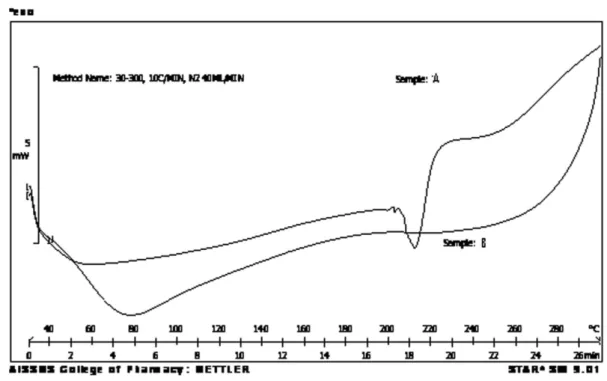
DSC studies on xyloglucan and thiomer was carried out in order to study thermal behavior of polymers. Figure 4 represents the differential scanning thermogram of thiomer (A) and xyloglucan (B) show a broad endotherm at 54 oC and 74.59 oC respectively. The thermogram of thiomer exhibit a sharp endothermic peak 212.57 oC with
heat low -113.96 mJ/g which might be due to combustion
of thiomer.
FIGURE 1 - Structure of xyloglucan.
FIGURE 2 - Scheme for synthesis of xyloglucan-cysteine
conjugate.
TABLE I - Thiol and disulphide group content of thiomers synthesized at different pH
Sr. no. Type of Thiomer % Thiol group content % Disulphide group content
1 TH2 3.63 ± 0.12 0.82 ± 0.19
2 TH3 4.95 ± 0.1 1.52 ± 0.13
3 TH4 6.17 ± 0.18 1.92 ± 0.08
4 TH5 7.67 ± 0.14 2.29 ± 0.06
5 TH6 5.90 ± 0.08 3.83 ± 0.12
TH2, TH3, TH4, TH5 and TH6: thiomer synthesized at pH 2, 3, 4, 5 and 6, respectively (n=3)
Thiol and Disulphide group content
In the pH-range of 2-5, the bonding of thiol groups increased with increasing the pH. At pH 2, the low thiol incorporation on xyloglucan (3.63 ± 0.12%). The amount of attached thiol groups increased at pH 4 (6.17 ± 0.28%) and reached to maximum at pH 5 (7.67 ± 0.14%). In contrast, at pH above 5 the yield of xyloglucan bonded thiol groups decreased again. A reason for this observation can be seen in the oxidation of the sulfhydryl groups during the coupling reaction which is favored at higher pH-values (Schmitz et al., 2008) and increased share of disulide bond formation between two thiol groups. The differences were
found to be signiicant after a multiple comparison test
followed by Tucky test (p<0.05) using PRIMER software.
On the other hand disulide group content was found
to be directly related to the pH of reaction. The amount of disulphide groups increased at pH 5 (2.29±0.06%) and
FIGURE 4 - DSC thermogram of (A) thiomer and (B) xyloglucan.
reached to maximum at pH 6 (3.83±0.12%) this is because hydrated and swollen matrix based on anionogenic polymers have high buffer capacity and are capable of maintaining previously adjusted pH value hence the values of disulphide group content increased from TH2 to TH6.
Water uptake studies
The swelling behavior of mucoadhesive polymers
has a great inluence on their mucoadhesive properties
(Bernkop-Schnürch et al., 2000). By absorbing, swelling and capillary effects, mucoadhesive polymers are supposed to take water from the underlying mucosal tissue leading to a considerably strong adhesion (Duchene et al., 1992).
The water uptake studies carried out on xyloglucan
and various thiomers showed a signiicant increase in
xyloglucan (5.5± 0.16%) and was found to decrease from TH2 (5.1± 0.5%) to TH5 (4.3±0.17%) and increased for TH6 (4.7± 0.15%). Thus due to higher water uptake the swelling rate of xyloglucan was higher than thiomers the reason for this could be that, xyloglucan possesses groups that ionize at higher pH values and results into negative charge generation in the polymeric matrix, which might help in loosening of polymeric structure and helps water penetration and swelling. The swelling behavior of thiomer was strongly reduced due to the immobilization of cysteine. The increase in mucoadhesion of thiomers despite of reduced water uptake can be attributed to the covalent bonding thiol group with mucin.
In vitro mucoadhesion studies
Mucoadhesion studies carried out on xyloglucan and thiomer revealed an increase in the mucoadhesive strength of thiomer as compared to xyloglucan, the
thiol/disulide exchange reactions between the thiol groups
of the thiomer and the cysteine-rich subdomains of mucin glycoproteins could be responsible for this (Constantia et al., 2002). Mucoadhesive property of thiomer is strongly dependent on pH of the reaction conditions and thus on the thiol group content. The results of the mucoadhesion studies (Table III) indicate that the increase in the mucoadhesive strength for TH2 was only 1.75 fold. This is occurs due to less immobilization of thiol group on to xyloglucan polymeric structure (Roldo et al., 2004). Mucoadhesion strength was found to increase as pH was increased and reaches maximum at pH 5.0, but further increase in the pH of reaction conditions did not result into increase in mucoadhesion. Mucoadhesive strength for TH5 showed 2.90 fold increase in mucoadhesion. A reason for this observation can be seen in the fact that thiolated
polymers do not only form disulide bonds with the mucus
glycoprotein but also inter and/or intrachain disulfide bonds within the polymer itself (Bernkop-Schnurch et al., 1999).
Viscosity measurement
The solutions of xyloglucan and thiomer were prepared in 2% concentration, and their rheological
properties were studied. It is clear from (Table IV)
that thiolated solutions are more viscous compared to xyloglucan solution and viscosity increases with thiomer
synthesized at increasing pH. Viscosity of TH5 shows
2.92 fold increase over xyloglucan. It occurs because of the formation of disulfide bonds within the three-dimensional polymeric network leads to an increased viscosity (Bernkop-Schnürch 2005).
TABLE II - Comparisonofwater uptake of discs of xyloglucan prepared from xyloglucan and thiomers prepared at different pH
(TH2 to TH6)
Time Xyloglucan TH2 TH3 TH4 TH5 TH6
30 2.2 ± 0.06 2.1 ± 0.06 2.1 ± 0.06 1.8 ± 0.15 1.8 ± 0.12 1.8 ± 0.16
60 2.9 ± 0.05 2.6 ± 0.05 2.6 ± 0.10 2.7 ± 0.25 2.7 ± .0.25 2.3 ± .0.12
90 3.6 ± 0.05 3.5 ± 0.12 3.2 ± 0.15 3.3 ± 0.15 3.3 ± 0.10 3.3 ± 0.08
120 4.2 ± 0.04 4.3 ± 0.38 3.8 ± 0.10 3.6 ± 0.12 3.6 ± 0.25 3.6 ± 0.12
150 4.8 ± 0.03 4.1 ± 0.26 4.3 ± 0.18 4.0 ± 0.15 4.0 ± 0.21 4.3 ± 0.18
180 5.2 ± 0.01 4.8 ± 0.12 4.5 ± 0.29 4.2 ± 0.23 4.2 ± 0.06 4.5 ± 0.12
240 5.5 ± 0.16 5.0 ± 0.15 4.8 ± 0.12 4.3 ± 0.17 4.3 ± 0.17 4.7 ± 0.17
TABLE III - Comparison of mucoadhesive strength of xyloglucan
and thiomer
Type of Polymer
Mucoadhesive Strength (dyne/cm2)
Improvement in Mucoadhesion
Xyloglucan 13083.3± 874.46
---TH2 22895.8± 1282.32 1.75 fold
TH3 25667.3± 1634.68 1.96 fold
TH4 33344.9± 2284.78 2.55 fold
TH5 38001.5± 1542.52 2.90 fold
TH6 34094± 1642.24 2.60 fold
TABLE IV - Viscosity of various thiomers at 25 oC
Sr. No. Type of
Polymer
Apparent viscosity (cps)
Improvement in viscosity
1 Xyloglucan 390.7
---2 TH2 788.2 2.02 fold
3 TH3 892.4 2.28 fold
4 TH4 964.1 2.47 fold
5 TH5 1142.5 2.92 fold
6 TH6 978.3 2.5 fold
CONCLUSION
The improvement of the mucoadhesive properties of polymers due to the immobilization of cysteine could
be conirmed for tamarind seed polysaccharide though
the water uptake decreased. Due to the introduction of thiol group within this polymer, its cohesiveness was greatly improved. Because of these features, thiolated polymers seem to represent a promising new generation of mucoadhesive polymers which should provide a much more prolonged residence time of drug delivery systems on various mucosal tissues compared to well establish polymers.
ACKNOWLEDGEMENT
The authors are thankful to AISSMS College of Pharmacy for providing the facilities for carrying out the research project and Bakre Starch (Malegaon, India) for providing Tamarind kernel powder.
REFERENCES
BERNKOP-SCHNÜRCH, A. Thiomers: a new generation
of mucoadhesive polymers. Adv. Drug Deliv. Rev., v.57,
p.1569-1582, 2005.
SCHNURCH, A.B.; STEININGER, S. Synthesis and
characterisation of mucoadhesive thiolated polymers. Int.
J. Pharm., v.194, p 239-247, 2000.
BERNKOP-SCHNÜRCH, A.; GERIT, H.S.; KRATZEL, M.; Modified mucoadhesive polymers for the peroral administration of mainly elastase degradable therapeutic
(poly)peptides. J. Control. Release, v.47, p.113-121, 1997.
BERNKOP-SCHNÜRCH, A. Polymer-inhibitor conjugates: a promising strategy to overcome the enzymatic barrier to
perorally administered (poly) peptide drugs. S.T.P. Pharm.
Sci., v.9, p.78-87, 1999.
BILICIC, M.; FILIPOVIC-GRCIC, J.; MARTINAC, A.; BARBARIC, M. Synthesis and characterization of thiomers
of polyaspartamide. Int. J. Pharm., v.291, p.211-219, 2005.
BORCHARD, G.; LUEBEN, H.L.; DE BOER. Effects of chitosan–glutamate and carbomer on epithelial tight junctions in vitro. J. Control. Rel., v.39, p.131-138, 1996.
CONSTANTIA, E.K.; BERNKOP-SCHNURCH, A.B. Polymer–cysteamine conjugates: new mucoadhesive excipients for drug delivery. Int. J. Pharm., v.234, p.91-99, 2002.
CONSTANTIA, E.K.; SCHNURCH, A.B. Thiolated polymers
- thiomers: development and in vitro evaluation of
chitosan-thioglycolic acid conjugates. Biomaterials, v.22,
p.2345-2352, 2001.
DUCHENE, D.; PONCHEL, P. Principle and investigation of the bioadhesion mechanism of solid dosage forms, a review.
Biomaterials, v.10, p.709-714, 1992.
GIDLEY, M.J.; LILLFORD, P.J.; ROWLANDS, D.W.; CRESCENZI, V. Structure and solution properties of
tamarind-seed polysaccharide. Carbohydr. Res., v.214,
p.299-314, 1991.
GLICKSMAN, M. Tamarind seed gum. In: GLICKSMAN, M.
(Ed.) Food hydrocolloids. Boca Raton: CRC Press Inc.,
1996. v.3, p.191-202.
GOHEL, M.C.; PATEL, M.M.; AMIN, A.F. Development of modiied release Diltiazem HCL tablet using compsite index
to indentify optimal formulation. Drug Dev. Ind. Pharm.,
v.29, p.124-131, 2005.
GU, J.M.; ROBINSON, J.R.; LEUNG, S.H.S. Binding of acrylic polymers to mucin/epithelial surfaces: structure property
relationships. Crit. Rev. Ther. Drug Carrier Systems, v.5,
p.21-27, 1998.
GUM JR., J.R.; HICKS, J.W.; TORIBARA, N.W. The human
MUC2 intestinal mucin has cysteine-rich subdomains
located both upstream and down-stream of its central
repetitive region. J. Biol. Chem., v.267, p.21375-21383,
1992.
JONES, D.S.; WOOLFSON, A.D.; BROWN, A.F. Design, characterization and preliminary clinical evaluation of a novel mucoadhesive topical formulation containing
tetracycline for the treatment of periodontal disease. J.
Control. Release, v.67, p.357-368, 2000.
KAWASAKI, N.; OHKURA, R.; MIYAZAKI, S. Thermally reversible xyloglucan gels as vehicles for oral drug delivery.
LEHR, C.M.; TIROSH, B. Bioadhesion technologies for the delivery of peptide and protein drugs to the gastrointestinal
tract. Crit. Rev. Ther. Drug. Carrier Systems, v.11,
p.119-160, 1994.
LEITNER V.M.; WALKER G.F.; BERNKOP-SCHNURCH, A. Thiolated polymers: evidence for formation of disulphide
bonds with mucus glycoproteins. Eur. J. Pharm. Biopharm.,
v.56, p.207-214, 2003.
LUDWIG, A. The use of mucoadhesive polymers in ocular drug
delivery. Adv. Drug Deliv. Rev., v.57, p.1595-1639, 2005.
MAJITHIYA, R.J.; GHOSH, P.K.; UMRETHIA, M.L.; MURTHY, R.S.R. Thermoreversible- mucoadhesive gel
for nasal delivery of sumatriptan. AAPS PharmSciTech,
v.7, p.67-73, 2006.
MORTAZAVI, S.A.; SMART, J.D. An investigation of some factors influencing the in-vitro assessment of
Mucoadhesion. Int. J. Pharm., v.116, p.223-230, 1995.
ROLDO, M.; HORNOF, M.; BERNKOP-SCHNURCH, A. Mucoadhesive thiolated chitosans as platforms for oral
controlled drug delivery: synthesis and in vitro evaluation.
Eur. J. Pharm. Biopharm., v.57, p.115-121, 2004.
SCHMITZ, T.; GRABOVAC, V.; PALMBERGER, T.F.; SCHNURCH, A.B. Synthesis and characterization of a chitosan-N-acetyl cysteine conjugate. Int. J. Pharm., v.347, p.79-85, 2008.
SCHNURCH, A.B.; SCHWARZ, V.; STEININGER, S. Polymers with thiol groups: a new generation of mucoadhesive
polymers. Pharm. Res., v.16, p.876-881, 1991.
SCHNURCH, A.B.; STEININGER, S. Synthesis and
characterization of mucoadhesive thiolated polymers. Int.
J. Pharm., v.194, p.239-247, 2000.
SUMATHI, S.; RAY, A.R. Release behaviour of drugs from
Xyloglucan tablets. J. Pharm. Pharm. Sci., v.5, p.12-18,
2002.
TIROSH, B. Mucus gel thickness and turnover in the gastrointestinal tract: response to cholinergic stimulus and
implication for Mucoadhesion. Pharm. Res., v.11,
p.794-799, 1994.
VODENICAROVA, M.; DRIMALOVA, G.; HROMADKOVA, Z.; MALOVIKOVA, A.; EBRINGEROVA, A. Xyloglucan degradation using different radiation sources: a comparative
study. Ultrason. Sonochem., v.13, p.157-164, 2006.
Received for publication on 30th March 2012