The Meaning of Work during Short-term Unemployment
1Pedro F. Bendassolli2 Fellipe Coelho-Lima Rafaele de Araújo Pinheiro Pollyanna Carvalho de Siqueira Gê Universidade Federal do Rio Grande do Norte
ABSTRACT - This paper reports the results of an investigation of the meanings unemployed people attribute to their work. The sample comprised 358 short-term (from one to six months) unemployed workers. Data were collected using a standardized
questionnaire based on a ive-dimensional meaning of work model that was previously adapted to the Brazilian context. The data were submitted to a conirmatory factor analysis. The results suggest that there might not be speciicities in the meanings unemployed workers attribute to their work, considering that the ive-factor structure of the meaning of work model was
empirically supported. The results indicate that the variables length of unemployment, number of formal jobs, age, and schooling
were signiicantly correlated with the number of dimensions of the meaning of work model.
Keywords: meaningful work; meaning of work; unemployment
Sentido do Trabalho em Situação de Desemprego de Curta Duração
RESUMO - O objetivo deste artigo é relatar os resultados de uma investigação sobre sentidos atribuídos ao trabalho por pessoas desempregadas. A amostra foi composta por 358 desempregados de curta duração (de um a seis meses). Utilizou-se instrumento associado a um modelo de sentidos do trabalho composto por cinco dimensões teóricas, e previamente adaptado
ao contexto brasileiro. Os dados foram submetidos a uma análise fatorial conirmatória. Os resultados indicam que parecem não haver especiicidades nos sentidos atribuídos ao trabalho por desempregados, haja vista que a estrutura fatorial do modelo de sentidos, concebido para trabalhadores empregados, foi empiricamente conirmada. As variáveis tempo de desemprego, número de empregos formais, idade, e escolaridade mostraram-se signiicativamente relacionadas com dimensões do modelo
de sentidos do trabalho adotado.
Palavras-chaves: sentidos do trabalho, signiicado do trabalho, desemprego
1 Agradecimento - Agradecemos o apoio da Secretaria do Estado de Trabalho, Habitação e Assistência Social do Rio Grande do Norte. 2 Endereço para correspondência: Universidade Federal do Rio Grande
do Norte, Campus Universitário, Centro de Ciências Humanas Letras e Artes, Departamento de Psicologia, Natal, RN, Brasil. CEP: 59078-970. E-mail: [email protected]
According to a report produced by the International Labour Organization (ILO, 2014), in 2013 the world population of unemployed workers was 199,8 million, and
this statistic was estimated to increase over the next ive years.
In developing countries, however, unemployment rates have shown a historic decline. In Brazil, we have seen a decline in unemployment rates since the 2000s—due, among other factors, to policies focused on market development and internal consumption and income distribution (Cacciamali & Cury, 2013). According to research from the Inter-Union Department of Statistics and Socioeconomic Studies (DIEESE, 2014), 18,7% of the country’s population were unemployed in 1998, compared to 10,3% in 2013. The National Sample Survey of Households (PNAD) conducted by the Brazilian Institute of Geography and Statistics (IBGE,
2013) conirms this trend: in 2002, unemployment reached 9,14% of the labor force, and this igure was reduced to 6,72%
in 2011 (Chahad & Pozzo, 2013).
These data are not exactly news. Since industrialization began to accelerate in the West in the nineteenth century,
unemployment has been a recurring theme on government and civil society agendas (Galeazzi, 2011). The roots of the phenomenon lie in the operating logic of modern capitalism, and itdoes not have a single-cause explanation. Several theories and accumulated empirical evidence have established unemployment as a complex, multidetermined phenomenon, subject to political, social, and economic
changes (Mclaughlin, 2013). In the ield of psychology,
research on the subject dates back to the 1930s, beginning with the seminal study by Jahoda, Lazarsfeld, and Zeisel (1933/1971) on the Marienthal community.Since then, and aligned with the cycles of economic expansion and downturn,
the study of unemployment has intensiied in psychology
research and offers a wide range of theoretical perspectives
and interventions (Paul & Moser, 2006a).
Although unemployment is widespread, defining unemployment is an increasingly challenging task, given the complexity of the forms of work today. However, two
deinitions will be useful for our purposes. The irst deinition,
that of the International Labour Organization (ILO, 1982),
deines an unemployed individual as one who:(a) does not
have formal paid employment or is in a situation of self-employment,(b) is looking for a new position (for a week or a month) but has not been successful, and (c) is able to work.
The second deinition, provided by a Brazilian institutionfor
given by DIEESE (1984), which assigns the status ofbeing unemployed to “individuals who are in aninvoluntary nonwork situation, caused by a lack of job opportunities, or individuals whoare performing irregular work with a
desire for change”(p.9; author’s translation). This deinition
includes people who do not have any form of income and are looking for employment (open unemployment), but also those working in the informal market who seek formalized insertion in the job market (unemployment hidden by precarious work). The DIEESE statistics presented at the
opening of this section relect this deinition.
Another characterization of unemploymentconcerns its duration. If, in other historical moments — especially during periods of high economic growth (full employment)— unemployment was seen as a transitory situation, this scenario has changed. According to some authors (e.g.,
Antunes, 2009; Garcia, Rodarte, & Braga, 2006), a contingent
of unemployed workers who are unlikely to be reinserted in the formal labor began to appear in the 1970s. This came to be known as structural unemployment, and it is largely explained by the disappearance of jobs due to technological advances, which especially affects older workers who are
less qualiied (Gómez, Morejon, & Sabater, 2008).
Additionally, due to the heterogeneity of the current labor market, a person can now alternate between employment and unemployment, or stay in hidden unemployment or precarious or informal jobs for a long period of time (Dooley & Prause, 2004). As a result, two other categories are also necessary for understanding the phenomenon of unemployment: long-term and short-term unemployment.
The irst is deined as unemployment for at least six months.
Therefore, short-term unemployment is limited to a period of one week to six months (Winkelmann, 2014).
For decades, researchers have established relations between the duration of unemployment and the deterioration of multiple mental health indicators. This is one of the most traditional research fronts in unemployment psychology (e.g.,
Aaronson, Mazumder, & Schechter, 2010; Janlert, Wineield,
& Hammarström, 2014; Jones, 1992; McKee-Ryan, Song,
Wanberg, & Kinicki, 2005; Wineield, Tiggemann, Wineield,
& Goldney, 1993). The research results in the Brazilian context converge with the international literature, insofar as these also support the negative impact of unemployment on various mental health parameters (e.g., Argolo & Araújo, 2004; Bastos, 2011; Barros & Oliveira, 2009; Coelho-Lima, Costa, & Bendassolli, 2013; Pinheiro & Monteiro, 2007; Santos et al., 2010).
There is a consensus that the vein of research that explores the relationship between unemployment and mental health indicators is the most consolidated in the psychological literature (McKee-Ryan et al., 2005). Yet there is also recognition of a need to broaden the analytical perspectives on this phenomenon beyond its deleterious effects in those relationships (e.g., Mohr & Otto, 2011; Paul & Moser,
2006a; Wineield, 2002). This study aims to contribute to
this latter research direction, examining the relationship of unemployment to the meanings that unemployed people in a northeast Brazilian capital attribute to work as problematic. In doing so, this study also contributes to the investigations that are interested in the meaning of work in the unemployment
situation—a minor branch of the literature, compared to the branch focused on the psychosocial impacts of unemployment on health and well-being.
One of the first initiatives in the direction of investigating the afore mentioned problematic was Brief,
Konovsky, Link and Goodwin’s (1995) study. Deining the
meaning of work based on its economic and experiential functions, the authors demonstrated that when people are unemployed, they perceive a diminished economic function of labor, which in turn leads to a diminished experiential function (work is no longer a sphere of subjective importance). Moreover, it is this subjective deprivation that leads to a lower perception of well-being.
In another study, Paul and Moser (2006b) define
unemployment as a situation of inconsistency between a desired job (evaluated based on commitmentto and involvementin work and the work ethic) and the individual’s current status as unemployed. Thus, they affirm the importance of the meaning of work in subjective reactions to unemployment. Similarly, in a meta-analysis study, McKee-Ryan et al. (2005) found that a high centrality of work has a negative impact on the physical and mental well-being of the unemployed. That is, the higher the centrality of work, the greater the possibility that the person will suffer when unemployed (see also McKee-Ryan & Kinicki, 2002). Hetschko, Knabe, and Schob (2013) highlight the relationship between work and one’s identity, which is undermined during unemployment.
Continuing in this vein, Hoorn and Maseland (2013) show that in countries where the values of the Protestant work ethic prevail, people suffer more from unemployment
situations. Mohr and Otto (2011) show that in order to fulill
its role in restoring mental health, a new job taken up by an unemployed person must have meaning. Otherwise, either the effectof the new job on mental health will decrease with time or the person will end up leaving the job, returning to the unemployment situation. Finally, Ezzy (1993) points out that the more positive the representation of work is for a person, the more its loss will be felt. These studies reinforce the heuristic power of investigating the meanings attributed to work in order to understand the relation of the individual to unemployment. However, we must ask, of what does this meaning consist?
The question of the interpretation that workers attach to their work has mobilized researchers from various
ields.In psychology, the question is investigated in ield
studies about the sense and meaning of work.These studies have occurred mostly since the late 1980s, with research focusing on the work of the Meaning of Work Research Team (MOW, 1987), which contributed to an understanding of the meaning of work as a cognition with a multiplicity of facets and determinants (Bendassolli & Gondim, 2014). More recently, with the emergence of positive psychology
and the recastingof the existentialist perspective in these ield
studies, a new focus of investigation was established around
the perspective of “meaningful work,”deined as work that
This study adopts a model that is located closest to this second perspective: the model of the meaning of work proposed by Morin (1997, 2001, 2007) and Morin and Dassa
(2006), for whom “the meaning of work is an effect of
coherence between the characteristics that the subject seeks in his work and those he realizes in the work he performs” (Morin, 2007, p. 5; author’s translation). This model was
developed by incorporating three theoretical inluences. The irst is Hackman and Oldham’s job enrichment theory,
according to whicha variety of tasks, an identity and meaning assigned to work, autonomy, and feedback are capable of producing motivation and commitment. The second is Emery
and Trist’s sociotechnical approach, which identiies six job
properties that foster commitment: variety and challenge, continuous learning, leeway and autonomy, recognition and support, meaningful social contribution, and a desirable
future. Finally, Morin’s research was also inluenced by the
humanistic-existential perspective, according to which the self is oriented towards self-realization and self-development through work (Morin, 1997; Morin, Tonelli & Pliopas, 2007).
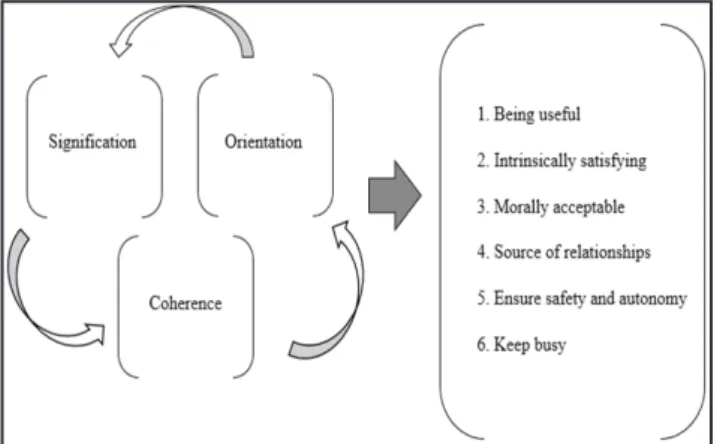
Integrating these perspectives, Morin (1997, 2001,
2007) deines the meaning of work as an affective structure
consisting of three dimensions related to several factors
(Figure 1): signiicance, related to values and representations
attributed to the work; orientation, related to the intentions that guide the actions that are taken; and coherence, which is how workers perceive harmony between the resultsthey get at work and their existential expectations (Morin, Tonelli, & Pioplas, 2007). This model has already been used for several years by Brazilian researchers (for an overview, see Bendassolli & Borges-Andrade, 2011; Silva & Tolfo, 2012; Tolfo, Coutinho, Baasch, & Cugnier, 2011).
In this study, the general purpose of investigating unemployment from the perspective of the meaning attributed to work unfolds in four specific operational
questions: (a) Are there speciicities in the meanings that the
unemployed attribute to work? (b) How does the duration of unemployment influence the meaning attributed to work? (c) How does the number of formal jobs held relate to the assignment of meaning to work? (d) How does the
unemployed person’s proile (age, gender, education, and
household income composition) relate to this meaning?
By speciicities in attributed meaning (Question 1), we
mean the existence of an empirical structure of meaning
Figure 1.Meaning of work theoretical model.Ellaboration by the authors based on Morin (1997. 2001. 2007).
factors among the unemployed similar to that found among employed workers. Although this study is not comparative in nature (employed vs. unemployed), the strategy we adopt
to answer Question 1 is to use an instrument for the meaning
of work that has been validated for employed people. This is the instrument inspired by the Morin model (1997, 2001) and
operationalized by Morin and Dassa (2006). This instrument
has previously been validated for the Brazilian context (Bendassolli & Borges-Andrade, 2011). Our hypothesis
is that if a conirmatory procedure (conirmatory factor
analysis) shows that the structure provided by the original
model satisfactorily its the data for the unemployed, then we will have evidence for a negative answer to Question 1.
Question 2 derives from published indings that point to the inluence of unemployment duration in predicting
psychosocial phenomena associated with unemployment (e.g., Chen et al., 2012; McKee-Ryan et al., 2005; Schunck
& Rogge, 2010). Question 3 is based on the premise that
work experience (in formal employment) may be related to
the meaning attributed to work, speciically, in the acception
of the meaning of work adopted in this study (Morin, 1997, 2001). Because the instrument developed by Morin addresses the characteristics that such work must have in order to be meaningful, it seems reasonable to assume that work socialization (inferred from work experience)
can inluence the structure of meaning assigned to work, even for unemployed workers.Finally, Question 4 relects
variables that are often cited in the literature as related to unemployment: age (e.g., Gallo, Bradley, Siegel, & Kasl, 2000), sex (e.g., Rantakeisu, Starrin, & Hagquist, 1999),
education (e.g., Vesalainen & Vuori, 1999), and house hold
income composition (e.g., Estramiana, 1992; Kelvin & Jarrett, 1985).
Method
Participants
The sample consisted of unemployed workers who accessed the units of the National Employment System (SINE) in the city of Natal/RN.The sampling strategy was accidental sampling, resulting in a total of 358 participants. However, as an inclusion criterion, participants had to be unemployed at the time of the survey. In fact, almost the entire population served by the SINE units in question consists of people seeking new formal job opportunities (unemployed people). We found that many had informal employment, but this did not act as an exclusion criterion because, according
to the ILO and DIEESE deinitions given in the introduction,
this is also considered to be an unemployment situation. Thus, the only exclusion criterion was having a formal work contract. The length of unemployment was not considered as an inclusion or exclusion criterion. However, as described below, the entire sample was composed of people who were in this condition for no more than six months, i.e., short-term unemployed persons (Winkelmann, 2014).
and only 0.3% were over 60 years.The sample was divided
in practically the same way with regard to sex, with 51.7%
male. The personal income of most participants (86.1%) was
not more than twice the minimum wage at the time of data collection. Turning to education, 52% had an incomplete higher education, 13.2% had completed high school, 10.1% had completed higher education, 9.8% had some type of graduate degree, 8.4% had completed primary education,
and 5.9% had an incomplete secondary education (0.6% of
the participants did not provide this information). For family income, 92% of the participants had the support of another, either one (34%), two (44%), or three (13%) people (spouse or relatives). The average duration of unemployment was
1.69 months (SD = 1.0), with an absolute variation from
one to six months.
Instrument
We used a scale for the meaning of work that was developed based on Morin’s (1997, 2001, 2007) theoretical
model. This 25-item version (Morin & Dassa, 2006) was
translated and adapted to the Brazilian context by Bendassolli and Borges-Andrade (2011). When using the scale (for
Canadian workers in the health ield and French-Canadian
managers), Morin obtained several factorial solutions through
exploratory analyses. The inal structure that resulted in the 25 items provides saturation in ive factors, which is the model adopted here to perform the conirmatory factor
analysis.
The ive factors found by Morin and Dassa (2006), with
their reliability indexes (Cronbach’s alphas), are as follows: Learning and Development (.89), with items addressing how much work enables growth, skill development, and
expressiveness; Quality of Work Relationships (.85),
evaluating the work environment, interactions, and companionship at work; Work Utility (.84), with items assessing the social function of work and its impact on people and society; Autonomy (.77), evaluating the perception of the subject’s freedom to organize work his or her own way; and Ethics (0,90), addressing the perception of justice and fairness in labor relations.
The scale was presented with four response options: 1 (strongly disagree), 2 (somewhat disagree), 3 (somewhat agree), and 4 (strongly agree). Sociodemographic questions were also added, concerning age, sex, educational level, length of time unemployed, number of formal jobs held in the past two years, and the household income composition
proile. Since the instrument was initially designed to be
applied to employed people, we proceeded with a pre-test
involving approximately 20 people with a similar proile to
the target participants. The objective was to determine any need for adjustments, which proved necessary. In our view,
this may be related to both the proile of the sample and the
fact that the instrument contains issues that induce people to think about work in general and also about a particular job, the current job. Because of this ambiguity, we decided to enter the instruction that when responding, participants should take into account their recent work experience.
Data collection procedure
This research was developed in the broader context of a partnership with the Department of State for Labour, Housing and Social Assistance of Rio Grande do Norte. This city’s
unemployment rates have relected the national proile since
2000. In 2012, the unemployment level in the state was at
7.1%, which is close to the national average (7.6 %; IBGE,
2013).
The instrument application sites were the units of the city’s SINE. The collection took place between November 2013 and April 2014 in four units that were active at the time of the research. Researchers visited the SINE units at different times and approached the people waiting for service. The application was divided into three stages: presentation
of the researcher and research, followed by clariication of
the procedures to be adopted and ethical care (anonymity,
purpose of the information, risks and beneits), and inally,
assisted (presential) application of the questionnaire. In the case of workers with a lower educational level, cards were used with different colors and shades to illustrate the Likert scale for each issue. The entire application procedure took
about 30 to 60 minutes. All ethical considerations involving
human research were observed.
Data analysis procedure
We explored the data in order to identify omissions and
the proile of the distribution, in view of the requirements that
are necessary for conducting the type of analysis we adopted.
In all, we identiied 11 missing cases, and as these represented
only 2% of the total sample, we decided to exclude them (listwise deletion). The number of participants previously presented took these exclusions into account. We also found
six variables with extreme univariate outliers (z-score ≥
3,9) that accounted for 1% to 3% of the total number of respondents to these variables. However, we chose not to delete these, given that the next step of the analysis was to identify multivariate outliers, those with the greatest impact on the type of analysis to be performed. Based on inspection of the Mahalanobis distance for each respondent (p <0.01),
31 cases were identiied and excluded.
Observing the values of asymmetry and kurtosis, we noted that these do not exceed the limits given by Kline (2011) and Marôco (2010) as critical for conducting a
conirmatory factor analysis based on the estimation of
maximum likelihood (|sk|<2–3; |ku| <7–10), which was the method we adopted. The range of values found in the data, with the correction for the elimination of multivariate
extreme cases, were|sk|:.63–2.0; |Ku|: 0.1–4.0. However, the Mardia coeficient indicates that the data differ from
multivariate normality. For this reason, and considering the size of the sample (for which other estimation methods are discouraged—see Marôco, 2010), we decided to perform bootstrapping procedures (with replications from 1,000
samples and a 99% conidence interval) to ensure greater
reliability of the parameters obtained.
(2011), and Marôco (2010), as a reference. For evaluating the quality of the local adjustment of the model, the factorial
validity (standardized factor weights λ ~ .50), the items’ reliability (R2 ≥ .25), and the internal reliability of the factors/latent variables based on Cronbach’s alpha (α ~ .70)
were considered. Factor analysis was performed with the AMOS software, version 21. After the empirical structure
was veriied, average comparisons were made between the ANOVA and the student’s t-test, and a correlation analysis
(Pearson test) was conducted between meaning factors and descriptive variables.
Results
Table 1 shows the adjustment indices for the original
model and the respeciied model. Concerning the former, we
note that, although a minimal acceptable solution was found by AMOS, this solution presents unsatisfactory adjustment
indices, thus requiring changes. The irst set of changes
consisted of checking the standardized factor weights for each item. At this stage, it was found that two items had values below the value stipulated as a minimum criterion (λ
~ .50). Thus, we excluded items 01 (concerning doing a job ittingthe individual’s skills) and 07 (concerning exercise
of the individual’s judgement to solve problems at work).
A second adjustment, indicated by the AMOS modiication
indexes, concerns the corre-lation between errors of items
within a single factor. Three cases were identiied: two in
factor 4, Learning and Development, between items 09 (“My job allows me to improve myself”) and 13 (“My job allows me to learn”) and between 04 (“Doing my job gives me great satisfaction”) and 22 (“I take pleasure in doing my job”), and one in factor 3, Work Utility, between items 02 (“My work is useful to society”) and 05 (“My work contributes to society”). We opted to allow these errors to covary freely amongst themselves. The correlation is most probably associated with the similarities in the semantic formulations of these pairs of items (especially in the Portuguese version), indicating overlap or redundancy between them.
With these changes, there is a notable improvement
in the it indices for the respeciied model (Table 1). All the model parameters proved to be signiicant (p <.001).
Index Original Model Respeciied Model
χ2
Gl
χ2/df
GFI TLI CFI RMSEA
790.36 265
2.98 0.84 0.85
0.86
0.07
409.39 177 2.31 0.90 0.92 0.93
0.06
Note: GFI = Goodness-of-Fit Index; TLI = Tucker-Lewis Index;
CFI = Comparative Fit Index; RMSEA = Root Mean Square
Error Approximation. Parameters estimated under p < 0,001. The reference values (Byrne, 2010; Kline, 2011; Marôco, 2010) are:
GFI, TLI and CFI ≥ 0,90; RMSEA ~ 0,05; χ2\/df ~ 1; χ2 = the
lower, the better
Table 1. Indexes of Adequacy of the Five Factors Model of Meaning of Work
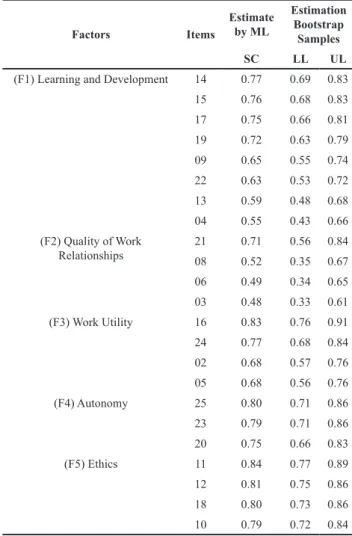
Table 2 presents the standardized estimation coeficients,
together with the (minimum-maximum) range produced by the bootstrap replications. In a visual inspection, we noted that the observed factor weights do not differ much from the range of values arising from those replications, which indicates that although the data do not exhibit multivariate normality, they are stable and reliable. The analysis of the standardized residuals matrix indicates no serious cases of variables with high values shared between them (z > 2). The only variable that contains a higher number of such residuals is 04 (“Doing my job gives me great satisfaction”), which
it shares with ive other variables. However, we decided to
keep this variable in the model, since its error covariance with that of item 22 is allowed.
In terms of consistency (alphas), most of the factors present reasonable to excellent indices, as shown in Table 3, which also presents the means for each of these. The factor means show little variation amongst themselves, although they are somewhat lower for factors 4 (Autonomy) and 5 (Ethics). To better explore possible statistical differences between the means by participant in the descriptive factors
Factors Items
Estimate by ML
Estimation Bootstrap Samples
SC LL UL
(F1) Learning and Development 14 0.77 0.69 0.83
15 0.76 0.68 0.83
17 0.75 0.66 0.81
19 0.72 0.63 0.79
09 0.65 0.55 0.74
22 0.63 0.53 0.72
13 0.59 0.48 0.68
04 0.55 0.43 0.66
(F2) Quality of Work Relationships
21 0.71 0.56 0.84
08 0.52 0.35 0.67
06 0.49 0.34 0.65
03 0.48 0.33 0.61
(F3) Work Utility 16 0.83 0.76 0.91
24 0.77 0.68 0.84
02 0.68 0.57 0.76
05 0.68 0.56 0.76
(F4) Autonomy 25 0.80 0.71 0.86
23 0.79 0.71 0.86
20 0.75 0.66 0.83
(F5) Ethics 11 0.84 0.77 0.89
12 0.81 0.75 0.86
18 0.80 0.73 0.86
10 0.79 0.72 0.84
Note: ML = Maximum Likelihood; SC = Standardized
Coeficient (factorial); LL = lower limit; UL = upper limit. Conidence interval for the bootstrap simulations: 99%;
probability estimates: p < 0.01.
Table 2. Standardized Coeficients and Estimate Ranges from
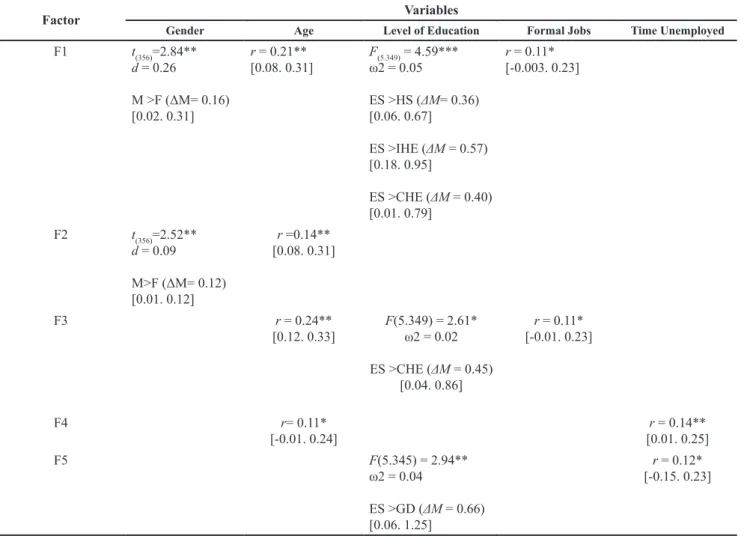
and other variables, we conducted several tests (ANOVA
and Pearson’s correlation); the results are summarized in
Table 4. Similarly to the conirmatory analysis, bootstrapping
procedures were also carried out for the test statistics (1,000
samples, 99% conidence interval); these intervals are also
shown in Table 4.
What can be observed from Table 4 is that men have a higher average than women in the Learning and Development
and Quality of Work Relationships factors. The educational
Factor Average (DP) Alpha
(F1) Learning and Development 3.51 (0.55) 0.85
(F2) Quality of Work Relationships 3.56 (0.45) 0.62
(F3) Work Utility 3.58 (0.57) 0.84
(F4) Autonomy 3.04 (0.84) 0.82
(F5) Ethics 3.14 (0.84) 0.87
Table 3. Average. Standard Deviations. and Factor Consistency Index
Factor Variables
Gender Age Level of Education Formal Jobs Time Unemployed
F1 t(356)=2.84**
d = 0.26
M >F (ΔM= 0.16)
[0.02. 0.31]
r = 0.21**
[0.08. 0.31]
F(5.349) = 4.59***
ω2 = 0.05
ES >HS (ΔM= 0.36)
[0.06. 0.67]
ES >IHE (ΔM = 0.57) [0.18. 0.95]
ES >CHE (ΔM = 0.40) [0.01. 0.79]
r = 0.11*
[-0.003. 0.23]
F2 t(356)=2.52**
d = 0.09
M>F (ΔM= 0.12)
[0.01. 0.12]
r =0.14**
[0.08. 0.31]
F3 r = 0.24**
[0.12. 0.33]
F(5.349) = 2.61*
ω2 = 0.02
ES >CHE (ΔM = 0.45)
[0.04. 0.86]
r = 0.11*
[-0.01. 0.23]
F4 r= 0.11*
[-0.01. 0.24]
r = 0.14**
[0.01. 0.25]
F5 F(5.345) = 2.94**
ω2 = 0.04
ES >GD (ΔM = 0.66)
[0.06. 1.25]
r = 0.12*
[-0.15. 0.23]
Note: * p<0.05; ** p <0.01; p<0.001. In brackets. the range estimated by bootstrapping replications. with 1000 samples and 99%
conidence level. Effect size (ω2 and d); ES = Elementary School; HS= High School; IHE = Incomplete Higher Education; CHE = Complete Higher Education;GD = Graduate Degree; ΔM = difference between averages of two groups. F1 = Learning and Development; F2 = Quality of Work Relationships; F3 = Work Utility; F4 = Autonomy; F5 = Ethics.
Table 4. Relationship between Meaning of Work Factors and Descriptive Variables
level inluences three factors of the meaning of work: the
lower the educational level, the higher the average factors in Learning and Development, Work Utility, and Ethics. The number of formal jobs is correlated with Learning and Development and withWork Utility (the higher the number of formal jobs in the last two years, the higher the averages assigned to those two factors). Unemployment time is correlated with the factors Autonomy and Ethics. Age is
associated with four of the ive factors of meaning at work. Finally, there were no signiicant relationships between the averages of the factors and the family income proiles.
Discussion
The discussion is organized around the guiding questions
of this study. The irst question concerned whether there were speciicities in the meanings attributed to work by unemployed workers. The fact that the conirmatory analysis
proposed by Morin (1996, 2001) and Morin and Dassa (2006) points to a negative answer to Question 1, that is, there were
no substantial changesto the structure envisaged by Morin’s original model, which was designed for employed workers, despite the exclusion of some questions. In the absence of substantial changes, we can assume that for the participants of this study, the structure of the assignment of meaning to work is similar to that found by Morin for professional healthcare workers and management and by Bendassolli and Borges-Andrade (2011) for artists.
However, this conclusion should be analyzed with
caution, as it may have been inluenced by methodological
decisions of this study and also by characteristics of the sample. Regarding the former, it must be noted that Morin and
Dassa’s (2006) instrument sometimes assumes that the person has a speciic and current job (in the sense of employment
— 21: “I can count on the support of my co-workers”) but also assumes a broad concept of work (such as occupation/ activity in a more permanent or stable sense—02: “My work is useful to society”). This may have led the respondents to think about work in general, as a human and social category, referring to their socialization, as predicted by MOW (1987). Moreover, the instruction that, when responding, participants should consider their recent work experience (for the reasons explained in the Method section) may also have contributed in such a way that the structure ofassigned meanings did not show substantive differences from the structure found by other studies using the same instrument.
With respect to the characteristics of the sample, the decisive factor was the length of time that most participants were unemployed (for 87%, between one and two months). Apparently, the loss of a job and its consequent absence for a short time do not interfere with the way workers attach meaning to their work. This can be due to at leasttwo aspects
of such an unemployment situation. The irst is that this
short period of unemployment may not yet be understood by the person as a lack of work, but only as a momentary withdrawal—similar to what happens over long vacation periods. This understanding may be motivated because unemployment has not yet shown its negative material effects, as these are minimized or are mitigated by the help of close relatives, unemployment insurance, or the worker’s own savings. The second possible explanatory aspect of the unemployment situation concerns the possibility that the workers, even if unemployed from their formal jobs, are involved in informal activities for which, objectively and subjectively, they would retain the psychosocial functions linked to work; Coutinho (2009) describes something similar with respect to informal work.
These ideas on the influence of the duration of unemployment lead to the second question of this research, which concerns precisely whether the durationis related to the meaning attributed to work. There are two plausible answers to this question. First, resuming the previous conclusion regarding the overall structure of the meaning assigned to
work within the model of Morin and Dassa (2006), we can
conclude that up to a certain point (in this case, approximately two months), it is not possible to identify significant differences in the structure of the meaning assigned to work,
despite the limitations discussed above. This inding seems to
differ from the indings in the literature regarding the impact
of the duration of unemployment on mental health indicators. Several studies have shown thateven a short duration (less than six months) is enoughfor experiencingthe harmful effects of job loss on mental health (e.g., Janlert et al., 2014; Jones, 1992; McKee-Ryan et al., 2005). Therefore, new studies could explore the possibility of differential effects of the mechanisms of psychological adaptation, which are better known in the case of mental healththan in the case of the meaning of work (Mohr & Otto, 2011).
A second plausible answer to the question about the duration of unemploymentis related to the characteristics of the meaning factors. As shown in Table 4, there is a correlation, weak but significant, between the duration of unemployment and theAutonomy and Ethics factors. Although very speculatively, we can imagine that the longer one is unemployed, the more one appreciates (or idealizes) autonomy (to reduce cognitive dissonance with the unemployment situation), and the more one tends to emphasize the importance of respect and regard for human dignity. However, studies have pointed out the ambiguous and contradictory role of autonomy for the unemployed: although it may be valued atthe beginning of unemployment, over time
it can turn into a cause of suffering because of the dificulty
that the unemployed have in sustaining a temporal structure in their daily lives (e.g., Jahoda, 1982; Mohr & Otto, 2011;
Paul & Moser, 2006a).
The third question concerned the relationship between the number of formal jobs held by the individual in recent years and the meaning attributed to work. Considering the characteristics of the instrument, the hypothesis was that there could be relationships between these. In fact, two
correlations, weak but signiicant, were identiied between
the number of formal jobs and the factors Learning and Development and Work Utility. Notably, 85.2% of the participants held one to two formal jobs in the previous two years, compared to 8.3% with more than two (and up to six)
jobs (6.5% of the responses were omitted). Again, it is not
possible to determine the precise number of jobs at which the correlation occurs, but only that the correlation seems to follow the accumulation of work experience (inferred from the number of formal jobs). Perhaps the variety of activities, contexts, and experiences helps explain the emphasis on the dimension of learning and growth associated with the meaning of work. This is convergent with the model used here (Morin, 1997, 2001, 2007).
These last indings should be put into perspective. It
should be taken into consideration that the short duration of unemployment may have contributed to the participants having recast the memory of their experience in their last job when responding, and not the fact that they had held a number of formal jobs in recent years. Even with all of the limitations mentioned, this result indicates the importance of work experience in the attribution of meaning to work, which is consistent with the literature, in that one of the determinants of the meaning of work is work experience (MOW, 1987).
The last question guiding this study concerns the relation
between the proiles of the participants (age, sex, education
and income composition) and meanings attributed to work.
education and greater work experience tended to assign higher values to the Learning and Development factor. This can be interpreted in two ways:due to their unemployment condition, they value and seek such a characteristic of work in order to facilitate their own employability; but they also value it due to their broader connections with the world of work through previous work experience, as already suggested.
It is noteworthy that there were no signiicant differences
relating to the composition of household income variable. This may be explained by the fact that most of the participants (92%) were not the only household members responsible for their own livelihood, since they were sharing income with spouses or family members.In any case, one question for future research concerns the impact of income on assignments
of meaning to work: Could a situation of inancial scarcity,
combined with a high responsibility for family support, possibly change the meanings attributed to work, understood as a structural dimension of human existence (and not just as a job)? In the case of the impact of unemployment on
mental health, the answer has been afirmative (Ezzy, 1993; Wineield, 2002).
Moving toward the end of this article, we present
a summary of its indings and limitations as well as its
contributions. For the summary, we can say that beyond the
conirmation of the factor structure of Morin and Dassa’s (2006) model, there is no evidence that this model must
be adjusted for research on the meaning of work for the unemployed. This is conditioned by the limitations of this study, some of which have already been highlighted. In particular, since all the participants were recently unemployed, the sample composition strategy may have hindered the emergence of assignments of meaning that are
speciic to the unemployment condition. The instruction for
participants to respond in light of their recent work experience may also have been similarly responsible for the results. As already explained, we decided to include this instruction in view of ambiguities in the issues that compose the Morin
and Dassa instrument (2006). However, these constraints
and limitations coexist with some contributions that this study has made.
This study contributes to a broadening of perspectives for understanding unemployment. It suggests, for future research, the heuristic possibility that the meaning of work factors can be used as moderating or antecedent variables of important facets of unemployment, such as mental health, well-being, and self-esteem (which are the most commonly investigated facets - e.g., McKee-Ryan et al., 2005). Researchers could operationalize explanatory models with these variables.
Another contribution concerns the issue of the length of unemployment. In research on the impact of this duration on mental health, there is evidence that the initial moments of unemployment can bring more harm than its prolonged duration, because of theactivity of adaptive mechanisms
(Paul & Moser, 2006a). Although the indings on this topic
are not free of controversy (Mohr& Otto, 2011), perhaps the impact of time on the meaning attributionprocess follows a different logic.
Prior work experience, by offeringto the individual a real
contact with work activities, can inluence the dimensions of
the meaning assigned to work (as illustrated in the present study, which shows differences in factor 1, Learning and Development, and 3, Work Utility, for workers who have held more jobs and thereforehave more work experience). Moreover, it is likely that the continuity of the meanings that are culturally disseminated regarding work, and that also have a part in socialization processes, are guaranteed even in the absence of activity, at least temporarily. This may be associated with the centrality of work (McKee-Ryan et al., 2005).
In addition, the pressions and tensions associated with job loss probably act differently on mental health indicators,
such as anxiety (due to inancial dificulties resulting from
loss of employment), than on values or preferences in relation to work (which are, in theory, more stable). In line with results reported by Mohr and Otto (2011) and Paul and
Moser (2006b), it is important to develop research aimed at
understanding meanings and expectations concerning work in order to foster action plans for the unemployed. What the unemployed expect from work can help in understanding and redirecting their integration strategies—obviously,
considering the inluence of personal variables (such as
age, gender, education) and contextual variables (economic situation, supply of jobs). It would be useful to deepen our understanding of the effect of the duration of unemployment on those meanings/expectations.
Finally, the prospect of using the meaning of work can be added to many existing strategies of psychosocial
intervention for the unemployed, speciically in the Brazilian
reality (e.g., Abs & Monteiro, 2010; Ribeiro, 2009). In the direction suggested by Mohr and Otto (2011), the focus for reintegration should also include, in addition to
qualiication or requaliication (Vuori & Vesalainen, 1999),
a concern with understanding the consistency or lack thereof
(Paul & Moser, 2006b) between the employment sought
and expectations, values, and work preferences—that is, work–self congruence, a central element in the model of the meaning of workpresented here (Morin, 1997, 2007). Such understanding would help in designing interventions for
transitions and resigniications of the work trajectory, such
as unemployment.
References
Abs, D., & Monteiro, J. K. (2010). Práticas da psicologia clínica em face do sofrimento psíquico causado pelo desemprego contemporâneo. Psicologia em Estudo, 15(2), 419-426.
Aaronson, D., Mazumder, B., & Schechter, S. (2010). What is behind the rise in long-term unemployment? Federal Reserve Bank of Chicago Economic Perspectives, 2, 28–51.
Antunes, R. (2009). Os sentidos do trabalho: Ensaio sobre a airmação e negação do trabalho. São Paulo: Boitempo. Argolo, M. A. D., & Araújo. J. C T. (2004). O impacto do
desemprego sobre o bem-estar psicológico dos trabalhadores da cidade de Natal. Revista de Administração Pública, 8, 161-182. Barros, C. A., & Oliveira, T. L. (2009). Saúde mental de trabalhadores desempregados. Revista Psicologia: Organizações e Trabalho,
Bastos, R. L. A. (2011). Desemprego na região metropolitana de Porto Alegre: Aspectos da experiência dos anos 2000. Revista ABET, 10(2), 184-205.
Bendassolli, P. F., & Borges-Andrade, J. E. (2011). Signiicado do
trabalho nas indústrias criativas. RAE-Revista de Administração
de Empresas, 51(2), 143-159.
Bendassolli, P. F., & Gondim, S. M. (2014). Signiicados, sentidos
e função psicológica do trabalho. Avances en Psicologia Latinoamericana, 32(1),131-147.
Brief, A., Konovsky, M., Goodwin, R., & Link, K. (1995). Inferring the meaning of work from the effects of unemployment.
Journal of Applied Social Psychology, 25, 693–71.
Byrne, B. M. (2010). Structural equation modeling with AMOS. New York: Routledge.
Cacciamali, M. C., & Cury, E. L. (2013). Desenvolvimento, mercado de trabalho e distribuição de renda. Revista Paraense de Desenvolvimento, 34(124), 55-72.
Chahad, J. P. Z., & Pozzo, R. G. (2013). Mercado de trabalho no Brasil na primeira década do século XXI. Temas de economia aplicada, 11-29.
Chen, L., Li, W., He, J., Wu, L., Yan, Z., & Tang, W. (2012). Mental health, duration of unemployment, and coping strategy.BMC public health, 12(1), 597.
Coelho-Lima, F., Costa, A. L. F., & Bendassolli, P. (2013). A produção científica da Psicologia brasileira acerca do desemprego. Universitas Psychologica, 12(4), 1283-1299. Coutinho, M. C. (2009). Sentidos do trabalho contemporâneo:
as trajetórias identitárias como estratégia de investigação.
Cadernos de Psicologia Social do Trabalho, 12(2), 189-202. Departamento Intersindical de Estatística e Estudos Socioeconômicos.
(1984). Sistema PED. São Paulo: DIEESE.
D e p a r t a m e n t o I n t e r s i n d i c a l d e E s t a t í s t i c a e E s t u d o s Socioeconômicos. (2014). Mercado de trabalho metropolitano em 2013. São Paulo: DIEESE.
Dooley, D., & Prause, J. (2004). The social costs of underemployment. New York: Cambridge University Press.
Estramiana, J. L. A. (1992). Desempleo y bienestar psicológico.
Madrid: Siglo Veintiuno.
Ezzy, D. (1993). Unemployment and mental health: A critical review. Social Science and Medicine, 37, 41-52.
Galeazzi, I. (2011). Desemprego. In A. D. Cattanni & L. Holzmann (Eds.), Dicionário de trabalho e tecnologia (pp. 100-105). Porto Alegre: Zouk.
Gallo, W., Bradley, E., Siegel, M., &Kasl, S. (2000). Health effects of involuntary job loss among older workers. Journals of Gerontology, 55, 131-140.
Garcia, L. S., Rodarte, M. M. S., & Braga, T. S. (2006). Desemprego
de longa duração como corolário da Década Neoliberal. In J. M. Januzzi & M. Soares (Eds.), As várias faces do mercado de trabalho no Brasil (pp. 54-78). Belo Horizonte: Fundação João Pinheiro.
Gómez, R. P., Morejón, A. R., & Sabater, C. R. (2008). Expectativas y duración del desempleo. Revista de Psicología del Trabajo y de las Organizaciones, 24(2), 129-151.
Hetschko, C., Knabe, A., & Schöb, R. (2013). Changing identity: retiring from unemployment. Economic Journal 124(575),
149-166.
Hoorn, A., & Maseland, R. (2013). Does a Protestant work ethic exist? Evidence from the well-being effect of unemployment.
Journal of Economic Behavior & Organization, 91, 1-12.
Instituto Brasileiro de Geograia e Estatística. (2013). Síntese de indicadores sociais: Uma análise das condições de vida da população brasileira 2013. Brasília: Autor.
International Labour Organization [ILO]. (2014). World of Work Report 2014: developing with jobs. Genebra: ILO.
International Labour Organization [ILO]. (1982). Resolutions concerning economically active population, employment, unemployment and underemployment.Genebra: ILO. Available
in https://stats.oecd.org/glossary/detail.asp?ID=2791
Jahoda, M. (1982). Employment and unemployment: A social-psychological analysis. Cambridge: Cambridge University Press.
Jahoda, M., Lazarsfeld, P. F., & Zeisel, H. (1971). Marienthal: The sociography of na unemployed community. Chicago: Aldine-Atherton. (Original publicado em 1933)
Janlert, U., Wineield, A.H., & Hammarström, A. (2014). Length
of unemployment and health related outcomes: A life course analysis. European Journal of Public Health, 24(5), 1-6.
Jones, L. (1992). Specifying the temporal relationship between job loss and consequences: Implications for service delivery.
Journal of Applied Social Science, 16, 37–62.
Kelvin, P. & Jarret, J. (1985). Unemployment: its social and psychological effects. Cambridge: Cambridge University Press. Kline, R. B. (2011). Principles and practice of structural equation
modelling. New York: The Guilford Press.
Marôco, J. (2010). Análise de equações estruturais. PêroPinheiro: ReportNumber.
McKee-Ryan, F. M., & Kinicki, A. J. (2002). Coping with job loss: A life-facet model. International Review of Industrial and Organizational Psychology, 17, 1–29.
McKee-Ryan, F.M., Song, Z., Wanberg, C.R., & Kinicki, A.J. (2005). Psychological and physical well-being during unemployment. Journal of Applied Psychology, 90(1): 53-76.
Mclaughlin, E. (2013). Understanding unemployment. London: Routledge.
Mohr, G., & Otto, K. (2011). Health effects of unemployment and job insecurity. In A. S. Antoniou, & C. Cooper (Eds.), New meaning in organizational psychology and behavioral medicine
(pp. 289-311). Surrey: Gower Publishing.
Morin, E. (1997). Le sens du travail pour des gestionnaires francophones. Revue Psychologie du Travail e des Organizations, 3(2/3), 26-45.
Morin, E. (2001). Os sentidos do trabalho. RAE: Revista de Administração de Empresas, 14(3), 8-19.
Morin, E. (2007). Sens du travail, santé mentale au travail et engagement organisationnel. Cahier de Recherche, 543, 99-193.
Morin, E. M., & Dassa, C. (2006). Characteristics of a meaningful work. Montréal: HEC.
Morin, E., Tonelli, M. J., & Pliopas, A. N. V. (2007). O trabalho e seus sentidos. Psicologia & Sociedade, 19(número especial),
47-56.
Meaning of Work International Research Team [MOW]. (1987).
The meaning of work. London: Academic Press.
Paul, K. I., & Moser, K. (2006a). Quantitative reviews in
psychological unemployment eesearch: An overview In T.
Kieselbach, A. Wineield, C. Boyd, & S. Anderson (Eds.),
Paul, K. I., & Moser, K. (2006b). Incongruence as an explanation
for the negative mental health effects of unemployment: Meta-analytic evidence. Journal of Occupational and Organizational Psychology, 79, 595-621.
Pinheiro, L. R. S., & Monteiro, J. K. (2007). Reletindo sobre
desemprego e agravos à saúde mental. Caderno de Psicologia Social e do Trabalho, 10(2), 35-45.
Rantakeisu, U., Starrin, B., & Hagquist, C. (1999). Financial hardship and shame. British Journal of Social Work, 29, 877–901.
Ribeiro, M. A. (2009). Estratégias micropolíticas para lidar com o desemprego: Contribuições da psicologia social do trabalho.
Revista de Psicologia Política, 9(18), 331-346.
Santos, E. J. R., Ferreira, J. A., Albuquerque, C. P., Almeida, H. N., Mendonça, M. C., Silva, C. S., & Almeida, J. G. (2010). Desemprego. Psychologica, 52(2), 35-44.
Schunck, R., & Rogge, B. G. (2010). Unemployment and its association with health-relevant actions. International Journal of Public Health, 55(4), 271-278.
Silva, N., & Tolfo, S. (2012). Trabalho signiicativo e felicidade
humana: Explorando aproximações. Revista Psicologia: Organizações e Trabalho, 12(3), 341-354.
Steger, M. F., Dik, B. J., & Duffy, R. D. (2012). Measuring meaningful work: The Work as Meaning Inventory (WAMI).
Journal of Career Assessment, 20, 322-337.
Tolfo, S. R., Coutinho, M. C., Baasch, D., &Cugnier, J. S. (2011).
Sentidos y signiicados del trabajo. UniversitasPsychologica, 10(1), 175-188.
Vesalainen, J., & Vuori, J. (1999). Job-seeking, adaptation and
re-employment experiences of the unemployed. Journal of Community and Applied Social Psychology, 9, 383–394.
Vuori, J., & Vesalainen, J. (1999). Labour market interventions
as predictors of re-mployment, job-seeking activity and psychological distress among the unemployed. Journal of Occupational and Organizational Psychology, 72, 523–538.
Wineield, A. H. (2002). The psychology of unemployment. In L.
Backman (Ed.), Psychology at the turn of the millennium (pp. 393-408). New Yourk: Psychology Press.
Wineield A. H., Tiggemann, M., Wineield, H. R., & Goldney, R.D.
(1993). Growing up with unemployment: A longitudinal study oits psychological impact. London: Routledge.
Winkelmann, R. (2014). Unemployment. In A. C. Michalos (Ed.),
Encyclopedia of quality of life and well-being research (pp.
6766-6767). Holanda: Springer.
Recebido em 26.07.2014 Primeira decisão editorial em 12.12.2014 Versão inal em 21.12.2014