Instituto Politécnico de Coimbra
Instituto Superior de Contabilidade
e Administração de Coimbra
Manjunath Shankar Bere
Logistic Operators- Operational Planning Performance & Decision
Targets
Coimbra, October 2017 ISCAC | 2 0 1 7 Manj un ath Sh an k ar Bere Lo g is ti c O pe ra tors - O pe rati on a l P la nn ing P erf orm an c e & Dec is io n T argetsInstituto Politécnico de Coimbra
Instituto Superior de Contabilidade
e Administração de Coimbra
Manjunath Shankar Bere
Logistic Operators- Operational Planning
Performance & Decision Targets
Relatório de estágio submetido ao Instituto Superior de Contabilidade e Administração de Coimbra para cumprimento dos requisitos necessários à obtenção do grau de Mestre
em Management Information Systems, realizado sob a orientação da Professora
Doutora Ana Cristina Santos Amaro e supervisão de Dr.ª Cristina Maria Falcão.
iii
TERMO DE RESPONSABILIDADE
Declaro ser o autor deste relatório de estágio, que constitui um trabalho original e inédito, que nunca foi submetido a outra Instituição de ensino superior para obtenção de um grau académico ou outra habilitação. Atesto ainda que todas as citações estão devidamente identificadas e que tenho consciência de que o plágio constitui uma grave falta de ética, que poderá resultar na anulação do presente relatório de estágio.
ACKNOWLEDGEMENTS
The completion of this internship report would not have been possible without the steadfast support of several people.
First of all, I would like to express my most profound appreciation and sincere gratitude to Professora Doutora Ana Cristina Santos Amaro, my Academic Supervisor, for her invaluable guidance, technical know-how, wisdom and professionalism throughout my work. I am also deeply grateful to Dr.ª Cristina Maria Falcão, my Company Supervisor, who always gave insights, expertise on the subject, comments and a valuable supervision of my internship. They are both excellent mentors and have provided support throughout my work. I would like to extend my heartiest thanks to them for their patience and kind involvement in this study.
I would like to thank Luís Simões group for providing me with an opportunity to work on this project. The successful completion of which, would not have been possible without the involvement of the employees working at Luís Simões. Namely, I would like to thank Elsa, Ângela, Joana, Susana, Patrícia, Ana and Cátia for their cooperation, insights, as well as for the organisational teachings and procedures.
I am indebted to the ISCAC | Coimbra Business School for the opportunity given to me in pursuing this Master’s program. My gratitude also goes to all the faculty members and the administration from the Coimbra Business School who provided me personal attention, academic support and primary material for the report.
At last, but not least, my acknowledgement goes to the people in my life who supported me throughout this process. A special and sincere thanks to my parents and all family members who provided their encouragement in my research.
My love and gratitude also go to the people dearest to me, who have been extraordinarily supportive and believed in me.
v
RESUMO
Este relatório apresenta uma perspetiva global sobre o estágio realizado no grupo Luís Simões, S.A., registando as atividades planeadas e as desenvolvidas.
O impacto alcançado pela logística, nesta "Nova Era" de dimensões mundiais, de tecnologias e de mercados inovadores, induziu uma progressiva motivação para esta área. Investigadores e profissionais reconheceram essas oportunidades e os novos paradigmas sociais associados, apresentando-os em diferentes artigos científicos e trabalhos técnicos. Desses destacam-se as contribuições com impacto no planeamento e escalonamento associado aos operadores logísticos. Estes registos foram importantes incentivos para o desafio proporcionado pela Luís Simões, S.A.
As principais atividades desenvolvidas durante o estágio centram-se no funcionamento regular de um operador logístico, como sejam: planeamento e agendamento de frotas,
controlo de armazém, monitorização, programação de clientes e de pedidos. Além disso,
faz ainda parte dos objetivos definidos o desenvolvimento de alguns indicadores-chave
de desempenho (KPIs). Posteriormente, pretende-se que esses indicadores sejam
integrados no novo sistema de informação, Sistema de Gestão de Transportes (TMS), cuja implantação foi iniciada na Luís Simões, S.A. Neste âmbito, conclui-se ser possível alcançar algumas melhorias relativamente a parametrizações, medições e monitorizações. Globalmente, trata-se de requisitos de personalização do TMS para as práticas diárias adequadas ao grupo na região de Coimbra.
Palavras-chave: Logística, Planeamento, Escalonamento, Otimização,
ABSTRACT
This report presents a global perspective on the internship carried out in Luís Simões, S.A group and it also registers the planned and the enrolled activities.
The impact reached by logistics, in this “New Era” of worldwide dimensions, technologies and novel markets, introduced a progressive motivation to this area. Researchers and practitioners have recognised these opportunities and the new related social paradigms, presenting them in different scientific and technical papers. A special focus is devoted to the contributions emphasising the impact of planning and scheduling of logistic operators. These contributions were important incentives to the challenge provided by Luís Simões, S.A.
The core activities developed during the internship concerned the regular operation of a logistic operator namely, fleet planning and scheduling, warehouse control, monitoring and programming of clients and orders. Besides that, the development of some Key
Performance Indicators (KPI) was also part of the objectives. Moreover, these desirably
would be integrated within the new information system, Transportation Management System (TMS), implemented in Luís Simões, S.A. Herein, some improvement can be achieved concerning parameterisations, measurements and monitoring being reportable. These can be considered as TMS customisation for the practices of the group in Coimbra region.
Keywords: Logistics, Planning, Scheduling, Optimisation, Key Performance Indicators
vii
TABLE OF CONTENTS
1 INTRODUCTION ... 1
1.1 Problem Statement ... 1
1.2 Objectives and Methodology ... 3
1.3 Report Structure ... 4
2 LITERATURE REVIEW ... 5
2.1 Logistic Operators ... 5
2.2 Transportation Planning and Vehicle Scheduling ... 6
2.3 Performance Management ... 9
2.3.1 Performance Measurement ... 10
2.3.2 Key Performance Indicators (KPI) ... 12
2.4 Management Information Systems ... 13
2.4.1 Transportation Management Systems (TMS) ... 13
2.4.2 Warehouse Management Systems (WMS) ... 15
3 CASE STUDY ... 17
3.1 Organisation Description ... 17
3.2 Mission, Vision, Values & Policies ... 18
3.3 PEST Analysis ... 22
3.4 SWOT Analysis ... 27
3.5 Organisational Operations ... 29
4 CORE CONCEPTS & FACILITY TOOLS ... 33
4.1 Functionalities of TMS ... 33
4.2 Information Systems in the Case Company ... 40
4.3 Visual Mapping of Routes ... 47
5.1 Logistic Operators – Characterisation of Performance Metrics ... 50
5.2 Definition and settings of the operational planning problem ... 57
5.3 Scheduling Proposal ... 62
5.4 Decision framework to help and support daily management ... 63
6 CONCLUSION & FUTURE DEVELOPMENTS ... 66
6.1 Conclusions ... 66
6.2 Further Developments ... 67
REFERENCES ... 69
APPENDICES ... 77
APPENDIX 1 – ORGANISATION STRUCTURE OF LUÍS SIMÕES ... 77
APPENDIX 2 - INTERVIEW QUESTIONS TO THE LOGISTICS MANAGER ... 78
APPENDIX 3 - WHAT LS GROUP AT COIMBRA ARE MEASURING ... 79
APPENDIX 4 – FEATURES & ADVANTAGES OF WTRANSNET PORTAL ... 80
APPENDIX 5 – CLIENT PARAMETERISATION ... 81
APPENDIX 6 - MACRO STRUCTURE OF e-TMS PLATFORM ... 82
ix
INDEX OF FIGURES
Figure 1 - Iberian Network of Luís Simões Group ... 17
Figure 2 - Organisational Structure of Iberian Transportation of Luís Simões ... 29
Figure 3 - Transport types in Luís Simões ... 30
Figure 4 - Exemplification of the plant and other centres ... 30
Figure 5 - General Functions of Planning Process ... 31
Figure 6 - Freight Management module of ERP... 44
Figure 7 - ERP Sales Control integration with ERP Freight Management ... 45
INDEX OF TABLES Table 1 - Luís Simões Logística Integrada S.A. details... 18
List of abbreviations
1PL First-party Logistics 2PL Second-party Logistics 3PL Third-party Logistics 4PL Fourth-party Logistics 5PL Fifth-party LogisticsAPD Absolute Percentage Difference
BCM Business Control Model
CSF Critical Success Factor
DC Distribution Centre
DEA Data Envelopment Analysis
DISC Distribution Scheduling
EDI Electronic Data Interchange
ERP Enterprise Resource Planning
FSP Fleet Scheduling Problem
FTL Full Truckload
GDP Gross Domestic Product
GIS Geo-Information Service
GPS Global Positioning System
GSM Global Systems for Mobile
JIT Just-in Time
KPI Key Performance Indicator
LS Luís Simões
LSP Logistics Service Provider
LTL Less than Truck Load
MIS Management Information Systems
xi
OR Operations Research
PI Performance Indicator
PM Performance Measurement
POS Process Operational Structure
QMS Quality Management System
RFID Radio Frequency Identification
SCM Supply Chain Management
SKU Stock Keeping Unit
TM Transportation Management
TMS Transportation Management System
TQM Total Quality Management
VRP Vehicle Routing Problem
VSP Vehicle Scheduling Problem
1 INTRODUCTION
This internship report is part of the Master program in Management Information Systems (MIS) carried out at ISCAC | Coimbra Business School. The internship has to fulfil the non-lecturing component of the Master, and it has the objective of providing students with valuable first-hand work experience in the field of studies of their masters’ branch and in this case, the logistics’ branch.
The internship was accepted in the group Luís Simões, Logística Integrada, S.A., at their office of Taveiro, Coimbra region and it lasted between November 2016 and June 2017. This period was held under the supervision of Dra. Cristina Maria Falcão, Manager of Luís Simões for Coimbra Region and with the academic guidance of Doutora Ana Cristina Amaro from the Master in MIS, of ISCAC | Coimbra Business School.
The internship took place for six months with a weekly workload of 40 hours, within a total of 960 hours, in accordance with the regulation stated for the second cycle courses of ISCAC | Coimbra Business School (e.g. article 21, paragraph 4).
The title adopted for the internship is Logistic Operators- Operational Planning
Performance & Decision Targets, accordingly with the desired core subject. So, to fulfil
the theme and the Master course requirements, a Logistics and Transportation company, was required to overlook the operational activities and challenges involved in the daily decision management.
Therefore, a proposal was submitted to the group Luís Simões, Logística Integrada S.A., for the theme. The Group recognised the interest of the subject, accepted the internship proposal and accordingly, the collaboration was established between the Coimbra Business School and the company.
So, the internship as a practical first-hand approach started in a broad reputed Logistics and Transportation Company in the Iberian Peninsula, the group Luís Simões. S.A.
1.1 Problem Statement
In last few decades, business globalisation and the new worldwide trade opportunities introduced significant challenges to companies. Under this scenario, managers had to fight against price pressure, product quality, variability and availability within strongly competitive markets. Globally, new management paradigms arrived from the new and emerging business perspectives. In here, the assurance of service levels to worldwide
customers represents a competitive advantage that strongly impacts companies’ performance. Logistic operators emerged in this context as essential chain links to ensure the commitment of customer requirements within feasible target levels. These are important motivations focused especially on the role of logistic operators. In the following paragraphs, the remaining key-words defined for this internship subject are also justified. Therefore, concerning the operational planning of logistic activities through an integrated Supply Chain Management (SCM), it is a recognised research topic in both perspectives, technically and scientifically. Thus, the detailed optimisation of logistic operators’ activities is essential not only to enhance their business consolidation but also to achieve resource savings and improve the entire chain operation. In practice, great expectations
are placed on planning.
In literature, several contributions cover planning problems subject. Typically, in supply chain management, decisions cover three planning levels (Bertrand, 2003; Manzini, Gamberi, Gebennini, & Regattieri, 2008), namely, i.) Strategic; ii.) Tactical and iii.) Operational. The significant differences amongst these planning levels are related to the planning horizon or time frame and with the details included in the problem description to management goals.
Moreover, the measuring and control of Key Performance Indicators (KPIs) assume an important role in companies’ managing strategies. This is due namely to the possibility of separate valuable information from unimportant, simplify complex subject matters and create transparency. KPIs are the basis for analysing and improving processes as well as benchmarking. The most commonly recognised functions of KPI are: i) support planning in various areas (e.g. strategy and budget); ii) requirement to set goals and to control the implementation; iii) basis for decision making within a company; iv) incentives especially for the top management, but for employees as well.
Also, the Information Systems (IS) play an important role to integrate the whole supply chain operations and give a competitive edge to enhance the efficiency and create higher client satisfaction. It is also possible to have a real-time monitoring of the logistic operators through the integrated information systems which provide agility, flexibility, and reliability in the operative functions of the firm.
In due course, various tools and planning/ scheduling applications were studied during the internship which was helpful for: i.) Logistic Operators – Characterisation of their
operational problems, metrics and available planning tools, decision support applications and information systems practices; ii.) Developing Key Performance Indicators for the operational activities; iii.) The exploration of scheduling proposal and iv.) The decision
framework that supports Logistic Operators’ managing and daily work decisions.
Globally, the operational planning of logistic activities is an important research subject for the integrated Supply Chain Management (SCM), recognised in the literature review and also known as a key topic in the organisational and technical fields.
1.2 Objectives and Methodology
The main objectives set for this internship project can be defined as follows:
• Logistic Operator – global characterisation covering the identification of: operational problems, available metrics, existing planning tools, current information systems, decision support applications and practices;
• Operational Planning Problem – Definition, settings and involved data (e.g. activities or tasks in the defined problem);
• Scheduling Tools – Study to support Logistic Operator decision processes;
• Decision Framework –Analysis concerning the daily management of logistic operator.
Concerning the methodology used to achieve the research objectives, the process followed during the internship consisted of three key steps. First, at the initial stage, the problems were identified from the preliminary state of art literature review. This process involved study in determining the gaps that were identified within the interest of research area. Several key research questions were generated from the research problems. The literature was thoroughly studied to determine whether those research questions had been answered. The research aim was recognised based on the final selection of research questions, and the research objectives were derived from the main aim of the study. As a result of the earlier step, it was necessary to study the information systems in the industrial environment. The Management Information System was explored, and the study resulted in the identification of the planning and scheduling problem involved in the transportation and logistics industry. Also, an exhaustive literature review was done to the information system employed in the case company. Hereinafter, Luís Simões, S.A. company will be referred to as “case company”.
Finally, during the last step of the research, the scheduling tools were explored. The data collection exercise involved a qualitative approach using interview and meetings with the logistic operators’ employees as a primary data gathering method. In this study, qualitative data and participative observation are primarily accommodated to ascertain the issues pertaining to transportation planning and scheduling in the case company. Besides that, some research design methodology was also explored.
1.3 Report Structure
This report is organised into six chapters that reflect the course of the work carried out in achieving the defined objectives.
In this chapter, as previously stated, the problem statement, the objectives and the methodologies implemented to achieve them were presented. Chapter 2, Literature
Review, is composed of a review and analysis of the state of art literature concerning the
theme of the internship.
Chapter 3, titled Case Study, describes the case company and examines the competition, resources and capabilities. Also, a detailed analysis is presented concerning the organisation and the involved operations.
Following the company presentation, Chapter 4 introduces the Core Concepts & Facility
Tools. In here, the concepts of transportation scheduling in relation to the objectives as
well as the tools employed in the case company are explained. In Chapter 5, named
Internship Activities, the development of the key performance indicators carried out in
the case company is presented, and the subsequent objectives are explained.
Finally, in Chapter 6, the conclusions are presented, and the final considerations are summarised, as well as the expectations and the achievement of the objectives. Furthermore, some future developments are also proposed.
2 LITERATURE REVIEW
This chapter describes the literature within the research area involved in the internship objectives. The main aim is to provide the foundations and to introduce the scientific and the technical contributions proposed so far in these fields. The first section of the chapter presents the literature concerning logistic operators and the planning parameters for the operational transportation planning. After that, the Performance Measurements (PMs) and decision support tools for the enterprise managers are presented.
2.1 Logistic Operators
According to the Council of Supply Chain Management Professionals1, logistic operators can be defined as, “Logistic operators own trucks to move goods or pick up freights, rail
cars and the locomotives to move the freight across long distances on the land. They possess and operate ships or aircrafts to move bulk cargoes across the ocean and also via the air, and also to other continents. Some logistic operators do not possess a fleet of vehicles but act as an intermediary to provide transportation to clients. All are essential links in the global supply chain that moves the good and freight to provide services to clients.”
Morgan Stanley’s report2 (2010) explains the concept of logistics and defines logistics as an integral of the supply chain process. The supply chain processes plans, implements, controls, and executes the effective and efficient flow of materials, storage of items, and the associated information from the point of source to the point of consumption to meet clients’ necessities.
The Morgan Stanley report extensively elucidates the logistic operators systematically in five considered categories namely- First-party Logistics (1PL), Second-party Logistics (2PL), Third-party Logistics (3PL), Fourth-party Logistics (4PL), and Fifth-party Logistics (5PL). The progressive augmentation of a numeric issue in PL designation is mostly related to the continuous trial of enlargement and integration of logistics service providers.
1 Council of Supply Chain Management Professionals- https://cscmp.org/
2.2 Transportation Planning and Vehicle Scheduling
Along a supply chain, several key decisions have to be made and coordinated according to the clients’ demand. These decisions are of different importance in different stages. They may comprise the rather simple question “Which vehicle has to be scheduled next on a respective route?” as well as a grim task whether to open or close a distribution centre (DC). The important decisions to be made is akin to being prepared beforehand. The preparation involves the job of planning. The planning process in the logistics and transportation industry consists of different recurrent tasks traditionally maintained subsequently. This planning process starts at the strategic level with collecting or forecasting data of client demand (Bunte & Kliewer, 2009). The planning supports decision-making by identification of alternatives to the future activities and selecting the optimal, or at least, the best possibility in the absence of optimal modelling (Domschke & Scholl, 2005).
Domschke & Scholl, (2005) further classify the planning process in different phases, namely: i) The identification and analysis of a decision problem; ii) The characterisation of the organisational objectives; iii) The future developments forecasting; iv) The identification and evaluation of feasible activities (solutions); v) Also, the selection of alternative solutions for informed decision-making.
Supply chains are very sophisticated in nature. Not every detail has to be agreed upon, but it should be respected in a plan and during the planning process. Therefore, it is perpetually essential to obscure from reality and to use an uncomplicated model of the realm, a so-called model, as a basis for building a plan. The art of “model building” is to characterise the world problem without merely ignoring the constraints of the real-world (R. E. Hall & Lieberman, 2012).
Forecasting and simulation models attempt to make an effort to anticipate potential developments and to describe associations between input and output of complex systems. However, they do not support the selection of one or a few solutions that are good regarding predefined criteria from a broad set of feasible activities (Nahmias & Olsen, 2015). These are the purposes for optimisation models, recognised a long time ago (Bertrand, 2003). Based on the length of planning boundaries and the significance of the decisions to be made, planning tasks are generally categorised into three different planning levels (Manzini et al., 2008).
Therefore, planning levels go from Long-term to Mid-term and from there to Short-term. Following this of all levels, the main characteristics of planning and sequencing are the reduced planning horizon (e.g., feasible time frame) and the increased operational details, the time required to accurately describe the operational policies (e.g., measuring frequency, monitoring, etc.) (Kreipl & Pinedo, 2004).
On the other hand, transportation arises to ensure physical flows and the interaction between different SC clusters, namely from suppliers to manufacturers and from them to final customers, while accounting for other intermediate chain partners (e.g. distribution centres, retailers, etc.). Usually, manufacturers require transportation services to transport raw materials and other products to geographically dispersed location, and also to distribute finished products in order to achieve client demands (Amaro & Barbosa-Póvoa, 2008a). The demand for final products with its regional and sequential distribution is exogenously defined as for the multitude of transportation planning process (Chopra & Meindl, 2015). However, the recognition for protecting the environment and the societal awareness towards the carbon emission levels, the researchers and practitioners have placed importance on the planning and scheduling of the transportation activities (Crainic, 2003).
The operational transportation planning focuses on lean operational decisions determining the mode and the carrier choice (Stank & Goldsby, 2000). The execution of shipment schedules and their modification are also part of the operational transportation planning process (Crainic, 2000). The transport planning task is also characterised as operational. It is also one of the major misunderstandings in operational transportation planning that vehicle schedule is only accomplished if the vehicles are solely used for the supply chain under consideration (Fleischmann, 2010).
As Crainic (2003), asserts while road transportation concerning the planning and scheduling perspective, a more interesting and practical classification differentiates them: i.) Long-haul transportation and vehicle routing distribution, VRP problems; ii.) The multi-modal transportation system of a region, irrespective of its dimensions; iii.) Consolidated transportation wherein vehicle or fleet of vehicles serve different clients with different starting point and destinations, also door-to-door deliveries to a particular client in case of customisation of services.
The strategic and tactical ends of the planning level can draw up guide operatives to handle the business, but the operational planning capabilities ultimately define the performance of the logistics and transportation industry.
Different issues are addressed at the operational planning levels in order to ensure the client demand is satisfied by optimising the efficient utilisation of available resources. Most importantly, time plays a crucial factor in the operational planning (R. Hall, 2012). Thus, in the real-time situation, the conformity to the time restrictions, integrating and optimising decision-making with the possible impact on the performances emphasises the critical aspect of the operational planning in the transportation industry.
Traditionally, the models in the transportation planning often use known static data called as input. The formulations for tactical plan consider aggregated forecast demand as “known.” Consequently, in the real-world problems, these models are subjected to constant changes and optimal solutions cannot be implemented as planned (Crainic, 2003). The set of uncertainties in the model are characterised by the real-world problems as these uncertainties are reflected in the operational planning models such as- vehicle scheduling problem, vehicle and crew scheduling problem, empty vehicle distribution and repositioning, terminal and linehaul operations, and dynamic allocation of resources (Amaro & Barbosa-Póvoa, 2009).
Vehicle Scheduling
The vehicle scheduling problem arises when the logistic operators or logistics service providers (LSPs) of transportation network must manage a fleet of vehicles to serve the clients in the present prospects of client demands. The capacities of the fleet are directly associated with the number of availability of vehicles. Thus, the optimal size of the fleet for a transportation network requires certain trade-offs to garner benefits for achieving
the targeted demands, the fixed costs of vehicles or fleet of vehicles and the penalty that will cost for not meeting the demands. However, for serving demands, the assignment of
vehicles and each reallocation (i.e. vehicle is in a different location) has to account for the fulfilment requirements, using the vehicle in a particular location. This assignment of vehicles or fleet of vehicles is part of the so-called vehicle scheduling in transportation perspective (Amaro & Barbosa-Póvoa, 2008b).
Generically, vehicle scheduling problems are commonly classified into three groups that is vehicle routing, fleet sizing, and fleet assignment. In the recent past, many types of research have been carried out on vehicle route optimisation, especially focusing on vehicle routing problem (VRP) with soft window (Hou, Jia, Tian, & Wei, 2013). Larsen, Madsen, & Solomon (2008) proposed an exact algorithm based on set partition to balance
the minimum number of vehicles required and the client demand satisfaction. Authors as Luo & Wu (2015) assert the integrated problem of vehicle scheduling and allocation. Besides that, fleet sizing is one of the problems existing in the real-world scenario and requires important decisions for significant investments as is the case in any business entities. Many researchers have conducted researches on fleet sizing problem (FSP). Żak, Redmer, & Sawicki (2011) studied the fleet sizing problem in a transportation and logistics firm with a heterogeneous fleet. Rahimi-Vahed, Gabriel Crainic, Gendreau, & Rei (2015) discussed the problem of the most desirable optimal fleet sizing for the vehicle routing problem, i.e., periodic VRP, multi-depot VRP, and multi-depot periodic VRP. Moreover, some research papers are focused on the fleet assignment or vehicle scheduling problems addressing from the perspective of optimisation of transportation model and the solutions. Xia, Li, Ma, & Xu (2015) addressed a comprehensive model that provides a solution for optimal fleet deployment, optimisation of speed and vehicle allocation is proposed while accounting for profit maximisation. Simão et al. (2009) proposed a model for large-scale dynamic fleet management and presented a dynamic programming to solve dynamic problems in the real-world. Also, Topaloglu & Powell (2007) introduced the concept of how to coordinate decisions to solve the issues related to pricing and vehicle scheduling of a carrier.
2.3 Performance Management
By its nature, the term “performance” is a diverse subject. Any business enterprise whether private or public has to remain within the boundaries of financial constraints and deliver the perceived value or money to its stakeholders. The term “performance
management” is a continuous process of identifying, measuring and developing the
performance of personnel, business teams and aligning overall performance with the strategic goals and objectives of the organisation (Lydenberg, Rogers, & Wood, 2010). In performance management, the Key Performance Indicators (KPIs) are in focus for estimating the efficiency of the organisation. The role of KPIs can be described in a performance management process (also called performance measurement process). These can be summarised as i.) KPI definition; ii.) Monitoring and Compliance; iii.) Data analysis; iv.) Improve business processes; v.) KPI Refine.
The KPIs should be evaluated any time when the Critical Success Factors (CSF) are reviewed. KPI also should be flexible in terms of any relevant changes in environment, processes, and conditions (Parmenter, 2015).
2.3.1 Performance Measurement
Performance measurement characterises the method of quantifying the efficiency and effectiveness of various processes and operations. The effectiveness signifies how the client requirements meet and the efficiencies signify how effectively the organisation resources and assets utilised to ensure the service level (Neely, Gregory, & Platts, 1995). For a brief understanding of performance, there is always a better way to start with a definition. According to Dwight (1999), “the performance is a degree to which the goals
attain.” Authors like Meier, Lagemann, Morlock, & Rathmann (2013) states, “the performance is an ability of the firm to attain goals and objectives.” In pursuit of realisation and evaluation of goals, performance measurements must quantify the effectiveness and efficiencies. On the other hand, Samsonowa (2011) assumes that the
effectiveness signifies the level of goal fulfilment and the efficiency indicates how well the corresponding processes perform to meet those goals.
The performance indicators of the specific process remain the same irrespective of how an organisation measures their performance and which system they may use (Parmenter, 2015). According to Jordan & Messner (2012), the basic function of performance indicator is to facilitate the management for necessary action and provide means of control and enhance to meet the strategic objectives. Waal (2003) states that the measurement influences the action plan which generates a behaviour pattern to align the business environment, culture, and strategic objectives of an organisation. It is extremely important that performance indicators require strong association with the business strategy to ensure efficiency of an organisation and create a positive environment which aligns the corporate culture.
The concept of performance measurement originated in the early 1980’s in Manufacturing industries. The conceptualisation and development of PMs through varieties of innovations such as Just in Time (JIT), and total quality management (TQM) took place (Wong & Fung, 1999). Supply Chain Management is an integrated structure with a primary goal to link business operations with business functions and therein to provide a platform for performing cohesively and building a high-performance business model.
There is one crucial aspect which deems necessary for an organisation to benefice from PMs is to have a strong connection to the organisation strategy to ensure the applicability (Neely et al., 1995). The organisation requires correlating its mission, vision, and objectives to align PMs with company strategy successfully. The step an organisation must consider is to identify its critical success factors (CSFs) and appropriate PMs and derive those measurements into company’s vision, mission, objectives, and core values. One of the difficult task for managers is to derive these measurements into strategic form and making those measurements as tangible as possible (Franceschini, Galetto, & Maisano, 2007). Choosing a right indicator is a daunting task and as authors Franceschini et al., (2007) further asserts, “A strategy without indicators are useless; and indicators without a strategy are meaningless.”
The indicators form a foundation of PMs in the evaluation of how well the organisation is adhering to its strategic goals and objectives. The metric, unit, type of PM varies in the literature of PMs, and there are various definitions found in the literature which describes measurements that evaluates the degree to which the goal fulfils. There are several measurements commonly identified in the literature are: “performance metrics”, “critical success factors”, “key result indicators”, “key performance indicators”, “key success indicators”, “success measures”, “strategic measures”, “performance criteria”, and “indexes" (Samsonowa, 2011). Furthermore, the terms which are relevant and are of interest in recent years among academicians and practitioners are, “performance indicators”, “key performance indicators”, “performance metrics”, and “performance measures” (Stadtler, Fleischmann, Grunow, Meyr, & Surie, 2014).
Although the term performance indicators differ between academia and the practitioners, this is mainly due to the existence of priority where academicians concern with definition, evaluation, validation, and generalisation of the process of measurement and evaluation of performance. Whereas, practitioners deal with the applicability and usefulness of the specific business arena. In actual practice, a combination of a technical reference and what is practically feasible is relevant in the industrial world. It is therefore extremely essential to analyse the theory suggested and understand the practical relevance. The non-parametric practices existing for performance measurement such as Data Envelopment Analysis (DEA) would be challenging to adapt and make the high applicability of it. According to Franceschini et al., (2007) states that the indicators as a tool for performance measurement are of great interest both to the academicians and the practitioners.
2.3.2 Key Performance Indicators (KPI)
In any business enterprise, it is indeed crucial to establish and gauge the efficiency to find out that whether the enterprise is operating according to the established standards and operating procedures while identifying the actions required to enhance the performance levels to meet those expectations within an organisation. Key Performance Indicators are often termed to be an essential instrument for measuring the business activities, as they are quantifiable and required to achieve business goals and objectives.
The success of an organisation in the fast-growing businesses, it is required that corporate management must understand their strength and weaknesses. Key Performance Indicators (KPIs) are the quantifying parameters that reflect the success factors of the business environment. For effective supply chain integration, the KPIs are vital tools for monitoring and improving the efficiency to gain competitiveness in the global market (Taylor, 2010). Also, Chae (2009), addresses that a well-built performance indicator (PI) is an essential factor for competitiveness in the global market. There are quite a many measures in the literature discussing the means to improve SCM system (Folan & Browne, 2005), while few of them in the literature discuss having a clear view and avoid ambiguity. Also, many SCM performance indicators are static and on many occasions lag behind in the distinctive working contexts of the supply chains (Neto & Pires, 2012). There can be many types of indicators that can be employed in an organisation. However, Folan & Browne (2005) are critical in terms of viewing the maximum number of indicators as fallacious and asserted that there are a minimal number of indicators that improve the efficiency of an organisation and they named it as key performance indicators (KPI). Van der Vorst (2000), categorises the performance indicators into three levels, namely: i.) The supply chain level; ii.) the logistics level; and iii.) the process level. Also, Pettersen (2009) asserted that in order to have an effective and efficient supply chain management, it is necessary to measure the performance indicators with four levels- profit, time, delivery promptness, and waste elimination.
Authors as Wong & Wong (2008) made a critical analysis of the literature and indicated that the performance measurements are not viewed as a whole supply chain entity and further indicating the fact that performance measurement is difficult with multiple inputs and outputs. The supply chain performance indicators that are measured in the form of output-input ratios provide robustness, reliability, and flexibility in the supply chain (Asadi, 2012).
2.4 Management Information Systems
The information system in logistics presents an integral part of any logistical system, providing the functional area of logistical management. The objective of the information logistics are the information flows, reflecting the material movement, finance, and many other operations related to the logistics.
A necessary condition for the coordination of all units of the logistics system, turns out to be the existence of information system, which should be capable, to process, to provide quickly and economically the right signal directed to the right point at the right moment (Bowersox, Closs, & Cooper, 2011).
Management Information Systems (MIS) are composed of computing and communication hardware, operating systems, and applications to support business processes (i.e. wide array of business functions) which aid to accomplish the goals and objectives of an organisation (Surwade, 2016). In Portugal, the use of computerised planning systems in the industrial environment is nonetheless limited (Azevedo, Romão, & Rebelo, 2012).With the increased complexity and global demand for large varieties of products, dynamic supply chains need to be coordinated without comprising the flexibility of the networked organisation (Verwijmeren, 2004).
The concept of a supply chain is in fact based on the value-chain network comprising of the functions directed towards providing available resources and the information to achieve objectives of an efficient supervision and management of the suppliers as well as the flow of supplies (Lau & Lee, 2000).
Global supply chain networks cannot entirely rely on a particular technology or the platform. The literature review classifies functional technologies in the supply chain into sections that specify issues associated with the characteristics of collaborations are evaluated. The challenges of implementing new technologies in these groups to existing platforms are analysed and exploited.
2.4.1 Transportation Management Systems (TMS)
The commercial software suites applied to operate an enterprise’s transport services are designed primarily to satisfy the requirements of standardised and dynamic carrier communication. They are mentioned as “transportation management systems” (TMS). Nevertheless, these systems are designed to manage the manufacturers’ interfaces to the
logistics service providers (LSPs) and are therefore largely transaction-based (Caputo, Pelagagge, Scacchia, Caputo, & Scacchia, 2003).
In recent years, transportation management systems (TMS) have earned significant recognition across all industries (House & Jackson, 1995). They are characterised as “software applications that expedite the procurement of transportation systems, the short-term planning process and optimisation of shipping activities, and the implementation of consignment plans with continuous analysis and collaboration” (Helo & Szekely, 2005). Transportation Management processes are determined by a transportation demand, which in turn is deducted from goods demand (Hall, 2012). Also, while in the past, the information availability has been a significant obstacle in many cases to performing high-quality transportation planning (Stank & Goldsby, 2000), with the implementation of TMS, this information does become accessible at high-quality standards. In the consumer goods sector, the industries have been aware of the importance of transport challenges for quite long time, and as such has been the first to implement the TMS application for greater ease in the operations.
The TMS application suites are well integrated and have extended functionalities to cover the transportation management problems from planning to real-time tracking and tracing, and from payment services to freight tendering (De Muynck, 2015). Nowadays, the cases in which Enterprise Resource Planning (ERP) software vendors develop some extended TMS functionalities, these have been acquired through mergers and acquisitions. Most probably, the main being the G-log by Oracle and the most recent one being the acquisition of i2 by JDA.
De Muynck (2015) explicitly differentiates between exact TMS solutions, fleet-based routing and scheduling software. On the other hand, McLaughlin, Motwani, Madan, & Gunasekaran (2003) present a case study on the implementation of a TMS application, although they do not use the term TMS but refer to the implemented system as a “business process tool for freight management”, which further implies that today's TMS suites are transaction-based order management tools.
In the past, demand for TMS services was mainly triggered by managers of extensive transportation networks but now, due to the innovation focus has shifted from strategic planning processes (e.g., total cost sourcing decisions) toward improving the effective operational planning and scheduling features, are largely available (Capgemini, 2011). However, the number of TMS merchants that operate favourably on a worldwide scale is
very confined (Connaughton, 2008). The leading global vendors of TMS are currently i2 and Oracle (G-Log), closely followed by JDA (Manugistics) and Manhattan Associates (Connaughton, 2008; De Muynck, 2015). Lauterbach & Metzger (2015) indicate that SAP introduced the first release of its TM (Transportation Management) module (release 6.0). However, Connaughton (2008) states that the consumer base is still minimal and business feedback from consumers is limited. However, there are also a substantial number of small TMS vendors that claim these software companies are successful in their home markets. Since the regional TMS markets have been controlled by a large number of local players who are best at understanding the specifics that concern to the transportation markets in their home regions (Capgemini, 2011).
2.4.2 Warehouse Management Systems (WMS)
Warehousing is known as an essential competitive component of a supply chain. Consequently, Warehouse Management Systems (WMS) have, in most applications, become necessary to efficiently achieve the increasing levels of warehouse performance required (Faber, Koster, & Velde, 2002). WMS have frequently not kept up with changes inside and outside the warehouse, nor reflected relevant developments in Operations Research (OR) (Lahmar, 2008).
A WMS is a software package that gathers, scrutinises, and communicates the information necessary to move goods or items through a warehouse or distribution centre (DC). From this information, a WMS can guide employees on the best ways in which to perform warehouse activities (e.g., where to put or where to find an item), and, as such, governs the flow and storage of products through the facility.
Like ERP systems, WMS software is provided as a set of modules from which the organisation in question must choose. Common to all modules is the ability to review and communicate activity information, such as product activity, facility performance, and inbound and outbound movements. The overall role of WMS has also extended, with some systems offering capabilities related to import-export, coordination of multiple warehouses, full accounting systems, labour planning, the ability to connect with the advanced planning tools, returned-goods management amongst others (Richards, 2017). Potential benefits of WMS implementation have been reported by authors such as Min & Zhou (2002) and Faber, Koster, & Velde (2002). Piasecki (2007), however, notes that the size of this reduction in comparison to total inventory often is minimal because ‘‘the
dominant factors that control inventory levels are lot sizing, lead times, and demand variability. It is improbable that a WMS will have a significant impact on any of these factors.’’
A WMS application is distinguished as a ‘‘logistics execution system.’’ Moreover, it is designed for day-to-day operational planning activities. A WMS plans at a reasonably low level, typically not extending beyond the facility walls. The primary function of a WMS is not an optimisation of the process; instead, it performs a supervisory function concerned with the activities within the warehouse with the goal of making the best use of the resources (capital and labour) (Ballard, 1996).
Planning at a level higher than that of the WMS needs a software that is not confined to the analysis of one particular area. For example, the Advanced Planning and Scheduling Systems (APS) make available the Operations Research (OR) competencies in the optimisation package that are required in WMS and other planning systems (Green, 2001).
A WMS has developed autonomously, and hence have a unique association with, enterprise resource planning (ERP) systems. As Frazelle (2001) explains, in ERP systems, the warehousing module ‘‘is typically an afterthought application for these software providers and the full-suite provider.’’ As a consequence, most ERP systems require the functionality to aid the warehousing and transportation activities adequately (Frazelle, 2002; Handfield & Nichols, 2002; Spiegel, 2003). Lacefield, (2005) states that several ERP vendors now claim their systems to be capable of handling supply-chain processes. The market for WMS and many other logistics execution systems is mature; it is hard to differentiate warehouse software based only on processes ‘‘inside’’ the facility. This situation has led the WMS developers to focus on the issue of product flow. Applications have been added to better coordinate warehousing with other activities in the supply chain (Poirier, 2016).
3 CASE STUDY
In this chapter, the case company "Luís Simões Logística Integrada, S.A." is presented. The company’s mission, vision, values and policies along with the SWOT analysis and the competition in the Iberian Peninsula are presented. Also, the organisational operations are explained below in detail.
3.1 Organisation Description
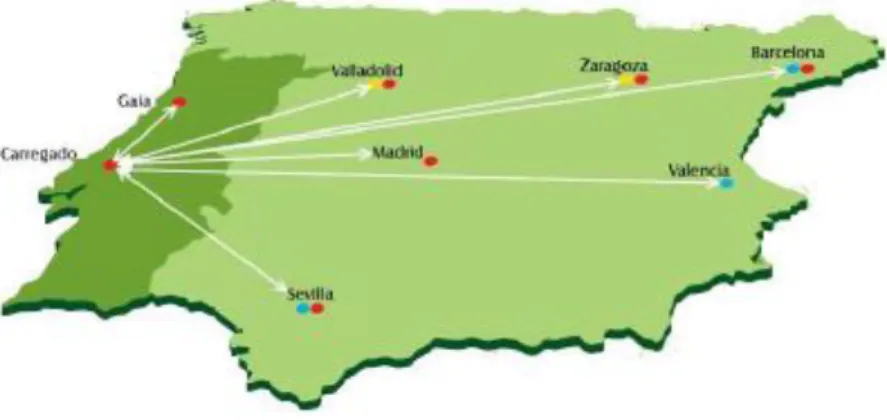
The Luís Simões Logística Integrada S.A. is a subsidiary company in the transport and logistics industry of Luís Simões group. It is business entity founded in 1948 in Portugal, and 100% of its capital belongs to Luís Simões family. The organisational structure of Luís Simões is presented in Appendix 1. The core business of LS is transport and logistics, but the company has been expanding its business to other areas such as Rent a Cargo and Technical Services (RETA), Corporate Management, and Real Estate Businesses. The market of Portugal and Spain are the focus of company’s operations. Moreover, having founded in 1990, the LS spread across Iberian Peninsula which can be seen on the map below-
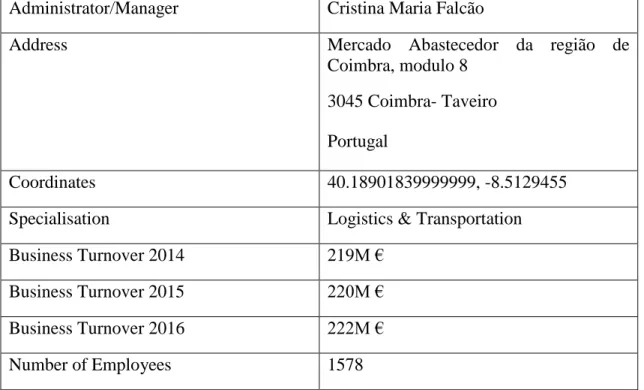
The details of group are enumerated in the table1 below-
Table 1 - Luís Simões Logística Integrada S.A. details
Administrator/Manager Cristina Maria Falcão
Address Mercado Abastecedor da região de
Coimbra, modulo 8 3045 Coimbra- Taveiro Portugal
Coordinates 40.18901839999999, -8.5129455
Specialisation Logistics & Transportation
Business Turnover 2014 219M €
Business Turnover 2015 220M €
Business Turnover 2016 222M €
Number of Employees 1578
3.2 Mission, Vision, Values & Policies
It is essential to know the Mission, Vision, Values and Policies that guide the company and all its employees because they are part of the organisation's purpose.
i. Mission
The purpose of the mission is to explain to its employees and stakeholders the purpose and rationale of the organisation in a transparent way (Johnson, Scholes, & Whittington, 2008). For Luís Simões, its mission is to “Ensure efficient and competitive transport, Logistics and supporting service solutions, promoting the client satisfaction and that of society in general, from the economic, social and environmental point of view.”3
ii. Vision
A vision is something that organisation aspires to be in the future (Johnson et al., 2008). LS has the following vision: “To be the Iberian company of reference in terms of quality of service for Transport and Logistics sector.”
iii. Values
The values are the “principles” that guide the organisation’s strategy (Johnson, Scholes, & Whittington, 2008). The organisational values of Luís Simões presented below, are in line with the Mission and Vision, thus serving a guide for all its collaborators-
• Client Orientation: To exceed client expectations by providing value-added services supported by flexible, innovative and technologically advanced solutions;
• Respect for people: To guarantee the continued qualification of all employees, developing their skills for different and challenging performances of their activity, with quality and security;
• Sustainability: To support the organisation’s sustained development through transparent and socially and ethically responsible conduct;
• Trust: To instil group and employee performance with respect towards colleagues, clients, and suppliers, believing in each other’s working skills and the advocacy of LS values;
• Loyalty: To base day-to-day practice upon the professionalism, operational rigour and transparent relationships, placing LS interests above personal interests, in order to protect institutional credibility and positive image;
• Innovation: To focus management on structured processes, supported by modern technological systems, contributing to the development of competitive advantages in relation to the market;
• Environment: To implement sound environmental practices, reducing the adverse effects resulting from our activity and protecting the surrounding environment;
• Concern for safety: To guarantee the best working conditions through preventive measures, in order to eliminate risks inherent to the activity and preserve the employees’ well-being.
iv. Policies
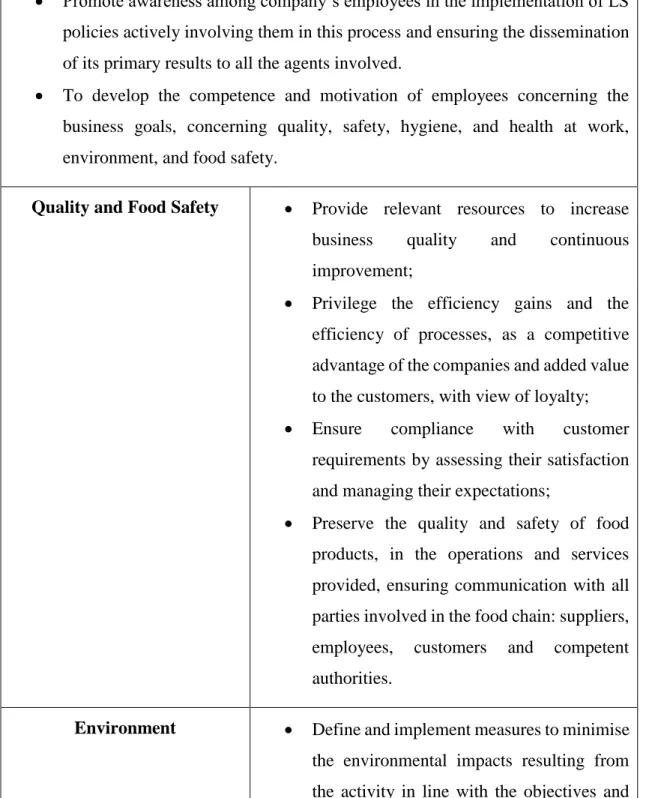
The Luís Simões organisation makes some commitments based on its values (table 2)-
Table 2 - Policies of LS Group
• Comply with appropriate statutory and regulatory requirements, as well as other subscribed requirements whether the environment, food safety, other plans of their responsibility to society.
• Promote awareness among company’s employees in the implementation of LS policies actively involving them in this process and ensuring the dissemination of its primary results to all the agents involved.
• To develop the competence and motivation of employees concerning the business goals, concerning quality, safety, hygiene, and health at work, environment, and food safety.
Quality and Food Safety • Provide relevant resources to increase
business quality and continuous improvement;
• Privilege the efficiency gains and the efficiency of processes, as a competitive advantage of the companies and added value to the customers, with view of loyalty; • Ensure compliance with customer
requirements by assessing their satisfaction and managing their expectations;
• Preserve the quality and safety of food products, in the operations and services provided, ensuring communication with all parties involved in the food chain: suppliers, employees, customers and competent authorities.
Environment • Define and implement measures to minimise
the environmental impacts resulting from the activity in line with the objectives and
targets defined and revised on a regular basis taking into account the most significant environmental aspects, measuring and evaluating the results obtained to ensure their effectiveness continuously;
• Continuously improve the environmental performance of the company to prevent pollution, reduce waste, atmospheric emissions, and energy consumption, using natural resources rationally.
Health and Safety at Work • Provide the necessary resources to prevent
occupational hazards, improve safety conditions in the performance of the activities and to monitor the health of the employees, to develop their skills and to raise awareness on occupational safety and health.
Social Responsibility • Promote a transparent relationship with
stakeholders and society in general, whether through the commitments expressed above or through the development of targeted actions, to promote personal, professional, family valuation, information, raising awareness and of solidarity directed towards external entities.
3.3 PEST Analysis
i. Political/Legal4
In Portugal, the evolution of the legislative framework for road transportation activity took place in the following stages:
a) In the first half of the 1980s, total liberalisation of transport within a 50-km radius granted the fleet to work for others, and also to operate in the long haul led to the concentration of transport operators in this type of traffic;
b) In the second half of the 1980s, there was no increase in the range of distribution (i.e.,> 50km), which meant that the transport in private fleets was carried without restrictions. Even though being the case of lower returns, these legislative developments led to the decrease in the rate of global fleet usage;
In 1986, Portugal joined the European Economic Community (EEC).
c) During the 1990s, national and international licenses were granted based on the experience and/or size of the fleet. While the national market was accessible to the majority of transporters, who were asked for more than three years of experience in the local market and the possession of a minimum Social Capital equivalent to the value of two lightweight trucks. While access to the international market to the companies with more than three years of experience at national level and a fleet of summation of the gross vehicle weight with more than 22 tons totalled and less than 220 tons;
This internationalisation took place in 1995 with the Schengen agreement which ends control of Europe's internal borders.
d) In 1999, private transport and carriage were not subject to any legislation. For transport on behalf of others in heavy vehicles, the legal framework was embodied in Dec. Law no. 38/99, with national and international licenses being granted by compliance with three requirements, designated by conditions of access to the profession: Suitability, Professional Capacity, and Financial Capacity. Upon verification of these conditions, the licenses were granted to access the market
4 The Information for Political/Legal analysis was adapted from Associação Nacional de Transportes Públicos Rodoviários de Mercadorias (ANTRAM) documents
through vehicles that were identified correctly and licensed for the public transport, after registration with the competent authority Directorate-General for Land Transport (DGTT)5.
Currently, market access is regulated by Decree-Law no. 257/2007 of 16th July, which established the legal framework governing the issuance of licenses and access to freight road transportation on a contractual and initial fee basis and is regulated by the Institute of Mobility and Land Transport, (IMT). The digital tachograph became compulsory on vehicles weighing more than 3500 kg and with registration after May 1, 2006, is a fundamental tool in the control of driver schedules.
Specific labour laws for professional drivers are increasingly demanding (EC Regulation 561/2006) and its increasingly heavy penalties (Law no. 27/2010).
This situation among the highly competitive market and the fuel prices in recent years (e.g., since 2005, the fuel price was increased by 50%, and it peaked in 2015, 1.52€ and also in 2016 by 1.50€) led to cause of obstruction in this sector. Also, the maximum paralysis caused by the financial crisis of 2008 and during the rise of fuel prices in 2011. ANTRAM6, the National Association of Road Transport is the most significant employer association in this sector. The association has successively called for a reduction of petroleum products, something that the government has not yet conceded.
With regard to incentives, there are several programs that the sector can take advantage of, such as SIMIAT, PRIME, SIME, and SIPIE.
ii. Economical7
Europe
Eurozone Gross Domestic Product (GDP) will have grown by 1.7% year-on-year in the first quarter of the year, Eurostat said on 3 May in its first estimate of the economic performance at the start of 2017. The figure was in line with expectations and reinforces the continuation scenario of the Eurozone's slow recovery this year.
5 Information extracted from - Direcção-Geral de Transportes Terrestres (DGTT) 6 ANTRAM - http://www.antram.pt/
The EU as a whole will have grown by 1.9%. If these figures are confirmed, Portugal should have grown more than the average of the monetary union. INE released the first estimate on 15 May.
"Compared to the same quarter last year, seasonally adjusted GDP grew by 1.7% in the Eurozone and by 1.9% in the EU to 28 in the first quarter of 2017, after 1.8% and 1.9% in the quarter ", the Eurostat (2017) statement said.
"Seasonally adjusted GDP increased by 0.5% in the Eurozone and by 0.4% in the EU-28 during the first quarter of 2017 when compared to the previous quarter, according to the rapid estimate published by Eurostat, the statistics office of the EU ", reads the press release.
The figures are in line with forecasts of a slow recovery in the Eurozone. The European Central Bank (ECB), which updated forecasts in March, expects Eurozone GDP growth of 1.8% this year and 1.7% in 2018, after 1.7% in 2016. The European Commission, which will update forecasts this year (December 2017), pointed in February to a growth of 1.6% this year.
Portugal
In the Stability Program, presented at the end of April, the Government revised the economic growth forecast upwards for 2017 from 1.5% to 1.8%, aligning its estimate with that of the Bank of Portugal. In February, however, the European Commission, pointed to 1.6%.
iii. Socio-Cultural8
At the socio-cultural level, in order to demographically characterise the country, the Portuguese population at the end of 2011 totalled 10,561,614 people, of which 48% are male and 52% female.
Region wise, the Alentejo has misplaced populace in the remaining of last decade (-2.5%), and the Central region also confirms a slight reduction of population (-1%). The Algarve and the Autonomous Region of Madeira have very significant increases in population, compared to 2001, respectively + 14.1% and + 9.3%. In the North, the
8 Data from the socio-cultural analysis were taken from Instituto Nacional de Estatística (INE) documents
population steadied, and Autonomous Region of the Azores shows a small upsurge of 2%.
The country strengthened the pattern of growth and development of the previous decade and further expanded the concentration of the populace in the large urban zones of Lisbon and Porto. The most of the municipalities of the interior lost population. In 2011, 198 municipalities registered decreases in population compared to 171 municipalities in 2001 (INE, 2011).
When analysing the behaviours and lifestyles of the national population, taking into account which may influence the road transport sector, it is national road haulage that is well above the average European Union, as well as the development of the consumer society it uses with commercial areas to meet their needs.
There are high rates of accidents mainly due to the low level of safety measures adopted by national drivers who do not practice defensive driving. On the other hand, the alcohol consumption in Portuguese society, many drivers exceed the statutory value (0.5 g / l) when driving. It is, therefore, necessary to implement a set of measures into the dangers of their actions, as well as more stringent legal and enforcement measures.
iv. Technological
In a business world where R&D is increasingly decisive and consequently technologically innovative for cost reduction and productivity of road haulage is no exception. With regard to technological innovation, it is relevant to mention four critical vectors of development: security, communication, logistics, and Environment. Of these four vectors, we highlight transport vehicles - where the significant advances are seeking to investigate and develop economic resistance with respect to complying the strict anti-noise and low pollution standards imposed by the European Union.
Security
Being considered the most important vector for road transport companies, since it is ultimately about the integrity and well-being of its members. Employees, notably drivers, necessary measures have been taken in order to ensure the standardised manufacture of vehicles on the road and to ensure the safety of crew as well as the safety of third-party drivers. Thus, it is exemplified that the installation of automatic control devices and onboard devices such as the black box (allowing, as in other transport, in case of accident
establish the reasons and causes of a road accident, facilitating the investigation process and seeking to avoid similar future situations).
Two other examples are- the approval by the European Commission in 2001, and other being the imposition of the installation of speed limiters in all vehicles of more than 3.5 tons or having more than nine seats. However, the introduction of an electronic driving license which exchanges information enables the authorities for identifying the offenders more quickly.
Regarding innovation, an agreement is being programmed to design to ensure the presence of active safety system installed in all vehicles. These safety systems may include- vehicle distance control, vehicle collisions avoidance, the physical state of drivers, progress related to the type of composition of tires, less water projection, factors determining the adhesion of tires to the ground, and alerts for pressure loss in tires.
Communication
Advances in communications are equally important in this sector, not only in enabling remote monitoring of the fleet and their recovery in case of theft but also in the control of consumption and distances. One example is the installation of GPS systems in the vehicles, thus strategic analysis of a Transportation Company with better management of routes and vehicle traffic, also trying to avoid potential congestion, minimising the danger of accidents, and allowing the reduction of fuel consumption. Another case is the use of GSM mobile phones, the features offered by this type of portable device are- permanent contact between the base/seat and the vehicles and avoidance of unnecessary routes. Wherein this portable device permits better assistance and control of the service provided as well as minimising the potential delays in deliveries.
Logistics
Associated with transportation, is the logistics through which the goods pass, from the place of manufacturing, through loading, transport, unloading, and to the point of sale. The Internet and other means of support are increasingly being used, with the aim of integrating the communication systems between the companies responsible for transport/logistics and the final customer, thereby being an existence of a permanent monitoring and control of stocks, eliminating the surpluses of warehouses of distribution companies.
It becomes more frequent in transport sector that to overcome the competition in an attempt to the inclusion of services provided in the logistics component for a vertical integration of a supply chain process, elimination of one of the intermediaries of the