Process Optimisation and
Minimal Processing of Foods
Proceedings of the second main meeting
European Commission
COPERNICUS PROGRAMME
Concerted action CIPA-CT94-0195
Warsaw
Agricultura
l University, War
saw, Poland, Dezember
1996
Editors : Jorge C. Oliveira and
Marc E. Hendrickx
Project Coordinator : Fernanda A. R. Oliveira
Area leader : Marc E. Hendrickx
The proceedings of the second workshop organised by the COPERNICUS concerted action Process Optimisation and Minimal Processing of Foods in December 1996 at the Agricultural University of Warsaw, Poland, consist of five booklets, one for each project area:
• Thermal Processing • Freezing
• Drying • High Pressure
• Minimal and Combined Processes
Each booklet includes all communications that were presented at the meeting, either orally or in poster, and later forwarded by the authors as written text, plus the questions and answers that were recorded. As with the set of booklets related to the first meeting, some editorial effort was put into trying to harmonise the written style and improve the readability of the texts, but no scientific reviewing was performed.
The third and final project meeting will lead to a third set of booklets. A book including selected papers is also being prepared, to be published by a professional scientific publisher.
We would like to thank all participants that have generously contributed to making the project meetings very successful and lively, and particularly to those that have taken the effort to present oral or poster communications with accompanying written texts. This effort has allowed the project to gather a very good set of disseminating materials and we hope that in this way the project results can be of better use to all partners and to a wider audience.
Porto, October 5th, 1997 Fernanda A. R. Oliveira Jorge C. Oliveira Marc E. Hendrickx i
Foreword
iii
Table of Contents
C.L.M. Silva
Optimization of Thermal Processing Conditions: Objectives, Opportunities and Challenges 1
P. Verboven, N. Scheerlinck, J. De Baerdemaeker and B. M. Nicolaï
Importance of the Local Surface Heat Transfer Coefficient
in Thermal Food Process Calculations: a CFD Approach 18
S. Akterian
Strategy for Controlling Thermal Processes
in Case of Random Fluctuations of the Heating-Medium Temperature 26
M. Proks, J. Dobiás and M. Voldrich
Overall Migration of Volatiles from Plastics
and Paperboard Packaging Materials During Food Heating 33
J.-C. Leuliet and S. Lefebvre
Mixed Convection in a Constant Wall Heat Flux Exchanger 37
J. Korolczuk, J.P. Tissier, V. Breton-Dollet and J.F. Maingonnat
Effect of Heating Temperature on the Microstructure of Maize Starch Gels 44
J. Korolczuk, V. Breton-Dollet, J.P. Tissier, J.F. Maingonnat
Rheological Properties and Microstructure of Maize Starch/Milk Proteins Gels 47
P.S. Fernández, F. Rodrigo, P. Periago and A. Martínez
Effect of Environmental Factors on the Thermal Resistance of Spores 52
N. Barrett, A. Grandison and M. Lewis
Contribution of the Lactoperoxidase System to the Keeping Quality of Pasteurised Milk 60
T. I. Wirjantoro and M. J. Lewis
1
Optimization of Thermal Processing Conditions:
Objectives, Opportunities and Challenges
C.L.M. Silva
Escola Superior de Biotecnologia, Universidade Católica Portuguesa, Porto, Portugal
Abstract
Research work on the determination of optimal thermal processing conditions for food products is critically reviewed in this communication. Special relevance is given to the identification of the more adequate criteria and objective functions normally used to establish conditions that assure the safety of the final product and optimize the process, respectively. The analysis focuses mainly on previously published work and on recent results obtained by the author’s research group. These include examples for sterilization of pre-packaged food products, hot-filling pasteurization of acid fruit pulps and continuous pasteurization of acid fruit juices. A main conclusion of this literature review is that the work done in this field is still quite limited. Furthermore, few authors attempted to validate optimal conditions for maximizing final product quality and existing work concerns very limited specific conditions. Two case studies are presented. One focuses on the experimental validation of estimated optimal processing conditions for maximizing the final quality of in-pack sterilization of peach puree. The quality attributes considered are colour and total carotenoids. Colour is experimentally evaluated at the surface and in volume average terms and it is quantitatively measured using a colourimeter and a taste panel. A more theoretical example is also presented for the optimization of hot-filling pasteurization of acid fruit pulps. The more adequate restrictions and corresponding processing conditions are discussed. Finally, the use of freezing storage before pasteurization of acid juices as a way to optimize product quality is also discussed.
1. Introduction
It is well know that thermal processes, such as pasteurization and sterilization, are very important to stabilize foods and assure its microbiological safety, but also cause its quality degradation. When a thermal process is applied, part of the product’s original nutritional and sensorial quality is lost. Although the negative effect of thermal processes cannot be avoided, it can be minimized. After the identification of the process purpose, it is possible to optimize process conditions (Manvell, 1997). The main objective of the optimization of thermal processing conditions is always the maximization of the final nutritional and/or sensorial product quality.
2
The nutritional quality, such as vitamin content, is important in terms of public health, but the consumer’s perception goes to food sensory attributes, such as texture, colour, flavour, etc. (Silva, 1993). Thermal processing conditions can also be optimized in terms of economic aspects. The energy consumption can be minimized (Barreiro et al., 1984) or the productivity can be
maximized (Banga et al., 1991). Obviously, in this situation a compromise must be attained in
terms of the final product quality (Banga et al., 1991; Silva et al., 1993).
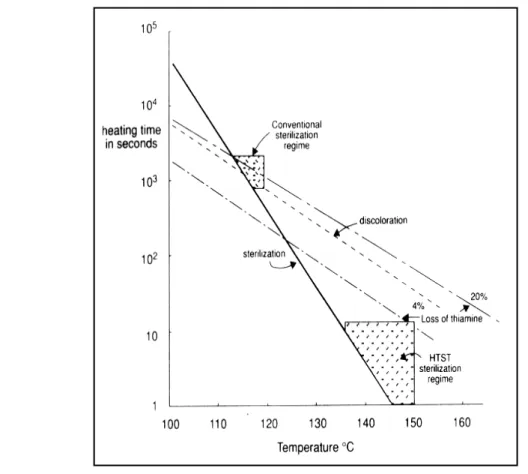
The quality optimization of thermally processed food products is possible due to the different temperature dependency of the thermal degradation kinetics of target micro-organisms and quality attributes. This is the basis of the high temperature short time (HTST) principle. In figure 1 the bold line corresponds to equivalent time - temperature processing conditions in terms of microbial lethality. It can be observed that at higher temperatures the quality factors are relatively more thermal resistant. Therefore, a HTST sterilization regime (UHT treatment), when applicable, results in products with superior quality.
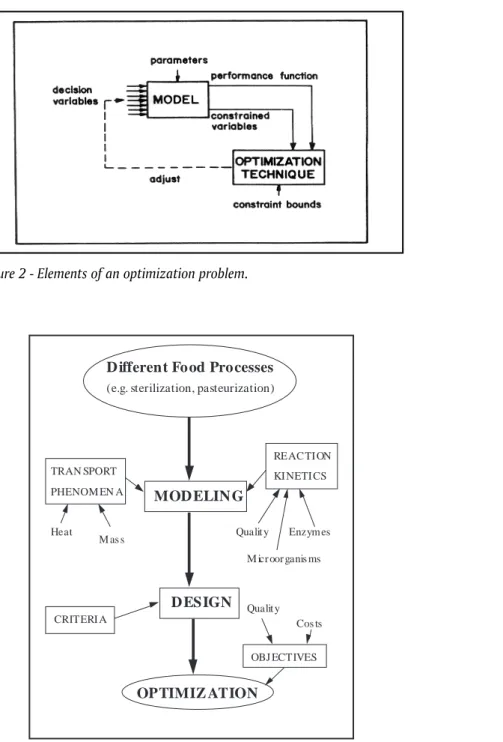
Five elements are common to all optimization problems: (i) the identification of the design variables that can be controlled, (ii) the requirements that must be met (constraints or restrictions), (iii) the definition of the objective function (the mathematical expression of what is to be optimized), (iv) the mathematical model of the situation and (v) an optimization technique (Norback, 1980). Figure 2 presents the links between these elements. The relevant parts of the mathematical model are presented in more detail in figure 3. Mathematical modelling of heat
3
Figure 3 - Steps for the optimization of the thermal processing conditions of foods. Figure 2 - Elements of an optimization problem.
and mass transport phenomena and micro-organisms, enzymes and quality attributes degradation kinetics have to be taken into consideration.
2. State of the art
Most of the published research work in the field of optimization of thermal processing conditions for food products deal with sterilization of prepackaged food products (Silva et al., 1993). The target
microorganism normally used to determine food safety is Clostridium botulinum (Richardson et al.,
1988), for which the z value is 10°C (Pflug et al., 1978). Common constraints are: (i) a target sterility
value at a single point:
D ifferent Fo od Pro cesses (e.g. sterilization, pasteurization)
MOD ELIN G D ESIGN OPTIMIZ ATION TRAN SPORT PHENOM EN A REACTI ON KI NETI CS CRITERI A OBJ ECTIVES Heat M as s Qualit y Enzym es
M icr oor ganis ms
Cos ts Qualit y
4
(1)
or (ii) an integrated sterility value representing the volume average survival of micro-organisms (Stumbo, 1973):
(2)
The least-lethality point (LLP) position is usually considered at the geometric center. A sterility value specified at the LLP position assures a minimum sterility in all points of the food and is the most adequate criterion (Silva et al., 1993). Few authors studied the effect of different constraints
on optimal processing conditions.
The most common objective function is the maximization of product quality. In pre-packaged products the quality can be optimized in volume average terms or at the surface. Surface quality is particularly important for sensory properties. On the other hand, volume average quality is more relevant for nutritional parameters (Ohlsson, 1980a). Very few authors took into consideration the minimization of process costs (Silva et al., 1993). Although the maximization of product quality is
the more important objective, it may be possible to define an objective function that could lead to high quality, near the maximum possible value, but with significative cost savings. Banga et al.
(1991) considered the minimization of the total processing time in order to improve the productivity of the process. They used an additional constraint on the final product surface quality retention, to ensure an adequate quality of the final product. However, very few studies of this type exist.
The quality thermal degradation kinetics is normally considered to be first order:
(3)
and the reaction rate temperature dependence is described by the Arrhenius law:
(4)
or by the Bigelow model:
(5)
Furthermore, very few data exists on the kinetics of sensory parameters determined with a taste panel (Holdsworth, 1990), although the final evaluation of the food product is done by the consumer.
Most of the heat transfer mathematical models available in this field have the same common assumptions: (i) the product heats by pure conduction, (ii) the product is homogeneous, (iii) there
Fc= 10(Tcz-Tmref)dt 0 tp C C = e -k t = 10- t / D C k = kref exp(- Ea R ( 1T - 1T )) D = D x 10Trefz - T ASM = 1 VT 10 -(F(V)/Drefm) dV 0 VT FS = Drefm log(ASM) T Tref ref
5 is no surface resistance to heat transfer, (iv) the heating medium temperature is constant (CRT - constant retort temperature), (v) there is no heating medium come-up-time and (vi) the geometry is cylindrical. Few authors attempted to validate experimentally their models (Silva et al., 1993), and when a
validation was attempted it was often with model foods. More realistic conditions, such as for example heating by convection, non regular geometries, particulated foods, were not considered. The limitations of the available models often result from limitations in computing capacity and accuracy of the model parameters.
The determination of optimal sterilization temperatures to minimize the thermal degradation of food quality attributes has been a subject of study since 1969 (Teixeira et al., 1969a). Silva et al.
(1993) presented an extensive literature review about modelling optimum processing conditions for the sterilization of prepackaged foods. Most of the research work available assumes constant retort temperature. A limited number of studies exist on the optimization of variable retort temperatures (VRT) (Noronha, 1995). Very few authors validated experimentally the predicted optimal conditions (Silva et al., 1994; Banga et al., 1993). This type of study requires the selection
of a food quality indicator and the quantification of its degradation kinetics, the characterization of the heat transfer into the product and finally the experimental determination of the best processing conditions and its comparison with predicted values. The quality of the products must be evaluated analytically and by a taste panel, and a correlation between both measurements must be made. Although time-consuming, this work is essential to assess the usefulness of any mathematical procedure (Silva et al., 1993).
In the field of continuous thermal processing and less severe thermal treatments, such as pasteurization, there is a complete lack of research on the determination of optimized processing conditions. Particularly for pasteurization processes, it is difficult to identify the adequate criteria to ensure the stability of the products. Furthermore, for pasteurized products, usually with shorter shelf-lives, the consumer expects a superior quality. Therefore, the optimization of sensory parameters, such as aroma, flavour and colour, is of great interest for this type of products.
3. Case studies
Ongoing research work at the author’s laboratory is presented in this item
3.1 Critical evaluation of restrictions used to optimize sterilization processing conditions
The geometric center is usually considered the least-lethality point for a cylindrical package (Ball and Olson, 1957). This assumption is correct if it is solely the heating phase that is included in the calculation of the sterility value. Figure 4 presents a case study where the LLP position is different from the geometric center. Teixeira et al. (1969b) were the first to discuss the localization of this point.
6
They concluded that the least-lethality point is not always at the center and that the correct position depends on the container geometry and processing conditions. If the cooling phase is also taken into consideration for the sterility value calculation, the least-lethality point appears along the radius or the vertical axis, depending on the half-height to radius ratio (Flambert and Deltour, 1972). The Flambert and Deltour (1972) research assumed no surface resistance to heat transfer. Recently Silva and Korczak (1994) presented a similar study for the existence of surface resistance to heat transfer. They concluded that the processing temperature, target sterility and the kinetic parameters of the micro-organisms do not significantly affect the location of the least-lethality point. However, the package dimensions and the heating rate of the product (this variable also takes into consideration the surface heat transfer coefficient) have a great influence on the least-lethality point position.
Several research works on the theoretical calculation of optimal sterilization temperatures have been presented in literature (Teixeira et al., 1969a, 1975a; Thijssen et al., 1978; Saguy and Karel, 1979;
Ohlsson, 1980a,b; Thijssen and Kochen, 1980; Nadkarni and Hatton, 1985; Bangaet al., 1991). Silva et al. (1993) concluded, from a review on this research field, that the two optimization restrictions
most commonly used are a target integrated sterility value, as defined by Stumbo (1973), or a sterility value specified at the geometric center of the cylindrical container. As explained above, neither of these two constraints is the most adequate. A target sterility value specified at the least-lethality point is the most correct criterion, however there is no research work that makes use of this target for the calculation of optimal sterilization temperatures.
Therefore, the purpose of this research was a critical evaluation of the restrictions normally used to optimize sterilization processing conditions. Optimal temperatures maximizing the surface or the volume average quality retention were calculated using the three different criteria. The differences between optimal temperatures were studied as a function of food properties, processing conditions and target lethality (Silva and Korczak, 1994).
Figure 4 - Example of time-temperature profiles of the heating medium, and at the geometric center, LLP position and surface of a cylindrical can.
7
3.1.1 Study of the least-lethality location
The least-lethality point position for a conduction heating product packaged in a finite cylinder container was studied as a function of different variables such as package dimensions, heating rate, surface heat transfer coefficient, heating medium temperature, target lethality and kinetic parameters of the microbial death kinetics. The heating medium temperature, target lethality and kinetic parameters of microbial death have no relevant effect on the least-lethality point location. The most important variables to determine this position are the package dimensions and the heating rate of the product (which takes into consideration the overall surface heat transfer coefficient).
When the half-height to radius ratio is approximately equal to 0.9 the least-lethality point position is at the center. This happens also when this ratio is very small (smaller than 0.1) or very large (larger than 4.0). When the half-height is smaller than the radius (0.1<H/R<0.9) the least-lethality point is located along the vertical axis. The least-lethality point is located along the radius (0.9<H/R<4.0) when the radius is larger than the half-height. The least-lethality point is closer to the geometric center for slower heating products (larger fh), which corresponds to products with lower thermal diffusivity and/or larger dimensions.
A similar work, considering infinite surface heat transfer coefficient, was also carried out by Flambert and Deltour (1972). Under experimental conditions with no surface resistance to heat transfer the only variable affecting the position of the least-lethality point was the package dimensions, and the heating rate of the product had no significant effect.
3.1.2 Effect of different restrictions on optimal sterilization temperatures
Optimal sterilization temperatures, maximizing the volume average or the surface quality, using as restriction a target sterility value specified at the geometric center or at the least-lethality point, were calculated for 14 case studies. Different surface heat transfer coefficients, heating rates of the product, package dimensions, target sterilities and kinetic parameters of the quality attribute were taken into consideration.
When there is no surface resistance to heat transfer the difference between optimal temperatures, using the two constraints, is negligible. However, when a finite surface heat transfer coefficient exists, the difference ranges from 0.5 to 3.6°C. This difference becomes more significant for case studies with larger zqvalues. The difference between the two optimal temperatures, using as restriction a target sterility value at the geometric center or at the least-lethality point, for maximizing surface quality is smaller than the corresponding difference of temperatures for maximizing volume average quality. To compare optimal temperatures using as restriction an integrated sterility value or a sterility value specified at the least-lethality point, the two criteria values must be equivalent in terms of microbial lethality. A few case studies were carried out and under these conditions there is not a significant difference between optimal temperatures.
8
3.2 Objective functions
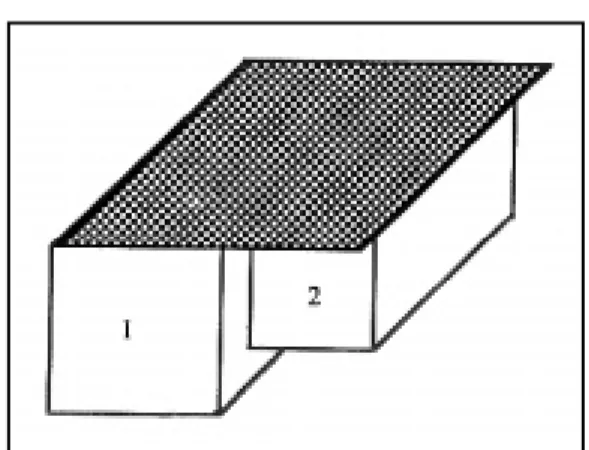
The packages with two rectangular divisions (Figure 5) are very practical from the consumer point of view. However, the existence of different food products, processed under the same sterilisation time-temperature heating conditions, represent a real problem regarding the final safety and quality. To mathematically model the thermal sterilisation of meals in this type of pack it is necessary to consider two rectangular containers at the same time and define adequate criteria to assure the safety in both divisions. Both rectangular containers have also to be considered if optimum conditions, for maximising the final quality of the overall meal, are to be determined. There is no study in literature dealing with this type of problem (Ávila and Silva, 1996b).
The objectives of this research study were: 1) the development of a model to describe the thermal sterilisation of different food products in packages with two rectangular divisions, 2) the definition of the most adequate sterilization criteria for rectangular containers and 3) considering quality factors with different degradation kinetics in each pack division, define a new objective function for maximizing the overall product quality retention.
The volume average quality retention in each division of the package was optimised
(6)
as well as the mean value of the two divisions.
(7)
Optimal conditions were calculated as a function of the heat penetration rate, surface heat transfer coefficients and z-values.
Optimising the quality factor with higher temperature resistance to degradation (higher z-value) can considerably damage the food product with lower z-value. Optimising a mean retention value in both divisions takes considerable advantages in lowering overprocessing of the less resistant quality factor and barely affects the retention of the other. Therefore, to calculate optimum conditions for rectangular packages a new objective function taking into consideration the mean value of the overall quality retention in each division was proposed (Ávila and Silva, 1995).
Figure 5 - Three dimensional two division rectangular pack with metal lid.
(C/Co)ave = 1 VT 10 1 Dref 10(T - Tref) / z dt 0 tp dV 0 VT
9
3.3 Validation of optimal sterilization conditions
The experimental validation of predicted optimal sterilization conditions for canned peach puree is currently being carried out.
The thermal degradation kinetics was determined for two quality indicators: i) total carotenoids and ii) colour, evaluated analytically using a Hunter colourimeter and by a taste panel. The thermal degradation of total carotenoids is well described by an irreversible first order kinetics (an example of an isothermal experiment is presented in figure 6) (Ávila and Silva, 1996a)
(8)
and its temperature dependence modeled by the Arrhenius law. This model also fits well the kinetic data of the colour parameters: 1/a, 1/TCD and b/(La) (figure 7). To quantify the colour of the samples the panel used a continuous scale of 1 to 9, where 1 corresponds to a non heat treated sample and 9 to an overprocessed sample. A typical result at constant temperature is shown in figure 8. These results are currently being modeled and correlated with the Hunter colourimeter results.
Heat penetration studies were carried out and the heat penetration parameters, fh, jh, fcand jc were determined as well as the thermal diffusivity of the product (peach puree).
The results described above were introduced into a computer program for theoretical calculation of processing conditions leading to a final maximum quality retention of the quality factor under consideration. Several sterilization experiments are being carried out, for a constant target sterility value at the geometric center of 3 minutes. Figure 9 presents some preliminary results. However, from these results it can already be concluded that the experimental validation is possible.
This type of work is going to be completed and extended in order to consider: i) peach pieces and the sensorial evaluation of texture, ii) surface resistance to heat transfer and iii) optimum variable retort temperature (VRT).
Figure 6 - Total carotenoids as a function of time at constant sterilization temperature. C - Cf C - Co f = exp (- k t) 0.4 0.5 0.6 0.7 0.8 0.9 1 1.1 0 5 10 15 20 25 C time (min)
10
Figure 7 - (L a)/b as a function of processing time and temperature.
0 0.2 0.4 0.6 0.8 1 0 20 40 60 80 100
0
0.1
0.2
0.3
0.4
0.5
0.6
0.7
0.8
95
105
115
125
135
Tmedium (º
b/La
3 5 7 9 11 13 15 17 19 0 50 100 150 i ( i ) La/b T115ºC T120ºC T125ºC T130ºC T135ºCFigure 9 - Experimental validation of predicted optimal constant sterilization temperature.
Figure 8 - Colour evaluated by a taste panel as a function of processing time. time (min)
tempo (min)
11
3.4 Hot-filling pasteurization
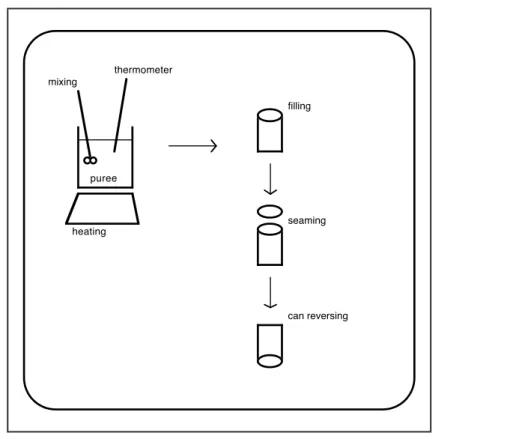
The hot filling technique is a simple pasteurization process and can be easily implemented for acid fruit purees. The fruit puree is considered to reach a given hot filling temperature instantaneously and, after filling into the container, cooling by conduction takes place (figure 10). Given a filling temperature, specific container dimensions are required in order to achieve a target volume average pasteurization value for the most thermal resistant microorganism or spoilage enzyme.
No optimization of the hot filling thermal processes, in terms of maximizing final quality retention, was investigated in previous research works. All the authors focused their attention on the process requirements in order to achieve a required P value for adequate commercial pasteurization. Several pasteurization conditions (filling temperature, container radius and half-height, heating medium conditions, etc.) can achieve the same pasteurization value required for a specific fruit puree preservation. However, only one set of thermal treatment conditions gives maximum quality retention of the fruit pulp.
The objectives of this work were: 1) the development of a mathematical model to describe the pasteurization of a food product during the cooling phase of a hot filling process with experimental validation of predicted time-temperature profiles during the cooling phase and 2) study the effect of filling temperature, cooling medium (overall heat transfer coefficient), P value and container shape on the container size required and corresponding final quality retention (Silva and Silva, 1997).
mixing thermometer puree heating filling seaming can reversing
12
A total of 54 simulations were performed to evaluate the effect of four different processing variables on final product quality. Vitamin C retention was the quality factor predicted by the computer simulations. Specific pasteurization conditions (TF, Pave, U, S) were tested in each computer simulation case study and a certain container volume (V) is required to achieve the target volume average P-value. Volume average quality retention was computed for each case. When using the same set of conditions (TF, Pave, S), the (C/C0)aveis slightly lower for air cooling than for water cooling. In Figure 11, the Pareto chart shows the standardized effects of different parameters on the product volume average quality retention, (C/C0)ave. An effect that exceeds the vertical line (critical t-value, =0.05) may be considered significant. The most important factors in decreasing order are TFand Pave, followed by U. Quality retention is not a linear function of TFand Pavebecause (TF)2
and (Pave)2also have a significant effect on (C/C
0)ave. The interaction effect of TFand Pave, given by
TFPave, arises from a difference in (C/C0)ave sensitivity to Pave changes for different filling temperatures. Container shape, S, was not significant for the final quality within the ranges of values simulated.
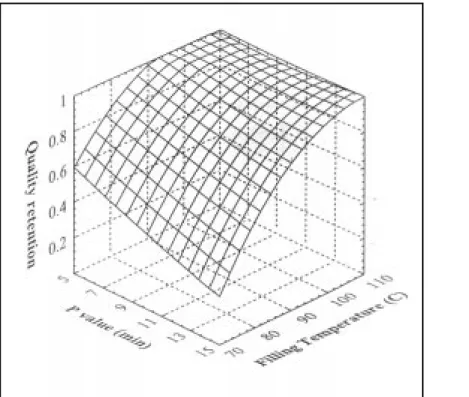
Figure 12 shows the predicted response (volume average vitamin C retention) surface as a function of the main variables (filling temperature and pasteurization value), for water cooling at 20ºC. A total of 27 simulation results were used for the surface prediction. This figure strengthens the conclusions taken from the Pareto chart of standardized effects (Figure 11). Final quality is greatly improved when using higher filling temperatures. Minimum pasteurization values also give better quality, although temperature is the major variable for maximum quality retention. The quadratic effect of temperature (TF)2within P
averange is apparent from the surface shape shown in Figure 12.
Figure 11 - Pareto chart for the evaluation of several standardized effects on hot filled product volume average quality retention.
13 The interaction effect of temperature and pasteurization value (TFPave) is also clear from this surface response chart, because at 70ºC, quality is much more sensitive to Pave than at 110ºC.
An experimental validation of the conclusions drawn from this theoretical study is very important. This work is being carried out for cupuaçu puree. Cupuaçu (Theobroma grandiflorum) is a tropical
fruit that grows in the Amazon area of Brazil, and has a high economic potential due to its characteristic and exotic flavour/aroma and good preservation properties.
3.5 Pasteurization of juices
Fresh orange juice contains particles in suspension giving it a “cloudy” appearance. After juice extraction the cloud loses stability and forms an unattractive two-phase system. This characteristic affects the appearance and decreases the juice commercial value. The cloud loss is due to the pectinesterase (PE) enzyme activity. Thermal treatment is used commercially to inactivate this enzyme. The adequacy of a pasteurization treatment depends on the extent of the PE inactivation. Because of the low orange pH (generally pH<4) the micro-organisms occurring in the juice are less thermal resistant than the enzyme PE. However, the relatively high temperatures necessary for PE inactivation produce undesirable “cooked” off-flavour and degrade juice aroma. Seymor et al.
(1991) observed some grapefruit PE inactivation during frozen storage. Therefore, in order to preserve the quality attributes of the juice the use of freezing and frozen storage as a pre-treatment before a less severe pasteurization can be proposed. This is the subject of an extensive research study currently being carried out (Molinari and Silva, 1997).
Figure 12 - Effect of filling temperature and pasteurization value on the predicted response surface (C/Co)ave.
14
References
Ávila, I.M.L.B. and Silva, C.L.M. (1995). Optimum sterilisation conditions for foods inside packs with two divisions. Poster presented at: 9th World Congress of Food Science and Technology, Budapeste (Hungary), 30/07 to 04/08 1995.
Ávila, I.L.M.B. and Silva, C.L.M. (1996a). Mathematical modelling of thermal degradation kinetics of peach puree total carotenoids and colour. Poster presented at: IFT96 - New Orleans - 22 to 26 June 1996.
Ávila, I.M.L.B. and Silva, C.L.M. (1996b). Modelling the thermal sterilization of foods inside packs with two divisions. Mathematics and Computers in Simulation, 42. 279-285.
Ball, C. O., and Olson, F.C.W. (1957). Sterilization in Food Technology, McGraw-Hill, New-York. Banga, J.R., Perez-Martin, R.I., Gallardo, J.M., and Casares, J.J. (1991). Optimization of the thermal processing of conduction-heated canned foods : study of several objective functions. Journal of Food Engineering , 14, 25-51.
Banga, J.R., Alonso, A.A., Gallardo, J.M. and Pérez-Martin, R.I. (1993). Kinetics of thermal degradation of thiamine and surface colour in canned tuna. Z. Lebensm. unters. forsch, 197, 127-131.
Barreiro, J.A., Perez, C.R., and Guariguata, C. (1984). Optimization of energy consumption during the heat processing of canned foods. Journal of Food Engineering, 3, 27-37.
Flambert, F. and Deltour, J. (1972). Location of the critical area in thermally-processed conduction heated canned food. Lebensm. - Wiss. u. Technol., 5, 7-13.
Holdsworth, S.D. (1990). Kinetic data - What is available and what is necessary. In: Processing an Quality of Foods. 1 HTST Processing, R.W. Field and J.A. Howell (Ed.), P.74, Elsevier Applied Science, London.
Manvell, C. (1997). Minimal processing of food. Food Science and Technology Today, 11 (2), 107-111. Molinari, A.F. and Silva, C.L.M. (1997). Effect of frozen storage on thermal inactivation kinetics of orange juice pectinesterase. Proceedings of the conference: Food Quality Modelling - Leuven, Belgium - 4-6 June 1997.
Nadkarni, M.M., and Hatton, T.A. (1985). Optimal nutrient retention during the thermal processing of conduction-heated canned foods : application of the distributed minimum principle. Journal of Food Science, 50, 1312-1321.
Norback, J.P. (1980). Techniques for optimization of food processes. Food Technology, 2, 86-88. Noronha, J.F. (1995). Improved Procedures for Designing, Evaluating and Optimising In-Pack Thermal Processing of Foods. Ph.D. thesis, Laboratory of Food Technology, Department of Food and Microbial Technology, Faculty of Agricultural and Applied Biological Sciences, Katholieke Universiteit Leuven, Belgium.
Pflug, I.J., and Odlaug, T.E. (1978). A review of z and F values used to ensure the safety of Low-acid canned foods. Food Technology, 6, 63-70.
Ohlsson, T. (1980a). Optimal sterilization temperatures for flat containers. Journal of Food Science, 45, 848-852.
15 Ohlsson, T. (1980b). Optimal sterilization temperatures for sensory quality in cylindrical containers. Journal of Food Science, 45, 1517-1521.
Richardson, P.S., Kelly, P.T., and Holdsworth, S.D. (1988). Optimisation of in-container sterilisation processes. In : Progress in Food Preservation Processes, vol. 2, P.1, CERIA, Brussels, Belgium, April 12-14.
Saguy, I., and Karel, M. (1979). Optimal retort temperature profile in optimizing thiamin retention in conduction-type heating of canned foods. Journal of Food Science, 44, 1485-1490.
Seymor, T.A., Preston, J.F., Wicker, L., Lindsay, J.A. and Marshall, M.R. (1991). Purification and properties of pectinesterase of Marsh White grapefruit pulp. J. Agr. Food Chem., 39, 1080-1085. Silva, C.L.M. (1993). Optimization of Sterilized Conduction Heating Foods: A Generalized Approach. Ph.D. thesis, Escola Superior de Biotecnologia, Universidade Católica Portuguesa, Porto, Portugal.
Silva, C.L.M. and Korczak, K. (1994). Critical evaluation of restrictions used to optimize sterilization processing conditions. Proceedings of the conference: 4th Bath Food Process Engineering Conference, 19-21 September.
Silva, C.L.M., Oliveira, F.A.R. and Hendrickx, M. (1993). Modeling optimum processing conditions for the sterilization of prepackaged foods. Food Control, 4 (2), 67-78.
Silva, C.L.M., Oliveira, F.A.R., Lamb, J., Pinheiro Torres, A. and Hendrickx, M. (1994). Experimental validation of models for predicting optimal surface quality sterilization temperatures. International Journal of Food Science and Technology, 29, 227-241.
Silva, F.V.M. and Silva, C.L.M. (1997). Quality optimization of hot filled pasteurized fruit purees: container characteristics and filling temperatures. Journal of Food Engineering. In press.
Stumbo, C. (1973). Thermobacteriology in Food Processing, 2nd ed., Academic Press, New York. Teixeira, A.A., Dixon, J.R., Zahradnik, J.W., and Zinsmeister, G.E. (1969a). Computer optimization of nutrient retention in the thermal processing of conduction-heated foods. Food Technology, 23(6), 137-142.
Teixeira, A.A., Dixon, J.R., Zahradnik, J.W., and Zinsmeister, G.E. (1969b). Computer determination of spore survival distributions in thermally-processed conduction-heated foods. Food Technology, 23(3), 78-80.
Teixeira, A.A., Zinsmeister, G.E., and Zahradnik, J.W. (1975a). Computer simulation of variable retort control and container geometry as a possible means of improving thiamin retention in thermally processed foods. Journal of Food Science, 40, 656-659.
Teixeira, A.A., Stumbo, C.R., and Zahradnik, J.W. (1975b). Experimental evaluation of mathematical and computer models for thermal process evaluation. Journal of Food Science, 40, 653-655. Thijssen, H.A.C., and Kochen, L.H.P. (1980). Calculation of optimum sterilization conditions for packed conduction-type foods. Journal of Food Science, 4, 1267-1272.
Thijssen, H.A.C., Kerkhof, P.J.A.M., and Liefkens, A.A.A. (1978). Short-cut method for the calculation of sterilization conditions yielding optimum quality retention for conduction-type heating of packaged foods. Journal of Food Science, 43, 1096-1101.
16
Questions and Answers
For Ultra-High-Temperature (UHT) sterilization of liquid foods, why do you say that for some case-studies the criteria should be the inactivation of enzymes?
Stoyan Tantchev
In Ultra-High-Temperature (UHT) sterilization of some low acid liquid foods some enzymes are much more heat resistant (have higher z-values) than micro-organisms and its spores (with lower z-values). In these situations the criteria should be the enzime inactivation. The micro-organisms, for these particular cases, are also inactivated by default.
Could you explain better the relation between filling temperature and heating medium?
Stoyan Tantchev
The cooling medium can be water or air. In hot-filling pasteurization the objective is to reach as quick as possible the filling temperature and the pasteurization is obtained during the product cooling. Cooling with air is slower and therefore requires smaller containers, to assure the target pasteurization, and results in lower quality products.
How do you think that consumers would react to your suggestion that quality levels could be lowered to help reduce the food manufacturers costs?
Philip Creed
It is necessary to investigate the consumers perception of quality. When we (theoretically) optimize just the quality, we search for a maximum of quality retention. If this maximum quality is not perceived by most of consumers, probably it is possible to identify processing conditions that result in final products with a slightly lower quality, not detected by the consumer, and minimum production costs. This idea was first presented by Banga et.al. (1991). The processing conditions are calculated for minimizing
costs, but using another restriction on the final product quality level.
How did you determine the quality attributes? Did you obtain any correlation between sensorial quality (consumer acceptance) and the attributes studied?
Stepan Akterian
Q
A
Q
A
Q
A
Q
17 We are doing some studies on the experimental validation of optimal sterilization conditions for maximizing the quality of sterilized peach puree. For that we chose colour as one of the most important quality attributes. To quantify it we used a Hunter colourimeter and we are trying to use a taste panel. From preliminary experiments we found that the panel had a great sensitivity to colour change. The next step in our research is to model the colour thermal degradation using the trained taste panel. We did not correlate yet the results obtained using the colourimeter and the taste panel.
For a given change in fh value, how far does the least-lethality-point (LLP) move towards the surface?
Philip Richardson
It depends on the values of other variables, such as the surface heat transfer coefficient, package shape and dimensions, but it can move quit near the surface. For example for a rectangular package with 0.05m in all directions, a thermal diffusivity of
1.7x10⁻⁷m2/s, a surface heat transfer coefficient of 600W/m2/K in all walls except at the lid were the
value is 10W/m2/h, when a target sterility value of 3 minutes is specified at the geometric
center, a sterility value of 2.12 minutes is observed at the LLP and this point is located at 3/4, of the distance to the surface, far from the center. The more important variables affecting the LLP position are the fhvalue, the surface heat transfer coefficient and the container shape.