The Effect of Leadership Functions on
Team Effectiveness of Virtual Teams
Alexandra Matos
Dissertation written under the supervision of PhD Patricia L.
Costa
Dissertation submitted in partial fulfilment of requirements for the MSc in
Management, at the Universidade Católica Portuguesa, 5
thJanuary 2018
i
Abstract
Title
The Effect of Leadership Functions on Team Effectiveness of Virtual Teams Author
Alexandra Margarida Martins de Matos
The purpose of this dissertation is the study of four different leadership functions on virtual teams and how can they impact differently the effectiveness of these teams. Data was collected from 332 employees. The results show that leadership functions in general are key for team leaders, it is through them that the leader structures all the work for the team. Additionally, the results indicate that being part of a virtual team or face-to-face team it is not statistically significant in terms of the impact of these functions in team effectiveness, since that when the leader works with leadership functions it will always lead to team effectiveness.
Key Words: Leadership functions, virtual teams, team effectiveness, structure and plan, encourage self-management, perform task, solve problems
ii
Resumo
Título
O Efeito de Funções de Liderança na Eficácia de Equipas em Equipas Virtuais Autor
Alexandra Margarida Martins de Matos
O objetivo desta dissertação é o estudo de quatro funções de liderança em termos de eficácia de equipa, em equipas virtuais. Os dados foram recolhidos de 332 trabalhadores. Os resultados indicam que, as funções de liderança são, no geral, fundamentais para o líder de equipa, é através delas que o líder irá estruturar todo o trabalho a realizar pela sua equipa. Adicionalmente, os resultados revelam que fazer parte de uma equipa virtual não é estatisticamente significativo relativamente ao impacto destas funções na eficácia de equipa uma vez que, quando o líder usa funções de liderança, os níveis de eficácia da equipa serão sempre superiores, quer se esteja a falar de equipas virtuais ou tradicionais.
Palavras-Chave: Funções de liderança, equipas virtuais, eficácia de equipa, estrutura e planificação, incentivar a autogestão, executar tarefas, resolução de problemas
iii
Acknowledgements
I would like to start by thanking my master thesis supervisor PhD Patrícia Costa, for all the support given, commitment to all the students from the Team Effectiveness seminar and availability to clarify doubts and to help during these past months when we were writing the dissertation.
Secondly, I want to thank my seminar colleagues, Maria Marcos, Julia Erhart, Benni Berggold, Eva Tschas and Soraia Badrudin for all the encouragement and union that was created during this process. It was a pleasure working with you.
My parents were crucial during this, and so I would like to thank them for never letting me give up during the thesis and in life, they always encouraged me to do better and to be better, without them I am not sure if I would come this far.
Finally, I would like to thank all my friends that always showed me that I was able to the dissertation and for never letting me stress out and be depressed over these months. I want to thank them for all the relaxing moments they allowed me to have.
iv
Table of Contents
Abstract ... i Resumo ... ii Acknowledgements ... iii 1. Introduction ... 1 2. Literature Review ... 3 2.1 Virtual Teams ... 3 2.2 Team Effectiveness... 72.4 Team Leadership Functions ... 9
2.4.1 Structure and Plan ... 10
2.4.2 Encourage team self-management ... 11
2.4.3 Perform team task ... 13
2.4.4 Solve Problems ... 14 3. Methodology ... 17 3.1 Participants ... 17 3.2 Procedure ... 17 3.3 Measures ... 18 4. Results ... 19 5. Discussion ... 22 5.1 Practical Implications ... 25
6. Limitations and suggestions for future research ... 26
Conclusion ... 28
References ... 29
v
List of Figures
Figure 1 - Hypotheses 1 ... 16 Figure 2 - Hypotheses 1.1, 1.2, 1.3 and 1.4 ... 16
List of Tables
Table 1 - Cronbach's alpha for each variable ... 18 Table 2 - Mean and standard deviation of each variable and respective correlations .... 19 Table 3 - Regression analysis’ results ... 20
1
1. Introduction
According to previous research, it has been proved that the percentage of professional employees working in virtual teams (VT) has grown to over 60% (Martins, Gilson, & Maynard, 2004). Additionally, it is also known that close to 70% of multinational companies use VTs and these companies believe that the number will continue to grow over the years. (Gilson, Maynard, Jones Young, Vartiainen, & Hakonen, 2015). Virtual Teams, in a general overview, offer companies the ability to reduce travel costs and number of business travel (meaning the costs related to join team members in order to work on a common task, both geographically and temporally) and optimize time (Martins et al., 2004).
As shown, virtual teams are being more used nowadays than they were before, this is due to the fact that companies work with high technology that allows team members to work at any time, everywhere, not needing a physical place to work. It gives commodity to employees, encourage their autonomy, and also increases their problem-solving skills. For companies this is a plus too, since they save money in terms of travel expenses as employees do skype meetings and also, companies are able to have people from different nationalities all over the world. These teams face some challenges, the biggest one is the physical distance that leads to the need for a better structure in terms of tasks and goals. Furthermore, trust is another factor associated with the physical distance, in fact it is more difficult for virtual team members to build trust between each other due to the lack of contact (physically).
Virtual teams may also have a leader. In this case, the person who assumes this role must know how to do certain tasks efficiently, for example, a virtual team leader must structure and plan in a way that all the work that needs to be done is done in time and divide it within the team in order for team members to understand what needs to be done clearly. This task is also important in traditional teams but, in virtual teams is key, as team members do not work in the same physical place, therefore the communication between them is harder, so the task must be direct and clear.
This study is focused on four different leadership functions that are required for team need satisfaction and team effectiveness (structure and plan, encourage team self-management, perform team task and solve problems) (Morgeson et al., 2010) and how
2 can they impact differently virtual teams. Team leadership is defined as the vehicle that leads to the satisfaction of the teams’ needs, consequently, will enhance the teams’ effectiveness (Morgeson et al., 2010). When comparing virtual teams with face-to-face teams, the first ones will display lower performance levels concerning the function problem solving for example, as the time needed to reach decisions will be higher and, therefore the teams’ effectiveness will decrease (Geister, Konradt, & Hertel, 2006). The purpose of this study is, therefore, to evidence, from this four leadership functions, which are the ones that will generate more effectiveness in virtual teams and which are the ones that will not generate as much effectiveness as the previous ones, in virtual teams. Further analysis of this topic will take place in the literature review (chapter 2) and results of the survey will be shown in the methodology and results chapters (chapters 3 and 4).
3
2. Literature Review
This chapter will include a more in-depth analysis about virtual teams, team effectiveness and the four leadership functions that will be studied (structure and plan, encourage team self-management, perform team task and solve problems). After these explanations, hypothesis will be created, so that a relationship can be established between virtual teams, leadership functions and team effectiveness.
2.1 Virtual Teams
To better understand the concept of virtual teams, there is the need to go back and firstly understand what teams are.
Teams
According to Salas, Dickinson, Converse, & Tannenbaum (1992), a team can be defined as “a distinguishable set of two or more people who interact, dynamically, interdependently, and adaptively toward a common and valued goal /objective/mission, who have been assigned specific roles or functions to perform, and who have a limited life-span of membership” (p. 4). A shorter, but still clear definition of teams is given as, certain elements of a team, that work together in order to achieve a goal that would not be possible to accomplish if people worked alone (Marks, Mathieu, & Zaccaro, 2001). The same authors referred that, in order to accomplish success, a team need to acknowledge each other’s talents, the available resources in that time to perform the task and also, the tools used inside the team that allow the communication between team members. All these definitions say, more or less, the same thing, which is, teams are defined as a group of a minimum of two members who work together in order to achieve a common goal or complete a certain task. As characteristics of team members, following the description of the Business Dictionary, they should be interdependent, share authority and responsibility for self-management, be accountable for the collective performance and work toward a common goal. Although individuals may be part of a team, they should have more individualized tasks from which they are responsible for, but at the same time, share the same goal as others team members. So basically, be a member of a team means to be able to work at an individual level (autonomy) but share goals with others and work towards that.
4
Virtual Teams
Now, making the transition to virtual teams, is known that these type of teams are being more used nowadays than they were before, some definitions of virtual teams will be given from different authors in order to have a broader perception of what these teams are and how are they different from traditional teams. According to Krumm, Kanthak, Hartmann, and Hertel, (2016), virtual teams has become a trend, but a trend that came to stay. Working with others across a geographical distance have become very common in the workplace of many organizations, disregarding the role performed by the employee. Martins et al., (2004), say the exact same thing, it is very common nowadays (unlike before) to have members working all over the world from the same team, in which they use technology to switch information among them. According to the same authors, the distance of team members, time zones and the structure of the organization can be viewed as boundaries of virtual teams. With virtual teams, companies are able to take advantage of the fact that a team can have different nationalities and, consequently, different languages are spoken. It facilitates the business/deals made in the company, because employees can speak to clients in a more familiar language.
Krumm et al., (2016), define virtual teams according to the usage of digital media. The authors believe that in order to be a virtual team member, the employee must use digital media to interact and share information with colleagues that work at different locations and in different time zones. Virtual teams can also be characterized (in short words) by the geographic distribution, relative amount of electronic communication (e-communication) media usage and cultural diversity (Hoch & Kozlowski, 2014). Bell & Kozlowski, (2002), also mention that the two characteristics that better distinguish traditional teams from virtual teams are the special distance and the communication (face-to-face or technologically mediated). Johnson, Bettenhausen, & Gibbons, (2009), enumerate different dimensions that best characterize virtual teams according to different authors: Cohen and Gibson (2003), considered electronic dependence (media usage) and geographical distance as the two dimensions the better characterize VTs. Griffith, Sawyer, and Neale (2003), considered three, the level of technology support, percentage of time apart while working on task, in order to see if the team is actually virtual or not, because if employees work apart but most of the time work together, it cannot be considered as virtual team, and spatial distance. Lastly, Kirkman and Mathieu (2005),
5 identified three dimensions, the use of digital media, amount of informational value provided by those tools, and synchronicity of communication.
Virtual teams represent the future, the future of companies as travel expenses are becoming a big weight in terms of company expenses and also, waste of time due to the fact that when travelling, individuals lose some precious time of work, they do not maximize their time. Teams nowadays have a lot of tools that allow individuals to work together and share important information in a second (e-mail, skype calls, specific industry-related programs). In this work, we assume that virtual teams are characterized by their level of virtualness, meaning the geographical distance and how teams communicate (they are geographically dispersed and communicate via technology). However, we concur that cultural diversity is an important characteristic of a virtual team, technology destroyed the barriers that previously existed in terms of working with people from other countries/nationalities.
Main differences between traditional teams and virtual teams
There are some differences between these types of teams and traditional teams, being the most common, the geographical distance. Traditional teams work in the same physical place, share information and discuss tasks in face-to-face meetings (Krumm et al., 2016). In agreement with Martins et al., (2004), virtual teams need to be teams first, the fact that they highly use digital media in order to communicate is just a characteristic. Regarding skills, team members in traditional teams are chosen based on their professional skills, whereas team members in virtual teams are selected besides their skills, also their autonomy, ability to self-management, work under time pressure and be goal-oriented, be a technological person (due to the fact that all work must be done via a computer/internet/certain software and all communications with the team are made through the same channels), number of languages spoken (cultural diversity inside the company).
Benefits from having virtual teams and challenges
Companies add value by having virtual teams as explained before. Martins et al., (2004) stated in their article that, virtual teams are excellent in terms of giving a mechanism (structure) to reduce expenses, or to maximize time (travel costs, time consumed by the travel trips, coordination among the team). Another benefit from having these teams is the fact that companies will hire employees more qualified, meaning that they have a
6 diverse set of skills for the job (once that skills needed to be a virtual team member are stricter than in traditional teams). Keith Ferrazzi (CEO of Ferrazzi Greenlight) referred that a good virtual team can only achieve success if, and only if, they manage to develop their communication skills, high level of emotional intelligence, ability to be autonomous and a lot of resilience to never give up (K-Ferrazzi, 2014). Krumm, Kanthak, Hartmann, & Hertel, (2016) also mention benefits, more specifically, five benefits from having virtual teams: (1) The capacity of employees to work on the same task/project without needing to be physically close to switch information. (2) Costs, by implementing the concept of virtual teams, companies are able to reduce costs for example, in terms of traveling. (3) Companies hire more qualified people, based on the top skills that people must have to work on virtual teams, also, these people are able to absorb more information as they have an open mind. (4) The generation of ideas. In virtual teams, more ideas can be generated as different people work from different countries and different cultures. Facilitates innovation. (5) Companies become able to react more quickly to rapid changing environments.
As it happens in traditional teams, these teams also face challenges. Krumm, Kanthak, Hartmann, & Hertel, (2016), as it happened before, refer the main challenges that companies face when implementing virtual teams: (1) The definition and implementation of workflows, all monitored that will facilitate team members working across distance. (2) The performance of virtual team employees can only be measured by the system, as the team is working apart. Digital media is crucial in this manner, because employees need to be motivated by the team and the leader although they are distant from each other. (3) The team spirit, motivation and aspects related are difficult to sustain in culturally diverse teams. (4) The communication via digital media can be challenging, because members must ensure they transmit information in the right way to avoid misunderstandings and also, considering the different time zones. Adding value to this study, Suchan & Hayzak (2001), mentioned that, team members must guarantee that they know each other very well, even though not sharing the same language, because if the members do not get to know each other, it is difficult to understand some messages when working together related to tasks, coordination of work, conflict management and rules. In addition, Keith Ferrazzi, from his experience with virtual teams in his company, pointed which are the most effective virtual teams, the small ones—fewer than 10 people,
7 following previous research, team members reduce effort when feeling less responsible for results or deadlines (K Ferrazzi, 2014).
2.2 Team Effectiveness
Team effectiveness is a chapter of this dissertation to highlight how distinct leadership functions can affect differently the effectiveness in virtual teams. Beginning with the difference between team performance and team effectiveness according to Salas, Sims, and Burke, (2005, p. 557):
“Team performance accounts for the outcomes of the team’s actions regardless of how the team may have accomplished the task. Conversely, team effectiveness takes a more holistic perspective in considering not only whether the team performed (e.g., completed the team task) but also how the team interacted (i.e., team processes, teamwork) to achieve the team outcome.”
This comparison is important, to understand that team effectiveness gives a more in-depth analysis of how the team performed, since it considers more parameters, being team performance one of them through team task. To consider a team as effective, team members need to be able to sustain the teams’ high level of performance, apart from all the adversities. In order for this to happen, rules, norms and processes need to be created to help individuals feeling comfortable and this way, better adapt to rapid changes (Zaccaro et al., 2001). In addition, other authors have a different view of which are the factors that makes successful team, however, we consider that, Zaccaro gives a better understanding of what it takes to be an effective team. Hinsz, Tindale, and Vollrath, (1997) consider that successful team action requires two main aspects: (1) Acknowledgment of the individuals’ contribution to the team and (2) A process/structure/plan that incorporates the individuals’ contributions to the team and give a faster response when problems arise.
There are two core components in team effectiveness: task and nontask. The first one matters to the job/tasks that a team member needs to do during the day, it shows a decrease of the perception of team effectiveness, as it is related to the use of digital media in terms of communication. The perception decreases because, teams that are not able to communicate face-to-face have bigger difficulties switching information between team members, modify the team goals and gathering real and honest feedback. The component
8 nontask is related to the satisfaction of employees. In this case, individuals that are part of a virtual team tend to be less satisfied than individuals from face-to-face teams. This happens due to the high focus on the tasks and low involvement with other team members (spatial distance) (Johnson et al., 2009).
What the previous authors showed was, more or less the same as mentioned in the introduction of this dissertation, that when comparing traditional face-to-face teams with virtual teams, the last ones tend to have lower performance levels in terms of group decision/problem solving because it takes more time in virtual teams to reach a conclusion/solution. Nevertheless, these differences seem to attenuate over time (Geister et al., 2006).
A previous study from Schippers, Den Hartog, Koopman, and Wienk (2003), exhibited that virtual teams, normally show superior performance comparing to teams that work more closely in terms of geographical distance. This can only be proved when the task can be done by one individual and does not require the help or supervision of another (task interdependence) (This study was distributed in 54 teams incorporated in 13 organizations in the fields of IT, financial services, government and chemical industries) (Morgeson, DeRue, & Karam, 2010).
Trust is also a big component when speaking about virtual teams, virtual team members must be able to trust in each other more than traditional team members that are able to see what the colleagues are doing and the information exchange is easier, thus, when there is trust in a team, the chances that the team will be more effective are higher. Trust is a determining factor in the effectiveness of a team. As a title of example, in a contractual relationship, part A and part B must get to know each other/ build trust before agreeing to the terms of the contract. This way it is easier to negotiate the terms and benefit both parties because they already know each other and each of them knows what is the goal of the other (Aubert & Kelsey, 2003).
According to some researchers, when complex tasks appear, virtual teams are usually the best teams that can give answer to those tasks. Additionally, the type of the task has been mentioned to have higher importance when determining the success of a virtual team. For instance, it is not expected virtual teams to be able to interpret and solve an ambiguous task (virtual teams work with the concrete, well-defined, structured tasks). Before
9 associating individuals with certain tasks, it is important that the match between task type and type of team is done. (Martins et al., 2004).
The behaviour of the virtual team leader will determine the teams’ effectiveness. Given the fact that virtual teams work in complex environments, the virtual team leader must be able to adapt to this environment. A virtual team leader can only be effective when it proves to have high levels of behavioural complexity, which in the case of traditional teams does not happen. Thus, team members will consider that, a leader who exhibit multiple roles, is an effective leader due to the adaptability of different environments and resilience. It is clear that when a leader if effective, the team results will increase and their performance will go up. For this to happen, virtual team leader must communicate well with employees, define clear roles for everyone and structure tasks on time.
2.4 Team Leadership Functions
Team leadership is high related with team satisfaction and team effectiveness, meaning, when a team is satisfied with the leader, their commitment will be higher and thus, it will enhance team effectiveness (Morgeson et al., 2010). The following sections will be related to the four leadership functions that are going to be studied in this dissertation (Structure and plan, encourage team self-management, perform team task and solve problems).
Leadership Functions are divided in two phases: The transition phase and the action phase. The first one is defined as, time periods where the teams mainly focus on planning and structuring the tasks/activities in order to reach a common goal (Marks et al., 2001). The action phase is described as, time periods where the teams “get their hands on the job”, meaning that its expected in this phase that teams will conduct activities leading straight to goals (Marks et al., 2001). The transition phase comprises the function structure and plan, whereas the action phase includes the other three mentioned above (encourage team self-management, perform team task and solve problems). The transition phase, compared to the action phase is less studied in the context of virtual teams. A figure of the processes included in each phase is shown in Appendix 1.
Thus,
10
2.4.1 Structure and Plan
The leadership function structure and plan incorporate some aspects of the daily work of a leader, such as, determining the best way to reach a goal (structure a plan), which individuals are in charge of the different tasks (clear clarification of roles), and establishing deadlines. All these aspects together will determine the teams’ performance, each individuals’ efforts to the common goal and the processes required to achieve the goal proposed (Morgeson et al., 2010).
Structure and Plan is a key function, because when working in teams, there is the need for the leader to divide tasks among all team members in order to reach a common goal faster. In virtual teams this leadership function may be even more important than in traditional teams as members need to understand what is the purpose of each task, when they should deliver the task done, and what is/are the goal(s). This will determine the teams’ performance because all the information is clear and well structured. Salas, Sims, & Burke, (2005) say this exact message in their article, if a team leader is not able to structure the teams work, it will automatically lead to an ineffective team performance. Martins, Gilson, & Maynard, (2004) give the same importance to this function, they mention that, in virtual teams, it is even more important than in face-to-face teams that the work is structured and planned ahead. Virtual team leaders have the important role of providing a clear direction to the teams’ individuals goals. The fact that team leaders structure and plan ahead of the deadline and establish direct goals, will increase the ability of individuals to see their own performance and be able to evaluate their performance through feedback. Therefore, virtual team leaders must have some characteristics considered to be crucial to the role, such as, proactivity, ability to structure and well communicate with others and ability to set clear goals. Also, processes and mechanisms must be created by the leader, in order to regulate and evaluate the team performance (Bell & Kozlowski, 2002).
Moreover, virtual and traditional teamwork generally differs in terms of required competencies, for example, organizing and executing (similar to structure and plan) is essential in virtual teams. Given the high geographical distance, virtual team members often face the low contact with other individuals from the same team, hence, there is no control in terms of interpersonal relations inside the team. A consequence of this can be the fact that employees in virtual teams not always have the same work schedule as they
11 can define which suits them best, meaning, they can start working earlier, work late hours, take on more tasks than they are supposed to. This leads to high levels of conscientiousness to avoid from abusing their autonomy (Krumm et al., 2016).
Additionally, Zaccaro et al., (2001), refer that, a leader who is able to provide clear performance goals, tasks, processes/projects will increase its sense of adaptability, since it will react more peacefully in time pressure circumstances.
In conclusion, structure and plan will have a bigger importance in virtual teams than face-to-face teams, because it will determine teams’ performance, autonomy (linked with conscientiousness). As these members do not work in the same physical space, they really value a good structured plan, tasks and goals, so the leader must be effective in the message he wants to pass on. In order to reach successfully the teams’ goal, it is important that virtual team members share information and knowledge with each other as much as they can.
Therefore, the first hypothesis will be:
H1.1: Structure and Plan will lead to higher team effectiveness, especially in more virtual teams.
2.4.2 Encourage team self-management
Encourage team self-management was perceived to be one of the most important leadership functions regarding virtual teams. It is important that leaders encourage individuals to self-manage themselves and be autonomous, these two skills are extremely important when managing the work that needs to be done for a specific task or a project (Krumm et al., 2016). Manz and Sims, (1980), in their theory of self-management as a substitute for formal leadership suggested that, when team leaders encourage individuals to work in a task and to problem solve the adversities that naturally occur during the time, the leader is encouraging individuals to be autonomous and to believe in themselves, their work and ability to generate solutions to a problem. Through this process, the leader creates resilience in the team and increase the levels of adaptability (Morgeson et al., 2010). Oakley, (1999), refer the main competencies that virtual team members must own, being them: The ability to self-manage, taking responsibility for their own actions, the ability of the individual to lead their own work (self-leadership). Furthermore, due to the high geographical distance, it gets more difficult to monitor team members and thus, they
12 must engage in self-management skills to a greater extent in VTs. (Martins et al., 2004). In addition, Tesluk and Mathieu (1999), through their study found a curious aspect, that when team leaders engage in the leadership function encourage team self-management and, in fact encourage their team members, individuals are more motivated and willing to engage in problem solving, either it is actions or strategies in order to decrease the performance barriers. It is expected that leadership functions will in fact, increase teams’ performances (Zaccaro et al., 2001).
In the article of Zaccaro, there are some reasoning that evidence the fact that teams can enter in different performance environments and individuals must be able to adapt and take responsibility for their actions, ‘‘leaders are not so much responsible for directing specific team actions as they are responsible for developing the underlying individual and team capabilities that enable teams to self-manage their actions’’ (p. 134) (Zaccaro et al., 2001).
So, what are self-managing skills and why do virtual team leaders need to encourage team self-management? Self-management skills can integrate four major components: interdependence, persistence, learning motivation and creativity. Interdependence is high related with autonomy, which includes individuals’ ability to prepare and structure their work autonomously, without the help of others. Persistence is more related with feelings, meaning that is expected that an individual working in a virtual team to be persistent, resilient, do not give up at the first adversity and fight for results. Learning motivation is a characteristic that newly hired employees usually have, it is all about the new and fresh, the capacity to learn and motivation to learn new contents. Creativity is a characteristic that can be more frequent in individuals of virtual teams. Virtual team members work across distance, so they need to be very creative in the way they communicate and interact among each other, also in the way thay face new challenges and solve problems (Hertel, Konradt, & Voss, 2006).
By stimulating the self-management, team members may have the perception that they self-manage themselves and so, they are able to generate solutions and solve problems without the authorization of a superior person. This situation can in fact destroy the professional relationship between team leader and team member, once the team member overstepped the boundaries. So, in order for this not to happen, the company must apply the concept of “empowered leader” to all the virtual team leaders. Stewart and Manz (1995) describe an “empowered leader” as someone who plays the role of a leader, that
13 has democratic orientation and low level of involvement with team members. Although this leader establish some distance between leader and team members, it is able to show different behaviours such as assisting and helping team members in locating resources, helping clarifying doubts, the key word for this leader is supporting (Oakley, 1999). As an example, Hoch & Kozlowski, (2014), revealed that when the team leader makes the team members feeling empowered and able to self-manage themselves, the global performance of the team increases (Study made for 35 sales and service VTs in high-tech companies) (Kirkman et al., 2004).
In conclusion, for the reasons above mentioned by the researchers, the second hypothesis will be:
H1.2: Encourage team self-management will lead higher team effectiveness, especially in more virtual teams.
2.4.3 Perform team task
The leadership function of performing team task is considered to be important because it is likely that it will enhance the team productivity and hence, the team effectiveness. This happens in all types of teams. As an example of a study, Kane et al. (2002), observed team leaders that performed functions related to tasks that were direct related with team performance. What they found was that the relationship between the team productivity/performance and the leader who performed these kinds of tasks was positive (Morgeson et al., 2010).
Perform team task is acknowledged as being proactive in the team, which means, sharing thoughts, solutions, giving ideas and help other team members performing tasks and achieving goals (Morgeson et al., 2010). As it is clear by the definition, perform team task is a difficult leadership function to execute in virtual teams due to spatial constraints (geography). It becomes more difficult for a leader to understand where and when the team members need help performing some tasks because it is not visible as it happens in traditional face-to-face teams.
Virtual teams are mostly addressed for complex tasks, as they require more expertise, that team members of traditional teams usually do not own. As it was mentioned before, there is one key aspect that is crucial in virtual teams: the task type, it will determine the good or bad performance of a virtual team (more ambiguous tasks will have negative impact
14 on the performance of virtual teams because individuals will take longer to understand the task and therefore, the goal will be reached later) (Straus & McGrath, 1994). In fact, it is important, related with what was said that, inside the company, top management should not consider the task type independently, because it is not enough to determine the success or insucess of a team. Instead, task type should be matched with virtual teaming in order to take advantage of both traditional teams and virtual teams (Martins et al., 2004). In addition, according to Salas, Sims, & Burke, (2005) a leader needs to be a role model to his team members, it has some responsibilities, being the main ones: to do the job, or ask team members to help him by dividing the tasks equally among all.
Although we acknowledge that there are some advantages in having this leadership function present in virtual teams, the opinion is not consensual. As some authors have the same opinion, that having this leadership function in virtual teams will be a plus, Bell & Kozlowski, (2002), refer in their article that virtual team members are highly experts in what they do, they differentiate from others by their abilities and capacities to perform tasks. The more specific is the task that the team needs to perform, the more the team will need experts to do it, the more these expertise’s will not be found in a close location. Therefore, the third hypothesis will be:
H1.3: Perform team task will lead to higher team effectiveness, especially in less virtual teams.
2.4.4 Solve Problems
Solving problems is conceptualized according to Morgeson, DeRue, & Karam, (2010), as the identification of problems during the tasks (in the first stage), generation of ideas from team members in order to agree on one possible solution to the task problem (second stage) and the effective implementation of the solution (third stage). This leadership function involves some challenges for the virtual team leader, as he needs to be supportive and able to motivate and engage team members in order to solve the problem effectively. Some people may believe that when an individual becomes a leader, he should be able to manage on its own the team that he is in responsible for, detect the problems, identify solutions and implement the most proper one (Salas et al., 2005). This happens in normal traditional teams. It is however, not possible to say that solving problems in virtual teams
15 is as easily as it is in traditional teams, there are a lot of constraints, being one of the most obvious the geographic distance.
According to (Bell & Kozlowski, 2002), there is one may problem in virtual teams that creates a barrier when trying to solve problems, which is the lack of face-to-face contact. It becomes difficult for a leader to follow the team members performance and more difficult to implement solutions to problems when the team works apart, this way, the leader cannot mentor, coach or help his team members developing functions due to the distance. Creativity takes an important role in this case, where the leader needs to find an innovative way of implementing solutions and generating ideas fast (Malhotra, Majchrzak, & Rosen, 2007).
The leaders of virtual teams have different tasks than traditional team leaders. Virtual team leaders need to mentor their team members, give support to them in order for them to understand always the tasks and feel supported, it needs to enforce norms because they are extremely important in companies and specially when individuals work apart, it is also important that leaders reward their members, again for them to feel supported and feeling that they add value to the company. One struggle of a virtual team leader is the fact that they cannot know when the individuals are feeling down, due to the lack of face-to-face contact, also, when the team needs focus and resources. As it happened in the last paragraph, in this case the leader needs to be creative, in order to create a mechanism that facilitates the sharing of emotions, thoughts and others among the team (Malhotra et al., 2007).
Therefore, the fourth hypothesis will be:
H1.4: Solve problems will lead to higher team effectiveness, especially in less virtual teams.
16
Figure 1 - Hypotheses 1
17
3. Methodology
3.1 Participants
For the purpose of this study, a total of 332 respondents (n=332) answered a questionnaire. In addition, 54,8% of respondents have been working for the respective companies for the past two years (mean=4,58; sd=6,9). The respondents answered the questionnaire individually and autonomously. The majority of the respondents were female (59,4%), and were under 30 years old (mean=32,05; sd=11,12). From all the 332 people that answered the questionnaire, 86,4% have a university degree or higher, the remaining have high school degree or lower. Furthermore, it is important to mention that, 61,4% of the respondents have Portuguese nationality, 38,6% have Austrian, German, Spanish or French nationality.
3.2 Procedure
In order to test the hypotheses previously stated, six master students from the Católica Lisbon School of Business and Economics and Team Effectiveness dissertation seminar collected data during the fall 2017. At first, a questionnaire was built, covering the study variables – leadership functions, team effectiveness, means of communication within the team and demographics. The questionnaire was addressed to employees that worked in teams (with different degrees of virtuality). The questionnaire was shared by e-mail and social media (Facebook, WhatsApp groups and LinkedIn contacts).
As it was mentioned before, the questionnaire was divided into parts. The first question regarded the team leadership (transition phase and action phase functions), more specifically, the four leadership functions that mattered to this dissertation (structure and plan, encourage self-management, perform task and solve problems). The second question, was related to the teams’ perception of its effectiveness. The third question took into consideration the channels that the team used to communicate among each other, this question mattered to the analysis because, from this question we were able to realize if the team in which the employee worked with, was more or less virtual. Lastly, the respondents were asked to fill some demographic details about themselves.
18 3.3 Measures
Leadership functions were measured with selected items from Morgeson et al., (2009),
self-report ‘Team Leadership Questionnaire (TLQ)’ scale. The original 82-item scale was adapted into a 12-item scale, that surveyed 3 items considering the function structure and plan (‘My team’s leader defines and structures own work and the work of the team’), 3 items considering the function solve problems (‘My team’s leader helps the team develop solutions to task and relationship-related problems’), 3 items about the function encourage self-management (‘My team’s leader encourages the team to be responsible for determining the methods, procedures, and schedules with which the work gets done‘) and 3 items concerning the function perform task (‘My team’s leader intervenes to help team members get the work done’). The responses were based using a 7-point scale (1 = strongly disagree; 7 = strongly agree), according to their level of agreement with the items.
Team Effectiveness was measured through the self-effectiveness perception. Team
effectiveness perception was measured using a 4-item scale (‘My team is effective’), for this matter participants answered using a 7-point scale (1 = strongly disagree; 7 = strongly agree).
‘% of Face-to-Face communication’ was measured according to Dennis, Fuller and
Valacich, (2008), ‘Media Synchronicity Theory (MST)’ scale, adapted in this study to an 8-item scale, in which participants split 100% between the different channels of communication among the team (Face-to-Face; Video Conference; Telephone Conference; WhatsApp; Fax; Email and Other).
To understand the reliability of the scales, we calculated the Cronbach’s alpha. In order for a scale of a variable to be reliable, its alpha should be higher than 0.6. In this study all the variables scales are above that reference number. Results are presented in Table 1.
Variable Scale Number of items Cronbach’s alpha
Leadership Functions (12) .95
- Structure & Plan 3 .85
- Encourage Self - Management 3 .86
- Perform Task 3 .87
- Solve Problems 3 .87
Effectiveness Perception 4 .92
19
4. Results
The collected data was analysed in the SPSS Statistics Software. One dataset was built that included all the results from the questionnaire, from all 332 respondents (N = 332). The data analysis was performed under regression and simple analysis. The four hypotheses were tested using moderation. The moderation analysis was conducted using Preacher & Hayes (2004) Process Macro for SPSS. Process is an essential tool for moderation, it gives the results of the interaction between the independent variable and the moderator, also shows the conditional effect of the independent variable (the 4 leadership functions) on the dependent variable (effectiveness) at the values of the moderator (% FtF communication). All the variables were centered in SPSS when running the Process Macro. The purpose of these analyses was to show that the leadership functions structure and plan, encourage team self-management would lead to more effectiveness, especially in more virtual teams and also, that the leadership functions perform team task and solve problems would generate more effectiveness, especially on less virtual teams.
The next table illustrates the mean (x̅) and standard deviation (σ) of each variable and, the correlations between all the variables.
Variable x̅ σ Correlations
1. 2. 3. 4. 5. 6.
1. Structure & Plan 5,62 1,04 1
2. Enc. Self-Manage 5,67 1,07 ,65** 1
3. Perform Task 5,65 1,14 ,73** ,72** 1
4. Solve Problems 5,68 1,07 ,75** ,74** ,80** 1
5. Effectiveness 5,61 1,09 ,42** ,43** ,43** ,43** 1
6. % of FtF Com. 52,35 23,76 ,01 ,03 ,14* ,05 ,08 1 For a confidence interval of 95% (*p<0.05; **p<0.01)
Table 2 - Mean and standard deviation of each variable and respective correlations
The variables presented in the table, from 1 to 6 (structure and plan until effectiveness) take the mean value between 5 and 6, which means, adapted to our scale, that respondents answered to the respective questions in the questionnaire with somewhat agree (5) and agree (6). (e.g. ‘My team’s leader encourages the team to be responsible for determining the methods, procedures, and schedules with which the work gets done’ - 5).
20 Regarding correlations, in general, all the functions are positively correlated between them (which is expected), but when considering the correlations of the variables with ‘% of Face-to-face communication’, only the leadership function perform task represent a statistically significant result (r=,14; p < 0.05), leading to the conclusion that this mean of communication, does not affect teams’ effectiveness directly. A team leader, either its virtual of non-virtual should always combine and use different leadership functions in his work to enhance the effectiveness of the team, regardless of the moderator that, in this case, is the variable virtual/FtF communication. In addition, the four leadership functions presented, show a significant positive correlation with effectiveness (Structure and Plan p<0.01; r=,419; Encourage self-management p<0.01; r= ,431; Perform Task p<0.01; r= ,431; Solve Problems p<0.01; r= ,427).
The following equation represents the regression analysis used for the purposes of this study:
𝒀 = 𝒂 + 𝒃 × (% 𝑭𝒕𝑭 𝑪𝒐𝒎) + 𝒄 × (𝑳𝑫 𝒇𝒖𝒏𝒄𝒕𝒊𝒐𝒏) + 𝒊 × (% 𝑭𝒕𝑭 𝑪𝒐𝒎 × 𝑳𝑫 𝒇𝒖𝒏𝒄𝒕𝒊𝒐𝒏),
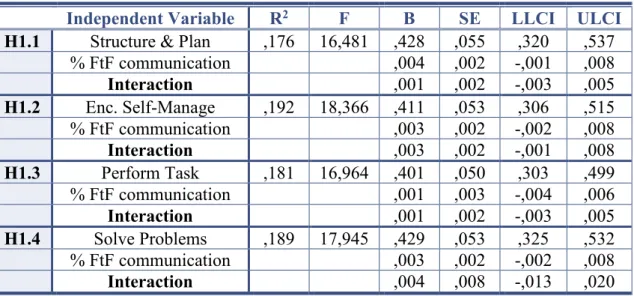
where Y represent the dependent variable (Effectiveness), (a) represents the constant, (b) represent the effect of the percentage of face-to-face communication between team members, (c) represents the effect of each leadership function that matters to this study (structure and plan; encourage self-management; perform task; solve problems), and finally (i) represents the effect of the interaction between the percentage of FtF communication and each leadership function. The results of (b), (c) and (i) are presented in the table below.
Independent Variable R2 F B SE LLCI ULCI
H1.1 Structure & Plan ,176 16,481 ,428 ,055 ,320 ,537
% FtF communication ,004 ,002 -,001 ,008 Interaction ,001 ,002 -,003 ,005 H1.2 Enc. Self-Manage ,192 18,366 ,411 ,053 ,306 ,515 % FtF communication ,003 ,002 -,002 ,008 Interaction ,003 ,002 -,001 ,008 H1.3 Perform Task ,181 16,964 ,401 ,050 ,303 ,499 % FtF communication ,001 ,003 -,004 ,006 Interaction ,001 ,002 -,003 ,005 H1.4 Solve Problems ,189 17,945 ,429 ,053 ,325 ,532 % FtF communication ,003 ,002 -,002 ,008 Interaction ,004 ,008 -,013 ,020
21 We can see that the direct effects are all positive and significant. The leadership function structure and plan explains 17,6% of the variance of the responses concerning the overall effectiveness of the team (R2 = 0,176; F (4,31) = 16,48). All the four leadership functions present, more or less, identical results: encourage self-management explains 19,2% of the variance of the responses concerning the overall effectiveness of the team (R2 = 0,192; F (4,31) = 18,37), perform task explains 18,1% of the variance of the responses regarding the overall effectiveness of the team (R2 = 0,181; F (4,31) = 16,96) and the function solve problems explains 18,9% of the variance of the responses regarding the overall effectiveness of the team (R2 = 0,189; F (4,31) = 17,95).
However, the percentage of FtF communication does not moderate any of these relationships. The value zero is comprised between the lower CI and the upper CI (e.g. Interaction of structure and plan with the amount of face-to-face communication LLCI = -,003; ULCI = ,005). Thus, none of these hypotheses were supported.
22
5. Discussion
The intention of this study is to support the four hypotheses previously stated. It is important for a team that the leader incorporates leadership functions, regardless of the percentage of face to face communication of that team. Bell and Kozlowski, (2002), propose in their article some limitations related to the ability of the virtual team leader to accomplish all leadership functions. One of the limitations is the spatial distance where virtual team members lack the face-to-face contact between the team. It is expected that virtual team leaders will be more effective than traditional ones, meaning that these leaders are expected to plan ahead, equally distribute tasks, create and encourage self-managing teams through the establishment of concrete goals.
Accordingly, we expect that some leadership functions would be more important to use in virtual teams that in non-virtual teams, consequently the leader will increase the overall teams’ effectiveness. Gilson et al., (2015), confirmed that leadership occupies an important role when working in virtual teams, according to previous research relating virtuality and leadership, it was revealed that team members will be more satisfied with their team and the respective leader, when the leader is geographically distant from the team.
Overall, when integrating and combining the leadership functions in his work, the team leader will increase the teams’ performance and hence, its effectiveness. Yet, the percentage of face-to-face communication did not directly influence the results.
Team leadership is defined as the vehicle that leads to the satisfaction of the teams’ needs, consequently, will enhance the teams’ effectiveness (Morgeson et al., 2010). In addition, a leader should be able to combine functions, managers that perform people-oriented and task-oriented leadership roles are proven to be more effective that the ones that only focus on one leadership function (Wakefield, Leidner, & Garrison, 2008). As shown in our study, leadership functions by themselves will always lead to team effectiveness. In this study we used the ‘% of Face-to-Face communication’ between team members as a moderator, to see the different impact on teams’ effectiveness (a proxy for virtual and non-virtual teams). Perhaps, virtuality may be more related to the degree of synchronicity of the communication and also, to the richness of the channels of communication (See appendix 1) (e.g. in terms of media richness, videoconferencing will have higher importance for team members than e-mail (Martins et al., 2004)). Possibly these may be
23 two variables that need to be added to the study due to its relevance and perhaps, impact on the results.
Dennis, Fuller, and Valacich, (2008), develop the Media Synchronicity Theory (MST), which is focused on the support of synchronicity, more concretely in the capacity that media channels have that leads to synchronicity. These authors argue that most tasks have different and complex processes, that requires the use of different media capabilities. For the more complex tasks, distinct media should be used at different times, however they believe that the best way is, to use several media simultaneously (e.g. “Face-to-Face communication accompanied with documents; telephone conferencing with synchronous electronic conferencing”) (p.576). On the other hand, when tasks are less complex, other types of media can be used because the probability that it induces to misunderstandings is low (e.g. email). Furthermore, as referred before, in terms of media richness, videoconferencing will have higher importance for team members than e-mail due to its media richness in terms of synchronicity. In terms of media, there are other technologies that support the communication and exchange of information in VTs, for example, telephones, internet, instant messaging, electronic boards, group decision support systems, calendars (scheduling) (Martins et al., 2004).
Baltes, Dickson, Sherman, Bauer, and LaGanke, (2002), conducted a study in which they compared decision making in FtF and Virtual (computer-mediated) teams. The results presented show that the decrease in terms of group effectiveness can be proven by the high level of computer-mediated communication between team members, consequently the time needed to perform a task will increase and, as a result, team members are less satisfied when comparing to face-to-face teams. The authors suggest that, a text-based synchronous media, like instant messaging, will be less effective than FtF communication, due to its position in the graph that compares the degree of synchronicity and the presence of nonverbal and para-verbal cues (see appendix 1).
Relationship is also an important factor when speaking about effectiveness of a team. There is a direct relationship between the effectiveness of information exchange and the strength of relational links. Hence, as in virtual teams, interpersonal relations cannot be developed, due to the distance of the team members that restricts the relationships in terms of closeness of team members, it implies that traditional meetings should be used as a supplement and not a substitute of computer-mediated communication with the purpose of creating a sense of belonging to a group (Warkentin, Sayeed, & Hightower, 1997).
24 Thus, virtual teams will be less effective than FtF teams due to the lack of interpersonal relationships.
By combining synchronicity and the communication channels, we believe that it will boost the teams’ effectiveness through the leadership functions. The richer is the channel, the less difficult it is to use and understand each other. As said before, videoconference is richer than email for example, because when members speak and discuss problems through videoconference, they are able to see each other and discuss the problems on the minute so, they reach to conclusions faster. On the other hand, by using email, the team members most of the times do not understand the tone that the members use when speaking to them and it leads to misunderstandings sometimes, because the message was not conveyed clearly. If a team’s communication is asynchronous, the time to complete the task will be longer. So, the richer the communication channel and the synchronicity of the team, the easiest it is to implement leadership functions and pass the message on to the team members, thus, the teams’ performance will increase and lead to higher effectiveness. When combining these two variables (synchronicity and communication channels), we believe that it will impact positively the results of the study, since we believe that respondents will be able to identify the teams’ communication channels. For future studies, instead of using the variable of Face-to-Face communication between team members, researchers explore the communication between team members and its leader. We consider that this variable is relevant and will impact the results differently because a team can be virtual and work apart and also work together but where the leader is matters to the distribution of work and accomplishment of tasks. Are teams more effective if they work together and have their leader close? Or they work better and more efficiently (even in terms of performance) if the leader is far away and communicates with the team virtually? These are important questions that need answer.
We acknowledge that, in the study of Morgeson et al., (2010), there are 15 leadership functions divided between the transition phase (7 functions) and the action phase (8 functions) but, for the matters of this study only four of them were chosen, one from the transition phase (structure and plan) and three from the action phase (encourage self-management, perform task and solve problems). Different leadership functions may impact the results differently, especially when considering these two phases. It would be interesting to analyze the different results and compare when considering only functions from the transition phase and only functions from the action phase. The results probably
25 will be different and have different impacts in virtual teams and in non-virtual teams. One possible explanation for this differentiation is that, in the transition phase its expected that the team focus primarily on evaluation and planning of activities, in order to reach the goals, whereas in the action phase, teams are expected to do more practical tasks, where they conduct activities leading to goals directly. Maybe different functions will have a more positive impact in distinct communication channels: it is possible that for actions that need to be done in a short time frame, and for solving problems, synchronous communication is advantageous. Asynchronous means may, on the other hand, allow for better strategy formulation, as individuals may have more time to reflect on different options and because it is easier to track back what has been said/decided. Also, we can also question if there is a phase where virtual teams outperform and how, or these kinds of teams always underperform under the same circumstances as non-virtual teams? These questions are relevant for further studies.
In conclusion, the team effectiveness highly depends on the ability of the leader to accomplish the leadership functions. These functions will enhance the likelihood that leaders and its teams will better structure their work and accomplish success faster (Zaccaro et al., 2001).
5.1 Practical Implications
Some practical implications may be considered for the real world, from the results of this study. Starting with virtual teams, these kinds of teams are being used by companies more and more, due to its individuals’ high competence, knowledge and 24/7 productivity (since employees work around the globe with different time zones), it also helps the company expanding the business for other countries and also it reduces costs to companies (due to eliminating overlapping functions). For these purposes, individuals should have training before starting the work (training that focused on the mission and vision of the company, learn how to do the tasks and how to communicate with the team – channels used) and also, get to know their colleagues and team member in order to start gaining trust in each other and work on tasks, as in these teams the trust in an important factor to consider because they do not work in the same physical space so sometimes there may be room for mistrust.
The second implication that we consider is that, along with the training for virtual team members, leaders should also have training in order to learn the most effective strategies
26 to reach effectiveness with his team, learn how to establish goals and tasks that team members are able to perceive (otherwise may lead to misunderstandings that, consequently will lead to a delay in the teams’ work and therefore a worse performance), also, how or what is the better way to implement and use the leadership functions, that are crucial to the team’s leader daily-life in terms of distributing the tasks among the team and building trust.
6. Limitations and suggestions for future research
Apart from the study’s contributions, we must present a number of limitations that should be reported. First the sample size (n=332), although it is a big number it is not big enough, or at least is not sufficient to reach accurate conclusions. In addition, data was collected at an individual level (one source only) and only in a given moment of time (cross sectional). More data should be collected in different moments. This was not possible due to the time constraints imposed for writing the thesis dissertation. For future research, we advise that data must be collected in different moments in time, to see the impacts on the results (to analyse is respondents change their answer or not and also to analyse the differences between these moments).
Secondly, the evaluation of virtuality is subjective, we cannot guarantee that all of the respondents use the same perceptions of time for the answers. As said before, although there is only one possible scale to answer the questionnaire that goes from one to seven, data was self-reported as each participant answered based on self-evaluation. For future research we propose that, the team should be considered in the process, meaning that instead of just asking participants about what they consider to be the level of virtuality in their team, ask to more team members from the same team, the same questions, aggregate the results and compare them. This way we avoid subjectivity since we have more than one answer from the same team.
Thirdly, we consider that by not including synchronicity and asynchronicity, we created a limitation, only by including the amount of Face-to-Face communication that, by itself it is not enough to reach conclusions or to have enough impact on the results. For future research it is important that synchronicity and communication channels among the team and the team leader be included as different moderators aside from the one that we used in this study.
27 Lastly, in line with the previous paragraph, another limitation found was that we only considered in this study, the amount of Face-to-Face communication with the team. We did not have in consideration the amount of communication between the team and its team leader. It is important to evaluate and compare the difference in the results between the communication among team members and the communication between team members and the leader. In the future may be interesting to include the variable about communication between the team and its leader and, ask respondents about their opinion on the leader and the team, to see how this answer changes across time. We are proposing to include the team leader to understand if the team works together but apart from the leader or if the team works apart mostly.
28
Conclusion
This study contributed to the understanding of the importance of leadership functions in the context of teamwork, considering virtual and non-virtual teams. We believe, according to our hypotheses that, the leadership functions structure and plan and encourage team self-management would have higher impact on virtual teams’ effectiveness, whereas the leadership functions perform team task and solve problems would have higher impact on non-virtual teams’ effectiveness. After running a regression analysis and a simple moderation analysis on SPSS Statistics software, we came to the conclusion that we could not validate the four hypotheses. However, even though none of the hypotheses stated were confirmed, the main conclusion we can take from this study is that, leadership functions will always have a big impact on the success or failure in the role of the leader, because by using them, it will enhance teams’ effectiveness. Furthermore, the team leader must always incorporate them when structuring the teams’ work.
29
References
Aubert, B. A., & Kelsey, B. L. (2003). Further Understanding of Trust and Performance in Virtual Teams. Small Group Research, 34(5), 575–618. https://doi.org/10.1177/1046496403256011
Baltes, B. B., Dickson, M. W., Sherman, M. P., Bauer, C. C., & LaGanke, J. S. (2002). Computer-Mediated Communication and Group Decision Making: A Meta-Analysis. Organizational Behavior and Human Decision Processes, 87(1), 156– 179. https://doi.org/10.1006/obhd.2001.2961
Bell, B., & Kozlowski, S. (2002). A Typology of Virtual Teams : Implications for Effective Leadership. Group & Organization Management, 27(1), 14–49.
Dennis, A. R., Fuller, R. M., & Valacich, J. S. (2008). Media, Tasks, and Communication Processes: A Theory of Media Synchronicity, 32(3), 575–600.
Geister, S., Konradt, U., & Hertel, G. (2006). Effects of Process Feedback on Motivation, Satisfaction, and Performance in Virtual Teams. Small Group Research, 37(5), 459– 489. https://doi.org/10.1177/1046496406292337
Gilson, L. L., Maynard, M. T., Jones Young, N. C., Vartiainen, M., & Hakonen, M. (2015). Virtual Teams Research. Journal of Management, 41(5), 1313–1337. https://doi.org/10.1177/0149206314559946
Hertel, G., Konradt, U., & Voss, K. (2006). Competencies for virtual teamwork: Development and validation of a web-based selection tool for members of distributed teams. European Journal of Work and Organizational Psychology, 15(4), 477–504. https://doi.org/10.1080/13594320600908187
Hoch, J. E., & Kozlowski, S. W. J. (2014). Leading virtual teams: Hierarchical leadership, structural supports, and shared team leadership. Journal of Applied Psychology, 99(3), 390–403. https://doi.org/10.1037/a0030264
Johnson, S. K., Bettenhausen, K., & Gibbons, E. (2009). Realities of Working in Virtual Teams: Affective and Attitudinal Outcomes of Using Computer-Mediated Communication. Small Group Research, 40(6), 623–649.
30 https://doi.org/10.1177/1046496409346448
Kayworth, T. R., & Leidner, D. E. (2001). Leadership Effectiveness in Global Virtual Teams. Journal of Management Information Systems, 18(3), 7–40. https://doi.org/10.1080/07421222.2002.11045697
Krumm, S., Kanthak, J., Hartmann, K., & Hertel, G. (2016). What does it take to be a virtual team player? The knowledge, skills, abilities, and other characteristics required in virtual teams. Human Performance, 29(2), 123–142. https://doi.org/10.1080/08959285.2016.1154061
Malhotra, A., Majchrzak, A., & Rosen, B. (2007). Leading Virtual Teams. Academy of
Management Perspectives, 21(1), 60–70.
https://doi.org/10.5465/AMP.2007.24286164
Marks, M., Mathieu, J., & Zaccaro, S. (2001). A tempporary based framework and taxonomy of team processes. Ademy Oi Management Review, 28(3), 357–376. https://doi.org/10.5465/AMR.2001.4845785
Martins, L. L., Gilson, L. L., & Maynard, M. T. (2004). Virtual teams: What do we know and where do we go from here? Journal of Management, 30(6), 805–835. https://doi.org/10.1016/j.jm.2004.05.002
Morgeson, F. P., DeRue, D. S., & Karam, E. P. (2010). Leadership in Teams: A Functional Approach to Understanding Leadership Structures and Processes. Journal of Management (Vol. 36). https://doi.org/10.1177/0149206309347376 Oakley, J. G. (1999). Leadership Processes in Virtual Teams and Organizations. Journal
of Leadership & Organizational Studies, 5(3), 3–17. https://doi.org/10.1177/107179199900500301
Salas, E., Sims, D. E., & Burke, C. S. (2005). Is there a “Big Five” in Teamwork? Small Group Research, 36(5), 555–599. https://doi.org/10.1177/1046496405277134 Straus, S. G., & McGrath, J. E. (1994). Does the medium matter? The interaction of task
type and technology on group performance and member reactions. Journal of Applied Psychology, 79(1), 87–97. https://doi.org/10.1037/0021-9010.79.1.87
31 Wakefield, R. L., Leidner, D. E., & Garrison, G. (2008). A model of conflict, leadership, and performance in virtual teams. Information Systems Research, 19(4), 434–455. https://doi.org/10.1287/isre.1070.0149
Warkentin, M. E., Sayeed, L., & Hightower, R. (1997). Virtual Teams versus Face-to-Face Teams: An Exploratory Study of a Web-based Conference System. Decision Sciences, 28(4), 975–996. https://doi.org/10.1111/j.1540-5915.1997.tb01338.x Zaccaro, Stephen J; Rittman, Andrea L; Marks, M. A. (2001). Team leadership. The
Leadership Quarterly, 12, 451–483. https://doi.org/10.1016/S1048-9843(01)00093-5
32
Appendices
gAppendix 1 - Placement of six communications media according to degree of synchronization (simultaneity) of communication and degree of nonverbal and para-verbal cues present... 32
Appendix 2 - Processes in Transition and Action Phases ... 33 Appendix 3 - Questionnaire ... 34
Appendix 1 - Placement of six communications media according to degree of synchronization
33 Appendix 2 - Processes in Transition and Action Phases
34 Appendix 3 - Questionnaire